Modern wood and steel automatic driveway gate with board-formed concrete piers at a Pacific Northwest home
Custom automatic driveway gate, wood and steel infill, Pacific Northwest residence.
Washington State · Northwest Washington · Puget Sound

Automatic gates in Washingtoninstallation, access control and custom fabrication

Emerald Gate Systems designs, fabricates, installs and services automatic gates in Washington: custom gates, access control and bollards for homes, farms, communities and commercial facilities. Headquartered in Sedro-Woolley, working from the Skagit Valley and the San Juan Islands through Everett, Seattle, Bellevue, Tacoma and Olympia.

Washington licensed, bonded and insured contractor Family owned, based in Skagit County In-house fabrication, no subcontracted crews Built to UL 325 and ASTM F2200

Start here

Automatic gates in Washington: every service, and every place we work

This page is the map. It explains what each of our seven service lines actually involves, how gate systems behave in Washington conditions, and which of our detailed service and city pages goes deeper on the subject you came for. If you already know what you need, the phone number above reaches the people who build it.

A gate is three things at once: a piece of structural steel, a machine with a duty cycle, and a security decision. Most problems we get called out to fix come from those three being specified by three different people who never spoke to each other.

Emerald Gate Systems keeps them together. We draw the gate, cut and weld it in our own Sedro-Woolley shop, set the posts, run the power, install and program the operator, configure the access control, and force test the safety system before we hand it over. When something needs adjustment in year three, the company that built it is the company that answers.

That structure is the reason this page is organized the way it is. Design, automation and access control are separated below because they are genuinely different disciplines, but they are quoted, installed and serviced as one system.

We work across four counties and the island communities of Puget Sound, with project work extending south through the King, Pierce and Thurston County markets. Our address is in Skagit County. Everywhere else on this page is service area, not a branch office, and we say so plainly rather than implying a local presence we do not have.

What that means in practice is scheduling. A repair call in Mount Vernon and a repair call on Orcas Island are not the same logistical problem, and we will tell you honestly what our response looks like to your address before you commit to anything.

See the full service area

Services7Core service lines, every one delivered in house
Coverage4Counties, plus the island communities of Puget Sound
StandardUL 325The safety standard every automated gate we install is built to
No costFreeOn site evaluation, measurement and a written quoteBook a visit
Who we work with

The property decides the gate, not the catalog

A gate protecting a working dairy in Lynden and a gate at a medical office in Lynnwood have almost nothing in common beyond the word gate. These are the property types we build for most often, and what usually drives the specification in each.

  • HomeownersDriveway and pedestrian entrances where privacy, curb appeal and daily convenience matter more than throughput. Automation is usually about not getting out of the car in the rain.
  • Estate propertiesLonger approaches, wider openings, ornamental fabrication and integration with existing walls, piers and landscape lighting. Often paired with intercom and camera at the entrance.
  • Farms and agricultural operationsEquipment width rather than car width. Gates sized for tractors, trailers and delivery trucks, built to survive being clipped, and often powered off grid where trenching is impractical.
  • Rural and acreage propertiesLong private driveways, limited power at the road, and emergency access requirements that have to be planned rather than assumed.
  • HOAs and community associationsShared entrances where dozens of residents need credentials, guests need temporary access, and the board needs a record of who came through. Board turnover makes documentation as important as hardware.
  • Multifamily and apartment propertiesGarage and pedestrian entry with high daily cycle counts, resident turnover, and the practical need to revoke a credential the same day someone moves out.
  • Property managersPortfolios rather than single sites. Consistent hardware, remote administration and a single service relationship usually matter more than any individual product feature.
  • Commercial facilitiesOffices, retail and mixed use sites where the entrance is part of the customer experience as well as the security plan.
  • Warehouses and distributionHigh cycle operators, loop detection, and gates that cannot be the reason a truck sits at the road. Duty cycle is the first specification, not the last.
  • Healthcare facilitiesControlled entry combined with ADA compliant door automation, and access schedules that differ by entrance and by shift.
  • Government and institutionalDocumented access, defined perimeters, and equipment chosen for serviceability over a long ownership period.
  • General contractorsGate and access scope coordinated with site work, electrical and landscape trades, with clearances and conduit resolved before the concrete goes in rather than after.

The common thread is that the entrance is rarely the first thing anyone thinks about and frequently the thing that causes the most trouble later. Getting the width, the swing, the power and the credentials right at the drawing stage costs a conversation. Getting them wrong costs concrete.

What we do

Seven service lines, quoted and installed as one system

Each has its own detailed page. What follows is the working explanation: what the service involves, what drives the specification, and where the decisions get made.

01
Drawing and fabrication

Custom Gate Design

The stage where the gate stops being a product and starts being a response to a specific opening. It is also where most of the money is either saved or wasted.

Dimensions decide everything downstream

Opening width sets the configuration. A fourteen foot opening can be a single swing leaf, a sixteen foot opening usually should not be, and anything past twenty feet is normally a bi-parting pair or a slide. Vehicle clearance matters as much as width: a property receiving a horse trailer, a boat or a delivery box truck needs turning room and headroom a passenger car never reveals.

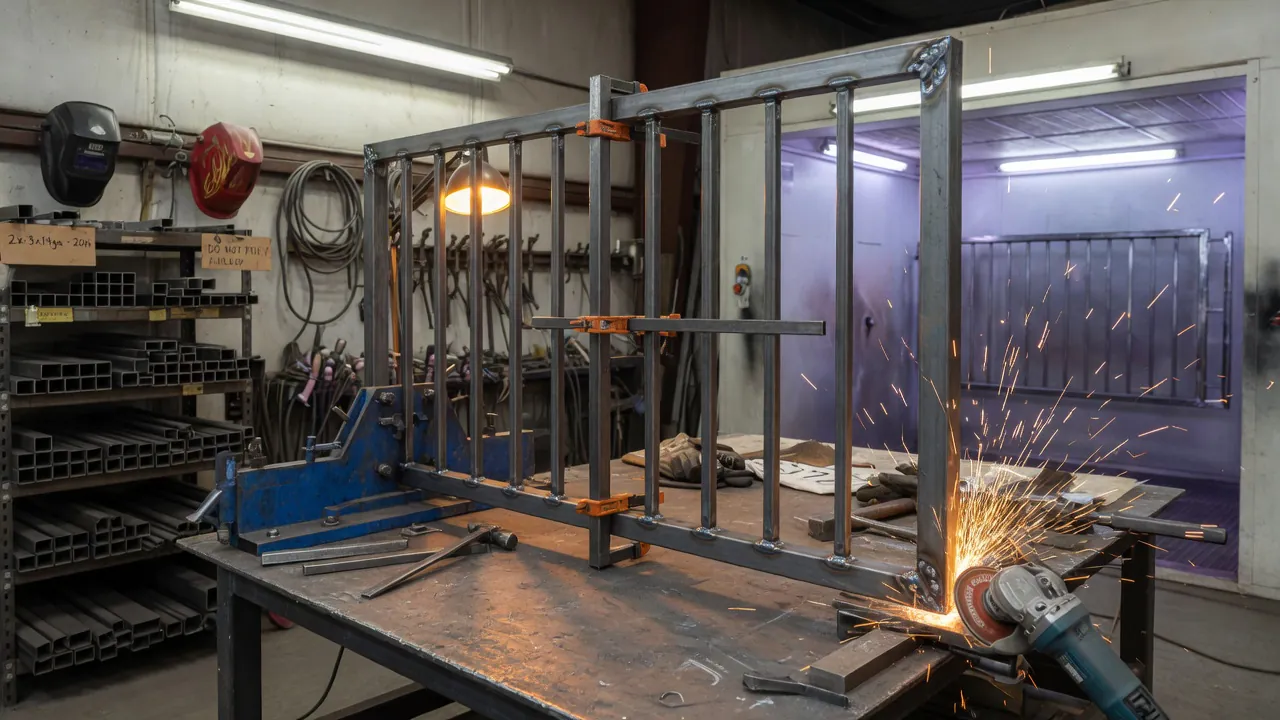
Steel gate frame being welded in the Emerald Gate Systems fabrication shop in Sedro-Woolley
Frame fabrication, Sedro-Woolley shop
Terrain

A swing gate travels through an arc. Ground rising across that arc will bind it, drag it, or force it to hang high enough to leave a gap underneath.

Slope changes the answer

On the graded hillsides around Bellevue, Bothell and the Seattle neighborhoods above the water, a slide or cantilever solves in geometry what a swing gate would fight for years. On the flat approaches of the Skagit Valley near Burlington and Mount Vernon, a swing gate is frequently better looking and less expensive.

Materials follow exposure

Ornamental steel gives the widest design vocabulary and takes finishes well. Aluminum reduces mass on very wide leaves and resists corrosion. Cedar and timber infills suit Pacific Northwest architecture and pair naturally with board-formed concrete and stone piers. Mixed material gates, steel frame with timber or perforated infill, are the most common request for contemporary homes.

Architecture is not decoration

A gate that ignores the house reads as an add-on no matter how well it is built. We take cues from the roof line, fenestration rhythm, fence infill and pier detailing, and draw the gate to sit inside that language rather than argue with it.

Wind is a structural input here

Solid infill panels on an exposed site near Blaine, Semiahmoo or the Whidbey Island shoreline behave like sails. That loads hinges, posts and operators far beyond what the same gate would see inland, and it is a common cause of premature failure. Where exposure is high we open the infill, brace the frame differently, or size the hardware for the load.

Design prepares for automation

Post size, hinge selection, frame stiffness and conduit routing all change if an operator is coming later. Building a manual gate that can accept automation cleanly costs very little at fabrication and a great deal to retrofit.

  • Sets Opening width, leaf count, swing or slide, materials, infill, finish, pier and post design
  • Driven by Terrain, exposure, architecture, vehicle types, security, automation plan
  • Materials Ornamental steel, structural steel, aluminum, cedar, perforated and laser-cut panels
  • Built Cut, jigged, welded and finished in our Sedro-Woolley shop
02
Homes, estates and acreage

Residential Gate Installation

Driveway gates, estate entrances, courtyard and pedestrian gates, and the automation and entry hardware that make them usable every day rather than occasionally.

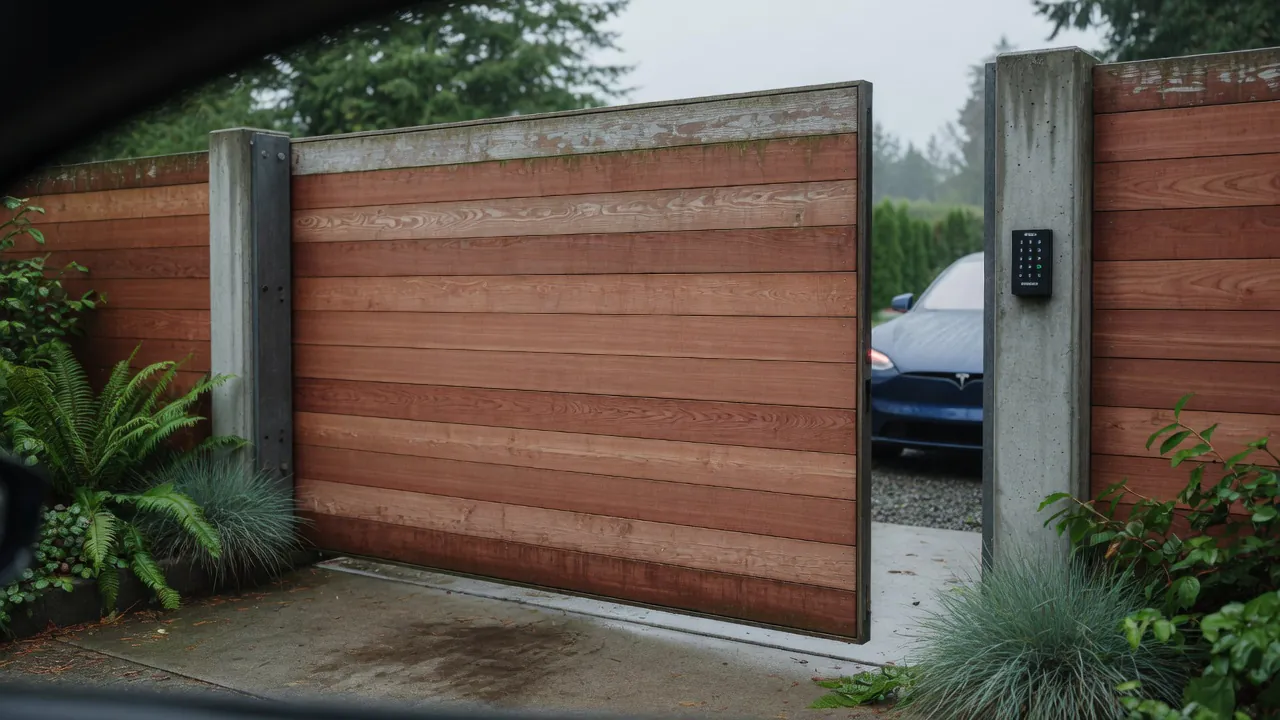
Horizontal cedar slat driveway gate with concrete piers and a keypad set into the pier
Cedar slat driveway gate with keypad recessed into the pier

The brief is rarely one thing

Residential projects mix privacy, security, containment and appearance, and the balance changes the design more than owners expect. A gate specified to keep dogs and children inside is a different object from one specified to slow an unfamiliar vehicle, which is different again from one specified mainly to finish a driveway visually.

Layout comes before product

Many older lots, particularly in Seattle neighborhoods platted before two-car garages and delivery vans, have short approaches. A gate opening outward across a sidewalk is a liability. A gate swinging inward may not clear a parked vehicle. On those sites the honest answer is often a slide gate, or moving the gate line back to create stacking room.

Rural inverts it

Long driveways in Arlington, Granite Falls, Monroe and the upriver Skagit communities have room but often no power at the road.

Entry hardware decides daily experience

Keypads suit households with predictable visitors. Intercoms, particularly video intercoms, matter when the gate is far from the house or when deliveries are frequent. Smartphone access has become the default request because it removes the remote nobody can find, and lets an owner admit a contractor from work. Most installations end up with two or three in combination.

Safety equipment is not optional

Photo eyes, edge sensors and correctly configured force limits are what keep a powered gate safe around children, pets and vehicles. They are also the components most often found disabled or misaligned on gates installed in a hurry. Typical residential projects run from single driveway gates on suburban lots in Edmonds, Mill Creek and Mukilteo, through estate entrances in Woodway and Bellevue, to working rural entrances around Snohomish, Lake Stevens and Stanwood.

  • Covers Driveway, estate, courtyard and pedestrian gates plus automation and entry hardware
  • Entry Keypad, intercom, video intercom, smartphone credential, remote, vehicle sensor
  • Safety Photo eyes, edge sensors, force limiting, manual release, tested before handover
  • Site inputs Approach length, slope, stacking room, power, existing fence and pier lines
03
Facilities, fleets and multifamily

Commercial Gate Solutions

These start from traffic and operations, not appearance. How many vehicles, how often, at what hours, driven by whom, and what happens when the gate is down.

Duty cycle

A residential gate cycles six to ten times a day. A distribution yard can cycle several hundred. An operator sized for the first fails early under the second.

Sizing is the whole job

Duty cycle is the specification that separates commercial from residential work. We size operators from measured or estimated cycle counts, not from gate width alone. Vehicle mix follows: fleet access, delivery trucks, service vans and employee cars all need different clearances and different detection. Loop detectors buried in the drive are what allow a gate to close safely behind a long vehicle rather than on it, and getting loop placement wrong causes both damage and nuisance calls.

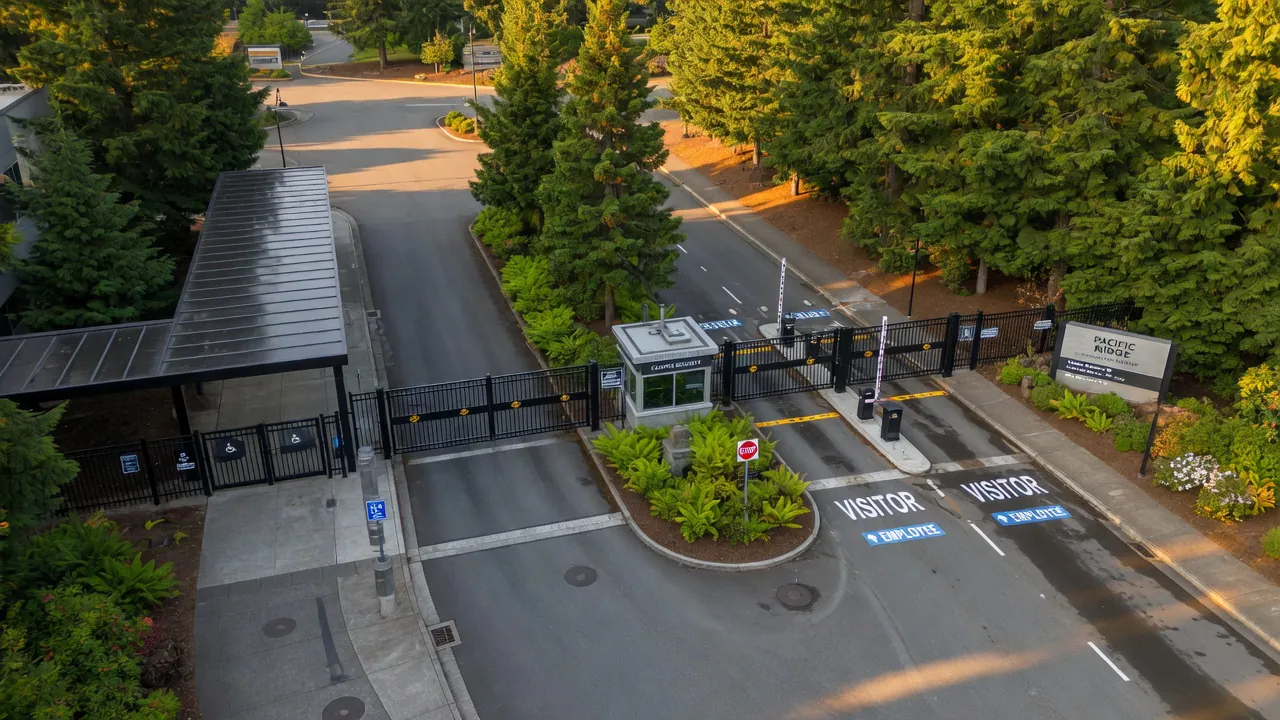
Aerial view of a gated community entrance with separated resident and visitor lanes and barrier arms
Resident and visitor lanes separated at a community entrance

Credentials are operational, not technical

Warehouses and industrial sites around Everett, Marysville and Arlington usually need durable credentials that survive gloves and weather. Offices and retail in Seattle, Bellevue, Tacoma and Olympia more often need credentials issued and revoked quickly as staff change. Multifamily needs resident credentials plus a workable path for guests and deliveries.

Emergency access is designed, not improvised

Fire department access, power failure behavior, and a manual release a person can operate in the dark are part of the specification rather than an afterthought.

Maintenance belongs in the first conversation

A commercial gate is a machine in continuous service. Scheduled inspection of hinges, rollers, chains, sensors and boards costs a fraction of an emergency call, and on a high traffic site the difference between planned and unplanned downtime is measured in stalled deliveries. We specify equipment we can get parts for and return to.

  • Starts with Cycle count, vehicle types, operating hours, credential population, emergency requirements
  • Hardware High cycle slide and swing operators, barrier arms, loop detection, fail-safe and fail-secure
  • Properties Warehouses, yards, offices, retail, healthcare, institutional, multifamily, parking
  • Ongoing Scheduled maintenance rather than reactive repair
04
Credentials and permissions

Access Control

The decision layer. The gate is the barrier. Access control decides who gets through it, when, and whether anyone can later tell that they did.

Bought together, they fail separately

A perfectly built gate with poorly planned credentials becomes a gate residents prop open. A well administered access system on an undersized gate becomes a maintenance contract. We specify them together and plan them as different problems.

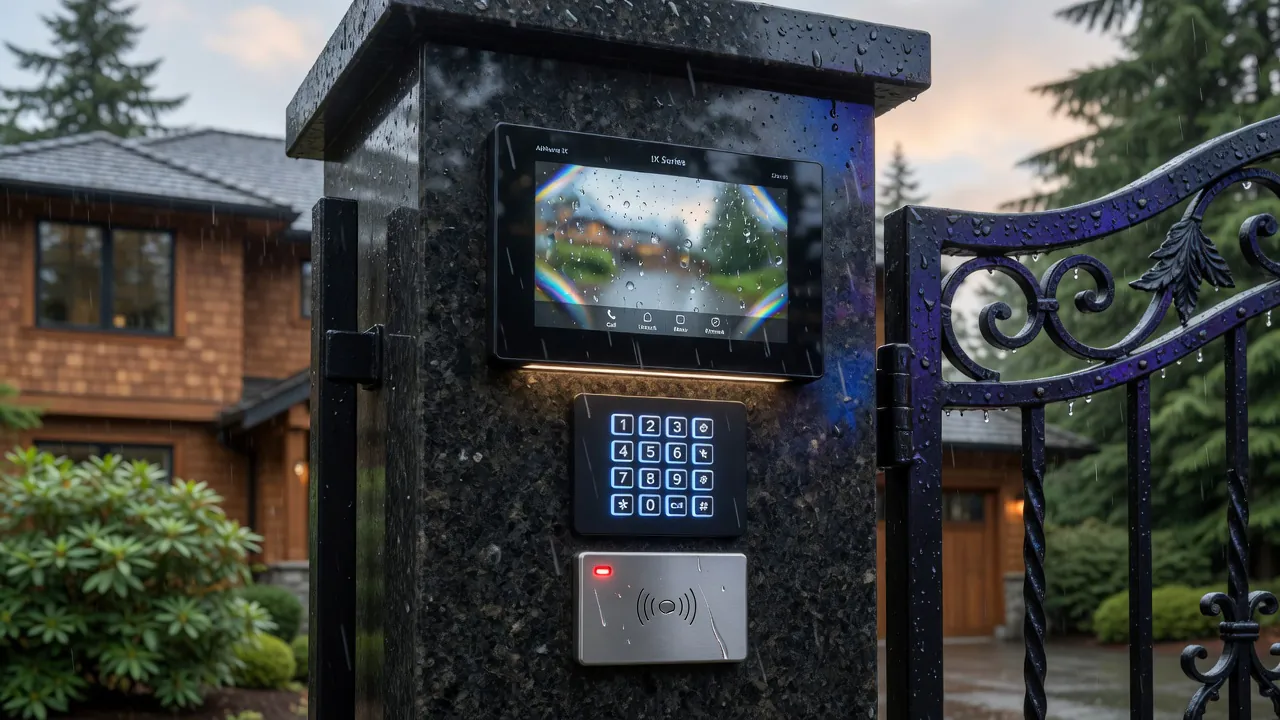
Video intercom, keypad and proximity card reader grouped on a stone gate pillar in the rain
Screen, code and card on one sealed pillar

Keypads

Simplest option, appropriate where the user population is small and stable. Their weakness is code sharing, which is a policy problem rather than a hardware one.

Cards, badges and fobs

Each user gets an identifiable credential that can be revoked individually. That single capability is usually what pushes a property from keypads to credentials.

Mobile

The key lives on a phone the user already carries and never leaves at home, and it can be issued remotely.

Intercom and telephone entry

These solve the visitor problem rather than the resident one. A video intercom lets someone see who is asking before opening anything, and telephone entry lets a resident release the gate without being on site.

Vehicle credentials

Long range tags and plate based approaches suit sites where drivers should not have to stop and reach out of a window. Common on higher volume commercial entrances and busy gated communities.

Remote management is what quietly matters

Being able to add a credential, revoke one, change a schedule or check an access record without driving to the site changes what a small management team can realistically administer. Access control also extends beyond the driveway: pedestrian gates, building doors and ADA compliant entrances often share the same credential system, which is usually the right outcome for both users and administrators.

  • Credentials Keypad codes, proximity cards, badges, fobs, mobile credentials, vehicle tags, intercom release
  • Administration Individual revocation, schedules by entrance and time, access records where required
  • Visitors Video intercom, telephone entry, temporary codes, delivery access
  • Chosen by Population size, turnover rate, who administers it and how often they are on site
05
Vehicle control and protection

Bollard Installation

Addresses the part of a site a gate does not: the pedestrian edge, the storefront, the utility cabinet, and the places a vehicle should not be able to reach.

Fixed

Permanent, set in concrete, used where the boundary never needs to move. Storefront frontages, building corners, walkway edges, fuel and utility equipment, and the ends of pedestrian routes.

Removable

For locations normally closed to vehicles but occasionally needing to open: service access, event loading, emergency routes, courtyards taking scheduled deliveries. A little convenience traded for flexibility.

Automatic and retractable

Where access changes frequently enough that nobody should have to walk out and unlock something. A larger civil and electrical undertaking, specified where the traffic pattern genuinely justifies it.

Placement is the part that gets underestimated

Bollards work by geometry: spacing that stops a vehicle while allowing a wheelchair, a stroller and a delivery cart to pass, and positioning that accounts for the approach angle a vehicle would actually take. Spacing chosen by eye tends to be either ineffective or an accessibility problem.

Usually part of a larger project

Bollards frequently share a site with gates and access control, because the same conversation about vehicles, pedestrians and property protection produces all three. Storefronts in Seattle, Bellevue and Tacoma are the common commercial context, alongside institutional and healthcare properties.

We do not make crash rating or security certification claims for bollard installations unless the specific product and installation method carry a verified rating. Where a project genuinely requires a rated system, that requirement should be established before design rather than assumed afterwards.

06
Service on every brand

Gate Repair & Maintenance

Most of our week. We service gates and operators from all major manufacturers, including systems installed by other companies.

The failures repeat

Sagging leaves, usually from hinge wear or a post that has moved. Dragging rollers and contaminated tracks on slide gates, particularly where the track collects gravel, needles and leaf litter. Operators running intermittently, which is almost always electrical rather than mechanical. Control boards killed by moisture ingress or a surge. Safety loops cut or crushed by later site work. Photo eyes knocked out of alignment by a vehicle or a landscaper.

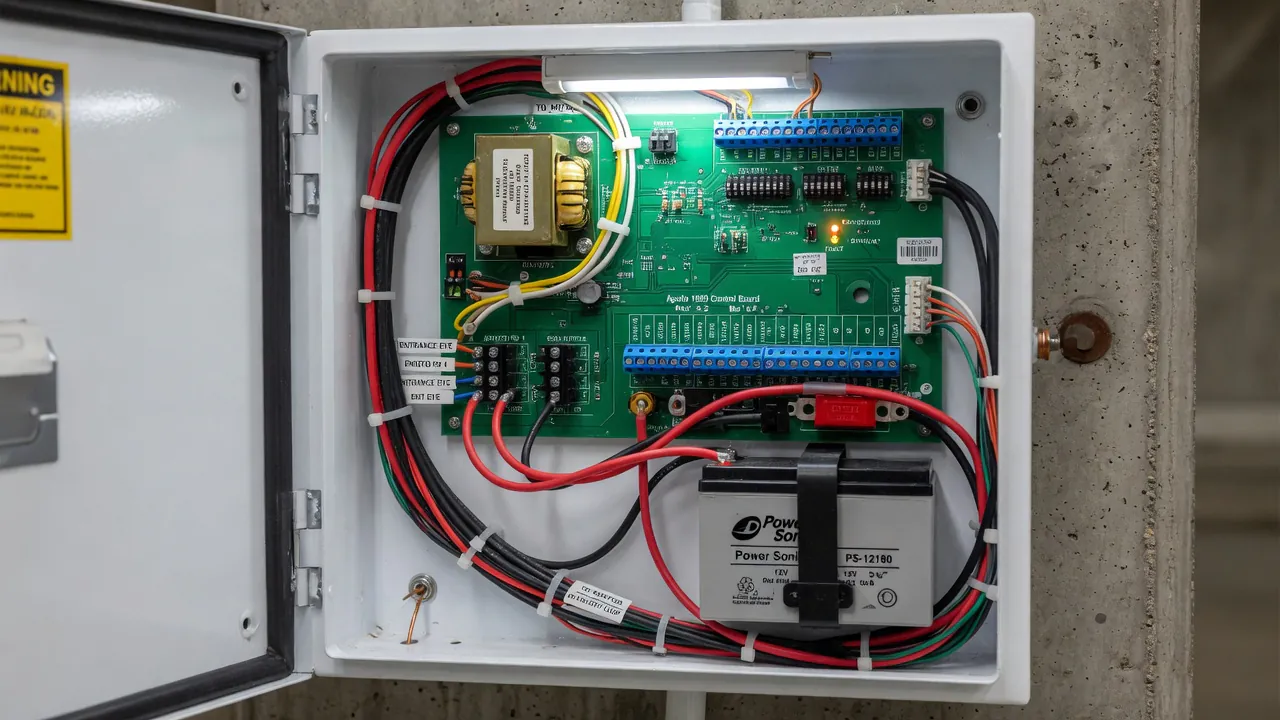
Gate control panel enclosure opened to show the control board, labelled wiring and battery backup
Sealed enclosure, labelled runs, readable board
Alignment masquerades as an operator fault

A binding gate forces the operator to work against the structure. Replacing the operator without correcting alignment buys a more expensive version of the same failure.

Weather is the accelerant

Eight months of moisture, salt carried inland off Puget Sound, and freeze and thaw cycling in the upriver and mountain communities all attack the same components: untreated steel, cheap fasteners, unsealed welds, and any enclosure not rated for the exposure it actually gets. Coastal and island properties near Anacortes, Oak Harbor, Blaine and the San Juans see this fastest, which is why specification for those sites should differ from an inland property.

Preventive is the cheaper path

A scheduled inspection covers hinge and roller wear, chain and belt tension, fastener condition, operator mounting, safety device function and force settings, control board condition and enclosure sealing. On a commercial site that inspection is the difference between a planned adjustment and an unplanned closure.

Repair or replace

A genuine judgement call rather than a sales decision. When the structure is sound and the operator has reached end of life, replacing the operator is clearly right. When the frame is racked, the posts have moved, or the gate was undersized from the beginning, continuing to repair it spends money on a problem that will return. We say which one we think it is and explain why.

  • Common faults Sagging leaves, dragging rollers, failed operators, dead boards, damaged loops, misaligned photo eyes
  • Brands All major operator manufacturers, including systems we did not install
  • Preventive Scheduled inspection of hardware, safety devices, force settings and electrical enclosures
  • Environmental Moisture, salt, freeze and thaw, vegetation and debris intrusion
07
Operators, controls and safety

Automatic Gate Systems

The machinery: the operator that moves the gate, the controls that tell it to, and the safety devices that stop it when something is in the way.

Four parts, plainly

A gate. An operator, the motor and gearbox that moves it. A control board, the small computer deciding what the operator does. And inputs, from a keypad to a photo eye to a buried loop.

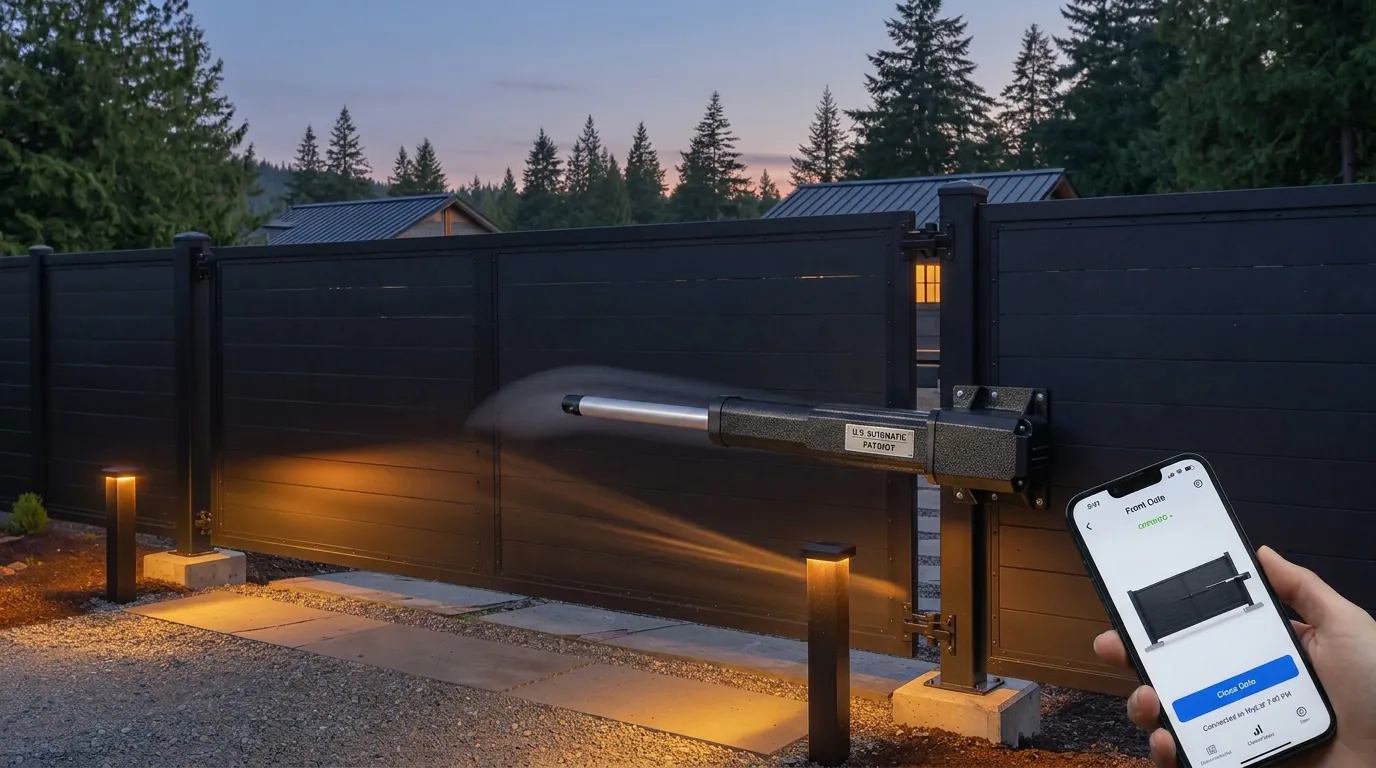
Gate operator arm on a dark slatted gate at dusk with a smartphone app controlling entry
Arm operator with smartphone credential

Swing operators

Arm and underground styles. Arm operators are more common, easier to service, and appropriate for most residential and light commercial openings. Underground operators disappear visually and suit designs where hardware would spoil the entrance, at the cost of drainage sensitivity and harder service access.

Slide operators

These drive the gate along a track or, in a cantilever arrangement, along rollers with no ground track at all. Cantilever gates cost more and are worth it where a ground track would fill with snow, gravel or debris, or where the drive surface cannot be interrupted.

Safety devices should never be value engineered

Photo eyes detect an obstruction across the opening. Edge sensors detect contact. Force limiting stops the gate when it meets unexpected resistance. Loop detectors sense a vehicle and prevent the gate closing on it. UL 325 and ASTM F2200 describe how these are configured, and we build to them because a powered gate is powered machinery in a place where children and pets exist.

Failure behavior is a choice

What the gate does in a power cut is decided deliberately: battery backup to keep operating, fail-safe to release and allow manual opening, or fail-secure to remain closed. The right answer depends on whether the priority is keeping people out or letting people out, and it differs between a rural driveway near Sultan and a distribution yard in Marysville.

High cycle changes the calculation

Duty rating, chain or belt selection, and the maintenance interval are all specified from the cycle count. This is where a lot of undersized commercial installations go wrong.

  • Operators Swing arm, underground swing, rack driven slide, cantilever slide, barrier arm
  • Controls Control board, receivers, timers, schedules, access control integration
  • Safety Photo eyes, edge sensors, force limiting, loop detection, manual release
  • Power Mains with battery backup, or solar where trenching is impractical and the load is sized honestly
Decisions

How to choose a gate system

Ten questions that decide most of a gate specification, each answered directly first and then explained. If you can answer these about your property, you are most of the way to a useful quote.

Should I choose a sliding or swinging gate?

Choose a swing gate when the ground is level and you have room for the leaf to travel. Choose a slide gate when the driveway rises, when the approach is short, or when you cannot give up the space a swing needs.

A swing gate is generally less expensive, has fewer moving parts, and looks more traditional. It needs a flat arc and clear space to swing into. A slide gate needs room alongside the opening for the gate to retract, which many properties have and many do not, but it is unaffected by slope and it opens in a fixed footprint. On very wide openings, bi-parting swing leaves or a cantilever slide are usually the practical options.

What gate works best on a sloped driveway?

A slide or cantilever gate, in most cases.

The reason is geometric rather than mechanical. A swing gate sweeps an arc at a fixed height above its hinge point. If the ground rises across that arc, the gate either contacts the ground partway through its travel or has to be hung high enough to clear the highest point, which leaves a gap under the rest. Slide gates travel parallel to the ground and simply do not have this problem. Where a swing gate is required on a slope for design reasons, rising hinges can help within limits, and regrading the arc is sometimes the better investment.

How much space does an automatic gate require?

More than the opening width. Plan for stacking room in front of the gate and for the travel path behind it.

Stacking room is the space a vehicle occupies while waiting for the gate to open, measured from the gate line back toward the street. Too little of it and a car waits in traffic. For a swing gate you also need the swing arc kept clear permanently, which affects where vehicles can park and where landscaping can go. For a slide gate you need a run alongside the opening roughly equal to the gate width, plus room for the operator. On constrained sites this is often the single constraint that decides the design.

What type of gate works for high traffic?

A slide or cantilever gate with a high duty cycle operator, loop detection and a maintenance schedule.

High traffic changes the failure mode. Components that would last a decade at ten cycles a day can wear out in a year at three hundred. Slide gates generally handle high cycle counts better than swing gates because the load path is simpler and the gate does not fight its own mass through an arc. The operator should be selected from the expected cycle count, and loop detection becomes essential rather than optional because the gate will otherwise eventually meet a vehicle.

What access control system should I choose?

Choose based on how many people need access, how often that list changes, and who administers it.

A household with stable users is well served by a keypad and a phone credential. A property where individuals come and go needs credentials that can be revoked one at a time, which means cards, fobs or mobile credentials. A managed property with multiple sites needs remote administration or the management burden becomes the deciding cost. Technology choice follows administration, not the other way around.

How does weather affect gate design?

In this region, moisture and wind drive most of it, and both are specification inputs rather than maintenance details.

Persistent rain finds unsealed welds, untreated steel and enclosures rated for a drier climate. Wind loads solid infill panels, and on exposed sites that load transfers straight into hinges, posts and operators. Freeze and thaw cycling in the upriver and mountain communities affects ground tracks and drainage at post bases. Design that ignores all this works for a few seasons and then does not.

What should coastal property owners consider?

Salt exposure, wind, and the fact that specification correct for an inland site is frequently wrong on the water.

Salt carried off Puget Sound attacks fasteners, unsealed welds and cheap hardware first. Stainless fasteners, correctly prepared and coated steel or aluminum, sealed enclosures and drainage detailing at post bases all matter more on Fidalgo Island, Whidbey Island, the San Juans and the Blaine and Semiahmoo shoreline than they do a few miles inland. Maintenance intervals should also be shorter on those sites.

How do I plan for emergency access?

Decide deliberately what the gate does without power, and confirm what the local fire authority requires before installation.

An automated gate can be configured to fail open, fail closed, or keep operating on battery. Each is correct in different circumstances, and the choice should be conscious. Emergency services access requirements vary between jurisdictions and are worth confirming in advance rather than discovering at inspection. A manual release that a person can actually find and operate in the dark is part of the same plan.

When should an existing manual gate be automated?

When the gate structure, posts and hinges are sound enough to carry powered operation.

Automation multiplies the loads a gate already sees. A gate that sags slightly when pushed by hand will sag considerably faster when driven by a motor several times a day. The assessment covers frame condition, hinge and post integrity, ground clearance through the full travel, and whether power can reach the location practically. Where the structure is sound, automating an existing gate is substantially cheaper than replacing it.

When is replacement better than repair?

When the problem is structural rather than mechanical, or when the gate was wrong for the opening from the start.

Replacing an operator on a sound gate is straightforward value. Continuing to repair a racked frame, a moved post, or a leaf that was always too heavy for its span is spending money to delay the same conversation. The honest test is whether the repair addresses a component that wore out or a decision that was wrong.

Residential

Homes, estates and rural properties

What a residential gate is actually for, and the trade-offs that decide whether it feels like an asset or an inconvenience three years later.

Privacy and boundary

For most homeowners this is the honest primary motivation. A gate marks where the property begins and removes the ambiguity that invites people up a driveway. It also changes how the house is approached visually, which is why the design conversation matters as much as the hardware one.

Security, described accurately

A gate is a deterrent and a delay. It removes casual and opportunistic access, it makes an approach deliberate rather than accidental, and combined with lighting, cameras and controlled credentials it forms a useful perimeter. It is not, by itself, a guarantee against a determined intruder, and we would rather say that than sell something on an implication that will not hold.

Convenience, which is what you notice daily

Automation is where the gate earns its keep. Opening from the car in November rain, letting a delivery through from an office in Seattle, giving a contractor a code that expires. These are the interactions that happen every day, and they are worth specifying carefully.

Curb appeal and architecture

The entrance is the first built element anyone sees. A gate drawn to match the house, its materials and its proportions reads as part of the property. A stock gate bolted between two posts reads as an addition. The cost difference is smaller than most people assume.

Driveway layout and stacking

Approach length, slope and the distance to the street decide more than style does. Short approaches, common in established Seattle, Edmonds and Mountlake Terrace neighborhoods, often push toward slide gates or a gate line set further back. Longer approaches in Snohomish, Arlington and Stanwood give more freedom but introduce power and cable run questions.

Rural and acreage entrances

Properties around Granite Falls, Monroe, Sultan, Gold Bar and Index frequently combine a long private drive with no power at the road. That combination is where solar becomes genuinely useful, provided the load is calculated honestly against a Washington December rather than a manufacturer's optimistic figure.

Estate entrances

Wider openings, ornamental fabrication, integrated piers, lighting and intercom. Woodway, Bellevue and the waterfront properties of the San Juan Islands are typical settings. The engineering question on these is usually leaf mass against hinge and operator selection.

Waterfront and coastal homes

Everything above, plus salt. Specification for Whidbey Island, Camano Island, Anacortes and the Blaine shoreline should assume accelerated corrosion and shorter maintenance intervals from the outset.

Farms and working properties

Equipment width, durability and daily practicality. Gates around Lynden, Everson, Nooksack and the Skagit flats are sized for tractors and trailers, not sedans, and are built expecting to be used hard.

Residential gate installation

Commercial

Facilities, fleets, multifamily and institutional

Commercial gate design should begin with traffic and operations. Appearance matters, but a good looking gate that cannot keep up with the site is a liability from the first week.

Traffic volume and duty cycle

Everything starts here. Count the vehicles, or estimate them honestly, and size the operator from that number. Under-sizing is the most common and most expensive mistake in commercial gate work, and it usually shows up as an operator failure eighteen months after installation.

Access credentials at scale

Employee entry, contractor access and delivery drivers all need different handling. Populations that change frequently need credentials that can be revoked individually and issued without a site visit. This is where a system that is slightly more expensive to install becomes considerably cheaper to run.

Delivery and fleet vehicles

Long vehicles need loop placement that keeps the gate open until the vehicle is fully clear. Wide vehicles need clearances checked against the real turning path, not the drawing. Sites in the Everett, Marysville and Arlington industrial corridors deal with this daily.

Visitor management

Video intercom, temporary codes and telephone entry all solve the visitor problem differently. The right choice depends on whether someone is always present to answer, and whether visitors arrive predictably or at random.

Emergency access and failure behavior

What happens in a power cut is a design decision. So is fire department access. Both should be settled before installation and documented afterwards, particularly on properties with changing management.

Safety on a high traffic entrance

More cycles and more vehicles mean more opportunities for something to go wrong. Photo eyes, edge sensors, correctly set force limits and functioning loops are what keep a busy entrance safe, and they need checking on a schedule rather than after an incident.

Integration

Gates, pedestrian entrances, building doors, ADA entry systems and cameras work best administered together. Splitting them across vendors produces the coordination problem that most facility managers eventually inherit.

Operational continuity

The measure of a commercial gate is not how it performs on day one but how often it interrupts the business. That is a function of correct sizing, accessible spare parts and a maintenance interval that matches the traffic.

Commercial gate solutions

HOA and community gate systems

Regional engineering

What Washington does to a gate

Conditions here are specific enough that specification correct in a drier state is frequently wrong on this coast. These are the factors that actually change what we build.

Rain, moisture and drainage

Eight months of moisture is the default design case, not the exception. It finds unsealed welds, untreated steel, unrated enclosures and any electrical termination made casually. Drainage at post bases matters as much as the coating on the gate: a post sitting in standing water moves, and a gate whose post has moved will never align properly again.

Freeze and thaw

Inland and upriver communities including Concrete, Rockport, Marblemount, Darrington, Skykomish and Index see freeze cycles that flatland coastal sites largely avoid. Ground tracks fill and freeze, water in a post base expands, and gates that swing over a surface which heaves seasonally need clearance planned for the worst month rather than the average one.

Wind exposure

Solid infill acts as a sail. On exposed sites, particularly along the water at Blaine, Birch Bay, Semiahmoo, the Whidbey Island shoreline and the San Juans, wind load is a structural input. It changes hinge selection, post sizing, frame bracing and sometimes the infill design itself.

Salt and coastal exposure

Marine air accelerates corrosion on anything not specified for it. Stainless fasteners, properly prepared coatings, sealed enclosures and shorter inspection intervals are the practical response. This applies across Fidalgo Island, Guemes, Samish, Anacortes, Oak Harbor, Coupeville, Clinton, Lopez, Orcas and the wider San Juan Islands.

Vegetation and debris

Needles, leaf litter and blackberry find ground tracks, photo eye lenses and operator housings. Sites surrounded by conifers need either a cantilever design with no ground track or a realistic maintenance expectation. This is one of the most common causes of intermittent faults we are called to.

Terrain and long driveways

Rural approaches in Snohomish, Arlington, Granite Falls, Monroe, Sultan and the Skagit uplands are frequently long, sloped and unlit. Cable runs, voltage drop, gate position relative to the road, and where a vehicle can safely wait all become design questions rather than details.

Power availability

Where mains power at the gate would require substantial trenching, particularly across finished driveways or wet ground, solar becomes worth evaluating. It works when the load, the cycle count and the winter light are calculated together. It does not work simply because a panel is available, and we will say so when the numbers do not support it.

Island logistics

Ferry schedules are a real project constraint on Whidbey Island, Camano Island, the San Juan Islands, Lopez, Orcas and Guemes. They affect installation sequencing, how much of the work is prefabricated in the shop, and realistically how quickly a service call can be answered. We would rather plan around that openly than pretend distance is not a factor.

Commercial traffic patterns

The industrial corridors around Everett, Marysville, Arlington and the Puget Sound distribution routes generate cycle counts that residential specification cannot survive. Sizing for the real traffic is the whole job.

Selected work

Built, wired and handed over

A gate is a structure, a machine and a security device at once. These are the three parts doing their job on real installations.

Horizontal cedar slat driveway gate with board-formed concrete piers and a keypad set into the pier
Cedar slat driveway gateTimber infill in a steel frame against board-formed concrete, with the keypad recessed into the pier rather than surface mounted.
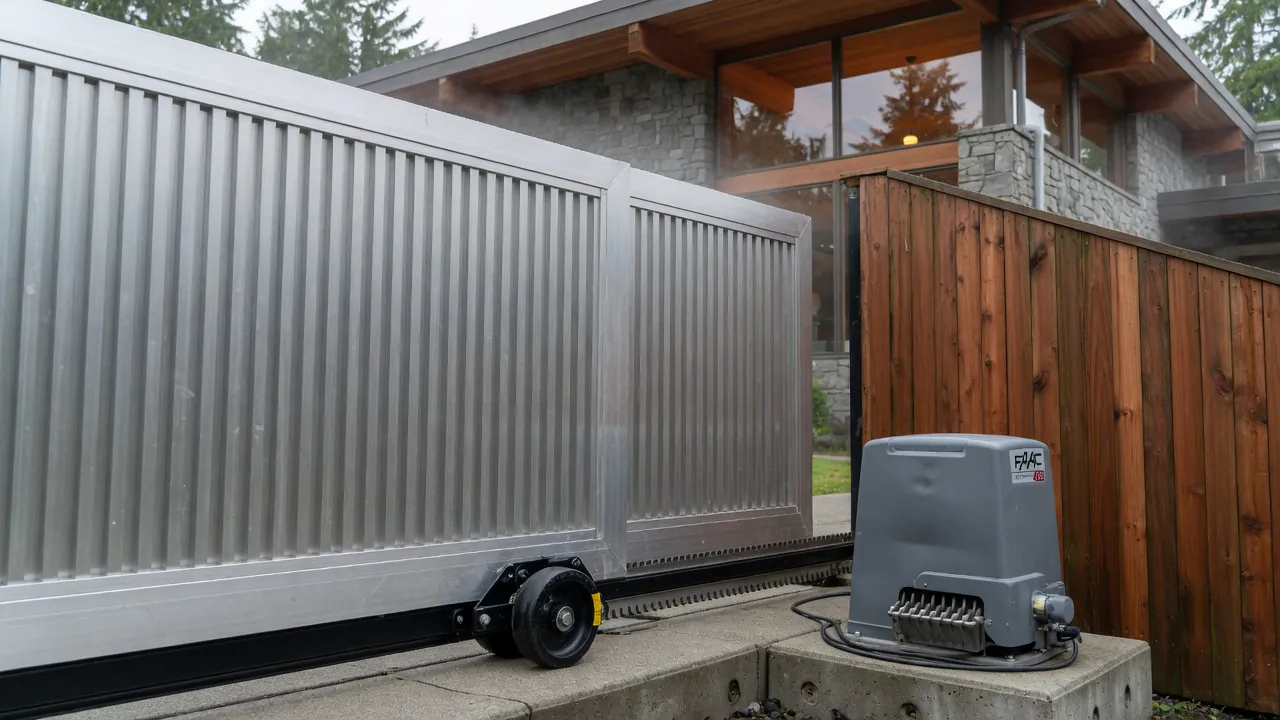
Aluminum slide gate on a rack drive operator mounted to a concrete pad at a residential entrance
Slide gate and rack driveWhere slope or a short approach rules out a swing gate, the leaf travels sideways instead.
Steel gate frame being welded in the Emerald Gate Systems fabrication shop in Sedro-Woolley
Fabrication in Sedro-WoolleyCut, jigged, welded and finished in our own shop before it is ever loaded for delivery.
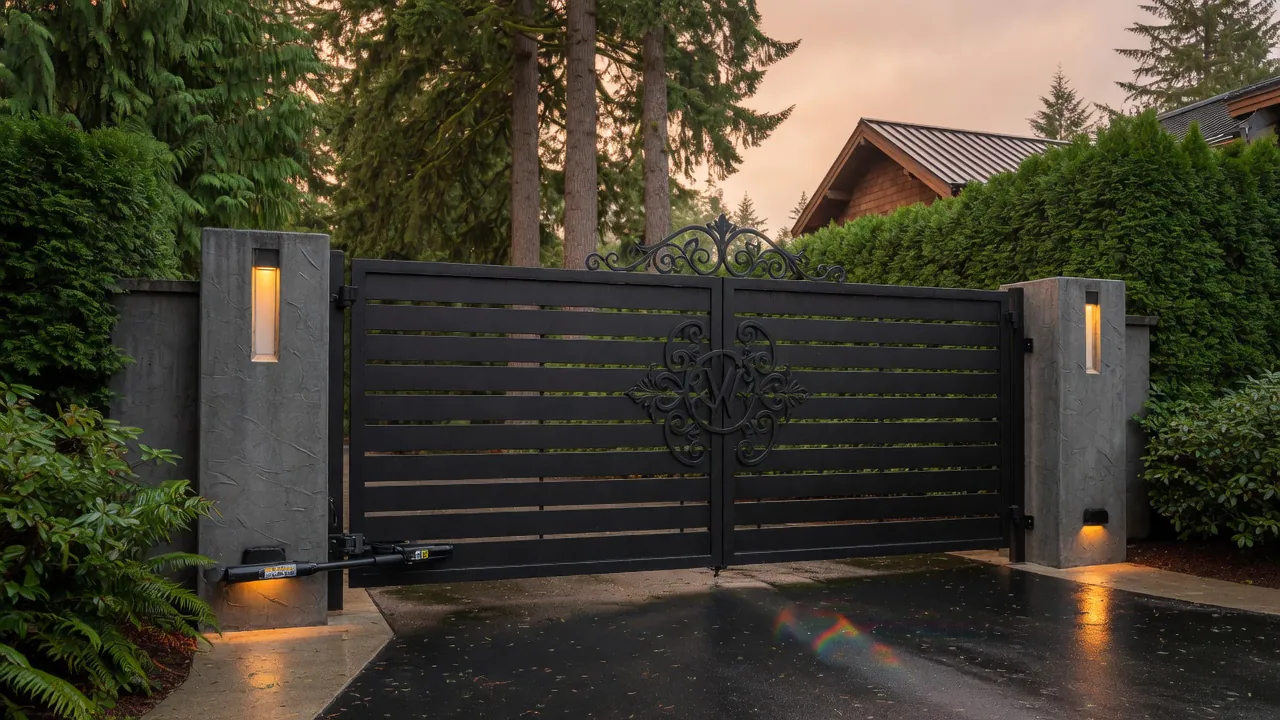
Black horizontal slat double swing driveway gate with illuminated stone piers on a wet evening
Double swing with lit piersWet season conditions are the design case on this coast, not the exception.
Gate operator arm on a dark slatted gate at dusk with a smartphone app controlling entry
Operator and phone entryThe arm does the work. The phone replaces the remote nobody can ever find.
Video intercom, keypad and proximity card reader grouped on a stone gate pillar in the rain
Video intercom pillarScreen, code and card on one pedestal, sealed for constant moisture.
Aerial view of a gated community entrance with separated resident and visitor lanes and barrier arms
Community entranceResident and visitor lanes separated so the queue at six in the evening never becomes the board's problem.
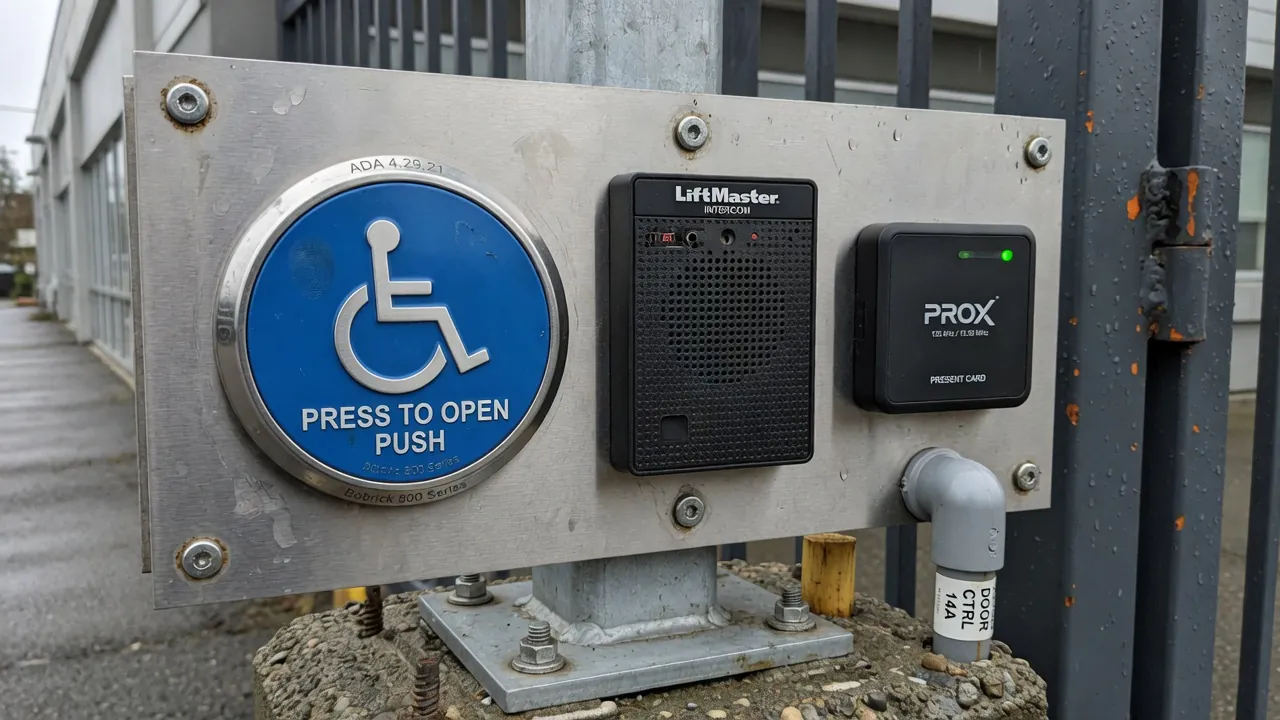
ADA push to open plate beside an intercom and proximity card reader at a commercial entrance
ADA compliant entryPush plate, intercom and reader grouped so the accessible route is the obvious one.
Gate control panel enclosure opened to show the control board, labelled wiring and battery backup
Controls and battery backupSealed enclosure, labelled runs, and a board a technician can actually read in three years.
Specification

Materials, finishes and what they cost you later

Material choice is where appearance, structure and service life meet. On this coast it is also where most premature failures are decided, years before they show up.

Structural and ornamental steel

Steel remains the default for custom gate work because it offers the widest design vocabulary, the highest strength for a given section, and the best behavior when welded. Ornamental steel takes scroll work, picket detailing, laser cut panels and custom patterns that no other material handles as economically.

Its weakness is corrosion, and the response is preparation rather than paint. Surface preparation before coating determines adhesion, and adhesion determines how long the coating survives at the welds and edges where moisture attacks first. A steel gate that was blasted, primed and powder coated properly will outlast one that was simply sprayed by a wide margin, and the price difference is a fraction of a replacement.

Galvanising

Hot dip galvanising gives sacrificial protection that survives scratches, which is exactly what a working farm entrance in Everson or Lynden needs. It can be left raw for an industrial appearance or coated over for color. The trade off is a heavier, less refined finish and some limits on very fine ornamental detail.

Aluminum

Aluminum is worth considering on very wide leaves where mass is the enemy, and on coastal properties where corrosion resistance without a coating system is attractive. It is less strong than steel section for section, which usually means larger members for the same span, and it welds differently. For long slide gates and exposed island sites it can be the correct answer.

Cedar and timber infill

Timber in a steel frame is the most requested residential style in this region for good reason: it reads warm against grey light and matches the architecture. Cedar handles Pacific Northwest moisture well when detailed correctly. The details that matter are end grain sealing, drainage where wood meets steel, and accepting that timber moves seasonally and needs periodic attention.

Powder coating and liquid finishes

Powder coating gives an even, durable finish and is the standard for most of what we build. Liquid systems remain useful for very large assemblies, for site touch up, and for finishes powder cannot achieve. On marine sites the specification should account for exposure explicitly rather than using a general purpose system.

Fasteners and hardware

The smallest components fail first. Ordinary fasteners on a waterfront gate at Semiahmoo, Birch Bay or on Fidalgo Island will weep rust into the finish within a season or two. Stainless fasteners, correctly specified hinges and quality bearings cost very little relative to the assembly and prevent the most visible early failures.

Posts and foundations

A gate is only as square as its posts. Foundation depth, concrete volume and drainage at the base determine whether the gate still aligns in year five. On soft ground, including the Skagit and Samish flats and much of the valley floor, this is the single most important structural decision and the one most often economised.

Enclosures and electrical

Control boards fail from moisture far more often than from electrical fault. Enclosure rating, gasket condition, cable entry detailing and where the enclosure is mounted relative to splash and runoff all matter. Battery backup should be sized and then actually replaced on a schedule, because a backup nobody has tested in four years is not a backup.

Infill and wind

Solid infill looks substantial and behaves like a sail. On exposed sites the load goes straight into hinges, posts and the operator. Partially open infill, slat spacing or perforated panels reduce that load considerably while keeping the visual weight. This is a structural decision disguised as an aesthetic one.

Safety

Why UL 325 and ASTM F2200 matter on your driveway

An automatic gate is powered machinery installed in a place where children, pets and vehicles move. Two standards describe how that machinery should be built and configured, and they are the reason a properly installed gate is safe rather than merely convenient.

What the standards cover

ASTM F2200 addresses the gate itself: how it is constructed, what gaps and protrusions are acceptable, how the gate is guided and restrained, and the physical characteristics that prevent entrapment. UL 325 addresses the operator and its safety devices: entrapment protection, force limits, the requirement for external secondary devices, and how operators are classified by application.

Entrapment protection in practice

Entrapment is the risk of a person or animal being caught by a moving gate. Protection comes in layers. The operator senses unexpected resistance and stops or reverses. External devices, photo eyes and edge sensors, detect an obstruction before or at contact. Correctly configured, these overlap so that a failure in one does not remove protection entirely.

Force settings

Force limiting is not a set and forget adjustment. It has to be tuned to the actual gate, because a heavy ornamental leaf and a light aluminum slide behave differently, and it should be rechecked when anything changes. Gates that have been adjusted upward over the years to overcome a developing mechanical problem are a recurring and genuinely dangerous finding.

Operator classification

Operators are classified by the type of property and user they serve, from single family residential through to industrial applications with restricted public access. Using an operator outside its class is both a safety and a durability problem, and it is a common finding on sites where equipment was chosen on price.

Where installations most often fall short

The failures we see repeatedly are disabled photo eyes, sensors knocked out of alignment and never realigned, edge sensors that were never connected, force settings raised to mask a binding gate, and missing or unreachable manual release. None of these are exotic. All of them are the result of either a hurried installation or years of unmaintained service.

Gaps and reachable moving parts

Gate design contributes to safety independent of the electronics. Openings that can trap a hand, protrusions that can catch clothing, and gaps that change as the gate travels are structural characteristics decided at the drawing stage. Retrofitting around a gate that was designed without these in mind is always harder than drawing it correctly.

Testing before handover

We test safety devices and force settings before we hand a gate over, and we show the owner what the manual release is and where it is. That last part matters more than it sounds. In an emergency or a power cut, the person on site needs to know how to open the gate without instructions.

What to ask any installer

Ask which external entrapment protection devices are included, how force settings will be verified, whether the operator class matches the property, and what the gate does in a power failure. An installer who answers those clearly is telling you a great deal about the rest of their work.

Power

Getting electricity to the gate

On rural Washington properties this is frequently the largest single variable in a quote, and the one owners have thought about least.

Mains power and trenching

The straightforward path is a trench from the nearest suitable supply to the gate, carrying conduit for power and for control and communication cabling. Cost scales with distance and with what the trench has to cross. Open ground is inexpensive. A finished driveway, a mature landscape, a septic field or a wet area is not.

Voltage drop over distance

Long runs are an engineering question rather than simply a length of cable. Conductor sizing has to account for voltage drop so the operator receives what it needs at the far end, particularly on the long approaches common around Arlington, Granite Falls, Monroe and the upriver Skagit communities.

Conduit planning

The cheapest thing anyone can do on a gate project is put in more conduit than is needed today. Adding a camera, an intercom or a second reader three years later is trivial with a spare conduit and expensive without one. When a trench is already open, additional capacity costs very little.

Solar and off grid

Solar is genuinely useful where trenching would be disproportionate. It is also frequently oversold. The calculation that matters is the winter one: expected cycles per day, the current draw of the operator and any accessories, battery capacity, and realistic December light at that specific site with its specific tree cover. A panel that carries a gate comfortably in July can fall behind in a Washington winter.

Where the numbers work, off grid automation removes a large civil cost and is very reliable. Where they do not, we say so before the purchase rather than after the first dark month. Sites around Gold Bar, Index, Camano Island and rural Skagit are where we run this calculation most often.

Battery backup and failure behavior

Any automated gate should have a considered answer to a power cut. Battery backup keeps it operating for a period. Fail-safe releases it for manual opening. Fail-secure keeps it closed. The decision belongs to the property, not to the equipment, and it should be recorded so the next owner or the next property manager knows what was chosen.

Surge and grounding

Rural sites on long overhead supplies see surges that kill control boards. Surge protection and proper grounding are inexpensive at installation and expensive to retrofit after the second board failure.

Ownership

Keeping a gate working, by season and by site

Most gate failures announce themselves months in advance. Maintenance is mostly a matter of noticing.

Autumn

The most important month of the year on this coast. Leaf litter and conifer needles fill ground tracks, collect in operator housings and cover photo eye lenses. Clearing tracks and drainage before the wet season begins prevents a large share of the winter service calls we receive. Check that water leaving the driveway is not running toward the post bases.

Winter

Moisture and, inland, freeze. Watch for a gate that has begun to drag, which usually means a post has moved or a hinge is wearing. Check enclosure seals and look for condensation inside. In the upriver and mountain communities, keep ground tracks clear of ice and confirm the manual release still operates when you actually need it.

Spring

The right time for the annual inspection. Hinge and roller wear, chain or belt tension, fastener condition, coating integrity at welds and edges, operator mounting, and a full test of safety devices and force settings. Address anything that moved over winter before the dry months hide it.

Summer

Vegetation growth into the swing arc and across sensors, and the season most people notice cosmetic issues. A good time for coating touch up, and for confirming that landscaping has not been planted somewhere the gate needs to travel.

Coastal and island properties

Shorter intervals across the board. Salt attacks fasteners, hinge pins, unsealed welds and electrical enclosures continuously rather than seasonally. Rinse exposed hardware where practical, inspect fasteners and coatings more often, and expect to service a waterfront gate near Anacortes, Oak Harbor, Blaine or in the San Juan Islands more frequently than an inland equivalent.

Wooded and rural sites

Debris is the dominant failure mode. Cantilever designs avoid the ground track problem entirely and are worth the additional cost where trees surround the entrance. Where a track exists, clearing it is the single highest value maintenance task.

High cycle commercial sites

Maintenance interval should be driven by cycle count, not the calendar. Chains, belts, rollers and hinges wear proportionally to use. Scheduled inspection on a busy entrance is cheaper than a single unplanned closure, and it lets parts be replaced during planned downtime.

What owners can do themselves

Keep tracks and the swing arc clear. Keep photo eye lenses clean and check they are still aimed at each other. Watch for changes in sound or speed, which usually precede a mechanical failure by weeks. Know where the manual release is. Everything beyond that, particularly force settings and anything electrical, belongs to a technician.

Repair and maintenance service

By property type

What each kind of property actually needs

The same seven services combine differently depending on who owns the property and who uses the entrance.

HOAs and community associations

The hardware is rarely the hard part. The difficulty is administration across changing boards and changing residents. Communities need individually revocable credentials, a workable path for guests and contractors, and documentation that survives a board turnover. We have inherited community gates where nobody currently on the board knew who installed the system, what the master code was, or which of four keypads was still live. Written documentation of the system, the credential list and the service history is as much a deliverable as the gate. Shared road communities on Coupeville, Camano Island and Orcas add the further complication that maintenance responsibility is shared, which makes an agreed inspection schedule genuinely valuable.

Multifamily and apartment properties

High cycle counts, constant resident turnover and a delivery volume that did not exist when many of these entrances were designed. The two decisions that matter most are an operator rated for the real traffic and a credential system that lets management revoke access the same day a tenant leaves. Vehicle gates and pedestrian doors should share a credential system wherever possible, because residents will not carry two. Guest and delivery access is the perennial problem, and video intercom with remote release solves it better than codes that circulate indefinitely.

Property managers with portfolios

Consistency beats optimisation. Standardising hardware across sites means one set of spares, one training requirement and one service relationship. Remote administration is close to essential once a portfolio passes a handful of properties, because the alternative is driving to a site to add a credential. Access records matter for dispute resolution more than for security.

Warehouses, yards and distribution

Duty cycle first, everything else second. Loop placement has to account for the longest vehicle that will use the entrance, not the average one. Barrier arms and gates serve different purposes and are frequently both appropriate. Downtime is the real cost, so specification should favour serviceability and parts availability over any individual feature. The corridors through Everett, Marysville and Arlington are where we do most of this work.

Healthcare and clinical facilities

Controlled vehicle access combined with ADA compliant pedestrian entry, and access schedules that differ by entrance and by shift. Reliability requirements are higher than in most commercial settings because an entrance failure has clinical consequences. Door automation and gate access should be planned together rather than by separate trades.

Government and institutional

Documented access, clearly defined perimeters and equipment selected for a long ownership period. Procurement usually requires specification before design, which makes the site assessment more important rather than less. Serviceability over a decade outweighs initial cost.

Farms and agricultural operations

Width for equipment, durability against contact, and automation that works where power does not readily reach. Gates on working properties near Lynden, Everson, Nooksack, Arlington and across the Skagit flats are used dozens of times a day by vehicles that were not designed to be careful. Simplicity and repairability matter more than sophistication.

General contractors

The value we add on a construction project is early coordination. Conduit routing, post foundations, clearances and power provision all need to be resolved before concrete is poured and landscaping is installed. Gate scope brought in late is the classic source of change orders, and almost all of it is avoidable with one conversation at the right stage.

Terminology

Gate and access control terms, explained

The vocabulary quotes are written in, translated into plain language.

  • OperatorThe motor, gearbox and control board that physically moves the gate. Also called an opener. Rated by duty cycle and by the class of property it is approved for.
  • Duty cycleHow many times an operator can run in a given period without overheating or wearing prematurely. The single most important commercial specification.
  • Swing gateA gate hinged at one side that travels through an arc. Simple and traditional, sensitive to slope and to available swing space.
  • Bi-partingTwo swing leaves meeting in the middle. Used on wide openings where a single leaf would be too long and heavy.
  • Slide gateA gate that travels horizontally, usually on a track or on rollers. Unaffected by slope, needs run space alongside the opening.
  • Cantilever gateA slide gate carried on rollers with no ground track, counterbalanced by a tail section. Costs more, immune to debris and snow in the track.
  • Photo eyeAn infrared beam across the opening that detects an obstruction and prevents the gate closing on it. An external entrapment protection device.
  • Edge sensorA pressure sensitive strip on the leading edge of a gate that reverses it on contact. The second common external protection device.
  • Loop detectorA wire loop buried in the drive surface that senses a vehicle. Used to open the gate, to hold it open, and to prevent it closing on a vehicle.
  • Force limitingThe operator's ability to sense unexpected resistance and stop or reverse. Must be tuned to the specific gate and rechecked when anything changes.
  • Manual releaseThe mechanism that disconnects the operator so the gate can be moved by hand, used in a power failure or an emergency.
  • Fail-safe and fail-secureWhat the system does without power. Fail-safe releases and allows opening. Fail-secure remains locked. A deliberate choice, not a default.
  • CredentialAnything that proves the right to enter: a code, a card, a fob, a phone, a vehicle tag. Individually revocable credentials are what distinguish an access system from a shared code.
  • Proximity readerA reader that recognizes a card or fob held near it, without contact. The most common commercial credential hardware.
  • Telephone entryA system that calls a resident or office so they can speak to a visitor and release the gate remotely.
  • Stacking roomThe space between the gate and the street where a vehicle waits for the gate to open. Insufficient stacking room is one of the most common design failures.
  • UL 325The safety standard covering gate operators, including entrapment protection requirements and operator classification.
  • ASTM F2200The standard covering gate construction, including gaps, protrusions and guarding characteristics that reduce entrapment risk.
Configurations compared

Swing, slide, cantilever and barrier, side by side

Four ways to close an opening, each with a genuine advantage and a genuine cost. Most properties are suited to one or two of them, and the site usually decides rather than preference.

Single swing gate

One leaf hinged at one side, travelling through an arc into or out of the property. It is the least expensive configuration, has the fewest moving parts, and reads as the most traditional. For openings up to roughly twelve to fourteen feet on level ground it is usually the right answer.

The constraints are space and slope. The arc has to stay permanently clear, which affects parking, planting and where anything can be stored. Ground that rises across the arc will bind the gate. Beyond about fourteen feet, the leaf becomes long and heavy enough that hinge loading, sag over time and operator sizing all become significant, which is the point where bi-parting or sliding becomes the sensible choice.

Best on: level suburban and rural driveways with room to swing. Common across the Skagit valley, in Burlington and Mount Vernon, and on flatter lots throughout Snohomish County.

Bi-parting swing gates

Two leaves meeting in the centre, each covering half the opening. Doubling the leaf count halves the individual leaf length, which brings the loading back into a comfortable range on wide openings while keeping the traditional appearance a slide gate cannot offer.

The cost is two operators instead of one, two sets of hinges, and a synchronisation requirement. There is also a practical detail owners rarely consider: a bi-parting gate takes longer to clear than a single leaf of the same opening, because both leaves must travel. On a busy entrance that difference accumulates.

Best on: wide estate entrances where appearance matters. Frequently specified in Woodway, Bellevue, and on waterfront properties in the San Juan Islands and around Anacortes.

Tracked slide gate

The gate travels horizontally along a track set into or onto the drive surface, driven by a rack and pinion operator. It is entirely unaffected by slope, needs no swing clearance, and handles wide openings and high cycle counts well.

The two costs are space and debris. It needs a clear run alongside the opening roughly equal to the gate width, which many properties simply do not have. And the ground track collects everything: gravel, needles, leaves, ice and standing water. On wooded or snowy sites that track becomes a maintenance commitment, and a neglected track is the most common cause of slide gate failure we attend.

Best on: sloped driveways, constrained approaches and commercial entrances with room alongside. Common on Seattle and Bellevue hillside properties and throughout the commercial corridors.

Cantilever slide gate

A slide gate carried entirely on rollers mounted to posts, counterbalanced by a tail section extending past the opening. No ground track at all, which removes the debris problem completely.

It costs more, both in material and in the space the counterbalance requires: the gate needs roughly half its opening width again as tail run. In exchange it works reliably where a tracked gate would need constant clearing, and it leaves the drive surface uninterrupted, which matters where vehicles cross at an angle or where the surface cannot be cut.

Best on: wooded rural entrances, sites with freeze conditions, and commercial yards where the drive surface must stay clear. Common through the upriver Skagit communities and the eastern Snohomish valleys.

Barrier arm

A pivoting arm that controls vehicles without forming a physical barrier to pedestrians. Fast, inexpensive relative to a gate, and appropriate where the objective is traffic control and access records rather than perimeter security.

It does not secure a boundary. Anyone can walk past it and a determined vehicle can break it. That is not a flaw when the requirement is managing parking, controlling entry lanes or recording access at a site that is otherwise open during business hours, and it is a serious mismatch when the requirement is actual security.

Best on: parking facilities, employee entrances, controlled lanes at commercial and institutional sites, and community entrances where a separate secured gate handles the perimeter.

Vertical pivot and vertical lift

Less common, but worth knowing about. A vertical pivot gate rotates upward from horizontal, and a vertical lift raises the whole leaf. Both are specified where there is no room to swing and no room to slide, which occurs on very tight commercial sites and in some industrial applications. They carry higher equipment cost and more complexity, and they exist because occasionally nothing else fits.

From service calls

The problems we are called out to fix

Patterns from repair work across four counties. Almost all of these were decided at specification or installation rather than caused by wear, which is why they are worth reading before a project rather than after.

The operator was sized for the gate, not the traffic

A residential rated operator on a commercial entrance will move the gate perfectly well and fail within a couple of years. Duty rating is about how often, not how heavy. This is the single most expensive specification error in commercial gate work and it is invisible until it is not.

No stacking room

The gate was placed where it looked right rather than where a vehicle could wait clear of the road. Once the concrete is in, the options are to accept it or to rebuild the entrance. Measuring the waiting distance before the gate line is set costs nothing.

Force settings raised to mask a mechanical problem

A gate begins to bind, so someone increases the force so it keeps working. The binding gets worse, the force goes up again. Eventually the safety margin that force limiting exists to provide has been engineered away. We find this regularly and it is genuinely dangerous.

Photo eyes disabled or never aligned

Usually because they were triggering falsely, which is nearly always an alignment or mounting problem rather than a fault. Disconnecting them removes the external entrapment protection the standard requires. If a safety device is nuisance tripping, the answer is to fix why.

Posts set without adequate foundation

The gate hangs square for a season and then does not. On soft ground, including much of the valley floor and the tidal flats around Bow, Edison and the Samish area, foundation depth and drainage decide whether a gate stays aligned. No amount of hinge adjustment fixes a post that has moved.

Trenching discovered after the quote was accepted

Power distance was assumed rather than checked, and the cost appears midway through the project. This is why we look at power availability during the site evaluation and put it in the written quote rather than treating it as a variable.

Solar sized for July

The panel and battery carry the gate comfortably through summer and fall behind in December. The calculation has to be run against winter light at that specific site, including tree cover, and against the real cycle count including accessories.

Inland specification on a coastal site

Ordinary fasteners, a general purpose coating and an unrated enclosure on a property at Blaine, Birch Bay, on Whidbey Island or in the San Juans. The gate looks correct for two years and then the fasteners weep, the coating lifts at the welds and the control board corrodes.

One shared code, never changed

Common on community and multifamily entrances. Every resident, former resident, contractor and delivery driver knows the code. The hardware is working exactly as designed and the access control has effectively ceased to exist. This is an administration problem that individually revocable credentials solve.

No documentation

Nobody currently responsible knows who installed the system, what equipment it uses, what the master credential is or when it was last serviced. Extremely common on HOA and managed properties after a board or manager changes. Written documentation should be part of the handover, not an optional extra.

Afterwards

What happens once the gate is working

Installation is the beginning of the relationship rather than the end of it. A gate is a machine on your property for the next fifteen or twenty years.

Handover and orientation

We walk through operation, credential management, what the safety devices do, where the manual release is and how to use it, and what the gate will do in a power cut. On community and commercial properties we do this with whoever will actually administer the system rather than only with whoever signed the contract.

Documentation

Equipment models, configuration settings, credential structure and the service record. This matters most on properties where the responsible person changes: HOAs, managed portfolios and commercial facilities. It is the difference between a future service call that takes an hour and one that starts with an investigation.

The first few weeks

New gates settle. Hinges bed in, timber moves, and the way people actually use the entrance is never quite how they described it. Minor adjustments in the first month are normal rather than a sign of a problem, and we would rather make them than have you live with something slightly wrong.

Ongoing service

An inspection interval matched to your site, your cycle count and your exposure. Coastal, wooded and high traffic sites justify shorter intervals. We would rather set a realistic schedule than sell a generic annual plan that fits nobody.

Credential changes over time

Residents move, staff change, contractors finish. A system that makes those changes easy gets maintained. A system that requires a service visit to add one person does not, and eventually reverts to a propped gate or a shared code.

Upgrading without replacing

Access control technology moves faster than gate hardware. A sound gate and a healthy operator can carry several generations of credential systems. Planning conduit and mounting for that at installation makes later upgrades straightforward rather than disruptive.

When we recommend someone else

If a routine repair on a distant property would be better served by a closer contractor, we will say so. Taking work we cannot support properly damages the relationship more than declining it does.

Where we work

Service coverage across Washington

Emerald Gate Systems is headquartered in Sedro-Woolley, Skagit County. Everything below is service area rather than a branch location, and the notes are about what the terrain, exposure and property mix in each place actually do to a gate specification.

Snohomish County and North Puget Sound

Our densest working region outside Skagit. It contains three quite different environments: the I-5 corridor cities with short suburban approaches, the eastern river valleys running up toward the Cascades, and the industrial and distribution corridor along the waterfront.

Everett covers the widest property range of anywhere we work. Industrial yards near the waterfront, distribution and service businesses along the corridor, historic homes in the older neighborhoods and newer residential development further out. Commercial cycle counts here are high enough that operator sizing is the first conversation. Everett gates and access control

Marysville sits between agricultural land and commercial development, which produces an unusual mix of farm entrances and business access control on the same service route. Marysville access control and commercial gates

Arlington combines working farmland, rural acreage and an expanding light industrial base. Farm and ranch entrances here are sized for equipment rather than cars, and many sit far enough from power to make trenching a real budget line. Arlington farm and ranch gates

Snohomish itself is a mix of historic town properties and surrounding acreage, where a gate frequently has to satisfy both an architectural expectation and a working entrance requirement. Custom gates in Snohomish

Lake Stevens and Monroe bring residential development pressed against rural land, with driveways long enough to need planning but close enough to power to avoid the off grid question. Lake Stevens residential gates and Monroe farm and commercial gates.

Stanwood anchors the northern edge of the county near the Camano crossing, with flat agricultural approaches and coastal wind exposure arriving from the west. Stanwood custom gates

Edmonds, Mountlake Terrace, Brier, Lynnwood, Mill Creek, Mukilteo and Bothell form the southern suburban band. Lots are smaller, approaches are shorter, and stacking room is usually the binding constraint. Slide gates and carefully positioned gate lines do most of the work here, and gated community access is a recurring requirement rather than an occasional one. See Edmonds, Mountlake Terrace, Brier, Lynnwood, Mill Creek, Mukilteo and Bothell.

Woodway is a distinct case: larger estate parcels with mature landscape, where ornamental fabrication and integration with existing walls matters more than throughput. Woodway estate gates

Granite Falls, Sultan, Gold Bar, Index and Skykomish run east up the Skykomish and Stillaguamish valleys. Long driveways, limited power, steeper ground and genuine freeze cycling. This corridor is where off grid solar and slide configurations earn their place. See Granite Falls, Sultan gate repair, Gold Bar solar automation and Index driveway gates.

Darrington sits furthest into the mountains, with the most demanding combination of weather, distance and power availability in the county. Darrington custom gates

Snohomish County automatic gate installation

Skagit County and the surrounding valley

Our home county. The valley floor is flat, agricultural and wind exposed, the upriver corridor climbs into the Cascades, and the western edge meets salt water. Three different specifications inside about forty miles.

Sedro-Woolley is where our shop is. Gates for this town are cut, welded and finished a short distance from where they are installed, which is the one place we can honestly describe ourselves as local rather than serving. Our Sedro-Woolley gate shop and Sedro-Woolley automatic gate installation.

Mount Vernon and Burlington together carry most of the county's commercial and residential volume. Flat approaches make swing gates practical and attractive, while commercial sites along the corridor need the same duty cycle thinking as anywhere else. See Mount Vernon and Burlington.

Anacortes and Fidalgo Island are the county's saltwater edge. Everything specified here assumes marine exposure: fasteners, coatings, enclosure sealing and shorter maintenance intervals. Anacortes and Fidalgo Island gates

La Conner sits on the Swinomish Channel with a mix of historic property, waterfront exposure and tight village lots. Automating an existing gate is a frequent request here, because many entrances already exist and simply were never powered. La Conner gate automation

Bow, Edison and the Samish flats are farmland meeting tideland. Wind comes off the water unobstructed, ground is soft, and post foundation detail matters more than it does a few miles inland.

Concrete, Lyman, Hamilton, Rockport and Marblemount form the upriver corridor along the Skagit. Long rural driveways, real freeze and thaw, heavy tree cover dropping debris into anything with a ground track, and older gates that predate current safety practice. Bringing those up to standard is regular work for us. Upriver gate safety upgrades

Guemes Island sits just off Anacortes and shares the marine exposure of the outer islands with the added constraint of ferry access for equipment and service calls.

Across the county the property mix runs from working farms and dairy operations through valley residential to commercial sites along the I-5 corridor. That range is the reason our seven service lines exist rather than a narrower specialism.

Skagit County gate installation

What a driveway gate costs in Skagit County

Whatcom County and the border communities

Whatcom combines a substantial agricultural economy, a university city, and a stretch of shoreline running to the Canadian border. Farm entrances and coastal exposure are the two defining requirements.

Bellingham is the county's commercial and residential centre, with hillside properties above the bay where slope decides configuration and waterfront properties where salt decides materials. Bellingham gates, fabrication and repair

Lynden and the surrounding Nooksack valley are dairy and berry country. Gates here are equipment width, built to be used hard, and frequently automated at a distance from the house. Lynden farm and equipment gates

Ferndale spans residential, agricultural and industrial property within a short radius, which makes it one of the more varied service areas in the county. Ferndale gate repair and service

Everson and Sumas continue the agricultural pattern toward the border, with working entrances, equipment access and the practical requirement that a gate survives being clipped occasionally.

Blaine and Semiahmoo sit directly on the water at the north end of the county. This is among the most exposed ground we work on: wind straight off the strait and constant salt. Building access control and gate hardware here is specified accordingly. Blaine and Semiahmoo access control

Birch Bay shares that exposure with a higher proportion of seasonal and second home properties, where remote access and the ability to let someone in while away become the deciding features rather than the gate design itself.

Whatcom County gates and access control

Island communities

Islands change three things: exposure, logistics and expectations about service response. We would rather set those expectations honestly than discover them mid project. Note that these are island communities and unincorporated areas as well as incorporated cities, and we try to describe them accurately rather than treating every place name as a town.

Whidbey Island is the largest and most varied, running from Clinton at the south end to Oak Harbor in the north. Oak Harbor carries most of the island's commercial and higher density residential work, with coastal grade specification as the default. Oak Harbor and Whidbey Island custom gates

Coupeville sits mid island with a mix of historic property, agricultural land and shared private roads. Community and shared road gates are a recurring requirement here, which brings its own credential and administration questions. Coupeville community and shared road gates

Clinton, at the ferry end of the island, sees a high proportion of properties whose owners are not always present, which pushes toward remote access and video intercom rather than keypads.

Camano Island is reached by bridge rather than ferry, which simplifies logistics considerably, but the exposure and the long rural driveways remain. Off grid automation is common. Camano Island off grid gate automation

The San Juan Islands, including Orcas and Lopez, are the furthest reach of our service area and the most logistically demanding. Ferry scheduling affects how much we prefabricate in the shop, how installation is sequenced, and realistically how quickly we can return for service. Waterfront estate entrances here combine ornamental expectations with severe exposure. San Juan Islands estate gates

Guemes Island, reached by the Anacortes ferry, sits closer to our shop than the San Juans but shares the same planning requirement around equipment and service trips.

Across all island properties the consistent advice is the same: specify for the exposure from the beginning, plan maintenance intervals shorter than an inland equivalent, and treat ferry logistics as a project constraint rather than an inconvenience to be discovered later.

Greater Puget Sound and wider Washington markets

We take project work south and west of our core counties. These are service areas reached from Sedro-Woolley, not local offices, and scheduling reflects that. For a straightforward repair call, a closer contractor may genuinely serve you better, and we will say so.

Seattle presents the most constrained sites we work on: steep grades in the hillside neighborhoods, lots platted before modern vehicles, alley approaches, historic and design review districts, and dense multifamily buildings needing shared entry. Layout planning usually matters more than material choice.

Bellevue combines high value residential with substantial commercial development. Estate entrances on sloped ground and office and retail access control are the two dominant requirements, often on the same street. The wider county picture, from Kirkland and Redmond through Kent and the foothills, is covered in our guide to automated gates in King County.

Tacoma brings port and industrial property alongside established residential neighborhoods, with commercial gate work driven by traffic volume and durability.

Olympia adds government and institutional facilities to the commercial mix, where documented access, defined perimeters and long term serviceability tend to outweigh appearance.

Poulsbo, across the sound on the Kitsap Peninsula, is a smaller market where waterfront exposure and rural acreage entrances are the common requirements.

Full Washington service area

Where we work across Northwest Washington

Direct answers

Questions we are asked, answered plainly

Each answer starts with the short version, then explains the reasoning and the variables that change it. Where a professional assessment genuinely changes the outcome, we say what the assessment looks at.

How do automatic gate systems improve property access?

They remove the need to stop, get out and handle the gate, and they let a property owner decide who gets through without being present.

The practical gain is daily. A vehicle approaches, a credential is presented or a sensor detects the vehicle, the gate opens and closes behind it. The security gain is different: a powered gate that closes automatically is closed most of the time, whereas a manual gate that requires effort tends to be left open. The main variables are cycle count, which decides operator sizing, and power availability, which decides whether the installation is straightforward or involves trenching. A site assessment establishes both before anything is quoted.

How do I choose a gate design for my Edmonds home?

Start with the approach, not the style. In most established Edmonds neighborhoods the distance between the street and the house decides whether a swing gate is realistic.

Measure how far back from the road you can set the gate line and still have a vehicle wait clear of traffic. If that distance is short, a slide gate is usually the honest answer even if a swing gate would look better. If there is room, then the design conversation opens up: material, infill, pier treatment and how the gate relates to the house. Slope matters too, since much of the area sits on graded ground. Our Edmonds page goes further into local conditions.

What is involved in gate repair in the San Juan Islands?

The repair itself is standard. The logistics are not, and they should be planned into the schedule rather than discovered.

Island service means ferry travel for technicians, parts and sometimes equipment. We handle that by diagnosing as thoroughly as possible before travelling, carrying the parts most likely to be needed, and grouping island work where we can. Corrosion is the most common underlying cause in the San Juans, so a repair visit often includes assessing whether the failed component was specified for marine exposure in the first place. Response times to island properties are realistically longer than to mainland ones, and we will tell you what to expect for your address.

Where can I find commercial gate solutions near Olympia?

We take commercial project work in the Olympia market, planned as scheduled project work rather than same day service.

Commercial gate and access projects in that market are typically institutional, government adjacent or facility based, where the work is scoped and scheduled in advance. That suits our model. What we do not offer is a local Olympia depot or an emergency response time comparable to our northern counties, and pretending otherwise would waste your time. For a project with a planned timeline, the distance is not the constraint people assume.

What access control options work for Arlington businesses?

For most Arlington commercial sites, durable physical credentials plus a mobile option for management is the practical combination.

The area's business mix skews toward light industrial, agricultural service and trades, where users are frequently wearing gloves, arriving in trucks and operating in weather. Proximity cards and fobs handle that better than touchscreens. Adding mobile credentials for supervisors and office staff gives remote administration without forcing every field employee onto a phone based system. Where vehicle traffic is heavy, long range vehicle credentials remove the need to stop at all.

Can an existing driveway gate be automated?

Usually yes, provided the gate structure, posts and hinges can carry the additional load.

Automation increases both the frequency and the consistency of the forces on a gate. A gate that already sags, binds or drags will do so faster once a motor is driving it. The assessment looks at frame condition and squareness, hinge and post integrity, ground clearance through the full travel, and whether power can reach the location without disproportionate cost. When those check out, retrofitting an operator, safety devices and access control is considerably cheaper than replacing the gate. Details are on our gate automation retrofit page.

What gate works best for a Washington waterfront property?

One specified for salt and wind from the beginning: corrosion resistant materials, stainless fasteners, sealed enclosures and an infill that does not act as a sail.

Waterfront failure is rarely dramatic. It is fasteners weeping rust, a control board corroding inside an enclosure that was never rated for the exposure, hinges seizing, and coatings lifting at welds. Material selection, coating preparation and enclosure rating are the decisions that determine whether a coastal gate lasts. Wind is the second factor, and it argues for open or partially open infill on exposed sites unless the structure is sized for the load. Maintenance intervals should be shorter than an inland equivalent.

How often should an automatic gate be serviced?

Residential gates in this climate benefit from an annual inspection. High cycle commercial gates need it more often, driven by cycle count rather than the calendar.

An inspection covers hinge and roller wear, track condition, chain or belt tension, fastener condition, operator mounting, safety device function and force settings, control board condition and enclosure sealing. Coastal and island properties and heavily wooded sites justify shorter intervals because salt and debris are the two fastest acting problems here. We would rather set a realistic interval for your specific site than quote a generic number.

What is the difference between a gate operator and an access control system?

The operator moves the gate. The access control system decides whether it should move.

They are separate systems that talk to each other. An operator is the motor, gearbox and control board that physically drives the gate, along with its safety devices. Access control is the credential layer: keypads, cards, fobs, phones, intercoms and the software or logic that grants or denies entry and, where required, records it. You can upgrade one without replacing the other, which matters because access control technology changes faster than gate hardware does. Confusing them is the reason people sometimes replace a perfectly good operator when the actual problem was a credential system nobody could administer.

Do gates need permits in Washington?

Sometimes, and it depends on the jurisdiction, the structure and the electrical work involved.

Structural elements, electrical connections, work in or near the public right of way, and installations in historic or design review districts can all trigger permitting or approval. Requirements differ between cities, counties and unincorporated areas, so a rule that applies in one place may not apply a few miles away. We assess this during the site evaluation and handle the coordination rather than leaving it with you. Our guide to gate permits in Washington covers the general picture.

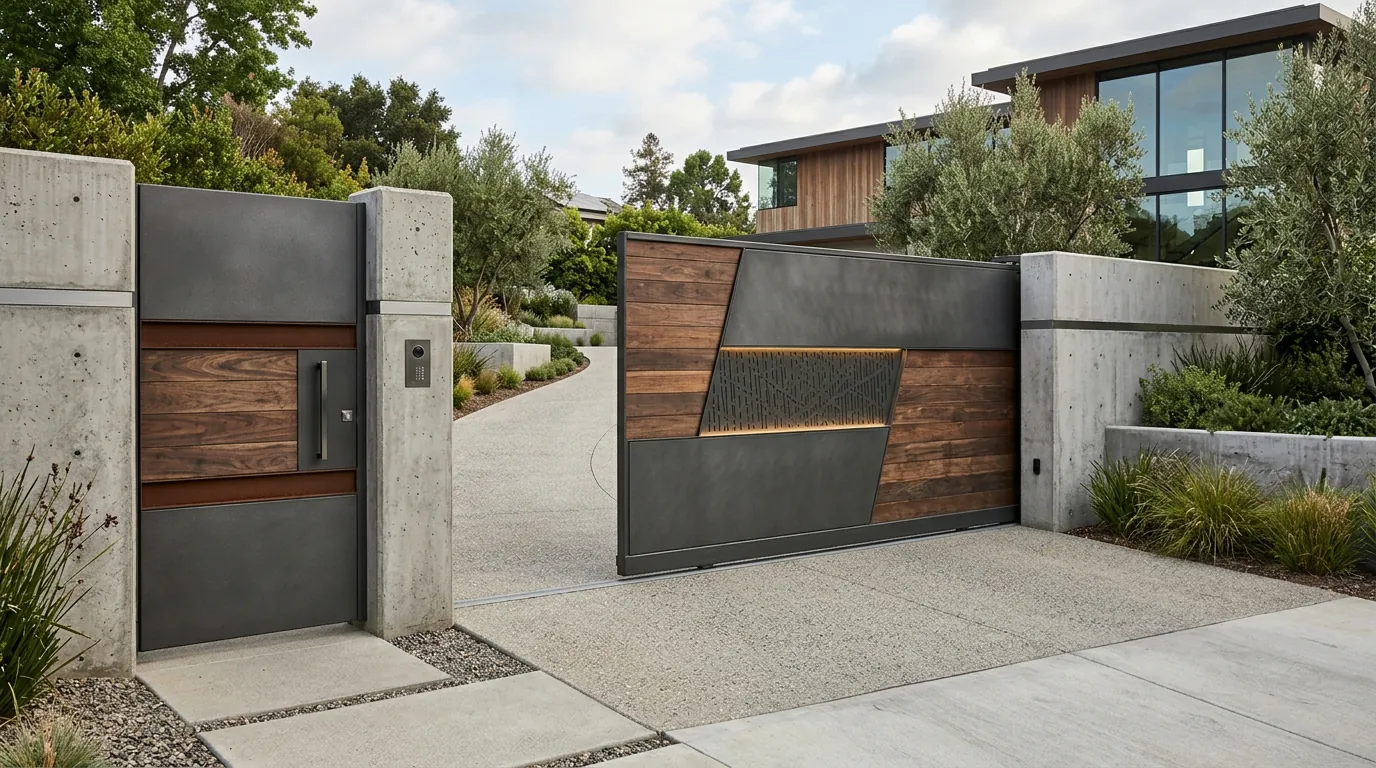
Gate types

What these gates actually look like

A visual vocabulary for the categories we build most often, described so you can identify what you are looking at and tell us what you want.

Modern horizontal slat driveway gate

Horizontal metal slats in a welded frame, usually powder coated dark, with even gaps that give partial visibility. Suits contemporary and mid century architecture, pairs naturally with board-formed concrete and cedar. The gaps also reduce wind load, which makes it a sensible choice on exposed sites.

Ornamental steel estate gate

Traditional ironwork, often bi-parting, with scroll or picket detailing and finials. Hung between substantial piers, frequently with integrated lighting. Heavier than it looks, which makes hinge and operator selection the critical engineering decision.

Cedar and steel mixed material gate

A steel frame carrying timber infill. The most requested style for Pacific Northwest homes because it reads warm against grey light and matches regional architecture. Requires attention to the timber's movement and to sealing where wood meets steel.

Cantilever slide gate

Slides horizontally on rollers with no ground track at all, carried by a counterbalanced tail section. Costs more than a tracked slide and is worth it where debris, snow or an uninterrupted drive surface rules a track out. Common on commercial yards and wooded rural sites.

Sliding commercial security gate

Solid or mesh infill on a rack driven slide, sized for high cycle counts. Function first: the visual language is industrial and the specification is driven by duty rating and detection rather than appearance.

Rural farm entrance gate

Wide, robust and unfussy. Sized for equipment rather than cars, built to survive contact, and often automated at a distance from any building. Frequently paired with off grid power.

Automated swing gate with arm operator

The most common residential automation. The arm operator mounts at the pier and drives the leaf through its arc. Visible, serviceable and appropriate for the majority of level residential openings.

Keypad access pedestal

A weather sealed keypad on a post at driver height, set back far enough that a vehicle can reach it without blocking the road. Simple, reliable, and appropriate where the user group is small and stable.

Card and fob reader entrance

A proximity reader at the vehicle or pedestrian entrance, issuing each user an individually revocable credential. The visual difference from a keypad is small; the administrative difference is large.

Video intercom entry system

Screen, camera, call button and often a keypad and reader grouped on one pillar. Solves the visitor problem rather than the resident one, and increasingly the default on properties where deliveries are frequent.

Fixed bollards at a storefront

Evenly spaced steel posts set in concrete along a pedestrian edge. Spacing is the design decision: close enough to stop a vehicle, open enough for a wheelchair, a stroller and a delivery cart.

Operator and control installation

The part nobody photographs and every technician judges. A sealed enclosure, labelled runs, a readable board and battery backup. This is where a good installation is distinguishable from a fast one.

Service and repair in progress

Scheduled maintenance and repair visits on gates of every brand, including systems installed by other companies.

Coastal and waterfront entrance

Marine specification throughout, on the islands and the exposed shoreline. Visually similar to inland work, materially different underneath.

Photography on this page shows Emerald Gate Systems work. Where a category is not yet represented by a verified project photograph, the section is described in text rather than illustrated with stock imagery.

How a project runs

From first call to a gate that works

Every project varies. This is the sequence most of them follow, and what actually happens at each stage.

  • 01 Initial enquiryA conversation about the property, the problem and roughly what you have in mind. Often enough to rule options in or out before anyone travels.
  • 02 Site evaluationWe come to the property. No charge, no obligation. This is where most of the real design decisions get made.
  • 03 MeasurementOpening width, approach length, slope across the swing arc, stacking room, clearances and existing pier or fence lines.
  • 04 Traffic and access assessmentWho uses the entrance, how often, in what vehicles, at what hours, and who needs to be let in that does not live or work there.
  • 05 DesignThe gate drawn for your opening and your architecture, with configuration, materials, infill and finish resolved.
  • 06 Equipment selectionOperator sized from cycle count and gate mass, safety devices, controls, access control hardware and power strategy.
  • 07 Written quoteItemised, covering fabrication, automation, controls, electrical, site work and installation, with nothing waiting to appear later.
  • 08 FabricationSteel cut, jigged, welded and finished in our Sedro-Woolley shop. Because we build it, a correction is an afternoon rather than a reorder.
  • 09 Site preparationPost foundations, conduit, trenching and any drainage or grading work the installation requires.
  • 10 InstallationPosts set, gate hung and aligned, hardware fitted and adjusted through the full travel.
  • 11 AutomationOperator mounted, powered, connected and configured, with force settings and travel limits set for the actual gate.
  • 12 Access control configurationCredentials issued, schedules built, intercom and remote access set up and tested with you present.
  • 13 Safety testingPhoto eyes, edge sensors, force limits and loop detection verified against UL 325 and ASTM F2200 practice before handover.
  • 14 OrientationWe walk you through operation, manual release, credential management and what to do in a power cut.
  • 15 Maintenance planningAn inspection interval matched to your site, your cycle count and your exposure, rather than a generic schedule.
Cost

What actually drives the price

We do not publish price ranges, and the reason is not evasiveness. Gate projects vary so widely by site that a published figure would mislead more people than it helped. What we can do is explain exactly which variables move the number, so you can see where your project sits.

Gate dimensions

Width drives everything. A wider opening needs more material, a stiffer frame, heavier hinges and a larger operator. Beyond certain spans the configuration itself has to change, which is a step change in cost rather than a gradual one.

Materials and fabrication

Ornamental ironwork takes hours that a simple slat panel does not. Timber infill adds material and detailing. Finish specification, particularly coatings prepared for marine exposure, adds real cost and real service life.

Design complexity

A gate drawn to match a specific house costs more at the design stage than a standard panel and usually less over the life of the property. Curves, custom patterns and integrated lighting all add fabrication time.

Operator requirements

Duty cycle and gate mass determine the operator, and the gap between a residential unit and a genuine high cycle commercial one is substantial. Sizing down to save money here is the most expensive saving available.

Electrical work and trenching

Frequently the largest single line on a rural quote. Distance from the power source, what the trench has to cross, and whether that surface is finished driveway or open ground all change the figure significantly.

Access control

A keypad and a multi credential system with remote administration and access records are different orders of investment. This is where the operational requirement should drive the spend.

Site preparation and terrain

Post foundations, drainage, grading across a swing arc and removing whatever is currently in the way. Sloped and wet sites cost more to prepare, and preparing them properly is what prevents alignment problems later.

Traffic volume

Higher traffic raises operator specification, adds detection hardware and shortens the maintenance interval. All three carry cost, and all three are cheaper than downtime on a commercial site.

Safety equipment

Photo eyes, edge sensors and loops are not the place to economise. They are a modest proportion of a project and the entire reason a powered gate is safe to have around people.

Travel and logistics

Distance from Sedro-Woolley affects mobilisation. Island properties add ferry time for crew, equipment and any return visit, which is why we prefabricate as much as possible before travelling.

Existing infrastructure

Sound existing posts, usable conduit or a structurally good gate can reduce a project considerably. Automating an existing gate is typically far less than replacing it, provided the structure carries the load.

Commercial requirements

Documented access, integration with other systems, scheduled credentials and specified failure behavior all add scope beyond the physical gate.

A site specific estimate is preferable because these variables interact. Two identical gates on two different driveways can differ substantially once power, ground and access are accounted for. What a driveway gate costs in Washington

Frequently asked

Questions about gates, automation and access in Washington

Grouped by subject. If your question is not here, the phone number reaches the people who would answer it anyway.

What is the best residential gate design for homes in Bellingham?

It depends heavily on where in Bellingham the property sits. On the hillside neighborhoods above the bay, slope across the swing arc is usually the deciding factor and a slide or cantilever configuration often solves it cleanly. Closer to the water, salt exposure moves the decision toward corrosion resistant materials, stainless fasteners and sealed enclosures. On flatter inland lots a swing gate is frequently the better looking and less expensive option. Architecturally, mixed material gates combining a steel frame with cedar infill are the most requested style in the area because they sit well against Pacific Northwest homes and grey light. The honest process is to measure the approach and the grade first, then choose the style within what the site allows.

How much does commercial gate installation cost in Seattle?

We do not publish figures because the range on commercial work is genuinely wide and a number without a site behind it would mislead you. What we can say is which variables move it most in Seattle specifically: constrained sites frequently require slide or cantilever configurations rather than cheaper swing gates, trenching across finished surfaces is common and expensive, duty cycle on a commercial entrance drives operator selection substantially, and access control scope varies enormously between a single reader and a managed multi credential system. Sites in historic or design review districts can also carry approval requirements that affect timeline more than cost. A site evaluation produces an itemised written quote, which is more useful than a range.

Can you install automatic gate systems in Tacoma?

Yes, as scheduled project work. Tacoma sits outside our core northern counties, so we plan installations there rather than offering same day service. That suits most gate projects, which are designed, fabricated and scheduled over weeks rather than hours. For routine repair calls in the Tacoma market, a closer contractor may genuinely serve you better on response time, and we will say so rather than take work we cannot support well. For design and fabrication led projects, the distance is not the constraint people assume.

What access control solutions work for Arlington businesses?

Most Arlington commercial sites are best served by durable physical credentials combined with mobile access for whoever administers the system. The local business mix leans toward light industrial, agricultural service and trades, where users wear gloves, arrive in trucks and work outdoors. Proximity cards and fobs handle those conditions better than touchscreens. Adding mobile credentials for supervisors gives remote administration, which matters when the person managing access is not always on site. For entrances with heavy vehicle traffic, long range vehicle credentials remove the need to stop and reach out of a window at all. The deciding question is usually how often the user list changes.

Can an existing gate in Everett be automated?

In most cases yes. The assessment is structural before it is electrical. We look at whether the frame is square and sound, whether the hinges and posts can carry the additional and more consistent loading that automation brings, whether ground clearance holds through the full travel, and whether power can reach the gate without disproportionate trenching. Everett's older residential neighborhoods often have sound existing gates that were simply never powered, which makes them good retrofit candidates. Where a gate already sags or drags, automating it accelerates the underlying problem rather than solving it, and we will recommend addressing the structure first.

What should Whidbey Island property owners consider when choosing a gate?

Three things beyond the usual. First, marine exposure: specify corrosion resistant materials, stainless fasteners and properly sealed enclosures from the outset rather than treating it as a maintenance issue later. Second, wind: solid infill panels on exposed island sites carry significant load into hinges, posts and operators, which argues for open or partially open infill unless the structure is sized for it. Third, logistics: ferry access affects installation sequencing and realistic service response, so we prefabricate as much as possible in the shop and plan visits rather than improvising them. Properties from Clinton at the south end through Coupeville to Oak Harbor all share these conditions to varying degrees.

How does coastal weather near Anacortes affect gate maintenance?

It shortens every interval. Salt carried in marine air attacks fasteners, unsealed welds, hinge pins and any electrical enclosure not rated for the exposure. On Fidalgo Island and the Anacortes waterfront we would expect inspection at shorter intervals than an equivalent inland property, with particular attention to fastener condition, coating integrity at welds and joints, enclosure sealing, and hinge and roller lubrication. The failures are gradual rather than sudden, which is exactly why scheduled inspection catches them while they are still adjustments rather than replacements.

What type of gate works for rural Snohomish County properties?

Rural Snohomish properties usually have the opposite problem from suburban ones: plenty of room, but limited power and longer distances. That combination favours gates sized generously for equipment and vehicles, with the automation strategy decided by what power is realistically available at the gate. Where mains power would require substantial trenching, solar is worth evaluating honestly against the winter load. Slide gates suit sites where the driveway rises from the road. Around Arlington, Granite Falls, Monroe and Sultan we also see a high proportion of entrances that need to accommodate trailers and farm equipment, which changes the width requirement well beyond what a car would suggest.

How long does a gate project take from first call to completion?

Fabrication is the longest stage because the gate is built rather than pulled from stock. Once fabrication is complete, most residential installations are completed within one to a few days on site, depending on trenching, electrical work and how much site preparation the approach needs. Commercial and multifamily projects with extensive access control take longer, and island projects add ferry scheduling. We give a schedule with the written quote rather than a generic estimate, because the variables differ so much by site.

What happens to an automatic gate in a power outage?

Whatever it was configured to do, which is a design decision made at installation rather than a fixed behavior. Battery backup allows the gate to keep operating for a period. A fail-safe configuration releases the gate so it can be opened manually. A fail-secure configuration keeps it closed. The right choice depends on whether the priority is keeping vehicles out or letting people out, and it differs between a rural driveway and a commercial facility. Every automated gate should also have a manual release that a person can find and operate in the dark, and we cover that in the handover.

Do you service gates installed by other companies?

Yes. We repair and maintain gates and operators from all major manufacturers regardless of who installed them. Sagging leaves, dragging rollers, failed operators, dead control boards, damaged safety loops and misaligned photo eyes are routine work. When we are called to a gate we did not install, part of the visit is establishing whether the fault is a worn component or an original specification problem, because those lead to different recommendations.

Are bollards worth installing alongside a gate?

On commercial and public facing sites, frequently yes, because they solve a different problem. A gate controls the vehicle entrance. Bollards protect everything the gate does not: the storefront frontage, the pedestrian edge, utility and mechanical equipment, and any area where a vehicle should not be able to reach. On residential properties they are less common but occasionally useful where a driveway runs close to a structure. The design decisions are spacing, approach angle and foundation depth rather than appearance.

How do I manage access for an HOA or community entrance?

Start with administration rather than hardware. Decide who will issue and revoke credentials, how often that person is available, and whether the board needs a record of entries. Those answers determine whether you need a simple shared code, individual credentials, or a system with remote administration and access records. Community entrances also need a workable path for guests, deliveries and contractors, which is usually where video intercom or temporary codes come in. Board turnover makes written documentation of the system as important as the system itself, and it is the thing most often missing when we inherit a community gate.

Can a gate be automated if there is no power at the road?

Often yes, either by trenching power out to the gate or by using solar. Which is better depends on distance, what the trench would have to cross, and the honest winter load calculation. Solar works well on rural entrances with moderate cycle counts and adequate sky exposure. It works poorly on shaded sites, on high cycle entrances, or where the panel would be sized optimistically against a Washington December. We would rather tell you solar will not carry your gate before you buy it than after.

What safety equipment does an automatic gate need?

At minimum, photo eyes across the opening to detect an obstruction, correctly configured force limiting so the gate stops when it meets unexpected resistance, and a manual release. Edge sensors detect direct contact and are appropriate on many installations. Vehicle loop detection prevents a gate closing on a vehicle still in the opening and becomes essential on commercial entrances. UL 325 and ASTM F2200 describe how these should be configured. We install to that practice and test it before handover, because a powered gate is powered machinery in a place where children and pets exist.

How do I choose between a keypad, a fob and a phone credential?

By how many people need access and how often that list changes. A keypad suits a small stable group and fails when codes get shared. Fobs and cards give each person a credential that can be revoked individually without disturbing anyone else, which is usually what pushes a property to upgrade. Phone credentials remove the physical item entirely and make remote issuing practical, which matters for managed properties. Many installations end up combining two of these, with a keypad as a fallback and credentials for regular users.

Does Emerald Gate Systems have offices in Seattle or Bellevue?

No. We are headquartered in Sedro-Woolley, in Skagit County, and we travel to projects across Washington including the Seattle and Bellevue markets. We mention this plainly because some contractors imply a local presence they do not have. What you get from us is a Washington family business with its own fabrication shop rather than a franchise, and an honest answer about scheduling to your specific address.

What is the difference between a gate operator and a gate opener?

In practice the terms are used interchangeably. Operator is the term used in the industry and in the safety standards, and it refers to the motor, gearbox and control board that drives the gate. Opener is the more common consumer term, borrowed from garage door equipment. Both describe the same component. What matters more than the terminology is duty rating, because that is what determines whether the unit is appropriate for your cycle count.

How do I get a quote?

Call us or use the contact form and we will arrange a site visit. The visit is free, carries no obligation, and produces a written itemised quote covering fabrication, automation, controls, electrical work, site preparation and installation. We measure the opening, check grade, drainage, power and clearances, and ask how the entrance is actually used before recommending anything.

Project evidence

Case studies

Real project documentation carries more weight with prospective clients and with search engines than description does. The structures below are ready for verified project information.

  • Case study 01Arlington commercial access control. Property type, existing condition, credential requirement, chosen system, installation constraints and measured outcome. [CMS: INSERT VERIFIED PROJECT DETAIL AND PHOTOGRAPHY]
  • Case study 02Anacortes coastal residential gate. Marine exposure specification, material and coating decisions, automation approach and maintenance interval set. [CMS: INSERT VERIFIED PROJECT DETAIL AND PHOTOGRAPHY]
  • Case study 03Everett high cycle commercial entrance. Cycle count, operator sizing, loop detection layout and downtime outcome. [CMS: INSERT VERIFIED PROJECT DETAIL AND PHOTOGRAPHY]
  • Case study 04Lynden farm entrance. Equipment width requirement, off grid power calculation, durability specification. [CMS: INSERT VERIFIED PROJECT DETAIL AND PHOTOGRAPHY]
  • Case study 05Lynnwood community access modernisation. Resident credential migration, guest handling, board documentation. [CMS: INSERT VERIFIED PROJECT DETAIL AND PHOTOGRAPHY]
  • Case study 06Skagit upriver gate safety upgrade. Existing gate condition, safety devices added, force settings and standards compliance. [CMS: INSERT VERIFIED PROJECT DETAIL AND PHOTOGRAPHY]

Customer testimonials are published only with permission and only where the project and the person are verifiable. We do not publish invented quotes.

Service and area

Which services go where

All seven service lines are available across the service area. These notes describe where each is most frequently requested and why, which is more useful than a grid of every possible combination.

Custom Gate Design is requested most where architecture is specific or the site is difficult. Estate properties in Woodway and Bellevue, waterfront homes in the San Juan Islands, Anacortes and on Fidalgo Island, contemporary residences around Seattle, Edmonds and Mill Creek, and historic properties in Snohomish, La Conner and Coupeville. Design work also drives most of what we fabricate for Mount Vernon, Burlington and Sedro-Woolley.

Residential Gate Installation covers the widest geography, from suburban driveways in Lynnwood, Mountlake Terrace, Brier, Mukilteo and Bothell through to acreage entrances in Arlington, Granite Falls, Lake Stevens, Monroe, Stanwood and Camano Island. Upriver and mountain properties around Concrete, Rockport, Marblemount, Darrington, Sultan, Gold Bar, Index and Skykomish add long driveways and power constraints to the same brief.

Commercial Gate Solutions concentrate in the industrial and distribution corridors: Everett, Marysville, Arlington and Burlington in the north, and the Seattle, Bellevue, Tacoma and Olympia markets to the south. Bellingham and Ferndale carry the equivalent commercial work in Whatcom County, and Bothell and Lynnwood sit between the suburban and commercial patterns.

Access Control follows population rather than geography. Multifamily and community properties in Lynnwood, Everett, Bellevue and Seattle, business parks in Arlington and Marysville, healthcare and institutional facilities across the Puget Sound markets including Olympia, and shared road communities on Coupeville, Camano Island and Orcas. Border area properties around Blaine, Semiahmoo, Sumas and Birch Bay frequently combine gate and building access on one credential system.

Bollard Installation is predominantly commercial and public facing: storefronts and mixed use frontages in Seattle, Bellevue, Tacoma, Everett and Bellingham, institutional and healthcare properties across the region, and utility and equipment protection on industrial sites in Marysville, Arlington and Ferndale.

Gate Repair & Maintenance is our most geographically distributed service because we take it on gates of every brand. Coastal and island properties on Whidbey Island, Guemes, Lopez, Orcas, the San Juan Islands and at Blaine and Birch Bay see the shortest maintenance intervals due to salt. Wooded and upriver sites around Concrete, Lyman, Hamilton, Rockport, Marblemount and Darrington see debris and freeze related faults. Suburban and commercial repair work runs continuously through Everett, Ferndale, Sultan, La Conner, Mount Vernon and the wider Snohomish County corridor.

Automatic Gate Systems underpin nearly everything above. Retrofit automation on sound existing gates is common in established areas including La Conner, Mountlake Terrace, Edmonds and Everett. Off grid and solar automation concentrates in rural Snohomish and Skagit, on Camano Island, and through Gold Bar, Index and the upper valleys. High cycle automation belongs to the commercial corridors, and coastal specification governs everything on the water from Bow, Edison and the Samish flats through Anacortes, Oak Harbor, Clinton and Nooksack valley properties near Lynden and Everson.

Being found

How businesses get found in AI answer engines

A short explanation of how search engines and AI assistants build an understanding of a company, and what we do about it. This describes an approach, not a guarantee.

Search engines and AI assistants do not read a website the way a person does. They build a model of an entity: a named organisation, the services it provides, the places it serves, and how consistently that information is expressed everywhere the organisation appears. When someone asks an assistant for a gate installer in Northwest Washington, the system is drawing on that model rather than reading a brochure.

Consistency is the foundation. A business name, address and phone number that match across the website, business listings and directories give the system a stable anchor. Variation introduces doubt, and doubt reduces the confidence with which any system will surface a business.

Service descriptions matter because they define what the entity actually does. A page that says quality solutions describes nothing a machine can associate with a query. A page that explains what Custom Gate Design involves, what a duty cycle is, and how access control differs from a gate operator gives a system genuine material to match against real questions.

Geographic context works the same way. Naming a city is weak. Explaining what salt exposure does to hardware on Fidalgo Island, or why slope changes the configuration on a Bellevue hillside, creates an association between the business, the place and the problem that a list of city names cannot.

Structured content helps because it makes relationships explicit. Clear heading hierarchy, question and answer formats, and content organized by user intent rather than by keyword allow a system to extract a specific passage as an answer rather than having to summarise an entire page.

Schema markup contributes by stating relationships in a machine readable form: this organisation, these services, this area served, these questions and answers. It supplements clear content. It does not substitute for it, and marking up thin or inaccurate information does not improve anything.

Authoritative service pages matter more than a single large page. That is why this page is organized as a hub that points to detailed service and location pages rather than attempting to replace them. Depth lives on the specific pages; this page explains how they relate.

Genuine project evidence and photography carry weight that description cannot. Real installations, documented properly, distinguish a working contractor from a page of claims. Reviews and citations from independent sources do the same, which is why they belong to the customer rather than to us.

Clear question and answer content helps because it matches how people actually ask. Most gate questions arrive as sentences, not keywords.

No approach guarantees inclusion in Google AI Overviews, ChatGPT, Perplexity, Claude, Gemini, Copilot or any other system. These platforms change how they select and cite sources, and anyone claiming a guaranteed method is describing something they cannot control. What is within our control is publishing accurate, specific, well structured information about work we actually do.

Next step

Tell us about the entrance

We come to the property, measure it, tell you what genuinely fits, and put a written number on it. No charge, no obligation, and no pressure to decide while we are standing there.

Emerald Gate Systems, Sedro-Woolley, Washington. Washington licensed, bonded and insured contractor. Serving Skagit, Snohomish and Whatcom Counties, the Puget Sound island communities, and project work across Washington State.