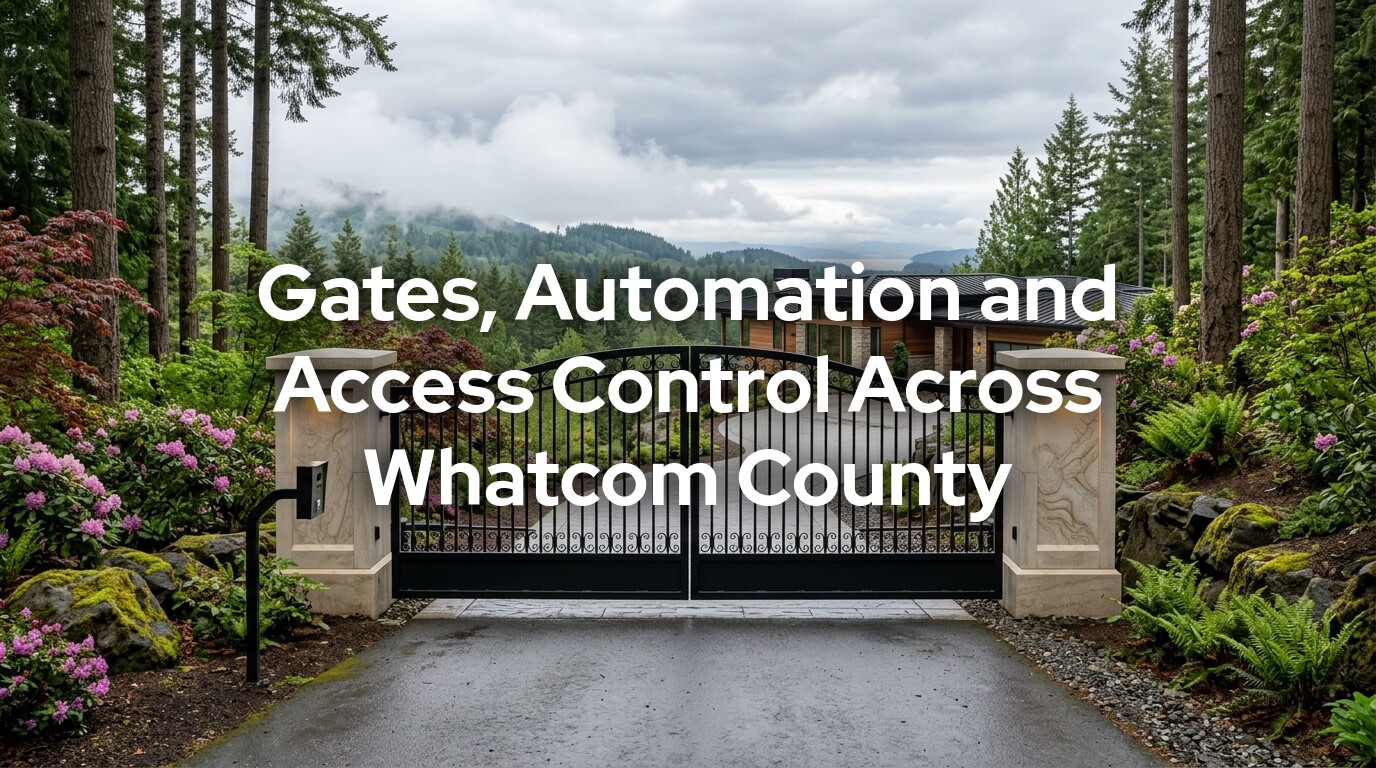
Gate Installation in Whatcom County should be planned around more than a county name. Bellingham, Lynden, Ferndale, Blaine, and the border communities all create different gate conditions. A residential driveway near Bellingham, a farm entrance outside Lynden, a commercial yard in Ferndale, and a border-area business near Blaine should not receive the same gate recommendation just because they share the same county.
Emerald Gate Systems installs, fabricates, automates, repairs, and maintains gates and access control systems across Whatcom County from its Sedro-Woolley headquarters and fabrication shop. The company serves residential properties, farms, rural driveways, commercial sites, institutional entries, managed properties, border-area businesses, and access-controlled entrances through one Northwest Washington team.
This page exists because Whatcom County was named across the site but did not have a dedicated county hub. The Bellingham page will handle the main city search. This county page captures the wider service area, including Lynden, Ferndale, Blaine, smaller communities, agricultural properties, rural sites, border-adjacent businesses, and projects that need countywide context before a city-specific page makes sense.
The best gate system begins with the property. What vehicles enter? How wide is the real turning path? Is the site open to wind? Is utility power nearby? Will the gate serve a farm, business, home, institution, apartment, or managed property? Who needs access after hours? What happens during power loss? Which authority reviews fire access? Can the gate be serviced after installation?
Those questions shape the gate more than a product list. A strong Whatcom County page should answer them locally and route the reader to the right next service page.
What Does Gate Installation in Whatcom County Include?
Gate Installation in Whatcom County can include custom gate fabrication, automatic gate installation, access control, video intercoms, cameras, farm gates, commercial gates, gate repair, solar and off-grid automation, gate automation retrofits, ADA entry work, bollards, and long-term maintenance. The correct scope depends on the property and how the entrance is used.
A Whatcom County gate project may include:
- Residential driveway gates
- Custom iron, steel, cedar, aluminum, or mixed-material gates
- Automatic swing gates
- Automatic sliding gates
- Cantilever gates
- Farm and agricultural gates
- Equipment-width openings
- Commercial yard gates
- Warehouse and facility gates
- Border-area business access
- Keypads and remotes
- Card readers, fobs, and mobile credentials
- Video intercoms and phone entry
- Security cameras for gate areas
- Vehicle loops and free-exit devices
- Battery backup
- Solar gate openers where suitable
- ADA door and entry automation where applicable
- Bollards for storefronts, equipment, and public-facing areas
- Gate repair and maintenance
Countywide gate planning should not flatten every project into the same recommendation. A Bellingham commercial property may need employee credentials, visitor entry, ADA coordination, cameras, and maintenance planning. A Lynden farm may need wide equipment access, rugged hinges, gravel and mud planning, and solar review. A Ferndale facility may need delivery access and vehicle loops. A Blaine border-area property may need careful access-control administration and traffic planning.
For more detail on any of those, see our automatic gate installation page, our access control page, our farm gates page, or our Bellingham page.
Schedule a free Whatcom County gate consultation when the entrance needs a site-specific recommendation for fabrication, automation, access control, repair, or replacement.
Why Whatcom County Needs Its Own Gate Hub
Whatcom County needs its own gate hub because the county is too varied for one generic service- area paragraph. Bellingham, Lynden, Ferndale, Blaine, rural roads, agricultural properties, border communities, commercial sites, and wooded residential areas all create different gate requirements.
This page helps organize:
- Bellingham urban, residential, commercial, ADA, and institutional searches
- Lynden farm, dairy, berry, equipment, and rural entrance searches
- Ferndale commercial, industrial, farm, and residential searches
- Blaine border-area, business, residential, and vehicle-access searches
- Countywide gate repair and maintenance intent
- Countywide access-control intent
- Security camera gate systems Whatcom intent
- Rural solar and battery backup questions
- Long-tail Whatcom cities that do not justify separate pages yet
A county page earns its place by explaining what changes by location. A farm entrance outside Lynden may need very different gate hardware from a compact Bellingham driveway. A Ferndale commercial yard may need more cycle capacity than a residential gate. A Blaine business may need credentials and traffic control that reflect border-area vehicle movement. A rural property outside the city may need battery backup, solar review, long power runs, and a manual release plan that works during winter conditions.
Rather than a separate page for every Whatcom city and service combination, we keep one county page, one Bellingham page and focused service pages. Fewer paths, and it is clearer where to go.
One county page can still serve long-tail communities when the writing is specific. The key is to explain why the county matters, not merely repeat a city list.
What Makes Whatcom County Gate Projects Different?
Whatcom County gate projects are shaped by city density, agricultural land, open-field wind, rural driveways, wet ground, tree cover, commercial facilities, border-area traffic, winter weather, and power distance. The right gate should be selected after those conditions are reviewed on site.
Common Whatcom County conditions include:
- Open agricultural land and wind exposure
- Wide equipment and trailer access
- Rural gravel driveways
- Long utility power runs
- Winter outages
- Wet soil and drainage concerns
- Wooded properties and debris around sensors
- Bellingham urban and institutional entrances
- Ferndale commercial and industrial access
- Blaine border- area vehicle movement
- Access-control administration for changing users
- Emergency access review
- Service distance from the Sedro-Woolley shop
Open farmland changes gate design because wind can hit long gate leaves and solid infill directly. A gate that looks attractive in a drawing may place too much force on posts, hinges, operators, and foundations if wind exposure is ignored.
Rural driveways change power planning. Utility power may be far from the entrance. Trenching can be a major part of the project. Solar may be practical, but only when winter sun, shade, gate cycles, battery capacity, and accessory loads are evaluated honestly.
Commercial and institutional sites change access-control planning. User credentials, cameras, visitors, deliveries, staff, maintenance crews, and after-hours procedures all need structure. A single shared code is rarely a strong long-term answer for a busy property.
Whatcom County also includes places where city and county conditions blur. A Bellingham mailing address may still describe a property with a long rural drive, trees, gravel, and limited power. A Ferndale property may combine commercial access with farm traffic. The recommendation should follow the site, not just the city name.
Bellingham Gate Installation and the Dedicated City Page
Bellingham gate installation deserves its own city page because it carries the strongest Whatcom search volume and includes several overlapping service intents. Bellingham projects may involve residential automatic gates, custom fabrication, commercial access, ADA entry automation, access control, video intercoms, cameras, and all-brand repair.
Bellingham projects may include:
- Residential driveway gates
- Custom iron, cedar, steel, or aluminum gates
- Automatic swing and sliding gates
- Commercial and institutional access
- ADA door and entry automation
- Keypads and video intercoms
- Cameras and managed access
- Gate repair and maintenance
- Automation retrofits
- Battery backup and outage planning
This Whatcom County page should not try to outrank the Bellingham page for the main city term. Instead, it should explain how Bellingham fits into the broader county service area and then send readers to the dedicated Bellingham page for city-specific detail.
Bellingham entrances often require more coordination than a simple private gate. Urban sites can have tighter geometry, pedestrians, employees, customers, visitors, ADA considerations, building access systems, fire access, and service access. The gate may need to work with a building, a parking area, a commercial entrance, or a managed property.
County properties near Bellingham may look different. They may have longer driveways, more tree cover, gravel approaches, and limited utility power. That is why the site visit matters.
Review automatic gate installation in Bellingham, WA when the project needs the dedicated Bellingham city page.
Lynden Farm Gates and Rural Entrances
Lynden farm gates and rural entrances should be designed around equipment, livestock, trailers, mud, wind, gravel, power distance, and long-term repair access. Whatcom County agriculture creates practical gate needs that are different from decorative residential driveway gates.
Lynden area gate planning may include:
- Equipment-width openings
- Tractor and implement access
- Livestock trailer turns
- Feed and supply deliveries
- Farm worker access
- Veterinary and service access
- Rural shoulders and ditches
- Open-field wind
- Gravel and mud around the entrance
- Solar and battery review
- Manual release
- Emergency access
- Rugged hinges, rollers, and hardware
A farm gate should be planned from the turning path, not only the measured opening. A trailer may need more room than the gate width suggests when it approaches from an angle beside a ditch, shoulder, fence line, or narrow road. Columns, pedestals, and landscaping can reduce the usable path.
Livestock-aware design is also important. Gaps, lower edges, sharp projections, latch points, and fence transitions should be reviewed around how the property actually moves animals and equipment.
Solar can be useful on farm entrances when utility power is distant, but it should be sized for winter. Intercoms, cameras, cellular radios, and other accessories draw power even when the gate is not moving.
Review farm and agricultural gates when a Whatcom County property needs equipment-width openings, livestock-aware design, solar options, and automation that can handle working land.
Ferndale Gates for Commercial, Farm, and Residential Properties
Ferndale gate projects may include commercial entrances, industrial access, farm properties, residential driveway gates, service yards, access-controlled gates, and repair for existing systems. The right system depends on traffic, vehicle type, power, users, and the consequences of downtime.
Ferndale projects may need:
- Commercial sliding gates
- Cantilever gates for yards or gravel entrances
- Residential driveway gates
- Employee access credentials
- Delivery and vendor access
- Vehicle loops
- Keypads and card readers
- Video intercoms
- Cameras
- Farm equipment clearance
- Battery backup
- Maintenance planning
Commercial gates should be sized around actual cycles, not only gate weight. Shift changes, vendors, deliveries, employees, service crews, and after-hours access can create short periods of repeated use. A residential-duty operator may not fit that workflow.
Farm and rural properties near Ferndale may need wide entrances, stronger hardware, mud and gravel planning, and solar review. Residential properties may need a gate that balances privacy, curb appeal, visitor access, and simple daily use.
Access control should be chosen by user group. A small residence may need remotes and a keypad. A business may need individual credentials, schedules, event records, and camera review. A managed property may need a clear administrator responsible for users.
Review commercial gate systems when a Ferndale property needs higher-cycle equipment, vehicle loops, credentials, and maintenance planning.
Blaine and Border Community Gate Systems
Blaine and the border communities can require gate systems that account for residential access, commercial traffic, vendors, deliveries, vehicle movement, border-area businesses, after-hours users, and clear access-control procedures. Border-area traffic does not mean every property needs a complex system, but it does mean access should be planned carefully.
Blaine area gate planning may include:
- Residential driveway gates
- Commercial yard gates
- Border-area business access
- Employee credentials
- Vendor and delivery access
- Vehicle loops
- Video intercoms
- Phone entry
- Cameras
- After-hours access procedures
- Manual release
- Emergency access
- Weather and outage planning
A border-area business may need to know who is entering, when they are entering, and how credentials are removed when employees or vendors change. One permanent shared code can become hard to control once it spreads.
Traffic planning matters. Access devices should be placed where drivers can stop safely without blocking circulation, backing into the road, or forcing awkward reach from commercial vehicles. A reader placed for a passenger car may not work for vans, trucks, trailers, or service vehicles.
Residential properties near Blaine may have simpler needs. A driveway gate may need remotes, keypad entry, video intercom access, battery backup, or a solar evaluation. The right solution depends on the property, not the border label alone.
For border-community properties, the consultation should define normal users, occasional users, emergency access, outage behavior, and who manages the access list.
Custom Gate Fabrication for Whatcom County
Custom gate fabrication for Whatcom County should account for property use, material choice, wind exposure, maintenance, operator load, access control, and local conditions. Emerald Gate Systems fabricates gates in its Sedro-Woolley shop and installs them across Whatcom County where the project fit and service plan make sense.
Custom fabrication may include:
- Hand-forged iron details
- Laser-cut steel panels
- Structural steel frames
- Western Red Cedar infill
- Aluminum where lower weight or corrosion resistance is useful
- Mixed-material gates
- Farm gate frames
- Commercial sliding gates
- Cantilever gate structures
- Pedestrian gates
- Operator-ready reinforcement
- Access-control preparation
- Serviceable hardware layout
Custom does not mean overly decorative. It means the gate is built for the actual opening, vehicle path, users, and site conditions. A simple farm gate can be custom. A commercial cantilever gate can be custom. A cedar residential gate can be custom. A steel frame prepared for automation can be custom even when the design is clean and practical.
Material selection should be honest. Steel is strong and versatile, but needs coating and inspection. Cedar adds warmth and privacy, but moves with moisture and increases wind load when used as solid infill. Aluminum can reduce weight and improve corrosion resistance in some settings, but still needs proper design and compatible hardware. Ironwork creates character, but requires finish care.
Review custom gate design and fabrication when a Whatcom County property needs a gate built around the site rather than ordered as a stock panel.
Access Control and Security Camera Gate Systems in Whatcom County
Access control and security camera gate systems in Whatcom County should be based on the users, vehicles, communication options, and management responsibilities at the property. The system may include keypads, remotes, cards, fobs, mobile credentials, video intercoms, phone entry, cameras, vehicle loops, and managed access records.
Whatcom County access-control users may include:
- Homeowners
- Family members
- Employees
- Vendors
- Contractors
- Farm workers
- Delivery drivers
- Residents
- Students or staff at institutional sites
- Property managers
- Visitors
- Emergency responders
A private home may only need remotes and a keypad. A farm may need separate worker, delivery, and service codes. A commercial site may need credentials, schedules, cameras, and after-hours access. A managed property may need individual user records and directory updates. A border-area business may need tighter credential administration because user groups can change.
Cameras should be selected for a defined purpose. A wide overview camera is not the same as a camera positioned for visitor verification, gate-strike review, plate capture, or keypad activity. Camera placement should consider lighting, weather, glare, vehicle height, and what the owner actually needs to see.
Video intercoms are helpful when the gate is far from the building or when visitors need to be verified before entry. They require power, communication, camera angle, lighting, and a fallback method if cellular, internet, or cloud services fail.
Review access control systems when a Whatcom County gate needs keypads, RFID, video intercoms, cameras, phone entry, LPR, or managed user access.
Automatic Gate Installation Across Whatcom County
Automatic gate installation across Whatcom County should connect the gate structure, operator, safety devices, power, access controls, emergency access, and maintenance plan. A gate is not complete just because it opens and closes once during installation.
Automatic gate projects may include:
- Swing gate operators
- Sliding gate operators
- Cantilever gate operators
- Battery backup
- Utility power or solar power planning
- Monitored photo eyes
- Sensing edges
- Vehicle loops
- Keypads and remotes
- Video intercoms
- Cameras
- Phone entry
- Manual release
- Emergency access method
- Programming and testing
- Owner or manager training
The operator should be selected after the gate and site are understood. Gate weight matters, but so do length, wind area, mechanical resistance, traffic, power, duty cycle, safety devices, and service access.
A motor should not be used to hide a poor gate. If the gate drags, shifts, binds, or moves on unstable posts, automation can make the problem more expensive. Mechanical correction should happen before the operator becomes responsible for the movement.
Safety devices should be planned early. Vehicle loops, remotes, cameras, and keypads do not replace monitored entrapment protection where required. The gate should be built and guarded for automated movement.
Review automatic gate installation when a Whatcom County property needs a complete swing, sliding, or cantilever gate system built for Washington conditions.
Farm and Agricultural Gates in Whatcom County
Farm and agricultural gates in Whatcom County should be planned for equipment width, livestock movement, trailers, feed deliveries, mud, gravel, wind, rural shoulders, long power runs, and repair access. A farm entrance is a working part of the property, not just an ornament at the road.
Farm gate planning may include:
- Equipment-width openings
- Livestock trailer turning paths
- Tractor and implement clearance
- Farm worker access
- Feed and supply deliveries
- Veterinary and service access
- Livestock-aware lower clearances
- Mud and gravel management
- Rural ditch and shoulder conditions
- Open-field wind
- Solar feasibility
- Battery backup
- Manual release
- Durable hardware
- Maintenance access
Opening width should be based on actual use. A gate can measure wide enough and still be hard to use when a trailer turns from a narrow road or when a ditch, post, pedestal, or fence corner reduces the real path.
Farm gates often benefit from simple, rugged design. That does not mean the gate must be plain. It means the function comes first. A working entrance should survive mud season, repeated use, vehicle contact risk, and seasonal changes.
Solar can be useful on far entrances, but it should not be treated as automatic. Tree shade, short winter daylight, gate cycles, intercoms, cameras, and battery age all affect performance.
For farms near Lynden, Ferndale, and rural Whatcom County, start with equipment movement and winter access before choosing the gate style.
Commercial Gates for Whatcom County Businesses
Commercial gates for Whatcom County businesses should be planned around traffic, delivery access, employee credentials, vendors, cameras, vehicle loops, pedestrian routes, safety devices, power, emergency access, and downtime risk. A commercial gate is part of daily operations.
Commercial projects may include:
- Warehouse gates
- Service yard gates
- Distribution entrances
- Retail service access
- Facility gates
- Institutional entrances
- Commercial sliding gates
- Cantilever gates
- High-cycle operators
- Vehicle loops
- Card readers and fobs
- Video intercoms
- Cameras
- After-hours access
- Maintenance contracts
Traffic should be reviewed at peak periods, not only average use. Employees, vendors, deliveries, maintenance crews, visitors, and customers can create short bursts of repeated gate cycles.
Access control must have an owner. Someone must add and remove users, issue credentials, update phone directories, protect administrator accounts, and coordinate service. A gate with strong hardware but unmanaged access records is not a strong system.
Commercial gates should also plan pedestrian routes. People should generally not be directed through an automated vehicle gate as the normal walking path. A separate pedestrian gate or controlled door may be safer and easier to manage.
Review commercial gate systems when a Whatcom County business needs high-cycle operators, vehicle loops, badge entry, phone entry, cameras, and maintenance planning.
Solar and Off-Grid Gate Automation in Whatcom County
Solar and off-grid gate automation in Whatcom County can be useful for farms, rural drives, wooded properties, border-area entrances, and long access roads where utility power is distant or trenching is not practical. Solar should be sized honestly for winter conditions.
Solar planning should review:
- Winter sun exposure
- Tree shade
- Panel location
- Gate cycles per day
- Operator load
- Battery capacity
- Keypad power draw
- Video intercom power draw
- Camera or cellular equipment draw
- Safety-device power draw
- Manual release
- Emergency access
- Battery replacement access
Solar is strongest where the site has good exposure and the energy budget is realistic. A simple low- cycle gate with a keypad is different from a gate with video intercom, cameras, cellular equipment, lighting, and frequent traffic.
Whatcom County includes rural and wooded properties where solar may look attractive but winter shade can be severe. The panel location should be evaluated for the lowest seasonal exposure, not the clearest summer day.
Utility power may be better where it can be installed reasonably and permitted correctly. Solar is not automatically cheaper or more reliable. The right answer depends on trenching, exposure, traffic, accessory loads, and outage expectations.
Review solar gate openers and off- grid automation when a Whatcom County entrance needs a winter-sized panel and battery plan.
Gate Repair and Maintenance Across Whatcom County
Gate repair and maintenance across Whatcom County may involve automatic gates, farm gates, commercial gates, access-control systems, video intercoms, solar gates, safety devices, vehicle loops, and gates installed by other contractors. Emerald Gate Systems services all brands and publishes a transparent repair labor rate of $100 per hour.
Common Whatcom County repair issues include:
- Gate opens but will not close
- Gate closes then reverses
- Gate slows during cold or wet weather
- Gate moves unevenly
- Center gap changes
- Sliding track collects mud, gravel, ice, or debris
- Photo eyes are blocked or misaligned
- Sensing edges fail testing
- Battery backup fails during outages
- Solar charging is weak
- Keypad or intercom fails intermittently
- Camera or access-control communication fails
- Vehicle loop does not detect properly
- Hinges, rollers, or posts move under load
- Gate is struck by a vehicle or equipment
A repair should diagnose the complete entrance. The operator may be the visible problem, but the cause can begin with gate resistance, poor alignment, worn hardware, water intrusion, weak batteries, damaged wiring, a failed safety device, or an access-control fault.
Maintenance intervals should reflect the property. A private residential gate may need periodic service. A farm gate, commercial gate, HOA gate, access-controlled site, or high-cycle entrance may need more frequent inspection.
Review gate repair and maintenance when a Whatcom County gate changes speed, sound, alignment, closing behavior, battery performance, or access-control reliability.
Call (360) 657-9975 when a Whatcom County gate problem affects access, safety devices, business operation, farm movement, or emergency entry.
ADA Entries and Public-Facing Access in Whatcom County
ADA entries and public-facing access in Whatcom County may be relevant for Bellingham commercial buildings, institutions, offices, apartments, managed properties, storefronts, clinics, public- facing businesses, and other covered sites. A gate or access-control project should not ignore pedestrian routes and accessible entry needs.
Accessible entry planning may include:
- Accessible route review
- Door operator review
- Push-button controls
- Accessible keypads and readers
- Low-energy door operators
- Video intercom placement
- Pedestrian gate planning
- Clear floor space
- Door hardware and threshold review
- Power-loss behavior
- Inspection-ready documentation where applicable
Not every building automatically needs an automatic door operator, but many public-facing and commercial entries need careful review of the full route. A push button alone does not solve an entry that has poor clearance, difficult hardware, a bad threshold, or a control placed in the wrong location.
When a vehicle gate serves a property with pedestrians, people should generally have a separate pedestrian route rather than being directed through the automated vehicle gate as the normal walking path.
Review ADA door and entry automation when a Whatcom County commercial, institutional, or managed property needs accessible controls or inspection-ready entry documentation.
Gate Automation Retrofits in Whatcom County
Gate automation retrofits in Whatcom County allow property owners to add an operator, safety devices, access control, battery backup, and smart access to an existing manual gate. Retrofit can be a good value when the existing gate is structurally sound and moves freely by hand.
A retrofit evaluation should review:
- Gate frame condition
- Post or column stability
- Hinge or roller condition
- Sliding track or guide condition
- Manual movement through the full travel path
- Gate sag, twist, or binding
- Wind exposure
- Operator attachment points
- Safety-device placement
- Power availability
- Access-control placement
- Manual release
- Remaining service life
A motor should not be used to force a poor gate to work. If a gate drags, binds, shifts, twists, or has unstable posts, automation may increase wear and create repeated service calls. Repair or replacement may be the better first step.
Retrofit can be useful when the owner likes the existing gate and wants convenience, keypad access, remotes, video intercom use, smartphone access, or battery backup. It can also preserve a custom gate with useful remaining life.
Review gate automation retrofits when an existing Whatcom County manual gate may be suitable for automatic operation.
Which Gate Type Fits a Whatcom County Property?
The best gate type for a Whatcom County property depends on opening width, driveway slope, available side space, soil, drainage, wind, snow, traffic, power, access-control needs, and maintenance expectations. Swing gates, sliding gates, cantilever gates, manual gates, and automated systems each solve different problems.
| Gate type | Best Whatcom fit | Main advantage | Main caution |
|---|---|---|---|
| Single swing gate | Residential and rural driveways with enough clear arc space | Simple movement and traditional appearance | Needs stable posts, clear swing path, and wind review |
| Double swing gate | Wider residential, farm, and estate-style entrances | Shorter leaves and balanced look | Both leaves need alignment, stops, and coordinated automation |
| Tracked sliding gate | Compact sites with side runback and clean travel path | Preserves driveway depth | Track must stay drained, supported, and clear of debris |
| Cantilever gate | Farm, commercial, gravel, snow, or debris-prone entrances with side room | No ground track across the drive | Needs longer frame, counterbalance, and stronger supports |
| Manual farm gate | Low-cycle field, pasture, and seasonal access | Simple and rugged | Less convenient during rain, darkness, and frequent use |
| Automatic gate | Homes, farms, businesses, and managed properties needing controlled access | Convenience and access management | Requires power, safety devices, emergency access, and maintenance |
| Solar- powered gate | Remote rural entrances with good winter sun | Can reduce trenching where utility power is distant | Depends on shade, battery capacity, cycles, and accessory loads |
Appearance matters, but the site should narrow the options first. A gate that looks right but cannot clear the slope, resist the wind, manage traffic, or remain aligned in wet soil is not the right gate.
Vehicle movement is often overlooked. Cars, trailers, delivery trucks, farm equipment, and emergency vehicles do not use the same path. The opening, columns, ditch, road edge, access pedestal, and turn angle should be evaluated together.
Permits, Fire Access, and Standards in Whatcom County
Whatcom County gate projects may involve electrical permits, fire access review, security gate permits, right-of-way questions, building permits, HOA approval, private-road approval, accessibility review, or local city review depending on the address and scope. Requirements should be confirmed before posts, columns, conduit, operators, or access devices are installed.
Whatcom County Fire Marshal information states that proposed security gate locations should be shown on a scaled site plan and that a gate requires a Fire System Construction Permit from the Fire Marshal’s office. The correct review path should still be confirmed for the specific address because city, county, fire district, private road, and property-use conditions can differ.
Electrical work may require permitting through Washington Labor and Industries or through the correct local jurisdiction for the address. Gate operators, access- control wiring, cameras, intercoms, vehicle loops, solar equipment, and powered bollards should be reviewed for the correct permit path.
Automated vehicular gates should consider ASTM F2200 for gate construction and UL 325 concepts for powered gate operators and entrapment protection. Access- control equipment may also involve UL 294 concepts where applicable.
Fire access should be discussed early. The gate width, location, approach, setback, emergency device, manual release, and behavior during power loss may all matter. A device accepted at one property should not be assumed acceptable at another address.
Confirm permits and emergency access before custom fabrication, trenching, columns, operator pads, or access-control pedestals are finalized.
What Happens During a Whatcom County Gate Consultation?
A Whatcom County gate consultation reviews the property type, opening, vehicle movement, site conditions, power, access users, gate type, materials, safety devices, emergency access, permit questions, and maintenance plan before equipment is selected.
- Confirm the property type. Residential, farm, commercial, rural, institutional, managed, border-area, or mixed-use.
- Define the purpose. Convenience, privacy, access control, livestock movement, commercial traffic, repair, retrofit, or safety improvement.
- Measure the opening. Review clear width, slope, road approach, ditches, shoulders, fencing, and available swing or slide travel.
- Map vehicle movement. Include cars, trailers, delivery trucks, farm equipment, emergency vehicles, and where drivers stop to use controls.
- Evaluate drainage and soil. Look for standing water, soft ground, runoff, gravel, mud, snow storage, and track or foundation concerns.
- Review wind and exposure. Consider open farmland, hilltop locations, wooded sites, solid privacy gates, and coastal influence where present.
- Compare gate types. Review swing, double swing, sliding, cantilever, manual, automatic, solar, and retrofit options.
- Plan access control. Discuss keypads, remotes, cards, fobs, video intercoms, cameras, phone entry, temporary codes, and user management.
- Plan power. Compare utility power, trenching, conduit, battery backup, solar, and accessory loads.
- Plan safety devices. Identify photo eyes, sensing edges, vehicle loops, warning signs, and pedestrian separation.
- Review approvals. Discuss electrical, fire, HOA, right-of-way, private-road, city, county, or accessibility questions.
- Prepare the scope. Separate fabrication, site work, automation, safety, access control, power, permits, exclusions, and service planning.
A good consultation may recommend a different path than the owner expected. A swing gate may not fit the grade. A tracked slider may not suit a gravel or snow-prone path. Solar may not work under winter shade. A manual gate may need repair before retrofit. A commercial entrance may need more access-control administration than a simple keypad can provide.
Finding those issues early is the point of the visit.
How Is a Whatcom County Gate Installed?
A Whatcom County gate installation moves through consultation, design, fabrication, site preparation, mechanical installation, automation, safety-device installation, access-control setup, testing, and owner training. The exact sequence depends on whether the project is residential, farm, commercial, repair, retrofit, ADA-related, or new installation.
- Site review. The team evaluates the opening, traffic, power, drainage, grade, users, and service access.
- Design and material selection. Gate type, materials, finish, privacy, wind exposure, and use are reviewed.
- Fabrication planning. The gate is prepared for hinges, rollers, operator attachment, safety devices, and access controls.
- Shop fabrication. Custom gates are fabricated in the Sedro-Woolley shop where applicable.
- Site preparation. Posts, foundations, drainage, conduit, operator pads, loops, and access pedestals are coordinated.
- Mechanical installation. The gate is installed and tested for smooth movement before automation is relied on.
- Operator installation. The swing, slide, or cantilever operator is mounted, adjusted, and programmed.
- Safety-device installation. Photo eyes, sensing edges, signs, vehicle detection, and manual release are installed and tested.
- Access- control setup. Keypads, remotes, cards, fobs, intercoms, cameras, phone entry, and user credentials are programmed where included.
- Final testing. The gate is tested through normal movement, safety response, access operation, backup behavior, and manual release.
- Owner handoff. The owner or manager receives guidance on operation, credentials, manual release, maintenance, and service calls.
Testing should match the way the property uses the gate. A family driveway, farm entrance, commercial yard, school entry, apartment gate, or border-area business may all require different access workflows.
Documentation should be kept after installation. Owners and managers should retain model numbers, manuals, keys, manual-release instructions, access records, service notes, permit information, and maintenance recommendations.
What Does Gate Installation Cost in Whatcom County?
Gate installation cost in Whatcom County depends on gate type, opening width, materials, custom fabrication, foundations, drainage, operator, safety devices, access control, cameras, intercoms, power, solar, battery backup, permits, emergency access, travel, repair needs, and whether the project is residential, farm, commercial, retrofit, or new installation. Emerald Gate Systems does not publish one universal gate price because scopes vary widely.
Cost drivers may include:
- Manual versus automatic operation
- Swing, sliding, or cantilever configuration
- Opening width and vehicle geometry
- Iron, steel, cedar, aluminum, or mixed materials
- Custom fabrication detail
- Farm or equipment-width requirements
- Commercial duty cycle
- Posts and foundations
- Drainage or site correction
- Operator type and duty level
- Monitored safety devices
- Vehicle loops
- Keypads, remotes, cards, fobs, or mobile credentials
- Video intercoms and phone entry
- Cameras and communication equipment
- Utility power, conduit, trenching, or solar
- Battery backup
- Fire access equipment
- Electrical permits and inspections
- Repair or reinforcement of an existing gate
- Maintenance agreement
Compare proposals by scope, not total alone. A low number may exclude safety devices, power, conduit, permits, access-control programming, fire access, drainage, adequate hardware, repair assumptions, or service access.
Cost can sometimes be simplified responsibly. A property may choose a simpler pattern, open infill, fewer access-control features, a practical gate type, or conduit planning before paving. Cost should not be reduced by skipping safety devices, ignoring drainage, undersizing operators, or automating a poor gate.
Request an itemized Whatcom County gate quote that separates fabrication, installation, automation, access control, safety devices, power, permits, and maintenance assumptions.
How Long Does a Whatcom County Gate Project Take?
A Whatcom County gate project timeline depends on site review, design, materials, custom fabrication, finish preparation, posts, concrete, power, permits, fire access review, access-control equipment, weather, owner approvals, and whether the project is new installation, repair, retrofit, or commercial work.
Project stages may include:
- Initial consultation
- Site measurement
- Traffic and access review
- Gate type selection
- Material and design approval
- CAD planning where needed
- Permit and fire access review
- Material ordering
- Shop fabrication
- Finish preparation
- Utility locating
- Foundation work
- Conduit and power preparation
- Gate installation
- Operator installation
- Safety-device installation
- Access-control programming
- Testing and training
A repair may move faster than a custom fabricated automatic gate. A farm gate may require field and driveway coordination. A commercial gate may need work scheduled around business access. A Bellingham institutional or commercial entry may need more approval steps than a private driveway.
Weather can affect excavation, concrete, coatings, electrical work, rural access, snow, drainage, and service scheduling. A realistic schedule should account for Washington conditions rather than assume every stage happens in ideal weather.
Owners can reduce delays by finalizing materials, gate type, access devices, power route, permits, HOA approvals, traffic needs, and user groups early.
How Should Whatcom County Gates Be Maintained?
Whatcom County gates should be maintained according to gate type, traffic, exposure, material, power source, access-control equipment, and downtime risk. Farm, commercial, HOA, institutional, and high-cycle gates usually need more structured maintenance than low-use residential gates.
Maintenance may include:
- Gate alignment checks
- Hinge, roller, guide, chain, rack, and track inspection
- Post and foundation observation
- Debris removal
- Operator testing
- Photo-eye testing
- Sensing-edge testing
- Battery backup testing
- Solar charging review
- Keypad and reader testing
- Video intercom testing
- Camera review
- Vehicle- loop testing
- Credential and code review
- Manual release testing
- Drainage inspection
- Written service notes
Owners should watch for slower movement, unusual sound, uneven travel, changing gaps, corrosion, loose hardware, blocked sensors, weak batteries, access-control problems, or behavior that changes during wet or cold weather.
Maintenance should include user administration where access control is involved. Former employees, old vendors, former tenants, and outdated phone directories should not remain active because no one reviewed the credential list.
For many residential gates, professional service once or twice per year may be appropriate depending on use and exposure. High-cycle, farm, commercial, managed, or debris-heavy systems may need more frequent inspection.
How This Whatcom County Page Fits the Site Structure
This Whatcom County page should sit between the service-area hub and the Bellingham city page. It gives the county a real content destination while preventing Bellingham from competing with the broader county term.
| Page | What it covers | Best for |
|---|---|---|
| Service areas hub | Where we work across the region | Skagit, Whatcom, Snohomish, island, and greater Puget Sound routing |
| Whatcom County hub | Countywide gates, automation, access control and repair | Bellingham, Lynden, Ferndale, Blaine, farms, rural drives, and border communities |
| Bellingham page | Main Bellingham city page | Residential, commercial, ADA, custom, access control, and repair in Bellingham |
| Access control service page | The full technical detail on access control | Keypads, RFID, intercoms, cameras, phone entry, credentials, and LPR |
| Farm gates service page | Farm and agricultural gates | Equipment-width openings, livestock-aware design, solar, and mud-season automation |
| Gate repair page | All-brand repair and maintenance authority | Repair, maintenance, $100 per hour labor, emergency response, and service plans |
The county page should link to the Bellingham page, and the Bellingham page should link back to this county hub when broader Whatcom context matters. Service pages should link to this page when they discuss Whatcom service coverage.
This structure avoids thin duplicate pages. Lynden, Ferndale, and Blaine can be handled here until search demand or project volume justifies dedicated pages with distinct content.
Common Whatcom County Gate Mistakes to Avoid
Common Whatcom County gate mistakes include choosing the gate by appearance alone, underestimating wind on open land, selecting solar without winter analysis, placing access devices where trucks cannot reach them, using one permanent shared code, ignoring fire access, and waiting for a complete breakdown before repair.
Mistake 1: Choosing appearance before site conditions
A gate should fit the property visually, but wind, slope, traffic, soil, drainage, and power must narrow the design before the final look is approved.
Mistake 2: Ignoring open-field wind
Long swing leaves, solid cedar, steel panels, and dense infill can catch wind. Posts, hinges, operators, brackets, and foundations must be planned for that force.
Mistake 3: Assuming solar works on every rural property
Solar depends on winter sun, shade, cycles, battery capacity, gate resistance, intercoms, cameras, and communication equipment. A shaded gate may need utility power instead.
Mistake 4: Treating access control as an afterthought
Keypads, readers, intercoms, cameras, loops, and pedestals affect conduit, vehicle stopping position, lighting, communication, and service access. Plan them early.
Mistake 5: Using one shared permanent code
Shared codes spread to old vendors, former workers, guests, contractors, and people who no longer need access. Individual credentials and temporary codes are stronger where users change.
Mistake 6: Forgetting pedestrian access
People should generally use a separate pedestrian gate or controlled door instead of walking through an automated vehicular gate as the normal route.
Mistake 7: Delaying fire access review
Security gates may need Fire Marshal review, emergency operation, and a scaled site plan. Ask early so the gate layout can respond before construction.
Mistake 8: Comparing quotes by total alone
Compare scope. Confirm gate structure, operator, safety devices, access control, power, permits, emergency access, programming, maintenance, and exclusions.
Why Choose Emerald Gate Systems for Whatcom County Gate Installation?
Emerald Gate Systems serves Whatcom County from its Sedro-Woolley headquarters and fabrication shop. The company is family-owned, licensed and insured, and backed by more than 15 years in the gate and entry trade. The team handles design, CAD planning, fabrication, welding, installation, automation, access control, repair, and service through one accountable Northwest Washington process.
That one-team model matters in Whatcom County because projects often combine different needs. A Bellingham property may need automatic gates, ADA entry coordination, access control, and repair. A Lynden farm may need equipment-width openings and solar review. A Ferndale business may need commercial operators, vehicle loops, and credentials. A Blaine border-area property may need after- hours access and clear user administration.
Emerald Gate Systems can evaluate whether the right answer is a new custom gate, an automatic operator, access control, repair, solar power, a farm gate, a commercial gate, an ADA entry, a bollard layout, or an existing-gate retrofit. The company also services all brands, including gates installed by others.
The strongest recommendation is not the most complicated one. It is the one that fits the property, the users, the vehicles, the weather, the power source, the local approvals, and the future maintenance plan.
Call Emerald Gate Systems at (360) 657-9975 or request a free Whatcom County gate quote for gates, automation, access control, fabrication, and repair across Bellingham, Lynden, Ferndale, Blaine, and the border communities.
For the full regional picture, our guide to gate installation service areas in Northwest Washington shows how coverage works across Skagit, Whatcom, Snohomish, and the islands, and automatic gate installation in Northwest Washington covers site preparation, power, and operator selection in more depth.
Cities We Serve in Whatcom County
Whatcom County work runs from Bellingham north to the border. These are the towns we cover, each with its own guide.
- Gate installation in Bellingham
- Gate repair in Ferndale
- Access control systems in Blaine
- Farm gate installation in Lynden
Frequently Asked Questions About Gate Installation in Whatcom County
Who installs gates in Whatcom County?
Emerald Gate Systems installs gates across Whatcom County from its Sedro-Woolley headquarters and fabrication shop. Projects may include custom gates, automatic gate installation, access control, farm gates, commercial gates, ADA entries, solar automation, repair, and maintenance.
The company serves Bellingham, Lynden, Ferndale, Blaine, border communities, rural properties, farms, commercial sites, and managed entrances where the project fit and service plan make sense.
Does Emerald Gate Systems serve Bellingham?
Yes. Emerald Gate Systems serves Bellingham with automatic gate installation, custom fabrication, commercial gates, ADA entry automation, access control, video intercoms, cameras, and all-brand gate repair.
The dedicated Bellingham page should carry the main city term, while this Whatcom County hub explains the broader county service area.
Does Emerald Gate Systems serve Lynden?
Yes. Emerald Gate Systems serves Lynden and nearby Whatcom County agricultural properties. Projects may include farm gates, equipment-width openings, residential driveway gates, solar gate openers, access control, and repair.
Lynden area projects should account for equipment movement, livestock-aware details, open-field wind, rural shoulders, power distance, and future maintenance access.
Does Emerald Gate Systems serve Ferndale?
Yes. Emerald Gate Systems serves Ferndale properties, including commercial entrances, farm gates, residential driveway gates, access control systems, gate automation, and repair.
Ferndale projects may need traffic planning, delivery access, vehicle loops, credentials, solar review, or commercial-duty equipment depending on the property.
Does Emerald Gate Systems serve Blaine?
Yes. Emerald Gate Systems serves Blaine and nearby border communities where the project scope, access, travel, permits, and long-term serviceability fit the company’s Northwest Washington service territory.
Blaine area projects may need residential gates, commercial access, border-area traffic planning, employee credentials, delivery access, cameras, and emergency access review.
What types of gates are common in Whatcom County?
Common Whatcom County gates include residential driveway gates, farm gates, commercial sliding gates, cantilever gates, swing gates, custom iron gates, cedar gates, steel gates, aluminum gates, access-controlled gates, and existing-gate automation retrofits.
The right gate type depends on opening width, slope, wind, traffic, power, vehicle movement, and maintenance expectations.
Can Whatcom County gates be custom fabricated?
Yes. Emerald Gate Systems fabricates custom gates in its Sedro-Woolley shop and installs them across Whatcom County where the project fit is practical. Custom work may include iron, steel, cedar, aluminum, laser-cut panels, farm gates, commercial gates, and mixed-material designs.
Custom fabrication should account for automation, safety devices, access controls, wind, drainage, and future service access.
Does Emerald Gate Systems install automatic gates in Whatcom County?
Yes. Emerald Gate Systems installs automatic gates in Whatcom County, including swing gates, sliding gates, cantilever gates, driveway gates, farm gates, commercial gates, and access-controlled entrances.
The operator should be selected after the gate, site, traffic, power, safety devices, and maintenance needs are reviewed.
Does Emerald Gate Systems install access control in Whatcom County?
Yes. Emerald Gate Systems installs access control in Whatcom County, including keypads, remotes, cards, fobs, mobile credentials, video intercoms, phone entry, cameras, vehicle loops, and managed access systems.
The best access-control plan starts with who needs entry and who will manage permissions after installation.
Does Emerald Gate Systems install security cameras for Whatcom gates?
Yes. Security cameras can be included in Whatcom County gate and access-control projects when they solve a defined need such as visitor verification, gate-strike review, overview monitoring, or access-event documentation.
Camera placement should consider lighting, glare, weather, distance, network access, and what the owner actually needs to see.
Can a Whatcom County gate include a video intercom?
Yes. A Whatcom County gate can include a video intercom when power, communication, camera angle, lighting, driver position, and gate- release wiring are planned correctly.
Video intercoms are useful for long driveways, Bellingham commercial entries, farms, managed properties, and border-area businesses where visitors need verification.
Can an existing Whatcom County manual gate be automated?
Yes, an existing manual gate can sometimes be automated if it is structurally sound, aligned, properly supported, easy to move by hand, and suitable for operator attachment and safety-device upgrades.
If the gate drags, sags, twists, binds, or has unstable posts, repair or replacement may be recommended before automation.
Can Whatcom County farm gates use solar power?
Yes, some Whatcom County farm gates can use solar power when the site has enough winter sun, manageable gate cycles, properly sized batteries, and accessory loads that fit the energy budget.
Solar should be reviewed carefully because shade, cameras, video intercoms, cellular equipment, and frequent cycles can increase power demands.
What gate type is best for Whatcom County farms?
The best farm gate depends on equipment width, trailer turning path, livestock movement, mud, gravel, wind, power distance, and access users. Swing gates, cantilever gates, manual gates, and solar-powered systems may all work in the right setting.
The entrance should be evaluated around actual farm operations before the gate type is selected.
What gate type is best for Whatcom County commercial properties?
The best commercial gate depends on traffic, vehicle size, duty cycle, delivery needs, employee access, vendor access, pedestrian routes, and downtime risk. Sliding and cantilever gates are often useful for commercial yards, while swing gates may fit lower-cycle sites with enough space.
Commercial sites often need access credentials, vehicle loops, cameras, and a maintenance plan.
Do Whatcom County gate projects need permits?
Some Whatcom County gate projects may need fire access review, electrical permits, security gate permits, building review, right-of-way approval, HOA approval, private-road approval, or accessibility review depending on the address and scope.
Permit responsibility should be confirmed before fabrication, trenching, conduit, operator installation, or access-control device placement.
Do security gates need Fire Marshal review in Whatcom County?
Security gates may need Fire Marshal review in Whatcom County. County Fire Marshal information states that proposed security gate locations should be shown on a scaled site plan and that a gate requires a Fire System Construction Permit from the Fire Marshal’s office.
The correct requirement should be confirmed for the specific property address and authority having jurisdiction.
Which safety standards affect automatic gates?
Automatic gates may involve ASTM F2200 for automated vehicular gate construction and UL 325 concepts for powered gate operators and entrapment protection. Access-control equipment may involve UL 294 concepts where applicable.
A listed operator does not make an unsuitable gate safe by itself. Gate construction, safety devices, controls, programming, testing, and maintenance all matter.
Can pedestrians use an automatic vehicle gate?
Pedestrians should generally use a separate pedestrian gate, walkway, or controlled door rather than walking through an automated vehicle gate as the normal route.
Commercial, institutional, multi-family, and public-facing properties should review pedestrian routes and accessible entry needs carefully.
Does Emerald Gate Systems repair gates in Whatcom County?
Yes. Emerald Gate Systems repairs gates in Whatcom County, including automatic gates, farm gates, commercial gates, access- control systems, video intercoms, solar gates, safety devices, and gates installed by other contractors.
The published repair labor rate is $100 per hour, with parts, travel, permits, specialty equipment, and project-specific work handled separately.
How often should a Whatcom County gate be maintained?
Maintenance frequency depends on gate type, traffic, exposure, power source, access-control equipment, and downtime risk. Residential gates may need periodic service, while farm, commercial, HOA, institutional, or high-cycle gates may need more frequent inspection.
Owners should call for service when movement, sound, alignment, battery performance, or access-control behavior changes.
How much does gate installation cost in Whatcom County?
Gate installation cost in Whatcom County depends on gate type, opening width, materials, fabrication, foundations, drainage, operator, safety devices, access control, cameras, intercoms, power, solar, permits, emergency access, repair needs, and whether the project is residential, farm, commercial, retrofit, or new installation.
Emerald Gate Systems does not publish one universal gate price because each site needs a written scope.
How long does a Whatcom County gate project take?
Timing depends on site review, measurements, design, fabrication, materials, finish, foundations, power, permits, fire access review, access-control equipment, weather, owner approvals, and whether the project is repair, retrofit, or new installation.
A custom commercial or farm gate usually requires more planning than a simple repair.
Does Emerald Gate Systems serve all of Whatcom County?
Emerald Gate Systems serves Whatcom County communities where the project scope, access, travel, permits, schedule, and long- term serviceability fit the company’s Northwest Washington service territory.
Common Whatcom areas include Bellingham, Lynden, Ferndale, Blaine, rural properties, agricultural areas, border communities, and surrounding locations.
How do I start a Whatcom County gate project?
Start by calling Emerald Gate Systems at (360) 657-9975 or using the contact form to request a free quote and on-site consultation. Share the property address, property type, gate goal, vehicles, user groups, power location, access-control needs, and any known fire, permit, HOA, or private-road concerns.
You do not need to choose the gate type before the visit. The property should guide the recommendation.
Is Emerald Gate Systems licensed for gate installation in Whatcom County?
Yes. Emerald Gate Systems holds Washington contractor registration EMERAGS748D6 (General, active through 2028, $2,000,000 liability coverage) and electrical contractor license EMERAGS747KE (Doors & Gates specialty, active through 2028). Both licenses are verifiable through the Washington State Department of Labor & Industries portal. The L&I contractor registration number is required in advertising under RCW 18.27.100.
Does Emerald Gate Systems work with HOA entrances in Whatcom County?
Yes. Emerald Gate Systems installs and services HOA entrance gates and access-controlled entries in Whatcom County. HOA projects typically involve shared-access systems with keypads, vehicle loops, RFID cards or fobs, video intercoms, and emergency access plans that satisfy the HOA declaration and local fire access requirements.
What Whatcom County fire access rules apply to security gates on a required fire apparatus road?
Gates on a required fire apparatus access road in Whatcom County may need a Fire System Construction Permit from the Whatcom County Fire Marshal’s office. The County Fire Marshal asks that proposed security gate locations be shown on a scaled site plan. Gate type, Knox Box placement, emergency operation, and UL 325 compliance are reviewed as part of that process. Properties inside city limits should confirm requirements with the city fire department rather than the County Fire Marshal.
Start With the Whatcom County Property, Then Choose the Gate
Whatcom County gate installation should begin with the property conditions that will shape daily use. A Bellingham commercial entrance, Lynden farm gate, Ferndale service yard, Blaine border-area business, and rural driveway all need different decisions.
The strongest gate plan identifies the users, vehicles, opening geometry, wind, soil, power source, access-control needs, emergency access, and future maintenance before equipment is chosen. That may lead to a custom fabricated gate, automatic operator, farm gate, commercial sliding gate, cantilever system, solar power plan, video intercom, access-control upgrade, repair, or retrofit.
Emerald Gate Systems supports Whatcom County from its Sedro-Woolley fabrication shop, with design, welding, installation, automation, access control, repair, and maintenance handled by one Northwest Washington team.
The right gate is not the one that sounds best on a product sheet. It is the one that fits the site, grants access to the right people, works during real weather, can be opened during outages, satisfies the required review path, and remains serviceable years after installation.
Call Emerald Gate Systems at (360) 657-9975 or request a free Whatcom County gate quote for gate installation, custom fabrication, automation, access control, and repair across Bellingham, Lynden, Ferndale, Blaine, and the border communities.