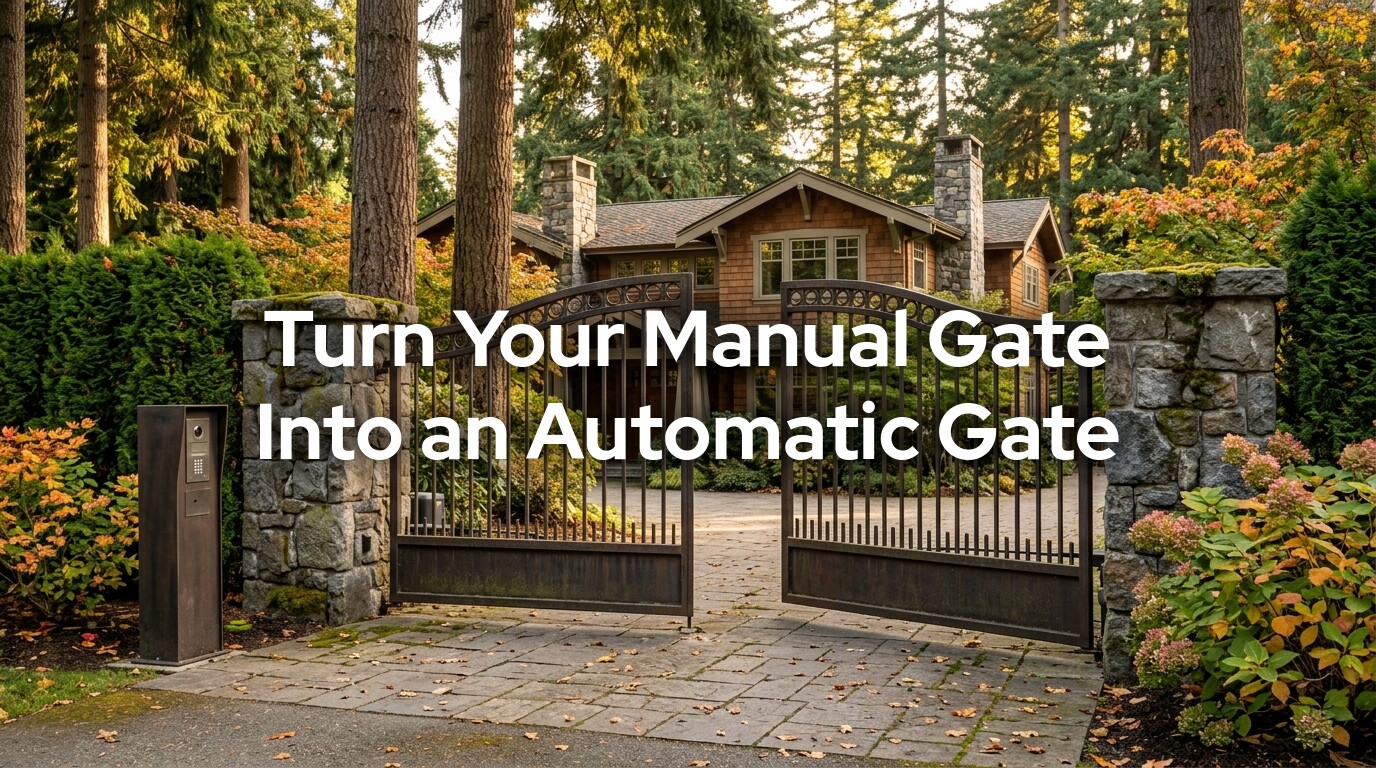
Gate Automation Retrofits let Washington property owners add an operator, safety devices, battery backup, access control, and smart entry features to a manual gate that is already on the property. When the existing gate is sound, a retrofit can preserve the gate, reduce unnecessary replacement, and turn a daily inconvenience into a practical automatic entrance.
Emerald Gate Systems evaluates and automates existing manual gates for residential properties, farms, acreage, private roads, HOAs, managed communities, commercial sites, island properties, and rural entrances across Skagit, Whatcom, and Snohomish counties, Whidbey Island, Camano Island, the San Juan Islands, and the greater Puget Sound region.
The company is family-owned, licensed and insured, headquartered in Sedro-Woolley, and backed by more than 15 years in the trade. Emerald Gate Systems handles design, CAD planning, welding, installation, automation, access control, repair, and service through one accountable Washington team. That matters because a retrofit is not only an operator installation. The gate structure, posts, hinges, rollers, safety devices, power, manual release, access controls, drainage, and long-term maintenance must work together.
The strongest retrofit conversations begin with honesty. Some manual gates are excellent candidates for automation. Others should be repaired first. Some should be replaced because automation would add force and complexity to a structure that is already failing. A motor does not fix a gate that drags, twists, sags, binds, or moves on unstable posts.
This page is the service-level home for gate automation retrofits in Washington. The Everett retrofit angle should support the Everett location page. General automatic gate installation should remain on the dedicated installation page. This retrofit page should convert owners who already have a manual gate and want to know whether it can become automatic.
What Are Gate Automation Retrofits?
Gate Automation Retrofits are projects that add powered operation, safety devices, access controls, power, backup operation, and user controls to an existing manual gate. Instead of removing the gate and starting over, the installer evaluates whether the current structure can support reliable automatic movement.
A retrofit may include:
- Swing gate operator installation
- Sliding gate operator installation
- Cantilever gate operator installation
- Operator brackets and reinforced attachment points
- Photo eyes and sensing edges
- Manual release setup
- Battery backup
- Utility power or solar power planning
- Keypads
- Remotes
- Smartphone access
- Video intercoms
- Telephone entry
- Vehicle loops or exit devices
- Cameras where appropriate
- Gate repair or alignment work before automation
- Documentation and owner training
A retrofit is not the same as attaching a motor to a fence panel. The gate must be able to move through its full travel with reasonable resistance. The supports must remain stable. The frame must accept operator force. The gate construction must be suitable for automation. The site must allow required safety devices and access controls to be placed correctly.
When those conditions exist, retrofitting can be a smart path. It preserves a gate the owner already likes, avoids unnecessary fabrication, and can often cost less than building a complete new automatic system. When those conditions do not exist, retrofit work can become a cycle of repairs.
The purpose of a retrofit evaluation is to answer one question clearly: is this gate worth automating?
Can Your Existing Manual Gate Be Automated?
Your existing manual gate can often be automated if it is structurally sound, remains aligned, has stable posts or support structures, moves freely by hand, and can accept required safety upgrades. A gate that drags, sags, twists, binds, has weak hardware, or has unsafe openings may need repair or replacement before automation.
A good candidate usually has:
- A straight and stable gate frame
- Posts, columns, rollers, or guides that do not move under load
- Hinges or rollers in good condition
- Smooth movement through the full travel path
- Enough clearance for the chosen operator
- Usable attachment points or room for reinforced brackets
- Space for photo eyes, sensing edges, and other safety devices
- Practical power access or a viable solar location
- A manual release location that can be reached safely
- Enough service access for future maintenance
A poor candidate may have:
- Posts that lean, shift, or rotate
- A swing leaf that lifts, drops, or drags through its arc
- A sliding gate that changes resistance or leaves its guides
- Exposed rollers or reachable pinch points
- Large openings that are not suitable for automated movement
- Severe corrosion or frame damage
- Loose hinges or failing rollers
- Unstable columns
- No practical operator attachment point
- No clear path for safety devices
- Power or solar conditions that do not support the desired system
Some gates fall in the middle. They may need new hinges, better rollers, bracing, guide repair, post correction, welding, finish repair, or safety-device preparation before automation becomes responsible.
Emerald Gate Systems can evaluate the existing gate and explain whether the better path is repair, retrofit, full replacement, or a phased approach.
Request a free retrofit evaluation before buying an operator for an existing manual gate.
The Five Tests Before Automating a Manual Gate
A manual gate should pass five basic tests before automation is recommended: mechanical movement, structural support, safety readiness, infrastructure readiness, and long-term value. These tests prevent the owner from spending money on an operator before the gate is ready to carry powered movement.
| Retrofit test | What it checks | Why it matters | Possible outcome |
|---|---|---|---|
| Mechanical test | How the gate moves by hand | The operator should not fight a dragging, binding, or unstable gate | Automate, repair first, or replace |
| Structural test | Posts, hinges, rollers, frame, guides, and attachment points | Powered movement adds repeated force to the structure | Reinforce, repair, redesign, or replace |
| Safety test | Entrapment zones, openings, pinch points, guards, photo-eye paths, sensing-edge locations | A manual gate may not be built for automated use | Add devices, correct hazards, or replace unsafe construction |
| Infrastructure test | Power, conduit, operator location, access devices, manual release, drainage, service access | Automation needs more than a motor | Utility power, solar, trenching, controls, and backup plan |
| Value test | Retrofit cost compared with remaining service life | A cheap operator is not a good value on a gate near failure | Retrofit, repair, replacement, or phased project |
The mechanical test comes first. A swing gate should open and close by hand without lifting, dropping, dragging, binding, or placing excessive load on hinges. A sliding gate should roll smoothly through its full travel without jumping, shifting, grinding, or changing resistance. A cantilever gate should remain level, guided, and stable.
The structural test checks whether the gate can carry operator force. Operator brackets should attach to reinforced areas, not thin decorative members. Posts and columns must stay stable. Rollers, guides, tracks, hinges, stops, and frames must tolerate repeated cycling.
The safety test is critical because manual gates were not always built with automated movement in mind. Large openings, exposed rollers, reach-through areas, sharp projections, weak guides, and uncontrolled pedestrian routes may require correction.
The infrastructure test asks whether the site can support power, controls, safety devices, access devices, backup operation, and future service. Power may come from permitted utility work or solar when site conditions support it. Access controls should be placed where drivers and pedestrians can use them safely.
The value test compares retrofit cost with expected life. A retrofit can be a strong value when the gate is sound. It is not automatically a bargain when the gate needs major reconstruction, new foundations, new hardware, safety correction, power infrastructure, and finish restoration.
When Does a Retrofit Make Sense?
A retrofit makes sense when the existing gate is worth keeping and the required automation work can be added without creating reliability, safety, or maintenance problems. The best candidates are gates with good structure, smooth movement, stable supports, enough clearance, and a practical path for power and safety devices.
Retrofit often makes sense when:
- The existing gate is attractive and the owner wants to keep it
- The frame is straight and structurally sound
- Posts, columns, hinges, rollers, and guides are stable
- The gate moves freely by hand
- The opening still fits the property’s vehicles
- The gate can accept operator brackets without awkward field improvisation
- Safety devices can be installed correctly
- Power can be supplied reasonably
- The owner wants smart access, remotes, keypad entry, or video entry
- The cost of retrofit is sensible compared with a new system
Retrofit can also be a good choice when the existing gate has sentimental, architectural, or practical value. A custom iron gate, cedar gate, farm gate, or well-built steel entrance may not need to be replaced if the structure is solid.
It can be especially useful when a property owner is tired of leaving the vehicle in rain, wind, or darkness to open a gate by hand. It can also help families, farms, private roads, and managed properties control access without rebuilding the entrance.
The key phrase is “when the existing gate is sound.” A good retrofit should respect the limits of the gate. More motor force is not a substitute for alignment, support, proper hardware, and safe movement.
A retrofit should preserve a good gate, not hide a failing one.
When Is Replacement Better Than a Retrofit?
Replacement is often better than a retrofit when the existing gate is unstable, unsafe, severely corroded, badly aligned, too narrow for current vehicles, poorly supported, difficult to guard, or near the end of its service life. Automation can make existing problems show up faster because the operator cycles the gate repeatedly.
Replacement may be the better path when:
- Posts or columns move under normal gate load
- The gate frame is bent, twisted, cracked, or severely corroded
- The opening is too narrow for trailers, deliveries, emergency vehicles, or daily use
- Hinges, rollers, guides, or tracks are failing repeatedly
- The gate has unsafe openings or exposed moving parts that cannot be corrected reasonably
- The gate is too heavy or wind-loaded for practical automation
- The site needs a different gate type, such as sliding or cantilever instead of swing
- Operator brackets cannot be attached properly
- The finish would require major restoration after structural work
- The total retrofit scope approaches the cost of a purpose-built automatic system
Replacement is not a failure of the retrofit process. It is sometimes the honest recommendation. A purpose-built automatic gate can be designed from the start for operator attachment, safety-device placement, controlled openings, wind exposure, drainage, and maintenance access.
A weak manual gate may have worked for years because a person could lift it, push it, force it, or compensate for its movement. A gate operator cannot make those same judgments. It will apply force according to its programming and the conditions it senses. That is why a poor manual gate can become an unreliable automatic gate.
The evaluation should compare total correction cost, remaining service life, safety, and future access needs. A lower upfront retrofit may not be the better value if the gate will still need replacement soon.
Review custom gate design and fabrication when a purpose-built automatic gate would provide a better long-term structure than modifying the existing gate.
How Does a Swing Gate Retrofit Work?
A swing gate retrofit adds a swing gate operator, brackets, control equipment, safety devices, power, and access controls to an existing gate leaf or pair of leaves. The gate must swing freely, remain aligned, and have stable hinge posts before an operator is installed.
A swing gate retrofit should review:
- Single leaf or double leaf configuration
- Gate length and weight
- Wind exposure
- Hinge condition
- Hinge-post stability
- Gate sag through the swing arc
- Driveway slope under the gate
- Bottom clearance
- Stop locations
- Operator arm geometry
- Bracket attachment points
- Manual release access
- Photo-eye locations
- Sensing-edge locations where needed
- Vehicle stopping position
- Pedestrian separation
The gate should not drag during any part of its arc. A gate that clears the driveway when closed but drags halfway open may not be a good retrofit candidate without hinge or grade correction.
Wind matters. Solid cedar, steel panels, privacy infill, and signage can create a large surface area. A larger motor alone does not solve wind load if the posts, hinges, brackets, and frame are not prepared for it.
Double swing gates require coordination between two leaves. Timing, overlap, stops, latching, and safety devices must be planned so one leaf does not fight the other.
Operator placement should not create a new obstacle. Arms, brackets, control boxes, and release mechanisms should be protected from vehicles, landscaping, livestock, and snow storage where relevant.
How Does a Sliding Gate Retrofit Work?
A sliding gate retrofit adds a slide gate operator, chain or rack drive, guide control, safety devices, power, and access controls to an existing sliding gate. The gate must roll smoothly through its full travel and remain stable in its track or guide system before automation is added.
A sliding gate retrofit should review:
- Gate frame condition
- Wheel and roller condition
- Track alignment
- Track support
- Guide posts and guide rollers
- End stops
- Gate travel distance
- Side runback
- Ground clearance
- Chain or rack attachment
- Debris, gravel, leaves, and fir needles
- Drainage along the travel path
- Photo-eye paths
- Sensing- edge placement
- Operator pad location
- Manual release access
The first test is manual movement. A sliding gate should move without grinding, wobbling, lifting, or leaving its guide path. If the gate requires two people to push it, an operator will struggle too.
Tracks are a common issue in Northwest Washington. Gravel, mud, ice, leaves, and fir needles can collect in the path and increase resistance. A tracked sliding gate may work on a clean paved entrance but cause repeated problems on a wooded gravel drive.
Guide systems should reduce risk without creating pinch or reach-through hazards. Exposed rollers and drawing-in zones may need guarding or redesign.
If the existing sliding gate has poor support, limited side runback, or repeated debris problems, a cantilever design may be worth comparing instead of forcing automation onto a poor track layout.
Can a Cantilever or Farm Gate Be Retrofitted?
A cantilever or farm gate can sometimes be retrofitted when the frame, support posts, rollers, guides, opening width, side runback, and movement are suitable for automation. These gates need special attention because they often serve gravel roads, equipment paths, muddy entrances, and rural properties with remote power.
A cantilever retrofit should review:
- Frame stiffness
- Counterbalance length
- Roller supports
- Post foundations
- Guide alignment
- Side runback
- Gate weight
- Drive method
- Operator mounting
- Safety-device locations
- Manual release
- Vehicle clearance
- Debris and snow conditions
A farm gate retrofit should review:
- Equipment-width opening
- Trailer turning path
- Livestock exposure
- Hinge or roller durability
- Mud and gravel
- Power distance
- Solar feasibility
- Operator protection from equipment
- Access-control device placement
- Emergency access
Cantilever gates are useful where a track across the road would be a problem. The trade-off is that the structure and support system must be strong enough to carry the gate properly. A weak cantilever support will not become reliable because an operator is added.
Farm gates need practical design. A manual farm gate that works because someone can lift it over a rut may not be ready for automation. The gate should align, clear the ground, and move predictably without human correction.
Review farm and agricultural gates when an existing farm entrance needs equipment-width clearance, livestock-aware design, solar power, or mud-season automation.
Which Gate Operators Can Be Added to an Existing Gate?
The operator that can be added to an existing gate depends on the gate type, weight, length, wind area, movement resistance, duty cycle, power source, safety devices, and expected use. The right operator is selected after the gate is evaluated, not before.
Operator selection should consider:
- Swing, slide, or cantilever configuration
- Gate weight
- Gate length
- Gate balance
- Wind exposure
- Mechanical resistance
- Daily cycle count
- Peak- use periods
- Residential, farm, HOA, or commercial use
- Battery backup
- Solar compatibility where needed
- Access-control inputs
- Safety-device compatibility
- Manual release
- Service access
- Parts availability
A motor rating should not be treated as permission to ignore poor gate movement. An underpowered operator can fail prematurely, but an oversized operator on a poor gate can stress the frame, hinges, posts, brackets, and safety system.
Residential properties may need simple dependable automation. Farms may need rugged operation and remote power. HOAs may need higher cycle capability. Commercial retrofits may need continuous- duty or high-cycle equipment, vehicle loops, badge access, and stronger maintenance planning.
Operator brackets should attach to suitable structure. Thin decorative members, loose wood boards, damaged frames, and unsupported rail sections are poor attachment points.
Emerald Gate Systems evaluates the existing gate first, then recommends the operator class, power plan, controls, safety devices, and any structural correction needed before installation.
What Safety Devices Are Required in a Retrofit?
A gate automation retrofit may require monitored photo eyes, sensing edges, guarding, warning signs, manual release, and other protection based on gate type, operator, movement, entrapment zones, property use, and applicable standards. Safety devices are not optional accessories added only when convenient.
Retrofit safety planning may include:
- Monitored photo eyes
- Sensing edges
- Physical guarding
- Roller and guide protection
- Reach-through evaluation
- Warning signs
- Vehicle detection
- Manual release
- Emergency access
- Pedestrian route separation
- Operator force and travel testing
- Battery backup testing
- Routine maintenance schedule
ASTM F2200 is relevant because it addresses automated vehicular gate construction. A manual gate may have openings, protrusions, rollers, guides, or lower clearances that were acceptable in manual use but need correction before powered operation.
UL 325 is relevant because powered gate operators must be installed with the required entrapment- protection approach for the gate type and application. A listed operator does not automatically make the complete installation safe.
Vehicle loops and exit probes can support traffic functions, but they do not automatically replace entrapment protection. Keypads, remotes, intercoms, and smartphone controls authorize movement, but they do not remove the need for safe gate construction and monitored devices.
Safety-device placement can be harder on retrofits than new installations because the existing gate and posts may not provide ideal locations. That is another reason the gate should be evaluated before equipment is purchased.
Never bypass a monitored safety device to keep a retrofit gate moving. Diagnose the fault and restore protection.
How Can Smart Access Be Added to an Existing Gate?
Smart access can be added to an existing gate with keypads, remotes, smartphone control, card readers, fobs, video intercoms, phone entry, cameras, temporary codes, and managed credentials. The correct access method depends on who uses the gate, how often permissions change, and how much administration the owner wants.
Smart access may include:
- Remotes for regular users
- Keypads for family, staff, vendors, or deliveries
- Temporary codes
- Smartphone-based entry
- Video intercoms
- Telephone entry
- Card or fob credentials
- Camera visibility
- Cloud administration where appropriate
- Event history
- Scheduled access
- Vendor access
- Delivery workflows
The simplest system that solves the problem is often the most reliable. A private driveway may need remotes, a keypad, and a video intercom. A farm may need a rugged keypad and remotes. An HOA may need individual credentials and a visitor directory. A commercial property may need badges, schedules, cameras, and event logs.
Smartphone access can be useful, but it should not be the only way into a property unless the owner has a reliable fallback. Phones lose battery. Apps update. Cellular service varies. Internet service can fail. A manual release, secondary credential, keypad, or other backup method may still be needed.
Access devices should be placed carefully. A keypad should not force drivers into the road. A video intercom should be visible, protected from rain, and positioned for the vehicle types that use the gate. A reader should not sit inside the gate’s moving path.
Review access control systems when an existing gate retrofit needs keypads, smartphone access, video intercoms, cameras, credentials, or managed user records.
Can Smartphone Access Be Added to a Manual Gate Retrofit?
Smartphone access can often be added during a manual gate retrofit when the operator, access- control equipment, power source, and communication method support it. It can let authorized users open the gate through an app, mobile credential, call-based release, cloud platform, or connected access-control system.
Smartphone access planning should review:
- Cellular service at the gate
- Wi-Fi or network reach
- Power source and standby load
- Gate user groups
- Guest access needs
- Temporary access needs
- Administrator responsibility
- Fallback access during outages
- Account security
- Subscription or platform requirements
- Owner comfort with app-based controls
Smartphone access is most useful when the owner needs flexible permission management. It can help with guests, deliveries, cleaners, caregivers, property managers, vendors, and family members who need changing access.
It is less useful if the property has poor signal, the owner wants no platform management, or the gate is remote and powered by a tightly sized solar system. Connected devices draw power and require communication.
A smartphone feature should not be added because it sounds modern. It should solve a defined problem. A basic keypad and remotes may be more dependable for some properties.
Where cloud access is used, the owner should protect administrator accounts, avoid shared passwords, and know how access is recovered if a phone, account, or property manager changes.
What Does Wi-Fi Enabled Gate Automation Add to a Retrofit?
Wi-Fi enabled gate automation means the operator, or a small bridge wired to it, joins the property network so the gate can be opened, closed and monitored from a phone anywhere. It is the feature most often asked for on retrofits in Woodinville, Mercer Island and the rest of the Eastside, and it changes little about the mechanical work: the operator still has to be sized and mounted correctly, and the safety devices still have to be in place.
What it adds is administration. Temporary codes for a contractor, a log of who opened the gate and when, alerts when the gate is left open, and the ability to let a delivery in from the office. Where the gate is out of Wi-Fi range, a cellular bridge does the same job. Choosing the right operator for this is covered in our gate operator installation guide, and the credential side in our access control page.
How Should Power Be Added for a Gate Retrofit?
Power for a gate retrofit can come from permitted utility power, battery backup, solar charging, or a combination of those options. The right method depends on distance from power, trenching conditions, traffic, operator load, accessory loads, outages, and site conditions.
Power planning should consider:
- Distance to existing electrical service
- Trenching route
- Conduit and conductor path
- Voltage drop
- Electrical permit jurisdiction
- Operator requirements
- Battery backup
- Solar exposure
- Access-control standby loads
- Camera or intercom loads
- Vehicle loop power
- Winter outage behavior
- Manual release
- Drainage and water entry
- Future service access
Utility power is often the strongest long-term option when it can be installed reasonably and permitted correctly. It supports higher traffic, heavier accessories, cameras, intercoms, lighting, and more predictable recovery after outages.
Solar can be a good option where utility power is distant or trenching is impractical. It must be sized for winter daylight, shade, gate cycles, battery capacity, and accessory loads. A solar gate with a video intercom and camera requires more careful sizing than a simple keypad gate.
Battery backup is useful, but it is not unlimited. Available cycles depend on battery age, temperature, gate resistance, traffic, and the power draw of controls and accessories.
Electrical work may require permits through Washington L&I or a city electrical program. Permit responsibility should be written into the proposal before wiring, conduit, or operator installation begins.
Review solar and off-grid gate automation when a manual gate is far from utility power or trenching is not practical.
How Does Battery Backup Work on a Retrofit Gate?
Battery backup helps a retrofit gate continue operating during some power interruptions or allows the system to support controlled operation when utility power is temporarily unavailable. Backup capacity depends on battery condition, operator load, gate resistance, temperature, traffic, and accessory power draw.
Battery backup planning should answer:
- How many cycles are expected during an outage?
- Is the gate the only vehicle entrance?
- How often do outages happen at the property?
- Does the gate serve residents, a farm, or a commercial site?
- What access controls draw power?
- Does the system include cameras or intercoms?
- Can the gate be opened manually?
- Who knows the manual release procedure?
- What happens if the battery bank is depleted?
- How often will batteries be tested?
A low-cycle private gate may use backup power very differently from a community, farm, or commercial gate. A busy gate can use stored energy quickly when many users continue entering and exiting during an outage.
Batteries are consumable. They age, lose capacity, and need testing under load. A battery can show voltage at rest and still fail when the operator starts moving the gate.
Backup planning should include manual release. Owners should know how to place the gate in a safe temporary condition if power is lost, the operator fails, or the battery is depleted.
Battery backup should also be protected from moisture, corrosion, rodents, poor ventilation, and difficult service access.
Can Solar Be Added During a Retrofit?
Solar can be added during a gate retrofit when the site has enough winter sun, the gate cycles are manageable, the batteries are sized honestly, and the access-control loads fit the energy budget. Solar is strongest when utility power is far away and trenching is difficult.
A solar retrofit should review:
- Winter sun path
- Tree shade
- Panel location
- Panel mounting
- Battery size
- Charge controller
- Operator load
- Gate resistance
- Daily cycles
- Keypad, intercom, camera, and communication loads
- Manual release
- Maintenance access
- Vegetation growth
A manual gate may be a good solar retrofit candidate if it is remote, low to moderate use, mechanically sound, and located where a panel can receive useful winter exposure.
Solar is a weak choice when the gate is shaded, used frequently, loaded with cameras and intercoms, or expected to operate heavily during long dark winter periods without enough battery capacity.
The design should be based on January conditions, not summer optimism. A panel that performs well in July may be shaded during the season when the battery needs the most charging help.
Solar also increases maintenance responsibility. Panels need exposure. Batteries need testing. Vegetation should be managed. Accessory loads should not be added later without reviewing the energy budget.
How Do Washington Conditions Affect a Gate Retrofit?
Washington conditions affect gate retrofits through rain, wet soil, drainage, wind, coastal salt, fir needles, leaf litter, gravel, snow, ice, slopes, long power runs, outages, and limited winter sun. These conditions influence whether an existing manual gate can be automated reliably.
Retrofit planning should review:
- Standing water near posts or tracks
- Wet soil and post movement
- Gravel shifting under sliding gates
- Fir needles and leaves in travel paths
- Wind load on solid gates
- Corrosion at hinges and lower rails
- Coastal salt exposure
- Snow storage
- Ice around gate travel
- Power route and conduit drainage
- Battery performance in cold weather
- Solar exposure in winter
- Manual release access during storms
Rain and drainage are frequent retrofit issues. A manual gate may tolerate some water because a person can push harder, lift slightly, or clear debris. An automatic operator needs predictable movement.
Wet soil can move posts and foundations. Repeated operator adjustment is not a lasting solution when the support structure continues to shift.
Wind matters on solid gates. A retrofit should evaluate frame stiffness, hinge support, post stability, operator attachment, and whether the existing design is too wind-loaded for practical automation.
Coastal properties need corrosion planning. Anacortes, Whidbey, Camano, Everett waterfront areas, and the San Juan Islands can expose hardware, fasteners, lower rails, and electrical components to salt air.
Wooded entrances need debris planning. Sliding tracks, photo eyes, control boxes, low hardware, and drainage areas can collect needles, leaves, moss, and small branches.
Washington weather should be treated as part of the retrofit scope, not as a maintenance surprise after installation.
Gate Automation Retrofit in Everett
Everett properties can include residential driveways, apartment entrances, small commercial yards, mixed-use buildings, managed properties, warehouse gates, and older manual gates that owners want to automate.
Everett retrofit projects may involve:
- Existing manual driveway gates
- Apartment or condo pedestrian and vehicle entries
- Commercial yard gates
- Older swing gates
- Sliding gates near tight urban driveways
- Gate operator replacement or first-time automation
- Access-control upgrades
- Video intercoms
- Keypads and mobile access
- Limited space for controls
- Traffic and delivery movement
- Electrical permit review
- Safety-device upgrades
Everett sites may have different retrofit constraints than rural properties. Space can be tighter. Delivery vehicles may use the same entrance as residents. Commercial yards may need higher duty equipment. Apartment properties may need managed credentials. Older manual gates may need correction before automation.
The Everett city page should include a local retrofit section that links back to this page. This page should remain the technical authority explaining when an existing gate can be automated, how safety upgrades work, and when replacement is the better answer.
For Everett projects, the evaluation should include the current gate type, vehicle traffic, access users, power route, safety zones, and whether the gate serves residential, commercial, apartment, or managed-property traffic.
For an Everett retrofit evaluation, call (360) 657-9975 and describe the existing gate, how it moves by hand, who uses it, and what access features you want added.
How Do Retrofits Differ for Homes, Farms, HOAs, and Commercial Sites?
Retrofits differ by property type because the same operator and access-control features do not serve every user group. A home, farm, HOA, apartment, and commercial property may all start with a manual gate, but the traffic, safety, power, and administration needs are different.
| Property type | Retrofit priority | Common features | Main caution |
|---|---|---|---|
| Private residence | Convenience, privacy, guest entry, outage access | Operator, remotes, keypad, video intercom, battery backup | Do not automate a sagging or wind-loaded gate without correction |
| Farm or acreage | Equipment access, mud, livestock, remote power | Heavy-duty operator, solar, keypad, remotes, manual release | Equipment, livestock, and mud can damage low components |
| HOA or apartment | Resident access, visitor entry, cycle count, administration | High-cycle operator, credentials, directory, loops, cameras | One shared code and no maintenance plan create long-term problems |
| Commercial site | Traffic, security, deliveries, downtime control | Continuous-duty operator, vehicle loops, badge access, cameras | Residential-duty equipment may not fit commercial traffic |
| Island property | Remote service, salt air, solar, ferry- aware planning | Coastal hardware, battery backup, clear documentation, solar where suitable | Service access and material staging matter more |
A private residential retrofit often focuses on convenience. The owner may want to stay in the vehicle during rain, open the gate for visitors, and keep a practical manual release for outages.
A farm retrofit must consider wide equipment, livestock, mud, gravel, remote power, and operator protection from equipment impacts.
An HOA or apartment retrofit should include traffic and user administration. The gate may need more than an operator. It may need resident credentials, visitor entry, vendor schedules, move-in and move-out procedures, and maintenance planning.
A commercial retrofit should consider downtime, delivery lanes, badge access, vehicle loops, and equipment duty. A gate that worked manually for years may not be prepared for daily high-cycle powered use.
The right retrofit begins with the property type and user workflow, not the assumption that every gate needs the same motor package.
What Happens During a Retrofit Evaluation?
A retrofit evaluation examines the existing manual gate, support structure, movement, safety readiness, power options, access-control needs, emergency access, site conditions, and long-term value. The goal is to determine whether automation is practical and what must be corrected before installation.
- Identify the gate purpose. Residential, farm, HOA, apartment, commercial, private road, island, or mixed-use access.
- Inspect the gate structure. Review frame, welds, rails, infill, corrosion, twist, sag, and damage.
- Check support stability. Review posts, columns, foundations, hinges, rollers, guides, tracks, stops, and latches.
- Move the gate manually. Confirm whether it swings or rolls freely through the full travel path.
- Review operator attachment. Identify where brackets, arms, chain, rack, or drive hardware could attach safely.
- Evaluate safety readiness. Review openings, pinch points, photo-eye paths, sensing-edge locations, guards, and pedestrian routes.
- Plan power. Compare utility power, trenching, solar, battery backup, and manual release.
- Plan access control. Discuss remotes, keypad, smartphone access, video intercom, phone entry, cameras, credentials, and temporary access.
- Review emergency access. Identify fire access, manual release, outage behavior, and who needs access during failures.
- Check site conditions. Look at drainage, grade, gravel, wind, trees, snow storage, coastal exposure, and service access.
- Discuss permits. Identify electrical jurisdiction, HOA approval, fire access, right-of- way, and any other likely approvals.
- Compare value. Determine whether repair, retrofit, replacement, or phased work is the best recommendation.
The evaluation may produce a simple answer. The gate may be solid, easy to move, and ready for an operator, safety devices, and access controls.
It may also produce a more layered answer. The gate may be worth keeping but need hinge repair, post stabilization, bracket reinforcement, safety-device preparation, or power work first.
It may also recommend replacement. That is sometimes the most honest outcome when the existing gate cannot support reliable automation.
How Is an Existing Gate Automated?
An existing gate is automated by first correcting gate movement and structure, then installing the operator, safety devices, power, controls, access devices, manual release, programming, testing, and owner training. The installation should not begin until the gate has been confirmed as a suitable automation candidate.
- Confirm retrofit scope. Decide which repairs, reinforcements, power work, controls, and safety devices are included.
- Repair mechanical issues. Correct hinges, rollers, guides, track, stops, latches, alignment, or frame problems as needed.
- Prepare operator attachment. Add reinforced brackets, pads, mounts, rack, chain, or other drive points.
- Install power infrastructure. Add utility power, conduit, battery backup, or solar equipment according to the approved plan.
- Install the operator. Mount the swing, slide, or cantilever operator to match the gate movement.
- Install safety devices. Add monitored photo eyes, sensing edges, guards, warning signs, and other required protection.
- Install access controls. Add remotes, keypad, smartphone access, intercom, camera, credentials, or vehicle detection where included.
- Program movement. Set limits, force settings, timing, obstruction response, and access-control sequence.
- Test the full system. Test open, close, safety devices, manual release, backup power, and access devices.
- Train the owner. Explain normal use, manual release, safety devices, battery backup, smart access, and maintenance signs.
- Document the system. Record equipment, settings, access devices, battery type, permits, manuals, and maintenance recommendations.
Testing should be more than one open-close cycle. The system should be checked through repeated movement, access-control operation, safety-device activation, manual release, and expected outage behavior.
Owner training is important. A newly automated gate changes how people use the entrance. Everyone responsible for the property should know how to open the gate manually, when to call for service, and how to avoid forcing the operator through a problem.
A clean retrofit handoff includes operation, safety, manual release, battery backup, access- control management, and maintenance guidance.
Which Permits and Approvals May Apply?
Gate automation retrofits may require electrical permits, fire access review, HOA approval, private- road approval, right-of-way review, driveway review, accessibility review, or local jurisdiction approval depending on the property and scope. Requirements depend on the project address, equipment, wiring, and use.
Electrical work may require permitting through Washington Labor and Industries or through a city that operates its own electrical program.
Permits or approvals may be relevant when the retrofit includes:
- New gate operator power
- Solar charging equipment
- Battery systems
- Control wiring
- Keypads or card readers
- Intercoms or cameras
- Vehicle loops
- Conduit or trenching
- Gate columns or foundations
- Fire access equipment
- Changes to a shared entrance
- Public-facing or multi-family pedestrian access
Fire access should be reviewed before the gate is automated, especially when it controls the only route to a home, barn, business, apartment community, private road, or facility. The local authority may review gate width, setback, approach, emergency entry method, manual release, and outage behavior.
HOAs and managed communities may have their own approval process. A gate owner may need board approval before adding automation, cameras, access control, solar panels, or changes to the gate appearance.
Right-of-way and driveway questions may arise when the gate is close to a public road, creates vehicle stacking issues, or changes how vehicles stop at the entrance.
Confirm permits and approvals before trenching, wiring, setting operator pads, adding access pedestals, or changing the gate structure.
Which Standards Apply to Retrofit Automation?
Retrofit automation may involve ASTM F2200 for automated vehicular gate construction, UL 325 for powered gate operator systems and entrapment protection, and UL 294 for access-control system units. These standards are important because a manual gate becomes a powered moving system after the retrofit.
ASTM F2200-24 addresses gate construction for automated vehicular gates. A manual gate may need construction changes before it is suitable for automation.
UL 325 external entrapment protection guidance is relevant to gate operators and monitored entrapment-protection devices. A retrofit should not rely on an operator alone.
UL 294 is relevant when access-control equipment regulates entry or exit through the gate system.
A listed operator does not automatically make the existing gate suitable. Gate construction, supports, gaps, rollers, guards, attachment points, safety devices, power, access controls, and maintenance all matter.
Retrofit work should be especially careful because older manual gates may have design features that were never intended for powered operation. The owner may have used the gate safely by hand for years, but automation changes how the gate moves and who controls that movement.
Standards do not remove the need for local review. The authority having jurisdiction may have additional requirements for electrical work, fire access, right-of-way placement, ADA routes, or commercial property use.
What Does a Gate Automation Retrofit Cost?
Gate automation retrofit cost depends on the gate condition, operator type, safety devices, power source, access controls, battery backup, solar equipment, repair work, permits, trenching, conduit, brackets, welding, drainage, site conditions, and whether the existing gate is truly worth keeping. Emerald Gate Systems does not publish one universal retrofit price because every existing gate starts in a different condition.
Cost drivers include:
- Swing, slide, or cantilever configuration
- Gate weight and length
- Mechanical condition
- Post, hinge, roller, track, or guide repair
- Operator duty level
- Operator brackets or reinforced attachment points
- Monitored photo eyes
- Sensing edges
- Vehicle loops or exit devices
- Battery backup
- Utility power, conduit, or trenching
- Solar panels and batteries where applicable
- Keypad, remotes, smartphone access, intercom, or cameras
- Electrical permits
- Fire access equipment
- HOA or property approval requirements
- Travel, ferry, or site access
- Maintenance plan
A retrofit can cost less than a complete new automatic gate when the existing gate is solid and needs only the correct automation package. Cost rises quickly when the gate needs new posts, welding, new hinges, new rollers, alignment correction, safety reconstruction, finish repair, power infrastructure, and access-control upgrades.
Honest pricing means separating the operator from the supporting work. A low operator price may not include safety devices, power, conduit, battery backup, access controls, structural repair, permits, or testing.
A good proposal should compare retrofit cost against remaining service life. Spending heavily on a gate that will need replacement soon may not be wise.
Request an itemized retrofit proposal that separates gate repair, operator, safety devices, power, smart access, permits, and maintenance assumptions.
How Long Does a Gate Retrofit Take?
Gate retrofit timing depends on the existing gate condition, required repairs, operator selection, safety devices, power, permits, trenching, solar equipment, access controls, weather, parts availability, and site readiness. A clean retrofit on a sound gate can move faster than a project requiring structural correction or power infrastructure.
A retrofit may include:
- Initial gate evaluation
- Repair versus replacement review
- Operator and control selection
- Permit and power review
- Gate repair or reinforcement
- Operator pad or mounting preparation
- Conduit or solar installation
- Battery backup setup
- Safety-device installation
- Access-control installation
- Programming
- Testing
- Owner training
- Documentation
Owners can reduce delays by sharing photos, gate measurements, known brand information, property address, power location, access needs, and whether the gate currently moves freely.
Weather can affect concrete, trenching, mud, drainage, and gate alignment work. Island projects may require ferry-aware staging. HOA and commercial projects may need scheduling that keeps the entrance usable.
Permits and approvals can affect timing. Electrical jurisdiction, fire access, HOA design review, private-road approval, and right-of-way questions should be identified early.
What Maintenance Does a Retrofit Gate Need?
A retrofit gate needs maintenance for the original gate structure and the new automation system. Hinges, rollers, guides, tracks, posts, brackets, operators, batteries, safety devices, access controls, wiring, and manual release should be inspected because the gate now moves under powered force.
Maintenance may include:
- Checking gate alignment
- Inspecting hinges, rollers, wheels, tracks, guides, and stops
- Checking operator brackets and fasteners
- Testing operator travel and limits
- Testing photo eyes
- Testing sensing edges
- Testing vehicle loops or exit devices
- Testing remotes, keypads, smartphone access, and intercoms
- Checking battery backup
- Inspecting wiring and conduit
- Checking drainage and debris
- Cleaning sliding tracks where present
- Inspecting corrosion and finish damage
- Testing manual release
- Reviewing access codes and credentials
Retrofit gates deserve extra attention during the first season because powered movement can reveal weaknesses that manual operation hid. A hinge that seemed acceptable may loosen under repeated cycles. A sliding track may collect debris faster than expected. A photo eye may need a better mounting position.
Many residential automatic gates benefit from professional service every six to twelve months. High-cycle HOA, commercial, farm, coastal, or debris-heavy gates may need more frequent inspection. The final interval should be based on use, exposure, equipment, and downtime risk.
Review gate repair and maintenance when a retrofit gate changes speed, sound, alignment, battery behavior, or safety-device reliability.
Repair, Retrofit, or Replace?
Choose repair when the gate is generally sound and has an isolated fault. Choose retrofit when a stable manual gate can accept an operator and required safety upgrades. Choose replacement when the existing gate, posts, hardware, wiring, or construction would require major correction before automation could be reliable.
| Current condition | Best starting request | What Emerald Gate Systems evaluates | Main limitation |
|---|---|---|---|
| No gate exists | New automatic gate installation | Opening, configuration, foundations, materials, operator, safety, access, and power | Accurate pricing requires a site evaluation |
| Manual gate is structurally sound | Automation retrofit | Movement, posts, hinges, rollers, operator attachment, safety upgrades, and power | Not every manual gate is appropriate for automation |
| Gate is slow, noisy, or intermittent | Repair and maintenance | Mechanical resistance, operator, batteries, sensors, controls, wiring, and alignment | Obsolete or unsafe systems may not be economical to restore |
| Gate is severely corroded or unstable | Replacement evaluation | Posts, foundations, frame, hardware, safety construction, and remaining service life | Partial repair may preserve a system that still cannot be relied upon |
| Users are difficult to manage | Access-control consultation | Credentials, video entry, schedules, user records, cameras, and administrator roles | More technology creates more administration |
| Utility power is distant | Solar and power evaluation | Winter sun, shade, cycles, battery capacity, accessory loads, and trenching alternatives | Solar is not suitable for every shaded Washington property |
Owners often ask for automation when the first need is repair. A gate that is hard to open by hand may feel like a perfect candidate for an operator, but that resistance is exactly what can damage the new equipment.
Other owners ask for replacement when a retrofit would work well. A stable, attractive, well-built manual gate may only need the right operator, power, safety devices, and access controls.
The correct path comes from inspection, not assumption.
What Common Retrofit Mistakes Should Be Avoided?
Common retrofit mistakes include buying an operator before evaluating the gate, using motor force to hide mechanical problems, skipping safety-device planning, ignoring power requirements, placing keypads poorly, underestimating wind, overlooking permits, and failing to plan maintenance.
Mistake 1: Buying the operator first
The operator should be selected after the gate is evaluated. Gate type, weight, length, wind area, movement resistance, power source, cycle count, and safety-device needs all affect the correct choice.
Mistake 2: Automating a dragging gate
A gate that drags by hand will not become dependable because a motor is added. The cause of the resistance should be corrected before automation.
Mistake 3: Ignoring structural support
Posts, columns, hinges, rollers, guides, and tracks must handle repeated powered movement. A weak support system can make a new operator look like the problem.
Mistake 4: Skipping safety upgrades
A manual gate may have openings, pinch points, exposed rollers, and reach-through hazards that need correction before automatic operation.
Mistake 5: Placing access devices where drivers cannot use them
Keypads, intercoms, and readers should be placed around vehicle stopping positions, road safety, trailers, pedestrians, and service access.
Mistake 6: Forgetting backup operation
Battery backup, manual release, and emergency access should be explained before the first outage, not after the gate fails closed.
Mistake 7: Assuming solar works anywhere
Solar can be useful, but it must be sized around winter sun, shade, battery capacity, cycles, and accessory loads.
Mistake 8: Treating retrofit as always cheaper
Retrofit can be less expensive when the gate is sound. It can become poor value when extensive structure, safety, power, and finish work is required.
Why Choose Emerald Gate Systems for Gate Automation Retrofits?
Emerald Gate Systems evaluates gate automation retrofits through one accountable Washington team that understands fabrication, automation, access control, repair, safety devices, solar power, and long-term service. The company is based in Sedro-Woolley and serves Northwest Washington and greater Puget Sound from within the region.
The team can inspect the existing gate, diagnose mechanical issues, fabricate or reinforce attachment points, install operators, add monitored safety devices, plan power, add smart access, integrate keypads or video intercoms, and maintain the system after installation.
That matters because retrofit work sits between installation and repair. The project may need welding, new hardware, gate alignment, electrical planning, access controls, and safety upgrades. Treating those as separate pieces can create gaps.
Emerald Gate Systems does not claim every manual gate should be automated. Some existing gates are excellent candidates. Some need repair first. Some should be replaced. The evaluation is designed to tell the owner which path makes sense.
The company also services all brands and gates installed by other contractors. That repair experience helps identify whether the existing gate is worth automating or whether the owner would be spending money on a system with limited remaining life.
The best retrofit is not just a working motor. It is a gate that moves correctly, stops correctly, opens for the right people, releases when needed, remains serviceable, and has a clear maintenance plan.
Call Emerald Gate Systems at (360) 657-9975 or request a free gate automation retrofit evaluation to find out whether your existing manual gate can become automatic.
If you are weighing retrofit against a full replacement, our guide to repairing versus replacing an automatic gate lays out the cost comparison, and if the gate is entirely new, automatic gate installation in Washington State covers planning the system from the property up.
Retrofit work by town: gate automation in Mountlake Terrace. Each guide covers the terrain, gate types and access needs we see there.
Frequently Asked Questions About Gate Automation Retrofits
Can my existing manual gate be automated?
Yes, many existing manual gates can be automated when the gate is structurally sound, properly supported, aligned, and easy to move by hand. The gate must also be suitable for operator attachment and required safety upgrades.
A gate that drags, sags, twists, binds, or has unstable posts may need repair or replacement before automation is installed.
What is a gate automation retrofit?
A gate automation retrofit adds an operator, safety devices, power, backup operation, and access controls to an existing manual gate. The goal is to preserve a good gate while adding automatic movement, smart access, and safer operation.
The existing gate must be evaluated first because not every manual gate is suitable for powered operation.
Is it cheaper to automate an existing gate than replace it?
Automating an existing gate can cost less than replacing it when the gate is straight, stable, properly supported, and ready for safety upgrades. It is not automatically cheaper when the gate needs new posts, hinges, rollers, welding, alignment, safety reconstruction, power work, and finish repair.
The evaluation should compare retrofit cost with remaining service life and replacement value.
What makes a manual gate a good retrofit candidate?
A good retrofit candidate moves freely, stays aligned, has stable supports, has strong attachment points, and can receive safety devices and access controls without major reconstruction. It should not require the operator to overcome dragging, binding, sagging, or unstable movement.
The gate should also still fit the vehicles and users who rely on the entrance.
What makes a manual gate a poor retrofit candidate?
A poor retrofit candidate may have moving posts, severe corrosion, bent framing, bad hinges, damaged rollers, poor track support, large unsafe openings, exposed moving parts, weak attachment points, or no practical power and safety- device plan.
Replacement may be more reliable than trying to automate a gate that is near the end of its service life.
Can a swing gate be retrofitted with an operator?
Yes. A swing gate can often be retrofitted when the gate leaf moves freely, the hinge post is stable, the gate does not drag through its arc, and the frame can accept proper operator brackets. Wind exposure, slope, bottom clearance, and safety-device placement must be reviewed.
Double swing gates require coordinated leaf timing and correct stops.
Can a sliding gate be retrofitted with an operator?
Yes. A sliding gate can be retrofitted when the gate rolls smoothly, remains guided, has enough side runback, and has a track or cantilever support system that stays clean and stable. Gravel, mud, leaves, ice, and fir needles can affect sliding gate reliability.
The gate should be moved by hand through its full travel before operator selection.
Can a farm gate be automated?
Yes, some farm gates can be automated when the opening, gate structure, posts, equipment movement, livestock exposure, power, and safety devices support it. Farm retrofits must account for mud, gravel, trailers, machinery, animals, and remote power.
Solar may be practical for some remote farm gates when winter exposure and battery sizing are adequate.
Can an HOA gate be retrofitted?
Yes. An HOA gate can be retrofitted when the gate structure and layout support automation or upgrades. The review should include resident traffic, visitor entry, credential management, vehicle loops, cameras, emergency access, and maintenance planning.
Community gates often need higher duty equipment and stronger administration than private driveway gates.
Can a commercial manual gate be automated?
Yes, a commercial manual gate can sometimes be automated when the structure, opening, support system, duty cycle, vehicle movement, safety devices, power, and access-control requirements support it. Commercial retrofits should be planned around downtime, traffic, deliveries, employees, and service access.
Residential-duty equipment may not fit a high-cycle commercial entrance.
Can smartphone access be added to an existing gate?
Yes. Smartphone access can be added when the operator, access-control equipment, communication method, power supply, and user workflow support it. It may use an app, mobile credential, cloud platform, phone entry, or connected access-control system.
A practical backup method should still be planned because phones, apps, cellular service, and internet connections can fail.
Can a video intercom be added during a retrofit?
Yes. A video intercom can be added during a retrofit when power, communication, camera angle, lighting, driver position, and gate release wiring are planned correctly. Video entry is useful for long driveways, private roads, managed properties, and entrances that are not visible from the building.
Video intercoms add power and communication requirements, especially on solar systems.
Can a keypad be added to a manual gate retrofit?
Yes. A keypad is one of the most common access-control additions during a retrofit. It can support family, guests, vendors, deliveries, workers, or temporary access. The keypad should be placed where drivers can reach it safely without blocking the road or interfering with gate movement.
Temporary or separate codes are usually better than one permanent code shared with every user.
Can solar power be used for a gate retrofit?
Yes. Solar can be used for a gate retrofit when the site has dependable winter sun, manageable gate cycles, properly sized batteries, and accessory loads that fit the energy budget. Solar is useful where utility power is distant or trenching is impractical.
Dense shade, frequent traffic, cameras, intercoms, and weak batteries can make solar unreliable.
Does a retrofit gate need safety sensors?
Yes, an automated retrofit gate may need monitored photo eyes, sensing edges, guards, warning signs, manual release, and other protections based on gate type, operator, movement, exposure, and applicable standards. Safety devices should be planned as part of the retrofit, not added casually afterward.
Vehicle loops and keypads do not automatically replace entrapment protection.
What are UL 325 and ASTM F2200?
UL 325 addresses powered gate operator systems and entrapment protection. ASTM F2200 addresses automated vehicular gate construction. They matter in retrofit projects because a manual gate becomes an automated vehicular gate once an operator is added.
A listed operator does not make an unstable or poorly constructed gate safe automatically.
Do gate automation retrofits need electrical permits?
Gate automation retrofits may require electrical permits when operators, power, control wiring, solar equipment, batteries, intercoms, cameras, or access devices are installed. Washington L&I handles many electrical permits, while some cities operate their own electrical programs.
Permit responsibility should be confirmed before wiring, trenching, conduit, or operator installation begins.
How do emergency responders open a retrofit gate?
Emergency responder access depends on the property and local authority. It may involve a manual release, approved key switch, lock box, receiver, credential, or another accepted method. Gate width, setback, approach, and outage behavior may also matter.
Do not assume a device accepted in one fire district will be accepted at another property.
What happens when a retrofit gate loses power?
A retrofit gate may use battery backup, solar charging, manual release, or programmed outage behavior depending on the system. Backup capacity is limited by battery condition, temperature, gate resistance, traffic, and accessory loads such as intercoms, cameras, radios, and control boards.
Owners should know the manual release procedure before the first outage.
How long does a gate automation retrofit take?
Retrofit timing depends on gate condition, repairs, operator availability, safety devices, power, permits, access controls, weather, and site readiness. A sound gate with nearby power can move faster than a gate needing structural correction, trenching, solar, or access-control integration.
The written proposal should separate evaluation, repairs, equipment, power, installation, testing, and training.
How much does a gate automation retrofit cost?
Retrofit cost depends on gate type, gate condition, operator, safety devices, power, battery backup, solar equipment, access controls, permits, repairs, trenching, brackets, and site conditions. Emerald Gate Systems does not publish one universal retrofit price because every existing gate begins in a different condition.
An itemized proposal is the best way to compare retrofit and replacement.
Can Emerald Gate Systems automate a gate installed by another company?
Yes. Emerald Gate Systems can evaluate and automate existing manual gates and service gates installed by other contractors. The team inspects the gate structure, supports, movement, safety readiness, power, and access-control needs before recommending retrofit, repair, or replacement.
Some gates installed by others may need correction before automation is responsible.
Should I repair my gate before adding automation?
Yes, when the gate has mechanical or structural problems. Hinges, rollers, posts, guides, tracks, alignment, corrosion, and movement resistance should be corrected before an operator is installed. Automation should not be used to force a damaged gate to work.
Repair first can protect the operator and improve the life of the full system.
Can a retrofit gate be used by pedestrians?
Pedestrians should generally use a separate pedestrian gate or door rather than walking through an automated vehicular gate. A dedicated pedestrian route can be planned with suitable hardware, access controls, closing behavior, and separation from the moving vehicle gate.
Multi-family, commercial, and public-facing properties should review accessible routes where applicable.
How often should a retrofit gate be maintained?
A retrofit gate should be inspected regularly because the original structure now carries powered movement. Many residential systems benefit from professional service every six to twelve months. HOA, commercial, farm, coastal, or debris- heavy systems may need more frequent maintenance.
Call sooner when the gate changes speed, sound, alignment, battery behavior, or safety-device response.
Where does Emerald Gate Systems provide gate automation retrofits?
Emerald Gate Systems provides gate automation retrofits across Skagit, Whatcom, and Snohomish counties, Whidbey Island, Camano Island, the San Juan Islands, and the greater Puget Sound region. The company is headquartered in Sedro-Woolley and serves residential, farm, HOA, apartment, commercial, rural, and island properties.
Scheduling depends on property location, scope, travel, ferry requirements, and long-term serviceability.
How do I start a gate automation retrofit project?
Start by calling Emerald Gate Systems at (360) 657-9975 or using the contact form to request a free retrofit evaluation. Share the property address, gate type, how the gate moves by hand, known problems, power availability, desired access features, and whether the gate serves a home, farm, HOA, apartment, or commercial property.
You do not need to choose the operator first. The existing gate should guide the recommendation.
Does Washington State require a licensed electrical contractor to add an operator to an existing gate?
Yes. In Washington State, adding an automatic operator to any gate requires an active electrical contractor license with a Doors & Gates specialty (Specialty 10) under RCW 19.28. Emerald Gate Systems holds electrical contractor license EMERAGS747KE with that specialty, issued by Washington L&I. Unlicensed gate automation work creates liability and may not pass inspection, which matters especially when the gate serves a fire apparatus access road or an HOA entrance.
Can a gate on a sloped driveway be retrofitted with an automatic operator?
A slope does not by itself prevent automation, but it changes the operator selection and the gate type. Swing gates on steep slopes often require articulating arms or a different pivot point to avoid dragging the ground on open or close. Sliding gates on slopes need extra counter-tension hardware or a flat run section. The driveway gate on a slope guide covers the structural choices in detail. Emerald Gate Systems evaluates grades and surface conditions as part of every retrofit consultation.
Can individual access codes or credentials be added for each tenant, employee, or delivery service during a retrofit?
Yes. A retrofit project can include a multi-user keypad, RFID reader, telephone entry system, or mobile-credential controller that supports individual codes or fobs for each tenant, staff member, or authorized vendor. Most modern access control systems allow codes to be added or removed remotely and can log entry events. This is a common requirement for apartments, multi-tenant commercial properties, and HOA gates that were previously manual.
Start With the Gate You Already Have
Automating an existing gate can be one of the most practical upgrades a Washington property owner makes, but only when the gate is ready for it. A good manual gate can often become automatic with the right operator, safety devices, power, backup operation, and access controls.
A weak manual gate should not be pushed into automation before its problems are corrected. Dragging leaves, unstable posts, damaged rollers, poor hinges, unsafe openings, missing guards, corrosion, and poor attachment points do not disappear when a motor is installed.
Emerald Gate Systems evaluates the complete entrance before recommending a retrofit. The review includes movement, structure, safety, power, access control, drainage, weather, emergency access, and long-term maintenance.
The result may be a straightforward retrofit. It may be repair first. It may be replacement. It may be a phased plan that preserves the existing gate while correcting the parts that matter.
The right choice is the one that gives the property a gate that opens reliably, closes safely, grants access to the right users, can be released during outages, and can be maintained for years.
Call Emerald Gate Systems at (360) 657-9975 or schedule a free gate automation retrofit evaluation to find out whether your existing manual gate can become an automatic gate.