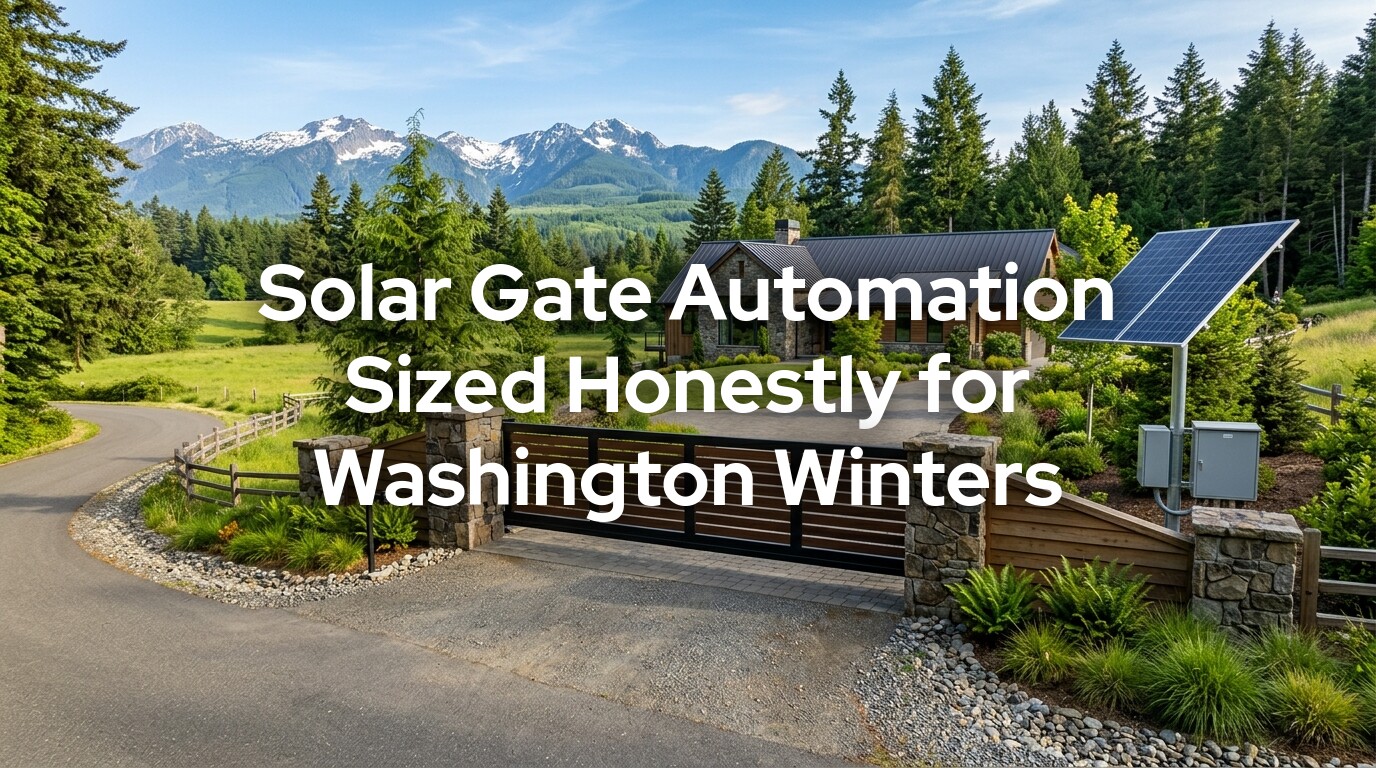
Solar Gate Openers in Washington should be sized from the property’s weakest winter conditions, not from a sunny July afternoon. In Western Washington, short winter days, cloud cover, fir shade, wet weather, battery aging, gate resistance, daily cycles, cameras, intercoms, radios, and standby electronics all affect whether an off-grid gate remains dependable.
Emerald Gate Systems installs solar and off-grid gate automation for suitable rural, farm, residential, island, acreage, commercial, and managed properties across Skagit, Whatcom, and Snohomish counties, Whidbey Island, Camano Island, the San Juan Islands, and the greater Puget Sound region.
The company is family-owned, licensed and insured, headquartered in Sedro-Woolley, and backed by more than 15 years in the trade. Emerald Gate Systems designs, fabricates, installs, automates, controls, and services gate systems through one accountable Washington team. That matters because solar gate automation is not just a panel and an opener. It is a complete power system attached to a moving gate, access controls, safety devices, batteries, wiring, and a property-specific outage plan.
Solar can be a smart solution where utility power is far from the gate, trenching would disturb a long driveway, rock, roots, pasture, wetlands, finished landscaping, island logistics, or steep terrain, or where a property owner wants the gate to remain less dependent on the grid. But solar is not automatically cheaper, simpler, or more reliable on every property.
The honest answer is this: solar works when the energy budget works. The panel must receive enough useful light during the lowest production season. The batteries must store enough energy for the expected traffic and outages. The gate must move freely enough that the operator is not wasting power. Accessory loads must be included from the beginning.
What Are Solar Gate Openers in Washington?
Solar Gate Openers in Washington are automatic gate systems powered by solar panels, charge controllers, batteries, and low-power gate operators instead of a traditional utility power run. A complete system may also include monitored safety devices, keypads, intercoms, cameras, remotes, vehicle detection, battery backup, manual release, and off-grid communication equipment.
The phrase solar gate opener is often used loosely. It may refer to a small residential swing operator with one panel, a larger off-grid sliding gate, a rural farm entrance with solar charging, or a complete island access system with video intercom and battery storage.
A working system usually includes:
- One or more solar panels
- Panel mounting hardware
- Charge controller
- Battery bank
- Gate operator
- Operator control board
- Monitored photo eyes or other required safety devices
- Manual release
- Remote controls or transmitters
- Keypad, card reader, intercom, or other access device where needed
- Wiring, conduit, enclosures, and weather protection
- Grounding and electrical planning where applicable
- Maintenance and battery replacement plan
Solar power changes the planning process. With utility power, the main question is how to bring permitted power to the gate safely and correctly. With solar, the question is whether the site can produce, store, and manage enough energy through winter, storms, shade, and real traffic.
That is why Emerald Gate Systems uses the phrase sized honestly. A small panel may make the system look solar-ready, but it may not produce enough energy for a shaded Washington entrance with frequent cycles and a video intercom. A battery may show voltage while lacking usable capacity under load. A gate may work in summer and slowly lose capacity through January.
Do Solar Gate Openers Work in Western Washington?
Solar gate openers can work in Western Washington when the site has dependable winter exposure, the panels and batteries are sized conservatively, the gate moves freely, and accessory loads are included in the energy budget. Solar becomes unreliable when shade, short winter daylight, high traffic, weak batteries, and heavy electronics are ignored.
Western Washington is not the Southwest. The system cannot be sized only from summer production or from a brochure showing ideal sunlight. A gate near tall firs, a north-facing slope, a wooded driveway, or a shaded island road may receive far less useful winter sun than the owner expects.
Solar is often practical for:
- Long rural driveways
- Acreage properties
- Farm gates far from a power source
- Island entrances where trenching is expensive
- Remote gates with light daily use
- Gates where a clean panel location is available
- Properties that need backup operation during some outages
- Manual gates being automated where utility power is not practical
Solar is often harder to justify for:
- Dense tree shade
- High-cycle HOA entrances
- Commercial gates with frequent traffic
- Gates using video intercoms, cameras, radios, heaters, or network equipment
- Sites with no clear panel location
- Properties where utility power is already nearby
- Owners who do not want battery maintenance
- Entrances where failure during winter would create major access risk
The right question is not “Does solar work?” The right question is “Does solar work at this gate, with this shade, this operator, this battery bank, this traffic, and these access-control devices in January?”
Request a free solar gate assessment before buying panels, batteries, or a solar-ready operator for a Washington property.
When Is Solar Better Than Trenching Utility Power?
Solar is usually stronger than trenching utility power when the gate is far from available service, the driveway is long, excavation would cross difficult terrain, the property is rural or island-based, or the trench would disturb finished surfaces, pastures, roots, rock, utilities, drainage, landscaping, or sensitive ground. Utility power is often stronger when it can be installed reasonably.
A long power run can involve trenching, conduit, wire sizing, utility coordination, electrical permits, inspections, pavement repair, drainage changes, and restoration. On a short, clean route, utility power may be the simpler long-term answer. On a long rural driveway, trenching can become the largest project constraint.
Solar may be a practical alternative when the gate is:
- Hundreds of feet from utility power
- At the end of a long gravel driveway
- Across pasture or farm ground
- On an island property where logistics matter
- Near mature landscaping the owner does not want disturbed
- Across rock, roots, culverts, drainage, or steep terrain
- Serving a low-cycle rural entrance
- Located where a south-facing or open panel location is available
Utility power may be better when:
- The power source is nearby
- The gate has high daily traffic
- The site is heavily shaded
- The owner wants video intercoms, cameras, heaters, and network equipment
- The gate must operate repeatedly during long outages
- Maintenance access is limited
- Battery replacement logistics are difficult
- The property cannot tolerate winter access uncertainty
The comparison should include long-term ownership. Solar avoids some trenching, but it adds panels, batteries, charging equipment, mounting, vegetation management, capacity testing, and eventual battery replacement.
Where utility power is practical, a permitted utility-powered gate with battery backup may provide simpler operation. Where utility power is not practical and winter exposure is good, a properly sized solar gate can be a strong solution.
What Does Honest Solar Gate Sizing Mean?
Honest solar gate sizing means calculating the system around winter production, actual shade, realistic daily cycles, gate resistance, operator load, standby electronics, battery storage, and the owner’s tolerance for outage risk. It does not mean attaching the smallest available panel and hoping the batteries recover before the next storm.
A solar gate energy budget should include:
- Gate operator power draw
- Opening and closing cycles per day
- Peak-use periods
- Standby control-board draw
- Photo eyes and sensing edges
- Keypad lighting or electronics
- Video intercoms
- Cellular communicators
- Wi-Fi bridges
- Cameras
- Vehicle-loop detectors
- Heaters or environmental accessories
- Battery age and usable capacity
- Winter panel production
- Panel angle and orientation
- Tree shade and seasonal sun path
- Desired outage behavior
Every load matters. A gate operator may use power only during movement, but many accessories draw power all day. A video intercom, cellular radio, camera, loop detector, or network bridge may consume energy while the gate is closed and quiet.
Gate resistance also matters. A binding swing gate, dirty slide track, weak roller, sagging hinge, wind-loaded solid panel, or misaligned operator bracket forces the system to work harder. A larger battery will not fix a gate that wastes energy because it does not move freely.
Battery capacity should be planned conservatively. Batteries do not provide full rated capacity forever. Cold weather, deep discharge, poor charging, age, high traffic, and accessory loads all reduce available performance.
Solar sizing should be explained in plain language. The owner should understand what the system is expected to do during normal winter weeks, cloudy periods, and outages. It should not be sold as unlimited off-grid power.
Call Emerald Gate Systems at (360) 657-9975 for a solar gate assessment that compares panel exposure, battery capacity, gate cycles, and accessory loads before equipment is selected.
Why Is January Sizing So Important?
January sizing matters because Western Washington solar production is usually weakest when gate reliability often matters most. Short days, low sun angle, clouds, rain, snow, storms, and tree shade can reduce charging while batteries are also affected by cold temperatures and higher outage risk.
A solar gate that performs well in July may not recover the same way in January. In summer, long daylight and high sun angles can hide weak sizing. The batteries may recharge quickly after repeated cycles. The panel may sit in full sun. The gate may seem reliable enough.
Winter changes the equation. The sun sits lower. Fir trees and hills create longer shadows. Cloudy days can repeat. Storms can interrupt access. Batteries may have less usable capacity. A gate with frequent deliveries, visitors, farm traffic, or community use can draw more energy than the system produces.
The weakest period should guide the design. A proper review should ask:
- Where is the sun in midwinter?
- Does a tree line shade the panel in January?
- Will the panel stay clear after storms?
- Does snow ever cover the panel or path?
- How many cycles happen on a typical winter day?
- How many cycles happen during holidays, deliveries, or storms?
- Which accessories draw power all day?
- How many days of limited charging should the battery bank support?
- What happens if the gate runs low on power?
Panel placement is often more important than panel appearance. A clean, visible panel near the operator may not be the best location if it sits in shade. A remote panel location may need additional wiring, protection, and mounting, but it may produce more useful winter energy.
The future informational post about whether solar gate openers work in Western Washington should answer this question in more detail and link back to this service page for installation.
How Do Panels, Batteries, and Charge Controllers Work Together?
Solar panels produce power when light reaches them. The charge controller manages that incoming power and charges the battery bank. The batteries store energy for gate operation, standby controls, and periods with little sunlight. The operator and access devices then draw from that stored energy when users enter or exit.
A solar gate system is only as dependable as the relationship between those parts. A large panel cannot help if the batteries are aged or undersized. A large battery bank cannot help if the panel never receives enough winter light. A strong operator cannot help if the gate is binding and wasting energy.
The main components include:
| Component | Role | Planning question | Common problem |
|---|---|---|---|
| Solar panel | Produces charging energy | Will it receive useful winter sun? | Tree shade, wrong angle, dirt, snow, damage |
| Charge controller | Manages charging into batteries | Is it matched to the panel and battery system? | Wrong setup, failed unit, poor connections |
| Battery bank | Stores energy for operation and standby loads | How many winter cycles and standby loads must it support? | Aging, deep discharge, cold, weak charging |
| Gate operator | Moves the gate | Is it efficient and appropriate for the gate? | Undersized operator or hard-moving gate |
| Access devices | Authorize entry and communicate with users | How much continuous power do they draw? | Large standby loads from cameras, radios, and intercoms |
| Safety devices | Support safe gate operation | Are monitored devices powered and tested? | Misalignment, water, damaged wiring, bypassed devices |
The system should be tested under load, not only by checking resting voltage. A battery can appear acceptable at rest and still fail when the operator starts moving the gate.
Panel and battery sizing should also account for future additions. If the owner plans to add a video intercom, camera, cellular communicator, or lighting later, that load should be discussed before the first system is installed.
Use NREL PVWatts as a general solar-estimation reference, but rely on an on-site gate assessment for shade, angle, cycles, accessories, and battery planning.
How Many Batteries Does a Solar Gate Need?
The number and size of batteries depends on gate cycles, operator load, standby electronics, battery chemistry, temperature, expected cloudy periods, access-control equipment, and outage expectations. A private rural driveway and a busy community entrance should not be sized with the same battery assumptions.
Battery planning should consider:
- Typical daily openings and closings
- Peak-day openings and closings
- Outage expectations
- Cloudy-day reserve
- Cold-weather performance
- Battery chemistry
- Battery age
- Depth of discharge
- Charging recovery time
- Operator power draw
- Accessory standby loads
- Manual release requirements
- Emergency access requirements
Batteries are consumable components. A planning range of approximately three to five years is common for many gate backup and solar batteries, but actual life depends on chemistry, charging, temperature, depth of discharge, traffic, accessory loads, and maintenance.
The owner should not judge battery health only by whether the gate worked yesterday. Batteries can decline gradually. The first warning may be slower operation, low-battery alarms, failure after several cloudy days, or a gate that works in summer but struggles in winter.
A battery bank should be accessible for testing and replacement. Hiding batteries in a hard-to-reach enclosure or behind landscaping may look clean on installation day but make future service harder.
Battery ventilation, enclosure condition, moisture, temperature, rodent protection, and wiring condition also matter. Washington rain and condensation can damage poorly protected connections.
The service plan should include capacity testing. Checking resting voltage alone does not prove the battery can carry the gate and accessories under load.
What Access-Control Loads Must Be Included?
Access-control loads must be included because many devices draw power even when the gate is not moving. Keypads, video intercoms, cellular radios, cameras, Wi-Fi bridges, card readers, loop detectors, heaters, lighting, and network devices can consume stored energy throughout the day and night.
Common loads include:
- Keypads
- Backlit keypads
- Card readers
- RFID readers
- Video intercoms
- Telephone entry systems
- Cellular communicators
- Wi-Fi bridges
- IP cameras
- License plate cameras
- Vehicle loop detectors
- Exit probes
- Network switches
- Radio receivers
- Low-temperature heaters
- Warning lights
- Control boards
A simple solar gate with remotes and a low-power keypad may have a manageable energy budget. A solar gate with a video intercom, camera, cellular router, and lighting has a very different demand.
Owners often underestimate standby loads because they think only about the gate moving. A camera may draw power continuously. A cellular communicator may remain active all day. A loop detector may stay powered. A control board may consume energy even when the gate is closed.
Communication reliability should also be tested. A cellular intercom may work near the house and fail at the gate. A Wi-Fi bridge may need line of sight. A camera may need better power and data planning than a basic keypad.
Solar access control should be as simple as the property can reasonably manage. Adding more devices may improve convenience, but it also increases power draw, maintenance, administrator responsibility, and points of failure.
Review access control systems when the solar gate needs keypads, video intercoms, cameras, phone entry, credentials, or remote management.
Which Gate Types Work Best With Solar Automation?
The best gate type for solar automation is the one that moves freely, uses an efficient operator, matches the site, and does not waste power fighting slope, wind, debris, poor hardware, or structural resistance. Swing gates, sliding gates, and cantilever gates can all work with solar when conditions support them.
| Gate type | Solar fit | Energy concern | Site concern |
|---|---|---|---|
| Single swing gate | Often practical for low-cycle residential or rural sites | Wind and long leaf load can increase operator effort | Needs clear swing arc and stable hinge post |
| Paired swing gates | Can reduce leaf length on wider entrances | Two operators or coordinated movement can increase power demand | Needs alignment and two stable sides |
| Tracked sliding gate | Can work when track is clean and supported | Debris or resistance increases draw | Track must drain and stay free of gravel, ice, mud, and fir needles |
| Cantilever gate | Useful for gravel, snow, and uneven roads | Heavier frame may need careful operator selection | Needs longer runback and strong support foundations |
| Farm gate | Often a strong use case for solar | Wide openings and rugged use can increase load | Must account for equipment, mud, livestock, and remote service |
| HOA or commercial gate | Possible only with careful energy planning | High cycles and accessories may exceed practical solar budget | Downtime affects many users and operations |
Mechanical movement comes first. A solar operator should not be installed on a gate that drags, sags, binds, twists, or has weak posts. A difficult gate uses more energy every time it opens and closes.
Wind matters, especially on solid cedar or steel privacy gates. A wind-loaded swing gate may require more operating force and may produce higher peak demand than a more open design.
Debris matters for sliding systems. Mud, gravel, fir needles, leaves, ice, and small stones can increase resistance and drain batteries faster. A cantilever gate can avoid a roadway track, but it may require a heavier frame and more structural work.
A solar gate should be designed as a complete system. The physical gate, operator, battery bank, safety devices, access controls, and winter maintenance plan should be evaluated together.
Review automatic gate installation when the gate type, operator, safety devices, and solar power need to be designed together.
Can an Existing Manual Gate Be Converted to Solar?
An existing manual gate can sometimes be converted to solar automation if it is structurally sound, moves freely, has stable posts or rollers, has suitable operator attachment points, and can accept the required safety devices and access controls. Solar power does not make an unsuitable manual gate ready for automation.
The evaluation should check:
- Post stability
- Hinge condition
- Roller and track condition
- Frame alignment
- Gate weight and length
- Wind area
- Movement resistance
- Lower clearances
- Reach-through or pinch hazards
- Operator attachment locations
- Manual release access
- Photo-eye and sensing-edge placement
- Panel location
- Battery and control enclosure location
- Access-control device placement
A retrofit can be a practical solution when the gate is well built and the site supports solar. It can preserve the existing entrance while adding convenience and controlled access.
It is not always the least expensive or most reliable option. A weak manual gate may need new posts, hinge repair, frame reinforcement, hardware replacement, safety upgrades, conduit, operator brackets, and access-control changes before solar equipment is added.
The proposal should compare retrofit cost with the expected life of the existing gate. If the structure is near the end of its service life, a purpose-built automatic gate may be the stronger long-term investment.
For many rural properties, the decision is not just manual versus automatic. It is whether to keep the existing gate, modify it, replace it, use utility power, use solar, or change the gate type completely.
Review gate automation retrofits when a manual gate may be suitable for solar-powered automation.
What Safety Devices Does a Solar Gate Need?
A solar gate still needs the safety devices required for the gate type, operator, movement, user exposure, and entrapment zones. Solar power does not reduce the need for monitored photo eyes, sensing edges, guarding, warning signs, proper gate construction, manual release, and testing where those protections apply.
Solar gate safety planning may include:
- Monitored photo eyes
- Sensing edges
- Physical guarding
- Warning signs
- Vehicle loops or detection devices
- Manual release
- Emergency access method
- Gate construction review
- Operator force and travel testing
- Battery backup testing
- Power-loss behavior
- Pedestrian separation
Vehicle loops, exit probes, and keypads help the gate operate and manage traffic, but they do not automatically replace entrapment protection. Each device has a specific function.
Safety devices also draw power. Monitored devices must be included in the energy budget and installed so they remain aligned, clean, protected, and serviceable through weather.
Outdoor photo eyes can be affected by rain, snow, insects, vegetation, direct sunlight, and damaged mounting. Sensing edges can be affected by impact, wear, water, and wiring. A solar design should plan these devices as permanent parts of the system, not optional accessories.
The gate itself must also be suitable for automation. Installing a solar-powered operator on a weak, exposed, unstable, or poorly guarded gate does not make the complete entrance safe.
UL 325 and ASTM F2200 concepts should be considered for powered gate systems and automated vehicular gate construction. The final requirements depend on the gate, equipment, property, and authority having jurisdiction.
Never bypass a monitored safety device to preserve battery power or keep a gate moving. Diagnose the fault and restore protection.
Which Electrical Permits and Approvals May Apply?
Solar gate automation may require electrical permits, fire-access review, HOA approval, right-of-way coordination, driveway approval, or other local review depending on the address and scope. Low- voltage controls, solar charging, batteries, and gate operators should not be assumed exempt without verifying the correct jurisdiction.
Washington Labor and Industries states that a permit must be purchased before electrical work begins. Some cities operate their own electrical inspection programs, so the project address must be checked.
Permit questions may arise when the project includes:
- New gate operators
- Solar panels and charging equipment
- Battery systems
- Control wiring
- Keypads and intercoms
- Camera systems
- Vehicle loops
- Power supplies
- Conduit
- Utility power backup
- Electrical changes to an existing entrance
Fire access may also matter. A rural driveway gate can still affect emergency apparatus access. The local authority may review clear opening width, setback, road approach, turnaround, emergency release, manual operation, and power-loss behavior.
HOAs may regulate gate appearance, posts, columns, lighting, access devices, solar-panel visibility, fencing, and placement. Island or rural roads may add private-road or association requirements.
The proposal should identify who is responsible for permits, approvals, fire access, electrical inspection, utility coordination, and owner-provided information.
Confirm permits before trenching, setting posts, mounting solar panels, installing operators, or concealing wiring. Moving finished equipment later costs more than planning correctly up front.
How Should Emergency Access and Outage Operation Be Planned?
Emergency access and outage operation should be planned before installation. A solar gate may continue operating during some grid outages, but its stored energy is still limited. The owner, installer, and local authority should understand manual release, emergency entry, battery reserve, and what the gate does when power becomes low.
Planning should answer:
- How do emergency responders enter?
- Is there an approved emergency key switch, receiver, lock box, or other method?
- How does the manual release work?
- Who has access to the manual release?
- What happens if the battery bank is depleted?
- Does the gate stay closed, open, or operate normally until low power?
- How many cycles are expected during an outage?
- Does the gate serve the only driveway?
- Can the gate be secured open temporarily?
- How will residents, employees, or family members be informed?
Solar can reduce dependence on the utility grid, but it is not unlimited backup. A storm can create low production and higher access demand at the same time. A gate may need to open for residents, deliveries, caregivers, livestock service, utility work, emergency vehicles, or repair crews.
Manual release should be practical. A release that is hidden, difficult to reach, rusted, blocked by snow, or unknown to the owner is not a good emergency plan.
Emergency access requirements vary by address and fire authority. Do not copy a device used on another property without confirming local expectations.
The owner should also know how to place the gate in a safe temporary condition if the solar system becomes depleted or damaged. That may mean securing it open, securing it closed, or calling for service depending on the property.
Outage behavior should be part of the written solar gate scope, not a question answered for the first time during a storm.
How Do Rural Properties Benefit From Solar Gate Automation?
Rural properties benefit from solar gate automation when the entrance is far from utility power, the gate has manageable traffic, the panel has strong winter exposure, and the owner wants controlled access without a long trench. Solar can be especially useful on acreage, private roads, wooded properties with open gate locations, and remote residential drives.
Rural gate needs may include:
- Long driveways
- Private-road access
- Visitor and delivery control
- Caregiver or vendor access
- Remote opening
- Manual release
- Utility or service access
- Battery backup
- Wildlife and livestock considerations
- Snow and storm procedures
- Low-maintenance hardware
The biggest rural challenge is often communication. A keypad may be simple and low power. A video intercom or remote camera may require cellular service, Wi-Fi extension, or another communication method. The signal should be tested at the gate, not assumed from service near the home.
Long rural driveways also create service considerations. Batteries, charge controllers, photo eyes, access devices, and operators should be reachable for maintenance. A gate at the bottom of a steep road or across a soft shoulder may need extra planning for service access.
Solar works best when the system is kept practical. A rural homeowner may not need a heavy cloud access platform if a keypad, remotes, and carefully managed temporary codes will solve the real problem with less power draw.
Shade changes over time. Fir trees grow. Brush returns. A panel that worked for the first winter may become shaded several seasons later if vegetation management is ignored.
How Do Farm and Agricultural Properties Use Solar Gates?
Farm and agricultural properties use solar gates where equipment access, livestock control, remote pastures, long driveways, and utility distance make off-grid automation practical. The system must account for wide vehicles, mud, gravel, daily work patterns, service access, and a realistic battery and panel design.
Farm solar gate planning should include:
- Equipment-width openings
- Trailers and implements
- Livestock service vehicles
- Feed and supply deliveries
- Veterinary access
- Utility and irrigation access
- Mud and gravel
- Gate impact risk
- Remote panel placement
- Battery enclosure protection
- Solar charging in winter
- Manual operation during failure
- Simple credential methods
- Durable hinges, posts, rollers, and hardware
Farm gates often need wider and more rugged design than residential driveway gates. The operator should not be chosen until the gate structure and vehicle approach are understood.
Solar can be valuable for far pastures and entrances where trenching power across working land is impractical. It can also reduce disruption to fields, fencing, livestock areas, or gravel roads.
The access system should match farm reality. A complex video system may not be needed at a service gate. A keypad, remotes, and clear manual procedure may be more practical. A main farm entrance with deliveries may need more communication.
Mud and water matter. Controls and batteries should be raised and protected. Conduit should be routed with drainage and equipment impact in mind. Photo eyes should not be placed where animals, debris, snow, or machinery will damage them repeatedly.
Review farm and agricultural gate systems when the solar gate must support equipment, livestock, mud season, and working- property access.
How Do Island Properties Use Solar and Off-Grid Gate Automation?
Island properties use solar and off-grid gate automation when utility power is distant, ferry logistics make trenching and repeat visits more difficult, coastal conditions require careful materials, and the owner wants a controlled entrance that can be serviced with fewer surprises. Whidbey, Camano, and San Juan projects need extra planning.
On Whidbey Island, outage exposure and wind change how the power system and hardware are sized. Our guide to automatic gates on Whidbey Island walks through outages, wind loading and ferry logistics for island properties.
Island solar gate planning should include:
- Ferry scheduling
- Material staging
- Remote diagnostic expectations
- Coastal corrosion
- Salt-air hardware
- Wind exposure
- Winter panel exposure
- Tree shade
- Battery capacity
- Access-control communication
- Manual release
- Spare keys and documentation
- Future service access
- Owner or caretaker training
Completing as much planning and fabrication as possible before the crew travels helps reduce field uncertainty. Missing a mounting detail, battery type, access-control component, or panel location can be more disruptive on an island property than on a mainland site close to the shop.
Coastal corrosion should be part of the system. Salt affects steel, fasteners, brackets, panel mounts, exposed terminals, locks, enclosures, hinges, rollers, and decorative finishes.
Communication can be challenging. Cellular, Wi-Fi, radio, and wired options should be compared from the gate location. A remote app is only useful if the communication path is reliable.
Island gates should also be simple enough to recover. The owner, caretaker, or property manager should know how to open the gate manually, whom to call, where documents are stored, and which parts are installed.
Review Whidbey Island gate installation and San Juan Islands gate systems when solar, ferry logistics, coastal exposure, and remote access all affect the project.
Solar Gate Automation in Snohomish County
Snohomish County includes a mix of suburban, rural, farm, foothill, wooded, and remote properties where power distance and winter exposure vary widely.
Snohomish County solar gate projects may involve:
- Arlington acreage
- Stanwood farm and rural properties
- Monroe and Sultan acreage
- Lake Stevens and Marysville residential properties
- Darrington, Granite Falls, Gold Bar, Index, and Skykomish foothill properties
- Long gravel driveways
- Tree shade
- Snow and storm access
- Winter outages
- Limited utility power near the gate
- Solar panel exposure challenges
The county’s geography changes the solar decision. A cleared rural entrance near Arlington may have good exposure. A wooded foothill driveway near Gold Bar or Skykomish may need a more careful shade review. A high-use managed property in Everett or Lake Stevens may be better served by utility power and battery backup.
Snow storage and storm damage should be reviewed in the foothills. A panel, operator, keypad, or photo eye should not be placed where snow, branches, plows, or runoff will damage it.
Snohomish County location content should explain local property conditions and link here for the full solar sizing, battery, and off-grid gate guidance.
For Snohomish County solar gate automation, call (360) 657-9975 and describe the gate location, shade, driveway length, vehicle traffic, and whether utility power is available nearby.
Solar Gate Openers in Gold Bar and Skykomish
Solar gate openers in Gold Bar and Skykomish require especially honest winter planning because foothill properties can involve tree cover, mountain shade, snow, storm access, long driveways, limited utility power, and difficult service conditions. Solar may work well on some clear sites and poorly on heavily shaded entrances.
Gold Bar and Skykomish planning should review:
- Winter sun path
- Fir and cedar shade
- Hill and mountain shadow
- Snow storage
- Storm access
- Gate resistance in cold weather
- Manual release location
- Battery enclosure protection
- Remote communication
- Operator service access
- Panel clearing after storms
- Emergency access expectations
The main risk is assuming that a panel will perform because the sky looks open in summer. In the foothills, winter sun can be blocked by trees, terrain, or the lower sun angle. A panel may need to be mounted away from the operator to reach better exposure.
Frequent power outages or storm interruptions do not automatically make solar the best answer. Solar still needs light to recover, and battery storage is finite. The system should be designed around how the gate will be used during the same conditions that reduce charging.
For a low-cycle rural entrance with good exposure, solar can reduce trenching and provide convenient controlled access. For a shaded high-use entrance, utility power may be more dependable where it can be installed reasonably.
The existing Gold Bar content should support local relevance and link to this service page as the technical solar authority. Skykomish content should follow the same pattern when added.
How Do Whidbey, Camano, and the San Juan Islands Change Solar Gate Planning?
Whidbey, Camano, and the San Juan Islands change solar gate planning through ferry logistics, salt air, remote service, wind exposure, long driveways, tree shade, limited utility access, and the need to prepare more thoroughly before installation. Solar can be valuable on island properties, but serviceability matters more than usual.
Island gates often need:
- Coastal-grade hardware planning
- Panel mounting that resists wind
- Battery and control enclosures protected from moisture and salt
- Clear documentation for owners or caretakers
- Remote access that actually works from the gate location
- Spare keys and manual release instructions
- Ferry-aware scheduling
- More complete staging before travel
- Maintenance intervals based on salt exposure
Salt air affects more than the gate frame. It can reach panel brackets, battery terminals, hinges, locks, operator mounts, access pedestals, enclosures, fasteners, and wiring connections.
Island owners should also think about who will notice a problem. A vacation or seasonal property may sit unused for long periods. If the batteries fail, the panel is shaded, or a communication device loses service, the issue may not be discovered until someone needs access.
A solar gate for an island property should include practical fallback. The owner, caretaker, property manager, or trusted local contact should know how to operate the gate manually and whom to call.
Where the system includes cameras, intercoms, and remote management, communication should be tested at the gate before the equipment is finalized. Good service near the house does not guarantee good service at the road.
What Happens During a Solar Gate Assessment?
A solar gate assessment reviews the gate site, panel exposure, shade, cycles, power distance, gate movement, operator type, battery needs, accessory loads, access controls, safety devices, permits, emergency access, and future maintenance. The goal is to decide whether solar is practical and how large the system must be to work reliably.
- Define the entrance goal. Identify whether the project is for convenience, privacy, farm access, island access, rural security, visitor control, or outage planning.
- Measure the gate opening. Review width, grade, swing arc, sliding runback, road approach, and vehicle paths.
- Evaluate gate movement. Confirm whether the gate moves freely or whether repair is needed before automation.
- Review utility distance. Compare solar with a permitted utility power run where practical.
- Study panel exposure. Look for winter shade from trees, buildings, slopes, hills, gates, fences, and future vegetation growth.
- Estimate gate cycles. Count daily users, visitors, deliveries, vendors, farm vehicles, residents, and peak traffic.
- List accessories. Include keypads, intercoms, cameras, loops, cellular radios, Wi-Fi bridges, lighting, and heaters.
- Plan batteries. Size storage around winter production, load, temperature, and outage expectations.
- Review communication. Test whether cellular, Wi-Fi, or wired methods are practical at the gate location.
- Check safety requirements. Identify monitored photo eyes, sensing edges, guarding, manual release, and emergency access.
- Discuss permits. Confirm the electrical jurisdiction, HOA, fire access, and property approvals.
- Plan maintenance. Decide how batteries, panels, controls, vegetation, and manual release will be inspected and serviced.
A good assessment may recommend against solar. That is part of honest sizing. If the property is too shaded, the traffic is too heavy, or accessory loads are too large, a utility-powered installation may be more dependable.
The assessment may also recommend a hybrid approach. A property may use utility power where available, battery backup for outages, solar only for supplemental charging, or solar on a different entrance with lower demand.
Use the assessment to compare solar, utility power, battery backup, and manual operation before panels or operators are purchased.
How Is a Solar Gate Installed?
Solar gate installation moves from assessment and design through gate preparation, foundations, operator installation, panel mounting, battery setup, charge-control wiring, safety devices, access controls, programming, testing, documentation, and owner training. The gate should move correctly before the solar power system is expected to carry it.
- Confirm scope. Define the gate type, users, power goal, access controls, and outage expectations.
- Prepare the gate. Repair or install hinges, rollers, guides, posts, tracks, stops, brackets, and frame components.
- Install operator supports. Place pads, brackets, arms, chains, racks, or other mounting equipment.
- Mount the operator. Install the solar-compatible operator and control enclosure.
- Locate the panel. Mount panels for useful winter exposure rather than simple visual convenience.
- Install batteries. Place batteries in a serviceable, protected, properly ventilated enclosure where applicable.
- Wire charge equipment. Connect the panel, charge controller, battery bank, operator, and accessories according to the designed system.
- Install safety devices. Add monitored photo eyes, sensing edges, signs, and protection required for the gate configuration.
- Install access controls. Add keypads, remotes, intercoms, cameras, loops, or credentials where included.
- Program operation. Set travel, limits, timing, access controls, manual release, and outage behavior.
- Test under load. Run the gate through repeated cycles and confirm safety and access operation.
- Train the owner. Explain normal use, low-battery signs, manual release, panel care, battery maintenance, and service intervals.
- Document the system. Record equipment, battery type, panel location, manuals, access controls, permits, and maintenance notes.
Final testing should include normal entry, exit, safety-device activation, manual release, low-power behavior where practical, and access-control function.
Panel appearance should not override performance. A panel hidden under trees or mounted where it looks tidy but receives poor winter exposure will not serve the gate well.
Owner training is important. The owner should know what the system can and cannot do, how to recognize low power, when to call for service, and how to open the gate manually if the batteries are depleted.
How Should Solar Gate Maintenance Be Planned?
Solar gate maintenance should include gate movement, operator condition, panel exposure, battery testing, charge-controller performance, wiring, enclosures, safety devices, access controls, manual release, vegetation, drainage, and winter preparation. Solar systems need maintenance because batteries age and site conditions change.
Maintenance may include:
- Testing battery capacity under load
- Checking panel output
- Cleaning panels where needed
- Inspecting panel mounts
- Checking charge controller status
- Inspecting battery terminals
- Looking for corrosion and moisture
- Checking wiring and conduit
- Testing photo eyes and sensing edges
- Testing keypads, remotes, intercoms, and cameras
- Checking gate alignment and travel resistance
- Lubricating approved mechanical hardware
- Removing debris from gate travel
- Managing vegetation and shade
- Testing manual release
- Reviewing outage procedure
- Updating documentation after battery replacement
Many low-cycle residential systems benefit from periodic professional inspection. Farm, coastal, island, commercial, HOA, wooded, or debris-heavy systems may need more frequent service.
Battery testing is especially important before winter. A battery that barely supports summer operation may fail during short cloudy days. A weak battery can also make the owner blame the panel or operator when the real issue is storage capacity.
Vegetation management should be part of the plan. Trees and brush grow. A panel that had winter sun when installed may become shaded later.
Owners should call for service when the gate slows, reports low battery, fails after cloudy weather, loses access-control communication, needs repeated resets, or behaves differently after rain or cold weather.
Review gate repair and maintenance when an existing solar gate needs battery testing, panel diagnosis, operator repair, access-control troubleshooting, or safety-device service.
What Does Solar Gate Automation Cost?
Solar gate automation cost depends on the gate type, operator, panel size, battery bank, charge controller, mounting, wiring, safety devices, access controls, communication equipment, site preparation, gate repair, permits, travel, ferry logistics, and maintenance expectations. Emerald Gate Systems does not publish one universal price because each site has a different energy budget.
Cost drivers include:
- New gate versus existing gate retrofit
- Swing, slide, or cantilever gate configuration
- Gate weight, length, and wind area
- Operator type and efficiency
- Panel quantity and mounting
- Battery size and chemistry
- Charge controller and wiring
- Battery enclosure
- Remote panel location
- Keypads, remotes, and credentials
- Video intercoms and cameras
- Cellular or network communication
- Vehicle loops or exit devices
- Safety devices
- Gate repair or hardware upgrades
- Permits and inspections
- Travel, ferry, or remote-site logistics
- Maintenance and battery replacement planning
A small package price can be misleading if it excludes the real loads. A solar-ready operator may not include the panel capacity, battery storage, safety devices, access controls, or mounting required for a Washington winter site.
Cost can sometimes be controlled by simplifying the access-control plan, improving gate movement, choosing efficient equipment, relocating the panel for better exposure, or using utility power where it is practical.
Cost should not be reduced by undersizing batteries, ignoring intercom loads, skipping safety devices, or pretending a shaded entrance will recover like an open field.
The best proposal explains what the system is designed to support, what it excludes, and what maintenance the owner should expect.
Request an itemized solar gate proposal that separates gate work, operator, panels, batteries, controls, safety devices, permits, communication, and maintenance assumptions.
How Long Does Solar Gate Installation Take?
Solar gate installation timing depends on assessment, design, gate condition, fabrication, operator availability, panel and battery selection, permits, foundations, weather, access-control equipment, communication testing, and site readiness. A simple retrofit can move faster than a new custom gate with solar power, intercoms, cameras, and island logistics.
The project may include:
- Initial solar gate assessment
- Shade and winter exposure review
- Gate condition inspection
- Power comparison and permit review
- Operator and solar equipment selection
- Battery and panel sizing
- Access-control decisions
- Gate repair or custom fabrication
- Foundations or operator pad work
- Panel mount installation
- Battery and charge-controller setup
- Safety-device installation
- Access-control installation
- Communication testing
- Programming and commissioning
- Owner training and documentation
Weather can affect excavation, concrete, panel mounting, site access, and ferry scheduling. Winter work may require more care around drainage, snow, and visibility.
Island and remote projects benefit from staging. Equipment, batteries, mounts, fasteners, access devices, and documentation should be prepared before the crew travels.
Owners can reduce delays by providing photographs, gate measurements, power information, shade observations, user needs, access-control preferences, and any known HOA, fire, permit, or private-road requirements.
Should a Solar Gate Be Repaired or Replaced?
A solar gate should be repaired when the gate structure is sound, the operator is supported, the batteries or charging system can be corrected, and the site still supports solar. Replacement may be better when the gate is unstable, the operator is obsolete, the batteries repeatedly fail, or the entrance no longer fits the property’s traffic and access needs.
| Condition | Repair may be reasonable | Replacement or redesign may be stronger |
|---|---|---|
| Weak battery | Battery is aged but charging system is healthy | Batteries fail repeatedly because system is undersized |
| Panel output problem | Panel is dirty, damaged, or has a repairable wiring issue | Panel location is permanently shaded in winter |
| Gate movement | Minor hinge, roller, or alignment issue | Gate is dragging, unstable, or unsuitable for automation |
| Operator condition | Supported model with available parts | Obsolete equipment, repeated failures, poor safety compatibility |
| Access control | Keypad or intercom has an isolated fault | Accessory load exceeds the solar energy budget |
| Property use | Traffic remains light and predictable | Traffic has increased beyond original solar sizing |
Repeated battery replacement is a warning sign. The problem may be the battery, but it may also be shade, charging, panel size, accessory load, gate resistance, or traffic growth.
A repair visit should test the battery under load, check panel output, inspect charging equipment, evaluate gate movement, review accessory loads, and determine whether solar remains suitable.
If the site no longer supports solar, the options may include a larger panel array, relocating panels, reducing accessory loads, replacing batteries, correcting gate resistance, adding utility power, or redesigning the gate system.
Emerald Gate Systems services all brands, including systems installed by other contractors. The published repair labor rate is $100 per hour, with parts, permits, travel, specialty equipment, and project-specific work handled separately.
What Common Solar Gate Mistakes Should Be Avoided?
Common solar gate mistakes include sizing from summer sun, ignoring tree shade, underestimating accessory loads, using solar on a dragging gate, treating batteries as permanent, placing panels for appearance instead of exposure, skipping permits, forgetting emergency access, and installing complex access control without enough power budget.
Mistake 1: Sizing from July instead of January
Summer performance can hide weak sizing. Winter sun is lower, days are shorter, clouds are common, and shade grows longer. A system should be based on the weakest normal production period.
Mistake 2: Ignoring fir and cedar shade
Tall trees can shade panels during the exact season when production is already limited. Shade should be assessed at the panel location, not from the house or driveway entrance alone.
Mistake 3: Forgetting standby loads
Intercoms, cameras, radios, readers, loop detectors, and network devices may draw power continuously. They can drain batteries even when the gate is not moving.
Mistake 4: Automating a poor gate
A gate that drags, binds, sags, or catches wind wastes energy and shortens equipment life. Mechanical repair should come before solar operator installation.
Mistake 5: Assuming batteries last forever
Batteries are consumable. They need testing, replacement planning, and protection from moisture, corrosion, temperature, and deep discharge.
Mistake 6: Placing panels where they look tidy
A neat panel location is not useful if it sits in shade. Panel placement should prioritize winter charging and service access.
Mistake 7: Skipping manual release planning
Every owner should know how to operate the gate when power is depleted or equipment fails. Manual release should be accessible and documented.
Mistake 8: Treating solar as always cheaper
Solar may avoid trenching, but panels, mounts, batteries, controls, enclosures, and battery replacement have costs. Utility power may be more dependable where it can be installed reasonably.
Why Choose Emerald Gate Systems for Solar and Off-Grid Gate Automation?
Emerald Gate Systems installs solar and off-grid gate automation as part of complete gate system planning, not as a panel add-on. The team evaluates the gate structure, operator, panel exposure, battery capacity, access controls, safety devices, communication, emergency access, permits, and future service needs together.
That approach matters in Washington. A solar gate must survive rain, shade, short winter days, rural power distances, coastal salt, storm outages, wet soil, farm traffic, ferry logistics, and changing vegetation. The system should be designed for those conditions from the beginning.
Emerald Gate Systems also designs and fabricates custom gates in Sedro-Woolley, installs automatic gates, integrates access control, services all brands, installs farm gates, supports HOA and commercial entrances, and provides gate repair and maintenance.
The company is based in Northwest Washington, not treating the region as a distant service territory. Its service area includes Skagit County, Whatcom County, Snohomish County, Whidbey Island, Camano Island, the San Juan Islands, and greater Puget Sound.
Emerald Gate Systems does not say solar is right for every property. That honesty is the point of the page. Solar is strongest when trenching is impractical, the panel location is strong, traffic is realistic, batteries are properly sized, and accessory loads are controlled. It is weaker when shade, high cycles, or heavy electronics overwhelm the system.
The right recommendation may be solar. It may be utility power with battery backup. It may be a hybrid plan. It may be gate repair before automation. It may be a new gate designed to use less power and operate more reliably.
Call Emerald Gate Systems at (360) 657-9975 or schedule a free solar gate assessment for rural, farm, island, acreage, or off-grid gate automation in Washington.
If you are still deciding whether solar makes sense at all, our guide to solar gate openers in Washington State weighs the trade-offs against trenching utility power, and automatic gate installation in Washington State covers how the operator, safety devices, and access control are planned around the power source.
Solar gate work by town: solar gate openers on Camano Island. Each guide covers the terrain, gate types and access needs we see there.
Frequently Asked Questions About Solar Gate Openers
Do solar gate openers work in Washington?
Solar gate openers can work in Washington when the system is sized for winter daylight, tree shade, gate cycles, battery capacity, gate resistance, and accessory loads. Solar is strongest where trenching utility power is impractical and the gate has dependable panel exposure.
It is not dependable at every site. Dense shade, frequent traffic, undersized batteries, heavy intercom loads, and poor gate movement can make a solar gate unreliable during winter.
Do solar gate openers work in Western Washington?
Solar gate openers can work in Western Washington, but they must be sized from the weakest winter conditions rather than summer sun. Short days, clouds, rain, fir shade, hills, accessory loads, and battery aging all affect whether the system remains dependable.
The design should be based on January exposure and actual traffic. A sunny July test does not prove winter reliability.
Is solar better than trenching power to a gate?
Solar is often better when utility power is far away, trenching would disturb long driveways or difficult terrain, or the property is rural, farm, or island-based. Utility power may be better where a practical permitted power route exists and the gate has high traffic or large accessory loads.
The decision should compare installation, maintenance, battery replacement, outages, shade, and long-term reliability.
How are solar gate openers sized?
Solar gate openers are sized by reviewing winter sun, panel exposure, shade, gate cycles, operator load, battery capacity, standby electronics, safety devices, access controls, and desired outage behavior. The panel and battery bank must support both gate movement and continuous accessory loads.
Responsible sizing includes keypads, intercoms, cameras, radios, loop detectors, and control boards, not only the motor.
Why is January solar exposure important?
January exposure is important because Western Washington solar production is weakest during short, cloudy winter days when outages and access issues may matter most. Trees, hills, buildings, and the lower sun angle can create shade that is not obvious in summer.
A gate that works well in July may slowly lose battery capacity in January if the system was undersized.
How long do solar gate batteries last?
Many gate backup and solar batteries are commonly planned around a three to five year replacement window, but actual life depends on battery chemistry, charging, temperature, depth of discharge, traffic, accessory loads, and maintenance. Batteries should be tested under load, not judged by voltage alone.
Repeated early battery failure usually means the full charging and load system should be diagnosed.
What drains a solar gate battery?
A solar gate battery can be drained by frequent gate cycles, weak charging, shade, aged batteries, cold weather, a dragging gate, video intercoms, cameras, cellular radios, Wi-Fi bridges, loop detectors, keypad lighting, heaters, and control boards that draw standby power.
The gate motor is only one load. Continuous electronics often use power even when the gate is closed.
Can a solar gate use a video intercom?
A solar gate can use a video intercom when the energy budget supports it and communication is reliable at the gate location. Video intercoms often draw more power than simple keypads and may require cellular service, Wi-Fi, wired data, or another communication method.
The intercom should be included in the solar sizing from the beginning, not added later as an afterthought.
Can a solar gate use cameras?
Yes, but cameras increase the power and communication requirements. A camera may draw power continuously, require network or cellular communication, and need a clear mounting location with useful lighting. Multiple cameras can make solar sizing much more demanding.
A simple solar gate and a solar gate with cameras are very different energy systems.
Can a solar gate use a keypad?
Yes. Keypads are common on solar gates and usually have lower power demand than video intercoms or cameras. The keypad should be mounted where drivers can reach it safely and where it is protected from rain, impact, snow storage, and vehicle movement.
Temporary or scheduled codes are better than one permanent shared code when permissions change.
Can solar power support an HOA gate?
Solar can support some HOA gates, but the system must account for high daily cycles, resident traffic, visitor entry, intercoms, cameras, credentials, loop detectors, and outage expectations. Many community gates consume stored power faster than a private driveway gate.
Utility power with battery backup may be more dependable for high- cycle entrances where a practical power route exists.
Can solar power support a commercial gate?
Solar can support some lower-cycle commercial gates, but high-traffic facilities usually require careful review. Employee cycles, deliveries, vendor access, cameras, intercoms, LPR, radios, and vehicle loops can create a large energy demand.
Commercial downtime has higher consequences, so the power plan should be conservative and documented.
Can a farm gate be solar powered?
Yes. Farm gates are often good candidates for solar when utility power is distant and the gate has good panel exposure. The design must account for wide equipment, mud, livestock service, trailers, remote access, battery protection, and winter charging.
The access system should match farm use. A simple durable setup may be better than a feature- heavy system with unnecessary power draw.
Can island gates use solar power?
Yes. Island gates can use solar power when exposure, battery capacity, coastal hardware, communication, and service access are planned carefully. Whidbey, Camano, and San Juan projects often benefit from reduced trenching but need extra attention to ferry logistics, salt air, and remote troubleshooting.
Manual release and documentation are especially important where return trips are harder to schedule.
Can an existing manual gate be converted to solar automation?
Yes, an existing manual gate can sometimes be converted when the gate is stable, aligned, properly supported, and easy to move by hand. It also needs suitable operator attachments, safety-device locations, manual release access, and a panel location with dependable winter sun.
If the gate drags, sags, binds, or has weak posts, repair or replacement may be needed first.
What happens if a solar gate battery dies?
If a solar gate battery dies, the gate may stop operating normally until the battery is charged, replaced, or the system is serviced. Owners should know the manual release procedure and whether the gate should be secured open or closed during low-power conditions.
Repeated battery depletion should trigger a review of shade, panel output, gate resistance, accessory loads, and battery health.
Do solar gate openers work during power outages?
Solar gate openers can continue operating during some utility outages because they use stored battery power and solar charging. Capacity is limited by battery condition, gate cycles, weather, accessory loads, and how much sun the panel receives during the outage.
Solar should not be described as unlimited backup. Manual release and emergency procedures still matter.
Do solar gate openers work in snow?
Solar gate openers can work in snowy conditions when the gate path, operator, sensors, panel, batteries, and manual release are planned correctly. Snow can block gate travel, cover panels, bury photo eyes, or reduce charging if the layout is poor.
Owners should plan snow storage and avoid placing panels, operators, or controls where plows or snow piles will damage them.
Can tree shade make a solar gate unreliable?
Yes. Tree shade is one of the most common reasons solar gate systems underperform in Western Washington. Fir trees, cedar trees, hills, buildings, and the low winter sun angle can reduce charging during the season when the battery needs the most help.
Shade should be reviewed at the panel location for winter, not just from summer observations.
Can the solar panel be mounted away from the gate?
Yes. A solar panel can sometimes be mounted away from the operator if that location receives better winter exposure. The design must account for wiring distance, conduit, voltage drop, protection from damage, visibility, maintenance access, and property layout.
A remote panel is often better than a shaded panel mounted neatly beside the operator.
Do solar gate openers need permits?
Solar gate opener projects may require electrical permits, fire-access approval, HOA review, right-of-way review, or other local approval depending on the address and scope. Washington L&I handles many electrical permits, while some cities operate their own electrical programs.
Permit responsibility should be confirmed before operator installation, wiring, solar equipment, or concealment of connections begins.
What safety devices does a solar gate need?
A solar gate may need monitored photo eyes, sensing edges, guarding, warning signs, vehicle detection, manual release, and emergency access depending on the gate type and operator. Solar power does not reduce safety requirements or make bypassing monitored devices acceptable.
Safety devices should be included in the power budget and tested during installation and maintenance.
How often should a solar gate be maintained?
A solar gate should be inspected regularly for battery health, panel output, shade, wiring, corrosion, operator condition, gate movement, safety devices, access controls, and manual release. Many systems benefit from seasonal review before winter, especially rural, farm, coastal, island, or debris-heavy sites.
Call sooner when the gate slows, reports low battery, fails after cloudy weather, or needs repeated resets.
Can Emerald Gate Systems repair solar gates installed by another company?
Yes. Emerald Gate Systems services all brands and gates installed by other contractors. Solar repair may involve batteries, panels, charge controllers, wiring, operators, safety devices, keypads, intercoms, cameras, gate movement, and whether the system was sized correctly for the site.
The published repair labor rate is $100 per hour, with parts, permits, travel, and project-specific work handled separately.
Where does Emerald Gate Systems install solar gate openers?
Emerald Gate Systems installs solar gate openers across Skagit, Whatcom, and Snohomish counties, Whidbey Island, Camano Island, the San Juan Islands, and the greater Puget Sound region. Projects commonly include rural driveways, farms, island properties, acreage, private roads, and remote entrances.
Project fit depends on winter exposure, shade, traffic, gate condition, access-control loads, and serviceability.
How do I start a solar gate opener project?
Start by calling Emerald Gate Systems at (360) 657-9975 or using the contact form to request a free solar gate assessment. Share the property address, gate condition, driveway length, shade, daily traffic, access-control needs, power availability, and whether the site is rural, farm, island, or remote.
You do not need to choose a solar kit before the assessment. The property should guide the design.
Start With the Energy Budget, Not the Solar Kit
Solar gate automation works best when the property is evaluated honestly before equipment is selected. The question is not whether a panel can charge a battery on a sunny day. The question is whether the complete system can support the gate, safety devices, access controls, communication equipment, and expected traffic during Washington winter conditions.
That means looking at January sun, tree shade, gate movement, panel location, battery capacity, accessory loads, manual release, emergency access, maintenance, and whether utility power is a better long-term option.
Solar can be an excellent solution for long rural driveways, farms, acreage, and island properties where trenching is not practical. It can reduce disruption, support controlled access, and provide a degree of independence from utility power. It can also disappoint when shade, high cycles, heavy electronics, and weak batteries are ignored.
Emerald Gate Systems installs solar and off-grid gate automation through one accountable Washington team that also handles gate fabrication, automatic gate installation, access control, farm gates, island gates, and long-term repair.
The strongest solar gate is not the one with the most optimistic brochure claim. It is the one sized around the real site, the real winter, the real users, and the real equipment drawing power every day.
Call Emerald Gate Systems at (360) 657-9975 or schedule a free solar gate assessment for off- grid gate automation in Washington.