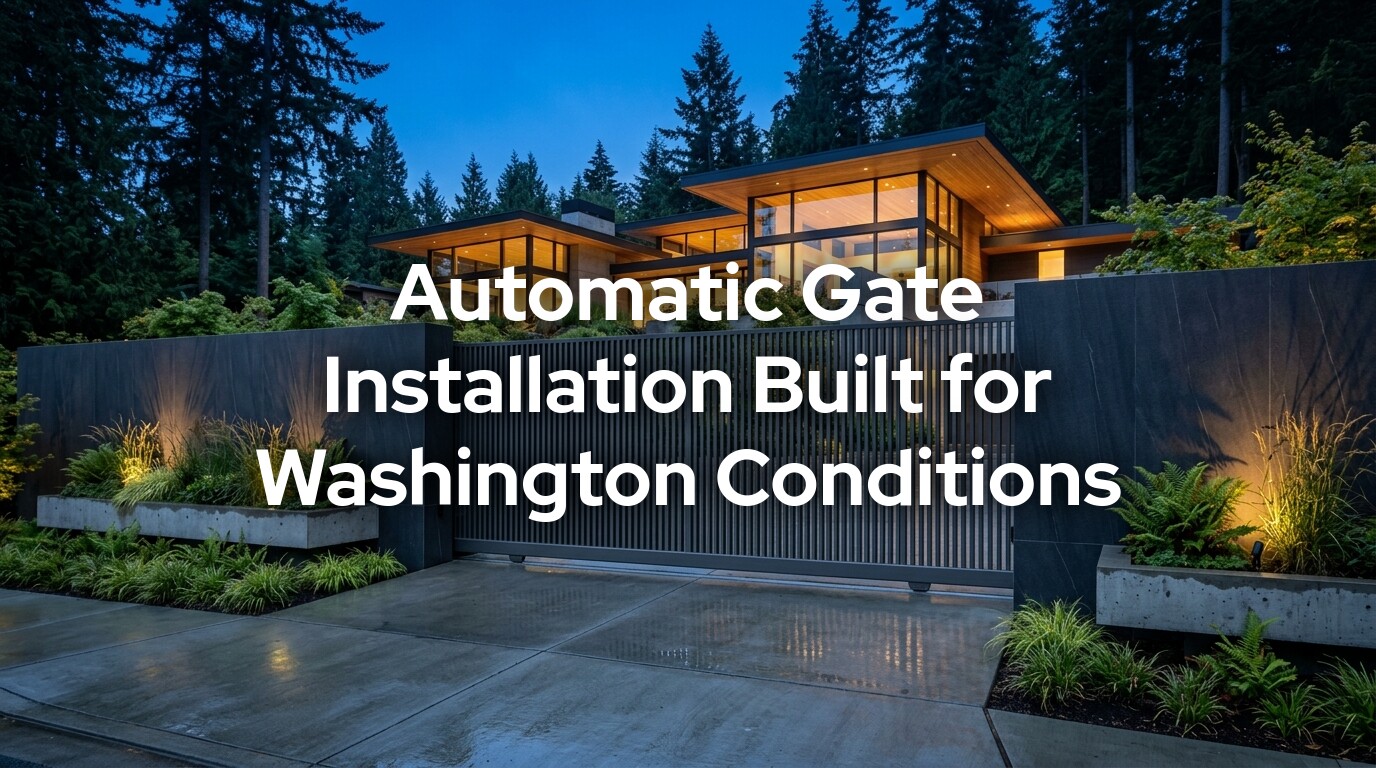
Automatic Gate Installation should begin with the property, not with an operator selected from a catalog. In Washington State, the driveway grade, drainage, soil, wind exposure, gate travel, power distance, winter outages, vehicle movement, and access needs all affect which system will remain reliable after the first wet season.
A complete automatic gate is more than a moving panel. It includes the gate structure, posts or sliding supports, foundations, operator, control board, monitored safety devices, power supply, battery backup, manual release, access controls, vehicle detection, communication equipment, and the site work that connects those parts.
Those components have to work together. A powerful operator cannot correct a gate that drags. A weather-rated enclosure cannot correct conduit that carries water into the controls. A keypad cannot solve visitor access if delivery drivers cannot reach it safely. Battery backup cannot provide unlimited operation during a long outage.
Emerald Gate Systems designs, fabricates, installs, automates, and services automatic gates from its own shop in Sedro-Woolley, Washington. The company is family-owned, licensed and insured, has more than 15 years in the trade, and serves Skagit, Whatcom, and Snohomish counties, Whidbey Island, Camano Island, the San Juan Islands, and the greater Puget Sound region.
The same accountable team handles CAD planning, welding, installation, automation, access control, testing, and future service. Core gate work is not handed from a separate fabricator to an unrelated operator installer and then to another service company.
What Is Automatic Gate Installation?
Automatic Gate Installation is the process of designing, building, powering, controlling, and testing a gate that opens and closes with a motorized operator. A complete installation includes the physical gate, supports, operator, safety devices, access controls, electrical or solar power, emergency operation, and final adjustment for the property’s traffic and conditions.
The work may begin with a new custom gate or with an existing manual gate that is suitable for automation. New construction gives the installer the greatest control over the frame, posts, foundations, operator attachment, conduit, drainage, safety zones, and access-device locations.
An existing gate requires a different starting point. The team must determine whether the structure is straight, stable, correctly supported, and easy to move by hand. A gate that sags, binds, twists, drags, or has weak hardware should be repaired before an operator is added.
Automatic operation does not make every entrance secure, safe, or convenient automatically. Those outcomes depend on the complete design. A gate can discourage unauthorized vehicle access, organize visitors, reduce the need to leave a vehicle in the rain, and create a controlled first point of entry. It does not replace fencing, locks, lighting, cameras, or practical property management.
The simplest dependable system is usually better than a feature-heavy installation no one wants to administer. A family driveway may need remotes, a keypad, and a video intercom. A community or commercial property may need individual credentials, schedules, vehicle detection, event history, and a documented maintenance plan.
Why Must Automatic Gate Installation Be Built for Washington Conditions?
Washington conditions affect automatic gates through persistent rain, saturated soil, wind, coastal salt, fir needles, leaf litter, snow, ice, storm outages, long rural power runs, and short winter daylight. The installation must address those conditions through drainage, stable foundations, appropriate materials, protected wiring, backup operation, and realistic maintenance access.
Rain is not usually harmful simply because it touches the gate. Problems begin where water remains. Standing water can soften soil around posts, fill a sliding track, reach underground connections, carry debris into moving hardware, or remain against damaged protective coatings.
Western Washington soil conditions vary by site. A gate post installed in stable native soil behaves differently from one installed in wet fill near a driveway shoulder. Long swing leaves and cantilever gates place substantial leverage on their supporting structures. Small foundation movement can become visible as a dragging edge, changing center gap, or repeated operator-limit problem.
Wind is particularly important for solid cedar and steel privacy gates. A large solid surface acts like a sail. Wind force reaches the frame, hinges, rollers, operator brackets, posts, and foundations. Selecting a stronger motor without addressing the structure does not solve the problem.
Coastal properties around Anacortes, Whidbey Island, Camano Island, and the San Juan Islands need additional corrosion planning. Foothill properties near Granite Falls, Darrington, Gold Bar, Index, and Sultan may need more attention to snow, ice, falling branches, difficult winter access, and longer outages.
Schedule a free on-site gate consultation before selecting equipment so drainage, soil, slope, wind, traffic, and power can be evaluated together.
Which Automatic Gate Configuration Fits the Property?
The correct gate configuration depends on opening width, driveway grade, side room, vehicle approach, wind, traffic, snow, debris, privacy, and maintenance tolerance. Swing gates need a clear opening arc. Sliding gates need side runback. Cantilever gates avoid a roadway track but require a longer frame and substantial support foundations.
| Gate configuration | Best suited for | Main advantage | Main limitation |
|---|---|---|---|
| Single swing gate | Level residential or rural entrances with clear arc space | Simple movement and a clean visual design | Places the full gate length and wind load on one support side |
| Paired swing gates | Wide entrances where two shorter leaves fit the architecture | Shorter swing radius and balanced appearance | Requires coordinated movement and two operating sides |
| Tracked sliding gate | Tight approaches with adequate side runback | Preserves driveway depth and avoids a swing arc | Track must remain straight, drained, and free of debris |
| Cantilever sliding gate | Gravel, uneven pavement, snow, commercial traffic, and rural drives | No ground track crosses the driveway | Needs a longer frame, counterbalance section, and larger foundations |
| Bi-folding gate | Selected constrained entrances where normal swing or slide space is limited | Reduces the movement depth or side space required | Uses more hinges, joints, and specialized moving hardware |
A gate should not be selected from opening width alone. The path vehicles take before and after the gate is equally important. A sixteen-foot opening may still be difficult for a trailer if the entrance is beside a ditch, narrow shoulder, retaining wall, or access pedestal.
Public-road setback also matters. Drivers need room to leave the road while the gate opens or while they use an intercom. A layout that leaves a vehicle stopped in an active lane creates a traffic problem even if the gate operates correctly.
Pedestrians should normally use a separate pedestrian entrance rather than walk through an automated vehicular gate. This is particularly important for commercial, multi-family, institutional, and community properties. For a side-by-side look at sliding, swing, electric and custom options, see our gate installation comparison for Washington properties.
When Is a Swing Gate Installation the Right Choice?
Swing gate installation is usually a strong choice where the driveway is reasonably level, the property has enough clear arc space, and the opening is not exposed to excessive wind. Swing systems work well for many homes, farms, and lower-cycle entrances, but they require stable hinge posts and carefully planned vehicle clearance.
A single swing gate creates one long moving leaf. It can produce a clean design, but the hinge side carries the full weight, leverage, and wind load. The longer and more solid the gate becomes, the more important the post, footing, hinges, frame stiffness, and operator attachment become.
Paired gates divide the opening between two leaves. Each leaf is shorter and needs less swing radius, which can improve fit on some wide driveways. The trade-off is added hardware, two operating sides, center alignment, and control coordination.
Driveway slope is the main reason a visually attractive swing gate may not work. If the driveway rises sharply behind the opening, the bottom of the leaf may strike the pavement. Special geometry or gate placement can sometimes address the problem, but every solution creates another trade-off involving clearance, hinge design, operator movement, or road conflict.
Outward-swinging gates need careful review. A gate should not enter a public road, sidewalk, shoulder, or area where a waiting vehicle may be struck. Local requirements, property boundaries, and emergency access may limit the available direction.
Solid swing gates require wind planning. On open Skagit Valley land or exposed coastal sites, an open steel or ornamental design may be more practical than a completely solid panel.
Ask Emerald Gate Systems about custom swing gate design and fabrication when grade, privacy, wind, and architectural appearance need to be resolved together.
When Is a Sliding Gate Installation Better?
A sliding gate is often better where vehicles need to stop close to the entrance, the driveway slopes behind the gate, or the property cannot spare a swing arc. The gate moves parallel to the fence, but it requires enough unobstructed side room and careful protection against debris, pinch areas, and ground movement.
A conventional sliding gate typically rolls on wheels over a track installed across or beside the roadway. The track must remain straight and properly supported. Mud, gravel, fir needles, snow, ice, and small stones can interfere with movement.
Drainage is critical. Water should not collect along the track or freeze where wheels travel. The pavement or concrete supporting the track must remain stable. A track installed across shifting gravel or poorly supported asphalt may require repeated adjustment.
Sliding gates can fit compact urban and commercial entrances well. They preserve driveway depth and avoid a leaf swinging toward vehicles. They still require room beside the opening for the complete gate to clear the roadway.
The slide path creates its own hazards. Rollers, guide assemblies, chain or rack systems, and areas where the gate travels behind a fence need appropriate guarding. People should not be able to reach through an opening into moving hardware.
Landscaping should be planned around the travel path. Shrubs, fence additions, stored materials, snow piles, and future structures can interfere with a gate that originally had adequate room.
When Is Cantilever Gate Installation the Better Long-Term Choice?
Cantilever gate installation is often the better choice where gravel, uneven paving, snow, debris, heavy vehicles, or drainage make a ground track difficult to maintain. The gate spans the roadway without wheels touching a track across the opening, but its longer frame and support system require more side room and foundation capacity.
A cantilever gate uses roller assemblies mounted beside the opening. Part of the gate extends behind the clear opening as a counterbalance. That extra section means the overall gate frame is significantly longer than the driveway width.
Property owners are sometimes surprised by the required runback. Trees, slopes, utility equipment, fence corners, buildings, retaining walls, and property lines can reduce the available space. The complete travel path should be measured before a cantilever design is selected.
The support foundations receive high loads because the gate is suspended above the roadway. Soil, drainage, wind, gate weight, frame length, and expected traffic all affect the support design.
Cantilever gates can be particularly practical for farms, commercial yards, gravel entrances, and foothill properties. They avoid track cleaning across the drive and reduce problems caused by plowing or roadway debris.
The trade-off is added structural material and fabrication. A cantilever gate should be selected because the site benefits from its geometry and maintenance advantages, not simply because it appears more advanced.
Call (360) 657-9975 to compare swing, tracked slide, and cantilever options after the available arc, runback, grade, drainage, and vehicle approach have been measured.
What Should an Automatic Gate Site Evaluation Cover?
An automatic gate site evaluation should document the opening, grade, drainage, soil, available travel, vehicle paths, power, communication, wind, snow, user groups, safety zones, emergency access, permits, and future maintenance access. The visit should end with a clear configuration recommendation and an explanation of the options that do not fit.
- Define the entrance goal. Identify whether the priority is privacy, convenience, controlled access, traffic management, appearance, livestock, commercial security, or several goals together.
- Measure the opening. Record the clear width, fence line, shoulders, road edge, grades, slopes, available swing arc, and sliding runback.
- Map vehicle movement. Include passenger vehicles, deliveries, trailers, farm equipment, garbage vehicles, snow equipment, and emergency apparatus.
- Inspect drainage. Identify standing water, runoff, ditches, culverts, track locations, underground-box risks, and places where water may reach controls.
- Evaluate soil and foundations. Look for wet fill, soft shoulders, organic soil, slopes, evidence of settlement, and practical footing locations.
- Review wind exposure. Consider open farmland, coastal wind, hilltops, solid panels, signs, and the direction in which the gate will move.
- Plan power. Compare utility service, trench length, conductor requirements, battery backup, solar exposure, and accessory loads.
- List every user group. Include family, residents, employees, guests, deliveries, vendors, caregivers, property managers, and emergency responders.
- Locate access devices. Determine where drivers and pedestrians will stop and whether keypads, intercoms, and readers can be reached safely.
- Identify hazards. Review swing arcs, slide paths, pinch points, reach-through areas, drawing-in zones, public access, and pedestrian conflicts.
- Confirm approvals. Identify the electrical jurisdiction, fire authority, HOA, right-of-way questions, and other review requirements.
- Plan maintenance access. Leave room to reach covers, hinges, rollers, chains, batteries, controls, sensors, and manual releases after landscaping is complete.
A useful evaluation may rule out the owner’s initial preference. Changing a drawing before fabrication is manageable. Relocating concrete, conduit, columns, or a finished gate is not.
How Do Drainage, Soil, and Slope Affect Automatic Gates?
Drainage, soil, and slope affect automatic gates by changing foundation stability, gate alignment, track performance, wiring conditions, and operating resistance. Water should be directed away from posts, operator pads, tracks, underground connections, vehicle loops, and access pedestals. The gate must remain mechanically stable before an operator can remain reliable.
Standing water near a post can soften surrounding soil and increase movement. A long gate magnifies a small post change at the far end of the leaf. The first visible symptom may be a gate that drags only near the closed position or no longer meets its center stop correctly.
Sliding systems need stable support along their travel. A track can become uneven if the surface below it settles or breaks. Cantilever systems avoid the roadway track but place larger concentrated loads on their support foundations.
Conduit also affects drainage. Water can travel through underground conduit from a low point to an enclosure. A sealed outdoor box can still experience water problems when the cable pathway was not planned properly.
Slope changes gate geometry. A swing gate requires clear space below the leaf throughout its arc. A sliding gate generally needs level travel even if the driveway itself slopes. The gate position may need to move back from the road to reach a more workable area.
Field observation: repeated limit adjustments are sometimes treated as routine operator work when they are actually evidence that the gate structure or ground is moving. The cause should be identified before the controls are reprogramd again.
Use a free site visit to review drainage and structural support before excavation. Contact Emerald Gate Systems through the gate project consultation page.
How Do Wind, Salt Air, Debris, Snow, and Ice Change the Design?
Wind, salt air, debris, snow, and ice change gate design by affecting structural load, corrosion, moving clearances, sensors, tracks, batteries, and service frequency. Exposed properties may need open infill, stronger supports, coastal-grade material planning, cantilever movement, higher sensor placement, or a different location for the gate and controls.
Solid panels deserve the most careful wind review. A cedar privacy gate may fit the architecture beautifully while placing much more force on its frame and hinges than an open steel design. Partial screening or spaced boards can preserve privacy while allowing some air movement.
Coastal gates need corrosion planning across the complete assembly. Salt collects behind brackets, inside sheltered joints, around fasteners, and where coating damage exposes metal. The front of a gate can still look clean while functional hardware begins deteriorating.
Fir needles and leaves cause more trouble than many owners expect. They fill sliding tracks, cover drains, block photo-eye paths, hide stones near wheels, and retain moisture around low hardware.
Snow storage should be planned before installation. A plow should not push snow against the operator, keypad, photo eyes, gate path, or manual release. Swing gates need a clear arc. Tracked gates need the roadway path cleared. Cantilever gates still need unobstructed side travel.
Ice should never be overcome by increasing operator force. If the gate is frozen or physically obstructed, it should be cleared before operation. Forcing the system can damage the drive, structure, or safety adjustment.
How Should Power, Battery Backup, and Solar Be Planned?
Gate power should be planned around the operator, daily cycles, voltage distance, access devices, communication equipment, winter outages, and maintenance. Utility power is often the most dependable choice where it can be installed reasonably. Solar is valuable on suitable remote sites but must be sized for January conditions, shade, and continuous accessory loads.
A long power run can involve trenching, conduit, conductor sizing, electrical permitting, restoration, and coordination with existing utilities. The power route should be decided before paving, landscaping, or other finished site work.
Battery backup provides limited stored operation. Its practical capacity depends on battery health, temperature, gate resistance, cycle frequency, and every connected accessory. A lightly used home gate and a busy HOA entrance do not receive the same outage performance from a similar battery arrangement.
The owner should know what the gate is designed to do during an outage. Options may include limited normal operation, opening and remaining open, manual release, or another property-specific sequence. The chosen behavior must also fit emergency-access requirements.
Solar works well where the panel has reliable exposure and the system has a realistic energy budget. Tree shade, low winter sun, frequent gate cycles, video intercoms, cameras, cellular equipment, heaters, and network devices can substantially increase the required panel and battery capacity.
Field observation: a solar gate that recovers easily during summer can slowly lose battery capacity through a cloudy winter if the design was based on peak panel output rather than the property’s weakest normal month.
Call (360) 657-9975 for a power assessment that compares trenching, utility service, battery backup, manual operation, winter sun, shade, and actual gate cycles.
How Is the Correct Automatic Gate Operator Selected?
The correct gate operator is selected by matching the gate type, weight, length, balance, travel resistance, wind area, expected cycles, usage classification, speed, power source, and safety-device requirements. Operator horsepower or maximum weight alone is not enough because a poorly moving gate can overload equipment that appears large enough on paper.
Mechanical movement comes first. A swing gate should move smoothly without lifting, dropping, or binding. A slide gate should roll consistently across the full opening. The operator should not be used to pull a misaligned gate into position.
Cycle demand must reflect real use. Count entries and exits for residents, employees, visitors, deliveries, vendors, caregivers, maintenance crews, and repeated peak periods. A gate serving a community, apartment, warehouse, or commercial yard needs different duty capability from a private driveway.
Wind area affects swing-gate operators significantly. A solid gate can place intermittent loads on the drive that are not represented by the gate’s static weight.
Speed should also be considered carefully. A faster gate can reduce vehicle wait time and road stacking, but it may require more specialized equipment and careful safety planning. Faster is not always better for a private driveway.
Serviceability matters. The operator should be installed where technicians can remove covers, reach drive components, test batteries, access controls, and use the manual release without dismantling columns or landscaping.
For commercial and managed properties, review commercial gate systems and high-cycle access planning before assuming a residential operator can support the traffic. Our gate operator installation guide goes through swing and slide operator types and how each is sized.
Which Safety Standards Apply to Automatic Gate Installation?
Automatic gate installation commonly involves UL 325 for gate operators and entrapment protection and ASTM F2200 for automated vehicular gate construction. UL 294 may apply to access- control units. The complete system must also satisfy applicable electrical, fire, building, accessibility, and local requirements for the property.
UL 325 gate-operator guidance addresses powered operator systems and hazards that include entrapment. The operator must be installed with compatible monitored protection appropriate to the gate and its identified hazard zones.
ASTM F2200-24 addresses automated vehicular gate construction. It covers physical gate considerations rather than replacing operator safety requirements. The frame, openings, guides, guards, protrusions, supports, and travel area all matter.
Common external protection devices include monitored photo eyes and sensing edges. A photo eye protects a defined beam path. A sensing edge responds to physical contact on a protected gate surface. One device does not automatically protect every possible hazard.
Vehicle loops and free-exit probes support traffic operation but should not be treated as universal entrapment protection. Every device has a specific purpose.
Safety testing should include normal opening and closing, activation of each monitored device, the operator’s response to a disconnected device, manual release, backup operation, and the actual routes taken by vehicles and people.
A failed safety device should be diagnosed, not bypassed. Increasing force or disabling protection to keep a gate moving removes a layer of safety while leaving the original problem unresolved.
Speak with an Emerald Gate Systems installer at (360) 657-9975 about gate construction, operator classification, monitored photo eyes, sensing edges, guarding, and emergency access.
How Does Smart Access Control Fit Into an Automatic Gate?
Smart access control decides who can request entry, when permission is valid, and how visitors communicate with the property. It may include remotes, keypad codes, cards, fobs, mobile credentials, video intercoms, telephone entry, cameras, vehicle detection, schedules, and managed user records.
A small residential property may only need remotes for regular drivers, separate keypad codes for trusted visitors, and a video intercom for unknown guests. A property with tenants, employees, or frequent vendors benefits more from individual credentials that can be removed without changing access for everyone.
Shared codes are convenient but difficult to control after they spread. Separate temporary or scheduled codes provide better accountability where the equipment supports them.
Video intercoms should be positioned for the actual vehicle approach. The installer should consider passenger cars, trucks, trailers, motorcycles, lighting, glare, rain, camera angle, and what happens when the primary call recipient does not answer.
Connected systems require account ownership. Someone must retain administrator credentials, remove old users, approve vendor access, manage software or subscriptions, and understand the fallback process during a network or cellular failure.
UL 294 access-control certification information addresses access- control system units. A listed device still needs correct installation, secure administration, power backup, and integration with the gate operator.
Review access control systems for automatic gates when the project needs keypads, intercoms, cameras, credentials, or managed visitor entry.
Which Permits and Approvals May Be Required?
Automatic gate projects may require electrical permits, local fire-access approval, HOA design review, right-of-way coordination, driveway approval, or other jurisdiction-specific review. The exact requirements depend on the address, electrical authority, property use, road, gate location, and whether the entrance controls emergency or public access.
Washington Labor and Industries handles electrical permits and inspections in many parts of the state. Certain cities operate their own electrical programs, so the project address must be checked before work begins.
Fire authorities may review clear gate width, setback, road approach, emergency entry method, manual release, power-loss behavior, and turnarounds. A device accepted in one district should not be assumed acceptable in another.
HOA review is separate from government permitting. An association may regulate gate height, style, color, materials, columns, lighting, fencing, landscaping, and visible equipment.
Approval should occur before fabrication. Changing a CAD drawing is manageable. Changing a finished steel frame, cedar infill, masonry column, or buried conduit is expensive.
Property owners should ask who is responsible for each permit and inspection. The written proposal should distinguish the gate contractor’s scope, electrical responsibilities, owner-provided approvals, and work by other trades.
Confirm permit and fire-access responsibilities during the consultation. Use the Emerald Gate Systems contact page before foundations, conduit, or columns are installed.
What Happens During the Automatic Gate Installation Process?
The installation process moves from consultation and site measurement through design, approvals, fabrication, foundations, power, mechanical installation, automation, safety testing, access-control setup, and owner training. The exact sequence varies, but the gate should move correctly by hand before the operator is commissioned.
- Consultation and needs review. The owner explains the property, users, traffic, design priorities, security needs, and current problems.
- Site measurement. The team measures the opening, grade, travel, road approach, drainage, soil, power route, and control locations.
- Configuration selection. Swing, tracked slide, cantilever, and other practical options are compared.
- Gate design. The frame, infill, materials, finish, posts, hardware, operator attachment, and safety considerations are coordinated.
- Permit and utility planning. Electrical jurisdiction, excavation, utility locating, fire access, HOA review, and other approvals are addressed.
- Site preparation. Work may include demolition, grading, drainage, trenching, conduit, foundations, operator pads, tracks, and posts.
- In-house fabrication. Emerald Gate Systems fabricates custom gates in Sedro-Woolley and prepares them for the specified hardware and automation.
- Mechanical installation. The gate, hinges, rollers, guides, stops, and supports are set and adjusted for smooth manual travel.
- Operator installation. The drive system, controls, disconnects, batteries, and manual release are installed.
- Safety installation. Monitored photo eyes, sensing edges, guards, warning signs, and other protections are positioned and tested.
- Access-control setup. Keypads, remotes, credentials, intercoms, cameras, loops, and communication equipment are programd.
- Commissioning. The complete system is tested through normal movement, obstruction response, access commands, backup power, and manual operation.
- Owner handoff. The owner learns normal use, credential management, outage procedures, basic inspections, and service contacts.
The project is not complete simply because the gate opens once. Final testing should reflect the way the entrance will actually be used.
Which Gate Materials Should Be Compared?
Gate materials should be compared by strength, weight, wind area, corrosion exposure, maintenance, appearance, repairability, and operator load. Fabricated steel provides strength and flexibility, ornamental iron supports detailed designs, aluminum reduces weight and corrosion risk, and Western Red Cedar adds privacy and Northwest character.
| Material | Advantages | Trade-offs | Maintenance focus |
|---|---|---|---|
| Fabricated steel | Strong, repairable, suitable for large custom frames and operator attachments | Heavier and dependent on effective corrosion protection | Inspect coating damage, welds, drains, low rails, and fasteners |
| Ornamental iron or steel | Detailed appearance with relatively open wind profile | Labor intensive and vulnerable where finish is damaged | Inspect shaped joints, decorative pockets, and exposed edges |
| Aluminum | Lower moving weight and strong corrosion resistance | Requires material-specific framing, welding, and attachment methods | Inspect finish, fasteners, and dissimilar-metal contact |
| Western Red Cedar | Privacy, warmth, and a natural Northwest appearance | Moves with moisture and adds wind area | Maintain finish, drainage, airflow, fasteners, and replaceable boards |
| Stone-coordinated elements | Architectural permanence and strong entrance definition | Requires structural coordination and may restrict service access | Inspect drainage, settlement, caps, conduit access, and gate clearances |
The gate should be designed as a moving structure rather than a fence panel. A stationary fence can tolerate details that create excessive weight, flexibility, or wind load in a gate.
Custom fabrication allows material and structural decisions to be coordinated. Emerald Gate Systems can incorporate hand-forged wrought iron, laser-cut steel, cedar, and stone-related details while planning the operator and hardware.
Explore custom gate design options when material, privacy, wind, operator load, and architecture need one coordinated plan.
What Does Automatic Gate Installation Cost?
Automatic gate installation cost depends on the gate, material, opening, foundations, configuration, operator, safety devices, power, trenching, access control, drainage, permits, site restoration, and travel. Emerald Gate Systems does not publish one universal installation range because two similar-looking driveways can require substantially different infrastructure.
The source information for Emerald Gate Systems includes one universal service price: repair labor is $100 per hour for all brands, including gates installed by other companies. That repair rate is not an installation price. Parts, travel, specialty equipment, and project-specific work may be additional.
A complete installation proposal should identify:
- Consultation, measurements, and CAD planning
- Gate material, fabrication, finish, and hardware
- Posts, foundations, tracks, hinges, rollers, guides, and stops
- Operator, control board, drive components, batteries, and manual release
- Photo eyes, sensing edges, guards, signs, and vehicle detection
- Keypads, intercoms, credentials, cameras, and communication equipment
- Utility power, trenching, conduit, conductors, solar, and charging equipment
- Drainage, paving repair, fence transitions, columns, and restoration
- Permits, inspections, fire-access coordination, and documentation
- Programming, testing, credential setup, and training
- Travel, ferry, freight, and remote-site staging where applicable
Cost can sometimes be reduced responsibly by simplifying ornament, choosing open infill, limiting access controls to features the owner will manage, or installing conduit before paving.
Foundations, required safety devices, drainage, and permit obligations should not be removed merely to make the initial proposal appear less expensive.
How Long Does Automatic Gate Installation Take?
A custom automatic gate project should normally be planned in stages and in weeks rather than as one installation appointment. Timing depends on design approval, fabrication, finish, permits, site preparation, concrete, electrical work, equipment availability, weather, inspections, and island or remote-property logistics.
A focused operator replacement on a suitable existing gate may move faster than a complete new entrance. It still requires diagnosis, compatible equipment, safety review, wiring, programming, and testing.
A custom project may include:
- Initial consultation and field measurement
- CAD design and owner revisions
- HOA, fire, or jurisdiction review
- Material procurement
- Gate fabrication and finishing
- Excavation, foundations, drainage, and conduit
- Electrical inspection
- Mechanical gate installation
- Operator and safety-device installation
- Access-control programming
- Final testing and owner training
Weather can affect excavation, concrete, coating, site access, and ferry travel. Saturated soil may delay footing work. Snow may limit access to foothill properties.
Owners can reduce delays by deciding early on gate style, material, privacy, opening direction, columns, power, access devices, lighting, landscaping, and user-management needs.
Request an itemized project sequence by calling (360) 657-9975. A realistic schedule should identify the stages controlled by Emerald Gate Systems and those dependent on permits, utilities, weather, or other trades.
What Maintenance Does an Automatic Gate Need?
Automatic gates need recurring inspection because the structure, operator, safety devices, power, access controls, and site conditions change through use and weather. A practical starting schedule is a monthly owner observation and professional service every six to twelve months, with more frequent attention for high-cycle, coastal, farm, HOA, or debris-heavy entrances.
Monthly owner observations can include:
- Changes in speed, sound, alignment, and stopping position
- Sagging, dragging, vibration, or visible frame movement
- Leaves, fir needles, gravel, mud, snow, and vegetation in the travel path
- Standing water around posts, tracks, pads, and controls
- Dirty, damaged, or misaligned photo eyes
- Loose hardware or damaged protective finish
- Battery or charging warnings
- Changes in keypad, intercom, camera, or credential operation
- Manual release access and condition
Professional service may include gate alignment, hinges, rollers, chain, rack, guides, stops, operator mounting, limits, monitored safety devices, vehicle loops, batteries, charging, wiring, corrosion, enclosure condition, access controls, and outage operation.
Maintenance intervals should be adjusted to actual cycles and exposure. A private gate in a sheltered location may need less frequent attention than an exposed waterfront gate or an HOA entrance used throughout the day.
Safety settings should not be adjusted casually. Increased force can hide mechanical resistance while placing more load on the gate and creating a more dangerous movement.
Learn more about gate repair and preventive maintenance when the gate changes behavior or service records show repeated faults.
What Wears Out During Long-Term Automatic Gate Ownership?
Long-term ownership involves eventual replacement of batteries, rollers, hinges, wheels, chains, belts, rack components, seals, relays, control boards, remotes, keypads, intercoms, and communication equipment. Actual life depends on traffic, alignment, corrosion, water, impact, temperature, charging, equipment quality, and whether small problems are corrected early.
Backup and solar batteries commonly require replacement before the operator itself. A practical planning range is approximately three to five years, but repeated deep discharge, poor charging, cold weather, heat inside an enclosure, and high accessory load can shorten that range.
A correctly selected operator on a freely moving gate may serve for many years. Ten to twenty years can be a reasonable ownership-planning range for quality equipment in suitable conditions, but it is not a warranty. Water intrusion, impact, undersizing, excessive cycles, and mechanical resistance reduce service life.
Rollers, hinges, wheels, and bearings should be replaced based on play, corrosion, flat spots, noise, binding, and changing gate geometry rather than waiting for complete failure.
Electronics can fail from age, power events, moisture, pests, corrosion, vibration, or changing technology. Keep model information, manuals, administrator credentials, wiring records, and service history in a location future owners or managers can access.
A maintenance reserve is more realistic than assuming the gate will operate indefinitely without renewal. Scheduled replacement of a battery or roller is usually less disruptive than emergency repair after secondary damage occurs.
Book a maintenance or repair evaluation at (360) 657-9975 when the gate becomes slower, louder, uneven, intermittent, or less reliable during rain or cold weather.
What Common Automatic Gate Installation Mistakes Should Be Avoided?
Common installation mistakes include choosing the gate before evaluating the site, using operator force to overcome poor movement, ignoring drainage and wind, treating safety devices as optional, selecting solar from summer conditions, sharing one permanent access code, and leaving future maintenance access out of the design.
Why is choosing the gate from appearance alone a mistake?
Appearance does not show whether the driveway has enough swing arc, side runback, foundation support, wind protection, or vehicle-stacking space. A design should be narrowed by the property first and then refined to match the architecture.
Why does a larger motor not fix a dragging gate?
A larger motor can force a dragging gate temporarily, but the added force reaches hinges, brackets, wheels, frames, posts, and the operator itself. Mechanical resistance should be corrected before equipment is sized.
Why should access control not be added at the end?
Access devices affect conduit, power, network connections, vehicle stopping positions, pedestrian routes, lighting, and user management. Adding them after concrete and paving can create awkward placement and unnecessary reconstruction.
Why is one shared code often a poor long-term choice?
A shared code can spread among former residents, contractors, guests, vendors, cleaners, and delivery drivers. Individual or temporary credentials provide better control where user permissions change.
Why is solar sizing from summer conditions a mistake?
Solar performance should be based on low winter production, tree shade, battery capacity, gate cycles, and continuous loads. A system that looks overpowered in July may struggle through January.
Why should a failed safety device never be bypassed?
A safety fault may indicate misalignment, impact, damaged wiring, water, vegetation, or a failing device. Bypassing the monitored circuit removes protection without repairing the cause.
Which Property Type Are You Fitting?
The right automatic gate depends less on the catalog than on how the entrance is used every day. The four property types below cover most of the work we do.
Residential driveways
For homeowners, an automatic gate can change the way a property feels and functions every day.
A residential automatic gate can help protect the driveway, reduce unwanted visitors, improve privacy, and add a polished entrance to the home. This is especially valuable for properties with long driveways, rural acreage, waterfront access, private lanes, or homes set back from the road.
Common residential gate options include:
- Automatic driveway gates
- Custom iron gates
- Aluminum driveway gates
- Wood and metal gate combinations
- Keypad entry systems
- Remote-controlled gate operators
- Video intercom systems
- Camera-integrated gate access
- Solar-assisted gate setups where appropriate
For homes in Northwest Washington, the system should be built with weather in mind. Motors, hinges, posts, wiring, access devices, and control boxes need to be selected and installed for long-term outdoor use.
A good residential gate system should not feel complicated. It should open smoothly, close safely, look right with the property, and make daily access easier for the people who actually live there.
Farms and agricultural entrances
Farm gates have different needs than residential gates. They often deal with wider entrances, heavy equipment, livestock areas, work trucks, delivery vehicles, gravel roads, mud, and frequent use.
For agricultural properties across Skagit County, Whatcom County, Snohomish County, and surrounding Washington communities, automatic gate installation needs to account for real working conditions.
A farm gate may need:
- Wider clear openings for trucks and trailers
- Stronger posts and hardware
- Durable operators built for daily use
- Keypad or remote access for workers
- Controlled entry for vendors and deliveries
- Safety devices for vehicles and equipment
- Service access for maintenance teams
- A design that handles rain, gravel, and uneven ground
A farm entrance gate should be simple, strong, and dependable. It should not slow down the workday or become another thing that constantly needs attention.
HOAs and managed communities
HOAs, apartment communities, and managed properties need gate systems that balance security with convenience. Residents need reliable access. Visitors need a clear way to request entry. Property managers need systems that can be updated when tenants move in or out.
Common HOA and managed property gate features include:
- Phone entry systems
- Directory-based access
- Keypads
- Card readers
- RFID access
- Remote transmitters
- Camera systems
- Vehicle detection loops
- Emergency access planning
- Scheduled gate programming
- Preventive maintenance
For property managers, the biggest issue is usually reliability. A gate that fails during peak traffic creates complaints quickly. A poorly planned access system can also become difficult to manage as residents, vendors, guests, and maintenance crews all need different access permissions.
A properly designed system makes daily management easier. Access can be organized, updated, and monitored more effectively. Learn more about our access control systems for Washington properties.
Commercial and industrial sites
Commercial gates are built for a different level of use. A business entrance, warehouse yard, storage facility, school property, government site, parking area, or service yard may see frequent vehicle traffic throughout the day.
A commercial automatic gate should be designed around security, access flow, safety, durability, and long-term serviceability.
Commercial properties may need:
- Sliding security gates
- Cantilever gates
- Heavy-duty gate operators
- Employee access control
- Badge readers
- Keypad entry
- Intercom or video entry
- Security camera integration
- Bollards
- Vehicle detection systems
- Emergency access coordination
- Scheduled maintenance plans
For commercial sites in Washington State, the gate is often part of a larger security system. It may need to work with cameras, alarms, building access, parking control, or property management systems.
Emerald Gate Systems supports commercial gate installation, control systems, security systems, bollards, sensors, and repair services for businesses and managed properties throughout the region.
Matching the system to the property and its location
Residential gates should make family access easy while handling visitors and deliveries for homes in Sedro-Woolley, Mount Vernon, or Edmonds. Farms need wide clearances, durable equipment, mud and gravel planning, and access for trailers or machinery near Arlington, Monroe, or in the Skagit Valley. HOAs need high-cycle reliability, credential administration, resident communication, and service response in Lake Stevens, Lynnwood, or Mill Creek. Commercial properties may require schedules, logs, cameras, delivery workflows, and stronger traffic control in Everett, Bothell, or Marysville.
Institutional and public-facing properties may also need ADA-compliant pedestrian entry, automatic doors, accessible controls, and coordinated security. Emerald Gate Systems installs gate systems, access control, ADA entry solutions, intercoms, cameras, sensors, and bollards. The full service range is described on our services page.
Location changes priorities. Automatic gate installation Seattle projects may emphasize compact geometry, neighbors, utilities, and local review. Gate repair Tacoma work may involve busy managed entrances and county or city requirements. Residential gate systems Washington projects in rural areas near Darrington, Gold Bar, or Granite Falls may prioritize long distances, solar feasibility, battery backup, and equipment access. Our service area overview includes Sedro-Woolley, Mount Vernon, Burlington, Anacortes, Bellingham, Everett, Marysville, Arlington, Stanwood, Lake Stevens, Snohomish, island communities, and the greater Puget Sound region. Additional local pages such as farm and commercial gates in Monroe, WA and residential gate installation in Lake Stevens, WA show how solutions adapt.
Can an Existing Gate Be Automated, Upgraded or Replaced?
Many existing gates can be automated or upgraded when they are straight, stable, properly supported, easy to move by hand, and compatible with safety equipment. An inspection should cover frame condition, welds, posts, footings, hinges, rollers, guides, stops, clearances, corrosion, and travel on properties throughout Northwest Washington.
Repair may be sensible when the structure is sound and the problem is limited to alignment, hardware, controls, sensors, wiring, batteries, or access devices. Modernizing a dependable gate with a correctly sized operator and updated safety equipment can extend its useful life for homeowners in Burlington, Lake Stevens, or Brier.
Replacement is usually wiser when the gate is severely corroded, bent, poorly balanced, too heavy for its hardware, repeatedly failing, unsafe, or badly matched to the site. Replacing only the motor will not correct structural defects. Likewise, installing new electronics on failing conduit or unstable posts may create another short-lived system in coastal or rural settings.
Ask for diagnosis before accepting a replacement recommendation. The technician should explain the failure, options, trade-offs, and likely remaining life of retained components. Start the conversation with our guide to automatic gate repair warning signs and service.
Call now at 360-657-9975 to compare the full cost of repair, upgrade, and replacement for your current gate in Sedro-Woolley, Skagit County, or anywhere in the greater Puget Sound region.
A Practical Decision Checklist Before You Commit
Begin by defining the problem. Decide whether the priority is security, convenience, privacy, traffic control, appearance, or a combination. List every user group, including family, residents, employees, visitors, deliveries, contractors, caregivers, emergency responders, and maintenance teams for properties in Mount Vernon, Everett, or on the islands.
Document vehicles, opening width, road speed, turning movements, slope, drainage, wind, power, internet or cellular coverage, snow storage, landscaping, and future construction. Choose swing, slide, cantilever, bi-fold, or specialty movement based on the site rather than appearance alone for driveways in Sedro-Woolley, Arlington, or Camano Island.
Select materials and openness with corrosion, wind, privacy, architecture, and maintenance in mind. Match the operator to gate weight, geometry, traffic, and exposure. Plan monitored safety devices, emergency access, backup power, manual release, credentials, communication, and camera needs across Skagit County, Whatcom County, and Snohomish County.
Confirm permits, electrical responsibility, utility locating, project sequence, restoration, warranties, training, documentation, and maintenance. Finally, compare complete scopes and the contractor ability to support the system after installation. For more guidance, browse our blog.
Call now at 360-657-9975 to turn your priorities into a clear, working entrance plan with Emerald Gate Systems serving Sedro-Woolley, Skagit County, and the greater Puget Sound region.
Signs you are ready for an automatic gate
You may be ready for an automatic gate if:
- You want more control over who enters your property
- You have unwanted vehicles or visitors entering the driveway
- You manage a property with residents, employees, vendors, or tenants
- You need to secure a commercial yard or parking area
- Your farm or rural property needs controlled vehicle access
- You want a more finished and professional entrance
- You already have a manual gate and want to automate it
- Your current gate system is unreliable or outdated
- You need cameras, intercoms, or access control at the entrance
A gate should solve a real problem. The right system should make access easier, not more complicated.
Why Choose Emerald Gate Systems for Automatic Gate Installation?
Emerald Gate Systems provides one accountable path from site evaluation and CAD design through fabrication, installation, automation, access control, safety testing, and service. The company is based in Sedro-Woolley, operates its own fabrication shop, uses its own crew for core gate work, and builds for Northwest Washington conditions.
The team serves residential, agricultural, commercial, HOA, institutional, and managed properties. That range matters because traffic, user administration, vehicle types, and service consequences differ across property types.
In-house fabrication allows the gate frame, hardware, operator attachment, materials, wind exposure, and access design to be planned together. Emerald Gate Systems works with hand-forged wrought iron, laser-cut steel, Western Red Cedar, and stone-coordinated designs.
The company services all brands, including gates installed by other contractors, at a transparent repair labor rate of $100 per hour. That service capability gives property owners a long-term path after installation.
Location also matters. Emerald Gate Systems is headquartered in Skagit County rather than commuting from Seattle for every Northwest Washington project. The service territory includes Sedro- Woolley, Mount Vernon, Burlington, Anacortes, Bellingham, Everett, Marysville, Arlington, Stanwood, Lake Stevens, Monroe, Whidbey Island, Camano Island, and the San Juan Islands.
No contractor can remove every trade-off. Gates require maintenance. Batteries wear out. Soil can move. Storms interrupt power. The value is a contractor willing to explain those realities before installation and remain accountable afterward.
Review the Emerald Gate Systems company overview, then call (360) 657-9975 to schedule a free site visit for your Washington automatic gate project.
For a regional view of the same work, our guide to automatic gate installation in Northwest Washington goes deeper on site preparation and operator selection, and automatic gate repair in Northwest Washington explains what we check on a service call before recommending repair or replacement. You can also see coverage by county on our Northwest Washington service areas page.
Installation work by town: gate installation in Everett, gate installation in Bellingham and what an automatic driveway gate costs in Skagit County. Each guide covers the terrain, gate types and access needs we see there.
Frequently Asked Questions About Automatic Gate Installation
How much does automatic gate installation cost in Washington State?
Automatic gate installation cost depends on gate size, material, fabrication, foundations, operator duty, safety devices, access control, power, trenching, drainage, permits, and site restoration. Emerald Gate Systems does not publish one universal installation range because an accurate proposal requires a site evaluation and complete project scope.
A low equipment price may exclude foundations, electrical work, photo eyes, access controls, paving repair, or permit responsibilities. Compare proposals by what is included rather than by the final number alone.
How long does automatic gate installation take?
A custom automatic gate project normally progresses through consultation, design, fabrication, foundations, electrical work, installation, programming, and testing. The full process is generally planned in weeks rather than days. Permits, materials, concrete, weather, design changes, inspections, and island logistics can extend the schedule.
A focused operator replacement may move faster, but the existing gate, safety devices, wiring, and control system still need evaluation before the new operator is commissioned.
What is the best automatic gate for a residential driveway?
The best residential automatic gate is the configuration that fits the driveway grade, available travel, wind, vehicle approach, traffic, and maintenance needs. Swing gates fit many level driveways, while tracked or cantilever sliding gates often work better where slope, limited depth, gravel, snow, or debris make swinging difficult.
Appearance should be selected after the practical configuration is understood. An on-site evaluation can rule out options that would otherwise create clearance or reliability problems.
What is the difference between a swing gate and a sliding gate?
A swing gate rotates inward or outward around hinge posts and requires a clear opening arc. A sliding gate moves parallel to the fence and requires side runback. Swing gates often suit open residential entrances, while sliding gates can fit slopes, compact approaches, commercial traffic, or sites where vehicles stop close to the gate.
Neither is universally better. Wind, soil, snow, debris, vehicle movement, and available space determine the stronger choice.
What is the difference between a tracked slide gate and a cantilever gate?
A tracked slide gate rolls on wheels over a ground-supported track. A cantilever gate is suspended above the roadway and moves through roller supports beside the opening. Cantilever gates avoid track problems caused by gravel, snow, mud, and debris but require a longer frame and larger supporting foundations.
A tracked system may use less overall side length, but its travel path requires consistent cleaning, drainage, and support.
Can Emerald Gate Systems automate an existing manual gate?
Yes. Emerald Gate Systems can evaluate an existing gate for automation when the frame, posts, hinges, rollers, alignment, and movement are suitable. A dragging, sagging, unstable, severely corroded, or poorly guarded gate may need structural repair or replacement before an operator and safety devices are installed.
The evaluation should compare the full retrofit cost with the expected service life of a purpose-built replacement.
Does an automatic gate improve home security?
An automatic gate improves access control by creating a managed point for vehicle entry and discouraging casual or unauthorized access. It does not replace fencing, door locks, lighting, cameras, or other security practices. Its value is greatest when visitor communication, credentials, and daily operating procedures are planned together.
A gate should be treated as one layer of a broader property-access plan, not as an impenetrable barrier.
Which access-control system is best for a residential gate?
Many residential gates use remotes or mobile credentials for regular users, separate keypad codes for trusted visitors, and a video intercom for unknown guests and deliveries. The best combination depends on household size, visitor frequency, internet reliability, rental use, privacy goals, and how often user permissions change.
A smaller system that is easy to manage can be more dependable than a complex platform the household does not maintain.
Can automatic gates include cameras and video intercoms?
Yes. Automatic gates can include video intercoms, overview cameras, license-plate cameras, telephone entry, keypads, cards, fobs, and mobile credentials. Device locations should be planned around lighting, weather, vehicle height, stopping position, communication reliability, and the information the owner needs before opening the gate.
A general camera and a plate-identification camera perform different tasks and may require different views.
Do automatic gates work during power outages?
Automatic gates can use battery backup, manual release, programd opening behavior, or solar-supported charging during outages. Backup capacity is limited by battery condition, temperature, gate resistance, traffic, and accessory loads. Owners should understand the approved manual and emergency procedure before a winter storm causes an interruption.
A busy HOA or commercial gate can use stored energy much faster than a low-cycle home entrance.
Do solar gate openers work in Western Washington?
Solar gate openers can work when panel exposure, January daylight, tree shade, battery capacity, daily cycles, gate resistance, and accessory loads are sized honestly. Solar is useful where trenching is difficult, but dense fir cover, frequent operation, cameras, intercoms, and communication equipment can make utility power more dependable.
Solar should be evaluated from the property’s weakest winter conditions rather than from summer output.
Are automatic gates reliable in Washington rain?
Automatic gates can be reliable in Washington rain when drainage, foundations, wiring, enclosures, coatings, and service access are designed for persistent moisture. Failures often begin where water softens soil, fills tracks, travels through conduit, reaches damaged connections, or remains against unprotected metal and low wood components.
Keeping drains and travel paths clear remains part of ownership even when the installation was designed correctly.
Can automatic gates operate in snow and ice?
Automatic gates can operate in snow and ice when their travel path, sensor locations, clearances, drainage, manual release, and plowing plan are considered. Operators should not be used to force a frozen or obstructed gate. Cantilever gates avoid roadway tracks, while swing gates need an arc free of snow piles.
Photo eyes and access devices should not be placed where the plow normally stores snow.
How does wind affect a solid driveway gate?
Wind creates substantial force on solid cedar, steel, and closely spaced privacy gates. That force reaches the gate frame, hinges, rollers, operator brackets, posts, and foundations. Exposed sites may require open infill, spaced boards, stronger framing, larger supports, a different gate configuration, or a revised privacy plan.
A larger operator does not correct an inadequately supported wind-loaded structure.
Which safety devices does an automatic gate need?
An automatic gate may require monitored photo eyes, sensing edges, guarding, warning signs, and other protection based on its operator, movement, entrapment zones, and property use. Vehicle loops and exit probes support traffic functions but do not automatically replace required entrapment protection. Every installed device should be tested regularly.
The physical gate must also be suitable for automation under applicable gate-construction requirements.
What are UL 325 and ASTM F2200?
UL 325 addresses powered gate-operator systems and entrapment protection. ASTM F2200 addresses the construction of automated vehicular gates. They work together: listed operator equipment and monitored safety devices must be installed on a physical gate whose openings, supports, guides, guards, and travel conditions are appropriate.
Installing a listed operator does not make a weak or hazardous manual gate suitable automatically.
Do I need an electrical permit for an automatic gate in Washington?
Electrical gate work may require a permit through Washington Labor and Industries or through a city that operates its own electrical inspection program. The correct authority depends on the project address. Fire access, HOA review, driveway, right-of-way, or building requirements may apply separately from the electrical permit.
Permit responsibilities should be confirmed before trenching, wiring, foundations, or equipment installation begins.
How do emergency responders open an automatic gate?
Emergency-access methods are determined by the local fire authority and may include an approved key switch, lock box, receiver, credential, manual release, or another jurisdiction-specific method. The authority may also review gate width, setback, approach, turnaround, and operation during a utility outage.
Do not copy an emergency device used in another fire district without obtaining local confirmation.
How often should an automatic gate be maintained?
Many residential automatic gates benefit from professional service every six to twelve months. High-cycle commercial, HOA, farm, coastal, or debris-heavy systems may need quarterly or semiannual inspections. Owners should perform a visual check each month and call sooner when movement, noise, alignment, battery performance, or safety behavior changes.
Manufacturer requirements and the actual property conditions should guide the final service schedule.
Does Emerald Gate Systems repair gates it did not install?
Yes. Emerald Gate Systems services all brands and works on gates installed by other contractors. The transparent repair labor rate is $100 per hour. Service may cover mechanical hardware, operators, batteries, solar charging, wiring, photo eyes, sensing edges, access controls, keypads, intercoms, cameras, and vehicle detection.
Parts, travel, permits, and specialty equipment may be additional depending on the project.
Should I repair, retrofit, or replace my existing gate?
Repair is reasonable when the gate structure is sound and the failure is isolated. Retrofit makes sense when a stable manual gate can accept suitable automation and safety devices. Replacement may be better when posts move, corrosion is severe, the frame is unsafe, parts are obsolete, or repeated repairs no longer restore dependable operation.
The decision should compare total correction cost, remaining service life, safety, and future access needs.
Can an automatic gate be used by pedestrians?
Pedestrians should generally have a separate pedestrian gate rather than being directed through an automated vehicular gate. A dedicated entrance provides a more predictable route and can be planned around accessible controls, closing behavior, security, and separation from heavy moving gates and vehicle traffic.
Public-facing and multi-family properties should review the complete accessible route and applicable requirements.
What should be included in an automatic gate warranty?
Warranty information should identify coverage for fabrication, finish, operator, controls, batteries, access devices, labor, and manufacturer components. It should state the duration, exclusions, required maintenance, service process, and who coordinates a claim. Different components may have different warranty terms and service requirements.
Keep the written proposal, manuals, model numbers, permits, programming records, and maintenance history.
Where does Emerald Gate Systems install automatic gates?
Emerald Gate Systems installs automatic gates across Skagit, Whatcom, and Snohomish counties, Whidbey Island, Camano Island, the San Juan Islands, and the greater Puget Sound region. Projects are coordinated from the company’s Sedro-Woolley fabrication shop and include residential, farm, commercial, HOA, institutional, coastal, and rural properties.
Scheduling and project fit depend on scope, location, ferry requirements, site access, and long-term serviceability.
How do I schedule an automatic gate site visit?
Call Emerald Gate Systems at (360) 657-9975 or use the contact form to request a free on-site consultation. Provide the property address, project type, current gate condition, expected users, vehicle types, power information, and the main goal for the entrance. Photographs and plans are helpful but not required.
You do not need to choose a gate type or operator before requesting the visit.
Start With the Property, Then Choose the Gate
Automatic Gate Installation in Washington State works best when the difficult decisions are made before fabrication, concrete, trenching, and equipment selection. The site should determine the gate movement. The gate should determine the operator. The users should determine the access controls. The identified hazards should determine the monitored protection.
A reliable system also acknowledges its limits. Solid gates require wind planning. Solar requires winter energy planning. Battery backup is finite. Access-control platforms require administration. Mechanical hardware and electronics require maintenance and eventual replacement.
Emerald Gate Systems provides one accountable path from the initial site review through CAD design, in-house fabrication, installation, automation, access control, testing, and future service. The team is based in Sedro-Woolley and builds for the rain, soil, wind, coastal air, rural distances, and outages that shape Northwest Washington properties.
Informed planning is more valuable than choosing a gate from a photograph or an operator from a weight chart. The strongest project begins with measurements, practical questions, honest trade-offs, and a written scope that explains the complete entrance.
Call Emerald Gate Systems at (360) 657-9975 or schedule a free on-site consultation for automatic gate installation built around your Washington property.
Frequently Asked Questions
Does automatic gate installation in Washington State require an electrical permit?
Yes. Any wired gate operator connection in Washington requires an electrical permit. The work is governed by WAC 296-46B, which applies statewide. Emerald Gate Systems holds an electrical contractor license with a Doors and Gates specialty (EMERAGS747KE), which covers all operator wiring from the panel forward. The permit is pulled before work starts and the installation is inspected by the authority having jurisdiction.
Can an automatic operator be added to a gate that is already installed on a Washington property?
In many cases, yes. If the existing gate posts are structurally sound, the hinge hardware is in good condition, and there is enough side room or arc space for the operator, a retrofit is possible. A site evaluation confirms whether the posts and hinges meet the load requirements of the new operator. Worn hinges, undersized posts, or limited clearance often need to be addressed before an operator goes on.
What is the practical difference between a swing gate and a sliding gate for automatic installation?
A swing gate pivots on hinges and requires a clear arc space in the direction it opens, with enough setback so a waiting vehicle does not block the sweep. A sliding gate travels along the fence line and needs side runback equal to roughly the width of the gate. Swing gates suit flat or gently sloped approaches with clear arc room. Sliding and cantilever gates work better on steep grades, tight approaches, gravel driveways, and commercial traffic, where no part of the gate crosses the driving surface.