Compare the most common gate systems and learn which style works best for driveways, commercial entrances, rural properties, and managed sites.
Choosing the right gate for a Washington State property is not always as simple as picking the one that looks best.
A gate has to fit the driveway. It has to work with the slope, space, traffic flow, security needs, weather exposure, and daily use of the property. A residential driveway in Sedro-Woolley may need something completely different than a commercial yard in Everett, a farm entrance in Skagit County, an HOA community near the Puget Sound, or a waterfront property on Whidbey Island.
That is where good planning makes all the difference.
Sliding gates, swing gates, electric gates, and custom fabricated gates all have their place. The right choice depends on how the property is used, who needs access, what level of security is required, and how much room the entrance has to work with.
At Emerald Gate Systems, we design, fabricate, install, automate, and service gate systems built for Washington State properties. From residential driveways and rural farm entrances to commercial gates, access control systems, intercoms, cameras, sensors, bollards, and ADA-compliant entry solutions, the goal is always the same: build the gate around the property, not the other way around.
If you are comparing gate installation options in Washington State, this guide will help you understand the differences between sliding gates, swing gates, electric gates, and custom gate systems before you make a decision.
What Is Gate Installation?
Gate installation is the process of designing, setting, mounting, and securing a gate system at a property entrance. Depending on the project, it may include gate fabrication, posts, hinges, rollers, operators, access control devices, safety sensors, electrical planning, and long-term service setup.
A basic manual gate may only need posts, hardware, and proper alignment. A more advanced gate system may include automation, cameras, keypads, intercoms, vehicle detection loops, card readers, remote controls, and backup power.
For Washington State properties, gate installation should also account for local conditions such as rain, soft ground, gravel driveways, tree debris, wind, sloped entrances, long rural lanes, and heavy commercial use.
A properly installed gate should do three things well: it should look right for the property, it should operate safely and reliably, and it should solve the access problem that made the owner want a gate in the first place.
Why Washington State Property Owners Install Gates
People install gates for different reasons. Some want privacy. Some need security. Some are dealing with unwanted traffic, delivery confusion, tenant access issues, or a driveway that no longer feels controlled.
For residential properties, a gate can create a stronger sense of privacy and make the entrance feel finished. For farms, a gate can help manage equipment access, livestock areas, service vehicles, and private roads. For commercial sites, a gate can protect work yards, parking areas, inventory, buildings, and employees. For HOAs and managed properties, a gate can help organize resident, guest, vendor, and emergency access.
Common reasons for gate installation include:
- Better control over who enters the property
- Added privacy for homes and rural driveways
- Increased security for commercial sites and storage areas
- Improved access management for HOAs and apartments
- Protection for farms, equipment, and private roads
- A more professional entrance for businesses
- A safer and more organized traffic flow
- Integration with cameras, intercoms, and access control systems
In Washington State, gates are especially useful because many properties have long driveways, wooded lots, rural access points, shared roads, weather exposure, or commercial needs that make open access a daily concern.
Sliding Gates: Best for Tight Spaces, Commercial Sites, and Secure Entrances
A sliding gate moves sideways across the driveway or entrance opening. Instead of swinging inward or outward, it travels along a horizontal path.
Sliding gates are one of the most practical options for many Washington State properties because they work well where space is limited or where a swing gate would be difficult to use.
When a Sliding Gate Makes Sense
A sliding gate may be the right choice when:
- The driveway is short or close to the road
- There is not enough room for a swing gate to open
- The entrance is used by commercial vehicles
- The property needs stronger security
- The gate will be opened and closed often
- Wind exposure is a concern
- The driveway slope makes a swing gate difficult
- The entrance needs a clean, controlled traffic path
Sliding gates are common for commercial properties, industrial yards, storage facilities, apartment communities, parking areas, schools, warehouses, and high-use access points. They can also work well for residential driveways where the entrance does not have enough swing clearance.
Benefits of Sliding Gates
Sliding gates are strong, practical, and efficient. They are often preferred for properties that need durability and reliable access control. The biggest benefits include:
- Better use of space: Since the gate slides sideways, it does not need a wide swing path.
- Good for sloped driveways: Many sloped entrances are better suited for sliding gates than swing gates.
- Strong security presence: Sliding gates can be built heavy-duty and are often used for commercial security.
- Good for frequent use: When paired with the right operator, sliding gates can handle regular daily traffic.
- Less affected by wind: A sliding gate does not swing open like a large door panel, which can help in exposed areas.
Things to Consider Before Installing a Sliding Gate
A sliding gate needs enough space to slide open fully. That means the property must have clear room along one side of the fence or entrance.
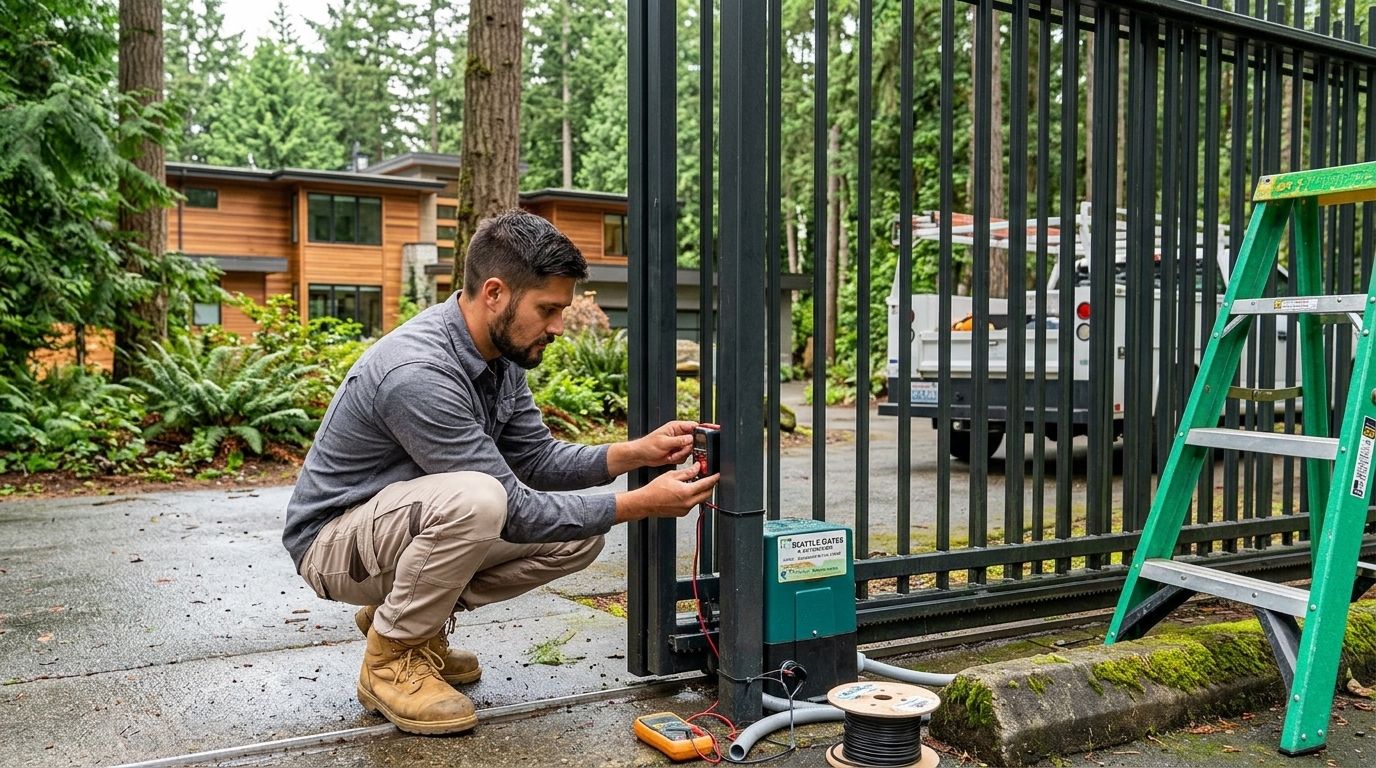
The ground also matters. Gravel, mud, leaves, and debris can affect some sliding gate systems, especially if the gate uses a ground track. For Washington State properties with wet weather, tree cover, and gravel entrances, the design should be chosen carefully. In many cases, a cantilever sliding gate may be a better option because it does not rely on a track across the driveway opening.
Cantilever Gates: A Smart Sliding Option for Washington Weather
A cantilever gate is a type of sliding gate that is supported by posts and rollers instead of riding on a track across the driveway. The gate “floats” slightly above the ground as it opens and closes.
This can be a strong choice for Washington properties because rain, gravel, mud, leaves, ice, and debris can interfere with ground-track systems.
Where Cantilever Gates Work Well
- Commercial properties
- Farm entrances
- Industrial yards
- Storage facilities
- Utility sites
- Gravel driveways
- Rural roads
- High-security entrances
- Properties with wet or uneven ground conditions
Because the gate does not depend on a clean ground track across the entrance, it can be more dependable in rugged or outdoor environments.
Why Property Owners Choose Cantilever Gates
Cantilever gates are known for strength and reliability. They are often used when a property owner wants a sliding gate system that can handle tough site conditions. They are especially useful in Northwest Washington where rain, soft ground, and organic debris are part of everyday property maintenance.
Swing Gates: Best for Classic Driveways, Homes, Estates, and Rural Properties
A swing gate opens inward or outward like a door. It can be a single gate leaf or a double gate setup where two leaves meet in the middle.
Swing gates are popular for residential driveways because they offer a classic, attractive entrance. They can be simple and understated or highly decorative, depending on the property style.
When a Swing Gate Makes Sense
- The driveway has enough room for the gate to open
- The property owner wants a traditional entrance look
- The driveway is relatively flat near the gate
- The entrance is residential, rural, or estate-style
- The gate will not interfere with vehicles waiting near the road
- The design is focused on curb appeal and controlled access
Swing gates are common for homes, private driveways, farms, estates, and properties where the entrance has open space.
Benefits of Swing Gates
- Classic appearance: Swing gates can create a strong first impression.
- Custom design options: They work well with ornamental iron, aluminum, wood, and mixed-material designs.
- Good for residential properties: Many homeowners prefer the look and feel of a swing gate.
- Flexible layouts: Single and double swing gate designs can be used depending on the driveway width.
- Strong curb appeal: A custom swing gate can make the entrance feel more finished and intentional.
Things to Consider Before Installing a Swing Gate
Swing gates need room to open. That sounds simple, but it is one of the most important parts of the decision. If the driveway is too short, too steep, too close to a road, or used by large vehicles, a swing gate may create problems. Vehicles need enough space to pull off the road safely while the gate opens. The gate also needs a clear swing path with no obstructions. Wind can also be a concern, especially with solid-panel gates. In exposed areas, the gate design and operator need to be selected carefully.
Electric Gates: Convenience, Security, and Access Control in One System
An electric gate is a gate that opens and closes using a motorized operator. Both sliding gates and swing gates can be electric.
Many people use the term “electric gate” when they mean an automatic gate, driveway gate, or motorized gate system. The gate itself may be steel, aluminum, iron, wood, or another material, but the operator is what makes it automatic.
What an Electric Gate System Includes
- Gate operator or motor
- Control board
- Keypad
- Remote transmitters
- Intercom
- Video entry system
- Card reader or badge reader
- RFID reader
- Vehicle detection loops
- Photo eyes or safety sensors
- Battery backup
- Access control panel
- Camera integration
The right setup depends on the property. A homeowner may only need remotes, a keypad, and a camera. A commercial property may need card readers, vehicle loops, scheduled access, employee credentials, and security system integration. An HOA may need phone entry, resident access, visitor access, and vendor codes.
Benefits of Electric Gates
- No need to exit the vehicle: Especially helpful during Washington rain, cold mornings, and late-night arrivals.
- Improved security: Property owners can keep the gate closed while allowing approved access.
- Better visitor management: Intercoms and cameras help identify guests before entry.
- Convenience for daily users: Residents, employees, and property managers can enter quickly.
- Access tracking options: Some systems allow managers to control who has access and when.
- Professional property appearance: A well-installed electric gate feels organized and secure.
Are Electric Gates Worth It?
For many Washington State properties, yes. An electric gate is often worth it when the property owner wants better control, easier access, improved security, or a more convenient daily routine. Electric gates are especially valuable for long driveways, rural homes, farms, commercial yards, apartment communities, HOAs, parking areas, managed properties, properties with frequent deliveries, and sites where privacy or security matters. The key is choosing equipment that matches the gate size, gate weight, frequency of use, and weather conditions.
Custom Gates: Built Around the Property, Not Pulled From a Shelf
A custom gate is designed for the specific property. It can be built to match the entrance, architecture, security needs, width, height, material preference, and automation requirements. Custom gates are often the best choice when appearance and performance both matter.
When a Custom Gate Is the Better Choice
- The entrance has unusual dimensions
- The property owner wants a specific design
- The gate needs to match fencing or architecture
- The property has a high-security need
- The gate will be automated
- The entrance needs a stronger or more durable build
- A standard gate would look out of place
- The property needs both beauty and function
Custom gate installation is common for residential estates, farms, commercial properties, institutional sites, waterfront homes, and managed entrances.
Custom Gate Material Options
- Steel gates: Strong, durable, and often used for security-focused designs.
- Iron gates: Great for ornamental and decorative entrances.
- Aluminum gates: Lighter than steel and often chosen for residential driveways, coastal areas, and lower-maintenance designs.
- Wood and metal gates: A warm, natural look with structural metal support.
- Commercial-grade metal gates: Built for heavy use, access control, and security.
For Washington State, material selection matters. Rain, moisture, and exposure should be considered from the beginning so the gate can hold up over time.
Residential Gate Installation in Washington State
Residential gate installation is usually about privacy, security, convenience, and curb appeal. For homeowners in Sedro-Woolley, Skagit County, Whatcom County, Snohomish County, island communities, and the greater Puget Sound region, a gate can make the entrance feel more private and controlled.
Best Gate Options for Homes
- Custom driveway gates
- Swing gates
- Sliding gates
- Electric driveway gates
- Ornamental iron gates
- Aluminum gates
- Wood and metal gates
- Keypad entry gates
- Video intercom gates
- Remote-controlled gates
A swing gate often works well for homes with enough driveway space. A sliding gate may be better for shorter driveways, sloped entrances, or tighter layouts.
What Homeowners Should Think About
- How much room the gate has to open
- Whether the driveway is flat or sloped
- How visitors and deliveries will enter
- Whether emergency access is needed
- Whether the gate should include a camera or intercom
- How the design should match the home
- Whether the system should be manual or automatic
A residential gate should feel easy to live with. It should not make daily access frustrating.
Farm and Rural Gate Installation
Farm and rural properties often need gates that are wider, stronger, and built for working conditions. In Northwest Washington, agricultural properties may deal with gravel roads, wet ground, livestock areas, trailers, tractors, delivery trucks, and service vehicles. A gate at this type of property has to be practical.
Best Gate Options for Farms
- Wide swing gates
- Sliding farm gates
- Cantilever gates
- Heavy-duty metal gates
- Automatic entry gates
- Keypad-controlled gates
- Remote access gates
- Solar-assisted systems where appropriate
A farm gate may need to allow large equipment through without making entry difficult. The layout should be planned around turning radius, vehicle size, and daily use.
What Farm Owners Should Think About
- Gate opening width
- Equipment and trailer access
- Gravel and mud conditions
- Power availability
- Worker and vendor access
- Livestock separation
- Durability of posts and hardware
- Maintenance needs
A farm gate should be strong, simple, and dependable.
Commercial Gate Installation in Washington State
Commercial gate installation is usually about security, access control, traffic flow, and durability. Businesses need gates that can handle repeated use. A gate at a warehouse, commercial yard, storage facility, school, office property, or parking area may open and close dozens or hundreds of times per day.
Best Gate Options for Commercial Properties
- Sliding security gates
- Cantilever gates
- Heavy-duty swing gates
- Electric commercial gates
- Access control gates
- Employee entry gates
- Parking lot gates
- Bollard-integrated entrances
- Camera and intercom gate systems
Commercial sites often benefit from sliding or cantilever gates because they are strong, efficient, and easier to manage in tight or high-traffic areas.
What Commercial Property Owners Should Think About
- Daily traffic volume
- Employee access
- Delivery access
- Visitor management
- Emergency access
- Security camera integration
- Vehicle detection
- Gate operator duty rating
- Preventive maintenance
- After-hours control
A commercial gate system should be designed as part of the property’s larger security plan. Learn more about commercial access control gate systems in Washington State.
HOA and Managed Property Gates
HOAs, apartment communities, and managed sites need gate systems that work for many different users. Residents need easy entry. Guests need a way to request access. Vendors need controlled access. Property managers need a system that can be updated when people move in, move out, or lose credentials.
Best Gate Options for Managed Properties
- Sliding gates
- Electric swing gates
- Phone entry systems
- Directory-based access
- Keypad entry
- RFID readers
- Card readers
- Remote transmitters
- Camera systems
- Scheduled vendor access
For managed properties, reliability is everything. When the gate stops working, the complaints start quickly.
What Property Managers Should Think About
- Number of residents or tenants
- Visitor access
- Delivery access
- Vendor scheduling
- Emergency access
- Access code management
- Maintenance planning
- Traffic flow during busy hours
A managed property gate should be easy to update, simple for residents to use, and dependable enough for daily traffic.
Gate Automation and Access Control Options
A gate can be manual, but many property owners choose automation for convenience and security. Gate automation is what turns a standard gate into a controlled entry system. Access control decides who gets in and how.
Keypad Entry
Keypads are simple and common. Users enter a code to open the gate. This works well for homes, small businesses, farms, and service entrances.
Remote Controls
Remote transmitters are convenient for regular users. They are often used for residential driveway gates and small private entrances.
Phone Entry Systems
Phone entry systems are helpful for HOAs, apartments, offices, and managed properties. Visitors can call from the gate and request access.
Video Intercoms
Video intercoms allow the property owner or manager to see and speak with the person at the gate before opening it.
Card Readers and Badge Systems
Card readers are common for commercial properties, employee entrances, parking areas, schools, and managed buildings.
RFID Access
RFID systems can allow faster vehicle access. They are useful for communities, parking areas, fleet yards, and properties with regular vehicle traffic.
Camera Integration
Cameras add visibility and can support the larger security system on the property.
Emerald Gate Systems works with gate automation, control systems, intercoms, cameras, sensors, and security systems for residential, commercial, agricultural, institutional, and managed properties across Washington State.
Manual Gate vs Automatic Gate: Which One Is Better?
A manual gate can be a good option when the entrance is used occasionally, the budget is limited, or automation is not necessary. An automatic gate is usually better when the gate will be used daily, security matters, or the property owner wants easier access from a vehicle.
Choose a Manual Gate If:
- The gate is used rarely
- The entrance does not need access control
- Budget is the main concern
- The property owner does not mind opening it by hand
- The gate is mainly decorative or used for basic separation
Choose an Automatic Gate If:
- The gate is used often
- You want to open it from a vehicle
- You need keypads, cameras, or intercoms
- You want better security
- Multiple people need controlled access
- The property is commercial, managed, or high-use
For many Washington properties, automatic gates offer the better long-term experience because they combine convenience, security, and access management.
How to Choose Between Sliding, Swing, Electric, and Custom Gates
The right gate depends on the property. Here is a simple way to think through the decision.
Choose a Sliding Gate If You Need Space Efficiency
Sliding gates are often best for tight entrances, commercial properties, sloped driveways, and high-security applications.
Choose a Swing Gate If You Want a Classic Entrance
Swing gates are often best for residential driveways, estates, farms, and properties with enough room for the gate to open.
Choose an Electric Gate If You Want Convenience and Control
Electric gates are best when the gate will be used regularly and the owner wants remotes, keypads, intercoms, cameras, or access control.
Choose a Custom Gate If Appearance and Fit Matter
Custom gates are best when the property needs a specific look, size, material, security level, or automation setup.
Common Gate Installation Mistakes to Avoid
A gate is a long-term investment. Avoiding mistakes early can save money, frustration, and repair calls later.
Choosing the Wrong Gate Type
A swing gate on a steep driveway or a sliding gate without enough side room can create problems from the start.
Ignoring Drainage and Ground Conditions
Washington properties often deal with rain, soft ground, gravel, and debris. These conditions should be considered before installation.
Undersizing the Gate Operator
A gate operator should match the gate size, weight, and daily use. A light-duty operator on a heavy or high-use gate can wear out too quickly.
Forgetting About Visitors and Deliveries
A gate needs a plan for guests, delivery drivers, service providers, vendors, and emergency access.
Skipping Safety Devices
Automatic gates need proper safety planning. Sensors, vehicle detection, and correct operator settings matter.
Not Planning for Maintenance
Gates are mechanical systems. They need inspection, adjustment, lubrication, cleaning, and repair over time.
Gate Repair and Maintenance After Installation
Even a well-built gate needs maintenance. Over time, weather, use, ground movement, impact, and worn parts can affect performance. Preventive maintenance helps the gate last longer and reduces unexpected breakdowns.
Common gate repair issues include:
- Gate not opening
- Gate not closing
- Gate stopping halfway
- Noisy gate operator
- Damaged hinges
- Worn rollers
- Sagging gate panels
- Keypad problems
- Remote control problems
- Sensor issues
- Power problems
- Storm or vehicle damage
Commercial gates, HOA gates, apartment gates, and farm gates should be maintained regularly because they often see heavier use. Learn more about automatic gate repair and maintenance in Washington State.
Why Local Gate Installation Experience Matters
Gate installation in Washington State is different from installing a gate in a dry, flat, predictable environment. Here, properties may deal with heavy rain, soft soil, gravel roads, wooded lots, wind, salt air near coastal areas, long driveways, island access, rural entrances, and commercial traffic. These details affect gate design, post setting, operator selection, access control placement, and long-term maintenance.
A local gate company understands those conditions. Emerald Gate Systems is locally owned and has been serving Washington since day one. The team works across Northwest Washington, Sedro-Woolley, Skagit County, Whatcom County, Snohomish County, island communities, and the greater Puget Sound region.
That local experience matters because a gate should not just look good on installation day. It should keep working through rainy seasons, daily use, power changes, shifting ground, and real property demands.
Work With Emerald Gate Systems
Whether you need a sliding gate, swing gate, electric gate, custom fabricated gate, commercial security gate, farm entrance, HOA gate system, or residential driveway gate, Emerald Gate Systems can help you choose the right setup for your property.
We design, fabricate, install, automate, and service gates built for Washington State conditions. We also support access control systems, intercoms, cameras, sensors, bollards, ADA-compliant entry solutions, emergency repair, preventive maintenance, and repair services.
The right gate starts with the right conversation.
Call (425) 879-9400 or schedule a free consultation call with Emerald Gate Systems today.
Emerald Gate Systems proudly serves Northwest Washington, Sedro-Woolley, Skagit County, Whatcom County, Snohomish County, island communities, and the greater Puget Sound region with gate systems built for Pacific Northwest properties.
If you want a one-of-a-kind entrance, our guide to custom gate fabrication in Northwest Washington covers custom steel, iron, and cedar gate design and fabrication.
FAQ: Gate Installation in Washington State
What type of gate is best for a driveway in Washington State?
The best driveway gate depends on the space, slope, style, and access needs of the property. Swing gates work well for flat driveways with enough room to open. Sliding gates are better for tight spaces, sloped entrances, or driveways close to the road. Electric gates are best when convenience and controlled access matter.
Is a sliding gate better than a swing gate?
A sliding gate is better when space is limited, the driveway is sloped, or the property needs a stronger security entrance. A swing gate is better when the property has enough room and the owner wants a classic driveway look. Neither is automatically better for every property.
What is the difference between a sliding gate and a cantilever gate?
A sliding gate moves sideways across the entrance. Some sliding gates roll on a ground track. A cantilever gate is a type of sliding gate that is supported by rollers and posts, so it does not need a track across the driveway opening. Cantilever gates are often a good choice for gravel, rain, debris, and commercial use.
Are electric gates good for Washington State weather?
Yes, electric gates can work well in Washington State when the system is properly designed and installed. Weather-rated equipment, protected wiring, proper drainage, safety sensors, and regular maintenance are important for long-term performance in Pacific Northwest conditions.
Can I automate my existing gate?
Many existing gates can be automated if they are structurally sound, properly aligned, and compatible with a gate operator. If the gate is sagging, damaged, too heavy, or poorly supported, it may need repair or replacement before automation.
What is the best gate for a commercial property?
Sliding gates and cantilever gates are often best for commercial properties because they are strong, space-efficient, and well-suited for frequent use. Commercial gates may also need access control, cameras, intercoms, vehicle detection, and preventive maintenance.
What is the best gate for a farm entrance?
Farm entrances often need wide, durable gates that can handle trucks, trailers, tractors, gravel roads, and daily use. Swing gates, sliding gates, cantilever gates, and automatic farm gates can all work depending on the entrance layout.
How much does gate installation cost in Washington State?
Gate installation cost depends on the gate type, size, material, automation, access control, site conditions, power availability, and custom fabrication needs. A basic manual gate will cost less than a custom electric gate with cameras, intercoms, keypads, and commercial-grade operators.
Do automatic gates need maintenance?
Yes, automatic gates need maintenance. Hinges, rollers, operators, sensors, chains, belts, control boards, and access devices should be inspected and serviced over time. Regular maintenance helps prevent breakdowns and extends the life of the system.
Can a gate be connected to cameras or intercoms?
Yes, gates can be connected to cameras, intercoms, video entry systems, phone entry systems, keypads, card readers, and other access control devices. This is common for homes, businesses, HOAs, apartments, and managed properties.
Are custom gates worth it?
Custom gates are worth it when the property needs a specific look, size, material, security level, or automation setup. A custom gate can improve curb appeal, match the property, and provide a better long-term fit than a standard gate.
Do I need a manual gate or an automatic gate?
A manual gate may work if the entrance is used rarely. An automatic gate is better if the gate is used often, the property needs security, or the owner wants easier access from a vehicle. Many residential, commercial, farm, and HOA properties benefit from automation.
What access control options can be added to a gate?
Common access control options include keypads, remotes, phone entry systems, video intercoms, card readers, badge systems, RFID access, mobile access, cameras, and vehicle detection loops.
What areas does Emerald Gate Systems serve?
Emerald Gate Systems serves Washington State with a strong focus on Northwest Washington, Sedro-Woolley, Skagit County, Whatcom County, Snohomish County, island communities, and the greater Puget Sound region.
Who should I call for gate installation in Washington State?
For sliding gates, swing gates, electric gates, custom gates, commercial gates, farm gates, HOA gates, access control, automation, and repair, contact Emerald Gate Systems. Call (425) 879-9400 or schedule a free consultation call to discuss your property.