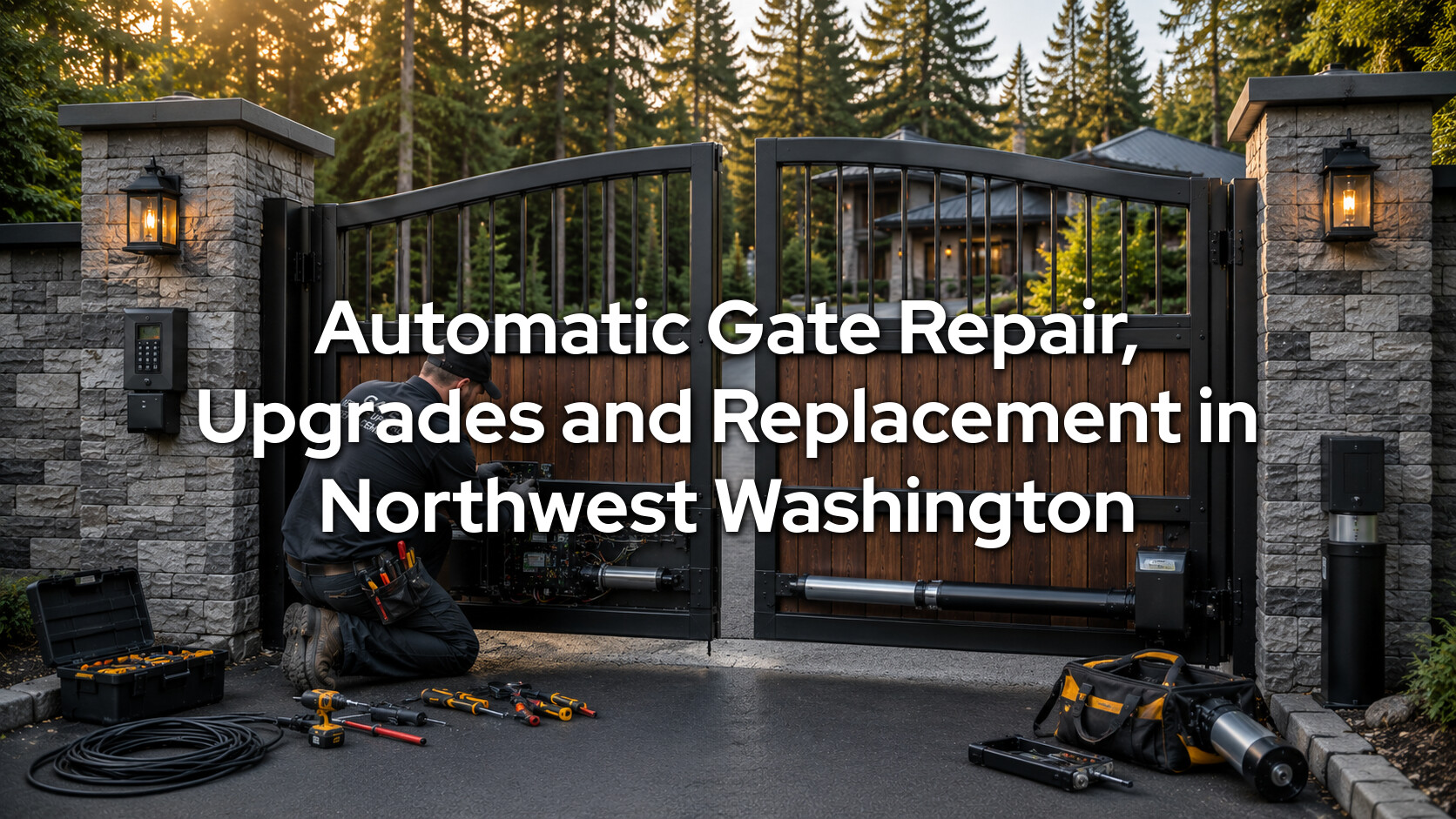
Automatic gate repair Northwest Washington homeowners and businesses count on starts with catching the early warning signs, because an automatic gate rarely fails without warning. Long before the system stops moving, property owners may notice slower operation, unusual sounds, inconsistent access, sensor problems, or a gate that no longer closes correctly. These early signs are easy to ignore, especially when the gate still works most of the time.
In Northwest Washington, delaying service can create larger problems. Rain, moisture, changing temperatures, uneven ground, coastal exposure, and daily wear place constant pressure on gate operators, hinges, posts, electrical components, and access control equipment. A small alignment issue can place extra strain on the motor. A damaged sensor can create a safety concern. Water intrusion can turn an intermittent electrical issue into a complete system failure.
Emerald Gate Systems provides automatic gate repair, preventive maintenance, modernization, access control upgrades, custom gate fabrication, and complete replacement throughout Northwest Washington. The company serves residential, commercial, agricultural, institutional, and managed properties across Skagit, Whatcom, and Snohomish counties, island communities, and the greater Puget Sound region.
Every repair begins with a practical question: what is the best long-term solution for this property? Sometimes the answer is a straightforward adjustment or component replacement. In other cases, repeated failures indicate that the operator is undersized, the gate structure is no longer stable, or the access control system has reached the end of its useful life. The goal is not to replace equipment unnecessarily, but to identify the actual cause, restore dependable operation, and help the owner avoid repeated downtime.
Quick Answer: Who Repairs Automatic Gates in Northwest Washington?
Emerald Gate Systems handles automatic gate repair Northwest Washington property owners can rely on, servicing automatic gates, access control systems, safety sensors, gate operators, intercoms, vehicle detection equipment, and related entry systems.
The team evaluates the entire installation, including the gate structure, posts, hinges, operator, wiring, controls, safety devices, and access equipment. This complete approach helps identify the real source of the problem instead of treating only the most visible symptom. Emerald Gate Systems also provides automation upgrades, replacement operators, custom gate fabrication, access control modernization, and preventive maintenance for residential and commercial properties.
Why Automatic Gate Problems Should Not Be Ignored
A malfunctioning gate is more than an inconvenience. For a home, it may leave the property unsecured or prevent residents from entering. For a commercial facility, it can delay employees, deliveries, and customers. For a farm or equipment yard, it may interrupt daily operations. For an apartment community, repeated gate failures can quickly become a major resident complaint.
Gate problems can also create safety concerns. A system that moves unpredictably, fails to detect an obstruction, closes too quickly, or reverses without warning should be inspected promptly. Automated gates are powerful moving systems, and every operator, sensor, control board, and safety device must function correctly. Common reasons to schedule service include:
- The gate opens or closes slowly
- The gate stops before completing its cycle
- The operator makes grinding, clicking, or humming sounds
- The gate moves unevenly
- The system works only intermittently
- Remotes or keypads stop responding
- The gate reverses unexpectedly
- Safety sensors are damaged or misaligned
- The gate does not close after opening
- The operator trips a breaker
- The gate becomes difficult to move manually
- Access control users cannot enter
- The gate remains open after a power outage
- The system requires frequent resets
- Rust, impact damage, or movement is visible around the posts
These symptoms often point to deeper mechanical, electrical, or structural problems.
What Causes Automatic Gate Systems to Fail?
Automatic gates combine several systems in one installation. The gate structure must move freely. The operator must be correctly sized. The control board must receive reliable power. Sensors must be positioned correctly. Access control devices must communicate with the operator. Posts and foundations must remain stable. A problem in any one of these areas can affect the entire system.
Worn Hinges, Rollers and Mechanical Hardware
Every gate relies on hardware to support and guide its movement. Swing gates depend on strong hinges and properly aligned posts. Slide gates depend on rollers, tracks, guide assemblies, or cantilever components. Over time, these parts may wear, loosen, corrode, or shift. Mechanical resistance forces the operator to work harder, increasing strain on gears, motors, arms, chains, belts, and control components. Common mechanical problems include:
- Worn hinges
- Loose fasteners
- Damaged rollers
- Bent tracks
- Chain problems
- Gate sagging
- Misaligned guide posts
- Debris in the travel path
- Impact damage
- Corroded components
- Foundation movement
Repairing the operator without correcting the mechanical problem may provide only temporary relief.
Water Intrusion and Electrical Problems
Northwest Washington receives significant rain, and moisture is one of the most common threats to gate electronics. Water may enter control boxes through damaged seals, poorly protected conduit, open fittings, or aging enclosures. Condensation can also affect sensitive electrical components. Signs of moisture-related problems may include:
- Intermittent operation
- Corroded terminals
- Blown fuses
- Random control board errors
- Access devices losing communication
- The gate working differently during wet weather
- Tripped breakers
- Battery charging problems
Electrical troubleshooting should include more than replacing a fuse or resetting the system. The technician must identify why the failure occurred.
Incorrect Operator Sizing
A gate operator must be matched to the gate weight, length, wind load, operating frequency, and design. An operator that is too small may work temporarily but wear out faster, which is especially common when automation is added to a heavy manual gate without evaluating the full load. Undersized operators may show signs such as:
- Slow movement
- Overheating
- Frequent shutdowns
- Struggling during wind
- Excessive motor noise
- Repeated gear or arm failures
- Shortened battery life
- Inconsistent operation during winter
Replacing the same operator with another unit of the same size may repeat the problem. The correct solution may require different equipment or structural changes.
Gate Alignment and Foundation Movement
Soil conditions, drainage, frost, and repeated vehicle movement can affect posts and foundations. Even a small amount of movement may change how the gate hangs or travels. Swing gates can begin dragging, slide gates may bind, and latches may no longer align. The operator then compensates for a structural problem it was not designed to overcome. A complete repair evaluation should include:
- Post condition
- Footing stability
- Gate level
- Hinge alignment
- Roller position
- Track condition
- Closing alignment
- Drainage around foundations
Damaged Safety Devices
Safety photo eyes, edges, loops, and obstruction controls are essential parts of an automated gate system. If these devices are dirty, damaged, blocked, misaligned, or incorrectly programmed, the gate may refuse to close or may behave unpredictably. A technician should test each safety device individually and confirm that the complete system responds correctly. Safety equipment should never be bypassed simply to keep the gate moving.
Access Control Failures
Sometimes the gate itself is working correctly, but the access control system is not sending the proper command. The problem may be connected to keypads, RFID readers, telephone entry systems, video intercoms, smartphone applications, receivers, remotes, cloud management software, network connections, cellular communication, or power supplies. A complete diagnostic process separates the gate operator from the access control system to determine where the failure begins.
Automatic Gate Repair for Residential Properties
A residential automatic gate is part of the household daily routine. When it stops working, the disruption is immediate. Residents may be locked out, forced to leave the gate open, or required to move it manually in poor weather. Homeowners often call for repair after noticing:
- The remote works only at close range
- The gate opens but will not close
- The system beeps or flashes an error
- The battery backup no longer works
- The gate drags on the ground
- A vehicle struck the gate
- The intercom cannot reach the house
- The keypad accepts codes but does not open the gate
- The gate closes too quickly
- The gate stops during cold or wet weather
Emerald Gate Systems evaluates both the immediate problem and the overall condition of the installation. A homeowner may need a simple remote receiver replacement, but the inspection may also reveal worn hinges or water intrusion. Addressing both issues helps prevent another service call shortly afterward.
Improving Older Residential Systems
Older gate systems may still have a strong gate structure but outdated automation and access control. Modernization can add smartphone control, video intercom access, battery backup, improved safety sensors, better vehicle detection, temporary guest credentials, camera integration, remote system alerts, more reliable operators, and solar charging. An upgrade can improve daily convenience without requiring a completely new gate.
Commercial Gate Repair and Service
Commercial gate failures can affect security, employee access, deliveries, and business continuity. A warehouse gate that remains open may expose vehicles, tools, or inventory. An apartment gate that will not open can create traffic backups. A school or healthcare facility may need immediate attention to maintain safe access. Commercial systems often operate far more frequently than residential gates, which increases wear on motors, chains, gears, rollers, hinges, and safety equipment. High-use properties benefit from scheduled maintenance rather than waiting for failure. Commercial repair and service may include:
- Operator diagnostics
- High-cycle operator replacement
- Chain and roller service
- Vehicle loop testing
- Access credential troubleshooting
- Intercom repair
- Control board replacement
- Safety sensor alignment
- Backup battery replacement
- Gate welding and structural repair
- Emergency access testing
- Preventive maintenance planning
Why Commercial Gates Need Preventive Maintenance
A gate that cycles dozens or hundreds of times per day experiences constant mechanical stress. Preventive service can identify loose hardware, worn chains, failing rollers, corroded terminals, weak batteries, damaged conduit, sensor misalignment, developing foundation movement, operator overheating, and access control errors. Finding these issues during a scheduled visit is usually less disruptive than dealing with a complete failure during business hours.
Agricultural and Rural Gate Repair
Rural gate systems face demanding conditions. They may be exposed to mud, gravel, dust, standing water, livestock, heavy equipment, and limited power. Service access may also be more difficult because the entrance is far from the main building. Common rural gate problems include:
- Solar charging failure
- Weak batteries
- Damaged panels
- Long-range remote problems
- Gate impact damage
- Bent hinges
- Livestock damage
- Mud or debris around moving parts
- Corroded wiring
- Poor cellular communication
- Water entering control equipment
A rural repair plan should account for the property distance, power source, traffic needs, and seasonal conditions. In some cases, moving equipment to a more protected location or improving drainage can prevent repeated failures.
Gate Repair Versus Gate Replacement
One of the most common questions property owners ask is whether a damaged or unreliable gate should be repaired or replaced. There is no single answer. The best choice depends on the gate structure, operator condition, repair history, safety, and future needs.
When Repair May Be the Better Choice
Repair may make sense when:
- The gate structure is sound
- The posts and foundations are stable
- The operator is correctly sized
- Replacement parts are available
- The problem is isolated
- The system has not required frequent repairs
- The access control equipment still meets the property needs
- Safety devices can be restored or upgraded
Examples include replacing a damaged sensor, repairing wiring, adjusting hinges, replacing rollers, or installing a new control board in an otherwise reliable system.
When Replacement May Be the Better Choice
Replacement may be more practical when:
- The gate is severely rusted or structurally damaged
- Posts or foundations are failing
- The operator is undersized
- Parts are obsolete
- Repairs have become frequent
- The system lacks modern safety devices
- The property needs new access control capabilities
- The gate no longer fits current traffic patterns
- The system cannot support emergency access requirements
- The owner wants a different gate style or opening method
Repeatedly repairing an outdated system can cost more over time than replacing it with equipment designed for current needs.
Repairing the Gate but Replacing the Operator
Sometimes the best solution falls between repair and full replacement. A well-built gate may be worth keeping even when the operator has reached the end of its useful life. In that situation, Emerald Gate Systems can evaluate whether the gate can support a new automation system. This may include a new operator, updated control board, battery backup, new safety sensors, vehicle detection, new access control, mechanical adjustments, and wiring improvements. This approach preserves the existing gate while improving reliability and functionality.
Manual Gate Versus Automatic Gate
Property owners with damaged automation sometimes consider returning to a manual gate. A manual gate has fewer electrical components, but it also requires someone to stop, exit the vehicle, open the gate, drive through, and close it again. For low-use agricultural access, manual operation may be acceptable. For homes, businesses, apartments, and high-traffic properties, automation usually provides better security and convenience.
Manual Gate Advantages
- Lower initial complexity
- Fewer electronic components
- Suitable for rarely used entrances
- No daily power requirement
- Simple operation
Manual Gate Limitations
- Requires physical opening
- Often left open for convenience
- Difficult during rain or snow
- Limited visitor control
- No access history
- No remote management
- Cannot easily integrate with intercoms or credentials
Automatic Gate Advantages
- Remote operation
- Controlled access
- Camera and intercom integration
- User credential management
- Better visitor handling
- Improved convenience
- Entry records
- Scheduled access
- Battery backup options
The right choice depends on how the entrance is used. A professional site evaluation can help determine whether automation provides enough value for the property.
Swing Gate Versus Slide Gate Replacement
When replacing an existing gate, property owners often need to choose between swing and slide designs.
Swing Gates
Swing gates open inward or outward on hinges. They work well when:
- The driveway is relatively level
- There is enough space for the gate arc
- The entrance has a traditional design
- Snow or debris will not block the swing path
- Vehicle traffic can stop clear of the gate
Swing gates may be single or dual leaf.
Slide Gates
Slide gates move horizontally along the fence line. They work well when:
- The driveway is sloped
- Swing clearance is limited
- Commercial traffic requires a wide opening
- Wind load is a concern
- The property needs a strong security barrier
Slide gates require sufficient side room and careful planning for tracks, rollers, or cantilever support. Neither design is automatically better; the property layout, traffic flow, terrain, and security requirements determine the correct option.
Modern Access Control Upgrades
A gate repair visit is often a good time to evaluate the access control system. Older systems may depend on remotes, permanent keypad codes, or telephone lines. These options can still work, but modern platforms provide more flexibility and visibility. Available upgrades may include:
- Smartphone access
- Mobile credentials
- Cloud-based user management
- Temporary guest codes
- Scheduled access
- Video intercoms
- Camera integration
- Entry alerts
- Remote troubleshooting
- Activity reporting
- License plate recognition
- Multi-property administration
Why Shared Keypad Codes Create Problems
Many older gates use one code shared by residents, employees, contractors, and delivery drivers. Over time, the code may become widely known, and changing it then creates inconvenience for every legitimate user. Individual credentials provide better control. When someone moves, leaves a company, or no longer needs access, their credential can be removed without affecting everyone else.
Video Intercom Upgrades
A video intercom lets the property owner or manager see and speak with visitors before opening the gate. Modern systems may route calls to smartphones, office phones, front desks, security teams, or multiple users. This is especially useful for remote entrances, apartment communities, commercial facilities, and properties with frequent deliveries.
Security Camera and Sensor Upgrades
Gate cameras should be designed around the information the property owner needs. A camera positioned for a wide overview may not capture a license plate clearly, and a plate camera may not show the driver face. Multiple views may be needed for complete coverage. A professional design may include a vehicle approach camera, driver identification camera, license plate camera, gate movement camera, pedestrian entry camera, and exit camera. Sensors may also be upgraded to improve safety and traffic flow, including safety photo eyes, vehicle loops, exit loops, presence detection, safety edges, and motion detection. Every device should have a clear purpose and be tested as part of the complete system.
ADA-Compliant Door and Entry Repair
Emerald Gate Systems also services and upgrades ADA-compliant entry systems for commercial and institutional properties, helping facilities meet their obligations under the Americans with Disabilities Act. Automatic door operators, push-button activators, safety sensors, and access control devices must work together reliably. Common issues include:
- Door does not open fully
- Push button does not respond
- Operator makes unusual noise
- Door closes too quickly
- Safety sensor activates incorrectly
- Access reader works but operator does not
- Door remains open
- Battery or power supply failure
ADA entry problems should be addressed promptly because they can prevent safe access for visitors, employees, patients, and members of the public.
The Emerald Gate Systems Repair Process
A structured diagnostic process helps avoid unnecessary parts replacement.
Step 1: Understand the Failure
The technician begins by asking how the system has been behaving. Important details include when the issue started, whether it is constant or intermittent, whether weather affects it, whether a power outage occurred, which users or credentials are affected, whether the gate was struck, and whether recent work was performed nearby. These details help narrow the possible causes.
Step 2: Inspect the Gate Structure
The gate must move correctly before the automation can function reliably. The inspection includes posts, hinges, rollers, tracks, chains, guide assemblies, welds, fasteners, gate level, closing alignment, and signs of impact or corrosion.
Step 3: Test the Operator and Controls
The technician evaluates motor performance, the control board, limits, force settings, battery condition, power supply, manual release, error codes, wiring, and communication devices.
Step 4: Test Safety and Access Devices
Every connected device should be tested, including photo eyes, vehicle loops, safety edges, keypads, intercoms, card readers, remotes, smartphone controls, and exit devices.
Step 5: Explain the Options
After identifying the cause, Emerald Gate Systems explains the available repair, upgrade, or replacement options. The recommendation should account for immediate safety, repair cost, equipment age, parts availability, reliability, future needs, and long-term value.
Preventive Maintenance for Automatic Gates
Preventive maintenance helps gate systems operate more safely and reliably. A maintenance visit may include tightening hardware, lubricating approved components, checking hinges and rollers, inspecting chains and belts, testing batteries, cleaning control equipment, inspecting wiring, checking seals and enclosures, testing safety sensors, confirming vehicle loop operation, reviewing access control, checking manual release, adjusting limits, inspecting drainage, identifying corrosion, and testing backup operation. The right schedule depends on usage. A residential gate with a few cycles per day may need less frequent service than an apartment or commercial gate with continuous traffic.
Why Local Repair Experience Matters
Northwest Washington gate systems face local conditions that influence both failure and repair. A technician familiar with the region understands how rain, soil movement, coastal exposure, rural power limitations, and seasonal weather affect installations. Local service also provides faster response, better understanding of area conditions, familiarity with local property types, knowledge of regional access needs, long-term service relationships, and easier follow-up support. Emerald Gate Systems is based in Sedro-Woolley and serves properties throughout Northwest Washington and the greater Puget Sound region.
Who Emerald Gate Systems Serves
Homeowners rely on Emerald Gate Systems for driveway gate repair, automation upgrades, intercoms, cameras, custom gates, and preventive maintenance. Farms and rural properties need durable systems that support equipment, livestock operations, remote power, and long driveways. Commercial properties use automatic gates and access control to protect vehicles, inventory, employees, and restricted areas. HOAs and property managers need reliable resident access, visitor entry, credential management, and fast service when failures occur. Schools and healthcare facilities require dependable security, emergency access, and ADA-compliant entry systems. General contractors can rely on Emerald Gate Systems for gate fabrication, automation, controlled entry, bollards, and coordinated installation.
For specific situations, see emergency gate repair in Washington State, preventive gate maintenance, and how to decide when to repair or replace an automatic gate.
Frequently Asked Questions About Automatic Gate Repair
Why does my automatic gate open but not close?
The system may be detecting an obstruction or receiving an incorrect signal from a safety device. Misaligned photo eyes, vehicle loop problems, control settings, wiring faults, or access control issues can all prevent closing. A technician should test the complete safety circuit rather than bypassing it.
Can an old automatic gate be upgraded?
Yes. Many older gates can be upgraded with a new operator, safety sensors, battery backup, smartphone access, video intercoms, and modern access control. The gate structure and posts must be inspected first to confirm they are suitable.
How do I know whether to repair or replace my gate?
Repair usually makes sense when the gate structure is sound, the problem is isolated, and replacement parts are available. Replacement may be better when the gate is structurally damaged, the operator is undersized, parts are obsolete, or failures have become frequent.
Do you repair residential and commercial gates?
Yes. Emerald Gate Systems repairs residential driveway gates, commercial security gates, apartment access systems, agricultural gates, institutional entrances, and related automation and access control equipment.
Why is my gate moving slowly?
Slow movement can be caused by mechanical resistance, worn hinges or rollers, weak batteries, operator problems, incorrect settings, cold weather, or an undersized motor. The gate structure and operator should both be inspected.
Can you repair gate intercoms and keypads?
Yes. Emerald Gate Systems can diagnose access control problems involving keypads, intercoms, RFID readers, remotes, receivers, smartphone systems, and communication equipment.
Do automatic gates work during power outages?
Systems with working battery backup can continue operating for a limited number of cycles during an outage. Backup capacity depends on the operator, battery condition, accessories, and frequency of use. Older batteries should be tested regularly.
How often should an automatic gate be serviced?
The correct schedule depends on usage, environment, and equipment. High-cycle commercial and apartment gates usually need more frequent maintenance than low-use residential gates. A technician can recommend a schedule after inspecting the system.
Ready to Repair or Upgrade Your Automatic Gate?
A gate that works only part of the time is not providing dependable security. Emerald Gate Systems provides automatic gate repair, access control troubleshooting, operator replacement, safety upgrades, custom gate fabrication, preventive maintenance, and complete system modernization throughout Northwest Washington. Whether the problem is mechanical, electrical, structural, or connected to access control, the team evaluates the complete installation and explains the most practical path forward.
Call Emerald Gate Systems at (360) 657-9975 or request a site assessment to restore reliable access to your property. Learn more about Emerald Gate Systems or see our project portfolio.
Those early signs are precisely what a gate repair and maintenance visit is meant to catch.
n