Solar Gate Openers in Washington State: Are They Worth It?
A practical look at solar-powered gate automation for rural driveways, farms, remote properties, and low-power entry points.
Solar gate openers sound like the perfect solution at first. No trenching a long power line. No major electrical work at the entrance. No getting out of the truck in the rain to open the gate. Just a solar panel, a battery, a gate operator, and convenient automatic access at the driveway, farm road, private lane, or remote property entrance.
For many Washington State property owners, especially in rural areas, that idea is attractive. If your gate sits far from the house, barn, shop, office, or main power source, a solar-powered gate opener can make automation possible without running electrical service hundreds of feet down the driveway.
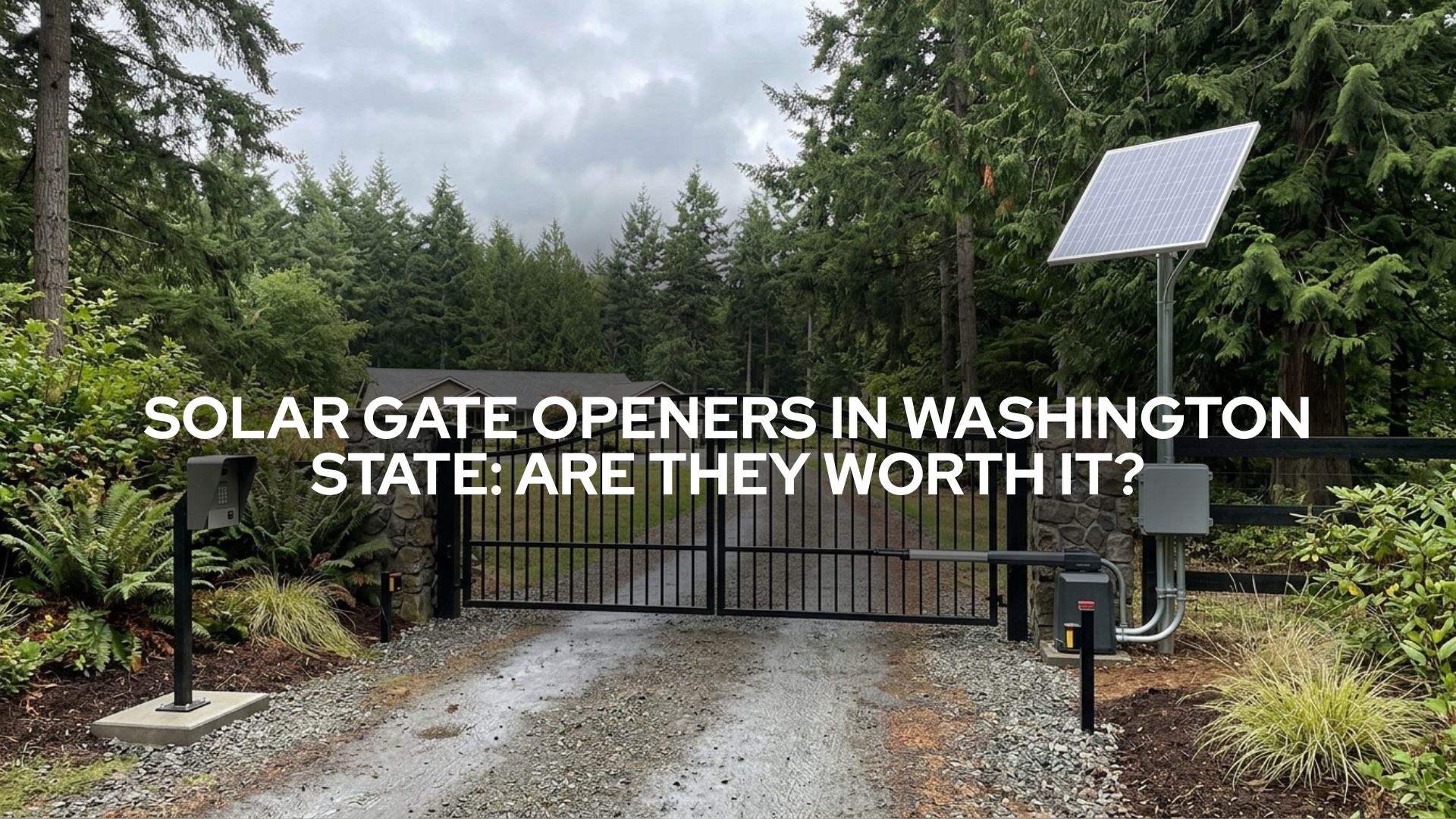
A solar opener that works well in an open, sunny field may struggle in a shaded driveway surrounded by evergreens. A low-use residential gate may be a good fit. A high-traffic commercial entrance with cameras, intercoms, RFID, and frequent cycling may need standard electrical power instead.
Emerald Gate Systems designs, installs, automates, repairs, and maintains gate systems across Northwest Washington State, Sedro-Woolley, Skagit County, Whatcom County, Snohomish County, island communities, and the greater Puget Sound region, including solar-powered options when they make sense.
Quick Answer: Are Solar Gate Openers Worth It in Washington State?
Yes, solar gate openers can be worth it for rural driveways, farms, private roads, and remote gates where running electrical power would be difficult or expensive. They work best when the gate is used lightly or moderately, the panel gets strong sun exposure, the entrance is not heavily shaded, the gate is not too large or heavy, the battery system has enough capacity, and access control equipment has low power demand. For shaded, high-use, heavy-duty, or commercial gate systems, a hardwired electric gate opener with battery backup is often the better choice.
What Is a Solar Gate Opener?
A solar gate opener is an automatic gate operator powered by energy collected from solar panels and stored in batteries. Instead of relying only on standard electrical power, the system uses solar energy to keep the gate opener charged and ready to operate. When someone uses a remote, keypad, intercom, or access control device, the operator pulls power from the battery to open or close the gate.
A solar gate opener system may include:
- Solar panel(s)
- Battery or battery bank
- Gate operator
- Control board
- Mounting hardware
- Charge controller
- Remote controls
- Keypad entry
- Safety sensors
- Vehicle detection
- Optional intercom
- Access control devices
Solar gate openers can be used on swing gates, sliding gates, farm gates, driveway gates, private road gates, and some light commercial entrances, depending on the site and usage.
Why Washington State Property Owners Consider Solar Gate Openers
A lot of Washington properties are spread out. The gate may sit far from the house, barn, business, shop, or utility connection. Running power to that gate may require trenching, conduit, electrical planning, permits, and added cost. That is one reason solar gate openers are so appealing.
Long Driveways
The gate is too far from the main power source, solar may reduce trenching cost.
Remote Entrances
The access point is away from buildings or utility connections.
Farm Gates
Automation is needed at a gate sitting in a field, gravel drive, or rural lane.
Private Roads
Multiple users need easier access without major electrical work.
Less Disruption
Solar may reduce trenching and electrical routing across the property.
Convenience & Security
Approved users open the gate from a vehicle; the gate stays closed otherwise.
How Solar Gate Openers Work
A solar gate opener works by collecting sunlight through a solar panel, converting it into electrical energy, and storing that energy in a battery. The battery powers the gate operator when the gate opens and closes.
- Solar Panel Collects SunlightMounted where it gets the best exposure available at the site.
- Charge Controller Regulates PowerKeeps the battery from being overcharged or damaged.
- Battery Stores EnergyHolds the reserve power needed for gate operation.
- Operator Uses Battery PowerThe motor draws from the battery, not directly from the panel.
- Access Devices Trigger the GateRemotes, keypads, or sensors send the open/close signal.
Solar Gate Openers vs. Standard Electric Gate Openers
Both can automate a gate. The difference is how they receive power.
Solar Gate Opener Benefits
- Less long-distance trenching
- Better fit for remote gates
- Convenient for rural entrances
- Battery-based operation
- Useful where utility power is difficult
- Good for low-use driveway & farm gates
Standard Electric Benefits
- More dependable for high-use gates
- Better fit for commercial entrances
- Stronger support for cameras & intercoms
- Better performance in shaded locations
- More predictable winter operation
- Easier support for advanced access control
For a low-use rural driveway with good sun exposure, solar may be a great fit. For a commercial gate, apartment entrance, HOA gate, shaded driveway, or high-use access point, standard electrical power with battery backup is often the better choice.
Best Uses for Solar Gate Openers in Washington State
Solar gate openers work best when the gate is not heavily used and the entrance gets enough sunlight.
Rural Driveways
Long drives where the gate is far from the house: open sky, moderate use, simple keypad or remote access.
Farms & Agricultural
Field entrances, equipment areas, livestock sections, and service gates located far from buildings or power.
Private Roads
Limited number of users at a remote entrance, works if traffic stays light.
Seasonal Properties
Cabins, recreational land, or low-use access points where full electrical service is not practical.
Low-Traffic Residential
Gates that open only a few times per day are stronger solar candidates than those cycling constantly.
When Solar Gate Openers May Not Be Worth It
Solar is not the right solution for every property.
Heavy Daily Use
Apartments, HOAs, commercial, employee lots, storage, schools, busy private roads, battery may drain faster than solar can recharge.
Shaded Entrances
Tall evergreens, wooded driveways, or shaded valleys can starve the solar panel.
Large or Heavy Gates
Oversized, poorly balanced, dragging, or hard-to-open gates need more power than solar can deliver.
Advanced Access Control
Cameras, video intercoms, phone entry, RFID, smart controls, or constant network traffic may exceed solar capacity.
Critical Commercial
Where gate failure would disrupt business operations, block employees, or delay deliveries.
Solar Gate Openers and Washington Weather
Washington State weather is the main reason solar gate openers need careful planning. The Pacific Northwest has long wet seasons, cloudy days, shorter winter sunlight, tree cover, and moisture.
What Affects Performance
- Cloudy weather reduces charging
- Winter has shorter days & weaker sun
- Rain & moisture on equipment
- Tree shade from evergreens
- Wind & falling debris
- Leaves & dirt on panels
What Makes a Property a Good Solar Candidate?
Good Solar Candidate
- Clear southern / strong sun exposure
- Limited tree shade
- Low to moderate gate usage
- Gate opens smoothly by hand
- Properly sized panel & battery
- Simple access control needs
- Good mounting location
- Realistic maintenance expectations
Poor Solar Candidate
- Heavy tree cover
- Deep winter shade
- High daily gate cycles
- Large or heavy gates
- Commercial / apartment traffic
- Cameras or advanced intercoms
- Frequent power demands
- Poor panel mounting options
- Gate that drags, sags, or binds
In poor-candidate situations, a hardwired gate operator with battery backup may be more reliable.
Solar Gate Openers for Swing Gates
Solar gate openers are commonly used on swing gates. A swing gate opens inward or outward like a door, single or double.
Solar can work well when the swing gate is lightweight enough, moves smoothly, the entrance has good sun exposure, use is light, and the property needs simple remote or keypad access.
Watch for: wind, slope, sagging hinges, and heavy gate panels. If a swing gate is hard to move by hand, the operator will need more power, which reduces solar performance. Inspect for alignment, hinge condition, post stability, and smooth operation before adding solar.
Solar Gate Openers for Sliding Gates
Sliding gates can also be solar-powered, but they often need more careful planning. They may be heavier and may require more power to move, especially if rollers, tracks, chains, or guide systems are not maintained.
Solar may work for a sliding gate when the gate is low-use, rolls smoothly, the operator is properly sized, the entrance has good sun, access control needs are simple, and the battery has enough reserve.
Solar Gate Openers for Farm Gates
Farm properties are one of the most common places where people ask about solar gate openers. That makes sense, farm gates are often located far from buildings and power.
Good Farm Applications
- Low-use farm driveways
- Field entrances
- Equipment access points
- Private farm roads
- Controlled rural entrances
- Gates with limited users
Planning Factors
- Trucks & trailers
- Tractors
- Workers & vendors
- Gravel roads
- Mud
- Livestock areas
- Wide openings
- Gate durability
- Power limitations
A farm solar gate opener should be simple, durable, and easy to maintain.
Solar Gate Openers for Private Roads
Private roads can be good solar candidates when traffic is light and power is difficult to bring to the entrance. However, shared private roads can become high-use quickly: residents, guests, deliveries, contractors, mail carriers, emergency responders, and service providers may all need access.
Before choosing solar, consider number of homes served, daily gate cycles, guest access, delivery access, emergency access, winter sun exposure, access control power needs, and maintenance responsibility.
Solar Gate Openers for Commercial Properties
Solar is usually less common for commercial gates because commercial systems often use more power and cycle more frequently. That said, solar may work for certain low-use commercial entrances or remote business access points.
Solar May Work When
- Traffic is low
- Excellent sun exposure
- Gate is not large or heavy
- Access control is simple
- Maintenance is tolerable
- Battery capacity is properly sized
Solar May Not Work Well When
- The gate is used all day
- Constant employee/vendor/delivery access
- Cameras/intercoms need continuous power
- The gate is large or heavy
- Security reliability is critical
- The entrance is shaded
Access Control Options for Solar Gate Openers
A solar gate opener can often work with basic access control options. The more advanced the access system, the more power planning matters.
Remote Controls
Usually a great fit, low constant power demand on the system.
Keypads
Common on rural driveways, farms, private roads, and low-use gates.
Intercoms
Possible, but require more planning, may need cellular service or network connections.
Cameras
Can add significant power demand if running continuously, careful design required.
Smart Access
May require constant connectivity, works in some solar setups but should not be assumed.
See our solar gate access control systems in Washington State page.
Battery Backup: The Most Important Part
The battery is the heart of a solar gate opener. The solar panel charges the battery. The battery powers the gate. If the battery is undersized, old, poorly maintained, or not receiving enough charge, the gate may stop working.
Signs of Battery Problems
- Gate opens slowly
- Gate stops halfway
- Works sunny days, fails cloudy
- Inconsistent response
- Keypad works, gate does not
- Frequent resets needed
- Fails more often in winter
Maintenance for Solar Gate Openers
Solar gate openers need maintenance just like any other automatic gate system.
- Clean solar panels
- Check panel angle & exposure
- Inspect batteries
- Test charging performance
- Check operator function
- Inspect wiring & connections
- Look for water intrusion
- Test remotes & keypads
- Check safety sensors
- Inspect hinges, rollers, tracks
- Confirm smooth gate movement
- Clear debris from path
See our solar gate opener repair and maintenance in Washington State page.
Common Solar Gate Opener Problems
- Not enough sun exposure
- Undersized solar panel
- Weak or failing battery
- Used more than expected
- Tree shade on the panel
- Dirty solar panel
- Water intrusion
- Worn gate hardware
- Gate dragging or binding
- Poor wiring connections
- Access control draws too much
- Winter performance issues
Many solar gate opener problems are not caused by the solar panel alone. The issue is often a combination of battery capacity, gate condition, shade, and usage.
Can You Add Solar to an Existing Gate?
Yes, solar can sometimes be added to an existing gate if the gate is in good condition and the site has enough sun exposure. Before adding solar automation, the gate should be inspected.
The gate should:
- Open and close smoothly
- Be properly aligned
- Have solid posts
- Have good hinges/rollers
- Not drag or sag
- Be compatible with an operator
- Have space for safety devices
- Have a good panel location
Solar Gate Opener Cost Factors
The cost of a solar gate opener in Washington State depends on the gate, site, equipment, and access control needs.
- Swing vs sliding
- Single vs double gate
- Gate size & weight
- Solar panel size
- Battery capacity
- Operator type
- Keypad/remote access
- Intercom or camera needs
- Safety sensors
- Existing gate condition
- Mounting location
- Site access
- Repairs needed
- Maintenance expectations
A simple low-use residential solar opener will usually cost less than a larger farm, private road, or commercial system with more power demand. The best way to get accurate pricing is to schedule a site review.
Solar Gate Opener vs. Running Power to the Gate
Choose Solar If
- Power is far away
- Gate use is low or moderate
- Sun exposure is strong
- Access control needs are simple
- The gate is not heavy
- Trenching is difficult or expensive
- You accept seasonal maintenance
Choose Standard Power If
- The gate is used heavily
- The entrance is shaded
- Needs cameras, intercoms, smart controls
- Property is commercial or managed
- Reliability is critical
- Gate is large or heavy
- Winter performance is a concern
Questions to Ask Before Installing a Solar Gate Opener
- How many times will the gate open each day?
- Does the entrance get direct sunlight in winter?
- Is the gate shaded by trees?
- Is the gate lightweight and easy to move?
- Is this a swing gate or sliding gate?
- Do you need keypads, remotes, cameras, or intercoms?
- Will the system serve a home, farm, private road, or business?
- What happens if the battery runs low?
- Is standard power available nearby?
- Would battery backup with hardwired power be more reliable?
- Who will maintain the solar panel and battery?
Why Local Experience Matters
Solar gate openers in Washington State require local judgment. A system that works in a sunny open region may not perform the same on a shaded driveway in Northwest Washington State. Properties near our service area often deal with rain, tree cover, soft ground, gravel roads, coastal air, and seasonal sunlight changes.
Work With Emerald Gate Systems
If you are considering a solar gate opener for a rural driveway, farm entrance, private road, remote property, or low-power access point, Emerald Gate Systems can help you decide whether solar is the right fit. We install, automate, repair, and maintain gate systems across Washington State, including solar gate opener options, automatic gate operators, access control systems, keypads, remotes, intercoms, cameras, sensors, and preventive maintenance plans.
The right answer may be solar. It may be standard power with battery backup. It may be repairing the existing gate before automation. The best choice starts with the property itself.
Is Solar Right for Your Gate?
Call today or schedule a free consultation. We’ll review your site, sun exposure, gate condition, and access needs to recommend solar or hardwired automation.
New to automatic gates? Our complete guide to automatic gate installation in Northwest Washington walks through planning, power, and the full installation process.
FAQ: Solar Gate Openers in Washington State
Are solar gate openers worth it in Washington State?
Solar gate openers can be worth it for low-use rural driveways, farms, private roads, and remote gates with good sun exposure. They may not be ideal for shaded entrances, high-use gates, or commercial properties that need constant reliability.
Do solar gate openers work in cloudy weather?
Yes, solar gate openers can still charge during cloudy weather, but they collect less energy than they do in direct sun. Battery capacity is important because the battery keeps the gate operating during cloudy periods.
Do solar gate openers work in winter?
Solar gate openers can work in winter if the system is properly sized and the panel gets enough sunlight. Winter is more challenging because days are shorter and cloudy weather is more common in Washington State.
What type of gate works best with a solar opener?
Light to moderate-use gates that move smoothly are the best candidates. Swing gates are common for solar openers, but some sliding gates can also work if they are properly aligned and not too heavy.
Can I use a solar gate opener on a farm gate?
Yes, many farm gates can use solar openers if the gate is low-use, the site gets good sun, and the system is properly sized. Farm gates should also be inspected for alignment, width, weight, and durability.
Can I use solar for a commercial gate?
Solar may work for some low-use commercial gates, but most high-traffic commercial gates are better served by standard electrical power with battery backup.
Can a solar gate opener power a keypad?
Yes, many solar gate openers can support keypad entry. Keypads are one of the most common access control options for solar-powered gate systems.
Can a solar gate opener power a camera or intercom?
Sometimes, but cameras and intercoms can require more power. Solar systems with cameras, smart controls, or intercoms need careful planning to make sure the battery and panel can support the load.
How much sun does a solar gate opener need?
The more direct sun the better. A solar panel should be placed where it gets strong exposure, especially during winter. Heavy tree shade can make solar unreliable.
What happens if the solar battery dies?
If the battery dies, the gate may stop operating until the battery is recharged or replaced. Some systems have manual release options, but a failing battery should be serviced quickly.
Can I add solar to an existing gate?
Yes, solar automation can sometimes be added to an existing gate if the gate is structurally sound, properly aligned, easy to move, and located where the solar panel can get enough sun.
Is solar better than running power to the gate?
Solar may be better when the gate is remote, power is far away, and usage is low. Standard power may be better for shaded entrances, high-use gates, commercial properties, and systems with cameras or advanced access control.
Do solar gate openers need maintenance?
Yes. Solar gate openers need maintenance, including panel cleaning, battery checks, wiring inspection, operator testing, safety sensor checks, and gate hardware inspection.
Why does my solar gate opener work sometimes but not always?
Intermittent operation may be caused by weak battery charge, poor sun exposure, dirty panels, too much gate use, worn gate hardware, water intrusion, or an undersized system.
Who installs solar gate openers in Washington State?
Emerald Gate Systems installs, repairs, automates, and maintains gate systems across Washington State, including solar gate openers, automatic gate operators, keypads, access control systems, intercoms, cameras, and preventive maintenance.
How do I schedule a solar gate opener consultation?
Call (360) 657-9975 or Schedule a Free Consultation Call with Emerald Gate Systems to find out whether a solar gate opener is right for your Washington State property.
For a property on the islands, our guide to solar gate openers on Camano Island covers panel and battery sizing around winter daylight, tree shade and real cycle counts.
Owners on the islands also ask how outages and wind change the specification; our guide to automatic gates on Whidbey Island covers backup power, wind loading and ferry logistics.
If a solar gate stops opening or closing after a run of cloudy days, start with our automatic gate not opening or closing troubleshooting guide before calling for service.