
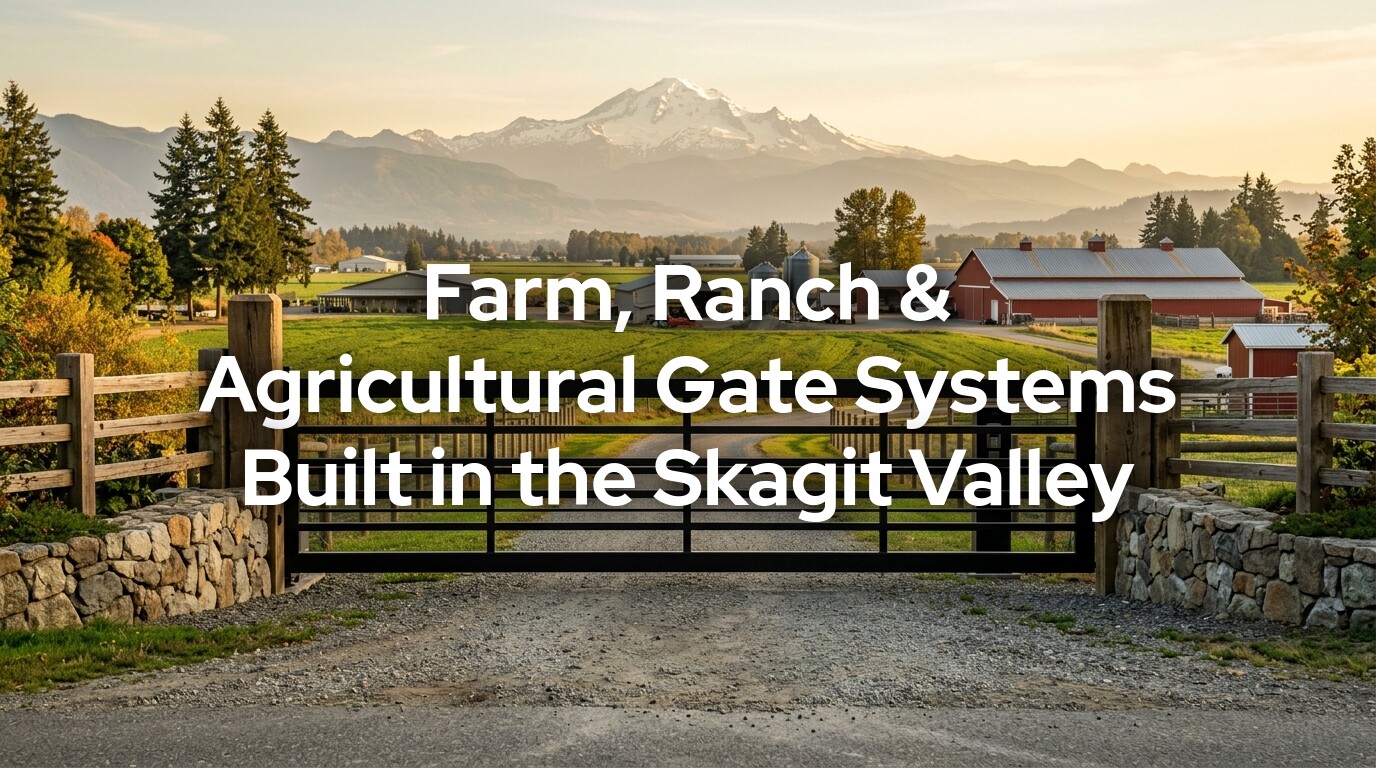
Farm & Agricultural Gates should be built around working land, not adapted from a residential driveway layout. A farm entrance has to handle equipment width, trailers, livestock movement, gravel, mud, drainage, remote power, repeated impact risk, emergency access, and daily use in weather that is rarely convenient.
Emerald Gate Systems designs, fabricates, installs, automates, and services farm, ranch, and agricultural gate systems from its Skagit Valley shop in Sedro-Woolley. The company serves farms, acreage properties, pasture entrances, equipment yards, farm stands, rural homes, agricultural businesses, and working properties across Skagit, Whatcom, and Snohomish counties, Whidbey Island, Camano Island, the San Juan Islands, and the greater Puget Sound region.
The company is family-owned, licensed and insured, headquartered in Sedro-Woolley, and backed by more than 15 years in the trade. Core design, CAD planning, welding, fabrication, installation, automation, access control, solar planning, and service are handled by one accountable team. That matters on farms because a gate is not just an entrance feature. It becomes part of the way equipment, livestock, workers, vendors, deliveries, family, and emergency responders move through the property.
Skagit Valley is one of Washington’s strongest agricultural regions. WSU Extension describes Skagit County as one of the largest and most diverse agricultural communities west of the Cascades, with about 90,000 acres of agricultural land, more than 90 crops, and about $350 million in crops, livestock, and dairy products. For Emerald Gate Systems, that farm economy is not an abstract market. It is the working territory outside the shop door.
A farm gate that works on paper can still fail in the field if the opening is too narrow for trailers, the posts move in wet soil, the operator sits where equipment clips it, the solar panel is shaded in January, the latch creates a livestock hazard, or the access pedestal makes drivers stop at the wrong angle. The strongest agricultural gate projects solve those details before fabrication, not after the first muddy season.
What Are Farm & Agricultural Gates?
Farm & Agricultural Gates are gate systems designed for working properties where equipment, trailers, livestock, feed deliveries, service vehicles, muddy ground, gravel drives, remote power, and repeated daily use shape the entrance. They may be manual, automatic, solar-powered, access- controlled, swing, sliding, cantilever, equipment-width, or part of a larger farm access plan.
A farm gate may serve many different purposes:
- Main farm driveway access
- Equipment entrance
- Pasture entrance
- Livestock handling area
- Feed and supply delivery route
- Private rural road
- Farm stand or public customer entry
- Agricultural business entrance
- Equipment yard or shop entrance
- Remote field entrance
- Service access to barns, pumps, wells, or storage
- Shared family and farm access
- Seasonal crop access route
- Emergency access route
That range matters because one farm may need a simple rugged manual gate for seasonal equipment, while another may need an automatic entrance with solar charging, keypad access, video entry, and enough clearance for trailers and delivery trucks.
Farm gates are different from decorative residential gates because the gate must support real movement. It needs to survive rain, gravel, mud, livestock contact, machinery, wind, fencing transitions, and drivers who may be turning with long implements or trailers.
It also needs to be serviceable. Batteries, hinges, rollers, latches, photo eyes, operators, panels, access devices, and control boxes must be reachable when the ground is wet and when the property is busy.
Why Does Skagit Valley Fabrication Matter for Farm Gates?
Skagit Valley fabrication matters because the gates are designed and built near the same kinds of agricultural properties they will serve. Emerald Gate Systems fabricates in Sedro-Woolley, close to Skagit Valley farms, rural roads, pasture entrances, equipment access points, and wet working ground that expose weaknesses in generic gate designs.
A farm gate built in a shop that understands the local conditions can account for practical issues that are easy to miss in a catalog:
- Wide equipment movement
- Trailer turning angle
- Ditches along rural roads
- Soft shoulders
- Wet soil around posts
- Flood-prone or saturated areas
- Open- field wind
- Gravel and mud around tracks
- Far-pasture power limitations
- Livestock contact and pressure
- Service access during poor weather
- Farm traffic during planting, harvest, and deliveries
In-house fabrication also keeps the gate structure connected to the automation plan. The frame, hinges, posts, roller supports, guide assemblies, operator brackets, safety-device locations, access- control equipment, and solar panel placement can be coordinated before steel is cut or posts are set.
A farm gate is often asked to do harder work than a driveway gate. The opening may be wider. The ground may be wetter. The vehicles may be longer. The impacts may be more common. The gate may be used by family, employees, seasonal workers, delivery drivers, vets, utility crews, feed suppliers, and emergency responders.
Being based in Skagit County does not automatically solve every problem. It does mean the team is not treating agricultural gates as a rare specialty. Farm entrances, commercial yards, rural homes, and acreage gates are part of the region’s daily property mix.
Request a free farm gate assessment when the entrance needs to be designed around working land rather than a standard residential driveway.
How Are Farm Gates Different From Residential Gates?
Farm gates are different from residential gates because they must handle larger vehicles, wider clearances, livestock movement, mud, gravel, long approaches, remote power, repeated impacts, service vehicles, and rougher daily use. A residential gate can focus on convenience, privacy, and curb appeal. A farm gate must keep the property working.
| Project factor | Residential gate | Farm or agricultural gate | Why it matters |
|---|---|---|---|
| Opening width | Usually sized for cars, pickups, guests, and deliveries | Must consider tractors, trailers, implements, wagons, feed trucks, and future equipment | A measured opening can still be too narrow during a turn |
| Traffic type | Family, guests, contractors, deliveries | Family, workers, livestock service, equipment, vendors, trucks, emergency responders | User groups may need different access methods |
| Ground conditions | Paved or compact driveway in many cases | Gravel, mud, wet soil, field edges, drainage ditches, and shifting shoulders | Posts, tracks, and low equipment need more planning |
| Gate contact | Occasional accidental contact | More exposure to equipment, livestock, trailers, and rough work | Hardware and component placement should reduce damage risk |
| Power | Utility power may be closer | Far pasture or rural entrances may need solar or long power runs | Power choice affects operator, access control, and maintenance |
| Safety | Family and visitor use | Vehicles, animals, workers, public customers, children, and service providers may mix | Pedestrian, livestock, and vehicle movement must be separated where practical |
| Maintenance | Often scheduled around household convenience | Must support work schedules, weather windows, and farm operations | Service access and durable parts matter |
The biggest mistake is treating a farm entrance as a scaled-up driveway gate. Bigger is not automatically better. The right farm gate should fit the equipment path, fencing, livestock behavior, soil, power plan, and maintenance routine.
A beautiful ornamental gate can be wrong for a working entrance if it creates pinch points, narrow clearances, livestock gaps, fragile decorative elements, or operator hardware placed where equipment will hit it.
A simple steel farm gate can also be wrong if it is too narrow, unsupported, hard to release, difficult to open in mud, or poorly prepared for automation.
What Should a Farm Gate Site Assessment Cover?
A farm gate site assessment should cover equipment movement, trailer turning, livestock needs, fencing transitions, road approach, ditches, shoulders, drainage, soil, mud, gravel, gate type, power distance, solar exposure, safety devices, access control, emergency access, and future service. The goal is to design a gate around how the property works.
- Define the gate purpose. Identify whether the gate serves a main driveway, pasture, equipment yard, service road, farm stand, barn area, field entrance, or commercial agricultural operation.
- List the vehicles. Include tractors, combines, trailers, wagons, pickups, feed trucks, livestock haulers, delivery vans, service vehicles, snow equipment, and emergency vehicles.
- Measure usable width. Account for turning path, mirrors, implements, ditch edges, fence corners, pedestals, columns, and future machinery.
- Review approach geometry. A straight approach and a tight turn off a narrow rural road require different openings.
- Evaluate ground conditions. Review gravel, mud, wet soil, slope, drainage, standing water, rutting, and erosion.
- Review livestock exposure. Consider species, handling method, gaps, latch locations, lower clearance, projections, and pressure against the gate.
- Choose gate movement. Compare single swing, double swing, sliding, cantilever, manual, and automated options.
- Plan power. Compare utility power, trenching, solar, battery backup, and accessory loads.
- Plan access control. Decide whether the property needs a keypad, remotes, temporary codes, intercom, camera, or simple manual access.
- Review safety devices. Identify monitored photo eyes, sensing edges, manual release, emergency access, signs, and separation from pedestrian or livestock movement.
- Plan service access. Make sure batteries, operators, hinges, rollers, panels, keypads, and controls can be reached during poor weather.
- Confirm approvals. Discuss electrical permits, fire access, right-of-way issues, private-road rules, easements, and property-owner responsibilities.
A useful farm assessment may reject the first idea. A tracked sliding gate may be poor where mud and gravel collect. A swing gate may be poor if the arc conflicts with equipment staging. A solar operator may be poor under heavy shade. A decorative gate may be poor near active livestock.
The site review should happen before the owner sets posts, builds stone columns, lays conduit, buys a gate kit, or pours concrete. It is much easier to move a gate line on a plan than after the farm has adapted around the wrong opening.
Call Emerald Gate Systems at (360) 657-9975 to review equipment width, livestock movement, mud, drainage, and remote power before a farm gate is designed.
How Wide Should a Farm Gate Opening Be?
A farm gate opening should be based on the widest equipment and the turning approach, not only the listed width of a machine. Mirrors, implements, trailers, wagons, hay equipment, livestock haulers, delivery trucks, snow equipment, and future machinery can all increase the usable clearance needed at the entrance.
Opening width should consider:
- Tractor width
- Implement width
- Trailer length and swing
- Livestock trailer approach
- Feed and supply truck access
- Combine or harvester movement where applicable
- Wide mirrors
- Hay wagons
- Farm stand delivery vehicles
- Snow equipment
- Fire apparatus
- Fence corners
- Ditches and shoulders
- Access pedestals
- Gate post protection
- Future equipment growth
A straight entrance from a wide road can use a narrower opening more easily than a sharp turn from a narrow lane. The same measured opening may feel generous in one location and frustrating in another.
Ditches and shoulders reduce usable width. A driver may avoid the ditch and swing wide, which changes the real path through the gate. A keypad pedestal or intercom post placed too close to the opening can also become an obstacle for trailers.
The gate leaf itself needs space. A double swing gate may reduce individual leaf length and be easier to handle on a wide opening. A sliding or cantilever gate may preserve driveway space but requires side runback.
Farm owners should think ahead. Equipment changes. A gate sized tightly for today’s machine may be too narrow after a new trailer, implement, or delivery requirement is added.
When in doubt, design the opening from the turn, the trailer, and the future equipment plan, not the narrowest machine that currently uses the entrance.
Which Gate Type Works Best for Farms and Agricultural Properties?
The best farm gate type depends on the opening width, equipment traffic, ground conditions, livestock exposure, power plan, snow, mud, wind, fencing, and whether the gate will be manual or automated. Single swing, double swing, sliding, cantilever, and specialty farm configurations can all work when matched to the site.
| Gate type | Best farm fit | Main advantage | Main limitation |
|---|---|---|---|
| Single swing gate | Simple lower-cycle entrances with enough clear swing space | Straightforward movement and familiar farm use | Long leaves can sag, catch wind, and require strong posts |
| Double swing gate | Wider equipment openings and main farm entrances | Shorter leaves reduce swing radius and hinge load per side | Two leaves require alignment and coordinated automation if powered |
| Tracked sliding gate | Hard-surface entrances with side room and limited swing space | Preserves driveway depth and works well for controlled vehicle lanes | Track can collect gravel, mud, manure, leaves, and ice |
| Cantilever gate | Gravel drives, mud-prone entrances, snow areas, and equipment lanes | No ground track crosses the farm drive | Needs a longer frame, counterbalance, side runback, and strong supports |
| Manual farm gate | Low-use pasture, field, and seasonal access points | Simple, durable, and lower complexity | May be inconvenient during rain, mud, or frequent use |
| Solar automated gate | Remote entrances with good winter sun and manageable traffic | Avoids long trenching where utility power is impractical | Requires honest winter sizing and battery maintenance |
| Pedestrian or personnel gate | Separate worker or visitor access near vehicle gate | Keeps people away from vehicle gate movement | Needs hardware, control, and route planning |
A double swing gate is often useful for wider farm entrances, but the posts and hinges still need to support the gate leaves through wet seasons and repeated use. If automation is added, both leaves must be coordinated properly.
A tracked sliding gate can be practical where the travel path is paved, supported, and easy to clean. It is often less practical where gravel, mud, manure, ice, or crop debris collect in the track.
A cantilever gate can be a strong farm option because it avoids a track across the drive. The trade- off is the need for side room and a larger support system.
The correct gate type should come from the site review, not from a catalog preference.
Review automatic gate installation when farm gate movement, safety devices, operators, and power need to be designed together.
How Should Farm Gates Be Designed Around Livestock?
Farm gates should be designed around livestock by reducing avoidable gaps, projections, trapping points, sharp edges, confusing movement, weak latches, and unsafe transitions between fence and gate. The correct design depends on the species, handling method, pressure against the gate, traffic frequency, and whether vehicles and animals use the same opening.
Livestock-aware design should consider:
- Species and animal size
- Herd movement
- Handling pressure
- Gate gaps
- Lower clearances
- Latch position
- Fence-to-gate transitions
- Sharp projections
- Pinch areas
- Gate swing direction
- Operator location
- Photo- eye placement
- Livestock contact with controls
- Emergency release
- Manual backup
No gate is risk-free around animals. Livestock behavior can be unpredictable, and working areas change during the day. The goal is to reduce avoidable hazards and design the gate for the way animals are actually handled.
A decorative residential gate may have lower gaps, ornamental openings, or protrusions that do not belong near livestock. A farm gate may need smoother surfaces, stronger rails, safer transitions, and a more rugged latch or operator layout.
Automation around livestock should be handled carefully. Animals should not be encouraged to linger in a moving gate path. Photo eyes, sensing edges, and controls need protection from impact, manure, mud, animals, vegetation, and equipment.
Where people walk through the area often, a separate personnel gate may be a better choice than asking workers or visitors to use the vehicle gate.
The gate should match the livestock system. A pasture entrance, barnyard, lane, handling area, dairy access point, and farm driveway may all need different details.
How Do Mud, Gravel, and Drainage Change Farm Gate Design?
Mud, gravel, and drainage change farm gate design because they affect posts, tracks, rollers, operators, photo eyes, wiring, access pedestals, batteries, and service access. A gate that works during a dry shop test can become unreliable after months of wet soil, rutting, gravel movement, and standing water.
Farm gate drainage planning should review:
- Standing water
- Soft shoulders
- Ruts
- Runoff from fields
- Culverts and ditches
- Gate post foundations
- Track location
- Operator pad elevation
- Conduit routes
- Underground boxes
- Photo-eye locations
- Battery and control enclosures
- Access pedestal bases
- Maintenance vehicle access
- Snow storage where relevant
Tracked sliding gates need special care in muddy and gravel conditions. A ground track can fill with gravel, soil, leaves, manure, ice, and small stones. That increases resistance and can overload the operator.
Swing gates avoid a track across the road, but they need stable posts and a clear swing arc. Wet soil can allow post movement, which changes the center gap, latch alignment, and operator geometry.
Cantilever gates avoid a roadway track, which can be valuable on gravel and mud-prone farm lanes. They still require strong foundations and side runback.
Low equipment is exposed to splash, mud, manure, vegetation, and accidental contact. Operators, batteries, control boxes, and safety devices should be placed where they can function and be serviced without becoming the first object hit by farm traffic.
For wet working entrances, plan the foundation, drainage, operator height, conduit, and service access before selecting the gate style.
When Does Solar Power Make Sense for Farm Gates?
Solar power makes sense for farm gates when utility power is distant, trenching would cross working ground, the entrance has dependable winter sun, gate traffic is manageable, and the owner accepts battery maintenance. Solar is especially useful for far pastures, remote field entrances, long rural drives, and gates where utility power is not practical.
Farm solar gate planning should include:
- Winter sun exposure
- Tree, barn, hill, or equipment shade
- Gate cycles per day
- Seasonal traffic changes
- Operator load
- Battery capacity
- Panel location
- Charge controller
- Keypad or remote loads
- Intercom, camera, or cellular loads
- Photo eyes and safety-device loads
- Manual release
- Emergency access
- Battery enclosure protection
- Vegetation management
Solar is strongest when the system is simple and the panel has reliable winter exposure. A far- pasture gate with light use and a clear panel location can be a good candidate.
Solar is more difficult when the farm gate has frequent cycles, video intercoms, cameras, cellular communication, heaters, long cloudy periods, or heavy shade. Every accessory draws power. Some draw power all day even when the gate is closed.
A solar farm gate should be sized around January conditions, not summer production. A panel location that looks open in July may sit in shade when the sun is lower.
Utility power may still be better where a practical permitted route exists and the gate is high-use or accessory-heavy.
Review solar and off-grid gate automation when a farm gate is far from utility power or needs battery-backed operation during winter outages.
How Is Farm Gate Automation Planned?
Farm gate automation is planned by evaluating the gate structure, opening width, equipment traffic, livestock exposure, operator load, safety devices, power source, access method, manual release, emergency access, and maintenance. The gate should move freely by hand before the operator is installed and commissioned.
Automation planning should consider:
- Gate weight and length
- Gate movement resistance
- Wind exposure
- Daily and seasonal cycles
- Farm equipment traffic
- Trailer movement
- Operator attachment points
- Post or support stability
- Battery backup
- Solar feasibility
- Safety-device placement
- Manual release
- Livestock and pedestrian separation
- Weather exposure
- Maintenance access
A motor should not be used to force a weak gate to work. If the gate drags, sags, binds, twists, or has unstable posts, automation will make the problem more expensive. The operator will apply repeated force to the same weak points.
Operator placement matters on farms. Equipment, livestock, trailers, and delivery trucks can damage low components. Brackets, arms, chains, racks, control boxes, and safety devices should be placed with real farm traffic in mind.
Speed should be realistic. A gate that opens slowly may frustrate drivers, but a gate that moves too quickly around mixed vehicles, people, and animals creates different concerns.
Battery backup and manual release are essential planning items. The owner should know what happens during outages, storms, low battery, or equipment failure.
Automate the gate only after the structure, movement, operator location, safety devices, and power plan have been reviewed as one system.
What Access Control Works Best for Farm Gates?
The best farm gate access control depends on who uses the entrance. Some farms need only remotes and a keypad. Others need temporary vendor codes, video entry, phone release, cameras, or managed credentials for workers, deliveries, service providers, family members, and emergency responders.
Farm gate users may include:
- Family members
- Farm employees
- Seasonal workers
- Feed suppliers
- Veterinarians
- Equipment service providers
- Delivery drivers
- Utility workers
- Farm stand customers
- Contractors
- Neighbors with shared access
- Emergency responders
- Property managers or caretakers
A simple keypad may be enough for a low-use farm entrance. Temporary codes can help control vendors or seasonal work. Remotes may be useful for family and workers who enter frequently.
Video intercoms and cameras can be useful for long driveways where the gate cannot be seen from the house or shop. They also add power and communication requirements, especially on solar gates.
Access devices should be placed where users can reach them safely. A keypad positioned for a car may not work for a feed truck, livestock hauler, tractor, or pickup with a trailer. A pedestal placed too close to the entrance may reduce usable turning space.
Shared codes can become a problem when seasonal workers, vendors, neighbors, and delivery drivers change. Where access changes often, individual credentials or scheduled codes may be better.
Learn more about access control systems when the farm entrance needs keypads, temporary codes, video intercoms, cameras, or managed user access.
How Should Farm Gates Handle Emergency Access?
Farm gates should handle emergency access through a clear, property-specific plan for fire, medical, utility, livestock, and storm situations. The plan may include manual release, approved emergency devices, lock boxes, key switches, radio receivers, battery backup, wide openings, clear signage, and instructions for family or workers.
Emergency access planning should answer:
- Can emergency vehicles reach the property?
- Is the gate opening wide enough for apparatus?
- Is the approach usable for large vehicles?
- Can the gate be opened during a power outage?
- Can the gate be opened if solar batteries are depleted?
- Who knows the manual release procedure?
- Does the local fire authority require a specific device?
- Can the gate be secured open during an emergency?
- Are livestock areas separated from emergency routes?
- Can workers or family access the gate during storms?
A farm gate may be on the only practical route to a house, barn, shop, livestock area, equipment yard, or field. Emergency planning should not be an afterthought.
Fire-access requirements vary by address and jurisdiction. Do not copy a device used at another property without confirming local expectations.
Manual release should be practical and protected. If it is hidden behind brush, blocked by mud, inaccessible during snow, or unknown to the people on the property, it is not a complete fallback plan.
Battery backup is useful, but finite. Frequent cycles during a storm can drain backup faster than expected, especially on a solar system with limited winter charging.
Confirm emergency access before posts, columns, operators, access devices, and solar equipment are installed.
Which Safety Standards Apply to Automated Farm Gates?
Automated farm gates may involve UL 325 for powered gate operators and entrapment protection, ASTM F2200 for automated vehicular gate construction, and local fire or electrical requirements. The exact requirements depend on gate type, property use, public exposure, equipment, and authority having jurisdiction.
UL 325 external entrapment protection guidance is relevant because farm gate operators still move heavy gates. A rural setting does not remove the need for monitored safety devices where required.
ASTM F2200-24 addresses automated vehicular gate construction. It should be considered when a manual farm gate is converted to automatic operation or when a new gate is built for automation.
Automated farm gate safety may include:
- Monitored photo eyes
- Sensing edges
- Physical guarding
- Warning signs
- Manual release
- Emergency access
- Stable gate construction
- Gate openings that reduce reach-through hazards
- Separation from pedestrian and livestock movement
- Operator force and travel testing
- Battery backup testing
- Periodic maintenance
Vehicle loops, remotes, keypads, and cameras help operate the gate, but they do not automatically replace entrapment protection. Each device serves a different purpose.
Farm conditions can make safety-device placement harder. Mud, manure, vegetation, livestock contact, equipment impact, and snow can damage or misalign devices. The layout should protect them as much as practical while keeping them effective.
Safety devices should not be bypassed to keep a farm entrance moving during chores, deliveries, or bad weather. A nuisance stop usually points to a fault that should be diagnosed.
Plan monitored safety devices, manual release, livestock separation, and emergency access before automating a farm gate.
Which Permits and Approvals May Affect Farm Gate Installation?
Farm gate installation may involve electrical permits, fire access review, private-road approval, easements, right-of-way concerns, utility locating, drainage work, environmental conditions, HOA or association rules, or local jurisdiction review. Requirements vary by address, gate type, power source, and whether the gate is automated.
Electrical work may require permitting through Washington Labor and Industries or through a city that operates its own electrical inspection program. Solar charging, battery systems, gate operators, access controls, intercoms, cameras, conduit, and low-voltage equipment should be reviewed for the correct jurisdiction.
Utility locating is important before digging post holes, operator pads, conduit runs, loop cuts, or solar panel supports. Rural properties can still have buried power, irrigation, water, communication, drainage, gas, and service lines.
Fire access may affect gate width, setback, approach, turnarounds, manual release, and emergency opening method. This is especially important when the farm gate serves the only route to a home, barn, shop, or livestock area.
Private roads and shared drives may require agreement from multiple owners. Easements can affect where a gate may be placed and who must have access.
Wetlands, drainage ditches, flood-prone areas, and field edges may add site constraints. A gate contractor should not promise that every farm road can be gated without checking the property conditions and applicable approvals.
Confirm permits, utility locating, fire access, easements, and power jurisdiction before excavation or automation work begins.
How Are Farm Gates Fabricated?
Farm gates are fabricated by turning the opening, equipment needs, livestock exposure, material choice, gate movement, hardware, operator plan, and site conditions into a durable working structure. Emerald Gate Systems fabricates gates in its Sedro-Woolley shop so the design, welding, installation, and automation plan stay connected.
Farm gate fabrication may include:
- Field measurements
- CAD planning
- Steel frame design
- Rail spacing
- Livestock-aware lower clearances
- Hinge or roller selection
- Latch and stop planning
- Operator bracket reinforcement
- Guide and track planning
- Cantilever support design
- Finish and corrosion protection
- Solar and access-control provisions
- Safety-device mounting provisions
- Fence transition details
- Service access planning
Not every farm gate needs to be decorative, but every farm gate should be intentional. A main farm entrance may combine strength and appearance because it represents the property. A pasture gate may need simpler rugged performance. A farm stand gate may need public-facing access control and a more finished look.
Material choice depends on use. Steel provides strength and repairability. Aluminum may be useful where lower weight and corrosion resistance matter. Cedar or mixed materials may fit residential-farm entrances, but solid infill can increase wind load.
Fabrication should account for automation if an operator will be added now or later. The frame should have suitable attachment points and enough stiffness for repeated powered movement.
Learn more about custom gate design and fabrication when a farm entrance needs a gate drawn and built for the actual opening rather than adapted from a stock panel.
Which Materials Work Best for Farm and Agricultural Gates?
The best farm gate material depends on the entrance purpose, opening width, livestock exposure, wind, corrosion risk, automation, maintenance expectations, and appearance. Steel, aluminum, cedar accents, and mixed-material designs can all work when selected for the correct farm application.
| Material or build style | Best fit | Strength | Maintenance focus |
|---|---|---|---|
| Steel tube frame | Equipment gates, farm drives, commercial agricultural entrances | Strong, weldable, repairable, automation-friendly | Finish protection, corrosion inspection, hardware service |
| Heavy-duty steel rail gate | Livestock-aware areas, rugged manual or automated use | Durable and practical for working entrances | Hinge, latch, impact, and coating checks |
| Aluminum gate | Where lower weight and corrosion resistance matter | Lightweight and easier on some operators | Hardware, fasteners, and frame compatibility |
| Steel and cedar farm entrance | Residential farms, acreage entrances, rural homes | Combines steel frame strength with Northwest appearance | Cedar movement, finish care, wind load, board replacement |
| Cantilever steel frame | Gravel, mud-prone, or equipment entrances with side room | Avoids track across the drive | Roller supports, foundations, and frame alignment |
| Mixed-material entrance | Farms with public-facing frontage, farm stands, or estate- agriculture properties | Can balance durability and appearance | Different materials age differently and need service access |
Steel is often the workhorse for farm gates because it can be fabricated, reinforced, welded, repaired, and adapted to automation. It needs proper finish protection, especially around welds, lower rails, hardware, and areas exposed to manure, fertilizer, mud, and moisture.
Aluminum can be useful where weight matters or corrosion is a concern, but the gate still has to be designed for the opening and expected use.
Cedar and mixed materials can look right on Northwest acreage, but they should be used carefully near livestock and wind. A solid privacy gate may not be the best fit for an open field exposed to strong gusts.
Hardware deserves as much attention as the gate frame. Hinges, rollers, latches, guides, fasteners, stops, brackets, and operator attachments often take the daily abuse.
How Do Farm Gates Handle Wind, Weather, and Corrosion?
Farm gates handle wind, weather, and corrosion best when the frame, infill, posts, foundations, hardware, finish, drainage, and maintenance plan are designed for the exposure. Open farmland, wet soil, coastal air, fertilizer exposure, manure, gravel, and winter storms can all shorten the life of a poorly planned gate.
Weather planning should consider:
- Open-field wind
- Solid gate wind load
- Rain and standing water
- Wet soil around foundations
- Gravel and mud abrasion
- Fertilizer and manure exposure
- Coastal salt near island or marine farms
- Snow and ice in foothill areas
- Fir needles and leaf debris
- Vegetation growth around panels and controls
- Condensation in enclosures
- Corrosion at welds and hardware
Wind matters most when the gate has solid infill, signage, cedar boards, or dense steel panels. An open rail farm gate usually transfers less wind load than a solid privacy gate. More motor power is not a complete answer to wind. The frame, posts, hinges, operator brackets, and foundations must carry the force.
Wet soil affects posts and tracks. If a post moves, the gate may sag, bind, or stop latching. If a sliding track shifts, the gate may increase resistance and overload the operator.
Corrosion protection should be planned before installation. Gates near fertilizers, manure, standing water, coastal air, and damaged coatings need more regular inspection.
No farm gate is maintenance free. The goal is to build it so inspection, cleaning, adjustment, and repair are practical.
Ask Emerald Gate Systems to review wind exposure, finish, drainage, and hardware access before choosing a decorative or solid farm entrance design.
How Do Farm Gates Support Different Agricultural Uses?
Farm gates support different agricultural uses by changing width, movement, structure, hardware, access control, and power around the specific work. A dairy access lane, berry farm entrance, crop field gate, livestock pasture, farm stand, equipment yard, and rural home entrance may need different gate details.
Crop and field access gates
Crop and field access gates should prioritize equipment width, easy seasonal use, durable latches, clear shoulders, drainage, and low maintenance. They may remain manual if use is seasonal, or use automation where convenience and access control justify the added equipment.
Dairy and livestock gates
Dairy and livestock gates should consider animal movement, pressure, lower clearances, fence transitions, smooth surfaces, latch protection, and separation from equipment lanes where practical. Automation should be used carefully around animals and only when the layout supports it.
Berry, nursery, and specialty crop gates
Berry, nursery, and specialty crop gates may need access for seasonal labor, delivery trucks, customer pickup, irrigation service, and equipment. Temporary codes or managed access can be helpful when user groups change during the season.
Farm stand and public-facing gates
Farm stands and public-facing agricultural properties may need a balance of customer access, staff access, delivery access, safety, appearance, and after-hours control. The gate should not confuse customers or block emergency response.
Equipment yard and shop gates
Equipment yard gates should account for trailers, implements, wide turns, night access, cameras, keypad placement, and operator protection. Bollards may be useful where equipment could strike access pedestals or control boxes.
Rural home and farm entrance gates
Rural home and farm entrances often combine residential appearance with agricultural practicality. The gate may need to look good from the road while still passing tractors, trailers, delivery trucks, livestock haulers, and emergency vehicles.
The farm’s daily use should guide the gate. A gate that looks right but slows the work is not the right gate.
Farm and Agricultural Gates in Skagit County
Farm and agricultural gates in Skagit County should reflect the region’s mix of fertile valley farmland, wet soil, drainage ditches, equipment movement, crop access, livestock operations, farm stands, and rural homes. Emerald Gate Systems is based in Sedro-Woolley, close to Skagit Valley farms and working acreage.
Skagit County farm gate projects may involve:
- Sedro-Woolley farm entrances
- Mount Vernon acreage and crop access
- Burlington agricultural and supply routes
- Bow, Edison, and valley farm properties
- Anacortes and Fidalgo Island agricultural or rural entrances
- Drainage ditches
- Open- field wind
- Wet shoulders
- Equipment-width openings
- Farm stand access
- Livestock and pasture gates
- Solar options for remote areas
Because Emerald Gate Systems fabricates in Sedro-Woolley, Skagit farm projects can be coordinated through a local shop that sees these conditions regularly. Site checks, fabrication adjustments, installation planning, and long-term service begin inside the same region.
Skagit Valley gates should not be designed only for one dry-season use. Planting, harvest, supply deliveries, winter mud, wet shoulders, and changing equipment all affect the entrance.
Review gate installation in Skagit County when the farm project needs local county context plus service-page depth.
Farm Gates in Whatcom and Snohomish County
Farm gates in Whatcom and Snohomish County often need the same working-property logic as Skagit Valley gates, but local conditions can change the design. Whatcom projects may include Bellingham-area county properties, Lynden and Ferndale agricultural entrances, and controlled farm access. Snohomish projects may include Arlington, Stanwood, Monroe, Sultan, Darrington, Granite Falls, Gold Bar, Index, and Skykomish-area acreage.
Whatcom County farm gate planning may include:
- Lynden and Ferndale agricultural access
- Nooksack Valley farm roads
- Equipment-width openings
- Livestock-aware gates
- Rural driveway automation
- Access control for workers and vendors
- Drainage and wet soil planning
Snohomish County farm gate planning may include:
- Arlington acreage and farm entrances
- Stanwood and north county rural properties
- Monroe and Sultan acreage gates
- Darrington and Granite Falls foothill properties
- Gold Bar, Index, and Skykomish remote access
- Snow and storm planning
- Solar feasibility
- Manual release and emergency access
Foothill and rural Snohomish properties may need more attention to snow storage, trees, long power runs, outage planning, and service access. Some may be good solar candidates. Others may be too shaded for reliable solar without a remote panel location or different power strategy.
City and county pages should carry local relevance. This farm service page should carry the full technical and commercial buying guidance.
For Whatcom or Snohomish farm gate projects, describe the equipment, livestock, road approach, power distance, shade, and mud conditions when requesting the site review.
How Do Island and Coastal Farm Gates Differ?
Island and coastal farm gates differ because salt air, wind, ferry logistics, remote service, limited power, tree shade, and material staging affect the design. Whidbey Island, Camano Island, and the San Juan Islands may need coastal-grade materials, solar planning, corrosion protection, and stronger documentation before the crew travels.
Island and coastal farm gate planning should include:
- Salt-air corrosion
- Wind exposure
- Ferry or remote travel coordination
- Material staging
- Solar and battery sizing
- Remote access control
- Panel exposure and tree shade
- Manual release
- Caretaker or owner training
- Future service planning
- Coastal hardware and fasteners
- Livestock and equipment movement
Coastal gates should not rely on finishes or hardware that cannot tolerate salt exposure. Steel, fasteners, brackets, hinges, battery terminals, operator mounts, and access devices all need attention.
Island logistics make planning more important. Missing parts, unclear measurements, wrong hardware, or unresolved power questions can create expensive return trips.
Solar can work well for some island agricultural gates, but only when winter exposure, battery capacity, and accessory loads support it. A shaded island entrance with video intercom and frequent cycles may need a different plan.
Review Whidbey Island gate installation and San Juan Islands gate systems when ferry logistics, coastal exposure, and remote service shape the farm gate project.
What Does Farm Gate Installation Cost?
Farm gate installation cost depends on the opening width, gate type, materials, fabrication, posts, foundations, drainage, soil, operator, solar power, access control, safety devices, fencing transitions, permits, travel, and repair or site-preparation needs. Emerald Gate Systems does not publish one universal farm gate price because working-property scopes vary widely.
Cost drivers may include:
- Main entrance versus pasture gate
- Manual versus automatic operation
- Single swing, double swing, sliding, or cantilever design
- Opening width
- Equipment and trailer clearance
- Steel or mixed-material fabrication
- Posts and foundations
- Wet soil or drainage work
- Fence transitions
- Operator type
- Solar panels and batteries
- Utility power or trenching
- Keypad, remotes, intercom, or camera
- Safety devices
- Manual release and emergency access
- Permits and inspections
- Travel, ferry, or remote-site logistics
- Maintenance planning
A simple manual field gate and a solar-powered equipment-width automatic entrance are not comparable projects. One may be primarily structural and mechanical. The other may involve fabrication, operator design, safety devices, solar charging, battery sizing, access control, and documentation.
Cost can sometimes be controlled responsibly. A simpler manual gate may be better for low-use pasture access. A wider clear opening may prevent repeated damage. A keypad may be enough where a video intercom would add unnecessary solar load.
Cost should not be reduced by undersizing posts, ignoring drainage, using residential-grade hardware for farm traffic, skipping safety devices, or pretending a shaded solar site will charge like an open field.
Request an itemized farm gate proposal that separates fabrication, posts, foundations, operator, power, access control, safety devices, permits, and maintenance assumptions.
How Long Does Farm Gate Installation Take?
Farm gate installation timing depends on the site review, measurements, gate design, fabrication, materials, foundations, power, solar equipment, access control, permits, weather, farm schedule, and site readiness. A simple manual gate may move faster than a custom automated farm entrance with solar, access control, and wide equipment clearance.
The project may include:
- Initial farm gate assessment
- Equipment and vehicle movement review
- Livestock and fencing review
- Opening width confirmation
- Gate type selection
- CAD design where needed
- Material ordering
- Shop fabrication
- Post and foundation work
- Drainage and site preparation
- Power, solar, or conduit planning
- Operator installation
- Safety-device installation
- Access-control installation
- Testing and adjustment
- Owner training and documentation
Farm schedules matter. Planting, harvest, livestock handling, deliveries, weather windows, and road access may affect when work can happen. A gate project should not block an essential farm route at the wrong time.
Weather can affect excavation, concrete, drainage, muddy access, and installation. Skagit Valley and other Northwest Washington farm sites often need scheduling that respects wet ground.
Owners can reduce delays by identifying the widest equipment, sharing photos, marking preferred gate location, explaining livestock movement, confirming power availability, and discussing seasonal access constraints early.
What Maintenance Do Farm Gates Need?
Farm gates need maintenance for hinges, rollers, latches, posts, foundations, guides, tracks, operators, batteries, solar panels, access devices, photo eyes, sensing edges, wiring, finish, drainage, and gate movement. Working conditions usually justify more frequent inspection than a low-use residential driveway gate.
Farm gate maintenance may include:
- Checking gate alignment
- Inspecting hinges and pins
- Checking rollers, wheels, tracks, guides, and stops
- Inspecting posts and foundations
- Clearing mud, gravel, manure, leaves, and debris
- Checking latches and manual release
- Testing operator travel
- Testing photo eyes and sensing edges
- Checking battery backup
- Testing solar panel output
- Cleaning solar panels where needed
- Checking keypad, remotes, intercom, and cameras
- Inspecting wiring and enclosures
- Looking for corrosion and finish damage
- Reviewing access codes and credentials
- Confirming emergency access procedure
Maintenance should be timed before the busy season where possible. A gate that fails during planting, harvest, livestock movement, or a storm can create more disruption than the same failure during a quiet period.
Solar farm gates should be checked before winter. Batteries, panel shade, charge controllers, and accessory loads can change the gate’s performance during the weakest production season.
Tracked sliding gates need frequent debris attention. Swing gates need post and hinge checks. Cantilever gates need roller and support inspection.
Emerald Gate Systems services all brands, including gates installed by other contractors. The published repair labor rate is $100 per hour, with parts, permits, travel, specialty equipment, and project-specific work handled separately.
Review gate repair and maintenance when a farm gate changes speed, alignment, sound, solar performance, latch behavior, or safety-device operation.
Should You Repair, Retrofit, or Replace an Existing Farm Gate?
Repair makes sense when the existing farm gate is structurally sound and the problem is isolated. Retrofit automation makes sense when the gate moves freely, has stable supports, and can accept safety devices and operator attachments. Replacement is often better when posts move, the frame is weak, the opening is too narrow, or the gate no longer fits farm use.
| Condition | Best starting point | What to review |
|---|---|---|
| Gate drags or sags | Repair review | Hinges, posts, frame, soil movement, and latch alignment |
| Opening is too narrow for equipment | Replacement or redesign | Wider opening, fence line, ditch, approach angle, and future machinery |
| Manual gate is stable and moves freely | Retrofit evaluation | Operator attachment, power, safety devices, and manual release |
| Gate is repeatedly hit by equipment | Layout redesign | Turning path, pedestal placement, bollards, and operator protection |
| Solar gate loses power | Solar diagnosis | Battery, panel exposure, shade, accessory loads, and gate resistance |
| Gate has severe corrosion or weak frame | Replacement review | Remaining service life, safety, repair cost, and finish strategy |
| Farm use has changed | New scope review | Equipment, livestock, traffic, access users, and power needs |
Do not automate a poor farm gate just to avoid replacing it. Automation adds repeated force and safety requirements. If the gate is not suitable, a retrofit can become a series of repairs.
A replacement may be the better investment when the opening needs to be wider, the posts are moving, the gate is unsafe around livestock, or the farm’s traffic has changed.
A repair visit can still be valuable before replacement. It can identify what failed, why it failed, and what the new design should avoid.
Review gate automation retrofits when a manual farm gate may be suitable for automatic or solar-powered operation.
What Common Farm Gate Mistakes Should Be Avoided?
Common farm gate mistakes include sizing the opening from equipment body width alone, ignoring trailer turning, setting posts in wet soil without enough support, using residential hardware in working conditions, placing operators where equipment hits them, underestimating solar loads, and ignoring livestock behavior.
Mistake 1: Measuring equipment but not the turn
A tractor, trailer, or implement needs more usable width during a turn than its straight-line body measurement suggests. Ditches, shoulders, fences, and pedestals can make the path tighter.
Mistake 2: Choosing a decorative design for active livestock areas
Decorative openings, projections, narrow lower gaps, and fragile details can be unsuitable around animals. Livestock-aware design should match the species and handling method.
Mistake 3: Automating a dragging gate
A gate that does not move freely by hand should not be forced with an operator. Mechanical resistance wastes power and damages equipment.
Mistake 4: Using a tracked slider in heavy mud without a maintenance plan
Ground tracks can collect gravel, mud, manure, stones, leaves, and ice. A cantilever gate or swing design may be better in some farm settings.
Mistake 5: Installing access controls in the equipment path
Keypads, intercoms, cameras, and control boxes should not be placed where trailers, trucks, or implements will strike them during normal use.
Mistake 6: Assuming solar works everywhere
Solar can work well on farms, but only with dependable winter sun, properly sized batteries, realistic cycle counts, and accessory loads included.
Mistake 7: Forgetting emergency access
A farm gate may control the only practical route to a house, barn, shop, pasture, or livestock area. Manual release and emergency entry should be planned.
Mistake 8: Waiting until failure for maintenance
Farm gates work in mud, rain, gravel, livestock areas, and equipment paths. Small alignment or battery issues can become larger failures if ignored.
Why Choose Emerald Gate Systems for Farm & Agricultural Gates?
Emerald Gate Systems builds farm and agricultural gates through one accountable Washington team that understands fabrication, automation, access control, solar power, repair, and working- property site conditions. The company is based in Sedro-Woolley, inside the agricultural region this page is built to serve.
The team can evaluate the complete farm entrance: opening width, equipment movement, livestock exposure, mud, gravel, drainage, gate type, materials, posts, operator, solar power, safety devices, access control, emergency access, and maintenance.
In-house fabrication matters because farm gates often need custom dimensions, stronger frames, operator-ready reinforcement, livestock-aware details, and hardware placed for real work rather than catalog appearance.
Emerald Gate Systems also installs solar and off-grid gate automation. That matters for far pastures, long drives, island farms, remote acreage, and gates where trenching utility power is not practical. The solar recommendation is based on winter exposure, battery capacity, traffic, and accessory loads, not optimistic summer assumptions.
The company services all brands and gates installed by others. That long-term repair capability matters because farm gates need adjustment, batteries, rollers, hinges, safety-device testing, access- control changes, and occasional impact repair.
Emerald Gate Systems does not claim that every farm needs the most complex gate system. Some farm entrances need a rugged manual gate. Others need solar automation, keypad access, camera visibility, and wide equipment clearance. The right recommendation starts with how the property actually works.
Call Emerald Gate Systems at (360) 657-9975 or request a free farm gate assessment for equipment-width openings, livestock-aware design, solar power, and mud-season automation from the Skagit Valley.
For the research-stage version of this topic, our guide to the best gate systems for farms and rural properties in Washington State compares layouts and materials, and if the pasture gate is far from utility power, solar gate openers in Washington covers panel and battery sizing for winter.
Farm gate work by town: farm gate installation in Arlington. Each guide covers the terrain, gate types and access needs we see there.
Frequently Asked Questions About Farm and Agricultural Gates
What is a farm gate?
A farm gate is a gate designed for working property access, including equipment, livestock, trailers, feed deliveries, service vehicles, and rural daily use. It may be manual, automated, solar-powered, access-controlled, swing, sliding, cantilever, or part of a broader agricultural access system.
The right farm gate is based on the property, equipment, animals, ground conditions, power source, and maintenance expectations, not just the width of the driveway.
How is a farm gate different from a residential driveway gate?
A farm gate usually needs wider clearance, stronger hardware, better mud and gravel planning, livestock-aware details, equipment-friendly access, and more rugged serviceability than a residential driveway gate. Residential gates often prioritize convenience, privacy, and appearance, while farm gates must support work.
The biggest differences are equipment movement, livestock exposure, repeated impact risk, remote power, and wet ground conditions.
How wide should a farm gate be?
A farm gate should be wide enough for the widest equipment and the actual turning path, including mirrors, implements, trailers, wagons, delivery trucks, and future machinery. Ditches, shoulders, fence corners, columns, and access pedestals can reduce usable clearance even when the measured opening looks adequate.
The opening should be designed from real movement, not only equipment specifications.
Can farm gates be automated?
Yes. Farm gates can be automated when the gate is stable, moves freely, has strong supports, and can accept the required operator, safety devices, power source, manual release, and access controls. Automation should not be used to force a sagging, dragging, or poorly supported gate.
A farm automation review should include mud, equipment impact risk, livestock movement, and emergency access.
Can farm gates be solar powered?
Yes. Farm gates can be solar powered when the site has dependable winter sun, manageable gate cycles, properly sized batteries, and accessory loads that fit the energy budget. Solar is often useful for far pastures, remote entrances, and long drives where trenching utility power is not practical.
Shade, high cycles, cameras, intercoms, and weak batteries can make solar unreliable if ignored.
What gate type is best for muddy farm entrances?
The best gate type for muddy farm entrances depends on drainage, ground stability, vehicle movement, and available space. Swing gates avoid a track but need stable posts. Cantilever gates avoid a ground track across the drive. Tracked sliding gates can work only when the track remains clean and supported.
Drainage and service access should be planned before choosing the gate configuration.
Are cantilever gates good for farms?
Cantilever gates can be good for farms when gravel, mud, snow, or debris would make a ground track difficult to maintain. They span the driveway without a track across the vehicle path, which can be useful for equipment and rural entrances.
The trade-off is that they need side runback, a longer gate frame, and strong support foundations.
Are swing gates good for farm entrances?
Swing gates can be good for farm entrances when there is enough clear swing space, stable posts, manageable wind exposure, and a suitable approach. Double swing gates are often helpful for wide openings because each leaf is shorter than a single wide leaf.
They are less practical where equipment queues in the swing area or where wet soil causes post movement.
Can an existing farm gate be automated?
An existing farm gate can sometimes be automated if it is structurally sound, moves freely, has stable posts or rollers, and can accept safety devices and operator attachment points. The gate should be evaluated before buying an operator or solar kit.
If the gate drags, sags, binds, or is too narrow for current equipment, replacement may be better.
What makes a farm gate livestock-aware?
A livestock-aware gate reduces avoidable hazards by considering gaps, lower clearances, projections, latches, fence transitions, swing direction, pressure points, and animal movement. The design should match the species, handling method, traffic, and location.
No gate is completely risk-free around animals, but proper planning can reduce common problems.
Can a farm gate be livestock-safe?
A farm gate can be designed to be safer around livestock, but no gate should be described as completely livestock-proof or risk-free. Animals can behave unpredictably, and gate safety depends on layout, handling method, species, maintenance, and how people use the area.
The better term is livestock-aware or livestock-safer design based on the actual farm operation.
What access control works best for farms?
The best access control for farms depends on users. Some farms need remotes and a keypad. Others need temporary vendor codes, video intercoms, cameras, phone entry, or managed credentials for workers, deliveries, veterinarians, utilities, neighbors, and emergency responders.
Farm access control should stay practical. Every added device increases power, maintenance, and administration needs.
Can a farm gate use a video intercom?
Yes. A farm gate can use a video intercom when power and communication are reliable at the gate location. Video intercoms are useful for long driveways, deliveries, farm stands, and properties where the entrance cannot be seen from the home, office, or shop.
On solar systems, intercom power draw must be included in the battery and panel sizing.
Can farm gates include cameras?
Yes. Cameras can help farm owners monitor deliveries, equipment yards, farm stands, remote entrances, and gate activity. Camera placement should be chosen for the purpose, such as overview, visitor verification, or equipment-area visibility.
Cameras require power and communication, so they should be planned early, especially on solar or remote gates.
Do farm gates need safety sensors?
Automated farm gates may need monitored photo eyes, sensing edges, guarding, warning signs, manual release, and other safety measures depending on gate type, operator, and exposure. Rural location does not remove the need for safety planning.
Safety devices should not be bypassed when mud, animals, vegetation, or weather cause nuisance stops. The cause should be repaired.
What standards apply to automated farm gates?
Automated farm gates may involve UL 325 for powered gate operators and entrapment protection, and ASTM F2200 for automated vehicular gate construction. Local fire, electrical, right-of-way, and property requirements may also apply depending on the address and equipment.
Standards should be considered before converting a manual farm gate to automatic operation.
Do farm gate projects need electrical permits?
Farm gate projects may need electrical permits when operators, solar charging equipment, batteries, access controls, intercoms, cameras, conduit, or powered devices are installed. Washington L&I handles many electrical permits, while some cities operate their own electrical programs.
Permit responsibility should be confirmed before wiring, operator installation, or concealment of connections.
How do emergency responders open a farm gate?
Emergency responder access depends on the property and local authority. The solution may involve manual release, key switches, lock boxes, radio receivers, approved emergency devices, battery backup, or another method accepted for the address.
The gate opening, approach, and turnaround must also be considered for emergency vehicles.
Can farm gates work during power outages?
Farm gates can continue operating during some outages when battery backup or solar power is properly designed. Capacity is limited by battery condition, gate resistance, cycles, weather, and accessory loads. Owners should know the manual release procedure before a storm or utility outage.
Backup power is helpful, but it is not unlimited.
How does mud affect gate automation?
Mud affects gate automation by increasing resistance, shifting posts, filling tracks, blocking sensors, covering low hardware, and making service access harder. Operators, photo eyes, batteries, control boxes, and wiring should be placed where they are protected and reachable.
Tracked sliding gates need special attention because ground tracks can collect mud, gravel, and debris.
How does wind affect farm gates?
Wind affects farm gates by increasing load on frames, hinges, posts, operators, and foundations, especially when the gate has solid panels, signage, or dense infill. Open agricultural land can expose gates to stronger wind than sheltered residential driveways.
More motor power is not a complete solution. Frame design, infill, supports, and gate configuration matter.
How much does farm gate installation cost?
Farm gate installation cost depends on opening width, gate type, materials, fabrication, posts, foundations, drainage, operator, solar power, access control, safety devices, fencing transitions, permits, travel, and site preparation. Emerald Gate Systems does not publish one universal farm gate price because scopes vary widely.
A written proposal should separate structure, automation, power, controls, and owner responsibilities.
How long does farm gate installation take?
Farm gate installation timing depends on site review, measurements, design, fabrication, foundations, power, solar equipment, access control, permits, weather, farm schedule, and site readiness. Simple manual gates may move faster than custom automated equipment-width entrances.
Planting, harvest, deliveries, livestock movement, and wet ground can affect scheduling.
How often should farm gates be maintained?
Farm gates should be inspected regularly because mud, gravel, rain, livestock, equipment, and remote power systems create more wear than many residential entrances. Hinges, rollers, batteries, solar panels, safety devices, access controls, posts, and drainage should be checked before problems interrupt farm access.
Solar systems should be reviewed before winter when battery and charging issues show up most often.
Can Emerald Gate Systems repair farm gates it did not install?
Yes. Emerald Gate Systems services all brands and gates installed by other contractors. Farm gate repair may include hinges, rollers, posts, operators, batteries, solar charging, safety devices, access controls, welding, alignment, and gate movement diagnosis.
The published repair labor rate is $100 per hour, with parts, travel, permits, and specialty equipment handled separately.
Where does Emerald Gate Systems install farm gates?
Emerald Gate Systems installs farm and agricultural gates across Skagit, Whatcom, and Snohomish counties, Whidbey Island, Camano Island, the San Juan Islands, and the greater Puget Sound region. The company is headquartered in Sedro-Woolley and fabricates gates in its Skagit Valley shop.
Project fit depends on location, access, ferry requirements, power, equipment movement, and long-term serviceability.
How do I start a farm gate project?
Start by calling Emerald Gate Systems at (360) 657-9975 or using the contact form to request a free farm gate assessment. Share the property address, equipment type, opening goal, livestock concerns, gate condition, power availability, shade, driveway surface, and whether the gate should be manual, automatic, or solar-powered.
You do not need to choose the gate type before the visit. The property should guide the design.
Start With the Work the Gate Has to Survive
Farm and agricultural gates should begin with the work, not the product. What equipment has to pass through? Which trailers turn at the entrance? Which animals are nearby? Where does the water go? How soft is the shoulder? Who needs access when the owner is not there? What happens during a storm or power outage?
Those answers shape the gate opening, frame, posts, hardware, operator, solar system, access controls, safety devices, and maintenance plan.
A gate for working land should be wide enough for real movement, rugged enough for farm use, safe enough for the people and animals around it, and serviceable enough to repair when weather, equipment, or time eventually take a toll.
Emerald Gate Systems builds farm, ranch, and agricultural gate systems from its Skagit Valley shop in Sedro-Woolley. The team can design and fabricate equipment-width gates, livestock-aware entrances, solar-powered remote gates, mud-season automation, and farm access systems that fit Northwest Washington conditions.
The best farm gate is not necessarily the most decorative or the most automated. It is the one that keeps the property working without creating avoidable problems at the entrance.
Call Emerald Gate Systems at (360) 657-9975 or schedule a free farm gate assessment for Farm & Agricultural Gates built in the Skagit Valley.
Frequently Asked Questions About Farm Gates in Washington
Do farm gates require a permit in Washington State?
Most manual farm gates do not require a permit. Automated gate operators that include electrical work typically require an electrical permit issued through the county or city. If the gate sits on a county road approach, a right-of-way permit from the Washington State Department of Transportation or the county may also apply. Permitting requirements vary by county and project scope; Emerald Gate Systems handles permit coordination as part of its installation service.
What gate width does a farm need for large equipment in Skagit County?
Most Skagit Valley operations need a minimum clear opening of 16 to 20 feet for combines, grain trailers, and wide hay equipment. A 14-foot single-swing gate is a common minimum for tractors and four-wheel-drive trucks. Gates sized for a passenger car are rarely wide enough for working farm equipment. The correct width comes from measuring the actual equipment at its widest point, including mirrors and attachments, before fabricating the gate.
What gate material holds up best on a Northwest Washington farm?
Galvanized steel tubing is the standard on Northwest Washington farms because it resists corrosion from rain, mud, and humidity better than bare mild steel. Powder-coated aluminum is lighter and corrosion-resistant but is not the best choice for daily heavy equipment contact. Cedar and cedar-composite panels are used on acreage where appearance matters, but they require more maintenance than steel in the Skagit Valley climate. The gate frame material should match the load the gate will carry every day.
Can an existing manual farm gate be converted to solar-powered automation?
Yes, if the gate post and hinge structure is in good condition and the gate itself moves freely. A solar-powered gate operator needs a south-facing panel location, battery storage sized for winter cloud cover common in Skagit County, and a gate that swings or slides without binding. Emerald Gate Systems inspects existing gates before quoting solar retrofits and will recommend post reinforcement or gate replacement when the original structure cannot support the added load of an operator.
What is the difference between a farm gate and a standard residential driveway gate?
A farm gate is typically wider, heavier, and built for repeated contact with equipment, livestock, and loaded trailers. Residential driveway gates prioritize appearance and smooth daily operation for cars and trucks. Farm gates may also need livestock-safe hardware (no exposed pinch points or gap sizes that trap hooves), high-cycle operators rated for more daily uses, and posts set in deeper footings to handle the torque from a heavy swinging panel. Fabricating a gate to farm specifications from the start is less expensive than upgrading a residential gate after installation.