
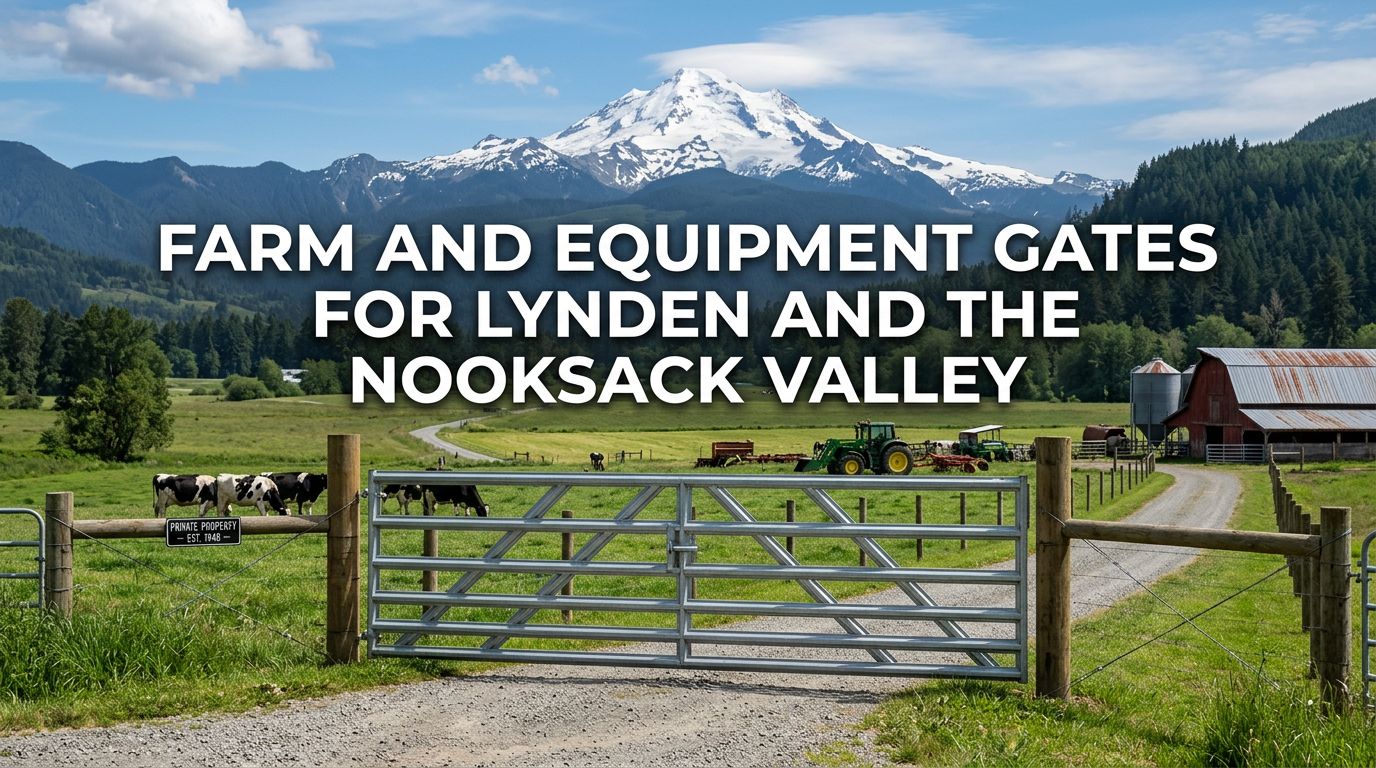
Farm gate installation Lynden WA is a different discipline from putting a driveway gate on a suburban lot, and the difference starts with what has to fit through the opening. A gate sized for pickups will not pass a manure spreader, a wide implement, a hay trailer, or a milk truck backing into a yard. On working land in the Nooksack Valley, the equipment sets the dimension and everything else follows.
Emerald Gate Systems fabricates in our own shop in Sedro-Woolley and works throughout Whatcom County. Lynden and the surrounding farmland are regular territory, and the projects here look nothing like the estate entrances forty minutes south. Wide openings, mud season, livestock, long private lanes, and equipment that does not slow down for a narrow gate.
This page covers what farm gate installation Lynden WA actually involves: sizing for implements rather than vehicles, livestock aware design, what mud and manure do to a ground track, power on remote pasture entrances, and where a simple manual gate beats an automated one. Call (360) 657-9975 or use the contact page to walk the property with us.
What Farm Gate Installation Lynden WA Has to Handle
Dairy and berry country runs on equipment that was not designed around gates. The working requirement is that the entrance never becomes the reason a job takes longer, and that shapes every decision.
Width comes first and it is measured against implements, not tractors. A tractor eight feet wide pulling a sixteen foot implement needs an opening for the implement. Hay equipment, sprayers, and harvest machinery are wider still, and none of it folds down for a gate. Livestock trailers need width plus turning room, and a trailer cuts inside the tow vehicle’s path through a turn rather than following it.
Traffic mix comes second. A Lynden farm entrance sees the family vehicles, farm equipment, feed and fuel delivery, milk pickup on a schedule, veterinary visits, seasonal labor, and buyers or contractors. Those groups need different access, and treating them as one group produces a system that frustrates all of them.
Ground conditions come third and they are the ones that destroy equipment. Valley soil holds water. Yard entrances collect mud, manure, gravel, and organic debris. A design that works on clean pavement fails within a season on a working farm approach, and that is a design mistake rather than a product defect.
Finally, there is the reality that farms operate on their own clock. A gate that needs a technician every few months is not a solution. Durability and simplicity beat features on a working entrance, and we design accordingly.
Sizing the Opening for Equipment, Not Vehicles
The single most common regret we hear on agricultural properties is that the opening is too narrow, and it is the one thing that cannot be adjusted afterward without new footings and a new gate.
Start by inventorying the widest thing that passes through, including the equipment that comes a few times a year and the equipment a neighbor brings for custom work. That number, not the driveway width, sets the requirement.
Then account for clear width rather than post to post. The dimension that matters is the actual unobstructed passage once hinges, operator hardware, stops, and any open leaf are accounted for, and it is always less than the number on the drawing. Designing to a minimum on paper reliably lands under it in practice.
Then account for the approach. Equipment entering from a county road at an angle sweeps a much wider path than its own width, and the longer the rig, the more dramatic that is. An opening that is wide enough but sits at the end of a tight approach still forces backing and repositioning.
The practical answer on many Lynden farms is two openings rather than one oversized gate. A normal width automated gate handles daily vehicle traffic and stays fast and manageable. A separate wide opening, often a straightforward manual farm gate, handles equipment a few times a season. That combination is usually cheaper and considerably more reliable than automating a thirty foot span that gets used occasionally, and we will recommend it when it fits.
Our guide to driveway gate width and layout covers the measurements and the geometry in detail.
Talk with Emerald Gate Systems. Bring us the widest implement that uses the entrance and we will design around it rather than around a catalog size. Call (360) 657-9975.
Livestock-Aware Design, Honestly Explained
Gates on livestock properties carry a responsibility that residential gates do not, and it is worth being precise about what a gate can and cannot do.
A farm gate can be designed to reduce avoidable hazards around animals, equipment, trailers, mud, and repeated use. It cannot make working land risk free, and no gate should be described as livestock proof. Animals behave unpredictably, and safety depends on layout, handling method, species, maintenance, and how people actually use the area.
What good design does address: infill spacing appropriate to the animals so heads and legs do not go through, ground clearance that does not create a trap or an escape, guarding at pinch and shear points, edges and corners that do not injure an animal that leans or pushes, and hardware that a curious animal cannot work loose.
Movement type matters around livestock. A swing gate opening into a working area creates a sweeping arc where animals may be standing. A slide gate travels along a line, which is more predictable but creates its own shear hazard along the receding side. Which is safer depends entirely on the layout, and that is a site conversation rather than a rule.
Automation around livestock deserves particular thought. A powered gate that operates while animals are in the area needs proper entrapment protection, and on a farm that protection sees mud, dust, and physical abuse that it would never encounter on a driveway. Devices have to be placed where they will survive and where they will actually detect what matters.
Our farm and agricultural gate systems page goes deeper on equipment width openings, livestock aware design, and mud season automation.
Mud Season and Why Ground Tracks Fail on Farms
The single most consequential technical decision on a Lynden farm gate is whether the gate runs on a ground track, and on a working entrance the answer is usually no.
A ground track is a channel at ground level that the gate rolls in. On clean pavement it works fine. On a farm approach it fills with mud, manure, gravel, straw, and organic debris within a season, and every cycle grinds that material into the rollers. In winter it holds water and freezes. Clearing it becomes a recurring chore that nobody has time for during planting or harvest.
Cantilever gates avoid the problem entirely. The gate is carried on rollers mounted to a fixed structure beside the opening, with a counterbalance section extending back. Nothing touches the ground across the opening. It costs more up front and stops being a comparison after the first wet season.
The requirement for a cantilever is side room for the counterbalance, typically a substantial fraction of the opening width again. On a farm entrance that space usually exists, which is one reason cantilever suits agricultural sites better than tight residential lots.
Swing gates are the other answer and work well on many farm entrances, particularly as double leaves on wide openings. Their constraints are the arc, which has to stay clear of the ground on a sloped or rutted approach, and wind on solid infill.
Drainage at the entrance matters regardless of gate type. Water that pools at post bases undermines footings over time, and in valley soil that shows up as posts that have moved and gates that no longer align. Correcting drainage during installation prevents the failures that cost the most.
Talk with Emerald Gate Systems. If someone quoted you a ground track slider for a working farm entrance, ask what happens in February. Call (360) 657-9975 for a straight answer.
Power on Remote Pasture and Field Entrances
Many of the gates worth automating on a Lynden operation are nowhere near a power source, and that changes the arithmetic completely.
Trenching a new circuit several hundred feet across a field, under a lane, or around existing drainage can cost more than the gate. The trench also has to account for voltage drop over distance, which drives conductor size and therefore cost, and for burial depth and separation requirements that an inspection will check.
Solar is the practical answer on remote entrances, provided it is sized honestly. That means sizing around the weakest winter conditions rather than a bright July day: short days, cloud cover, actual gate cycles, operator load, battery capacity, and any accessories like a keypad, camera, or cellular communicator. A system sized for summer will disappoint every January.
Where solar suits a farm entrance well is a gate with moderate cycle counts, dependable panel exposure, and no shade from trees or buildings. Where it does not is a high traffic yard entrance with several accessories running continuously. We will tell you which one you have.
Battery backup applies to grid connected gates too, and on farms it matters because winter storms take power down and stock still needs tending. Batteries fail quietly, so testing under load rather than at rest belongs in every service visit.
Our solar gate openers in Washington page covers panel and battery sizing for exactly this situation.
Access for Deliveries, Milk Pickup and Seasonal Labor
A farm entrance serves more distinct groups than most commercial properties, and the access plan has to reflect that or it becomes the bottleneck.
Regular scheduled visitors like milk pickup, feed delivery, and fuel need reliable access that does not depend on someone being available at the house. Codes or credentials that work every time, with a fallback when something goes wrong.
Seasonal labor is a different problem because the group changes and the turnover is high. Credentials that can be issued and revoked easily, and that do not require a technician visit to change, matter more than sophistication.
Contractors, veterinarians, and buyers need occasional access, often on short notice and often when nobody is at the entrance. Phone entry that reaches you wherever you are in the field handles this better than a keypad code that has to be given out and later forgotten.
What we steer people away from is a system so complex that it becomes another thing to maintain. On a working farm, the system that gets used is the one that is simple enough to explain in a sentence. Our access control systems page covers the options from keypads through cloud managed credentials.
Talk with Emerald Gate Systems. Tell us who comes through the gate in a normal week and we will design the access around that rather than around a product. Call (360) 657-9975.
Emergency Access on Long Farm Lanes
A gate at the county road is the front of an access route that the fire district cares about along its entire length, and on a farm that route can be long.
The requirements cover clear width for apparatus, approach and turning room, turnarounds on long lanes, surface and load capacity, and how the gate opens when there is no power and nobody is home. Which emergency access method your district accepts, whether a key switch, a lock box, or a radio activated receiver, is a question to answer before selecting equipment.
Manual release matters more on a farm than almost anywhere, because outages happen and the entrance may be the only way in for a vet or an ambulance. A release that has seized from corrosion, sits under mud, or whose key was lost is not a release. We test it on every service visit.
Agricultural exemptions cause a recurring misunderstanding worth clearing up. Some agricultural structures receive exemptions from certain building permit requirements, but those exemptions rarely extend to electrical work. A powered farm gate still needs its electrical work permitted and inspected. Requirements are published by Washington L&I.
Our page on gate permits in Washington State covers fire access review, electrical permitting, and setback together, including how the sequence should run.
Materials That Last on a Nooksack Valley Farm
Farm gates take physical abuse that residential gates never see, and material selection should account for the fact that something will eventually hit the gate.
Steel is the workhorse for agricultural entrances because it takes impact, can be repaired by welding rather than replaced, and can be built to spans that other materials struggle with. The requirement is a coating system that holds up against the moisture, ammonia, and physical wear of a farm environment, applied over proper surface preparation.
Aluminum resists corrosion inherently and weighs less, which reduces operator load, but it does not take impact the way steel does and it is harder to repair in the field. On a working entrance where equipment occasionally makes contact, that matters.
Wood suits certain farm and equestrian properties aesthetically and has its own maintenance rhythm. Mixed material designs, with a steel frame and wood or panel infill, get the structural performance of steel with the appearance the owner wants.
Whatever the material, the details decide the lifespan. Hinges sized for the actual load rather than the nominal weight. Posts set in properly sized footings that account for saturated valley soil. Fasteners that will not seize. Drainage that moves water away. Our custom gate fabrication page covers how material, span, and exposure are matched.
Talk with Emerald Gate Systems. Everything is fabricated in our own shop, so a farm gate is built to your opening and your equipment rather than adapted from stock. Call (360) 657-9975.
Maintenance That Fits a Farm Schedule
Farm gates need service, and the program that works is the one that fits around the operation rather than interrupting it.
Twice a year suits most agricultural entrances, timed before winter and after it, and scheduled around planting and harvest rather than during them. What gets checked is consistent: alignment, hinges and rollers, fastener tightness, path and track clearance, operator mounting and condition, battery under load, charging circuit, safety device alignment and function, access devices, enclosure sealing, drainage, and coating condition.
Between visits, the signals worth a call are a gate that sounds different, movement that has slowed, a leaf that no longer meets its strike, rust staining below a hinge, or water standing where it did not before. On a farm, the earliest signal is often that someone has started leaving the gate open because it has become annoying to use.
We service equipment from any manufacturer including systems we did not install, which matters on properties where a gate has been there through more than one owner. Our gate repair and maintenance page covers all brand service, and LiftMaster gate opener repair covers the operator families we see most.
The economic case for maintenance is stronger on a farm than anywhere else, because a gate that fails during a time sensitive operation costs far more than the service visit that would have prevented it.
Working With a Whatcom County Farm Contractor
We are headquartered in Sedro-Woolley, and Whatcom County farmland is regular territory rather than an occasional trip.
What matters more than office location is that fabrication happens in our own shop. A farm gate built to your opening, your equipment width, and your ground conditions is a different object from a stock gate adapted on arrival. When something needs modification, it goes back to the people who built it.
One team handles design, fabrication, installation, automation, access control, and service. On agricultural work that consolidation matters, because the alternative is a fabricator, an electrician, and an automation vendor each pointing at the other when something fails during harvest.
Lynden, Ferndale, Blaine, and the surrounding farmland sit alongside Bellingham in our Whatcom coverage. Our Whatcom County gate installation page covers the county, and Northwest Washington service areas shows the full picture.
You can verify our license and bond status through Washington L&I contractor verification before anyone comes out.
Talk with Emerald Gate Systems. Walk the entrance with us and we will tell you what it needs, including when the answer is a simpler gate than you expected. Call (360) 657-9975 or use the contact page.
Frequently Asked Questions About Farm Gate Installation Lynden WA
How wide does a farm gate need to be?
Implement width governs rather than tractor width, and that is frequently over twelve feet and sometimes far more. Inventory the widest thing that passes through, including equipment that comes a few times a year, and measure clear width rather than post to post.
Should I automate a wide equipment gate?
Often not. Many Lynden farms are better served by a normal width automated gate for daily traffic plus a separate wide manual opening for equipment. Automating a thirty foot span that gets used occasionally is expensive and adds a maintenance item for little benefit.
Will a sliding gate work on a muddy farm entrance?
A cantilever slider will, because nothing touches the ground across the opening. A ground track slider will fill with mud, manure, gravel, and debris within a season and freeze in winter. On a working entrance, cantilever is worth the additional cost.
Can a gate be made livestock proof?
No, and no one should describe a gate that way. A gate can be designed to reduce avoidable hazards around animals through infill spacing, ground clearance, guarding, and hardware selection, but working land is never risk free and safety depends on layout and handling as much as on the gate.
Do agricultural properties need a permit for a gate?
Agricultural exemptions apply to some structures but rarely extend to electrical work. A powered farm gate still needs its electrical work permitted and inspected. Emergency access requirements on long private farm lanes are frequently more demanding rather than less.
My gate is far from power. What are my options?
Trenching a long run can cost more than the gate. Solar is the practical answer on remote entrances when it is sized around winter conditions rather than summer sun, accounting for short days, cloud cover, cycle counts, and accessory loads. We will tell you honestly whether your entrance is a good candidate.
How do I handle milk pickup and deliveries?
Scheduled visitors need access that does not depend on someone being at the house. Codes or credentials that work reliably, with a fallback. Phone entry that reaches you in the field handles occasional visitors like vets and contractors better than codes that get given out and forgotten.
How do I manage seasonal labor access?
With credentials you can issue and revoke yourself without a service call. Turnover is the defining feature of seasonal access, so the system needs to make changes easy rather than sophisticated.
What material is best for a farm gate?
Steel for most working entrances, because it takes impact and can be repaired by welding rather than replaced. Aluminum where corrosion resistance and lighter weight matter more than impact tolerance. Mixed designs with a steel frame and other infill get structural performance with the appearance you want.
How deep do gate post footings need to be on valley soil?
Deeper than on well drained ground, because saturated soil offers less resistance and frost and moisture movement work on the footing over time. Posts that have shifted are the leading cause of gates that no longer align, and the correction is far more expensive than doing it right initially.
Does wind matter on an open farm entrance?
Yes, particularly on solid infill. A gate with panel or tight slat infill acts like a sail, and repeated wind loading drives hinge wear, post movement, and operator strain. Open picket and mesh patterns let wind through, which is one reason they are common on agricultural gates.
Can you service a gate another company installed?
Yes, including equipment from any manufacturer. That matters on farms where a gate has often been in place through more than one owner and the original installer is long gone.
How often should a farm gate be serviced?
Twice a year suits most agricultural entrances, scheduled around planting and harvest rather than during them. The economic case is stronger on a farm than elsewhere because a failure during a time sensitive operation costs far more than the service visit.
What is the first sign a farm gate is failing?
Usually that someone has started leaving it open. Before that, listen for a change in sound, watch for slower movement, check whether the leaf still meets its strike, and look for rust staining below hinges or water standing where it did not before.
Do you build gates for equestrian properties?
Yes. Equestrian entrances share the equipment width and livestock considerations of dairy and crop farms, with additional attention to infill spacing, clearance, and hardware that a horse cannot work loose or be injured by.
Can a gate help with biosecurity?
A controlled entrance helps by making access deliberate rather than casual and by letting you route visitors through a defined point. It is one element of a biosecurity plan rather than a solution on its own, and it works best when the access process is simple enough that people actually follow it.
What should I have ready for a site visit?
The widest equipment that uses the entrance, who comes through in a normal week, whether power is nearby, how the approach meets the road, and how the ground behaves in winter. We handle the measurements and the geometry.
How long does a farm gate project take?
Approvals and site work usually drive the schedule more than fabrication, since we build in our own shop. Confirming fire access requirements early keeps things moving. We give a realistic calendar at the site visit, including when to schedule around your season.
Design Around the Equipment and the Season
Farm gate installation Lynden WA works when the opening is sized for implements rather than pickups, the gate type suits mud season rather than a clean driveway, the access plan matches the people who actually arrive, and the whole thing is simple enough to keep working through a harvest.
Emerald Gate Systems fabricates in our own Sedro-Woolley shop and handles design, installation, automation, access control, and service with one team. On a working farm, having one number to call when the entrance stops cooperating is worth more than a longer feature list.
Call Emerald Gate Systems at (360) 657-9975 or schedule a free on-site consultation for your Lynden or Whatcom County farm.