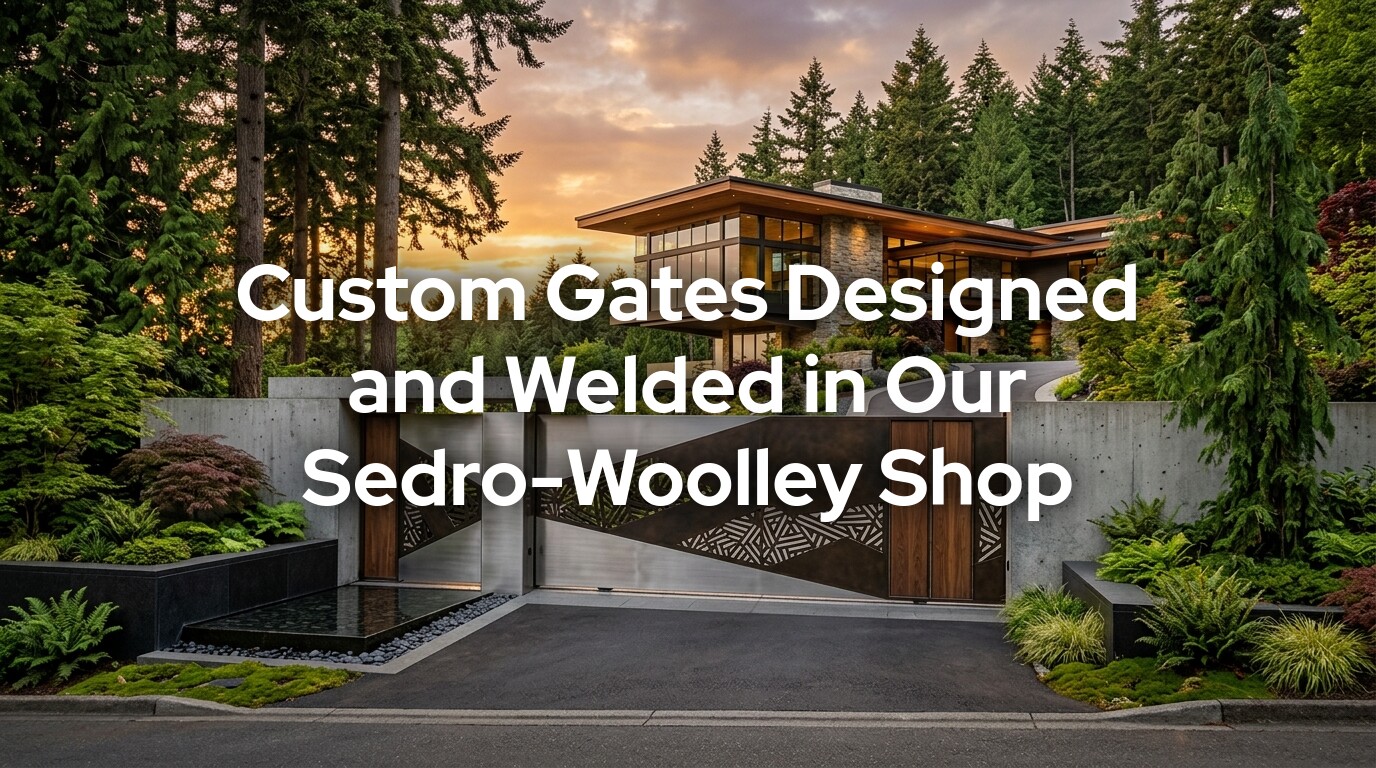
Custom Gate Fabrication in Washington should start with the actual entrance, not with a stock panel stretched to fit a difficult driveway. A custom gate has to match the opening, the architecture, the traffic, the wind, the power plan, the access controls, and the wet Pacific Northwest conditions it will live in every day.
Emerald Gate Systems designs and fabricates custom gates in-house at its Sedro-Woolley shop in Skagit County. The company works with hand-forged wrought iron, laser-cut steel, Western Red Cedar, and stone-coordinated designs for homes, farms, commercial properties, HOAs, island properties, and managed entrances across Northwest Washington.
A well-built custom gate is not only decorative. It is a moving structure. The frame has to stay square. The posts and foundations have to support the load. The hinges, rollers, guides, and stops have to work with the chosen configuration. If the gate will be automated, the frame must be prepared for the operator, safety devices, power, battery backup, and access-control equipment.
This is where in-house fabrication matters. The team drawing the gate should understand how it will be welded. The crew welding the gate should understand how it will be installed. The installer should understand how the operator, keypad, intercom, camera, safety devices, and service access will fit the final entrance.
Emerald Gate Systems is family-owned, licensed and insured, headquartered in Sedro-Woolley, and backed by more than 15 years in the trade. Core design, CAD planning, fabrication, welding, installation, automation, access control, and service are handled by one accountable team. The gate is not passed from a designer to a separate fabricator to an unrelated automation company.
What Is Custom Gate Fabrication in Washington?
Custom Gate Fabrication in Washington is the process of designing, drawing, cutting, welding, finishing, installing, and often automating a gate for one specific property. It replaces the one-size-fits- all approach with a gate built around the exact opening, material choice, visual style, vehicle movement, weather exposure, hardware, and long-term service needs.
A custom gate may be simple, ornate, modern, rustic, private, open, heavy-duty, pedestrian-scaled, farm-focused, or commercial. The defining feature is not decoration. The defining feature is that the gate is built around the site rather than forced onto it.
That matters in Northwest Washington because properties rarely behave like clean catalog examples. Driveways slope. Openings are irregular. Existing columns may not be square. Fence lines turn. Rural shoulders may be soft. Coastal sites see salt air. Wooded entrances collect fir needles and leaves. Some properties need trailers, farm equipment, or delivery trucks to move through without scraping a column or striking a pedestal.
Custom fabrication allows the gate to be planned for those conditions before metal is cut or cedar is fitted. The process can account for the driveway width, swing arc, sliding runback, wind load, privacy goal, operator location, access devices, pedestrian route, and future maintenance access.
Off-the-shelf gates can be useful in simple, low-demand settings, but they are built to standard sizes and standard assumptions. The compromises show up as awkward gaps, poor proportions, extra field welding, hardware that does not suit the site, insufficient support for automation, or a finished entrance that looks added on rather than designed for the property.
Why Does In-House Fabrication Matter?
In-house fabrication matters because the same company responsible for design, welding, installation, automation, and service can make decisions as one connected team. Emerald Gate Systems draws and fabricates gates in its Sedro-Woolley shop, so the structure, hardware, finish, automation plan, and access-control needs are coordinated before the gate arrives on site.
Many gate projects become complicated because each provider thinks only about its own portion. A fabricator may build a strong gate but leave no good operator attachment point. An operator installer may size equipment without understanding the weight, wind area, or frame stiffness. An access-control vendor may locate a pedestal where trailers cannot reach it safely.
A one-team fabrication process reduces those gaps. It allows practical questions to be answered early:
- Where will the operator attach?
- Will the frame carry the operating forces?
- Can the gate remain square under its own weight?
- Will the infill create too much wind load?
- Can photo eyes and sensing edges be placed correctly?
- Will the access keypad or intercom be reachable from the vehicle path?
- Can wiring and conduit be routed without damaging the finished design?
- Can the gate be serviced after landscaping, columns, and stonework are complete?
In-house fabrication also supports quality control. The gate can be checked for proportion, fit, weld quality, hardware placement, automation readiness, and finish preparation before field installation begins.
The trade-off is time. A custom gate requires measurement, design, approval, materials, fabrication, finishing, and installation coordination. It cannot always move as fast as a stock panel purchase. The benefit is a gate designed for the actual property rather than adapted after the fact.
Schedule a free on-site consultation when the entrance needs a gate designed around the driveway, architecture, automation plan, and Washington weather conditions.
What Types of Custom Gates Does Emerald Gate Systems Build?
Emerald Gate Systems fabricates custom gates for residential driveways, estate entrances, farms, commercial sites, pedestrian openings, HOA communities, waterfront properties, wooded lots, and rural acreage. Each gate is designed around the opening, traffic, material, operating method, access- control plan, and property character.
| Gate type | Typical use | Design focus | Important trade-off |
|---|---|---|---|
| Custom driveway gate | Homes, acreage, shared residential entrances | Privacy, curb appeal, vehicle access, automation readiness | Must fit grade, traffic, and daily household use |
| Ornamental iron gate | Estate, traditional, and architectural properties | Hand-forged detail, proportion, strength, finish protection | Requires skilled labor and careful corrosion planning |
| Laser-cut steel gate | Modern homes, businesses, branded entrances | Patterns, screens, logos, privacy, clean geometry | Panel density can increase wind load |
| Western Red Cedar gate | Residential, wooded, privacy-focused properties | Warmth, screening, Northwest appearance | Wood movement, finish care, drainage, and wind load matter |
| Farm and acreage gate | Equipment entrances, livestock areas, rural drives | Opening width, rugged hardware, solar, trailer movement | Residential proportions may not fit farm traffic |
| Commercial gate | Facilities, yards, warehouses, managed sites | Durability, duty cycle, access control, serviceability | Higher cycles require stronger equipment and maintenance planning |
| Pedestrian gate | Walk-through entries, side yards, controlled paths | Human scale, latch hardware, access integration | Should be separated from automated vehicle movement where practical |
| Mixed-material gate | Architectural entrances with multiple design cues | Steel frame, cedar infill, stone, iron, custom detail | Materials age differently and need coordinated maintenance |
The style follows the property and the purpose. A wide farm gate for trailers should not be designed like an ornamental residential entrance. A heavy commercial sliding gate should not be treated like a decorative driveway gate. A cedar privacy gate near salt air or open wind needs different detailing than a sheltered ornamental steel gate.
Custom fabrication gives the owner control over proportions, material, openness, privacy, pattern, finish, and hardware. It also gives the fabricator the ability to build the gate for the way it will actually move.
How Does the Design Consultation Work?
The design consultation begins on site. Emerald Gate Systems reviews the property, listens to the owner’s goals, measures the entrance, studies vehicle movement, evaluates drainage and grade, considers materials, and identifies whether the gate should be manual, automated, solar-powered, access-controlled, or part of a larger entry system.
The consultation should answer practical questions before discussing decorative detail:
- What is the entrance supposed to do? Privacy, security, appearance, livestock control, traffic management, guest entry, delivery access, or several goals together.
- What vehicles need to pass through? Passenger cars, delivery trucks, trailers, boats, farm equipment, service vehicles, and emergency apparatus may need different clearances.
- How does the driveway approach the gate? Road speed, stopping space, turning angle, slope, ditch location, and shoulder width affect the usable opening.
- How will the gate move? Swing, paired swing, tracked slide, cantilever, pedestrian, or manual movement all require different space and hardware.
- What materials fit the property? Iron, steel, cedar, stone, or mixed materials should support both the desired look and the physical conditions.
- Will the gate be automated? If yes, operator attachment, wiring, safety devices, access controls, and power must be planned before fabrication.
- What weather will the gate face? Rain, wet soil, wind, salt air, debris, snow, and shade all change the design.
- Who will use the entrance? Family, employees, residents, vendors, caregivers, deliveries, property managers, and emergency responders may all need access.
- What approvals may apply? HOA rules, electrical permits, fire access, right-of-way conditions, and accessible-entry issues should be identified early.
Photographs and inspiration images are helpful, but they are not a design by themselves. A gate that looks beautiful at another property may not work with the slope, wind, opening, or operator needs of your site.
Field observation: the best custom gate projects usually spend more time on the site questions than on the first sketch. When the opening, movement, and materials are understood, the visual design has a much better chance of looking intentional and working reliably.
How Does CAD Gate Design Help Before Fabrication?
CAD gate design helps the owner and fabricator review proportions, dimensions, materials, infill, frame layout, ornament, operator provisions, hardware locations, and relationship to columns or fencing before fabrication begins. It reduces surprises because changes on a drawing are easier than changes to welded steel or fitted cedar.
CAD planning is especially useful for:
- Comparing open and privacy-focused designs
- Checking visual proportions against the opening
- Coordinating paired gate leaves
- Planning laser-cut steel patterns
- Locating cedar boards and metal frames
- Checking hinge, roller, guide, and stop locations
- Coordinating operator brackets
- Planning edge protection and sensor locations
- Checking clearances near columns, stone, and fencing
- Reviewing where access-control devices will mount
- Identifying maintenance and service access
A CAD drawing is not useful if it ignores field conditions. The drawing should be tied to measured dimensions, driveway grade, post or column locations, gate swing or slide travel, fence alignment, and any site work that will occur before installation.
Owners should use the design review to resolve decisions early. Material, privacy level, pattern density, finish, opening direction, column relationship, lighting, access-device placement, and automation should be discussed before fabrication starts.
Late changes can be expensive because a gate is a connected structure. Adding cedar can change weight and wind load. Changing from open iron to laser-cut steel can affect the operator and foundations. Moving a keypad or intercom can affect conduit and concrete.
Use the CAD review to settle the shape, material, movement, access-control plan, and finish before welding and fabrication begin.
Which Materials Can Be Used for a Custom Gate?
Custom gate materials should be selected for appearance, strength, weight, wind exposure, corrosion risk, maintenance, automation, and property style. Emerald Gate Systems fabricates with hand-forged wrought iron, laser-cut steel, Western Red Cedar, and stone-coordinated designs, with each material chosen for a specific reason.
| Material | Best fit | Advantages | Maintenance focus |
|---|---|---|---|
| Hand-forged wrought iron | Traditional, estate, ornamental, and architectural gates | Classic detail, strong visual presence, custom craft | Finish protection around joints, curves, fasteners, and low areas |
| Laser-cut steel | Modern designs, privacy screens, patterns, logos, custom panels | Precise design control, clean lines, repeatable patterns | Coating quality, drainage, edge protection, wind load |
| Structural steel | Large frames, automated gates, farm gates, commercial entrances | Strength, weldability, repairability, operator support | Corrosion protection, coating damage, trapped water |
| Western Red Cedar | Privacy gates, wooded homes, Northwest architecture | Warmth, natural appearance, screening, design flexibility | Finish care, airflow, drainage, board movement, replaceability |
| Stone-coordinated elements | Architectural entrances, columns, monuments, walls | Permanent visual weight and strong property identity | Foundation coordination, drainage, conduit access, service clearance |
| Mixed materials | Properties that need strength, warmth, and architectural detail | Balances steel structure with cedar, stone, or ornamental elements | Different materials age differently and need planned maintenance |
The best material is rarely chosen by appearance alone. A solid cedar privacy gate may look perfect with a wooded home, but it can create more wind load than an open iron design. A laser-cut steel screen may provide a modern look, but dense panel patterns can behave more like a solid surface in wind.
Material decisions should also account for automation. Weight, balance, hinge load, roller load, frame stiffness, and operator attachment points all affect long-term performance.
When Is Hand-Forged Wrought Iron the Right Choice?
Hand-forged wrought iron is the right choice when the entrance needs traditional detail, ornamental character, strength, and a handcrafted appearance. It suits estate gates, classic homes, formal driveways, decorative pedestrian gates, and properties where the entrance should feel architectural rather than generic.
Ironwork can include scrolls, pickets, rings, arches, custom patterns, spear details, framed panels, decorative hinges, and matching pedestrian gates. The design can be subtle or elaborate depending on the property.
The advantage of wrought iron is visual depth. It creates shadow, detail, and permanence that a flat panel cannot imitate. It also allows air to pass through more easily than solid privacy gates, which can reduce wind pressure on exposed sites.
The trade-off is labor and finish care. Ornamental detail includes more joints, edges, curves, and connection points. Those areas need proper preparation and protection so moisture does not become trapped.
Wrought iron should also be designed for the operator and safety layout if the gate will be automated. Decorative lower sections, tight spacing, or exposed hardware can create issues if automation is added later without planning.
For a Sedro-Woolley area property, the hometown location page should carry the local custom iron gate angle. This service page should remain the broader Washington fabrication authority and link to the city page when local proof is needed.
When Is Laser-Cut Steel the Better Design Option?
Laser-cut steel is often the better option when the owner wants clean modern lines, custom patterns, privacy screening, business branding, geometric panels, nature-inspired designs, or repeatable architectural detail. It allows precise panel work that can be difficult to achieve with hand- forged elements alone.
Laser-cut panels can create a gate that is modern without feeling plain. Patterns may be subtle, bold, symmetrical, organic, branded, or tied to the home or business architecture.
The density of the pattern matters. A sparse design can preserve air movement and reduce wind force. A dense pattern provides more privacy but behaves more like a solid panel. That affects the frame, hinges, rollers, operator, posts, and foundations.
Panel edges should be considered during finishing. Cut edges, pockets, and low drainage points need proper protection. The design should not create areas that hold water, leaves, or debris.
Laser-cut steel is also useful for commercial properties that want a controlled entrance without making the gate look like a temporary barrier. Logos, address numbers, patterns, and architectural branding can be integrated when appropriate.
The final design should balance appearance, privacy, wind, weight, finish, and service access. The most dramatic panel is not always the strongest long-term choice for an exposed Washington property.
Ask Emerald Gate Systems to compare hand-forged iron and laser-cut steel during the CAD design review when the project needs both structure and visual identity.
How Does Western Red Cedar Change a Custom Gate?
Western Red Cedar changes a custom gate by adding warmth, privacy, and a natural Northwest appearance. It works well for homes, wooded properties, modern residential entrances, and gates that need screening without looking industrial. The gate frame, finish, airflow, drainage, and board attachment must account for wood movement and moisture.
Cedar is popular because it belongs visually in the Pacific Northwest. It pairs well with steel frames, stone columns, wooded driveways, modern homes, and rural properties. It can create a softer entrance than all-metal construction.
The trade-off is maintenance. Cedar changes with moisture and temperature. It needs room to move, the ability to drain and dry, and a finish plan that fits the owner’s expectations.
Cedar should usually be treated as an infill material supported by a properly designed frame rather than as the primary structure for a large automated gate. A strong steel or aluminum frame can carry the movement loads while the cedar provides the visual surface.
Board layout should allow replacement. If one board becomes damaged, the owner should not have to rebuild the complete gate. Fasteners, backing, spacing, airflow, and finish access should be considered during fabrication.
Solid cedar also affects wind. A fully screened cedar gate can catch more wind than an open metal gate. On coastal, hilltop, open-farm, or exposed island properties, partial screening or spaced boards may provide a better balance.
How Can Stone Be Integrated Into a Custom Gate Entrance?
Stone can be integrated through columns, walls, monuments, address features, entry piers, or surrounding hardscape that visually anchors the custom gate. The stonework must be coordinated with foundations, gate clearances, conduit, operator access, hinges, intercoms, lighting, and long-term service needs.
Stone gives an entrance permanence. It can make a gate look connected to the property rather than placed at the edge of the driveway as an afterthought.
The design must remain practical. Columns that are too close to the travel path can reduce usable opening width. Stone surrounding an operator can make service difficult. Conduit buried without coordination can leave no route for future access-control or safety-device wiring.
Drainage matters around stone and gate foundations. Water should not collect at the base of posts, columns, or operator pads. Freeze and moisture can affect surrounding hardscape, especially in foothill areas.
Access devices should be placed intentionally. A keypad, intercom, camera, or reader built into stone may look clean, but it must still be reachable from the correct vehicle position and serviceable later.
Stone coordination should happen during design, not after fabrication. The final gate width, hinge geometry, swing arc, slide runback, pedestrian route, lighting, and emergency access can all be affected by masonry placement.
How Is a Custom Gate Built for Automation?
A custom gate built for automation is fabricated with the future operator, safety devices, wiring, hardware, wind load, gate movement, and access controls in mind. The gate should move freely by hand before the operator is commissioned, and the operator should not be used to correct poor frame design or weak hardware.
Automation-ready fabrication may include:
- Frame stiffness appropriate to the gate length and material
- Reinforced operator attachment points
- Correct hinge or roller geometry
- Clear stops and travel limits
- Space for monitored photo eyes
- Locations for sensing edges where needed
- Conduit and cable routing provisions
- Clearance for manual release access
- Space for battery backup and controls
- Coordination with keypads, intercoms, and card readers
- Guarding and reduced reach-through hazards
- Service access after landscaping and columns are complete
A gate that will be automated should be designed differently from a purely decorative manual gate. The operator applies force repeatedly. Weather adds load. Users may cycle the gate many times per day. The structure has to remain aligned under those conditions.
ASTM F2200 applies to automated vehicular gate construction. UL 325 addresses powered gate operator systems and entrapment protection. Those concepts should be considered before fabrication rather than treated as accessories added at the end.
Pedestrian use should also be planned separately where practical. People should not be expected to walk through an automated vehicular gate as the normal route. A separate pedestrian gate or ADA entry may be a better solution for homes with frequent foot traffic, commercial sites, HOAs, apartments, or public-facing entrances.
Review automatic gate installation built for Washington conditions when the custom gate will include operators, safety devices, smart access, and backup power.
Which Gate Movement Works Best With Custom Fabrication?
Custom fabrication can support single swing gates, paired swing gates, tracked sliding gates, cantilever gates, pedestrian gates, and specialty configurations. The best movement depends on the driveway slope, opening width, available arc, side runback, wind, traffic, debris, snow, and vehicle approach.
When does a custom swing gate make sense?
A custom swing gate makes sense where the driveway is reasonably level and the property has enough clear arc space. Swing gates can look classic, simple, and proportional, especially with iron or cedar designs. Paired swing gates reduce the leaf length and swing radius for wider openings.
The support side carries the load. A long or solid swing gate needs careful post, hinge, foundation, frame, and operator planning. Wind is especially important on cedar privacy gates and dense laser-cut steel panels.
When does a custom sliding gate make sense?
A custom sliding gate makes sense where the driveway grade, traffic, or space makes swinging difficult. The gate moves parallel to the fence, preserving driveway depth and reducing conflicts with vehicles stopped near the entrance.
Tracked sliders need clean, supported, drained travel. Gravel, mud, fir needles, ice, and small stones can create service problems. Custom fabrication allows the gate frame and wheel or rack layout to match the site.
When does a cantilever gate make sense?
A cantilever gate makes sense where gravel, snow, uneven pavement, debris, or commercial traffic make a track across the drive undesirable. The gate is suspended through roller supports and does not rely on a ground track at the roadway.
The trade-off is a longer overall frame and larger support foundations. The counterbalance section must have enough side room. Trees, walls, slopes, property lines, and utility equipment can reduce that runback.
When does a pedestrian gate belong in the design?
A pedestrian gate belongs in the design when people need regular access without using the vehicular gate. It may include a latch, lock, keypad, card reader, intercom, or coordinated access-control system. It can also support safer movement for guests, employees, residents, and service providers.
Custom fabrication can match the pedestrian gate to the vehicle gate so the entrance feels cohesive while keeping pedestrian movement separate.
How Are Custom Gates Built for Pacific Northwest Weather?
Custom gates in the Pacific Northwest should be built for persistent moisture, wet soil, wind, debris, salt air, cold weather, and seasonal maintenance. The right response depends on material, finish, drainage, frame geometry, hardware, operator planning, and the exact location of the property.
How does rain affect fabrication?
Rain affects fabrication because water finds low points, exposed edges, damaged finishes, enclosed pockets, and poorly drained joints. A gate should be detailed so water can leave the structure rather than sit inside or against metal and wood.
Bottom rails, cedar board ends, low brackets, hardware pockets, and drainage openings deserve special attention. A gate that looks finished on the front face can still fail early if hidden areas trap moisture.
How does wind affect custom gates?
Wind affects solid cedar, steel panels, tight infill, and signage more than open iron designs. A gate with more surface area transfers more force into the frame, posts, hinges, rollers, operator, and foundations.
On exposed sites, the design may need open infill, spaced boards, stronger framing, paired leaves, a sliding configuration, or a different gate location.
How does coastal salt affect materials?
Coastal salt affects steel, fasteners, hinges, brackets, rollers, guides, and damaged finish areas. Properties near Anacortes, Whidbey Island, Camano Island, and the San Juan Islands should be planned with corrosion exposure in mind.
Finish protection, hardware selection, drainage, and regular inspection matter. No coastal gate should be treated as maintenance free.
How do fir needles and leaves affect gate design?
Fir needles and leaves collect in tracks, drainage openings, low frame pockets, hinge areas, photo- eye paths, and around access pedestals. Sliding tracks and low hardware need more owner attention on wooded properties.
Custom design can reduce debris traps, but it cannot remove the need for seasonal cleaning.
How do snow and ice affect gate construction?
Snow and ice affect bottom clearance, swing arc, sliding track, cantilever travel, sensor height, snow storage, and manual release access. A snowplow should not push snow against the gate path, operator, keypad, photo eye, or release hardware.
Foothill properties may need different clearances and maintenance planning than sheltered lowland sites.
Ask Emerald Gate Systems to evaluate rain, wind, salt, shade, debris, and snow before finalizing a material or privacy design.
How Are Coatings, Hardware, and Corrosion Protection Planned?
Coatings, hardware, and corrosion protection should be planned from the beginning because Washington moisture, coastal salt, and trapped debris can shorten the life of a gate that was otherwise well built. The protection strategy depends on material, exposure, finish expectations, maintenance, and whether the gate will be automated.
Steel needs a complete finish strategy. Bare or poorly protected steel can corrode, especially at welds, edges, fasteners, low rails, and areas where coating is damaged by impact or repeated movement.
Ornamental iron and detailed steel work require extra attention because decorative shapes create more joints and pockets. Those details should not trap water if the gate will be exposed to rain and salt air.
Cedar needs a different plan. It should be finished appropriately, allowed to drain and dry, and installed in a way that allows boards to move and eventually be replaced. Wood-to-metal contact areas should be detailed carefully.
Hardware often fails before the main gate frame. Hinges, rollers, bearings, fasteners, brackets, latches, guides, and operator attachments see movement, moisture, vibration, and impact. Choosing hardware based only on appearance can create long-term service problems.
Coastal properties need a more conservative approach. Suitable stainless hardware, isolation between dissimilar metals, protected steel, aluminum where appropriate, and accessible inspection points can all improve serviceability.
Finish maintenance should be discussed honestly. A custom gate is not a no-maintenance object. It is an outdoor structure that moves. Owners should expect inspection, cleaning, touch-up, lubrication where appropriate, and eventual service.
What Does the In-House Fabrication Process Include?
The in-house fabrication process includes design consultation, field measurement, CAD planning, material selection, cutting, fitting, welding, finish preparation, hardware coordination, installation planning, automation readiness, testing, and support. Emerald Gate Systems keeps those stages connected through its Sedro-Woolley shop and field team.
- Site consultation. The entrance, grade, drainage, traffic, vehicles, materials, and owner goals are reviewed.
- Measurements. The opening, fence line, columns, slopes, shoulders, runback, swing arc, and control locations are documented.
- Concept design. The visual direction, privacy level, material, and gate type are discussed.
- CAD drawing. Proportions, frame, infill, hardware, openings, and operator provisions are drawn for review.
- Material selection. Iron, steel, cedar, stone coordination, hardware, and finish expectations are matched to the property.
- Cutting and fitting. Raw material is prepared for the approved dimensions and details.
- Welding and assembly. The frame and components are built to support the gate’s movement and expected loads.
- Hardware preparation. Hinges, rollers, guides, stops, brackets, and operator attachment areas are coordinated.
- Finish preparation. Surfaces, edges, welds, and moisture-sensitive areas are prepared for the selected finish process.
- Installation staging. Posts, foundations, conduit, access devices, operator locations, and delivery are coordinated.
- Mechanical installation. The gate is set and adjusted so it moves correctly before automation is commissioned.
- Automation and access setup. Operators, safety devices, keypads, intercoms, cameras, credentials, and power are installed where included.
- Testing and handoff. The complete entrance is tested and the owner is shown operation, manual release, access controls, and maintenance expectations.
The sequence may change by project. A purely manual pedestrian gate may not require automation planning. A commercial sliding gate may require more infrastructure and access-control coordination. An island project may need additional staging before the crew leaves the mainland.
Because the same team handles design, fabrication, installation, and support, the finished gate can match the approved plan and the site conditions more closely.
How Do Custom Gates Fit Different Property Types?
Custom gates fit different property types by changing the frame, opening width, material, hardware, access method, and maintenance plan around the way the entrance is used. A home, farm, HOA, commercial facility, island property, and pedestrian entrance should not be designed from the same template.
How are residential driveway gates designed?
Residential driveway gates balance privacy, curb appeal, visitor entry, family use, deliveries, emergency access, and weather exposure. The gate should look like it belongs to the home while still fitting the driveway grade, vehicle approach, and daily movement.
Common residential choices include paired swing gates, cedar privacy gates, ornamental iron gates, modern laser-cut steel, video intercoms, keypads, battery backup, and solar where utility power is impractical.
How are estate gates designed?
Estate gates often use stronger visual identity, custom ironwork, stone coordination, decorative patterns, lighting, and advanced access control. The entrance should feel deliberate from the road while still allowing safe approach, clear emergency access, and long-term service.
Large ornamental gates require careful support. Proportion, weight, wind, hinge loading, and operator attachment should be resolved before fabrication.
How are farm and ranch gates designed?
Farm and ranch gates prioritize equipment width, livestock considerations, gravel, mud, wind, long driveways, solar power, and durable hardware. A gate that works well for passenger cars may be frustrating for trailers, tractors, and livestock service vehicles.
The usable opening should be planned around turning paths, ditches, shoulders, implements, and future equipment, not just the measured width between posts.
How are commercial gates designed?
Commercial gates prioritize durability, repeated operation, vehicle flow, delivery access, employee credentials, cameras, vehicle loops, and repair access. The design may need a sliding or cantilever structure rather than a decorative swing gate.
Business downtime matters. A commercial gate should be built so major service components can be reached without dismantling finished masonry, fencing, or landscaping.
How are island and coastal gates designed?
Island and coastal gates require added corrosion planning, wind review, solar or backup power consideration, remote access, and better preparation before installation. Whidbey, Camano, Anacortes, and San Juan Island projects should be planned so the gate arrives with as few unresolved field decisions as possible.
Fabrication completed in the shop before ferry travel reduces the risk of missing parts, incompatible hardware, or costly return trips.
How Much Does Custom Gate Fabrication Cost?
Custom gate fabrication cost depends on the gate size, material, design complexity, frame structure, ornament, cedar or steel infill, stone coordination, finish, hardware, automation readiness, access-control integration, site conditions, installation requirements, and travel. Emerald Gate Systems does not publish one universal fabrication price because accurate pricing requires a site-specific scope.
A complete custom gate proposal may include:
- On-site consultation and measurements
- CAD design and revisions
- Material selection
- Structural steel, wrought iron, laser-cut steel, cedar, or stone coordination
- Cutting, fitting, welding, and assembly
- Hinges, rollers, guides, stops, latches, and brackets
- Finish preparation and protective coating
- Posts, foundations, operator pads, or track work
- Automation-ready reinforcements
- Operator, safety devices, and battery backup where included
- Keypad, intercom, camera, credentials, or other access-control devices
- Conduit, power route, solar, or battery planning where included
- Delivery, installation, testing, and handoff
- Travel, ferry, staging, or remote-site logistics where applicable
Cost can sometimes be reduced responsibly. A simpler pattern, open infill, cleaner frame layout, standard hardware, and fewer material transitions can lower fabrication complexity without sacrificing function.
Cost should not be reduced by removing structural support, skipping corrosion protection, ignoring wind load, hiding drainage problems, or leaving automation details to be solved in the field.
The most useful comparison is not stock versus custom in isolation. It is whether the finished gate will fit the opening, work with the operator, survive the weather, match the property, and remain serviceable over time.
Call (360) 657-9975 or use the contact page to request a free site review and custom gate proposal.
How Long Does a Custom Gate Take to Design and Build?
A custom gate project moves through consultation, measurements, design, CAD review, approval, material procurement, fabrication, finishing, site preparation, installation, automation, testing, and handoff. Exact timing depends on design complexity, material availability, finish process, permits, concrete, electrical coordination, weather, and property readiness.
A simple manual gate may move faster than an ornate automated estate entrance. A laser-cut steel design may depend on approved panel artwork. A cedar gate may involve board selection and finish decisions. A stone-coordinated entrance may require separate column or hardscape sequencing.
The timeline should be planned in stages:
- Initial site consultation
- Design direction and budget discussion
- Measurements and field verification
- CAD drawing and revisions
- Owner, HOA, or project approval
- Material ordering
- Shop fabrication
- Finish preparation and coating
- Site infrastructure
- Delivery and installation
- Automation and access-control setup where included
- Testing and owner handoff
Weather can affect site work, foundations, concrete, finish, installation, ferry schedules, and access to rural or foothill properties. Project timing should allow for Washington field conditions rather than assuming every step happens during a dry week.
Owners can prevent delays by deciding early on material, privacy, pattern, finish, gate type, access devices, power route, columns, lighting, landscaping, and approval requirements.
Ask for a realistic sequence rather than one installation date. A custom gate is designed, fabricated, installed, and tested in connected stages.
Which Permits, Standards, and Approvals May Affect a Custom Gate?
A custom gate may involve HOA approval, driveway or right-of-way review, fire access, electrical permits, automated-gate safety standards, access-control requirements, and accessibility considerations. The requirements depend on the address, property type, road, gate location, automation plan, and authority having jurisdiction.
Electrical work may require permitting through Washington Labor and Industries or through a city that operates its own electrical program. This should be confirmed before conduit, operators, controls, or powered access devices are installed.
Automated vehicular gates should be considered with ASTM F2200-24 in mind. The standard addresses automated vehicular gate construction, including swing and slide gate types.
Operator systems and external entrapment protection should be planned with UL 325 external entrapment protection guidance in mind when automation is included.
Fire authorities may review clear opening width, setback, approach, emergency access method, manual release, and behavior during power loss. A device accepted in one district should not be copied to another property without confirmation.
HOA review may regulate height, materials, color, style, columns, lighting, fencing, setback, and visible equipment. Approval should occur before custom fabrication because modifying a finished gate is far more expensive than changing a drawing.
Accessible pedestrian entries may require additional review. A separate pedestrian gate, automatic door operator, push-button control, accessible keypad, or other entry component should be planned around the complete route, not only the gate panel.
Discuss approvals before fabrication begins. Early review can prevent expensive changes to finished steel, cedar, stone, conduit, or gate columns.
How Should Access Control Be Planned With a Custom Gate?
Access control should be planned with the custom gate because keypads, intercoms, cameras, card readers, vehicle loops, exit devices, and communication equipment affect the gate design, conduit, stonework, pedestal placement, power, and user experience. Adding access control after fabrication often creates awkward placement and extra reconstruction.
Start by listing users:
- Family members
- Residents
- Employees
- Guests
- Deliveries
- Vendors
- Contractors
- Caregivers
- Property managers
- Emergency responders
A home may need remotes, a keypad, and a video intercom. An HOA may need individual resident credentials, visitor directories, schedules, and a written process for move-ins and move-outs. A commercial site may need employee credentials, cameras, delivery access, vehicle loops, and administrator controls.
Device placement should be designed around real vehicle movement. A pedestal that works for a passenger car may not work for delivery trucks, trailers, farm equipment, or motorcycles. A camera should be positioned for the task it needs to perform, whether overview, visitor verification, or plate recognition.
Stone columns and custom gate monuments can hide conduit and equipment beautifully, but only if service access remains possible. A finished column should not prevent a technician from reaching wiring, relays, reader equipment, or intercom components.
Learn more about access control systems for gates and doors when the custom gate needs keypads, RFID, video intercoms, cameras, mobile credentials, or managed user access.
How Does a Custom Gate Stay Serviceable?
A custom gate stays serviceable when maintenance access is planned before fabrication and installation. Technicians need room to reach hinges, rollers, guides, tracks, chains, racks, operator covers, batteries, control boards, photo eyes, sensing edges, keypads, intercoms, cameras, wiring, and manual releases.
Serviceability is often forgotten because new entrances are designed for first impressions. Stone, landscaping, lighting, fencing, and decorative enclosures can make the installation look finished while blocking the very components that will need inspection or replacement later.
A serviceable custom gate should include:
- Accessible operator covers
- Reachable battery compartments
- Visible and testable photo eyes
- Replaceable sensing edges where used
- Accessible hinges, rollers, and guides
- Manual release access
- Conduit routes that can be traced
- Space around access-control pedestals
- Drainage around low equipment
- Room to remove boards or panels where needed
- Documented model numbers and wiring information
Custom gates also need owner maintenance. Keep the travel path clean. Watch for rubbing, sagging, unusual noise, corrosion, loose fasteners, damaged finish, standing water, debris, and changes in speed or stopping position.
High-cycle, coastal, farm, HOA, commercial, and debris-heavy gates may need more frequent service than a low-cycle residential gate in a sheltered location.
Emerald Gate Systems also provides repair and maintenance for all brands, including gates it did not install. The published repair labor rate is $100 per hour.
Review gate repair and maintenance when an existing custom gate needs adjustment, welding, hardware replacement, automation service, or access-control troubleshooting.
Where Does Emerald Gate Systems Fabricate and Install Custom Gates?
Emerald Gate Systems fabricates custom gates in Sedro-Woolley, Skagit County, and installs throughout Skagit, Whatcom, and Snohomish counties, Whidbey Island, Camano Island, the San Juan Islands, and the greater Puget Sound region. Project fit depends on location, scope, ferry requirements, site access, and long-term serviceability.
Custom gate fabrication for Skagit County
Skagit County is the company’s home territory. Projects may include Sedro-Woolley residential gates, Mount Vernon driveway and estate gates, Burlington commercial entrances, Anacortes coastal gates, farm access across the Skagit Valley, and custom cedar or iron work for rural properties.
Wet soil, agricultural access, coastal salt, and commercial traffic can all change the design. The gate should be built around the property, not the county name alone.
Custom gate fabrication for Whatcom County
Whatcom County projects may include Bellingham residential and commercial gates, farm entrances near Lynden and Ferndale, rural access, border-area businesses, and wooded or exposed properties. Material choice, wind exposure, power, and access-control needs should be evaluated on site.
Custom gate fabrication for Snohomish County
Snohomish County projects may include Everett commercial gates, Marysville and Lake Stevens residential gates, Arlington farm gates, Monroe acreage entrances, Stanwood properties, and foothill gates where snow, trees, and outages matter.
Commercial and HOA gates should be built for higher traffic and easier service. Rural and foothill gates should be built around winter access, power distance, and drainage.
Custom gate fabrication for island and coastal properties
Whidbey, Camano, Anacortes, and San Juan Islands projects require added attention to ferry logistics, coastal materials, corrosion, wind, solar power, remote access, and future service. Completing more work in the Sedro-Woolley shop before travel can reduce field uncertainty.
Island proposals should clearly identify travel, ferry, staging, materials, and service expectations.
Use the Northwest Washington service area hub to connect this fabrication page to the correct county, city, or island location page.
What Are Common Custom Gate Design Mistakes?
Common custom gate design mistakes include choosing appearance before site conditions, ignoring wind load, treating cedar as maintenance free, burying access controls in inaccessible stone, leaving automation to the end, placing keypads where drivers cannot reach them, and building a gate that cannot be serviced after landscaping is complete.
Why is copying another property’s gate a mistake?
A design that works on one property may fail on another because the slope, opening, wind, traffic, power, and vehicle approach are different. Inspiration photos are useful, but the final design should be drawn for the actual site.
Why should automation not be planned after fabrication?
Automation affects frame reinforcement, operator brackets, clearances, safety devices, wiring, stops, and access controls. Adding an operator after the gate is built can force compromises that should have been avoided during design.
Why is solid privacy sometimes risky?
Solid privacy increases wind load. On exposed properties, that force reaches the gate, posts, hinges, rollers, operator, and foundations. Open infill, spaced cedar, partial screening, or a different configuration may be more reliable.
Why should stonework and gates be coordinated early?
Stone columns and monuments affect the opening width, hinge geometry, conduit, intercoms, lighting, and service access. Changing stone after fabrication is difficult, and changing the gate after stone is complete can be expensive.
Why is a low bid risky for custom fabrication?
A low number may exclude finish protection, adequate hardware, operator preparation, site work, safety planning, or installation details. The best comparison is a complete scope, not a gate-panel price without the supporting work.
Why should maintenance access be part of the design?
Batteries, operators, hinges, rollers, access controls, wiring, and sensors need future service. A gate that cannot be accessed after landscaping and masonry are complete will be more expensive to maintain.
Why Choose Emerald Gate Systems for Custom Gate Fabrication?
Emerald Gate Systems provides custom gate design, CAD planning, fabrication, installation, automation, access control, and service through one accountable team based in Sedro-Woolley. The company builds gates in its own Skagit County shop and installs them across Northwest Washington.
The service is strongest when the owner wants a gate that fits the property rather than a stock gate forced into the opening. The process connects appearance to function: material, frame, weight, wind, hardware, operator, access controls, safety devices, drainage, and maintenance are planned together.
The company works with hand-forged wrought iron, laser-cut steel, Western Red Cedar, and stone- coordinated designs. That allows a gate to be traditional, modern, rustic, private, open, architectural, farm-focused, or commercial without separating the design from the way the entrance will actually operate.
The no-subcontractor core model improves accountability. The team responsible for drawing and fabricating the gate also understands how it will be installed, automated, adjusted, and serviced.
Emerald Gate Systems also repairs all brands and gates installed by other contractors. That long- term service capability matters because a gate is an outdoor moving structure. It will eventually need inspection, adjustment, hardware replacement, access-control changes, battery service, or finish attention.
The company does not claim that every property needs the most elaborate custom gate. Some entrances need a simpler design, a repair, an automation retrofit, or a different access-control plan. A trustworthy consultation may simplify the project as much as it defines the custom work.
Call Emerald Gate Systems at (360) 657-9975 or schedule a free on-site consultation for a custom gate designed, welded, and installed by one Washington team.
For the regional view of this work, our guide to custom gate fabrication in Northwest Washington covers steel, iron, and cedar in more depth, and once the gate is built, automatic gate installation in Washington State explains how the operator, safety devices, and access control are matched to it.
Custom gate work by town: custom gates in Granite Falls, estate driveway gates in Woodway and custom gate installation in Snohomish. Each guide covers the terrain, gate types and access needs we see there.
Frequently Asked Questions About Custom Gate Design and Fabrication
What is custom gate fabrication?
Custom gate fabrication is the process of designing and building a gate from raw materials to fit one specific property. It includes field measurement, CAD design, material selection, cutting, welding, hardware planning, finishing, installation, and, where desired, automation and access-control preparation.
The advantage is a gate built for the opening, architecture, traffic, weather exposure, and operating method. It avoids the compromises that often happen when a standard panel is forced to fit a non-standard entrance.
Where are Emerald Gate Systems gates fabricated?
Emerald Gate Systems fabricates custom gates in its Sedro-Woolley shop in Skagit County, Washington. The shop supports CAD planning, material preparation, cutting, welding, hardware coordination, and installation staging for projects across Northwest Washington and the greater Puget Sound region.
The Sedro-Woolley shop is also a local proof point. The company is based in Skagit County, not commuting from Seattle as a distant sales office for every project.
What materials does Emerald Gate Systems use for custom gates?
Emerald Gate Systems fabricates custom gates using hand-forged wrought iron, laser-cut steel, Western Red Cedar, and stone- coordinated designs. Material choice depends on the property style, privacy needs, wind exposure, operator requirements, corrosion risk, maintenance expectations, and the entrance’s daily use.
Each material creates trade-offs. Iron provides detail, steel provides strength, cedar provides warmth and screening, and stone creates architectural permanence when coordinated correctly.
Is wrought iron good for Washington gates?
Wrought iron can be an excellent choice for Washington gates when the design, welding, finish, drainage, and maintenance plan are appropriate. It provides traditional detail and strong visual presence while allowing more air movement than a fully solid privacy gate.
The main requirement is finish protection. Ornamental curves, joints, low areas, fasteners, and hardware pockets need careful preparation because moisture and salt can collect in hidden places.
Are laser-cut steel gates durable?
Laser-cut steel gates can be durable when the frame, panel thickness, coating, drainage, edges, hardware, and wind load are planned correctly. Laser-cut panels are useful for modern patterns, privacy screens, business branding, address details, and custom artwork.
Dense panels can behave more like solid gates in wind. The design should balance privacy, appearance, structural support, operator load, and the property’s exposure.
Are Western Red Cedar gates good for the Pacific Northwest?
Western Red Cedar gates fit many Pacific Northwest properties because cedar provides warmth, privacy, and a natural local appearance. The gate should use a stable frame, proper fasteners, airflow, drainage, finish care, and replaceable board details so the wood can move and be maintained.
Cedar is not maintenance free. It should be selected by owners who accept periodic finish care and understand that solid cedar increases wind load.
Can a custom gate combine iron, steel, cedar, and stone?
Yes. Mixed-material gates can combine steel frames, wrought iron detail, cedar infill, laser-cut panels, and stone-coordinated columns or monuments. This can balance strength, warmth, privacy, and architectural identity when the materials are designed to work together.
Mixed materials must also be planned for maintenance. Wood, metal, and stone age differently and require different drainage, finish, hardware, and service access decisions.
Can a custom gate be automated?
Yes. A custom gate can be designed and fabricated with automation in mind from the beginning. The frame, hinges, rollers, guides, operator attachment points, safety-device locations, conduit, access controls, and manual release should all be considered before the gate is built.
Automation should not be an afterthought. A gate that moves poorly by hand should not be forced with a motor.
What is the difference between a custom gate and a stock gate?
A stock gate is manufactured to standard sizes and assumptions. A custom gate is designed around the exact opening, property style, movement type, material, hardware, automation plan, and local conditions. Custom fabrication is especially useful where slope, width, wind, architecture, or access needs are not standard.
A stock gate may have a lower initial product cost, but it can require compromises in fit, appearance, support, automation readiness, and long-term service.
How much does custom gate fabrication cost?
Custom gate fabrication cost depends on size, materials, design complexity, ornamental detail, laser-cut panels, cedar infill, finish, hardware, automation preparation, installation, site conditions, access controls, and travel. Emerald Gate Systems does not publish one universal price because each gate is built around a specific property.
The best estimate comes from a free on-site consultation and a written scope that separates design, fabrication, finish, installation, automation, access control, and exclusions.
How long does it take to design and fabricate a custom gate?
A custom gate project moves through consultation, measurements, CAD design, approval, material selection, fabrication, finishing, site preparation, installation, and testing. The schedule depends on complexity, materials, finish, permits, weather, property readiness, and whether automation or access control is included.
Owners can reduce delays by finalizing material, pattern, privacy level, gate type, power route, access devices, columns, lighting, and approval requirements before fabrication begins.
Do you provide CAD drawings before fabrication?
Yes. CAD planning is part of the custom gate design process. Drawings help review proportions, frame layout, material placement, infill, hinges, rollers, operator provisions, hardware, and relationships to columns, fencing, stone, and access-control locations before material is cut or welded.
CAD is most useful when tied to verified field measurements and the final site conditions. If columns or paving change, the design may need to be checked again.
Can you match an existing fence, stone column, or home style?
Yes. Custom gate design can coordinate with existing fencing, stone columns, walls, architecture, driveway layout, and landscape style. The team reviews proportions, materials, colors, patterns, column spacing, hardware, and site constraints before recommending a design.
Matching the property should not override function. The gate still has to move correctly, resist expected loads, allow access, and remain serviceable.
Can you build a privacy gate?
Yes. Privacy gates can be built with Western Red Cedar, laser-cut steel, closely spaced infill, or mixed materials. The design should consider wind, weight, drainage, frame stiffness, operator load, maintenance, and how much screening is truly needed from the road or neighboring properties.
Full privacy may not be the best choice on an exposed site. Partial screening or spaced boards may provide a better balance.
Can you build a modern gate?
Yes. Modern custom gates may use laser-cut steel, clean horizontal lines, simple frames, cedar and steel combinations, geometric panels, matte finishes, hidden hardware where practical, and coordinated access-control placement. CAD design helps refine the proportions before fabrication.
Modern does not have to mean fragile or flat. The frame and support still need to be built for movement, wind, automation, and service.
Can you build an ornamental estate gate?
Yes. Emerald Gate Systems can fabricate ornamental estate gates with wrought iron detail, custom patterns, arches, pickets, scrolls, stone coordination, pedestrian gates, and integrated automation. The design should match the property’s architecture while still meeting movement, safety, access, and emergency requirements.
Large estate gates often require more structural planning because weight, wind, hinges, posts, foundations, and operator attachments all become more important.
Can you fabricate custom farm gates?
Yes. Custom farm gates can be designed for equipment-width openings, livestock considerations, gravel, mud, trailers, solar power, and rugged daily use. Farm gates should be planned around actual turning paths and future equipment, not only the measured width between posts.
A farm gate may need a simpler appearance than an estate gate but stronger practical detailing around hinges, posts, clearances, and power.
Can you fabricate custom commercial gates?
Yes. Custom commercial gates can be built for facilities, warehouses, yards, storefronts, apartment entrances, and managed properties. The design may include sliding or cantilever movement, stronger frames, access control, vehicle loops, cameras, safety devices, and service access for higher-cycle operation.
Commercial gates should be designed for peak use and downtime consequences, not only for appearance or opening width.
Do custom gates need special maintenance?
Custom gates need maintenance based on material, finish, exposure, traffic, automation, and site conditions. Owners should inspect for corrosion, damaged finish, loose hardware, cedar movement, blocked drainage, debris, unusual noise, misalignment, and changes in operator behavior.
Coastal, wooded, farm, commercial, HOA, and high-cycle gates may need more frequent professional maintenance than a sheltered residential gate.
How do you protect custom gates from rust?
Rust protection begins with material choice, design details, finish preparation, coating, drainage, hardware selection, and maintenance. Steel and iron gates need protection around welds, edges, fasteners, low rails, joints, and areas where water or salt can collect.
No finish is permanent. Chips, impacts, coastal exposure, and trapped debris should be inspected and corrected before corrosion spreads.
Can a custom gate be repaired later?
Yes. A well-designed custom gate can often be repaired through welding, hardware replacement, finish repair, hinge or roller service, operator updates, access-control changes, or board replacement. Serviceability depends on how the gate was designed and whether components remain accessible.
Maintenance access should be planned before installation so future repairs do not require dismantling stone, landscaping, or decorative covers.
Can Emerald Gate Systems repair a custom gate built by someone else?
Yes. Emerald Gate Systems services all brands and gates installed by other contractors. The team can evaluate mechanical movement, welding, hinges, rollers, tracks, operator attachments, safety devices, access controls, batteries, solar power, and whether the custom gate remains practical to repair.
The published repair labor rate is $100 per hour, with parts, travel, permits, and project-specific work handled separately.
Do custom gates require permits?
Some custom gate projects may require electrical permits, fire-access approval, right-of-way review, HOA approval, or other local review. Requirements depend on the address, automation, access-control equipment, property use, road, and authority having jurisdiction.
Permit and approval questions should be discussed before fabrication because changing a finished gate, column, or conduit route can be expensive.
Does Emerald Gate Systems install the gate after fabrication?
Yes. Emerald Gate Systems fabricates and installs custom gates, and can also add automation, safety devices, access control, solar power, and ongoing service where the project requires it. Keeping fabrication and installation connected helps the finished gate match the design and site conditions.
The same one-team approach also supports future troubleshooting because the company understands how the gate was built and installed.
Where does Emerald Gate Systems fabricate and install custom gates?
Emerald Gate Systems fabricates custom gates in Sedro-Woolley and installs across Skagit, Whatcom, and Snohomish counties, Whidbey Island, Camano Island, the San Juan Islands, and the greater Puget Sound region. Project fit depends on scope, location, ferry logistics, site access, and serviceability.
Common service areas include Sedro-Woolley, Mount Vernon, Burlington, Anacortes, Bellingham, Everett, Marysville, Arlington, Stanwood, Lake Stevens, Monroe, Whidbey, Camano, and the San Juans.
How do I start a custom gate project?
Start by calling Emerald Gate Systems at (360) 657-9975 or using the contact form to request a free on-site consultation. Share the property address, desired gate style, materials, privacy needs, vehicles, power availability, access-control goals, and any existing columns, fencing, or HOA requirements.
You do not need a finished design before calling. The consultation can turn ideas, photographs, measurements, and site realities into a practical gate plan.
Start With a Gate Designed for the Property, Not a Catalog Opening
A custom gate is worth building when the property deserves more than a standard panel. The opening may be unusual. The architecture may call for iron, cedar, laser-cut steel, or stone. The entrance may need privacy, automation, access control, farm equipment clearance, commercial durability, or coastal corrosion planning.
The strongest custom gate projects do not begin with the most decorative idea. They begin with the site. How wide is the usable opening? How does traffic approach? Where does water go? What does the wind hit? Who needs access? Will the gate be automated? Can the hardware be serviced later?
Emerald Gate Systems answers those questions through one accountable process: on-site consultation, CAD design, material selection, in-house fabrication, installation, automation, testing, and long-term service from a Sedro-Woolley team.
Hand-forged wrought iron, laser-cut steel, Western Red Cedar, and stone can all produce a gate with character. The difference is whether those materials are shaped into a moving entrance that fits the property and survives Northwest Washington conditions.
Call Emerald Gate Systems at (360) 657-9975 or schedule a free on-site consultation for custom gate design and fabrication in Washington.
Frequently Asked Questions: Custom Gate Design in Washington
What is the difference between a custom gate and a stock gate in Washington?
A stock gate is manufactured to standard sizes and assumptions. A custom gate is designed around the exact opening, property style, movement type, material, hardware, automation plan, and local conditions. Custom fabrication is especially useful where slope, width, wind, architecture, or access needs are not standard for the property in Northwest Washington.
Can a custom gate be automated after fabrication?
Yes, though it is more efficient to design automation into the gate from the beginning. The frame, hinges, rollers, guides, operator attachment points, safety-device locations, conduit runs, and access-control provisions are much easier to incorporate during fabrication than to retrofit after installation.
Do custom gate installations in Washington require permits?
Some projects require electrical permits, fire-access approval, right-of-way review, or HOA approval. Requirements depend on the address, automation, access-control equipment, property use, road type, and the authority having jurisdiction in that Skagit, Whatcom, or Snohomish County location.
How do you protect a custom gate from rust in the Pacific Northwest?
Rust protection begins with material selection, design details such as drainage slopes, surface preparation, powder-coat or paint coating, and regular inspection. Steel and iron gates need attention around welds, cut edges, fasteners, low rails, and joints where water or salt air can collect, which is especially relevant near Puget Sound and island properties.
Frequently Asked Questions: Custom Gate Design in Washington
What is the difference between a custom gate and a stock gate in Washington?
A stock gate is manufactured to standard sizes and assumptions. A custom gate is designed around the exact opening, property style, movement type, material, hardware, automation plan, and local conditions. Custom fabrication is especially useful where slope, width, wind, architecture, or access needs are not standard for the property in Northwest Washington.
Can a custom gate be automated after fabrication?
Yes, though it is more efficient to design automation into the gate from the beginning. The frame, hinges, rollers, guides, operator attachment points, safety-device locations, conduit runs, and access-control provisions are much easier to incorporate during fabrication than to retrofit after installation.
Do custom gate installations in Washington require permits?
Some projects require electrical permits, fire-access approval, right-of-way review, or HOA approval. Requirements depend on the address, automation, access-control equipment, property use, road type, and the authority having jurisdiction in that Skagit, Whatcom, or Snohomish County location.
How do you protect a custom gate from rust in the Pacific Northwest?
Rust protection begins with material selection, design details such as drainage slopes, surface preparation, powder-coat or paint coating, and regular inspection. Steel and iron gates need attention around welds, cut edges, fasteners, low rails, and joints where water or salt air can collect, which is especially relevant near Puget Sound and island properties.
Frequently Asked Questions: Custom Gate Design in Washington
What is the difference between a custom gate and a stock gate in Washington?
A stock gate is manufactured to standard sizes and assumptions. A custom gate is designed around the exact opening, property style, movement type, material, hardware, automation plan, and local conditions. Custom fabrication is especially useful where slope, width, wind, architecture, or access needs are not standard for the property in Northwest Washington.
Can a custom gate be automated after fabrication?
Yes, though it is more efficient to design automation into the gate from the beginning. The frame, hinges, rollers, guides, operator attachment points, safety-device locations, conduit runs, and access-control provisions are much easier to incorporate during fabrication than to retrofit after installation.
Do custom gate installations in Washington require permits?
Some projects require electrical permits, fire-access approval, right-of-way review, or HOA approval. Requirements depend on the address, automation, access-control equipment, property use, road type, and the authority having jurisdiction in that Skagit, Whatcom, or Snohomish County location.
How do you protect a custom gate from rust in the Pacific Northwest?
Rust protection begins with material selection, design details such as drainage slopes, surface preparation, powder-coat or paint coating, and regular inspection. Steel and iron gates need attention around welds, cut edges, fasteners, low rails, and joints where water or salt air can collect, especially near Puget Sound and island properties.