
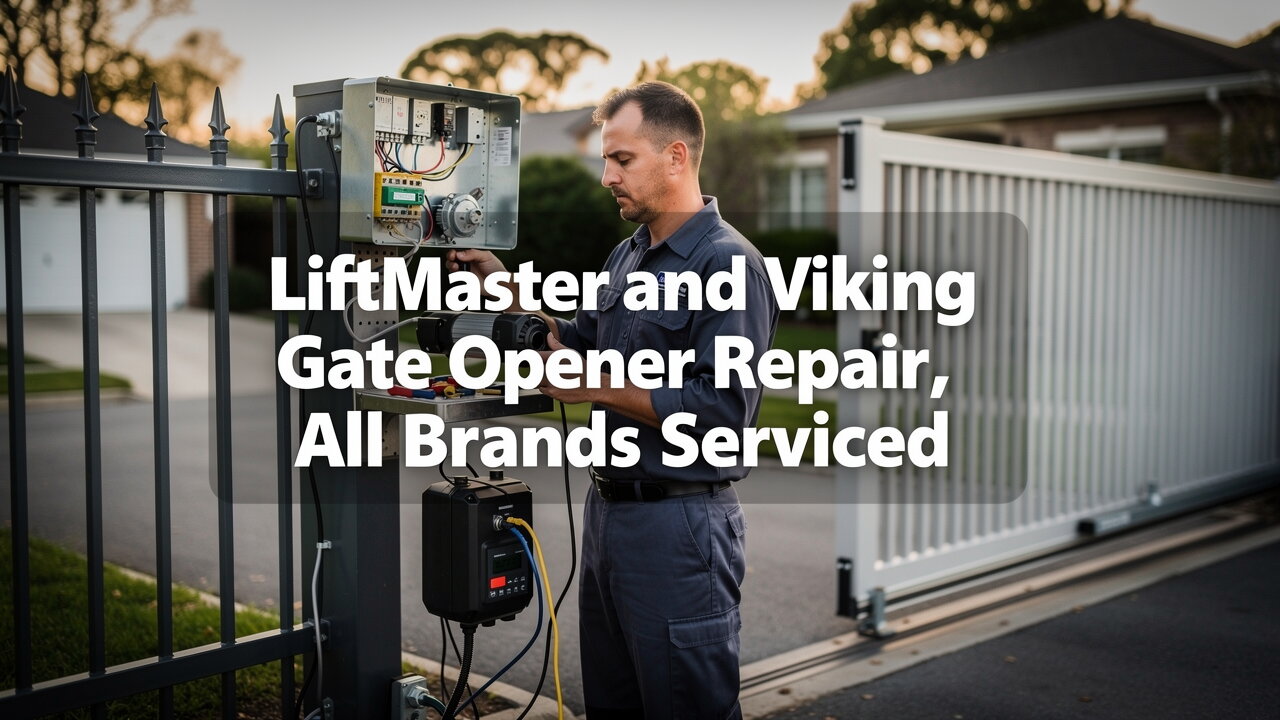
LiftMaster gate opener repair and Viking gate operator service cover the two operator families we see most often on Northwest Washington properties, and the fastest repairs start with an honest diagnosis instead of a parts guess. A gate that stops halfway, reverses for no reason, hums without moving, or works on the remote but not the keypad is telling you something specific. The job is to read that signal correctly before anyone opens a wallet.
Emerald Gate Systems services LiftMaster operators, Viking operators, and equipment from other manufacturers across Skagit, Whatcom, and Snohomish counties, including systems we did not install. Repair labor is published at $100 per hour. Parts, travel, permits, specialty equipment, ferry costs, and emergency scheduling may be additional, and we say so before the work starts rather than after.
This page explains what actually fails on these operators, how we work through a diagnosis on site, and how to tell the difference between a repair worth making and a system that has reached the end of its service life. If your gate is already down and blocking access, call (360) 657-9975 or use the contact page to request service.
What Actually Fails in a LiftMaster Gate Opener Repair
LiftMaster gate opener repair is not mysterious work. They are a motor, a gearbox or hydraulic assembly, a control board, a set of limit references, a power supply, and a group of safety and access devices that all report back to the board. When a gate misbehaves, the fault is almost always in one of those areas, and each one produces a recognizable pattern.
Across the properties we service in Northwest Washington, the failures cluster into a short list. Control board damage from moisture or a power surge. Limit switches or travel settings that drifted. Worn gearbox components on gates that have been dragging or fighting a bad hinge for months. Batteries that quietly died and were never noticed until the power went out. Obstruction sensors knocked out of alignment by a landscaper, a delivery driver, or a winter storm. Receivers that lost their programming. Corroded connections in an enclosure that was never sealed properly.
What separates a fast repair from a slow one is whether the technician treats the symptom or the cause. A gate that trips its obstruction sensing every morning may have a failing sensor, or it may have a hinge that binds when the metal is cold and the ground is wet. Replacing the sensor fixes nothing in the second case. That is why the first thing we do is operate the gate by hand.
The structure matters as much as the electronics. An operator sized correctly for a straight, well supported gate will struggle and eventually fail if that gate has sagged, if a post has shifted in soft ground, or if the track has filled with gravel and needles. Northwest Washington is hard on the parts of a gate nobody looks at. We look at them.
How We Diagnose a LiftMaster Gate Opener Repair on Site
Every LiftMaster gate opener repair follows the same diagnostic order, because skipping steps is how people end up paying for the wrong part. We start with the gate itself, disconnected from the operator, moved by hand through its full travel. A gate that is hard to move by hand will never run reliably under power, and no control board setting will change that.
From there we check power at the operator, not at the panel. Long runs to rural entrances lose voltage, and a system that reads fine at the house can be starved at the gate. We check the transformer, the battery condition under load rather than at rest, and any surge protection that may have taken a hit during a storm.
Then the control board. Most modern operators report faults through indicator lights or a display, and those codes narrow the search quickly when read against the correct documentation for that specific board revision. We confirm what the board thinks is happening, then verify it against what is actually happening at the gate, because a board reporting an obstruction and a gate that is genuinely obstructed are two different problems.
Safety devices come next. Photo eyes get checked for alignment, lens condition, wiring, and whether they are monitored by the board. Edge sensors get checked for continuity and physical damage. Access devices are tested one at a time so we can tell a dead keypad from a dead receiver from a wiring fault between them.
The last step is the part most companies skip: we run the gate through a full cycle several times and watch it. Intermittent faults hide from a single test. A gate that fails on the third cycle when the motor warms up is a different repair than a gate that fails every time.
Talk with Emerald Gate Systems. If your gate is behaving unpredictably and you would rather have it diagnosed than guessed at, call (360) 657-9975 or use the contact page to schedule service. We work on gates we did not install.
Control Board Faults and What They Usually Mean
The control board is the part owners fear most, partly because it is the most expensive single component in many operators and partly because “you need a new board” is the easiest thing for a technician to say. Sometimes it is true. Often it is not.
Boards fail for a small number of reasons. Water intrusion is the leading cause in Northwest Washington, and it rarely arrives dramatically. It arrives as a missing gasket, a conduit that was never sealed at the bottom, a cabinet mounted where roof runoff hits it, or a knockout left open. Moisture creeps in, condenses, and corrodes traces and terminal blocks over a season or two.
Power events are the second cause. A nearby lightning strike, a utility fault, or a surge when power is restored after an outage can damage the board, the transformer, or the receiver. Properties on long rural feeders see more of this than properties in town.
Insects and rodents are the third, and they are more common than most owners expect. A warm enclosure in a wet climate is attractive. Nests bridge terminals, and chewed insulation creates shorts that look exactly like a board failure until the wiring is traced.
Before condemning a board, we check the incoming power, the terminal connections, the wiring to every accessory, and whether a single shorted device is dragging the board into a fault state. Disconnecting accessories one at a time frequently reveals a bad photo eye or a damaged edge sensor that made the board look dead. When the board genuinely has failed, we say so, quote the part, and explain whether that repair makes sense against the age and condition of the rest of the system.
Limit Switches, Travel Settings and Gates That Stop Short
A gate that stops before it is fully open, closes partway and reverses, or slams the last few inches is usually a limit or travel problem, not a motor problem. How the limits are set depends on the operator design. Some use mechanical switches driven by a cam or a chain. Others use magnetic sensors. Others count rotations electronically and learn their travel during a setup routine.
Mechanical limits drift. Cams loosen, arms bend, and switches wear. On a slide gate, a magnet can shift on the chain or the bracket can move. On electronic systems, a learned travel profile can be thrown off by a change in the gate itself, which is why a gate that starts behaving badly after a hinge repair or a fence project often just needs its travel relearned.
The failure to watch for is a gate that reverses off the close limit repeatedly. That behavior is frequently misread as a limit fault when the real cause is the gate hitting resistance at the same point every cycle. A stone in the track, a raised slab, a sagging leaf catching the strike post, or ice in winter will all produce it. The board is doing its job by reversing. Something in the path needs correcting.
Setting limits correctly also matters for safety and for the life of the equipment. A gate that reaches its stop under full power stresses the frame, the hinges, and the gearbox on every cycle. Proper travel and slowdown settings extend the life of the whole assembly, and on a high cycle commercial entrance the difference is measured in years.
Talk with Emerald Gate Systems. A gate that stops short or reverses at the same point every time is usually telling you exactly where the problem is. Call (360) 657-9975 and we will read it properly instead of replacing parts until it stops.
Gearboxes, Motors and Mechanical Wear
When the electronics check out and the gate still will not move correctly, attention turns to the mechanical drive. Symptoms here are distinctive. A motor that hums but does not turn. Movement that is jerky rather than smooth. A grinding or knocking sound under load. A gate that runs fine in one direction and struggles in the other. Visible play in the arm or the drive assembly when the gate is stopped.
Most mechanical wear traces back to load the operator was never meant to carry. Gate weight is the obvious factor, but it is rarely the whole story. A gate with a failing hinge, a bent arm, a bound roller, or a post that has moved will demand far more torque than its weight suggests. The operator absorbs that abuse until something inside gives.
Wind is the underrated factor on Northwest properties. Solid privacy gates and gates with heavy infill act as sails. A gate that operates smoothly on a calm morning can strain badly in a winter storm, and that repeated overload shortens gearbox life. Coastal and ridge properties see it worst.
Whether a gearbox is worth rebuilding depends on the operator, the availability of parts, and the condition of the rest of the system. A well built operator on a sound gate with a single worn component is usually worth repairing. The same repair on a twenty year old unit with corroded housings, a failing board, and a gate that needs structural work is money spent on the wrong end of the problem. We lay out both paths with real numbers so the decision is yours and not a surprise.
Battery Backup and Power Problems in Northwest Washington
Batteries are the most neglected part of a gate system and the one that fails at the worst possible moment. In Skagit, Whatcom, and Snohomish counties, winter storms take power down regularly, and that is exactly when a property owner discovers the backup that was installed years ago has not held a charge since the last presidential election.
Sealed lead acid batteries used in most gate operators have a service life measured in a few years, shorter in cold, damp enclosures. They fail quietly. The gate keeps working on utility power, so nothing seems wrong, and the first symptom is a gate that will not open during an outage or one that opens once and dies.
Testing matters more than looking. A battery can show acceptable voltage at rest and collapse the moment the motor draws current. We test under load, check the charging circuit on the board, and confirm the battery is the correct type and capacity for the operator and for the number of cycles the property actually needs during an outage.
Power quality at the gate is the companion issue. Long rural runs, undersized conductors, shared circuits, and aging connections all produce voltage that is adequate at rest and inadequate under motor load. Symptoms look electronic but are electrical. On properties where trenching new power is impractical, solar gate openers in Washington can be the better answer, provided the system is sized honestly around winter daylight rather than summer sun.
Talk with Emerald Gate Systems. If your gate failed during the last outage, the battery is the first thing to check and the cheapest thing to fix. Call (360) 657-9975 before the next storm rather than during it.
Obstruction Sensors, Photo Eyes and Safety Edges
Safety devices cause more service calls than any other single category, and most of those calls are not device failures. They are alignment, contamination, or wiring problems, and they are entirely preventable.
Photo eyes need line of sight. A shrub that grew, a planter that was moved, a post that shifted, or a lens covered in road spray will break the beam and stop the gate. Fog, heavy rain, and low winter sun striking the receiver directly can all produce intermittent faults that clear by midday and return the next morning, which is why owners often describe them as random.
Edge sensors fail differently. They are physical devices mounted where they get hit, and they take abuse from vehicles, gravel, snow removal, and time. A damaged edge can read as permanently triggered, which will prevent the gate from closing at all.
The important part is what we do not do: we do not disable a safety device to make a gate work. Monitored entrapment protection is part of how a powered gate is designed to operate safely, and bypassing it transfers risk to whoever uses the entrance next. When a device fails, it gets repaired or replaced. The standards behind this are published by UL for external entrapment protection devices and by ASTM F2200 for gate construction, and they exist because gates are heavy things that move.
If your gate is older and has never had monitored safety devices, a service call is a good moment to review what it would take to bring it current. That work often pairs naturally with a gate automation retrofit when the structure is sound.
Remotes, Receivers and Keypads That Stopped Working
Access problems have a diagnostic logic of their own. The question is always whether the failure is at the device, at the receiver, or in the wiring between them, and testing each independently answers it quickly.
If one remote fails and others work, the remote is the suspect: battery, water damage, or lost programming. If every remote fails at once, look at the receiver, its antenna, and its power. Antennas are frequently the culprit. They get cut during landscaping, corrode at the connection, or get coiled inside a metal enclosure where they cannot do their job. Range that has gradually shortened over months usually points to the antenna rather than the remotes.
Keypads fail from moisture and from wear on the keys themselves. A keypad that works intermittently in wet weather has water in the housing or at the terminal, and drying it out is a temporary fix at best. Wireless keypads add a battery to the list of suspects.
Interference is real and increasingly common. More devices share the same frequency bands than they used to, and a new neighbor’s equipment, a new LED fixture, or a new wireless system on the property can degrade range without anything on the gate having changed.
When access devices are failing regularly, or when a property has outgrown remotes and codes, the repair conversation often turns into an upgrade conversation. Our access control systems page covers keypads, RFID, video intercoms, phone entry, cameras, and managed credentials for homes, communities, and businesses.
Talk with Emerald Gate Systems. Whether a keypad needs a repair or the whole access approach needs rethinking, we will tell you which. Call (360) 657-9975 or use the contact page.
Weather, Moisture and Corrosion on Northwest Operators
Equipment that performs for a decade in a dry climate has a harder life here. Rain arrives sideways. Fog sits for days. Coastal properties on Fidalgo Island and along the Skagit and Whatcom shorelines add salt to the air. Inland valley sites add fog, standing water, and organic debris that holds moisture against metal.
The damage shows up in predictable places. Terminal blocks corrode. Ground connections degrade until fault protection stops working properly. Fasteners seize, which turns a simple future repair into a difficult one. Bearings and rollers wash out when grease is displaced by water. Coating damage on the gate itself starts as a scratch and becomes rust that spreads under the finish.
Enclosure placement matters more than owners expect. A cabinet under a drip line, on the weather side of a post, or at the low point where water collects will fail years before an identical cabinet mounted thoughtfully. When we repair moisture damage, we address where the water is coming from, because replacing a corroded board in the same wet location just resets the clock.
Drainage at the gate is part of the same picture. Water that pools in a track, at a post base, or under an operator pad undermines the whole assembly over time. Correcting drainage is unglamorous work that prevents more expensive repairs than almost anything else we do. Our guide to seasonal gate maintenance in Washington covers what an owner can reasonably watch for between service visits.
Repair, Rebuild or Replace: How We Decide
Not every failed operator should be repaired, and not every aging operator should be replaced. The honest answer depends on five things: the age and condition of the operator, the availability of parts, the condition of the gate and its supports, how the property actually uses the entrance, and what the owner needs the system to do going forward.
| Situation | Usually the right call | Why |
|---|---|---|
| Single failed component, sound gate, parts available | Repair | Lowest cost, system has remaining life |
| Multiple aging components, sound gate | Operator replacement | Repairs stack up faster than a new unit costs |
| Operator fine, gate sagging or binding | Structural repair first | The gate is what is killing the operator |
| Obsolete unit, no parts support | Replacement | Future repairs become impossible |
| Property outgrew the system | Upgrade | Capacity, credentials or safety no longer fit the use |
Cycle count is the factor owners underestimate. A residential operator on a driveway that opens six times a day is in its comfort zone. The same unit on a shared private road, a small apartment building, or a business entrance may be running fifty or more cycles a day, and it will wear out on a completely different schedule. When the use has changed, replacing like for like just repeats the failure.
If you are weighing the numbers, our guide to automatic gate repair cost versus replacement works through the comparison in more detail, and automatic gate repair in Northwest Washington covers upgrades and replacement across the region.
Talk with Emerald Gate Systems. We will give you the repair number and the replacement number, and tell you which one we would choose on our own property. Call (360) 657-9975.
All-Brand Service Beyond LiftMaster Gate Opener Repair
Plenty of companies limit LiftMaster gate opener repair to systems they sold themselves. That leaves owners stranded when the original installer moves on, changes lines, or goes out of business, which happens often enough to be a real problem in this trade.
We service LiftMaster and Viking operators, and we service equipment from other manufacturers, including installations we had nothing to do with. What that means practically is that we diagnose what is in front of us rather than steering every call toward a replacement we would prefer to sell.
There are honest limits. Some equipment is genuinely obsolete and has no parts support. Some proprietary systems restrict access to programming tools or replacement components. Some installations were done in a way that has to be corrected before anything else can be reliable. When we hit one of those walls, we say so plainly and lay out the options, which may include replacing a component with a serviceable equivalent or replacing the operator with something that can be supported for the next decade.
The reason this matters is accountability. When design, fabrication, installation, automation, and service run through one local team, nobody gets to blame the other trade. Our licensed gate contractor page explains how that structure works, and you can verify our contractor status directly through Washington L&I contractor verification.
Commercial and High-Cycle Operator Service
Commercial entrances fail differently than residential driveways because they run far more cycles and because the cost of downtime is measured in blocked trucks and locked out staff rather than inconvenience.
On a high cycle gate, wear is continuous rather than occasional. Chains stretch. Rollers flatten. Bearings dry out. Vehicle loop detectors drift out of calibration. Access credentials multiply as staff and vendors change. The equipment that handles this properly is built for continuous duty, and residential grade equipment installed on a commercial entrance will fail on a predictable schedule no matter how well it is maintained.
Managed properties add a coordination problem. Whoever calls for service is often not the person who knows the system history, holds the programming credentials, or can authorize the repair. That is why we document what is installed, how it is accessed, and what was done on each visit, so the next call does not start from zero.
For apartments, condominiums, and communities, resident access is the pressure point. A gate stuck open is a security complaint and a gate stuck closed is an emergency access problem, and both generate calls to the board within the hour. Our HOA and community gate systems page covers service expectations, maintenance intervals, and credential management for boards and managers, and commercial gate installation in Washington State covers continuous duty operators and vehicle loops for facilities.
Talk with Emerald Gate Systems. If your entrance carries real traffic, a maintenance agreement costs less than the emergency calls it prevents. Call (360) 657-9975 to discuss what your site needs.
Maintenance That Prevents Most Operator Failures
The majority of the repairs described on this page are preventable, and the prevention is not complicated. It is attention on a schedule.
Twice a year covers most residential properties in this climate, with the visits timed before winter and after it. Commercial and high cycle sites need more. What gets checked is consistent: gate alignment and hinge or roller condition, fastener tightness, track and path clearance, operator mounting, chain or arm condition, lubrication where the manufacturer calls for it, battery condition under load, charging circuit, safety device alignment and function, access device operation, enclosure sealing, drainage, and the coating on the gate itself.
Owners can watch for the early signals between visits without touching anything. A gate that has started to sound different. Movement that is slower or less smooth than it was. A leaf that no longer lines up with its partner or its strike. Rust staining below a hinge. A remote that needs to be closer than it used to. Water standing where it did not before. Any of these is worth a call before it becomes a failure.
Documentation is the other half. Knowing what operator is installed, what accessories are on it, where the manual release is, how it is accessed for programming, and who holds the credentials turns a two hour diagnostic into a thirty minute repair. Our page on preventive gate maintenance covers what a reasonable program looks like, and what to check when a gate will not open or close covers the safe things an owner can look at before calling.
Where We Service Gate Operators
Emerald Gate Systems is headquartered in Sedro-Woolley and operates its own fabrication shop in Skagit County. Service runs across Skagit, Whatcom, and Snohomish counties, Whidbey and Camano Islands, the San Juans, and the greater Puget Sound region.
In Skagit County that includes Sedro-Woolley, Mount Vernon, Burlington, Anacortes, La Conner, Bow, Edison, and Concrete. In Whatcom County it includes Bellingham, Lynden, Ferndale, and Blaine. Snohomish County coverage runs from Everett and Marysville through Arlington, Stanwood, Monroe, Snohomish, and the Skykomish Valley communities.
Travel time, ferry schedules, and site access affect scheduling on island and remote properties, and we are straightforward about that when we book rather than after. Emergency response is available, with priority based on safety and access impact, but it should not be read as a guaranteed arrival window unless we have confirmed that commitment for your property specifically.
County and city detail lives on our Skagit County and Whatcom County pages, and the full coverage map is on gate installation service areas in Northwest Washington.
Talk with Emerald Gate Systems. Tell us the operator, the symptom, and the property, and we will tell you what it likely is before anyone drives out. Call (360) 657-9975 or use the contact page.
Swing, Slide and Barrier Operators Fail Differently
Grouping every gate operator together hides useful information. The three families we service most in Northwest Washington wear out in distinct ways, and knowing which one you have narrows a diagnosis before anyone arrives.
Swing operators move a leaf through an arc, which means the load changes continuously through the travel. Arm style units transfer force through a linkage and the pivot points are the wear items. Underground and pad mounted units carry load differently and are more exposed to standing water. On swing gates, most mechanical complaints trace back to the hinges rather than the operator. A hinge that has worn oval or a post that has settled changes the arc the operator was set up for, and the unit spends every cycle fighting geometry that no longer matches its programming.
Slide and cantilever operators drive a gate along a horizontal path, usually through a chain, a rack, or a belt. Their failure points are different: chain tension and stretch, worn drive sprockets, rack teeth packed with debris, rollers that have flattened, and truck assemblies that have lost their alignment. Ground mounted tracks are the worst offenders in this climate because they collect gravel, needles, and standing water. Cantilever designs avoid the ground track entirely, which is why we specify them so often on wet Skagit and Whatcom sites, but they place higher demands on the roller trucks and the counterbalance length.
Barrier arms are a category of their own. They cycle far more than any gate, often hundreds of times a day at a parking entrance, and they are struck by vehicles regularly. Their service pattern is dominated by arm replacement, spring adjustment, and loop detection rather than by motor failure.
The practical takeaway is that the same symptom means different things on different equipment. A grinding sound on a swing operator points toward the linkage or the gearbox. The same sound on a slide points at the chain path, the rack, or a roller. Reading the symptom against the drive type is the first filter.
Vehicle Loops, Free Exit and Detection Problems
A large share of commercial and community gate calls turn out to be detection problems rather than operator problems. The gate is healthy. It simply is not being told to do the right thing at the right time.
Vehicle loops are wire loops cut into the pavement and connected to a detector. They handle three jobs depending on how they are placed: free exit, which opens the gate for a vehicle leaving; safety, which holds the gate open while a vehicle is in the path; and shadow, which prevents a gate from closing on a vehicle waiting in the opening. When a loop fails, the symptom depends entirely on which job that loop was doing.
Loops fail from pavement movement, water intrusion at the sealant, cuts during paving or utility work, and detector drift. A gate that suddenly stopped opening for departing vehicles, or that closes while a truck is still in the opening, deserves an immediate loop and detector test. That second symptom is a safety issue and gets treated as one.
Detector sensitivity is the setting most often blamed and least often at fault. Turning sensitivity up to compensate for a damaged loop masks a problem that will get worse and can cause false detections from adjacent traffic or from rebar in the slab. We test the loop itself before touching the setting.
Alternatives exist where cutting pavement is impractical. Probe style and above ground detection can work on gravel and on sites where a saw cut is not an option, with tradeoffs in accuracy and in what they will and will not detect. On managed properties, detection is worth designing alongside credentials rather than bolting on later, which is covered on our commercial gate systems page.
Talk with Emerald Gate Systems. If your gate misses departing vehicles or closes too early, the fault is usually in detection rather than the operator. Call (360) 657-9975 and we will test the loops properly.
What You Can Safely Check Before You Call
There are a handful of checks any owner can make that either solve the problem or make the service call much faster. None of them involve opening an enclosure or working near a moving gate under power.
Start with power. Confirm the breaker has not tripped and that any disconnect at the gate is on. On properties where the gate shares a circuit with outbuildings or landscape lighting, a fault elsewhere can take the gate down with it.
Look at the path. Walk the full travel of the gate and look for anything that has changed: gravel in a track, a branch, a stone at the strike, a settled slab, standing water, ice, or a landscape bed that has crept into the swing. This one check resolves a meaningful share of the calls we receive.
Look at the photo eyes. They are usually mounted low on posts facing each other across the opening. Check that the lenses are clean, that nothing has grown or been placed in the beam, and that neither has been knocked out of alignment. Do not adjust them, just note what you see.
Test the access devices separately. Try each remote, then the keypad, then any intercom or app control. Knowing that the keypad works and the remotes do not, or the reverse, saves diagnostic time.
Note the pattern. Does it fail every cycle or occasionally? At a particular point in the travel? Only when wet, only when cold, only in the morning? Did anything change on the property recently, including landscaping, paving, fencing, electrical work, or a new wireless system? That context is genuinely useful.
What not to do: do not disable a safety device to force the gate to run, do not force a bound gate under power, and do not work inside a control enclosure. A gate that is binding badly enough to stop itself will damage something if it is forced.
Manual Release and Keeping Access During a Failure
Every powered gate has a way to be released and moved by hand, and the moment to learn where it is and how it works is not while a vehicle is blocked in a driveway at night.
Manual release designs vary. Some use a keyed release on the operator housing. Some use a lever or pin that disconnects the drive. Underground units often have a release under a cover that has to be located and cleared before it can be reached. Slide operators may require releasing a chain or disengaging a clutch. What they have in common is that they should be accessible without tools you do not have and without power.
The failure we see repeatedly is a release that technically exists but cannot be used. The cover is under landscaping. The key was lost years ago. The mechanism has seized from corrosion because it has never been exercised. On a service visit we test the release and correct it if it will not work, because a release that fails during an outage is not a release.
Emergency responder access deserves the same attention. Fire and medical access to a gated property should not depend on the gate having power or on someone being home to open it. Depending on the jurisdiction and the property, that may involve a key switch, a lock box, a radio receiver, or an agreed procedure with the local fire district. It is worth confirming what your district expects rather than assuming.
Communities and managed properties should document the release procedure and make sure more than one person knows it. A board that turns over every year loses that knowledge quickly unless it is written down, which is one of the things we document on maintenance agreements.
Talk with Emerald Gate Systems. If nobody at your property is sure how to release the gate by hand, that is worth fixing before the next outage. Call (360) 657-9975 and we will show you on site.
Documentation, Programming and Credential Handover
The least discussed cause of expensive service calls is missing information. A technician who does not know what is installed, how it is accessed, or what was changed last time spends the first hour of a visit rediscovering the system.
A properly documented gate system records the operator make and model, the control board revision, what safety devices are installed and where, what access devices are in use, how the system is accessed for programming, where the manual release is, what power feeds it, and what has been serviced and when. On managed properties it also records who holds administrative credentials.
Credentials are where this bites hardest. Systems with app based or cloud managed access are only manageable by whoever holds the administrator account. When a property manager changes, a board turns over, or an installer disappears without transferring access, the property can end up locked out of its own system. Recovering it ranges from a phone call to a full replacement of the controller depending on the manufacturer.
We treat handover as part of the job. When we install or take over a system, the owner or manager gets the documentation and the administrative access, not just a working gate. That is also why taking over someone else’s installation often starts with an inventory visit before any repair, so that what is there is known rather than assumed.
For communities and commercial sites, this is worth formalizing. Our HOA and community gate systems page covers credential management, resident and vendor access, and what a board should have on file, and access control systems covers the platforms themselves.
Frequently Asked Questions About LiftMaster Gate Opener Repair
Do you repair gate operators you did not install?
Yes. We service LiftMaster operators, Viking operators, and equipment from other manufacturers regardless of who installed it. Diagnosis covers the gate structure, the operator, safety devices, access control, and power, so the recommendation reflects the whole system rather than one part.
How much does gate opener repair cost?
Repair labor is published at $100 per hour. Parts, travel, permits, specialty equipment, ferry costs, and emergency scheduling may be additional. Most straightforward diagnostics and repairs are completed in a single visit, and we confirm the scope with you before the work begins.
My gate opens but will not close. What is wrong?
This is usually a safety device rather than a motor. A misaligned or dirty photo eye, a damaged edge sensor, or a genuine obstruction in the closing path will prevent closing while allowing opening. Check for anything blocking the beam or the path before calling, but do not disable a safety device to force the gate closed.
My gate hums but does not move. What does that mean?
The operator is receiving power and trying to run against something it cannot overcome. Common causes are a mechanically bound gate, a failed capacitor, a seized gearbox, or a gate that is physically obstructed. Disconnect the operator and try moving the gate by hand. If it is hard to move, the problem is mechanical.
Why does my gate stop halfway?
Stopping at the same point every cycle usually means the gate is meeting resistance there or a limit setting has drifted. Debris in a track, a sagging leaf catching a post, a raised slab, or ice will all cause it. Stopping at random points more often points to power, a failing board, or an intermittent connection.
How long do gate operator batteries last?
Sealed batteries in gate operators typically last a few years, shorter in cold, damp enclosures. They fail quietly because the gate keeps working on utility power, so the failure is only discovered during an outage. Testing under load rather than at rest is the only reliable check.
Can a control board be repaired instead of replaced?
Sometimes the board is fine and a shorted accessory, a corroded terminal, or a wiring fault is making it appear dead. We test the incoming power, disconnect accessories one at a time, and verify the wiring before condemning a board. When the board has genuinely failed, replacement is usually the practical answer.
Why did my remotes all stop working at once?
When every remote fails simultaneously, the receiver, its antenna, or its power supply is the likely cause rather than the remotes. A cut or corroded antenna is a frequent culprit. If only one remote fails, start with its battery and its programming.
My keypad works sometimes and not others. Why?
Intermittent keypad behavior in wet weather almost always means moisture has reached the housing or the terminals. Drying it is temporary. The housing, the seal, or the wiring entry needs correcting, and badly corroded keypads are usually replaced rather than repaired.
Is it worth repairing an old gate operator?
It depends on parts availability, the condition of the rest of the system, and how the property uses the entrance. A single failed component on a sound gate with supported parts is usually worth repairing. An aging unit with multiple failing components, no parts support, or a gate that needs structural work often is not.
How do I know if my gate is too heavy for its operator?
Symptoms include slow or labored movement, overheating, frequent obstruction faults, and premature mechanical wear. Weight alone is not the whole answer, because binding hinges, bound rollers, or a shifted post make a gate behave as though it weighs far more than it does. A hand test through full travel is the starting point.
Does wind damage gate operators?
Yes, particularly on solid privacy gates and gates with heavy infill, which act as sails. Repeated wind loading strains the gearbox, the arm, and the hinges. Coastal and exposed ridge properties in Northwest Washington see this more than sheltered inland sites, and it is a factor worth designing around rather than discovering later.
What does UL 325 mean for my gate?
UL 325 addresses entrapment protection for powered gate operators, including how safety devices are monitored so the system knows when one has failed. Older gates without monitored devices may not meet current expectations. A service call is a reasonable moment to review what bringing the system current would involve.
What is ASTM F2200?
ASTM F2200 addresses gate construction, covering things like how a gate is built, guarded, and prevented from falling or being pushed out of its track. It works alongside operator standards. A compliant operator on a non-compliant gate is still a problem.
Can you service gates on Whidbey Island or the San Juans?
Yes. Island service is available, and ferry schedules and travel time affect how it is scheduled and priced. We are clear about that when the appointment is booked rather than after the visit.
Do you offer emergency gate repair?
Emergency response is available, with priority based on safety, blocked access, security, and business impact. Response depends on location, weather, parts, ferry schedules, and technician availability, and it should not be read as a guaranteed arrival window unless we have confirmed that specific commitment for the property. Some visits result in temporary stabilization before a complete repair can be scheduled.
Should I have a maintenance agreement?
For residential driveways with light use, twice yearly service is usually enough. For commercial entrances, apartments, HOAs, and any high cycle gate, a maintenance agreement generally costs less than the emergency calls and downtime it prevents, and it keeps the system documented.
Can you upgrade my old gate instead of replacing it?
Often, yes. When the gate structure is straight, stable, properly supported, and suitable for required safety devices, adding a modern operator, monitored safety equipment, and current access control is frequently better value than replacing everything. When the gate is sagging, corroded, or poorly guarded, retrofitting a good operator onto a failing structure is not a good investment.
How quickly can you get parts?
Common parts for current operators are usually available quickly. Obsolete equipment, proprietary components, and specialty items take longer or may not be available at all, which is one of the factors that pushes an older system toward replacement rather than repair.
Do I need an electrical permit for gate work?
New or altered electrical work generally requires a permit in Washington, and responsibility depends on how the work is contracted. Requirements and fees are published by Washington L&I. A straightforward like for like component replacement is a different situation than a new circuit or a new installation, and we will tell you which one your job is.
Why does my gate work in summer but fail in winter?
Cold and wet expose problems that stay hidden in dry weather. Metal contracts and a marginal clearance becomes a bind. Grease thickens. Batteries lose capacity. Moisture that evaporated in July condenses in a cold enclosure. A gate that only misbehaves in winter usually has a clearance, drainage, or battery problem rather than an electronic one.
My gate closes on my car. Is that normal?
No, and it should be treated as urgent. A gate that closes while a vehicle is in the opening indicates a failed safety loop, a misaligned or failed photo eye, or a detection setting that is not doing its job. Stop using the automatic close function and call for service rather than working around it.
Can you take over service on a system another company installed?
Yes, and it usually starts with an inventory visit so we know what is actually there. That covers the operator, board revision, safety devices, access platform, power, and manual release, along with whether administrative credentials are available. Repairs go faster afterward because nothing has to be rediscovered.
Who holds the administrator access to my gate system?
Whoever set it up, unless it was formally transferred. On cloud managed and app based systems this matters, because without administrator access an owner cannot add or remove users. If you are not sure who holds it, find out before you need to change something urgently.
Does a vehicle loop failure mean cutting the pavement again?
Not always. A loop that reads open may have failed at a splice, at the lead in, or at the detector rather than in the loop itself, and those are repairable without new saw cuts. A loop physically broken by pavement movement or excavation does need to be recut, or replaced with an above ground detection method where cutting is impractical.
What information helps you diagnose faster?
The operator brand if you know it, what the gate does and does not do, whether it started suddenly or gradually, whether it correlates with weather or time of day, whether remotes and keypads behave the same way, and whether anything changed on the property recently. Photos of the operator and any fault lights help considerably.
Start With a Diagnosis, Not a Parts Order
LiftMaster gate opener repair starts with a system telling you where it hurts. The repairs that hold are the ones that start by listening to that, checking the gate by hand, verifying power under load, reading the board honestly, and testing every safety and access device independently before anything gets replaced.
Emerald Gate Systems services LiftMaster, Viking, and other manufacturers across Skagit, Whatcom, and Snohomish counties from our own shop in Sedro-Woolley, including gates we did not install. One team handles the structure, the automation, the access control, and the service, so responsibility for the result sits in one place.
Call Emerald Gate Systems at (360) 657-9975 or request service through the contact page to have your gate operator diagnosed properly.
Reading that signal correctly is the first step of any gate repair call.
If the diagnosis points to an operator that is undersized for the gate rather than a repairable fault, our gate operator installation guide explains how the replacement should be sized.