
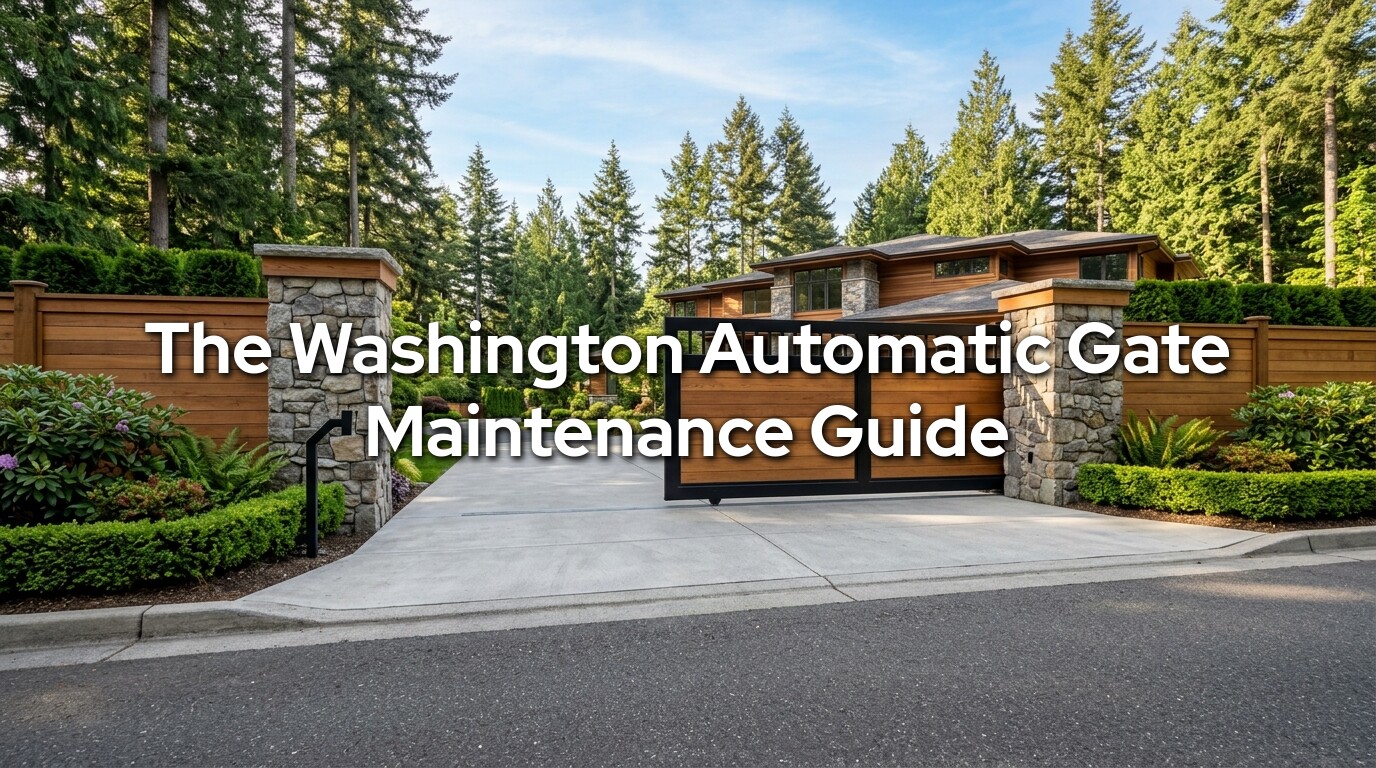
Automatic gate maintenance Washington owners plan for works best as a season by season habit, because an automatic gate rarely fails because of one dramatic event. More often, trouble develops a little at a time. A hinge begins carrying more weight than it should. A roller wears unevenly. A battery loses capacity. Leaves collect around a sliding gate track. A photo eye moves slightly out of alignment. Moisture reaches a connection that appeared dry during summer. The gate still works, so the early warning signs are easy to ignore.
Then a cold morning, windstorm, power outage, heavy delivery day, or week of steady rain exposes the weakness.
That pattern is especially common in Washington State. Automatic gates in the Pacific Northwest deal with moisture, vegetation, wind, seasonal debris, cold batteries, wet soil, gravel migration, power interruptions, and coastal corrosion. A residential driveway gate near Sedro-Woolley faces different conditions from an apartment gate in Lynnwood, an estate entrance in Woodway, a farm gate outside Arlington, or a commercial sliding gate in Marysville. The maintenance plan should reflect those differences.
Preventive maintenance is not simply adding grease once a year. It is a structured inspection of the entire entrance, including the gate structure, posts, foundations, hinges, rollers, guides, tracks, operator, batteries, electrical connections, safety devices, access controls, drainage, coatings, and emergency-release system.
Some work can be performed safely by an observant property owner. Other work requires a trained gate technician who understands heavy moving structures, automatic operators, electrical controls, monitored safety devices, and access-control programming. Knowing where that line falls is part of responsible ownership.
This guide explains what to inspect, when to inspect it, what changes deserve attention, how maintenance differs by gate type and property use, and when a repair has become a replacement decision. It is designed for homeowners, estate and farm owners, HOA boards, apartment managers, commercial property owners, facility teams, and contractors throughout Washington State.
Emerald Gate Systems is based in Sedro-Woolley and is positioned around custom gate fabrication, automatic gate installation, access control, repair, and ongoing service for residential, agricultural, commercial, institutional, and managed properties across Skagit County, Whatcom County, Snohomish County, island communities, and the greater Puget Sound region. Its local maintenance approach considers the complete system rather than treating the gate, operator, and access controls as unrelated equipment.
This guide provides general planning information. The manufacturer instructions for your specific operator and safety equipment should always take priority, and local code or permit questions should be confirmed for the property address.
What Does Preventive Automatic Gate Maintenance Actually Include?
Preventive automatic gate maintenance is a scheduled review of every part that affects movement, safety, access, and reliability. The purpose is to find developing problems before they stop the gate, damage other components, or create an unsafe condition.
A complete maintenance visit normally begins with the gate itself. Before testing the automation, the technician should evaluate whether the gate is straight, supported correctly, aligned, and capable of moving without abnormal resistance. An operator should move a mechanically sound gate. It should not be expected to pull a sagging swing leaf, overcome a failing hinge, drag a damaged wheel, or force a sliding gate through a dirty track.
The inspection may include:
- Posts, footings, concrete pads, and mounting points
- Hinges, pivots, wheels, rollers, guides, chains, racks, and belts
- Welds, frame members, brackets, fasteners, stops, and locks
- Operator mounts, limits, controls, gearboxes, and drive components
- Battery condition, charging, backup operation, and manual release
- Photo eyes, sensing edges, vehicle loops, and warning devices
- Keypads, remotes, RFID readers, badge systems, intercoms, and cameras
- Wiring, conduit, enclosures, seals, grounding, and visible corrosion
- Drainage, vegetation, gravel, mud, leaves, ice, and other site conditions
- Paint, powder coating, galvanizing, wood finish, and exposed metal
This broad approach matters because gate problems are often connected. A control board may report an obstruction because the gate has developed mechanical resistance. A battery may seem weak because the operator is working harder than it should. A photo eye may repeatedly lose alignment because its post is moving in saturated soil. Replacing the final failed component without correcting the underlying cause can lead to another service call.
Emerald Gate Systems’ maintenance and repair framework follows this complete-system logic by reviewing structure, automation, safety devices, access controls, power, drainage, and local environmental conditions together. Property owners who need a broader overview of those connected services can review our services page.
How Often Should an Automatic Gate Be Serviced?
An automatic gate should be checked as often as its use, environment, equipment, and consequences of failure require. A lightly used home gate may need a different schedule from a gate serving an apartment community, warehouse, school, private road, or busy commercial yard.
There is no responsible universal schedule for every system. The operator manufacturer, gate design, daily cycle count, age, weather exposure, access-control complexity, and service history should guide the interval.
A practical planning framework is:
| Property or gate use | Owner or staff observation | Typical professional planning interval |
|---|---|---|
| Low-use residential driveway | Monthly and after storms | Annually, or more often when recommended |
| High-use residence or estate | Monthly | Every 6 to 12 months |
| Farm or rural entrance | Monthly and after heavy weather or equipment impact | Every 6 to 12 months |
| HOA or apartment entrance | Weekly staff observation | Quarterly to semiannual |
| Commercial or institutional gate | Daily or weekly operational review | Quarterly, or based on cycle count |
| High-cycle or critical-security entrance | Frequent documented checks | Customized planned-maintenance schedule |
These are planning ranges, not replacements for the equipment manual. Some gate-operator instructions expressly call for monthly testing, while other manufacturers use different language or intervals. The model-specific documentation should control, and major operator manufacturers consistently direct owners to test the equipment regularly and follow the applicable safety instructions in the manual.
Frequency should increase when any of the following apply:
- The gate cycles many times each day
- Failure could block residents, employees, deliveries, or emergency access
- The entrance is exposed to coastal moisture, wind, mud, snow, or heavy debris
- The property uses a ground-track sliding gate
- The system has multiple safety and access-control devices
- The gate is old, recently repaired, or showing intermittent symptoms
- The entrance has been struck by a vehicle or heavy equipment
- Construction, paving, trenching, or landscaping occurred nearby
Waiting for failure is not a maintenance schedule. It is a repair strategy, and it usually produces more disruption.
A reliable schedule starts with the actual system. Call (360) 657-9975 to book a maintenance inspection and establish an appropriate service interval for your gate type, traffic, equipment, and Washington exposure.
Create a Baseline Before Beginning a Seasonal Maintenance Plan
The first useful maintenance step is documenting what normal looks and sounds like. Without a baseline, gradual changes are easy to miss.
Start by identifying the gate type, operator model, access-control equipment, battery type, safety devices, power source, installation date, and previous repair history. Keep manufacturer manuals, warranties, programming information, keys, approved manual-release instructions, permit records, and technician reports in one location.
The baseline should describe:
- Normal opening and closing time
- Normal sound during each direction of travel
- Where the gate stops when fully open and closed
- How dual swing leaves meet at the center
- Whether a sliding gate remains level through its travel
- Which indicator lights are normally on
- How the gate behaves during a power interruption
- Which credentials, remotes, codes, and intercom functions are active
- Where water normally drains after heavy rain
- Whether any movement, corrosion, or finish damage already exists
Photographs are useful. Take wide images of the entrance and closer images of hinges, rollers, operator mounts, foundations, electrical enclosures, sensors, and access devices. Repeat those photographs after major service or once a year. Side-by-side images can reveal post movement, settling, rust, cracking, or gate sag that is difficult to notice day to day.
For an HOA, apartment, or commercial site, include cycle counts when the equipment provides them. Also record service interruptions, unusual noises, false reversals, access complaints, power failures, impact events, and weather-related problems. A pattern such as repeated failures after heavy rain is valuable diagnostic information.
A baseline also helps distinguish a gate problem from an access-control problem. If the gate opens correctly from a local control but not from a keypad, the issue may be related to credentials, wiring, communication, or programming rather than the operator itself.
Spring Automatic Gate Maintenance in Washington
Spring maintenance should focus on what winter left behind. In Northwest Washington, that often means moisture, soil movement, corrosion, debris, damaged vegetation, weak batteries, and drainage problems.
Begin with a slow visual walk around the entrance while the gate is not moving. Look for branches, leaves, gravel, mud, standing water, damaged conduit, displaced sensor posts, cracked concrete, loose hardware, and changes in the surrounding grade. A branch that struck the gate during a storm may not have stopped operation, but it could have bent a bracket or shifted alignment.
Inspect Drainage and Foundations
Spring is the right time to examine how water moved through the site. Check for erosion around hinge posts, cantilever foundations, operator pads, loop cuts, and access-control pedestals. Standing water beside an operator or pull box deserves attention even when the enclosure appears sealed.
Wet soils around Sedro-Woolley, rural Skagit County, and parts of Whatcom County can reveal settling or post movement after winter. Look for a swing gate that no longer meets evenly, a slide gate that changes height during travel, or a sensor that now points above or below its receiver.
Clean the Gate Path
Remove leaves, sticks, loose gravel, moss, mud, and vegetation from the movement area. Clean ground tracks without damaging the track or nearby wiring. Check that a swing gate has clear space through its full arc.
Do not use the operator to push through debris. Mechanical resistance increases load on the motor, drive system, batteries, and mounting hardware.
Review Corrosion and Finish Damage
Inspect steel, ornamental iron, welds, hardware, and coating edges. Small chips should be addressed before rust spreads beneath the finish. Wood infill should be checked for swelling, splitting, loose fasteners, and areas where water remains trapped.
Spring is also a good time for professional testing of the operator, backup system, monitored safety devices, access controls, and manual release, including hardware, hinges, rollers, chains, belts, batteries, wiring, seals, safety sensors, vehicle loops, drainage, corrosion, limits, and backup operation.
Winter problems are easier to correct before summer projects begin. Call (360) 657-9975 to schedule a spring gate inspection for mechanical adjustment, drainage review, battery testing, sensor checks, and corrosion assessment.
Summer Automatic Gate Maintenance in Washington
Summer is the best season for repairs that require dry surfaces, coating work, excavation, concrete correction, or extended access to the gate area. It is also when vegetation, dust, insects, and increased property traffic can create new problems.
Control Vegetation and Insects
Trim plants that can touch photo eyes, sensing edges, gate leaves, chains, or operator arms. Do not allow vines to grow through a sliding gate, around hinges, or across access-control equipment.
Spider webs and insects can interfere with optical equipment or build nests inside poorly sealed enclosures. Owners can clean accessible exterior surfaces carefully, but control cabinets should remain closed unless opened by qualified personnel.
Inspect Finish and Weather Protection
Dry weather provides a better opportunity to repair coating damage, prepare rusted areas, repaint exposed metal, and maintain wood. The correct preparation and product depend on the existing finish. Painting over active corrosion or trapped moisture may improve appearance briefly without protecting the gate.
For coastal properties near Mukilteo, Edmonds, Stanwood, Woodway, and island communities, rinse accumulated salt and inspect fasteners, welds, hinges, electrical cabinets, and lower frame areas. Aluminum does not rust like steel, but its coating, welds, hardware, and contact with dissimilar metals still deserve inspection.
Review Solar Performance
Summer solar production can hide a weak battery bank. A solar gate may work well during long bright days and fail when fall cloud cover and shorter days arrive. Review charging history, battery age, panel condition, shade growth, wiring, and accessory load before the seasonal advantage disappears.
Trees that did not shade the panel at installation may now reduce exposure. Dust, pollen, bird residue, and vegetation can also reduce panel performance. Follow the solar equipment manufacturer’s cleaning and service instructions.
Use the Dry Season for Infrastructure Work
Summer is often the practical time to correct drainage, replace damaged conduit, improve operator-pad elevation, repair foundations, or rebuild a track base. It is also a sensible time to complete custom gate design or structural fabrication work when an older gate is no longer suitable for reliable automation.
Fall Automatic Gate Maintenance in Washington
Fall maintenance prepares the gate for the months when moisture, darkness, falling leaves, wind, and outages expose weak components.
Remove Leaves Before They Become Packed Debris
Leaves create more than a housekeeping problem. They can block a ground track, cover a photo eye, hold moisture against steel, fill drainage channels, and collect around an operator cabinet. When driven over repeatedly, leaves and gravel can become compacted into a sliding-gate path.
Properties with mature trees in Snohomish, Lake Stevens, Monroe, and the wooded parts of Greater Puget Sound may need repeated cleaning rather than one fall visit.
Test Batteries Before Storm Season
A battery that operates normally on utility power may not have enough capacity for an outage. The fall inspection should include battery age, charging condition, terminal condition, and an appropriate load or backup test performed according to the equipment instructions.
Cold weather reduces available battery performance, and repeated gate cycles during an outage can drain the system faster than expected. Cameras, intercoms, cellular modules, readers, and other accessories may also consume power.
Confirm Manual Release and Emergency Procedures
Authorized users should know where the manual release is, who may use it, and what the gate should do during an outage. Do not wait for a nighttime storm to locate a key or discover that the release has not been operated in years.
The release should be tested using the manufacturer-approved procedure while the gate is stationary. Users should never place themselves in the path of an unsecured gate, especially on a slope.
Review Access Credentials and Schedules
Fall is a useful time to remove old employee, tenant, vendor, and contractor credentials. Review keypad codes, RFID users, badges, time schedules, holiday settings, intercom directories, and emergency contacts.
This step is especially important for seasonal properties, HOAs, apartments, and businesses with staff changes. Physical maintenance and access administration belong in the same plan because an entrance can operate mechanically while still allowing outdated credentials.
Prepare before the first major windstorm or outage. Call (360) 657-9975 to arrange battery testing, fall cleanup, manual-release verification, and access-control review.
Winter Automatic Gate Maintenance in Washington
Winter maintenance is mostly about avoiding damage, preserving access, and responding correctly to ice, snow, wind, and power loss.
Do Not Force a Frozen or Obstructed Gate
If a gate stops after freezing weather, inspect the path from a safe position. A swing leaf may be frozen to the ground or blocked by packed snow. A sliding track may contain ice, gravel, or frozen debris. A roller or guide may also be restricted.
Do not repeatedly activate the operator. Repeated attempts can overheat equipment, drain batteries, damage gears, bend brackets, or worsen an alignment problem.
Avoid pouring hot water around the gate. It may refreeze, enter components, or create a more difficult ice condition. Use a method appropriate for the gate material and site, and avoid corrosive chemicals near metal, concrete, electrical equipment, pets, or landscaping.
Keep Sensors and Travel Areas Clear
Snow banks should not block photo eyes, sensing edges, vehicle loops, swing arcs, slide storage areas, or emergency-access equipment. Plowing plans should identify where snow can be placed without narrowing the opening or placing pressure against the gate.
In the foothill communities around Granite Falls, Darrington, Gold Bar, Index, and Sultan, snow and falling branches may combine with long power restoration times. Those properties benefit from clear manual-release access and a realistic backup plan.
Watch Battery and Solar Performance
Cold batteries provide less usable capacity. Solar charging also becomes more challenging during shorter days, cloud cover, snow accumulation, or seasonal shade. A solar gate that slows, stops early, or reports low voltage needs diagnosis before the batteries are deeply discharged.
Inspect After Wind and Tree Events
After a major storm, look for branches, bent frames, shifted posts, damaged sensor mounts, exposed wiring, and debris in tracks. If the gate was struck or pushed by wind, stop automatic use until its structure and safety devices are checked.
The National Weather Service maintains climate and seasonal information for Western Washington, reinforcing why weather exposure should be built into maintenance planning rather than treated as an unusual event.
Swing Gate Maintenance: Hinges, Arms, Posts, and Alignment
A swing gate depends on stable posts, healthy hinges, correct operator geometry, and an unobstructed arc. Small changes at the hinge side become larger at the leading edge.
Check for Sag and Uneven Movement
Stand outside the movement area and compare the gate’s current position with its normal alignment. A sagging leaf may scrape the driveway, miss its stop, contact the opposite leaf, or place additional force on the operator.
Common causes include hinge wear, loose fasteners, frame distortion, post movement, foundation problems, or impact damage. Adjusting the operator limits without correcting the structure can hide the symptom temporarily while increasing mechanical stress.
Inspect Operator Arms and Brackets
Linear and articulated arms transfer significant force through their mounting brackets. Look for loose hardware, cracks, distorted plates, rust around welds, or movement at the attachment point.
An arm should not be used to pull a twisted gate back into alignment. The gate should move correctly when disconnected using the approved service procedure.
Maintain Stops and Dual-Gate Alignment
Physical stops and center alignment help the system finish each cycle consistently. On a double swing gate, both leaves should meet in the intended position without one leaf pushing the other.
If the gate begins slamming, bouncing, stopping short, or changing position with wind, the cause may involve hardware, limits, control settings, or operator wear. A technician should evaluate the complete movement.
Protect Underground Operators
Underground swing operators provide a clean appearance but require particular attention to drainage, seals, corrosion, and service access. Standing water around the operator box is not normal maintenance. It is a site problem that should be corrected.
Swing gates at exposed properties in Arlington, Stanwood, or open areas of Whatcom County should also be reviewed for wind load, especially when solid panels or wood infill have been added after the original installation.
A swing gate should hang and move correctly before the motor does any work. Request a residential gate inspection if your gate sags, drags, meets unevenly, or changes behavior in wind.
Sliding Gate Maintenance: Tracks, Rollers, Guides, Chains, and Cantilever Hardware
A sliding gate depends on a clean travel path, aligned support hardware, stable foundations, and a drive system that remains correctly tensioned.
Ground-Track Sliding Gates
The track should remain clear, straight, firmly supported, and free from severe wear or impact damage. Remove leaves, loose gravel, mud, ice, and other debris before they become compacted.
Watch the wheels while the gate moves from a safe distance. A wheel that climbs, wobbles, binds, or changes sound may be worn, damaged, or misaligned. Do not place hands or tools near moving wheels.
The surrounding grade should direct water away from the track rather than across it. Repeated water flow can carry sediment into the wheel path or undermine the base.
Cantilever Sliding Gates
A cantilever gate travels above the driveway and avoids many ground-track problems, but it places concentrated loads on roller posts and foundations. Inspect the gate for sag, twist, guide contact, roller wear, and changes in clearance. Our comparison of sliding gate vs swing gate covers how each design behaves in this climate.
The counterbalance tail and support area should remain clear. Fencing, stored materials, vegetation, and pedestrian activity should not enter the gate’s rear travel zone.
Chains, Racks, and Drive Hardware
Chains should be aligned, supported, and tensioned according to the operator manufacturer. Too much slack can allow jumping or impact. Excessive tension can increase bearing and sprocket wear.
Rack-and-pinion systems should remain aligned through the full travel. A section that is too high, low, tight, or loose can create recurring noise and load changes.
Lubrication should follow the manufacturer instructions. Adding the wrong product can collect grit, damage seals, or contaminate components intended to remain dry.
Guides and Screening
Guide rollers should control the gate without crushing, scraping, or forcing it out of line. Protective screening and guards should remain complete, particularly where a sliding gate passes fixed fencing or posts.
These construction and safety concerns relate to ASTM F2200, which covers the construction of automated vehicular gate types, including horizontal slide and swing gates.
Maintaining the Gate Operator, Power Supply, Batteries, and Solar System
The operator should be maintained as part of the complete mechanical system. Replacing electrical parts while ignoring a dragging gate is unlikely to produce a lasting repair.
Operator Inspection
A professional operator inspection may include:
- Mounting bolts and brackets
- Limit settings and travel consistency
- Motor behavior and diagnostic codes
- Chains, belts, gears, sprockets, or hydraulic components
- Control-board condition
- Ventilation and enclosure seals
- Wiring, terminals, relays, and visible heat damage
- Manual release operation
- Backup and fail-safe behavior
Different operator types have different requirements. Some use grease, oil, hydraulic fluid, belts, or sealed gearboxes. Property owners should not assume that one maintenance method applies to every model.
Utility Power
Check accessible disconnects and exterior enclosures for visible damage, but do not open live electrical equipment. Repeated tripped breakers, heat marks, water intrusion, or intermittent power should be evaluated by qualified personnel.
Surge protection and grounding are especially important where windstorms, utility interruptions, long underground runs, or exposed rural services are common. Any modifications to branch circuits, disconnects, or other electrical work should follow current permit and inspection requirements.
Backup Batteries
Batteries should be evaluated for age, charging voltage, physical damage, corrosion, swelling, and actual capacity. A voltage reading alone may not reveal whether the battery can support the gate under load.
Record the installation date on the battery or service report. Replace batteries as a matched set when required by the system. Mixing old and new batteries can produce uneven performance.
Solar Gate Systems
Solar maintenance includes the panel, mounting, wiring, charge controller, batteries, operator, and accessory load. Check for new shade, panel damage, loose mounts, animal damage, corrosion, dirt, and declining charge performance.
A solar operator may appear to have a battery problem when the real cause is excessive mechanical resistance or increased accessory demand. Adding a camera, cellular intercom, heater, or new reader can change the energy budget.
Power problems are often system problems. Call (360) 657-9975 for operator diagnostics, battery testing, solar evaluation, backup planning, or automation upgrades.
Maintaining Safety Sensors, Vehicle Detection, and Access Controls
A gate that moves reliably is not fully maintained unless its safety and access systems are also working correctly.
UL 325 addresses gate-operator safety, including entrapment protection and the monitoring of external protection devices. ASTM F2200 addresses automated vehicular gate construction. These standards serve different but related purposes, and a qualified technician should understand how the operator, gate construction, protective devices, and site layout work together.
Photo Eyes and Sensing Edges
Photo eyes should be clean, aligned, securely mounted, and protected from vegetation, mud, impact, and standing water. A sensor post that moves slightly can create intermittent faults, especially after rain or freezing.
Sensing edges should be inspected for physical damage, loose mounting, cable problems, and proper monitored operation. A damaged edge should not be taped together and returned to service.
Never bypass a safety device to make the gate close. Repeated reversal is a symptom that needs diagnosis.
Vehicle Loops and Exit Devices
Vehicle loops support presence detection, free exit, hold-open, or traffic logic, depending on the system. They should be tested for consistent detection and reviewed after paving, trenching, concrete cutting, lightning events, or nearby utility work.
A loop problem can appear to be an operator failure. The gate may remain open because the system believes a vehicle is present, or it may not receive an expected exit command.
Keypads, RFID, Badges, and Remotes
Clean and inspect exterior devices for damaged buttons, cracked covers, loose pedestals, water intrusion, vandalism, and unreadable labels. Review user lists and remove credentials that are no longer authorized.
Avoid using one permanent shared code for every resident, employee, contractor, and delivery provider. Managed credentials make access easier to audit and revoke, as our comparison of RFID access vs keypad entry explains.
Intercoms, Cameras, and Mobile Access
Test call quality, video, directory accuracy, remote-release functions, cellular or network status, and after-hours routing. Confirm who owns the service account and who can administer users.
Access control is not an afterthought. It is part of the entrance’s everyday operation.
Maintaining Steel, Iron, Aluminum, Wood, and Custom-Fabricated Gates
Gate materials age differently, but no material is maintenance free.
Steel and Ornamental Iron
Steel provides strength and fabrication flexibility, but exposed steel will corrode. Inspect coating chips, weld areas, lower frame sections, drainage holes, fastener points, and places where water or organic debris remains trapped.
Early touch-up is usually easier than repairing corrosion that has spread beneath the coating. Deep rust, swelling, flaking, or section loss may require grinding, welding, replacement steel, or partial refabrication. See our guide to ornamental and wrought iron gates.
Aluminum
Aluminum does not develop red rust like steel, but it can oxidize, stain, crack, flex, or experience corrosion where incompatible metals meet. Inspect welds, hinges, brackets, fasteners, powder coating, and points where water collects.
Because aluminum is lighter, it can reduce operating loads, but a wide gate still needs proper framing and bracing.
Wood
Wood expands, contracts, absorbs moisture, and changes weight. Inspect boards for rot, splitting, warping, loose fasteners, failed finish, and contact with soil or standing water.
Wood infill can become heavier during prolonged wet weather, increasing load on hinges, rollers, and operators. A metal frame with replaceable wood infill is often easier to maintain than a gate built like a stationary wood fence.
Welds and Fabrication
Look for cracks, distortion, loose braces, broken tabs, and movement around hinges or operator brackets. A repeated crack usually indicates a load or geometry problem, not simply a need for another weld.
A good repair considers why the metal failed. It may require reinforcement, alignment correction, better drainage, a different bracket, or a more suitable operator.
Coastal and island properties deserve closer attention to coatings, hardware, and electrical cabinets. The same applies to custom estate gates with decorative joints and concealed areas where moisture may remain.
Preserve the gate before appearance damage becomes structural damage. Ask about custom gate fabrication and repair for steel, aluminum, ornamental, wood-infill, residential, farm, or commercial gates.
Maintenance for Residential, Estate, Farm, and Rural Gates
A maintenance plan should reflect how the property actually uses the entrance.
Residential Driveway Gates
A residential gate may have fewer daily cycles than a commercial gate, but it still controls household access. Maintenance should cover remotes, keypad codes, delivery access, visitor communication, battery backup, manual release, and the safety of children, pets, pedestrians, and vehicles.
Homes in Bothell, Brier, and Mountlake Terrace may have compact driveways where alignment and stopping space are critical. Properties around Lake Stevens, Snohomish, and Marysville may combine residential use with trailers, work vehicles, or larger lots.
Estate Gates
Estate entrances often include custom fabrication, solid privacy panels, masonry, landscape lighting, cameras, video intercoms, and premium finishes. More components create more maintenance responsibilities.
Solid gate surfaces also carry greater wind load. Properties near Edmonds, Mukilteo, and Woodway should pay close attention to wind exposure, coatings, salt, drainage, and hidden operator installations.
Farm Gates
Farm gates may serve tractors, trailers, livestock operations, employees, deliveries, and emergency vehicles. Inspect for impact damage, bent hinges, mud, gravel, vegetation, animal damage, and gate width clearance. See our guide to gate systems for farms and rural properties.
Properties around Arlington, Stanwood, Monroe, and rural Skagit County may also rely on solar power or long-range controls. Battery and communication testing should be included before the busiest agricultural season.
Remote and Island Properties
Remote sites need a practical spare-parts and service-access plan. Ferry schedules, long travel distances, cellular coverage, weather, and utility restoration can affect response time.
The system should use serviceable equipment, clear manual-release procedures, protected controls, and a backup plan suited to the number of users. Complexity has value only when it can be supported.
Maintenance for HOAs, Apartments, Commercial Sites, and Institutions
Managed and commercial gates need planned maintenance because failure affects more people, traffic, and business activity.
HOAs and Apartment Communities
An HOA or apartment entrance may cycle hundreds of times during a busy day. It may also manage residents, guests, deliveries, contractors, rideshare drivers, maintenance teams, and emergency responders.
The maintenance plan should include:
- Operator cycle count and duty
- Vehicle loops and traffic logic
- Resident credentials
- Visitor intercom and directory
- Camera and recording functions
- Pedestrian access
- Manual and emergency procedures
- Communication to residents during service
- Documentation of repeated faults
Communities in Mill Creek, Lynnwood, Lake Stevens, and Mountlake Terrace should not rely on residents to report every developing problem. Property staff should perform regular visual and operational checks. See gate access control for apartments and HOAs.
Commercial Properties
A commercial gate may protect vehicles, tools, inventory, loading areas, employee parking, or restricted operations. Failure can create a security problem, traffic backup, delivery interruption, or labor cost.
Commercial service should be based on cycle count, operator class, gate size, traffic, and consequence of downtime. High-use sites may need quarterly or more frequent professional attention.
Facilities in Bothell, Marysville, or Snohomish may integrate gate access with employee badges, time schedules, cameras, and building systems. All connected systems should be included in the maintenance scope.
Institutional and Public-Facing Sites
Schools, healthcare properties, government sites, and other public-facing facilities may have additional access, emergency, documentation, and accessibility responsibilities. Maintenance should be coordinated with facility operations rather than scheduled without regard to traffic or public use.
Bollards and Related Vehicle Controls
Some commercial entrances combine gates with barrier arms, traffic controls, or bollards. Those systems have separate inspection requirements and should not be treated as gate accessories.
Managed gates need managed service. Ask about commercial gate solutions and a documented maintenance plan for resident, employee, visitor, and emergency access.
What Does Automatic Gate Maintenance Cost?
Automatic gate maintenance cost depends on the system, site, traffic, service scope, location, and whether parts or corrective repairs are required. There is no useful statewide flat rate that covers a simple residential swing gate and a multi-lane commercial access system equally.
The main cost factors are travel and site accessibility, number of gates and operators, gate movement type, residential or commercial duty, mechanical condition, number of safety devices, access-control complexity, battery or solar testing, required cleaning or adjustment, replacement parts, welding or concrete work, emergency response, and documentation requirements.
A routine residential inspection may focus on one gate, one operator, a keypad, photo eyes, batteries, and mechanical hardware. An apartment or commercial visit may include multiple loops, readers, cameras, intercoms, software, directories, credential issues, and high-cycle equipment.
The important comparison is scope, not only service-call price. Ask whether the visit includes mechanical movement, operator diagnostics, battery testing, safety-device testing, access control, manual release, drainage, corrosion, and a written report.
A low-cost visit that lubricates a few parts but does not test the gate’s safety and backup functions is not equivalent to a full preventive inspection.
Owners should also budget separately for wear parts, batteries, finish maintenance, software or cellular fees, impact repairs, and eventual modernization. Preventive maintenance does not eliminate all failures. It improves the chance that developing problems are found before they become larger and more disruptive. For broader budgeting context, see automatic driveway gate cost in Washington State.
A planned agreement can be valuable for HOAs and commercial properties because it establishes service intervals, site contacts, documentation, priority procedures, and repair authorization in advance.
How to Troubleshoot Safely and Decide Between Repair and Replacement
Safe troubleshooting begins with observation, not disassembly. When the gate fails, record exactly what happened: whether it failed while opening, closing, or at rest; whether the operator moved or stayed silent; whether lights flashed or an alarm sounded; whether the problem began after rain, freezing, an outage, or impact; whether one remote fails or all controls fail; whether the keypad accepts the code; whether a vehicle loop is holding the gate open; whether the gate is visibly crooked, sagging, or off track; and whether it can move manually using the approved procedure.
Owners can check for obvious debris, blocked sensors, damaged devices, visible impact, and accessible power indicators. They should not open live cabinets, adjust force settings, bypass sensors, disconnect monitored devices, release a moving gate, or work near chains, rollers, hinges, or pinch points. Our troubleshooting guide walks through the owner-safe checks in order.
When Repair Usually Makes Sense
Repair is often reasonable when the gate structure is sound, posts and foundations are stable, the problem is isolated, replacement parts are available, the operator is correctly sized, safety can be restored, and the system still fits the property’s traffic and access needs.
When Replacement or Modernization Deserves Consideration
Replacement may be the better decision when the gate is badly corroded, twisted, or repeatedly cracking; posts, foundations, or track support are failing; the operator is obsolete or unsupported; the gate is too heavy or poorly balanced; safety devices cannot be integrated correctly; repair history is becoming frequent and expensive; the entrance no longer fits vehicles or traffic; access-control needs have changed significantly; or the original gate movement is wrong for the site.
An older gate can sometimes keep its frame while receiving a new operator, safety package, battery backup, keypad, RFID system, intercom, or camera. The structure should be inspected before any automation upgrade. Our guide to repair cost vs replacement compares the arithmetic in detail.
An intermittent gate is already giving useful information. Call (360) 657-9975 to request gate repair or a repair-versus-replacement assessment before the entrance fails completely.
Common Automatic Gate Maintenance Mistakes and Myths
Several maintenance habits create more problems than they solve.
Myth 1: Maintenance means lubricating everything. Different hinges, rollers, chains, bearings, gearboxes, and sealed components have different requirements. The wrong lubricant can collect grit, damage materials, or interfere with intended operation. Use only the products and locations identified by the manufacturer or qualified technician.
Myth 2: A stronger operator will fix a difficult gate. A larger motor does not correct a dragging wheel, sagging frame, failing post, poor track, or incorrect geometry. It may move the gate temporarily while transferring greater force into weak components. Mechanical condition comes first.
Myth 3: A new gate does not need maintenance. New systems need observation and scheduled service. Fasteners can settle, vegetation grows, drainage changes, batteries age, credentials accumulate, and impact damage can happen at any time. Early service can also identify installation adjustments before they become wear patterns.
Myth 4: A sensor can be bypassed until the next visit. Bypassing a photo eye, sensing edge, or other monitored device removes protection and can change how the operator functions. A gate that will not close because of a safety input needs diagnosis.
Myth 5: Solar gates do not work in Washington. Solar can work well when the panel, batteries, operator, gate load, shade, cycle count, and accessory demand are properly matched. Problems arise when a system is undersized or when mechanical resistance increases.
Myth 6: Aluminum and stainless hardware need no inspection. Corrosion resistance reduces some risks but does not eliminate loose hardware, coating damage, galvanic corrosion, cracked welds, dirt, or alignment problems.
Myth 7: The warranty covers every failure. Warranties commonly distinguish manufacturing defects, installation workmanship, wear, batteries, impact, weather, neglect, owner modifications, and service labor. Written terms matter.
Myth 8: If the gate still opens, it is safe. A gate may continue moving with damaged sensors, worn hardware, excessive force, missing guards, or unstable supports. Movement alone is not proof of safe condition.
What a Professional Inspection, Maintenance Record, and Warranty Review Should Include
A professional gate inspection should produce more than a verbal statement that the gate looks fine.
The technician should begin with site and failure history, then inspect mechanical movement before relying on operator diagnostics. The visit should address the gate structure, drive components, operator, power, backup, safety devices, access controls, drainage, corrosion, and manual release.
A useful service record may include the date and property contact, gate and operator identification, cycle count when available, observed condition, safety-device test results, battery condition, access-control issues, adjustments completed, parts replaced, photographs, urgent safety concerns, near-term repair recommendations, long-term modernization recommendations, and the next recommended service date.
Commercial, HOA, apartment, and institutional owners should retain these records with invoices, manuals, permits, programming information, and warranty documents. Records help identify repeated failures, support budgeting, and show whether recommended maintenance was completed.
Warranty Review
Separate the installation warranty from manufacturer warranties. Ask which terms apply to gate fabrication, welding and structural work, coatings and finishes, the operator, the control board, batteries, sensors and edges, access-control devices, labor and travel, and software or cellular service. Confirm whether maintenance is required to preserve coverage and who coordinates a manufacturer claim.
Permits and Electrical Modifications
Routine observation and mechanical maintenance are different from altering electrical work or materially changing the gate system. Washington Labor and Industries states that an electrical permit must generally be purchased before electrical work begins and that L&I currently inspects under the 2023 National Electrical Code. Some cities conduct their own electrical permitting and inspections.
Local requirements may also apply when a gate is relocated, substantially modified, or located across required emergency access. Confirm responsibility with the applicable city, county, electrical authority, fire authority, and property association before work begins.
A maintenance visit should leave you with clearer information. Call (360) 657-9975 or schedule a documented inspection for a residential, farm, estate, HOA, apartment, commercial, or institutional gate.
Frequently Asked Questions About Automatic Gate Maintenance
1. How often should I have my automatic gate professionally serviced?
A low-use residential gate is commonly evaluated once a year, while a high-use residential, HOA, apartment, or commercial gate may need service every three to six months. The correct interval depends on cycle count, gate type, environment, age, operator requirements, and the consequences of failure.
Some manufacturer instructions require or recommend more frequent testing. Follow the manual for the exact operator and safety equipment, and increase service frequency when the gate shows changes in sound, speed, alignment, or reliability.
2. What should I check on my automatic gate each month?
From a safe position, look for debris, damaged sensors, standing water, rust, loose visible hardware, gate sag, unusual sound, slow movement, and changes in where the gate stops.
Confirm that normal remotes, keypads, and access devices function. Review the manufacturer instructions for any owner safety test. Do not place yourself or a vehicle in the gate path, bypass sensors, open live electrical cabinets, or adjust operator force.
3. What is the best time of year for automatic gate maintenance in Washington?
Spring and fall are especially useful service periods. Spring reveals winter damage, drainage problems, corrosion, and soil movement. Fall provides time to test batteries, clean leaves, verify backup operation, and prepare for windstorms and outages.
High-use or critical-access gates should not wait for seasonal service if a problem appears. Maintenance should also follow impacts, flooding, electrical events, construction, or repeated faults.
4. Can I lubricate my automatic gate myself?
Only lubricate the points identified in the equipment or hardware instructions, using the specified product. Not every roller, bearing, hinge, chain, gearbox, or operator component should be treated the same way.
Applying a general-purpose spray everywhere can attract grit, damage seals, contaminate surfaces, or hide wear. Ask the technician to identify any safe owner-lubrication points during the service visit.
5. Why does my automatic gate move slowly in cold or wet weather?
Cold or wet weather can expose weak batteries, increased mechanical resistance, water intrusion, stiff hardware, poor drainage, or developing operator problems. The weather may reveal the problem rather than being the only cause.
A technician should inspect the gate’s manual movement, battery capacity, operator condition, controls, wiring, and site drainage. Increasing force or repeatedly activating the gate is not a safe repair.
6. Why does my gate open but not close?
The system may be receiving a safety or hold-open signal. Possible causes include blocked or misaligned photo eyes, a sensing-edge problem, vehicle-loop activity, access-control logic, damaged wiring, debris, or mechanical resistance.
Do not bypass the safety input. Note any warning lights or error codes and call for diagnosis if cleaning an obvious exterior obstruction does not restore normal operation.
7. How long do automatic gate batteries last?
Battery life varies with battery type, charging system, temperature, outage history, accessory load, and maintenance. Age alone does not prove capacity, so batteries should be tested under appropriate load.
Record the installation date and replace batteries according to the operator and battery manufacturer’s instructions. A gate that works on utility power may still have almost no useful backup time.
8. How do I maintain a solar gate opener?
Keep the panel clear and inspect it for damage, loose mounting, new shade, vegetation, and dirt. The complete system should also be checked for battery condition, charging performance, wiring, controller faults, gate resistance, and accessory load.
Solar maintenance is not only panel cleaning. A heavy or dragging gate can consume far more energy than the original design allowed.
9. Can rain damage an automatic gate operator?
Proper outdoor equipment is designed for its intended environment, but rain can still expose failed seals, poor conduit entries, damaged enclosures, low operator pads, corroded terminals, and inadequate drainage.
Water inside a cabinet or standing around an operator should be investigated. Drying the equipment without correcting the entry path or drainage problem may lead to repeated failure.
10. How should I clean automatic gate photo eyes?
Turn to the device manufacturer’s instructions. In general, accessible exterior lenses can be cleaned gently with a suitable soft material while the gate is stationary.
Do not twist the sensor, change its angle, open the housing, or use abrasive cleaners. Repeated loss of alignment may indicate a moving post, loose mount, impact, or foundation problem.
11. How often should a sliding gate track be cleaned?
Clean it whenever debris begins collecting, and inspect it more often during fall, storms, landscaping work, gravel migration, or snow.
A track should not be used as a drainage channel. Repeated mud, gravel, or standing water indicates that grading or drainage may need correction rather than more frequent sweeping alone.
12. What maintenance does a swing gate need?
Swing-gate maintenance focuses on hinges, posts, foundations, operator arms, brackets, stops, frame sag, leaf alignment, wind load, and the clear movement arc.
Double swing gates also need synchronized closing and consistent center alignment. Underground operators require particular attention to drainage and sealing.
13. How much does professional automatic gate maintenance cost?
Cost depends on gate type, number of operators, site access, travel, cycle count, mechanical condition, safety devices, access controls, battery testing, and whether parts or repairs are needed.
Ask for the inspection scope rather than comparing service-call prices alone. A full visit should address mechanical movement, automation, safety, backup, access control, drainage, and documented recommendations.
14. Is preventive maintenance cheaper than emergency gate repair?
Preventive maintenance is usually less disruptive and can identify worn or failing components before they damage related equipment. It cannot prevent every failure, impact, storm event, or electronic defect.
Its financial value is greatest where downtime affects many residents, employees, deliveries, or secured operations. Planned maintenance also makes budgeting and repair authorization easier.
15. When is an automatic gate problem an emergency?
Request urgent service when the gate is unstable, off track, hanging incorrectly, moving unpredictably, exposing live wiring, blocking emergency access, trapping vehicles, remaining unsecured at a critical site, or operating with damaged safety equipment.
Keep people away from the gate and stop automatic use when continued movement could cause injury or additional damage.
16. Should I repair or replace an old automatic gate?
Repair is often appropriate when the structure is sound, the operator is supported, parts remain available, and the problem is isolated.
Replacement or major modernization may be better when the frame, posts, foundations, operator, or safety system are obsolete or repeatedly failing. Compare repair cost, remaining life, parts support, traffic needs, safety, and downtime.
17. Can an old manual gate be automated during maintenance?
Possibly. The gate must be evaluated for structure, alignment, hinges or rollers, posts, foundations, weight, balance, and safe movement.
Automation should not be added to a gate that drags, sags, flexes, or lacks suitable construction. The project will also need power, monitored safety devices, controls, backup planning, and manual release.
18. Does automatic gate maintenance affect the warranty?
It can. Some warranties require maintenance, correct installation, approved parts, or documentation. Batteries, finishes, wear parts, labor, impact, weather, and owner modifications may have separate terms.
Keep service records and read both the installer warranty and manufacturer warranties. Ask who coordinates claims and which expenses remain the owner’s responsibility.
19. Do I need a permit to repair an automatic gate in Washington?
Routine cleaning or mechanical maintenance may not involve permitting, but electrical work, relocation, significant alteration, or changes to emergency access may require review.
Washington L&I generally requires permits before electrical work, although some cities perform their own permitting and inspections. Confirm requirements for the property and proposed work before beginning.
20. How often should an HOA or apartment gate be inspected?
Property staff should observe a busy gate frequently, often weekly or even daily at critical entrances. Professional service is commonly planned quarterly or semiannually, with more frequent attention for high-cycle or failure-prone systems.
The plan should cover operator performance, traffic loops, safety devices, resident credentials, visitor entry, cameras, backup operation, and communication procedures during downtime.
21. What should I do after a windstorm or falling branch?
Keep people clear and inspect the gate from a safe position. Look for branches, bent framing, shifted posts, damaged sensors, exposed wiring, track obstruction, and changes in alignment.
If the gate was struck or pushed, stop automatic use until it has been evaluated. Hidden bracket, weld, hinge, or foundation damage can worsen with continued cycling.
22. What maintenance records should I keep?
Keep dates, invoices, technician reports, photographs, battery replacements, parts, error history, credential changes, warranty documents, permits, and the next recommended service date.
HOAs and commercial owners should also track cycle counts, downtime, emergency events, resident or employee complaints, and recurring weather-related problems.
23. Why does my electric gate keep opening and closing on its own?
A gate that cycles by itself is usually reacting to an input it should not be getting. Common causes include a blocked or misaligned photo eye, a loop or exit sensor reporting a vehicle that is not there, a stuck button on a remote or keypad, and radio interference.
Do not bypass sensors or change force settings to stop it. Stop using the gate and have a technician trace which input is triggering the cycle.
24. Why is my gate opener not working after a power outage?
Start with the simple items. Confirm the gate was not left in manual release, check whether the backup batteries have run down, and look for a tripped breaker or GFCI outlet feeding the operator.
Returning power can also leave a control board needing a reset or damaged by a surge. Follow the operator manual, leave the control box closed if you are unsure, and call for service if the gate still does not respond.
25. Who handles automatic gate maintenance in Northwest Washington?
Emerald Gate Systems, based in Sedro-Woolley, services automatic gates across Northwest Washington, including Skagit, Whatcom, Snohomish, Island, and San Juan counties, on operators from brands such as LiftMaster, Viking, and FAAC.
Our work is backed by Washington contractor registration EMERAGS748D6 and electrical contractor license EMERAGS747KE. Call (360) 657-9975 or request a free on-site consultation to set up a maintenance schedule.
Protecting an Automatic Gate Through Every Washington Season
Automatic gate maintenance is not complicated because every component needs constant attention. It is complicated because the entrance is a connected system.
The gate structure supports the movement. Hinges, wheels, rollers, guides, chains, racks, and brackets control that movement. The operator supplies force. Batteries and electrical equipment provide energy. Photo eyes, sensing edges, loops, and controls influence when the gate moves. Keypads, RFID readers, badges, intercoms, cameras, and mobile systems decide who receives access. Drainage, foundations, coatings, vegetation, and weather affect all of them.
A maintenance plan should therefore do more than react to a failed motor.
In spring, inspect what winter rain, wind, freezing, and soil movement left behind. In summer, use dry conditions to address coatings, drainage, foundations, vegetation, solar exposure, and fabrication. In fall, remove leaves, test batteries, verify manual release, and prepare for outages. In winter, keep the travel path clear, avoid forcing frozen equipment, and inspect after storms.
The schedule should also reflect the property. A residential gate in Brier does not need the same program as an apartment entrance in Mill Creek. A farm gate near Arlington faces different conditions from a waterfront estate in Mukilteo. A remote entrance near Darrington needs different backup planning from a commercial property in Lynnwood.
The best maintenance decisions are based on observed condition, cycle count, equipment instructions, weather exposure, failure consequences, and documented service history. They also recognize when continued repair no longer makes economic or safety sense.
Emerald Gate Systems provides a local path from inspection and maintenance through mechanical repair, welding, custom fabrication, automation, battery and solar work, access-control troubleshooting, safety upgrades, and complete replacement. That continuity helps property owners address the cause of a problem rather than replacing the final component that happened to fail.
Protect the entrance before a small change becomes a complete access failure. Call (360) 657-9975 or schedule preventive maintenance, gate repair, safety testing, battery service, access-control troubleshooting, or a complete system assessment in Sedro-Woolley, Skagit County, Whatcom County, Snohomish County, island communities, Northwest Washington, and the greater Puget Sound region.
Working to a seasonal schedule instead of to a breakdown is what planned gate maintenance is for.