
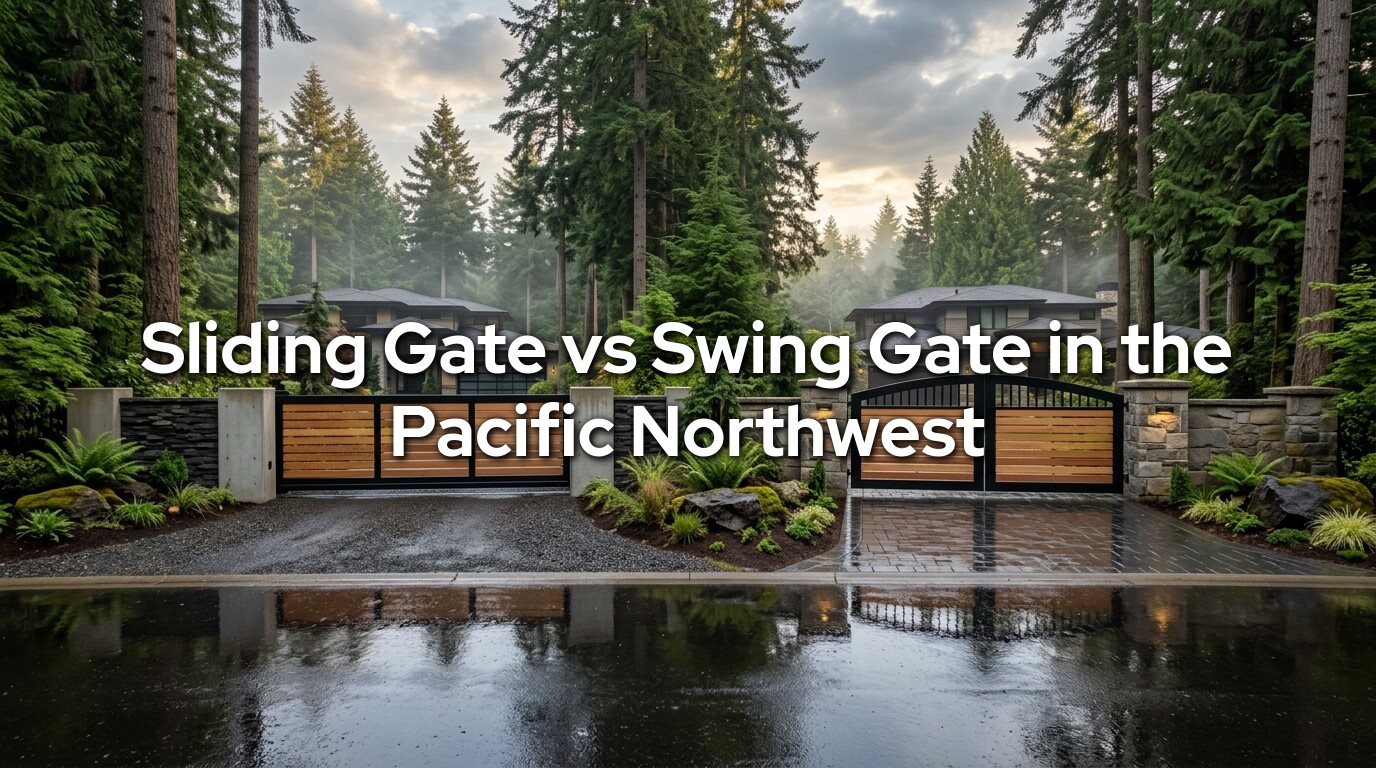
Sliding gate vs swing gate Pacific Northwest decisions are not mainly about style. Both can be attractive, automated, and connected to keypads, intercoms, cameras, or RFID access. The important difference is movement. A swing gate opens in an arc. A sliding gate travels sideways along the fence line. That difference changes the space required, the way the gate handles slope and wind, where vehicles wait, how foundations are built, and what must be maintained.
Washington properties make those questions especially important. A rural entrance near Sedro-Woolley may have wet soil, gravel, and equipment traffic. A compact driveway in Bothell, Brier, or Mountlake Terrace may have little road setback. Waterfront properties near Edmonds, Mukilteo, Woodway, or island communities may face wind and salt exposure. Foothill sites near Gold Bar, Index, Darrington, and Granite Falls may combine steep grades, tree debris, snow, and power interruptions.
This guide compares sliding and swing gates by the issues that determine long-term performance: driveway geometry, space, traffic, cost, installation, safety, security, access control, materials, power, weather, maintenance, repair, permits, and ownership expectations.
Emerald Gate Systems is positioned around custom gate fabrication, automation, access control, repair, and ongoing service for homeowners, farm and estate owners, HOAs, property managers, and commercial facilities across Sedro-Woolley, Skagit County, Whatcom County, Snohomish County, island communities, and the greater Puget Sound region.
The goal is not to declare one gate universally better. It is to choose the movement that asks the least of the site while meeting the property’s traffic, security, appearance, and service needs.
Which Is Better, a Sliding Gate or a Swing Gate?
The better gate is the one that fits the driveway without creating avoidable structural, traffic, drainage, or maintenance problems.
A swing gate is often the better choice when the driveway is relatively level, there is enough room for the gate arc, vehicles can wait clear of the road, and the owner wants a traditional residential or estate appearance. Swing gates can be straightforward to fabricate and install on favorable sites. They also keep the driveway surface clear because they do not require a ground track across the opening.
A sliding gate is often the better choice when the driveway rises behind the entrance, the gate is close to the road, the property needs a clear vehicle stacking area, or a swing arc would interfere with parked vehicles, landscaping, buildings, or pedestrian routes. Sliding gates are also common at apartment, HOA, and commercial entrances because they can work well with controlled traffic lanes and higher operating cycles.
Neither choice is automatic. A sliding gate needs enough side room to store the entire open gate, plus additional room for a cantilever tail when that design is used. A swing gate needs a clear arc and stable hinge posts that can resist leverage, wind, and repeated movement. A solid privacy gate may place heavy wind loads on a swing operator. A ground-track slider may collect gravel, leaves, mud, or ice if drainage and cleaning are poor.
The following comparison is a useful starting point.
| Decision factor | Swing gate | Sliding gate |
|---|---|---|
| Best driveway grade | Level or gently sloped within the swing path | Often better when the driveway rises behind the gate |
| Space required | Clear opening arc inside or outside the property | Clear storage space parallel to the fence line |
| Road setback | Needs room for vehicles to wait outside the swing arc | Often preserves more vehicle stacking space |
| Gravel and debris | No track across the driveway | Cantilever designs handle debris better than ground-track designs |
| Wind exposure | Large solid leaves can create significant wind load | Wind still matters, but movement and support differ |
| Typical appearance | Traditional, symmetrical, residential, estate | Clean, practical, modern, commercial, space-efficient |
| Maintenance focus | Hinges, arms, posts, stops, alignment | Rollers, guides, chain or rack, track or cantilever hardware |
| High traffic | Possible with correct equipment | Frequently selected for managed and commercial entrances |
A site can still break every general rule in that table. That is why a recommendation made from one driveway photo or a gate catalog is incomplete.
How Sliding Gates and Swing Gates Actually Work
Understanding the mechanics makes the later decisions easier.
Single and Double Swing Gates
A single swing gate hangs from one side. It can be economical on a modest, level opening, but its full width acts as leverage on one hinge post. As the leaf becomes wider, taller, heavier, or more solid, the post, footing, hinges, frame, and operator must carry more load.
A double swing gate divides the opening into two shorter leaves. This creates a balanced estate or residential appearance and reduces the length carried by each post. It also requires two hinge systems, coordinated automation, reliable center alignment, and stable foundations.
Ground-Track Sliding Gates
A ground-track slider rolls on wheels over a track across the driveway. It can carry substantial weight and usually needs less side length than a cantilever gate. The trade-off is exposure to gravel, leaves, mud, snow, and ice. Reliable performance depends on a stable surface, drainage, cleaning, and protection from vehicle damage.
Cantilever Sliding Gates
A cantilever gate is suspended above the driveway by roller assemblies beside the opening. With no ground track, it is useful on gravel, wet, wooded, or agricultural entrances. Its frame extends beyond the clear opening to form a counterbalance tail, so it needs additional side space and substantial roller-post foundations.
Specialty Movements
Telescoping, bi-folding, vertical pivot, and other specialty gates can solve unusual space problems. They also add moving parts and service complexity. The simplest movement that genuinely fits the property is usually the best long-term choice.
Review the full range of gate design, automation, access control, and service options before deciding from appearance alone. For a property-specific recommendation, call (360) 657-9975 or schedule an on-site consultation.
How Driveway Slope and Grade Affect the Choice
Driveway slope is often the deciding factor between a sliding gate and a swing gate.
A swing gate needs enough clearance beneath the leaf through its entire arc. If the driveway rises sharply inside the property, an inward-swinging gate may strike the pavement before it opens. Raising the gate higher can create an unattractive gap, reduce security, and introduce clearance concerns around pets or uneven ground. Special rising hinges exist, but they change the geometry, loads, and automation requirements. They are not a universal fix.
An outward-swinging gate may avoid an uphill interior slope, but it cannot be allowed to create a traffic hazard, enter a public right of way, block a sidewalk, or surprise a vehicle approaching from the road. Local approval and adequate setback matter. In many cases, outward movement is not practical.
A sliding gate moves across the slope rather than up the driveway, so it is often preferred where the drive rises immediately behind the entrance. The side travel path still needs evaluation. The grade along that path should support smooth movement and stable foundations. A slider traveling sharply uphill along the fence line will place different demands on the operator and braking system than one moving on a level path.
Cross slope matters too. If one side of the driveway is significantly higher than the other, the bottom of a swing gate may have a visible gap or may drag. A sliding gate can also encounter clearance changes if the drive crowns, dips, or drains across the opening.
Foothill properties near Monroe, Sultan, Gold Bar, Index, Darrington, and Granite Falls frequently combine slope with gravel, drainage channels, snow storage, and limited road setback. The correct answer may involve grading or retaining work before either gate type is installed. It is usually less expensive to correct the entrance geometry once than to keep adjusting a gate that was forced onto an unsuitable grade.
A useful site review measures more than the percentage of slope. It examines where the slope begins, how vehicles transition through the opening, where water travels, where snow is pushed, and whether the gate can move manually without binding.
How Available Space, Road Setback, and Traffic Flow Affect the Choice
Space includes more than the area occupied by the gate. Vehicles must approach, stop, authenticate, wait, turn, and clear the moving panel without blocking the road.
Swing Clearance
A swing gate needs an arc that remains clear every day. That space cannot double as parking, delivery staging, snow storage, landscaping, or a pedestrian path. A double swing uses shorter arcs than one long leaf, but both sides still need protected clearance.
The entrance should also provide enough room outside the gate for a vehicle to leave the traveled road before using a keypad or intercom. Short approaches in Bothell, Brier, Lynnwood, Mill Creek, and Mountlake Terrace may not provide that depth. In those settings, a swing arc can consume the same space vehicles need for stacking.
Sliding Storage Space
A slider preserves driveway depth but needs clear width along the fence. A ground-track gate generally needs storage space comparable to the opening. A cantilever gate needs more for its counterbalance tail and support hardware. Walls, trees, utilities, slopes, and property lines can make an apparently open area unusable.
Real Vehicle Movement
The largest regular vehicle should guide the layout. A passenger car entering squarely needs less room than a pickup with a trailer turning from a narrow road. Farms near Sedro-Woolley, Arlington, Stanwood, or Monroe may need equipment and emergency access. Managed properties may need room for visitor calls without backing traffic into the street.
A useful site plan shows the gate open and closed, the largest vehicle, access-control pedestal, road edge, pedestrian route, safety devices, and the place where a second vehicle waits.
Before choosing a gate movement, ask us to map the swing arc, slide storage area, vehicle stacking, trailer turns, and access-control position during a residential gate installation consultation.
How Pacific Northwest Weather Changes the Comparison
Rain does not automatically favor one gate type. Reliability depends on how water, wind, debris, freezing conditions, and coastal exposure interact with the design.
Rain, Debris, and Gravel
A swing gate leaves the driveway free of a track, which helps on gravel, muddy, or wooded properties. Its hinge posts, arms, stops, wiring, and operator pads still need drainage and protection from vegetation.
A ground-track slider needs a clean, stable path. Leaves, gravel, mud, snow, and ice can increase resistance. A cantilever slider avoids the driveway track and is often better for rural or wooded entrances, although its larger frame and foundations cost more.
Wind
A tall solid swing gate can act like a sail. The frame, operator, hinges, posts, stops, and concrete must carry loads that are easy to underestimate on a calm day. A large solid slider also needs rigid framing and stable guides. Open pickets, ornamental designs, mesh, or partial screening reduce wind area.
Open Skagit County farmland and Whatcom County properties may see strong crosswinds. Waterfront sites near Mukilteo, Edmonds, Woodway, Stanwood, and island communities can combine wind with salt-laden moisture.
Ice, Snow, and Coastal Exposure
Ice can hold a swing leaf at the ground, fill a slide track, cover photo eyes, and reduce battery performance. Owners should clear the path rather than force an obstructed gate with the operator.
Near saltwater, aluminum, suitable stainless hardware, quality coatings, sealed enclosures, and regular finish inspection become more valuable. Steel can perform well when joints shed water and damaged coatings are repaired promptly.
Weather changes the details needed for either gate. It rarely decides the movement by itself.
Why Soil, Drainage, Foundations, and Existing Structures Matter
Automatic gates depend on fixed geometry. A post that moves, a roller foundation that settles, or an operator pad that tilts changes alignment and operating load.
Swing Gate Support
A swing leaf places leverage on its hinge post. Longer, heavier, and more solid leaves require stronger posts and footings. A double swing divides the load, but its leaves must continue meeting correctly at the center. Wet or poorly compacted soil may require deeper foundations or additional preparation.
Sliding Gate Support
A ground-track slider needs a stable track base and aligned guide posts. The surface must resist rutting, water flow, and heavy vehicle loads. A cantilever system concentrates weight at its roller posts, so those foundations are critical.
Drainage, Conduit, and Existing Structures
Water should be directed away from operator pads, footings, tracks, loops, pull boxes, and access-control pedestals. Conduit routes are easier to protect before concrete and paving are complete.
Existing columns, fence posts, or walls should be reused only after their structure and foundations are verified. Decorative masonry may look substantial without being designed for automated gate loads. Soft Skagit Valley soils, Snohomish County tree roots, and crowded Greater Puget Sound utilities can all affect footing design.
Protect the project below ground. Call (360) 657-9975 for an on-site review of drainage, post locations, concrete, utilities, and gate travel before the entrance is fabricated.
How Sliding Gate and Swing Gate Costs Compare
A swing gate often costs less on a simple, level residential site. A sliding gate commonly adds a longer frame or track, guide posts, concentrated foundations, and more hardware. Site conditions can reverse that comparison.
Swing Gate Cost Factors
Cost changes with the number of leaves, opening width, height, material, wind area, hinges, posts, footings, operators, center stops, electrical work, and safety devices. A moderate single leaf is very different from tall dual estate gates with masonry columns and underground operators.
Sliding Gate Cost Factors
A slider may require a track or cantilever tail, wheels or roller assemblies, guides, operator foundations, chain or rack, protective screening, and a longer clear travel area. A steep entrance may still make it the better value if the alternative is major regrading for a swing gate.
Costs Shared by Both
Custom fabrication, coatings, power, trenching, solar equipment, battery backup, keypads, RFID, intercoms, cameras, loops, monitored safety devices, permits, programming, and owner training can represent a large part of either project.
Initial price should be weighed against cleaning, adjustment, corrosion protection, batteries, component wear, and downtime. A cheaper movement that conflicts with the site often costs more later. Residential pricing varies with gate size, material, operator type, access control, site conditions, and installation complexity, as our guide to automatic driveway gate cost in Washington State explains in detail.
A useful proposal separates fabrication, structure, automation, safety, power, access control, permits, and restoration so the owner can compare complete outcomes. See also why a gate quote may be higher than an online estimate.
What the Installation Process and Timeline Look Like
A complete gate project is a sequence, not a single installation day. Sliding and swing gates share many stages, but the civil and mechanical work differs.
Site Evaluation and Concept Design
The installer measures the opening, grade, side space, swing depth, road setback, vehicle paths, utilities, drainage, and power distance. The owner defines users, security goals, materials, privacy, access controls, and future needs. At this stage, the gate movement should be selected from the site facts.
Engineering, Permits, and Utility Planning
Large, heavy, high-wind, commercial, or unusual gates may need additional structural review. Utility locating, electrical permits, fire access review, HOA approval, or right-of-way questions should be addressed before excavation or fabrication. Access-control and communication pathways should be coordinated with the power plan.
Fabrication and Finish
Custom gates are drawn, cut, welded, checked for square, prepared, and coated. Swing gates must be built around hinge and operator geometry. Sliding gates must remain rigid across a long horizontal frame and include the correct tail, wheel, guide, chain, or rack details.
Foundations and Infrastructure
Crews excavate footings, set posts, install conduit, prepare operator pads, improve drainage, and build the track or cantilever support system. Concrete needs appropriate curing before the full gate load is applied.
Installation, Automation, and Commissioning
The gate is hung or set on rollers, aligned, moved manually, and adjusted before the operator is expected to move it. Controls, access devices, loops, photo eyes, edges, and backup power are installed and programmed. Commissioning should include repeated cycles, obstruction testing, credential testing, exit behavior, outage behavior, manual release, and owner training.
A straightforward residential project can have a relatively short on-site phase, while custom fabrication, permits, coatings, weather, concrete curing, masonry, long electrical runs, and specialty equipment can extend the overall schedule. Ask for a realistic sequence rather than only a promised completion date.
Plan the whole entrance, not just the gate panel. Explore custom gate design so fabrication, foundations, automation, access control, and finish are coordinated before work begins.
How Safety Requirements Differ Between Sliding and Swing Gates
An automatic gate is a large moving machine. Safe design begins with the movement path and the places where a person, bicycle, pet, or vehicle could be struck, pinned, drawn in, or trapped.
UL 325 is the primary product safety standard commonly used for automatic gate operators and related systems. ASTM F2200 addresses the construction of automated vehicular gates, including horizontal sliding and swing gates, covering multiple gate types and usage classes from residential to guarded industrial applications.
Swing Gate Hazards
A swing gate creates a broad impact and crushing zone throughout its arc. Risk areas can form between the moving leaf and a fixed wall, post, fence, parked vehicle, or grade change. Hinges and operator arms also create pinch points. People should not walk through the vehicular gate path, and controls should be positioned so a user cannot reach through the gate while activating it.
A solid or heavy leaf may continue carrying substantial momentum even at normal speed. Proper stops, operator settings, monitored safety devices, and clear zones are necessary. A gate should never rely on force settings alone to protect every hazard area.
Sliding Gate Hazards
A sliding gate can create draw-in and entrapment areas where the moving panel passes a fence, wall, guide post, roller assembly, or support structure. Openings in the gate can become hazardous when they move past fixed objects. Exposed rollers, pinch points, and the area behind the gate must be guarded or screened as required by the design.
Photo eyes, monitored sensing edges, inherent obstruction sensing, vehicle loops, screening, guards, and safe separation are selected around the actual layout. The correct device for one opening may be wrong for another.
Vehicular Gates Are Not Pedestrian Doors
A driveway gate should control vehicles. People need a separate pedestrian route when regular foot traffic is expected. That is especially important at HOAs, apartments, schools, commercial properties, and homes where children walk to the street. The pedestrian opening should not lead users into the gate’s travel or pinch zones.
Testing and User Training
Safety equipment must be tested after installation and during maintenance. Owners should know how the manual release works, what normal warning indicators mean, and whom to call when a sensor causes repeated stops. Bypassing a device because it seems inconvenient removes a layer of protection and usually leaves the original problem unresolved.
The installer should be able to point to each hazard area and explain what protects it. If that explanation is vague, the design is not finished.
What Washington Permits, Electrical Rules, and Emergency Access May Require
Permit requirements depend on the address, property use, driveway, electrical jurisdiction, fire district, and local code. A gate that needs little review at one private home may require a formal fire access plan at a multi-family, commercial, rural, or shared-road property.
Washington’s statewide building code remains based on the 2021 model codes with state amendments, effective March 15, 2024. The State Building Code Council lists the 2021 International Building Code, Residential Code, and Fire Code among the codes in effect.
Electrical Permits and Inspections
Washington Labor and Industries states that an electrical permit must generally be purchased before electrical work begins and that inspections currently use the 2023 National Electrical Code. Some cities operate their own electrical inspection programs, so responsibility should be confirmed for the project address.
The proposal should identify who installs the branch circuit, conduit, disconnect, grounding, surge protection, low-voltage wiring, solar equipment, network connection, and vehicle loops. It should also say who obtains permits and schedules inspections.
Fire Apparatus and Emergency Access
Gates across required fire access roads may need approval, clear-width and height provisions, an approved emergency opening device, and documented outage behavior. Skagit County states that security gates across fire access roads require Fire Marshal approval and an approved means of emergency operation. Whatcom County identifies gates and barricades across fire apparatus access roads as a permit category and asks for gate specifications, access controls, and emergency vehicle access device information.
Those examples show why a detail accepted in one county or fire district should not be assumed acceptable elsewhere. Island fire districts, city fire departments, and county authorities may use different devices or procedures.
Road Setback and Right-of-Way Concerns
A gate should not cause a vehicle to stop in a public travel lane while a code is entered or a visitor calls through an intercom. Swing leaves should not move into public space without appropriate approval. Sight distance, drainage, utility easements, shared-access agreements, and HOA rules can also affect placement.
Permitting should be discussed before the final gate movement is selected. A slider that preserves stacking space may solve an access concern. A swing gate placed farther inside may do the same. The right answer depends on the approved site layout.
Confirm the requirements before concrete is poured. Call (360) 657-9975 to discuss local review, electrical responsibility, emergency access, and safe gate placement for your specific Washington property.
Which Gate Provides Better Security, Privacy, and Access Control?
Security depends on the complete entrance, not only on whether the gate slides or swings.
Physical Security
A sliding gate can provide strong controlled closure when it has robust guides, stops, protected operator components, and a secure fence connection. A swing gate can also be secure with strong posts, hinges, stops, latching, and appropriate automation. Large gaps, light hardware, weak fence tie-ins, and poor closing logic can undermine either design.
A standard driveway gate controls ordinary access. It should not be called crash rated unless the complete tested system has that rating. Higher-risk commercial sites may need bollard installation or another engineered vehicle barrier.
Privacy and Wind
Both gate types can use open pickets, ornamental metalwork, mesh, wood infill, aluminum panels, or steel panels. More privacy usually means more weight and wind area. Sometimes a moderately open gate combined with fencing and landscaping provides better long-term performance than a very tall solid leaf.
Access Control
Remotes, keypads, RFID credentials, badge readers, video intercoms, mobile access, cameras, and vehicle loops work with either movement. Placement matters. Drivers should reach controls without entering the gate path or blocking the road. Managed properties should use credentials that can be individually removed rather than relying on one shared code. Our comparison of RFID access vs keypad entry covers the trade-offs.
Access control can be planned with the gate so credentials, visitor calls, cameras, loops, and closing logic fit the real traffic pattern.
Which Gate Works Best for Homes, Estates, Farms, and Rural Properties?
Property type changes the recommendation because vehicles, appearance, power, and maintenance needs differ.
Homes and Estates
A swing gate often suits a level residential entrance with generous interior depth. It can create a traditional or symmetrical arrival without a track across the driveway. A slider may be better when the drive rises, the gate is close to the street, or guest parking would occupy the arc.
Estate owners should consider wind, masonry support, lighting, cameras, landscaping, and service access along with appearance. Woodway and Edmonds properties may have limited frontage and strong architectural expectations, while homes in Lake Stevens, Snohomish, and Marysville may need to accommodate trailers, deliveries, or mixed suburban and rural traffic.
Farms and Acreage
Farm gates must fit trucks, tractors, trailers, livestock operations, mud, and gravel. A robust swing gate is practical where clear space is abundant. A cantilever slider can be valuable where the surface is uneven or equipment frequently waits inside the entrance. See our guide to gate systems for farms and rural properties.
Long rural driveways near Sedro-Woolley, Arlington, Stanwood, or Monroe may make utility trenching expensive. Solar can work when winter production, shade, gate cycles, battery capacity, and accessory loads are calculated.
Island and Remote Properties
Remote and island sites need a serviceability plan that considers ferry access, cellular coverage, salt exposure, power restoration, common replacement parts, battery backup, and manual release. A simpler maintainable system may be more valuable than specialty equipment.
Bring the real vehicles and users into the decision. Ask about residential, farm, estate, and custom gate options for Northwest Washington and greater Puget Sound properties.
Which Gate Works Best for HOAs, Apartments, and Commercial Properties?
Managed properties place greater weight on traffic flow, cycle capacity, credential administration, and downtime.
HOAs and Apartments
A sliding gate is often selected because it stays out of vehicle stacking space and aligns with a controlled lane. A swing gate can work where the entrance has generous depth, lower traffic, and a protected arc.
The design should account for resident peaks, visitors, deliveries, rideshare vehicles, vendors, move-ins, emergency responders, and pedestrian access. Individual RFID credentials, managed codes, or mobile access are usually more sustainable than one shared code. Residents also need a clear process during maintenance or failure. See gate access control systems for apartments and HOAs.
Commercial and Industrial Sites
Commercial entrances may prioritize truck turning, opening speed, employee schedules, audit logs, cameras, and high-cycle equipment. Sliding gates are common at warehouses, yards, and controlled parking because the panel stays out of the lane. Swing gates may fit lower-volume offices or rural facilities with ample setback.
A barrier arm can move traffic quickly but provides little perimeter closure. A full gate provides stronger closure but usually moves more slowly. Some sites use a combination, and higher-risk properties may need bollards or rated equipment.
Maintenance Planning
A managed property should define inspection frequency, emergency contacts, manual or staffed access, spare credentials, and repair authorization before a failure occurs. Residential-duty equipment should not be expected to carry commercial traffic. Our commercial gate solutions cover gate movement, operator duty, access control, and ongoing service needs.
How Materials and Custom Fabrication Affect Each Gate Type
Material affects appearance, weight, wind load, stiffness, corrosion, operator size, and maintenance.
Steel and Ornamental Metalwork
Steel is strong, weldable, and suited to modern, farm, estate, and commercial designs. It can form rigid sliding frames and substantial swing leaves. In Northwest Washington, joints should shed water and finishes should be selected for moisture and coastal exposure.
Ornamental designs allow air and visibility through the gate, reducing wind area compared with solid panels. The term wrought iron is often used for decorative work even when the modern structure is fabricated steel. See ornamental and wrought iron gate installation.
Aluminum
Aluminum resists rust and weighs less than steel, which can reduce loads on swing hinges, posts, rollers, and operators. It is often useful near saltwater. The frame still needs enough section size and bracing to prevent flex. Fasteners, dissimilar metals, welds, and coatings must be handled correctly.
Wood and Mixed Materials
Wood adds warmth and privacy but absorbs moisture, changes dimension, and increases weight. A metal frame with replaceable wood infill usually provides better automated-gate structure than a leaf built like a stationary fence panel. Owners should expect periodic cleaning, sealing, staining, and board replacement. See wood gate installation and repair.
Mesh, perforated panels, or mixed materials can provide screening with less wind pressure. Lighting, address numbers, cameras, and operator brackets are best integrated during fabrication.
A swing frame must remain square while hanging from one side. A slider must remain straight across a long span and move cleanly through its guides. Custom gate design coordinates material, structure, finish, and automation geometry.
How Operators, Power, Solar, and Battery Backup Change the Decision
The gate operator should be selected after the gate movement, weight, length, balance, wind exposure, and cycle count are understood. Choosing an operator first encourages the project to be designed around a product instead of the property.
Swing Operators
Common swing systems use linear arms, articulated arms, pad-mounted mechanisms, or underground operators. Each has different geometry, appearance, service access, and tolerance for gate conditions. An underground operator can preserve a clean architectural look, but drainage and serviceability become especially important.
A swing gate must move freely by hand before automation. The operator should guide a balanced, aligned gate, not drag a sagging leaf through a tight hinge or compensate for a failing post.
Sliding Operators
Sliding operators commonly drive a chain or rack and pinion. The selected system must suit gate weight, travel, speed, duty cycle, slope, and expected resistance. The chain or rack should be aligned and protected, and the operator foundation should remain stable.
High-cycle commercial sliders need equipment designed for sustained use, along with a maintenance schedule that reflects actual traffic. A residential operator on an apartment entrance may work initially and fail under the daily workload.
Hardwired Power
Utility power offers the greatest flexibility for frequent operation, intercoms, cameras, lighting, heaters where appropriate, network equipment, and battery charging. Long trenches can be costly, especially on rural driveways. Power distance, voltage drop, conduit, grounding, disconnects, and inspection requirements should be planned before paving or landscaping.
Solar Gate Automation
Solar can be a good solution for farms, remote homes, long driveways, and some island properties. It is not simply a panel attached to any operator. The design must account for winter solar availability, shade, gate cycles, battery capacity, operator efficiency, and the continuous load from keypads, radios, cameras, cellular devices, and intercoms.
A low-use, well-balanced swing gate may have modest energy needs. A heavy high-cycle slider with multiple accessories may require a larger array or hardwired power. Either movement can be solar powered when the energy budget is realistic.
Battery Backup and Manual Release
Battery backup supports operation during outages, but the number of available cycles is limited by battery condition, temperature, gate load, and accessory use. Owners should know whether the system opens, closes, or remains controlled when power is lost. They should also know the manual release procedure and keep it accessible to authorized users.
What Maintenance and Common Failures Look Like
Sliding and swing gates need different mechanical attention, but both depend on clean movement, stable structure, protected electronics, and tested safety devices.
Swing Gate Maintenance
Swing gates should be checked for hinge wear, loose hardware, post movement, frame sag, operator-arm play, damaged stops, bracket cracks, corrosion, and changes in the meeting point of dual leaves. A small alignment change can increase operator load throughout every cycle.
Vegetation, parked objects, snow piles, and grade changes must stay out of the arc. Underground operators need especially careful drainage inspection. Solid wood or metal leaves should be checked for wind-related movement and finish damage.
Sliding Gate Maintenance
Sliding systems require inspection of rollers or wheels, guides, chain or rack, operator sprockets, tracks, cantilever assemblies, end stops, screening, and alignment. Ground tracks need routine cleaning. Gravel migration, mud, leaves, ice, and worn wheel surfaces can create resistance.
A cantilever gate avoids a driveway track but still depends on roller adjustment and stable support posts. The long panel should not sag, twist, or contact the ground at either end of travel.
Shared Electrical and Control Maintenance
Both systems need photo-eye cleaning and alignment, sensing-edge testing, loop testing, battery checks, wiring inspection, enclosure sealing, credential testing, and review of outage behavior. Cellular or cloud systems may also need account, firmware, and communication checks.
Warning Signs That Deserve Service
Call for service when a gate becomes slower, louder, crooked, hesitant, inconsistent after rain, or difficult to move manually. Repeated reversals, unexplained opening, intermittent keypad response, a chain that jumps, a leaf that drops, or an operator that runs hot should not be treated as normal aging. Our guide to automatic gate repair warning signs covers what to watch for.
Owners can remove visible debris and inspect accessible components. They should not bypass safety devices, increase force settings, enter live electrical cabinets, or place hands near moving hinges, chains, rollers, and guides.
Preventive maintenance is especially important for HOAs, apartments, and commercial properties where one failure affects many users.
Address small changes before they become access failures. Call (360) 657-9975 when a gate starts dragging, shuddering, reversing, losing alignment, or working differently in wet weather.
When to Repair, Upgrade, or Replace an Existing Gate
An unreliable gate does not always need full replacement. The decision depends on structure, movement, operator condition, safety, parts availability, repair history, and whether the entrance still fits the property.
Repair
Repair is reasonable when the frame is straight, posts or roller foundations are stable, the gate moves freely, the operator is correctly sized, and the failure is isolated. Hinges, wheels, chains, sensors, batteries, wiring, controls, and access devices can often be replaced without rebuilding the entrance.
Upgrade
A sound manual gate may be automated after its posts, hinges, rollers, alignment, and construction are evaluated. An older automated gate may keep its leaf while receiving a new operator, monitored safety devices, battery backup, loops, keypad, RFID reader, or intercom. See automating an existing gate.
Replace or Change Movement
Replacement becomes more practical when foundations move, the frame is severely corroded or twisted, parts are obsolete, safety cannot be restored, or the opening no longer fits traffic. Repeatedly repairing a swing gate on an incompatible slope or a track slider with chronic gravel problems does not correct the original design conflict. Our guide to deciding when to repair or replace walks through the comparison.
Warranty
Ask for separate written terms for fabrication, finish, installation labor, operator equipment, batteries, safety devices, and access-control components. Confirm maintenance requirements, exclusions, claim responsibility, and possible travel or diagnostic charges. A warranty does not replace service or automatically cover impact, storms, blocked movement, neglected finishes, or owner modifications.
Compare immediate cost with expected remaining life, safety, downtime, parts support, and suitability of the existing movement.
Common Mistakes, Persistent Myths, and a Final Decision Checklist
Most gate problems begin with a planning shortcut.
Choosing by Appearance
A swing gate may look traditional, but appearance does not create clearance on a steep or shallow driveway. A slider may look commercial in a catalog, but custom fabrication can suit residential, estate, farm, or contemporary architecture.
Ignoring the Fully Open Position
Owners often measure the closed opening and forget storage. A cantilever slider needs room for its tail. A swing gate needs an arc that stays permanently clear of vehicles, landscaping, pedestrians, and snow storage.
Adding Privacy Without Rechecking Loads
Solid panels add weight and wind area. A wide privacy swing gate can overload posts and operators. A long privacy slider needs a rigid frame and stable guides. Privacy should be engineered before equipment is selected.
Treating Access Control as an Add-On
A gate may fit while the keypad does not. Drivers may be unable to reach it, visitor calls may block the road, or credentials may be difficult to manage. Access devices, loops, cameras, emergency operation, and pedestrian routes belong in the original layout.
Assuming Maintenance Means Lubrication
Maintenance also covers alignment, drainage, structural movement, monitored safety devices, wiring, batteries, controls, coatings, and operator diagnostics. Not every component should be lubricated.
Final Checklist
Favor a swing gate when the driveway is sufficiently level, the arc can remain clear, vehicles can stack safely, and wind loads are manageable. Favor a slider when side space exists, the driveway rises inside the entrance, stacking depth is limited, or managed traffic benefits from horizontal movement.
Before signing, confirm the opening, largest vehicle, grade, travel space, drainage, soil, wind, material, operator duty, safety devices, pedestrian route, emergency access, power, backup, credentials, permits, warranty, and service plan.
Compare complete systems, not isolated products. Call (360) 657-9975 to request a site-specific proposal that explains why the recommended movement fits your driveway, users, climate exposure, safety needs, and long-term service plan.
Frequently Asked Questions About Sliding Gates and Swing Gates
1. Is a sliding gate or swing gate better for a residential driveway?
A swing gate is often best for a level entrance with generous interior clearance. A slider is often better when the driveway rises, the gate is close to the road, or parked vehicles would occupy the swing arc. The final choice should also account for side space, wind, drainage, visitors, and the largest regular vehicle.
2. Which gate is best for a steep driveway?
A sliding gate is commonly preferred when the driveway rises immediately inside the entrance because it moves sideways rather than uphill. Its side travel path still needs a manageable grade and stable foundations. Some properties need grading, retaining work, a specialty design, or a relocated entrance before either standard gate will work well.
3. Is a swing gate cheaper than a sliding gate?
Often, on a simple level site. A slider usually adds track or cantilever hardware, guides, longer framing, and concentrated foundations. Site work can reverse the result. If a swing gate requires major grading or creates unsafe vehicle stacking, the slider may deliver the lower total ownership cost.
4. How much does either gate cost in Washington State?
Cost depends on opening size, material, fabrication, posts, concrete, operator duty, power, access control, safety devices, drainage, permits, finish, and site access. A sound existing gate automation is very different from a custom estate or commercial entrance. Request an itemized, site-specific scope rather than relying on a national average.
5. Which gate opens faster?
Speed depends on operator design, gate size, travel distance, settings, and usage class. Some commercial sliders are configured for efficient traffic, while a double swing may clear an opening quickly because each leaf travels a shorter distance. The complete entry transaction, including credential reading and vehicle clearance, matters more than motor speed alone.
6. Which gate is more secure?
Neither movement is automatically more secure. Security depends on the frame, posts, guides or hinges, stops, fence connection, closing logic, access-control rules, cameras, lighting, and credential management. A well-built swing gate can outperform a lightly built slider, and the reverse is equally true.
7. Which gate handles wind better?
Openness, size, material, stiffness, and exposure matter more than movement alone. A solid swing leaf can act like a sail, while a solid slider still needs strong guides and framing. Open pickets, ornamental patterns, mesh, or partial screening can reduce wind pressure on waterfront, bluff, and open-field sites.
8. Which gate is better for snow and ice?
A swing gate avoids a driveway track but needs ground clearance and a clear arc. A ground-track slider can collect packed snow or ice. A cantilever slider avoids that track. Whatever the design, keep the path and sensors clear and never force a frozen gate with the operator.
9. Can a sliding gate work on gravel?
Yes. A cantilever slider is often a strong choice because it moves above the driveway. A ground-track design can also work when the track base is stable and loose gravel is controlled. Drainage, grading, vehicle tires, and snow removal should be considered because they can move aggregate into the travel path.
10. How much side room does a sliding gate need?
A ground-track slider generally needs storage length similar to the clear opening. A cantilever gate needs additional length for its counterbalance tail. Posts, guides, operator placement, safety clearance, trees, walls, slopes, utilities, and property lines also consume room. The final measurement should come from the actual gate design.
11. How much room does a swing gate need?
It needs a permanently clear arc for each leaf plus enough stacking depth for vehicles outside that arc. Parking, landscaping, snow piles, trash containers, and pedestrian routes should not enter the movement zone. The grade must also provide bottom clearance from fully closed to fully open.
12. Can an existing swing gate be converted to slide?
Sometimes, but it is usually a redesign rather than a simple hardware change. The leaf may lack the frame stiffness, length, screening, wheels, tail, or guide details needed for sliding movement. New foundations and side space are normally required. Compare modification cost with a purpose-built sliding gate.
13. Can an existing manual gate be automated?
Often, when it is structurally sound, moves freely, stays aligned, and has suitable posts, hinges or rollers. Automation should not overpower a dragging or unstable gate. The site also needs operator space, monitored safety devices, power, backup, and an emergency-access plan.
14. How often should an automatic gate be maintained?
Frequency follows traffic, exposure, equipment, and manufacturer guidance. A private residential gate may need less service than an HOA, apartment, school, or warehouse gate. Respond promptly to changes in noise, speed, alignment, or wet-weather reliability, and inspect safety devices, batteries, access controls, structure, and drainage on a planned schedule.
15. Do automatic gates require permits in Washington?
They may. Electrical work generally requires the applicable permit and inspection. Gates on required fire access routes may need fire-authority approval and an approved emergency-opening method. Building, planning, driveway, right-of-way, or HOA review may also apply. Confirm requirements for the exact address before fabrication.
16. What happens during a power outage?
Many systems continue for a limited number of cycles on battery backup. Others remain in their last position or follow programmed behavior. Capacity depends on battery condition, temperature, gate load, and accessories. Owners should know the authorized manual release and test outage behavior before an emergency.
17. Can both gate types use solar power?
Yes, when the solar system is sized for gate load, cycles, winter sun, shade, batteries, and accessory demand. A light low-cycle gate with a keypad needs less energy than a high-cycle gate with cameras and a video intercom. Solar is especially useful where utility trenching is expensive.
18. Can both use keypads, RFID, badge readers, and intercoms?
Yes. Either movement can integrate remotes, keypads, RFID, badges, mobile access, intercoms, cameras, and vehicle loops. Placement and administration matter. Drivers should not enter the gate path to use controls, and managed properties should use credentials that can be individually removed.
19. How long does installation take?
The on-site phase may take several days, but the full project can span weeks. Design, permits, fabrication, coating, utility locating, foundations, concrete curing, electrical work, access-control setup, inspections, and weather all affect timing. Ask for a sequence that separates lead time from active construction days.
20. What warranty should an automatic gate have?
The proposal should separate workmanship coverage from manufacturer warranties for operators, controls, batteries, and access devices. Ask about fabrication, coating, maintenance requirements, exclusions, claim responsibility, and labor or travel charges. Warranty coverage does not replace preventive maintenance or cover every impact, weather, or owner-caused problem.
21. Is a sliding gate better for an HOA or apartment?
Often, because it preserves vehicle stacking space and works well in a defined lane. It still needs adequate side room, screening, foundations, pedestrian separation, high-cycle equipment, and planned maintenance. A swing gate may work at a lower-volume property with generous setback and protected clearance.
22. What should I ask before accepting a quote?
Ask why the proposed movement fits the grade, traffic, weather, and largest vehicle. Confirm materials, frame, finish, posts, footings, operator duty, safety devices, pedestrian access, controls, power, backup, drainage, permits, restoration, commissioning, training, warranty, and maintenance. The proposal should describe a complete working entrance and identify exclusions.
Choosing the Gate That Fits the Property for the Long Term
The sliding gate versus swing gate decision becomes clearer when the property is evaluated in the right order.
Start with grade, road setback, opening width, side storage, swing depth, vehicle turns, and stacking. Then account for Washington rain, drainage, soft soil, wind, coastal exposure, leaves, gravel, ice, and power interruptions. Finally, define the users, access controls, pedestrian route, emergency operation, daily cycles, maintenance expectations, and budget.
A swing gate is often the best value on a level property with generous interior clearance. It can provide a traditional appearance and keep the driveway free of a track. Its arc must remain clear, and the posts, hinges, operator, and wind design must suit the leaf.
A sliding gate is often stronger where the driveway rises behind the entrance, stacking depth is limited, or traffic needs to remain clear of the moving panel. Ground-track and cantilever systems solve different problems and carry different side-space, foundation, drainage, and maintenance requirements.
Neither movement is inherently more secure, attractive, or reliable. Reliability comes from matching the site, building the structure correctly, sizing the operator for real use, protecting entrapment zones, planning access and outages, and maintaining the system.
That local fit matters across Northwest Washington. A Mukilteo waterfront entrance faces different conditions from a Sedro-Woolley farm. A Lynnwood driveway has different traffic constraints from acreage near Granite Falls. An HOA in Lake Stevens has different cycle and credential needs from a private Woodway home.
Emerald Gate Systems brings design, fabrication, installation, automation, access control, repair, and maintenance into one planning path for residential, rural, managed, and commercial properties across Skagit County, Whatcom County, Snohomish County, island communities, and the greater Puget Sound region.
Make the decision on the property, not in a catalog. Call (360) 657-9975 or schedule an on-site consultation to compare sliding, swing, cantilever, custom, residential, farm, HOA, apartment, and commercial gate options for your Washington entrance.