
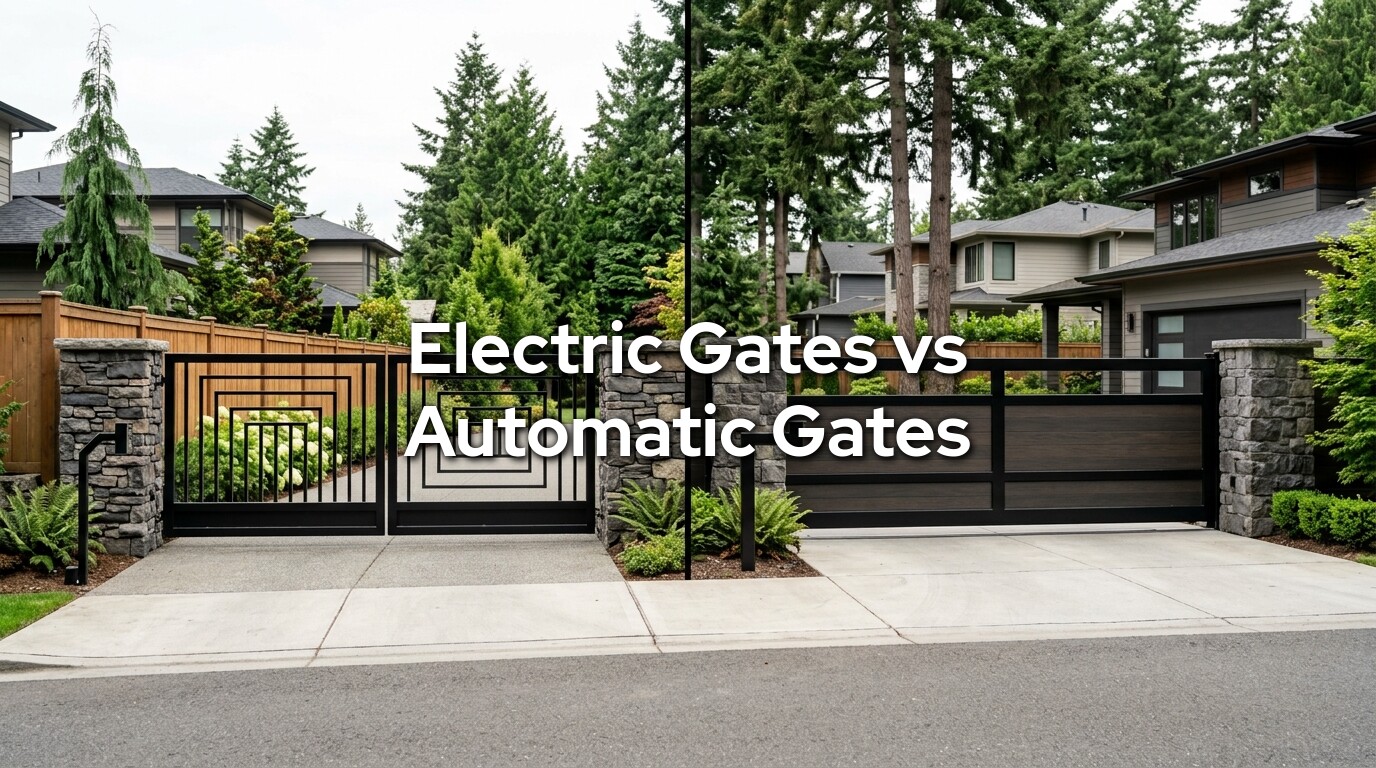
Powered gate systems Washington property owners shop for come with two labels, and both show up within the first minute of searching. One company advertises electric gates. Another installs automatic gates. Your neighbor calls theirs a motorized gate, and the manual for the equipment calls it a vehicular gate operator. Are these different products, different price points, different technologies?
Here is the honest answer up front: mostly, no. The terms overlap almost completely, and the companies using them are usually quoting the same equipment. But the small sliver where the two words genuinely differ turns out to matter quite a bit, because it touches the safety standard that governs every powered gate in the country and it explains why some systems behave so differently from others.
This distinction matters more in Washington than in most places, and not because of vocabulary. A powered gate here has to survive forty inches of annual rain, winter windstorms that take the power out, fir needles in every track, and driveways that run hundreds of feet from the nearest electrical panel. Whether the sticker says electric or automatic, the questions that decide whether you will love the system in year five are the same: what moves it, what triggers it, what stops it when a child is in the way, and what keeps it running when the lights go out in Marysville for two days.
This guide walks through all of it. You will learn what the two terms actually mean and where they came from, how a powered gate system is built piece by piece, the operator types that do the moving, the full spectrum of automation from a push button to a gate that recognizes your car, the access control and safety devices that make it livable and lawful, and the power and backup choices that matter in Pacific Northwest weather. By the end, the vocabulary will be the least of your worries, because you will know how to evaluate the system underneath the label.
We write this as installers, not observers. Emerald Gate Systems designs, fabricates, installs, and services powered gate systems from our base in Sedro-Woolley, working across Skagit County, Whatcom County, Snohomish County, the island communities, and the Greater Puget Sound region. Everything below reflects what actually holds up on driveways in Northwest Washington.
The Short Answer: Is There a Difference Between Electric and Automatic Gates?
For everyday purposes, electric gates and automatic gates are the same thing. Electric describes how the gate is powered, meaning an electric motor does the moving instead of your arm. Automatic describes how the gate behaves, meaning it opens and closes in response to a signal such as a remote, a keypad code, a sensor, or a timer. Nearly every gate installed today is both at once.
The two words are looking at the same machine from different angles:
| Electric gate | Automatic gate | |
|---|---|---|
| What the term describes | The power source: an electric motor moves the gate | The behavior: the gate cycles in response to signals and can close itself |
| Common usage | More common in the UK and in older US listings | Standard term in the US gate industry |
| What it includes | Any motor driven gate, even one requiring a held button | Systems with remotes, keypads, sensors, timers, and auto close |
| What it excludes | Purely manual gates | Technically, powered gates that only move while a button is held |
| Bottom line | Almost every one is also automatic | Every one is also electric, including solar systems |
Two edge cases keep the distinction from being pure semantics. First, a gate can be electric without being meaningfully automatic. Some industrial and older residential systems use what the safety standard calls constant pressure operation: the gate moves only while someone holds a button and watches it. Powered, yes. Automatic, no. Second, every automatic gate is electric at heart, including solar powered ones, because solar panels simply charge batteries that feed an electric operator, and even hydraulic operators use an electric pump to create their fluid pressure.
So when two companies quote your driveway and one says electric while the other says automatic, do not read anything into the words. Read the equipment list instead. That is where real differences live.
Why the Two Terms Exist and Why They Blur Together
The split is mostly geography and history, not technology. Electric gates became the everyday phrase in the United Kingdom and much of the Commonwealth, and it traveled into American usage through imported equipment brochures and early internet content. The American industry, along with the UL 325 safety standard that governs this equipment, settled on gate operators and automatic vehicular gates. Marketing then blended everything, because companies write for whatever words customers type.
You will also meet cousins of both terms: motorized gates, electronic gates, powered gates, gate automation, and automated entry systems. All of them point at the same category. AI assistants and search engines treat them as synonyms now, which is why asking any of them about electric versus automatic gates returns the same equipment recommendations.
What deserves your attention is the vocabulary that actually separates one system from another. Operator type determines how the gate physically moves. Duty cycle determines how much daily use the machinery tolerates. Activation method determines who and what can trigger it. Entrapment protection determines how it behaves around people and pets. Power and backup design determine what happens during a Skagit Valley windstorm. Those five phrases do more work than electric and automatic combined, and the rest of this article is organized around them.
One practical note from the quoting side of the counter: if a company leans hard on a label, fully automatic, smart gate, next generation, and goes quiet when you ask which operator model and which monitored safety devices are included, the label is doing the work the specification should be doing. Keep asking.
Curious what a complete system looks like when all five of those pieces are specified properly? Our services page walks through each part of a modern gate project, from design and fabrication to access control and long term service.
The Anatomy of a Powered Gate System
Every powered gate, whatever you call it, is the same seven parts working together. Knowing them turns a confusing quote into a checklist.
The gate panel is the part everyone pictures: the swing leaves or sliding panel, built from aluminum, steel, ornamental iron, or a metal frame clad in wood. The posts and footings carry the whole system, set in concrete deep enough to stay plumb through decades of Northwest freeze and saturation cycles. The operator is the motor and gearbox assembly that does the moving, and it is the heart of the system in every sense, including price and failure risk.
The control board is the brain, a weatherproofed circuit board that interprets signals, runs the motor, enforces limits, and manages timers. Safety devices, meaning photo eyes and contact edge sensors, watch the zones where a person or vehicle could be caught and tell the board to stop or reverse. Access control is everything that grants entry: remotes, keypads, intercoms, card readers, and phone apps. And the power supply ties it together, whether that is a 120 volt line from your panel, a low voltage feed, or a solar charged battery bank.
Here is why the anatomy matters when you shop. Quotes fail people at the joints between these parts. A beautiful panel hung on undersized posts sags in three years. A strong operator wired through a long undersized cable browns out on cold mornings. A perfect system with no exit device makes your own family punch codes to leave. When you evaluate a proposal, walk the seven parts and confirm each one is named, specified, and priced. Anything missing from the paper has a way of reappearing later as a change order.
One more part deserves a mention because Washington keeps proving its worth: the enclosure and drainage around the electronics. Control boards do not die of old age here nearly as often as they die of standing water and condensation. Where the operator sits relative to grade, and where winter runoff goes, is part of the anatomy too.
Gate Operator Types: What Actually Moves the Gate
The operator is where electric stops being an abstraction. Different operator designs move gates in different ways, and the right one depends on your gate style, weight, usage, and budget. As of 2026, residential grade operators run roughly $900 to $2,500 per gate leaf in equipment cost, with commercial and specialty units running $2,500 to $6,000 or more.
Linear Actuators: The Residential Standard for Swing Gates
A linear actuator is a motor driven ram that mounts between the post and the gate leaf, extending and retracting to push and pull the gate through its arc. These are the most common residential swing gate operators in Northwest Washington because they are compact, affordable, efficient enough for battery and solar setups, and simple to service. Their limits are honest ones: each unit moves one leaf, very heavy or very long leaves exceed their ratings, and mounting geometry has to be laid out correctly or the motor fights the gate its whole life.
Articulated Arm Operators: For Columns and Deep Hinges
An articulated arm operator uses a jointed, elbow style arm to reach gates hung on wide masonry columns or deep posts, where a straight ram cannot achieve workable geometry. If your design includes stone or brick columns, this is often the mechanism that makes automation possible without rebuilding the entry. Pricing sits slightly above comparable linear actuators.
Underground Operators: The Invisible Option
Underground operators bury the motor in a foundation box directly beneath the hinge point, leaving nothing visible but the gate itself. Estate and design driven projects love them, and on high end fabricated gates they are the cleanest look available. In our climate they come with one nonnegotiable condition: drainage. A foundation box that collects water becomes a bathtub for a motor. We install them successfully across the region, including on custom projects through our custom gate design work, but only where the box can drain properly, and they carry a premium of roughly $1,000 to $2,500 per leaf over surface mounted units.
Hydraulic Operators: Muscle for Heavy Gates and Heavy Use
Hydraulic operators use an electric pump and fluid pressure instead of gears to generate force. They move very heavy gates smoothly, tolerate punishing duty cycles, and last a long time under commercial loads, which is why they show up on large estate gates, farm gates with long steel spans, and busy commercial entrances. They cost more up front and their service work is more specialized. Most single family homes do not need one, and a company pushing hydraulic on a light aluminum gate should be able to explain exactly why.
Slide Gate Operators: Chains, Racks, and Duty Cycle
Sliding gates use a different family of operators, most commonly chain driven units and rack and pinion drives, where a gear on the operator walks along a toothed rack on the gate. Chain drive is the economical workhorse. Rack and pinion runs quieter and faster and dominates commercial work. With slides, the specification to scrutinize is duty cycle, because a slide operator on a busy entrance works every minute of the day, and the gap between a light residential unit and a continuous duty commercial unit is the gap between a ten year machine and a two year disappointment. Our comparison of sliding gate vs swing gate installation covers how the site decides this.
Wondering which operator your driveway actually calls for? Gate weight, leaf length, column design, slope, and daily traffic each pull the decision in a direction, and guessing wrong is expensive to undo. Ask about residential gate installation and we will match the mechanism to your gate instead of the other way around.
The Automation Spectrum: From Push Button to Fully Hands Free
Automatic is not one setting. It is a spectrum, and knowing where you want to land on it shapes both the equipment list and the price. Think of it as four levels.
Level one is powered but supervised. The gate moves only while someone holds a button with the gate in view. You will find this on some industrial gates and older systems. It is the configuration where electric and automatic genuinely part ways, and the safety standard treats it differently for exactly that reason: a human is actively watching every inch of travel.
Level two is momentary trigger. Press a remote once and the gate runs its full cycle, but it stays where you leave it. Open stays open until someone commands it closed. Plenty of rural farm gates around Arlington and Stanwood run this way on purpose, open all day during work, closed at night.
Level three is where most Washington homes land: triggered opening plus automatic closing. A timer closes the gate a set number of seconds after opening, a free exit loop or wand opens it automatically as you drive out, and the safety devices hold it open whenever anything is in the path. Daily life stops involving the gate at all. It simply gets out of your way and then quietly restores your privacy behind you.
Level four is scheduled and connected. The gate holds open during business hours and secures itself at night, your phone shows you a log of every cycle, a camera lets you see who is at the entrance from anywhere, and temporary codes appear and expire without you touching a keypad. Commercial sites live here, and a growing share of residential systems do too, since app connectivity now ships standard on most quality operators.
Two practical notes about climbing the spectrum. Auto close is wonderful and it raises the safety stakes, because a gate that closes itself must be equipped to notice what is in its way, which is why monitored photo eyes and edges stop being optional the moment a timer is involved. And every level above two should include a free exit device. Making your own household authenticate to leave is the single most common design regret we fix.
Smart Home and Vehicle Integration
Modern operators increasingly plug into the rest of your connected life. Manufacturer apps handle monitoring and control, in car buttons can trigger the gate the same way they trigger a garage door, and geofencing can start opening the entrance as your phone approaches the driveway.
Voice assistants deserve one clarification. Platforms generally allow opening and status checks by voice but restrict or add warnings around unattended closing, a deliberate safety posture inherited from the garage door world, because closing a heavy gate nobody is watching is precisely the scenario the standards exist to manage. Treat those limits as features, not shortcomings. And if integrations matter to you, name your platforms before equipment is selected, since ecosystems vary by operator brand and retrofitting connectivity is clumsier than specifying it up front.
Access Control: How People Actually Get Through
Access control is the difference between a gate that protects your property and a gate that annoys everyone who visits it. The technology stack in 2026 is mature, affordable, and worth choosing deliberately.
For the household itself, in car remotes handle daily driving and smartphone apps handle everything else: opening for a guest while you are at the store, checking whether the gate closed behind the last delivery, and creating codes on the fly. A wired or wireless keypad at the entrance, typically $300 to $900 installed, covers regular visitors, cleaners, and kids on foot.
For visitors and deliveries, the cellular video intercom has become the centerpiece. A driver pulls up, presses call, and your phone rings with live video from the entrance. You talk, you decide, you tap to open, from your kitchen or from another state. Installed cost runs $1,500 to $4,000 plus a small monthly cellular fee, and on long rural driveways out toward Sultan, Gold Bar, and Index, where a missed delivery means a forty minute round trip to town, it earns its keep faster than any other line on the quote. Standing delivery codes and expiring guest codes fill in the rest.
For staff, tenants, and communities, credentials scale up. RFID windshield tags open the gate without stopping, proximity cards and badge readers manage employee access at commercial sites, and telephone entry directories let apartment visitors dial a unit. Modern community systems are cloud managed, so an HOA board member in Mill Creek or a property manager overseeing apartments in Lynnwood can add a new resident or cut off a former one from a laptop in minutes, with no rekeying and no service call. Our comparison of RFID access vs keypad entry covers how to choose between credential types.
Credential Hygiene: The Free Security Upgrade
Whatever hardware you choose, how you manage codes does as much for security as the gate itself. Give vendors their own codes instead of sharing the family one, expire codes when a housekeeper or contractor moves on, issue temporary codes for one time visitors, and glance at the activity log occasionally so surprises surface early. Modern app based systems turn all of this into a two minute habit. The most common security gap we find on service visits is not failed hardware. It is a six year old master code known to every landscaper, dog walker, and former tenant in the county.
The selection principle is simple: map a normal week before choosing hardware. Who arrives, how often, in what vehicles, expected or not? A system chosen from that map feels invisible. A system chosen from a brochure creates the daily frictions everyone associates with gated properties. Our access control systems work covers everything from a single keypad to full community credential management, and the planning conversation is the part that matters most.
Want your gate to handle visitors as smoothly as it handles you? Describe an ordinary week at your property, the school runs, the deliveries, the landscaper on Thursdays. Call (360) 657-9975 and we will translate that week into hardware that fits it.
Safety Devices and Standards: The Part That Is Not Optional
The moment a gate can move without a person holding a button, it needs to be able to sense people. That is the entire logic behind UL 325 and ASTM F2200, the two standards that govern automated gates in the United States, and it is the one place where the electric versus automatic distinction has real teeth.
UL 325 governs the operator and its behavior. In plain terms, an automatically operating gate must have layered entrapment protection: the operator itself senses resistance and reverses, and monitored external devices, photo eyes and contact edge sensors, guard every zone where a person could be caught between the gate and something solid. Monitored is the load bearing word. Since the 2016 revision of the standard, the operator has to continuously verify those devices are connected and functioning, and refuse normal automatic operation if they are not. This is also where constant pressure systems get their exemption: a gate that only moves while a trained user holds a control in full view of the gate is allowed simpler protection, because the human is the safety device. The instant you add a remote, a timer, or an app, that exemption evaporates.
ASTM F2200 governs the gate structure itself. It requires screening on the lower portion of slide gates so a hand, a pet, or a child cannot reach into the moving path, limits gaps near rollers and supports, mandates positive stops so a gate cannot travel off its track, and prohibits protrusions that snag clothing. None of it changes how the gate looks from the street.
Two pieces of field earned advice complete the picture. First, automated vehicular gates are for vehicles. The standards expect pedestrians to be kept away from the moving gate, which is why well designed properties include a separate walk gate for people on foot rather than inviting family and guests to slip through the vehicle gate mid cycle. Second, this is where bargain kits and old installations fall short most often. The motor works fine. The judgment is missing. Bringing an older system up to monitored protection typically costs $500 to $1,200, and it is the least discretionary money in this entire subject.
Power, Backup, and Outages: Keeping the Gate Alive in Northwest Weather
Every automatic gate is an electrical appliance that lives outdoors, and in Western Washington that sentence carries weight. Power design decides more about long term satisfaction here than gate style does.
Standard practice is a 120 volt circuit run from your panel to the operator, installed under permit by a licensed electrician. Distance is the cost variable, since trenching runs $10 to $30 per foot and rural driveways can be long. Many operators also accept low voltage feeds, which allow smaller, cheaper wire over meaningful distances, within calculated limits that a designer must verify rather than assume. Electrical permits in Washington are handled through the Department of Labor and Industries or your local jurisdiction.
Solar is the third path, and the Pacific Northwest answer is more encouraging than people expect, with conditions attached. Gray skies are workable. What defeats solar gates here is shade and undersizing. A system built for our winters pairs an efficient low draw operator with a panel and battery bank larger than the standard kit, mounted with genuine southern exposure. On a driveway walled in by hundred foot firs outside Darrington, no panel size rescues the math, and a trenched or low voltage feed is the dependable choice. On an open field entrance near Snohomish or Monroe, solar can run for years untouched. See solar gate openers in Washington State for the full breakdown.
Backup power is not an accessory in this region. Windstorms drop lines somewhere in the Puget Sound area every winter, and a gate without a healthy battery either strands you at your own entrance or sits open all night. Quality operators include or accept battery backup that provides anywhere from dozens to a few hundred cycles depending on capacity. You also choose a personality for the system when power fails and batteries deplete: fail secure, where the gate locks in place, or fail open, where it releases so vehicles can always exit. Homes usually choose the exit friendly setting. Some commercial sites choose the opposite, deliberately. Decide it on purpose, not by default.
Round out the design with three small items that pay for themselves: a manual release, standard on every operator, that lets you disengage the motor and move the gate by hand, and which every adult in the house should practice using once; a surge protector on the gate circuit, under $200 installed, standing between storm season and a $400 to $900 control board; and fresh batteries, replaced every 2 to 4 years, load tested at every service visit.
Not sure whether your entrance calls for a trenched feed, low voltage, or solar? The answer lives in your driveway, your tree line, and your outage history, and it takes one visit to read them. Call (360) 657-9975 or schedule a free consultation, and we will design the power side before anyone talks gate styles.
Matching the System to Your Gate: Weight, Wind, Slope, and Style
Automation is not a bolt on accessory. The gate and the machinery have to be designed as one system, and most of the premature failures we get called to fix trace back to a mismatch made on day one.
Weight and length come first. Every operator carries ratings for maximum leaf weight and maximum leaf length, and both must be respected with margin, because a motor working at its ceiling every cycle ages in dog years. Material drives the math: a 14 foot aluminum leaf might weigh 150 pounds while the same design in ornamental iron passes 400, which changes the operator class, the hinge specification, and the post and footing design underneath everything. Our guides to aluminum gates and ornamental iron gates cover how material changes the equation.
Wind load is the factor unique to solid gates, and Western Washington keeps it relevant. A privacy gate with solid infill, wood cladding, or tight pickets is a sail. When a south wind funnels up an open valley near Stanwood or across the flats around Marysville, a solid 16 foot gate can present hundreds of pounds of wind force that the operator must either overcome or survive. The honest solutions are to size the operator for the load, to choose infill with some open area, or both. A designer who never asks about wind exposure on a solid gate design is skipping a chapter.
Slope and setback repeat their usual rule: driveways that climb need sliding gates, and in this climate that usually means cantilever slides that ride above the ground rather than in a debris collecting track. Underground swing operators add their drainage requirement, as covered earlier. And highly custom gates, oversized openings, unusual materials, or designs matched to the architecture deserve fabrication and automation planned together from the first sketch, which is precisely what our custom gate fabrication process does, so the finished piece moves as well as it looks.
The takeaway is a sequence, not a shopping list. Decide how the property needs to function, design the gate for the site, then select the operator for that gate. Projects that start from a discounted operator and work backward end up with a gate designed around a motor, which is exactly backward.
Residential vs Commercial Systems: Duty Cycles, Communities, and Layered Security
The same vocabulary covers a farmhouse gate near Granite Falls and a distribution yard entrance, but the equipment underneath diverges sharply. The dividing line is usage, and the standard formalizes it: UL 325 sorts operators into classes from single family residential up through industrial, with construction and duty cycle expectations rising at each step.
For a home, a residential class operator cycling ten or twenty times a day, serviced annually, is a fifteen year proposition. For an apartment community in Marysville or a busy commercial site, the entrance may cycle hundreds of times daily, which demands continuous duty operators, heavier drive components, vehicle detection loops cut into the pavement so the gate never closes on a car, and often a barrier arm working alongside the gate to manage traffic flow at peak hours.
Community systems add a management layer that matters as much as the steel. Residents turn over, vendors change, and the credential list has to follow reality without a locksmith visit. Cloud managed access control, covered above, is what keeps an HOA entrance in Bothell an amenity instead of a standing agenda item. Response time matters differently too: a stuck residential gate inconveniences one family, while a stuck community gate strands a hundred, which is why commercial agreements should specify emergency response expectations in writing. Our commercial gate solutions work is structured around exactly those realities.
One more layer belongs in the commercial conversation: gates control access, but they are not designed to stop a vehicle that refuses to stop. Where genuine vehicle intrusion is the concern, storefronts, utility sites, pedestrian areas, and loading zones, fixed or removable bollards do the structural work while the gate does the daily traffic work. The two together create layered security that neither provides alone, and our bollard installation service exists for precisely that pairing.
Planning an entrance that has to serve dozens of households or a business that cannot afford downtime? The equipment class, the credential system, and the service agreement all need to match the traffic. Call (360) 657-9975 and bring your peak hour numbers. We will spec for the busiest day, not the average one.
What Powered Gate Systems Cost in Washington
Whichever term appears on the quote, the money follows the same structure. As of 2026 in the Puget Sound region, complete automatic gate systems for single family homes run $6,000 to $15,000 installed, covering the gate panel, operator, monitored safety devices, basic access control, and labor. Simple single swing projects on prepared sites start near $4,500, custom estate work passes $25,000, and commercial or community entrances run $15,000 to $60,000 or more. For a deeper breakdown, see our guide to automatic driveway gate cost in Washington State.
Already have a gate you like? Adding the electric and automatic parts to an existing manual gate typically costs $2,500 to $7,000, with the electrical run driving most of the spread. Individual upgrades price out predictably: keypads at $300 to $900, exit loops and wands at $300 to $900, cellular video intercoms at $1,500 to $4,000, battery backup at $200 to $600 where not already included, and monitored safety devices at $500 to $1,200 on systems missing them. Our guide to automating an existing gate explains when a retrofit makes sense.
Ownership costs stay modest when they stay scheduled. Budget $200 to $500 per year for professional service and consumables, and expect the operator to serve 10 to 15 years before a $2,500 to $5,000 replacement renews the machinery while your gate, posts, and wiring carry on. The expensive version of gate ownership is the unscheduled kind, which is the subject of the next section.
Mistakes and Myths: Where the Terminology Leads People Wrong
Most of the trouble in this category starts with shopping the label instead of the system. These are the patterns worth avoiding, and the beliefs worth retiring.
The mistakes first. Comparing an electric gate quote against an automatic gate quote as if they were different products, when the real differences are operator model, duty cycle, and included safety devices. Buying a big box automation kit for a heavy site built gate, then discovering the hard way that its ratings, monitoring, and weather sealing were written for a lighter, drier world. Adding auto close to an old system without adding the monitored devices that auto close legally and morally requires. Skipping the exit device and sentencing your own household to code entry in the rain. And signing a commercial install with no written service response commitment, which converts every future failure into a negotiation.
Now the myths. An automatic gate is a different machine than an electric gate: no, with the narrow constant pressure exception covered earlier, they are the same machines wearing different names. Solar gates do not work in Washington: they work well on driveways with real sun and honestly sized components, and fail on shaded ones, which is a siting problem, not a climate verdict. Hydraulic always beats electromechanical: hydraulic wins on very heavy gates and relentless duty cycles, and is simply unnecessary weight and cost on a typical aluminum residential gate. A quality system is maintenance free: nothing that lives outside through a Northwest winter is maintenance free, and quality means thriving on an hour of attention a year rather than demanding rescue. And finally, automation makes gates dangerous: modern systems built to UL 325 and ASTM F2200 carry layered, self checking protection precisely because families use them, and the genuinely dangerous gates are the old, the improvised, and the unmaintained.
When did a technician last test your safety devices, load test your battery, and check your force settings? If the answer involves guessing, the system is due. Book a maintenance inspection and get a written picture of what your gate needs now, what can wait, and what is working exactly as it should.
Frequently Asked Questions About Electric and Automatic Gates
These are the questions Washington property owners actually bring us, answered directly first with the reasoning behind each answer.
Are electric gates and automatic gates the same thing?
For all practical purposes, yes. Electric refers to the power source, an electric motor moving the gate, while automatic refers to the behavior, a gate that cycles in response to remotes, keypads, sensors, or timers. Nearly every modern installation is both.
The distinction only becomes real on powered gates that move solely while a person holds a control, which the safety standard treats as its own category. When comparing quotes, ignore the label and compare the operator model, duty cycle rating, safety devices, and access control instead, because that is where actual differences between proposals live.
Can a gate be electric but not automatic?
Yes. A gate wired for constant pressure operation moves only while someone holds a button with the gate in full view, which makes it powered but not automatic in any everyday sense.
This setup survives mostly in industrial settings and older installations. It carries lighter entrapment protection requirements precisely because a trained person supervises every inch of travel. The moment a remote, timer, or app can move that gate, it becomes an automatic gate in the eyes of the standard and must carry monitored safety devices.
Is every automatic gate electric?
Yes, including solar powered gates. Solar panels charge batteries, and those batteries feed an electric operator, so the gate is still electrically driven. Even hydraulic operators use an electric pump to create their fluid pressure.
This is worth knowing because it collapses a false choice people sometimes bring to the buying process. You are not choosing between electric and solar as technologies. You are choosing how the electricity reaches the gate: a trenched line from the panel, a low voltage feed, or a solar charged battery bank.
What is a gate operator?
A gate operator is the motor and gearbox assembly that physically moves the gate, working with a control board that interprets signals and enforces limits, timers, and safety behavior.
It is the heart of the system and the component most worth scrutinizing on a quote. Residential grade operators run roughly $900 to $2,500 per gate leaf in equipment cost as of 2026, commercial units run $2,500 to $6,000 or more, and the model name on the quote tells a knowledgeable reader almost everything about what the system can handle.
Is a gate opener different from a gate operator?
No. Opener is the consumer word and operator is the industry and standards word, and both describe the same motor and gearbox assembly. Manufacturers write operator in their documentation because UL 325 does.
The one habit worth borrowing from the industry vocabulary: operators are specified by class and duty cycle, not just by brand. When a quote names the exact operator model, you can look up its ratings in minutes and know precisely what you are buying, which is much harder with a line that only says gate opener included.
What are the main types of gate operators?
The five families are linear actuators and articulated arm operators for swing gates, underground operators hidden beneath the hinge point, hydraulic operators for heavy gates and heavy use, and chain or rack and pinion operators for sliding gates.
Linear actuators dominate Northwest residential swing gates for good reasons: compact, efficient, affordable, and friendly to battery and solar power. Underground units buy invisibility at a premium and demand real drainage in our climate. Hydraulics earn their cost on large spans and commercial duty cycles, and slide operators are chosen primarily by duty cycle rating.
How does an automatic gate know when to open and close?
Through its triggers: remotes and apps for the household, keypads and intercoms for visitors, a free exit loop or wand that senses departing vehicles, and an auto close timer that shuts the gate after a set delay, all supervised by safety devices that hold or reverse the gate when anything is in its path.
Commercial systems layer on vehicle detection loops, credential readers, and schedules that hold the gate open during business hours. The homeowner version of the answer is simpler: after the first week, you stop thinking about it, which is the entire point.
What happens to an electric gate during a power outage?
A properly designed system keeps running on its backup battery, and every operator also includes a manual release that lets you disengage the motor and move the gate by hand.
In storm country like ours, backup is not optional equipment. Batteries typically deliver dozens to a few hundred cycles depending on capacity, and the system can be configured to either lock in place or release open if the battery finally depletes. Choose that behavior deliberately, replace batteries every 2 to 4 years, and have every adult in the house practice the manual release once before winter.
Can an automatic gate be opened manually?
Yes. Every legitimate operator includes a manual release, usually a keyed mechanism that disconnects the motor from the gate so it swings or rolls freely by hand.
This matters during extended outages, after equipment failure, and in emergencies. Keep the release key somewhere every adult can find, not in a junk drawer discovered by flashlight during a February windstorm. If you have lost yours, a service visit can replace it, and the visit is worth scheduling before you need it rather than after.
Are solar powered gate openers reliable in Western Washington?
Yes, on entrances with genuine southern sun exposure and components sized for our winters. Gray skies are manageable. Shade from evergreens is what actually defeats solar gates here.
A dependable Northwest solar setup pairs a low draw operator with a larger panel and battery bank than standard kits include. Open field entrances around Snohomish and Monroe run beautifully on solar for years. Driveways tunneled through mature firs in the foothills do not, and no panel upgrade changes that. On shaded sites, a trenched or low voltage feed is the honest recommendation.
What safety devices are required on automatic gates?
Current standards require layered, monitored entrapment protection: the operator senses obstruction and reverses, while monitored photo eyes and contact edge sensors guard every zone where a person could be caught. The operator must verify those devices are present and working, and refuse normal automatic operation if they are not.
The gate structure itself must also meet ASTM F2200, with screening on the lower portion of slide gates, controlled gaps near rollers, and positive stops. Bringing an older system up to monitored protection typically costs $500 to $1,200 and is the least optional spend in gate ownership.
Are automatic gates safe for children and pets?
Modern systems built and maintained to UL 325 and ASTM F2200 are engineered specifically for households with children and pets, using self checking sensors and reversing behavior. The gates that earn scary headlines are old, improvised, or stripped of their safety devices.
Two habits keep the engineering honest: teach kids that the vehicle gate is not a place to play or a door to walk through, and provide a separate pedestrian gate so nobody is tempted to slip past a moving gate. Then have the safety devices tested at every annual service.
Do electric gates work in heavy rain and wind?
Yes, when the system was specified for it. Quality operators use weather sealed enclosures, and professional installations set the electronics above grade with drainage carrying water away. Wind is the variable people miss: solid privacy gates act as sails and need operators sized for the load.
What fails in Northwest weather is rarely the concept and usually the shortcuts: bargain enclosures that breathe moisture, control boards mounted in low spots, and solid sixteen foot gates paired with light duty motors. Ask directly how a proposed design handles standing water and wind exposure, and listen for a specific answer.
How long do gate operators last?
Quality operators serve 10 to 15 years with annual maintenance, while gate panels in aluminum or galvanized steel routinely last 20 to 30 years or more.
Because the machinery wears out before the gate does, most owners replace the operator once in the gate’s life, typically $2,500 to $5,000 installed, and gain current safety monitoring, app control, and fresh backup capacity in the same stroke. Skipped maintenance compresses those numbers dramatically, which is the quiet math behind every neglected gate.
How much does it cost to automate an existing gate in Washington?
Typically $2,500 to $7,000, covering the operator, monitored safety devices, basic access control, and installation. The electrical run creates most of the spread.
A gate near existing power on a level suburban lot lands at the low end. A long rural driveway needing hundreds of feet of trench, or an older gate needing hinge and post reinforcement before it can be safely automated, climbs toward the top. A site visit turns the range into a number.
How much does a complete automatic gate system cost?
Most complete residential installations in the Puget Sound region run $6,000 to $15,000 as of 2026, with simple single swing projects starting near $4,500, custom estate gates passing $25,000, and commercial or community entrances running $15,000 to $60,000 or more.
The figure should include the gate, operator, safety devices, basic access control, and labor. Confirm what the word installed covers on any quote, since electrical runs, masonry, and permits are the items most often left off the paper and discovered later.
Do I need a permit for an electric gate in Washington?
The power run almost always requires an electrical permit, handled through Washington Labor and Industries or your city, with line voltage work performed by a licensed electrician or, on your own home, by you under your own permit. The gate itself rarely needs a building permit at normal residential heights.
Add possible layers depending on your situation: HOA design review, county road setback standards, and fire district access requirements on long driveways. A local installer should surface all of these before the design is final, not after.
How long does installation take?
Plan on 3 to 8 weeks from signed quote to working gate, with only 1 to 3 days of that spent on site. Fabrication lead time, 2 to 4 weeks for stock designs and 4 to 8 for custom work, consumes most of the calendar.
Concrete cure time can separate the post setting day from the gate hanging day, and winter rarely stops work west of the Cascades since deep ground freeze is uncommon. If the gate needs to be running by a specific date, the fabrication queue is the deadline to manage.
Can I add automation features to my gate later?
Usually, yes. Keypads, intercoms, exit devices, app modules, and additional remotes retrofit readily onto quality operators, and a sound manual gate can often be automated outright.
The retrofits that get complicated are the structural ones: a gate too heavy for its operator, posts never designed for the loads automation adds, or a pre 2016 system missing monitored safety architecture. The cheapest path to a full featured gate is telling your installer everything you might eventually want on day one, so the control board and wiring leave room for it.
What is the difference between residential and commercial gate operators?
Duty cycle and construction. UL 325 classes operators from single family residential through industrial, with each step built for more daily cycles, heavier components, and harder service. A residential unit cycling twenty times a day is a fifteen year machine; the same unit on a busy apartment entrance is a two year disappointment.
Commercial systems also add vehicle detection loops, credential management, sometimes barrier arms for traffic flow, and written service response commitments, because a stuck gate at a community entrance strands a hundred households instead of one.
What access control works best for HOAs and rental properties?
Cloud managed systems combining resident credentials, RFID tags or codes, a directory intercom for visitors, and remote administration, so managers add and revoke access in minutes without rekeying anything or rolling a service truck.
Resident turnover is the design constraint. Any system requiring physical key exchange or on site reprogramming ages badly in a community setting. Pair the credential platform with continuous duty operators and detection loops, and specify emergency response times in the service agreement before the first resident complaint, not after.
How do emergency vehicles get through an automatic gate?
Through dedicated emergency access devices: a Knox key switch that fire crews carry keys for, a siren activated sensor that opens the gate as responders approach, or both, backed by battery power so the entrance works during outages.
Fire districts across Skagit, Whatcom, and Snohomish County vary in what they require versus recommend, particularly on long rural driveways and new construction. Confirm your district’s expectation during design, and remember the manual release covers the household side of the same problem.
What maintenance does an electric gate actually need?
Budget $200 to $500 per year: one professional service visit of $150 to $350 covering lubrication, safety device testing, force and limit checks, and battery load testing, plus your own five minutes a month sweeping the track and wiping the photo eye lenses.
The Northwest additions are debris and biology. Fir needles collect in tracks, moss films anything horizontal, and spiders web across photo eye lenses, which is the single most common cause of a gate that refuses to close. Owners who keep that small routine almost never meet the expensive version of gate ownership.
Why would an automatic gate open or close by itself?
Phantom operation almost always traces to an input the system is honestly obeying: a remote with a stuck button transmitting from a couch cushion, a shorted wire in a keypad or intercom run, a vehicle loop reacting to water intrusion, or an auto close timer doing exactly what it was programmed to do.
It is rarely the motor and never ghosts. A technician isolates the cause by disconnecting inputs one at a time. In the meantime, note when it happens, because a gate that misbehaves during rain or wind is usually pointing at moisture in a connection.
Should I choose a swing gate or a sliding gate for automation?
Choose swing for level driveways with room for the gate to sweep, and it will usually cost less to automate. Choose a sliding gate, generally cantilever style here, for sloped driveways, short setbacks near the road, and sites where the swing path cannot be kept clear.
Automation works excellently with both. The operator family simply follows the gate type, which is one more reason to settle the site questions first and select machinery second rather than falling for a discounted operator and designing backward.
The Bottom Line: Same Machines, Better Questions
Electric gate or automatic gate: the label on the quote matters far less than the specification under it. Nearly every powered gate today is both, and the vocabulary that actually separates a great system from a headache is operator type, duty cycle, activation method, monitored entrapment protection, and power and backup design. Get those five right for your gate, your slope, your tree line, and your outage history, and the system disappears into daily life the way good machinery should.
You are now equipped to read any gate proposal in Washington the way an installer reads it. Ask which operator model and class, which monitored safety devices, how power reaches the gate and what happens when it fails, and who answers the phone in year seven. Companies with good answers welcome those questions.
When you want those answers for your own entrance, call (360) 657-9975 or schedule a free consultation. From our shop in Sedro-Woolley we design, fabricate, install, and service gate systems across Northwest Washington, from island communities to the Cascade foothills, and everything on our services page reflects the standards described in this guide. Call it electric, call it automatic, and let us build you the version that earns either name.