
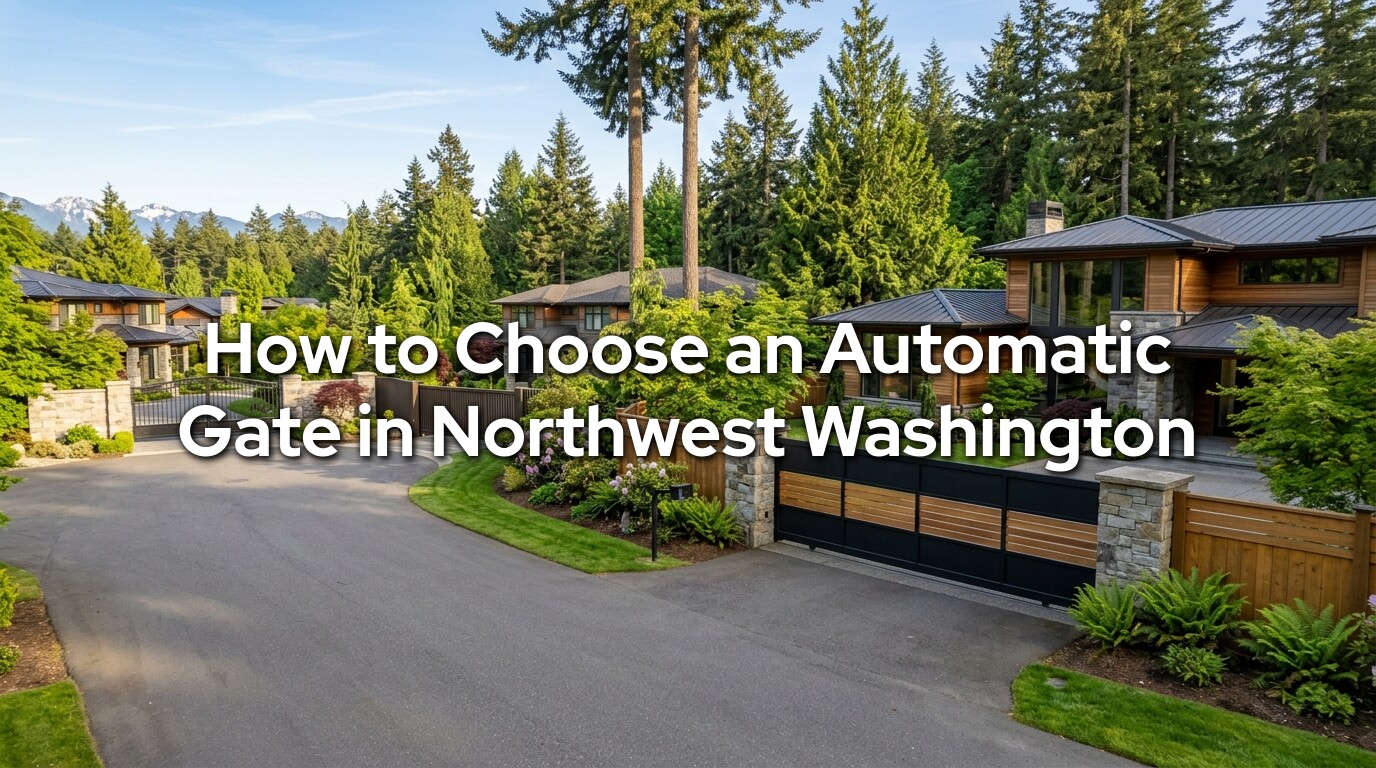
How to choose an automatic gate feels like one decision. It is actually seven smaller ones, and nearly every regret we get called to fix traces back to making them in the wrong order. The homeowner who fell in love with a solid cedar design before anyone measured the wind exposure. The buyer who picked a swing gate from a photo and discovered their driveway climbs uphill exactly where the gate needed to sweep. The family that sized the opening for the cars they had, two years before the boat.
Order is the whole trick. Get the sequence right, purpose first, site second, style fourth instead of first, and every later choice narrows naturally until the right gate is almost picking itself. Get it backward and you spend the budget forcing a design to work on a property that was telling you no from the start.
This guide exists because Northwest Washington makes the sequence matter more than most places. Our driveways climb foothills, run three hundred feet through firs, sit ten feet off busy suburban streets, and face salt air on one side of the county and snow on the other. A buying guide written for the national average is quietly wrong here about power, about materials, about solar, about wind, and about winter. This one is written from the driveways themselves.
By the end you will have a working method: how to rank what you actually need the gate to do, how to read your own property the way an installer reads it, which configurations fit the six property types that dominate this region, how to choose materials and design you will still love in year fifteen, how to size the machinery and access control to your real life, what the sensible budget tiers look like in 2026, when to buy, and how to vet the company you hire. Emerald Gate Systems designs, fabricates, installs, and services gates from Sedro-Woolley across Skagit County, Whatcom County, Snohomish County, the islands, and the Greater Puget Sound region, and this is the conversation we have at kitchen tables every week, written down.
Start With Why: The Five Jobs a Gate Can Do
Every automatic gate does some mix of five jobs: security, privacy, safety for kids and pets, curb appeal, and daily function, meaning how smoothly the property handles arrivals, deliveries, equipment, and animals. The first real buying decision is ranking those five for your household, because your top two priorities quietly write most of the specification.
Rank security first and the spec leans toward steel, taller heights, tight sight lines, camera integrated access, and controlled credentials. Rank privacy first and you are shopping solid or near solid infill, which immediately raises the wind question that decides so much in this region. Rank kid and pet safety first and the design conversation turns to picket spacing, screening, a separate pedestrian gate, and the safety devices that watch the travel path. Rank curb appeal first and material, proportion, and how the gate frames the house lead, with custom fabrication on the table. Rank daily function first, common on working properties around Arlington and Monroe, and the priorities become opening width, an effortless exit device, delivery friendly access, and machinery rated for heavy daily cycling.
No ranking is wrong, but pretending everything ranks first is how projects blow budgets without satisfying anyone. Write your two, in order, before you look at a single photo. Every section below will refer back to them.
A Note for Buyers Replacing an Old Gate
If you are here because an existing gate aged out, you hold an advantage first time buyers do not: evidence. The old system already told you what it got wrong, the missing exit device, the keypad nobody could reach from the car, the swing that fought the slope, the width the trailer never quite cleared. Write those grievances next to your two priorities, because a replacement that merely renews the machinery while preserving the complaints wastes the one benefit of doing this twice. And remember that much of what you paid for the first time, posts, footings, buried wiring, often a sound panel, usually carries into the new project and shrinks it, as our guide to repair cost vs replacement explains.
The Right Order to Decide: A Seven Step Path
Here is the sequence this guide follows, and the one we walk with buyers on site. Step one, rank the five jobs, done above. Step two, read the site, because slope, setback, power, sun, and wind hold veto power over everything. Step three, choose the configuration, swing or slide, which the site largely dictates. Step four, choose material and design, the decision most people make first and should make fourth. Step five, size the operator and settle the power plan. Step six, design access control around a normal week at your house. Step seven, choose the installer, which is its own discipline.
Notice where style sits: fourth, after the property has spoken. That single reordering prevents most of the expensive mismatches in this trade, because a beautiful gate that fights its site becomes a maintenance relationship, while a well matched gate becomes furniture, present, working, and forgettable in the best way. The rest of this article takes the steps in order, at the depth each one deserves.
Want the whole sequence run for you in one visit? This is literally the service. Explore how we approach gate projects from design and fabrication through installation and long term care on our services page, and you will recognize every step above in the way we quote.
Read Your Property Like an Installer: The Self Assessment Walk
Before any quotes, take fifteen minutes and walk your own entrance with an installer’s eyes. Eight observations decide more about your gate than any catalog will, and you can make all of them yourself.
Stand at the entrance and look at grade. Is the driveway level through the zone where a gate would swing, or does it climb or fall? Rising grade in the swing path is the single most common site veto in this region, and it points you toward a slide before you have chosen anything.
Measure the setback, the distance from the road edge to where the gate would sit. A waiting car should fit entirely off the pavement, which means at least one full vehicle length, and more if trucks and trailers visit. Short setbacks on tighter lots around Mountlake Terrace and Brier are the second great argument for sliding gates, which stay on your property instead of sweeping toward the street.
Find your power. Where is the nearest panel or circuit, and how many feet of trench separate it from the entrance? On suburban lots the answer is boring and cheap. On acreage it can be the largest line on the quote, and it is better discovered now than in a proposal.
Look up and look south. Genuine southern sun exposure at the entrance keeps solar on the table. A canopy of firs takes it off, whatever any kit brochure claims.
Then note the quieter four: what the driveway surface is, since gravel argues against ground tracks and affects detection choices; where water goes in a hard rain, since the machinery will live at ground level; how exposed the entrance is to wind, which matters enormously if privacy ranked high for you; and what you can see of the road in both directions from a stopped car, since safe sight lines shape where the gate and keypad belong. Write your eight answers down. They are the site’s votes, and the site votes first.
The Two Measurements Worth an Actual Tape
Most of the walk is observation, but two numbers deserve a tape measure before anyone quotes. Measure the clear opening, post to post or the width you intend, remembering the future boat and trailer conversation. And measure the setback from road edge to gate line, since one full vehicle length off the pavement is the working minimum and delivery trucks appreciate more. While the tape is out, take a dozen photos: the entrance from the road in both directions, the driveway looking in, the likely operator location, and the route back toward power. A quote request that arrives with those two numbers and those photos gets a sharper, faster, more honest response from every company you contact, ours included.
Six Northwest Property Types and the Gates That Fit Them
Two decades of installations in this region sort into six recurring property types, and each has a configuration that keeps proving itself. Find yours below, not as a rule, but as the starting point the local evidence supports.
The Compact Suburban Lot
Short setback, level ground, a fence line to travel along, neighbors close enough to care about noise. Common across Lynnwood, Mill Creek, and Edmonds. The proven answer is a cantilever sliding gate in aluminum, quiet machinery, a keypad plus app access, and restrained styling that suits the streetscape. Where the lot is level and the swing path is genuinely clear, a single swing gate is the value alternative.
The Acreage and Farm Property
Wide openings for equipment, trailers, and stock, daily cycles from family, workers, and deliveries, and function ranked first. The pattern around Arlington, Stanwood, and the Snohomish valley: a dual swing or slide in galvanized steel sized generously, an exit wand so nobody stops on the way out, delivery codes, and machinery specified for real cycle counts rather than brochure ones. If livestock share the property, gate heights, latching behavior, and a person gate for foot traffic join the design conversation early. See our guide to gate systems for farms and rural properties.
The Wooded Foothills Driveway
Long runs through trees toward Sultan, Gold Bar, Index, Darrington, and Granite Falls, with power far away, shade everywhere, and storm outages a certainty rather than a possibility. Here the power plan leads the whole project: trench, low voltage, or, only with honest sun, solar. The configuration that thrives is a cantilever slide riding above needle litter and the occasional snow, with battery backup sized for multi day outages and a surge protector treated as standard equipment.
The Waterfront and Island Property
Salt air is the design constraint, from the island communities through the Mukilteo and Edmonds shoreline. Aluminum with stainless hardware is the default rather than the upgrade, finishes earn their money, and everything electrical appreciates sheltered mounting and more frequent rinsing. Style ranges freely; chemistry does not negotiate.
The Estate and Design Led Property
Here the gate is architecture, common in Woodway and the view neighborhoods, and the project starts in the fabrication shop rather than the catalog: custom ornamental iron or designed steel, often underground operators for a clean look, masonry columns, integrated video intercom, and lighting. These projects reward one team carrying design, welding, and automation together, which is exactly the case for in house custom gate fabrication.
The Community Adjacent Home
If an HOA reviews designs, or the gate serves a shared drive, sequence changes: design review approval comes before fabrication, styling usually harmonizes with the neighborhood, and anything serving multiple households belongs in commercial grade territory with managed credentials, closer to our commercial gate solutions work than to a single family install. Boards in Bothell approve faster when the submission arrives with drawings, finishes, and safety compliance already documented.
Recognize your property above and want the version tuned to your exact site? The archetypes get you eighty percent of the way, and the site walk covers the rest. Call (360) 657-9975 to schedule an on site consultation and we will confirm the configuration against your grade, power, wind, and week.
Swing or Slide: The Four Question Version
Whole articles exist on this comparison, and our full breakdown of sliding gate vs swing gate in the Pacific Northwest goes deeper. For buying purposes, four questions settle it for almost every property, and your site walk already answered them.
Is the ground level through the full arc a swing gate would sweep? If not, slide. Is there genuinely clear space for that arc, no parking, no snow storage, no slope toward the street? If not, slide. Is the setback long enough that an opening gate never reaches toward the road? If not, slide. And is the driveway gravel, or prone to collecting needles, cones, and winter mess? If so, and a slide is indicated, make it a cantilever, the style that travels above the ground instead of in a debris collecting track.
Answer yes to the first three and a swing gate is usually your value play: simpler machinery, lower cost, easy serviceability, and a classic look, with dual leaves for wide openings and better proportions. Land on slide and you are buying a solution to slope, setback, or mess, typically $1,500 to $4,000 more than a comparable swing and worth every dollar on the sites that need it. What you should not do is force the answer for style reasons, because both configurations fabricate beautifully, and the site’s vote outranks the photo you saved.
What About the Other Formats?
Buyers occasionally ask about the formats beyond swing and slide: barrier arms, vertical pivot gates, bi fold designs. The short answer for homes is that swing and slide cover effectively every residential situation in this region, and the exotic formats are commercial answers to commercial problems, barrier arms for parking flow, vertical pivots for sites with no room in any horizontal direction. If a residential proposal reaches for one of them, ask what site constraint demands it, because the honest answer is usually a cantilever slide wearing a simpler price.
Materials and Design: Choosing What You Will Look at for Twenty Years
Step four is where the project finally gets to be about taste, and taste chooses better with a few field facts underneath it.
Match the House, Not the Catalog
The gates that still look right in year fifteen echo the property behind them. Northwest contemporary homes carry horizontal slat designs and matte black or bronze aluminum well. Craftsman and farmhouse properties suit steel frames with cedar infill or simple vertical picket steel. Traditional estates earn ornamental iron with restraint. Bring photos of your house to the design conversation, not just photos of gates, because proportion against your entry, fence, and rooflines is what reads from the street. Our roundup of gate design ideas is a useful starting point.
The Infill Decision: Open, Solid, or in Between
Infill, the pattern filling the frame, sets privacy, wind behavior, and personality at once. Open picket designs give security and views, shrug off wind, and keep costs down. Solid infill delivers real privacy and presents real sail area, which on exposed ground means heavier machinery or a rethink. The in between designs, tight slats, mixed panels, perforated metal, louvered sections, are where most privacy minded buyers in this region should start, buying eighty percent of the screening at a fraction of the wind load.
Design for the Actual Household
Two members of the family deserve explicit design attention. Dogs define picket spacing and lower panel choices, and a determined small dog defines them further; solving this at fabrication costs little, while retrofitting screening later costs more and looks it. And people on foot deserve their own entrance: a matching pedestrian gate, typically $800 to $2,500, keeps family, guests, and deliveries out of the vehicle gate’s travel path entirely, which is both the safe design and the convenient one.
Materials in One Honest Paragraph
Aluminum panels run $2,000 to $6,000, never rust, and own the coastal zones. Galvanized and powder coated steel runs $2,500 to $8,000 and brings strength and span for security minded and working properties. Ornamental iron runs $4,000 to $12,000 and up and remains the estate language, with refinishing every 8 to 12 years as its membership fee. Steel framed cedar runs $3,500 to $9,000, looks like nowhere but here, and asks for sealing every 2 to 4 years plus recladding around year 12 to 15. Every one of them succeeds in this climate when the finish is specified honestly, and every one fails when it is not.
Design for the Dark Half of the Year
One design layer gets forgotten every summer and regretted every December: light. From November through February, most arrivals at a Northwest entrance happen in the dark, and a gate designed only for daylight becomes a guessing game of keypad buttons and black metal. Plan lighting with the gate, not after it: illumination on the keypad and intercom so guests can operate them, enough ambient light that the camera sees faces instead of headlights, and fixtures placed to flatter the design you just paid for. Wiring pulled during the gate’s own trench work makes all of this cheap, which is one more argument for deciding it now rather than discovering it at 4:30 on a December afternoon.
This is the step where a fabrication shop beats a catalog. Bring the house photos, the dog’s name, and the privacy ranking, and see what can actually be built. Call (360) 657-9975 about custom gate options and we will sketch designs against your architecture in our Sedro-Woolley shop, with the wind math already done.
Machinery and Power: Sizing the Gate to Your Real Life
Step five is the least visible decision and the one that most determines whether you love this system in year eight. Two honest counts do most of the work.
Count your real daily cycles. Every departure, arrival, delivery, landscaper, and school run is a cycle, and a family of five with working parents, activities, and regular deliveries can cycle a gate thirty times a day without noticing. Operators are rated for exactly this, from light residential duty through continuous commercial service, and the count decides the class. Machinery bought a class up from your count runs relaxed for 10 to 15 years; machinery bought to a brochure’s optimism ages in fast forward. Residential grade equipment runs roughly $900 to $2,500 per gate leaf, and the step up to heavier duty is one of the best value spends in the project. Our guide to powered gate systems and operator types covers the mechanisms in detail.
How to Read the Operator Line on a Proposal
You do not need to know brands to evaluate machinery. You need the proposal to name a specific model, and the model to answer four questions its published spec sheet makes public: its usage class, its duty cycle, its maximum leaf weight and length against your actual gate with margin, and whether battery backup is integrated or added. A proposal that names the model invites you to verify all four in ten minutes. A proposal that says heavy duty opener included invites you to hope. When two quotes differ by a thousand dollars, this line is usually where the difference lives, and reading it is how you find out whether you are comparing equipment or comparing adjectives.
Then commit to a power plan from your site walk. Power near the entrance means a straightforward trenched circuit under permit. Power far away means comparing a longer trench at $10 to $30 per foot against a low voltage design within its calculated limits, or, with real sun, a solar system sized for our winters rather than the kit’s home state. Whichever path, two items are regional table stakes: battery backup sized for storm season, because outages here are annual appointments, and surge protection, under $200, standing between November and the control board.
One buyer level tip that pays for a decade: whatever gets trenched, oversize the conduit and pull a spare line or two. Conduit is cheap while the trench is open and precious forever after, and it is what lets next year’s camera or intercom arrive without new excavation.
Access Control: Design the Week Before You Buy the Hardware
Step six is a worksheet, not a shopping trip. Take a normal week at your property and list everyone who arrives: household cars, kids on foot, the school carpool, packages, groceries, propane or fuel service, the landscaper, grandparents, the occasional first time guest. Then give each arrival a tool.
Household cars get remotes and, on any current operator, the app. Kids and regulars get keypad codes, $300 to $900 for the hardware. Everyone departing gets a free exit device, $300 to $900, so leaving never requires a credential, which is the single feature owners say they would never give back. Deliveries get their own standing code, and unpredictable visitors get you, through a cellular video intercom at $1,500 to $4,000 that rings your phone with live video from the entrance, the piece that transforms long rural driveways around Lake Stevens and Snohomish from a delivery problem into a non event.
Two design notes complete the step. Decide your app expectations now, remote opening, activity logs, temporary codes, alerts, because connectivity is easy to specify at purchase and clumsy to retrofit. And place the keypad and intercom where a driver reaches them from the seat, clear of the gate’s travel and with safe sight lines back to the road, details a good installer handles by habit and a bad one leaves you living with. The full menu, from a single keypad to community credential systems, lives on our access control systems page.
The best access setup is the one designed from your actual week. Bring the list, the school schedule, the delivery reality, and the one relative who can never work a keypad, and we will map every arrival to a tool before any hardware is chosen.
Budget Tiers: What Good, Better, and Best Buy in 2026
With the decisions above made, budget stops being a mystery number and becomes a tier choice. Here is how complete projects stack up across the Puget Sound region right now, and where the money is best aimed inside each.
| Tier | Installed range | What it buys |
|---|---|---|
| Essential | $4,500 to $7,500 | Single swing gate in stock aluminum, quality residential operator, monitored safety devices, keypad and remotes, on a level site with power close by |
| Complete | $8,000 to $15,000 | Dual swing or cantilever slide in aluminum or steel, heavier duty machinery, free exit device, cellular video intercom, storm sized battery backup, and real site work |
| Signature | $15,000 to $40,000+ | Custom fabrication, designed iron or steel, underground operators, masonry, integrated cameras and lighting, estate and working property openings |
The essential tier is a real system, not a compromise, and for compact level lots it is often exactly right. The complete tier is where most Northwest households land, and it funds the difference between a gate that works and a gate you never think about. In the signature tier the budget follows the design, and the design follows the property.
Two spending principles hold across all three. Money aimed at the operator class, the safety devices, the finish quality, and drainage always proves out, because those four determine the year eight experience. Money aimed at width restraint or deferred gadgets is recoverable later; conduit and prewiring make add ons cheap, while an undersized opening or a bargain operator make regrets expensive. And plan the ownership line honestly: $200 to $500 a year in service and consumables, with the machinery renewing itself once per gate lifetime at $2,500 to $5,000 somewhere past year ten. For the full breakdown, see automatic driveway gate cost in Washington State.
Phasing the Build Without Regretting It
Budgets are real, and a gate project phases well if you split it along the right seam. What phases gracefully: the intercom, cameras, extra remotes, lighting, and smart integrations, all cheap to add later when conduit and spare wiring were pulled on day one. What must never be phased: opening width, operator class, monitored safety devices, drainage, and finish quality, because each of those is either built in now or bought back later at multiples. The disciplined phased build installs the complete structural and machinery layer with prewiring everywhere, runs a keypad and remotes for a season, and adds the connected layer when the budget exhales. The regretted one saves on the operator and adds a better one in year four, which is not phasing, it is paying twice.
Timing the Project: Lead Times, Seasons, and the New Construction Advantage
When you start matters more than buyers expect, for two calendar reasons.
The first is lead time. From signed quote to working gate typically runs 3 to 8 weeks, with fabrication consuming most of it: 2 to 4 weeks for stock designs, 4 to 8 for custom work, longer for elaborate ornamental projects. The install itself is 1 to 3 days on site.
The second is our weather calendar. Installation proceeds year round west of the Cascades, but ownership begins whenever the gate does, and a system commissioned in September starts its life with a fresh battery, verified safety devices, and clean sensors exactly when storm season arrives. The buyers who order in late spring or summer get the relaxed fabrication queue and the autumn ready gate. The ones who call in November are often calling about the gate they wished they had ordered in June. Our seasonal maintenance guide explains why that timing matters for the whole first year.
If you are building or heavily renovating, you hold the single best card in this whole subject: the open trench. Running gate conduit while excavation is already happening, with spare capacity pulled for future intercoms and cameras, costs a fraction of dedicated trenching later, and coordinating the gate’s posts and footings with driveway pours and fence lines produces the cleanest installations we ever do. Tell your builder early, get the gate designer and the site plan in the same conversation, and the eventual system arrives at a discount measured in thousands. Retrofit buyers should not despair, since most of this guide assumes exactly that, but new construction buyers should not waste the card.
If a New Fence Is Part of the Plan
Gate and fence projects travel together often, and the order of operations matters. The gate’s posts carry loads a fence never sees, so they are engineered and set independently of the fence line, and the gate’s opening width and hardware get decided first, with the fence built to meet them rather than the reverse. Matching materials and finishes across both is easiest when one shop fabricates with the other in view, and on properties around Snohomish and Granite Falls where farm fencing meets an automated entrance, coordinating the two also settles the practical seams: where stock pressure ends, where the pedestrian gate lands, and how corners brace. Tell both trades about each other early, and the joint reads as one design instead of a negotiation.
Ready to put your project on the calendar ahead of the season? Fabrication queues fill from spring onward, and the autumn ready gate starts with a summer conversation. Call (360) 657-9975 about residential gate installation and we will map your project onto real dates.
Choosing Your Installer: The Local Vetting Checklist
Step seven decides how the other six turn out, because the same design executed by two different companies produces two different decades. Vet before you compare prices, and vet on these six points.
Verify the registration. Washington contractors must be registered, bonded, and insured, and the state lets you confirm all three in two minutes through the Labor and Industries contractor lookup. A company that hesitates to hand over its registration number has answered a different question than the one you asked.
Ask who does the electrical. Line voltage work belongs to a licensed electrician under permit, and a professional outfit names its arrangement immediately, whether in house licensing or a standing electrician partnership. Vague answers here predict vague answers everywhere.
Ask where the welding happens. A company with its own fabrication shop can build custom, modify designs to your site, and, just as importantly, repair structural problems for the life of the gate. A reseller of imported panels can do none of those, which you discover at the worst possible time. It is fair to ask to see recent fabrication work, and shops proud of theirs will show you, as ours does in our project portfolio.
Test the service area claim. The company that installs your gate should be the company that answers in year five, so ask where their trucks actually run and what response looks like from their shop to your driveway. An installer based in the region, reaching Skagit, Whatcom, and Snohomish County routinely, is making you a different promise than one passing through from two counties away. See our service areas.
Read the warranty before the contract. Manufacturer coverage on quality operators runs 2 to 5 years on parts; the installer’s labor and workmanship warranty is separate, shorter, and revealing. Get both in writing and read what maintenance the coverage assumes.
And ask about the relationship after installation. A company with a real maintenance program, scheduled visits, records, priority response, is planning to know your gate in year ten, which is exactly what you want. Ours is built around annual and twice yearly service through gate repair and maintenance, and any serious competitor should describe something similar without being prompted. Once two or three companies clear this bar, comparing their itemized quotes line by line is its own short discipline, and by then you will be choosing between good options, which is the whole point of vetting first.
Buyer Mistakes, Myths, and the Final Checklist
The mistakes below are the ones we get called to undo, and every one of them was avoidable at the buying stage.
Choosing the style before reading the site, the original sin this whole guide exists to prevent. Sizing the opening for today’s vehicles, then buying the boat, the trailer, or the RV that no longer fits; width is nearly free at fabrication and expensive forever after. Skipping the pedestrian gate and discovering the household now walks through the vehicle gate’s travel path daily. Ordering fabrication before HOA design review, which turns approval into renegotiation. Buying a bargain operator kit online and then shopping for someone to install it, a project that starts with the wrong machinery and ends with no warranty. And forgetting the unglamorous arrivals, the mail carrier, the garbage truck, the fuel delivery, whose access needs are cheap to design in and irritating to bolt on.
The myths are gentler but just as costly. Gates are only for estates: the essential tier says otherwise, and compact lots in Marysville benefit as much as acreage does. Any fence company can handle a gate: automation, safety standards, and electrical make this a different trade, and the standards have teeth. It is cheaper to wait until everything else is finished: the open trench card says the opposite for anyone building. And a gate will take care of itself: it is machinery outdoors in forty inches of rain, and it thrives on the small attention this region has taught every other machine to expect.
Before you sign anything, run the final ten point check: your two ranked priorities written down, the eight site observations from your walk, configuration chosen by the site, material and infill chosen against wind and household, opening width sized for the future, operator class matched to real cycles, power plan committed with backup and surge protection, a normal week mapped to access tools, pedestrian access solved, and an installer verified through the state lookup with both warranties in writing. Ten yeses, and you are not hoping for a good outcome anymore. You have specified one.
That checklist is a conversation we would be glad to have with you. Call (360) 657-9975 or contact Emerald Gate Systems and bring your rankings, your site notes, and your questions. We will turn them into a design, a specification, and a number you can trust.
Frequently Asked Questions About Choosing an Automatic Gate in Northwest Washington
These are the questions buyers across the region actually ask before their first quote, answered directly first, with the reasoning behind each.
How do I choose the right automatic gate for my property?
Decide in sequence: rank what you need the gate to do, read your site’s slope, setback, power, sun, and wind, let the site choose swing or slide, then choose material and design, size the operator and power plan, design access control around a normal week, and vet the installer last.
The order is the method. Style chosen first fights the site forever, while style chosen fourth arrives at a gate the property was already asking for. Most buying regret in this trade is sequence regret.
What is the best type of automatic gate for the Pacific Northwest?
For the region’s most common conditions, a cantilever sliding gate in aluminum or galvanized steel is the most forgiving all around choice, because it ignores driveway slope, stays clear of the road on short setbacks, and rides above the needles, gravel, and occasional snow that jam ground tracks.
That said, best is site specific. A level driveway with room for the arc makes a swing gate the better value, and the four question test above settles it: level ground, clear arc, generous setback, clean surface, and swing wins; miss any of them and slide, cantilever style, earns its premium.
What is the best material for a driveway gate in Western Washington?
Aluminum is the safest default across the region, because it cannot rust, weighs less, and eases the load on machinery, and near salt water it is the clear first choice. Galvanized and powder coated steel is the strength pick for security and working properties, and it performs beautifully here when the finish is specified honestly.
Ornamental iron remains the estate language with a refinishing schedule attached, and steel framed cedar delivers the most Northwest look of all in exchange for sealing every 2 to 4 years. The regional rule underneath all four: the finish quality matters as much as the metal.
How much should I budget for an automatic gate in Washington?
Plan in tiers. Essential systems run $4,500 to $7,500, complete systems for most households run $8,000 to $15,000, and custom signature projects run $15,000 to $40,000 and beyond, all installed, as of 2026 in the Puget Sound region.
Add the ownership line: $200 to $500 a year for service and consumables, with machinery renewal at $2,500 to $5,000 somewhere past year ten. If you already own a sound manual gate, automating it runs $2,500 to $7,000 instead of the full project.
What adds the most cost to an automatic gate project?
The invisible items: distance from power, which sets trenching at $10 to $30 per foot, difficult grade and drainage work, and stepping up from stock to custom fabrication. Width, material, operator class, and access control add cost in smaller, more visible increments.
This is why two similar looking gates can differ by thousands. The site sets the base price before the first design decision is made, which is also why a quote produced without a site visit is a guess wearing a number.
Is an automatic gate worth it for an ordinary home?
Yes, far more often than people assume. The essential tier at $4,500 to $7,500 puts a real system, quality machinery, monitored safety, keypad and app access, within reach of compact suburban lots, and the daily returns, controlled access, package security, contained kids and pets, do not care how large the property is.
Where it is honestly not worth it: a very short driveway where a gate would crowd the road, or a household unwilling to give machinery its hour of annual attention. Everyone else is a better candidate than the estate stereotype suggests.
How wide should a new driveway gate be?
Make the clear opening at least 12 feet for a typical home, and 14 to 16 feet if trucks, trailers, boats, or an RV will ever visit, and size for the vehicles you might own, not just the ones you do.
Width is nearly free at fabrication time and expensive forever after, and the calls we get about openings are never that the gate is too wide. On long rural driveways, confirm your fire district’s clear width expectations while you are at it.
Should I choose a single or double swing gate?
Single leaves suit openings up to about 14 to 16 feet and cost less to build and automate, since one operator does the work. Beyond that, dual leaves keep each panel’s weight and leverage sane, look better proportioned on wide entries, and split the wind load.
Duals cost more, two operators instead of one, but on wide openings they are the engineering answer, not a style upgrade. Your fabricator should be showing you the crossover math for your exact width rather than defaulting either way.
Should my gate be solid for privacy or open picket?
Start in the middle. Tight slats, louvers, and perforated designs deliver most of the screening at a fraction of the wind load, which matters because a fully solid gate is a sail, and exposed Northwest sites make sails expensive to move and hold.
Fully open picket wins on cost, wind, and sight lines; fully solid wins on privacy and asks for heavier machinery or shelter from the wind in return. Rank privacy honestly, check your site’s exposure, and let those two facts pick the infill.
How do I make a gate safe and practical for kids and dogs?
Design it in at fabrication: picket spacing and lower panels sized to the actual dog, screening on slide gates so nothing reaches the moving path, a separate pedestrian gate so people never walk through the vehicle gate, and the monitored photo eyes and edge sensors that current standards require.
Then teach the household that the vehicle gate is not a door or a toy. Systems built and maintained to UL 325 and ASTM F2200 are engineered precisely for family properties; the design choices above are how you meet the engineering halfway.
Do I need a separate pedestrian gate?
If anyone regularly arrives or leaves on foot, yes. A matching walk gate, typically $800 to $2,500, gives kids, guests, and deliveries their own entrance and keeps everyone out of the vehicle gate’s travel path, which is both the safety standard’s intent and the convenient design.
It also solves the daily annoyances no vehicle gate should be asked to handle: the dog walk, the mailbox trip, the neighbor kid. Most owners who skip it at purchase add it later at a worse price.
Can my gate match my house and fence style?
Yes, and it should. Custom fabrication builds to your architecture: horizontal slat aluminum for Northwest contemporary, steel framed cedar for craftsman and farmhouse, restrained ornamental iron for traditional estates, with finishes and proportions tuned to your entry and fence lines.
Bring photos of the house, not just of gates you liked online, because the gate reads against your property, not against the catalog page. This is the strongest argument for choosing a company with its own fabrication shop rather than a reseller’s binder.
What should I decide before requesting gate quotes?
Five things: your two ranked priorities, your eight site observations from the self assessment walk, the configuration the site indicates, a realistic budget tier, and your access control week. Bring vehicle sizes and future plans, the boat counts, and any HOA design rules.
Arriving with those decisions turns quotes from guesses into proposals you can compare, and it changes the conversation from what do you want to here is how we would build exactly that, which is where good projects start.
When is the best time of year to install a gate in Washington?
Order in late spring or summer. Fabrication queues are calmer, and a system commissioned by September begins storm season with a fresh battery, verified safety devices, and clean sensors, exactly when the region starts testing gates.
Installation itself runs year round west of the Cascades, since hard ground freeze is rare, so winter projects are entirely doable. The summer advantage is calendar and readiness, not feasibility.
Should I install a gate during construction or after?
During, if you possibly can. Open trenches make gate conduit nearly free, spare lines future proof the entrance for cameras and intercoms, and coordinating posts and footings with driveway pours and fence lines produces the cleanest result at the lowest cost.
Tell your builder early and get the gate designer into the site plan conversation. Retrofit installs are the normal case and work fine, but the new construction card is worth thousands and only plays once.
How long does it take to get an automatic gate installed?
Plan on 3 to 8 weeks from signed quote to working gate: 2 to 4 weeks of fabrication for stock designs, 4 to 8 for custom work, then 1 to 3 days on site, with concrete cure time sometimes separating post setting from gate hanging.
The fabrication queue is the schedule driver, which is why projects with a deadline, a move in, an event, the start of storm season, should start from the quote date, not the desired finish date.
Do I need a permit for an automatic gate in Washington?
The electrical run almost always requires a permit, through Washington Labor and Industries or your city, with line voltage work performed by a licensed electrician. The gate itself rarely needs a building permit at normal residential heights, though tall designs, masonry, HOA review, and fire district access rules can each add an approval.
A local installer should name every approval your address needs during design. Surprises here are a planning failure, not a regulatory one.
Do HOAs allow automatic driveway gates?
Usually yes, through design review, and the sequence is the whole game: approval before fabrication, never after. Boards respond to complete submissions, drawings, materials, finishes, and safety compliance documented, and to designs that harmonize with the neighborhood.
If the gate serves a shared drive or community entrance rather than a single home, the project also steps up into commercial grade equipment and managed credentials, which is a different specification and a different conversation.
Is solar a good choice for my new gate?
Only if your entrance has genuine southern sun. With real exposure and components sized for our winters, a bigger panel and battery bank than standard kits include, solar runs reliably here and eliminates the trench entirely.
Under a fir canopy, no kit succeeds, whatever the box promises, and a trenched or low voltage feed is the honest design. The buying moment is the right time for this truth, because solar chosen for the wrong site becomes a battery subscription with a January failure habit.
What ongoing costs come with owning an automatic gate?
Budget $200 to $500 a year: an annual professional service visit at $150 to $350, batteries every 2 to 4 years, and small consumables. Somewhere past year ten, plan for machinery renewal at $2,500 to $5,000 while the gate itself carries on.
That is the entire honest ledger for a maintained system. The unmaintained version trades those numbers for emergency calls at premium timing, which is the more expensive subscription.
What warranty should a new gate include?
Two layers in writing: manufacturer parts coverage on the operator, commonly 2 to 5 years on quality equipment, and the installer’s own labor and workmanship warranty, typically 1 to 2 years.
Read what the labor warranty assumes, because coverage universally expects reasonable maintenance, and service records are what keep it enforceable. A company reluctant to put both layers in writing before the contract is telling you something worth hearing.
How do I verify a gate contractor in Washington State?
Look them up in the Washington Labor and Industries contractor verification tool, which confirms registration, bonding, and insurance in about two minutes. Ask directly for the registration number; professionals hand it over without a pause.
Then verify the parts the state cannot: who performs the electrical work and under what license, whether fabrication happens in their own shop, and whether their trucks genuinely run your area, because the installer you want is the one still answering in year five.
What questions should I ask a gate installer before hiring?
Six do most of the work: are you registered, bonded, and insured, and what is the number; who does the electrical and pulls the permit; do you fabricate in house; what operator model and class are you proposing and why; what do both warranties cover in writing; and what does service look like after installation, including emergency response.
Confident companies enjoy these questions. Evasive answers to any of them are the cheapest red flag you will ever buy.
Does an automatic gate affect home insurance?
Sometimes favorably, occasionally administratively, and it is worth one call to your agent either way. Some insurers offer modest security related credits for gated, monitored entrances, and most simply want significant site improvements noted on the policy so the gate is properly covered as an other structure.
Sudden accidental damage, a vehicle strike, a falling tree, is commonly covered subject to your deductible, while wear is excluded, which is one more quiet argument for the maintenance records that keep every warranty and claim conversation short.
What mistakes do first time gate buyers make most often?
Choosing style before reading the site, sizing the opening for today’s vehicles instead of tomorrow’s, skipping the pedestrian gate, ordering fabrication before HOA approval, buying bargain equipment online and shopping for installation afterward, and forgetting the mail carrier, garbage truck, and fuel delivery in the access plan.
Every one is a sequence or foresight error rather than a money error, which is the encouraging part: the ten point checklist above prevents all of them for free.
The Bottom Line: Let the Property Choose, Then Make It Yours
Choosing an automatic gate in Northwest Washington is a sequence, not a shopping trip. Rank the five jobs and write down your top two. Walk the site and collect its eight votes on slope, setback, power, sun, wind, surface, drainage, and sight lines. Let those votes pick swing or slide. Then, and only then, choose the material and design you will look at for twenty years, size the machinery to your real daily cycles, commit to a power plan with storm season in mind, map a normal week onto access tools, and hire a verified local company with its own fabrication shop and a service program that plans to know your gate in year ten.
Buyers who follow that order end up with the quiet kind of gate: the one that opens as they crest the driveway, closes behind the last delivery, shrugs off the October windstorm, and never comes up in conversation again. That outcome is not luck and it is not spending. It is sequence.
When you are ready to run the sequence on your own entrance, call (360) 657-9975 or contact Emerald Gate Systems. From our fabrication shop in Sedro-Woolley we design, build, install, and service automatic gates across Skagit, Whatcom, and Snohomish County, the island communities, and the Greater Puget Sound region. Bring your rankings and your site notes, and we will bring the rest.