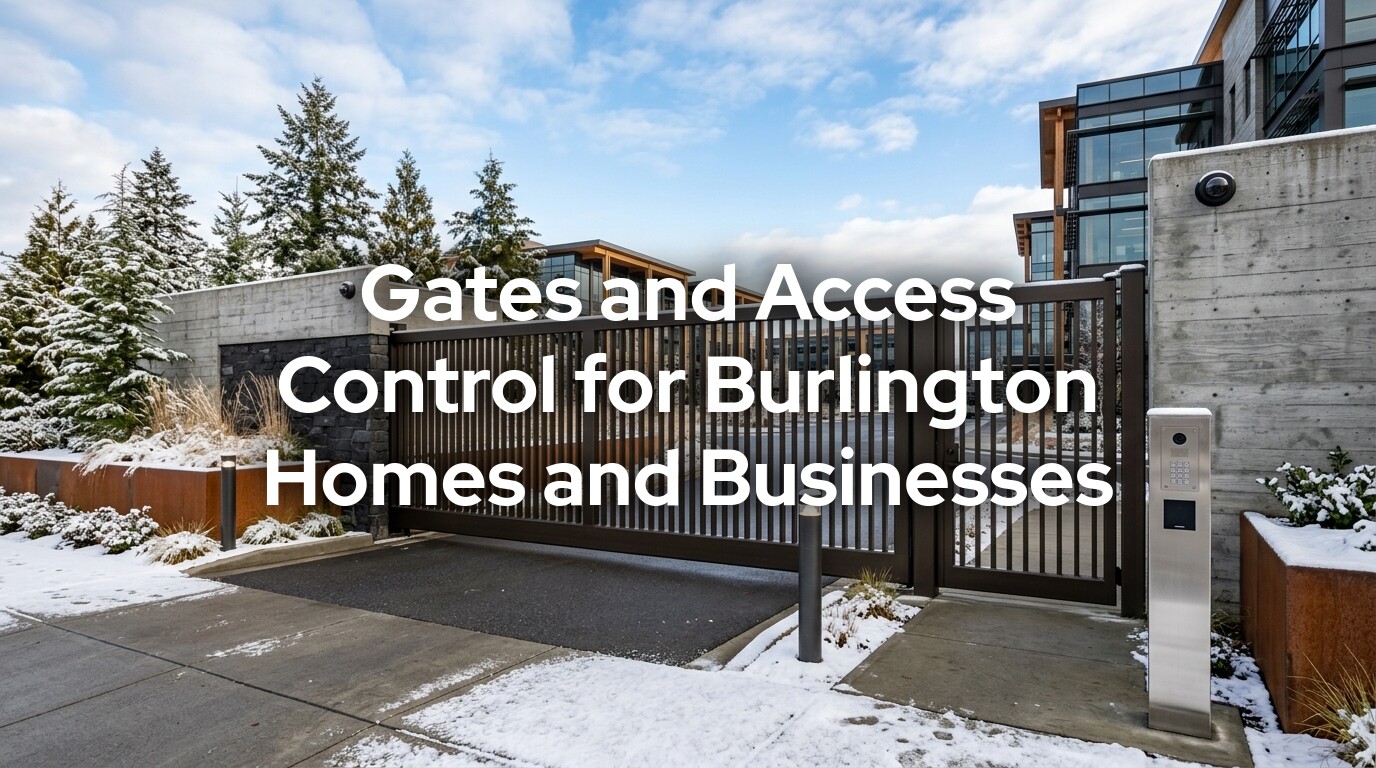
Gate & Access Control Installation in Burlington, WA should be planned around the city’s mix of retail storefronts, warehouse and distribution entrances, service businesses, residential driveways, delivery traffic, and I-5 corridor movement. Burlington is not just another nearby Skagit County city. Its commercial traffic, business access, parking areas, and storefront exposure create gate and entry needs that are different from a quiet residential driveway or a rural farm entrance.
Emerald Gate Systems installs, fabricates, automates, repairs, and maintains gates and access control systems for Burlington homes, retail properties, warehouses, distribution yards, storefronts, commercial sites, managed properties, and residential driveways. The company is headquartered in Sedro-Woolley, just next door in Skagit County, with its own fabrication shop supporting custom iron, steel, cedar, automatic operators, keypads, intercoms, cameras, bollards, safety devices, and repair service.
Burlington sits at a practical crossroads in Northwest Washington. The I-5 and State Route 20 corridor brings retail traffic, business activity, deliveries, employees, vendors, customers, and service vehicles through the area every day. That makes access control more than a convenience feature. For many Burlington properties, it is part of how the site manages vehicles, people, deliveries, restricted areas, and after-hours access.
Storefront security, warehouse gates, bollards and access control in Burlington are related needs, so they are all covered here rather than spread across separate pages. Where you need more detail, this page links to commercial gates, access control, bollards, automatic gate installation, custom fabrication, gate repair and the Skagit County page.
What Does Gate & Access Control Installation in Burlington, WA Include?
Gate & Access Control Installation in Burlington, WA includes the physical gate, operator, safety devices, access-control equipment, vehicle detection, power planning, emergency access, repair planning, and site-specific layout needed to control an entrance responsibly. Depending on the property, the project may serve a home, storefront, warehouse, service yard, distribution lane, managed entrance, apartment property, or commercial building.
A Burlington gate and access-control project may include:
- Residential driveway gates
- Custom iron, steel, cedar, or mixed-material gates
- Commercial sliding gates
- Cantilever gates for yards and vehicle entrances
- Swing gates for driveways and smaller controlled entries
- Automatic gate operators
- High-cycle or continuous-duty operators for commercial use
- Keypads
- Card readers
- Fobs and mobile credentials
- Video intercoms
- Phone entry systems
- Cameras
- Vehicle loops
- Free-exit devices
- Safety photo eyes
- Sensing edges
- Battery backup
- Solar review where utility power is impractical
- Bollards for storefronts, pedestals, and vehicle-control points
- Gate repair and maintenance
A gate alone controls movement only if the rest of the system supports it. A warehouse gate needs traffic planning. A storefront bollard needs a defined vehicle-control goal. A keypad needs to be placed where drivers can stop safely. A commercial operator must be selected for actual cycles, not only for gate weight. A residential driveway gate should fit the home while still allowing guests, deliveries, and emergency access.
The strongest Burlington projects begin with a site review. The team should know who enters, what vehicles use the entrance, where traffic queues, how deliveries arrive, whether pedestrians use the same area, where power is available, and what happens after hours or during a power outage.
Schedule a free Burlington gate and access-control consultation before choosing operators, credentials, bollards, intercoms, or gate hardware.
Why Is Burlington Different From Nearby Residential Markets?
Burlington is different from nearby residential markets because the city combines homes with strong commercial access needs along the I-5 and State Route 20 corridor. Retail properties, service businesses, warehouses, distribution entrances, storefront parking areas, delivery lanes, and employee access points create more vehicle-control and credential-management needs than a typical residential- only market.
Burlington projects often need to consider:
- Retail customer movement
- Delivery trucks
- Employee access
- Vendor access
- After-hours access
- Warehouse gates
- Service yard security
- Distribution traffic
- Storefront vehicle exposure
- Parking lot circulation
- Pedestrian routes
- Vehicle stacking near the road
- Fire access
- Accessible entries
- Bollards and pedestal protection
A gate serving a Burlington business should be sized around real traffic. Shift changes, delivery windows, service vehicles, maintenance crews, vendors, customers, and repeated openings during business hours all add demand. A gate that cycles a few times a day for a home is not the same as a gate that supports a working commercial site.
Site geometry matters too. Some commercial properties have compact lots, shared entrances, close drive aisles, loading zones, sidewalks, and storefront parking. A gate or access device placed without traffic review can cause vehicles to queue into circulation lanes or stop where pedestrians need to move.
Burlington also has residential needs. Homeowners still need driveway gates, custom gates, access control, video intercoms, repair, and automation. The difference is that the city page must speak to both audiences without forcing the same solution onto both.
A residential driveway and a distribution yard may both need a gate. They do not need the same gate.
Why Does Sedro-Woolley Fabrication Matter for Burlington?
Sedro-Woolley fabrication matters for Burlington because Emerald Gate Systems can design, build, stage, install, automate, and service Burlington gate systems from a nearby Skagit County shop. Burlington is close enough that field measurements, fabrication coordination, installation adjustments, and future service can stay connected to the same local team.
Local fabrication supports:
- Custom gate sizing for actual openings
- Commercial frame reinforcement
- Operator-ready gate construction
- Hinge, roller, track, and guide coordination
- Pedestal and access-control planning
- Bollard and gate equipment protection layouts
- Custom residential driveway gates
- Custom commercial yard gates
- Steel, iron, cedar, aluminum, and mixed-material options
- Repair knowledge after installation
A Burlington commercial gate may need reinforced operator attachment points, clean travel, protected controls, and equipment that can handle repeated cycles. A residential gate may need a custom design that fits the property and still supports automation. Both benefit when the gate is designed as a moving structure from the beginning.
When fabrication, automation, and access control are split among unrelated vendors, the property owner can end up with gaps. The gate fabricator may not plan for the operator. The operator installer may not control the gate frame. The access-control device may be placed after concrete is finished. The repair technician may not know how the gate was built.
Emerald Gate Systems’ one-team approach helps reduce those gaps. The frame, operator, safety devices, keypads, intercoms, vehicle loops, cameras, bollards, and maintenance plan can be reviewed as one entrance system.
Gates for Burlington Homes and Residential Driveways
Residential driveway gates in Burlington should make access easier, improve the entrance, support privacy goals, and give the owner more control over guests, deliveries, contractors, and daily routines. The system should be designed around the driveway, not selected from a standard package.
Residential driveway gate planning should include:
- Driveway width
- Driveway slope
- Vehicle turning path
- Road setback
- Guest access
- Delivery access
- Family routines
- Gate material
- Privacy level
- Wind exposure
- Drainage
- Operator choice
- Safety devices
- Keypad or remote access
- Video intercom needs
- Battery backup
- Manual release
Burlington homes may use custom steel gates, iron gates, Western Red Cedar gates, aluminum gates, or mixed-material designs. The right material depends on the house, fence, driveway, privacy goals, wind exposure, maintenance expectations, and whether the gate will be automated.
A residential gate should not be treated as a complete security plan by itself. It can reduce casual turnarounds, unwanted vehicle access, unapproved driveway use, and some nuisance traffic. It does not replace lighting, locks, cameras, fencing, and sensible property practices.
Convenience is often the daily benefit. A gate that opens from a remote, keypad, phone, or credential keeps the owner from getting out of the vehicle in rain, darkness, or cold weather. That convenience depends on a good access plan. If guests and deliveries cannot get through, owners often begin leaving the gate open or sharing a permanent code too widely.
Review automatic gate installation when a Burlington driveway needs a complete swing, sliding, or cantilever gate system built for Washington conditions.
Access Control for Burlington Homes and Businesses
Access control for Burlington homes and businesses should be based on who needs to enter, how often permissions change, what vehicles use the entrance, and who will manage the system after installation. Access control may include keypads, remotes, cards, fobs, mobile credentials, video intercoms, phone entry, cameras, vehicle loops, and managed user records.
Burlington access-control users may include:
- Homeowners
- Family members
- Guests
- Delivery drivers
- Retail employees
- Warehouse staff
- Distribution drivers
- Vendors
- Contractors
- Maintenance crews
- Property managers
- Emergency responders
- After- hours service providers
A residential property may only need remotes and a keypad. A retail property may need employee credentials, vendor access, and camera review. A warehouse may need vehicle loops, scheduled credentials, and a controlled service yard. A managed property may need individual user records and a clear process for adding and removing permissions.
One shared code can seem convenient, but it often becomes a long-term problem. Shared codes spread to former employees, delivery drivers, contractors, cleaners, vendors, guests, and people who no longer need access. Individual credentials, scheduled codes, or temporary codes can give the property better control where users change.
Device placement matters. A keypad should not force drivers to stop in a traffic lane. A card reader should not be unreachable from a commercial vehicle. A video intercom should not be hidden from the driver or placed where a delivery truck cannot approach. Cameras should be selected for their purpose, such as overview, visitor verification, gate-strike review, or vehicle identification.
Review access control systems when a Burlington property needs keypads, credentials, intercoms, cameras, phone entry, or managed access for gates and doors.
Storefront Security and Vehicle Control in Burlington
Storefront security and vehicle control in Burlington should begin with the specific risk at the property. A storefront near parking, drive aisles, loading areas, or high-traffic commercial frontage may need bollards, gates, access controls, cameras, lighting, pedestrian protection, or better vehicle routing. The solution should match the site rather than rely on one product for every storefront.
Storefront vehicle-control planning may include:
- Customer parking layout
- Drive aisle direction
- Storefront glass exposure
- Sidewalk and pedestrian routes
- Loading zones
- Cart return areas
- Emergency access
- ADA routes
- Fixed bollards
- Removable bollards
- Retractable bollards
- Decorative bollards
- Crash-rated bollards where justified
- Gate and bollard coordination
- Camera visibility
- Lighting
Bollards are not all the same. Decorative bollards guide movement and protect light-duty areas. Fixed bollards can help define permanent protection zones. Removable bollards can allow occasional access. Retractable bollards can support controlled vehicle movement when the site truly needs it. Crash-rated bollards are tested for specific conditions and require appropriate engineering and installation.
A storefront bollard project should not block accessible routes, emergency access, delivery movement, or maintenance. Clear width, spacing, visibility, foundations, underground utilities, drainage, and pedestrian circulation all matter.
Gates can also support storefront properties when controlling service yards, employee parking, trash enclosures, loading access, or after-hours restricted zones. The gate should be planned around deliveries and traffic flow so it does not create a new obstruction.
Review bollard installation when a Burlington storefront, public entry, or commercial site needs vehicle-control planning.
For Burlington storefronts, define what the system needs to protect before choosing fixed posts, removable posts, retractable bollards, gates, or access controls.
Warehouse Gates and Distribution Yard Access in Burlington
Warehouse gates and distribution yard access in Burlington should be planned around truck movement, employee access, vendor access, delivery windows, traffic queues, after-hours security, vehicle loops, cameras, gate duty, and maintenance. The gate must support the work happening behind it.
Warehouse and distribution gate planning should include:
- Truck approach direction
- Trailer turning path
- Queue length
- Loading dock access
- Employee parking
- Vendor entrance procedures
- Delivery schedules
- After-hours access
- Card reader or keypad location
- Vehicle loops
- Free-exit operation
- Cameras
- Gate speed and timing
- Operator duty cycle
- Emergency access
- Maintenance access
A warehouse gate should be sized around peak traffic, not just average daily use. Shift changes, delivery waves, vendors, maintenance crews, and service vehicles can create short periods of repeated gate cycling. That is where an undersized operator becomes obvious.
Sliding and cantilever gates are often strong commercial candidates because they keep the vehicle path more predictable than a wide swing arc. A tracked sliding gate needs a clean, supported travel path. A cantilever gate avoids a ground track but needs side runback and stronger supports.
Access control should match the operating workflow. Employees may use credentials. Vendors may use scheduled access. Delivery drivers may need temporary codes or call-based entry. Management may need event records when something goes wrong.
Cameras should be placed with a purpose. A wide overview camera may show activity but not read a plate. A plate-focused camera may miss the driver or gate equipment. A camera pointed at the keypad may help troubleshoot entry issues. The system should be designed around what the property actually needs to know.
Review commercial gate systems when a Burlington warehouse, service yard, or distribution property needs high-cycle equipment, vehicle loops, credentials, and maintenance planning.
Commercial Gate Systems Along the I-5 Corridor
Commercial gate systems along the I-5 corridor should be designed for repeated use, vehicle movement, employee and vendor credentials, delivery access, and downtime consequences. Burlington properties near major commercial traffic cannot be treated like low-cycle private driveways.
Commercial gate systems may include:
- Sliding gates
- Cantilever gates
- Swing gates where appropriate
- High- cycle operators
- Continuous-duty operators
- Vehicle loops
- Free-exit devices
- Keypads
- Card readers
- Fobs and mobile credentials
- Phone entry
- Video intercoms
- Cameras
- Barrier arms where appropriate
- Bollards for reader and storefront protection
- Maintenance agreements
Commercial access planning should start with operations. Who enters? How often? What happens if the gate is stuck open? What happens if it is stuck closed? Which vehicles need access after hours? Who can approve a repair? Who removes old employee credentials? Who maintains the access list?
Downtime can be more expensive than the repair itself. A gate that blocks deliveries, employees, tenants, customers, or service vehicles can disrupt business. The maintenance plan should match that risk.
Pedestrian movement should be separated where practical. People should generally not be directed through an automated vehicular gate as the normal walking route. A controlled pedestrian gate or door may be more predictable and easier to coordinate with accessible hardware and building access.
For Burlington commercial gates, choose equipment by traffic, vehicle type, access workflow, and service risk, not by residential appearance.
Gate Types That Fit Burlington Properties
The best gate type for a Burlington property depends on whether the site is residential, commercial, retail, warehouse, managed, or mixed-use. Swing gates, sliding gates, cantilever gates, barrier arms, manual gates, and retrofit automation can all work when the configuration fits the traffic and site conditions.
| Gate type | Best Burlington fit | Main advantage | Main caution |
|---|---|---|---|
| Single swing gate | Residential driveways and lower-cycle private entrances | Traditional appearance and familiar movement | Needs clear swing space and stable hinge posts |
| Double swing gate | Wider residential or estate-style openings | Shorter leaves and balanced appearance | Both leaves need alignment, stops, and coordinated automation |
| Tracked sliding gate | Commercial lanes or compact sites with side room | Preserves driveway depth and creates predictable vehicle movement | Track must stay clean, drained, and supported |
| Cantilever gate | Commercial yards, gravel entrances, debris- prone sites | No track across the vehicle path | Needs side runback, longer frame, and stronger supports |
| Barrier arm | Parking control or fast vehicle management where physical perimeter security is not the goal | Fast movement and clear traffic control | Does not replace a full security gate where physical closure is needed |
| Manual gate retrofit | Existing gates that are stable and move freely | Can preserve a useful gate while adding automation | Poor gates should be repaired or replaced first |
| Bollard-controlled access | Storefronts, pedestrian areas, equipment protection, restricted vehicle points | Controls vehicle movement without a full gate across every opening | Spacing, foundations, accessibility, and utilities must be reviewed |
A residential driveway gate may prioritize privacy, appearance, family use, guest access, and convenience. A commercial sliding gate may prioritize employee access, delivery control, vehicle loops, and downtime reduction. A storefront bollard layout may prioritize vehicle separation from pedestrians and glass frontage.
The best configuration is the one that solves the property problem. A swing gate can look better on some driveways but create conflicts at a busy commercial entrance. A sliding gate can fit a compact site but become a maintenance issue if the track fills with debris. A cantilever gate can avoid a track but requires enough side runback.
Video Intercoms, Keypads, and Phone Entry in Burlington
Video intercoms, keypads, and phone entry systems help Burlington properties manage visitors, deliveries, vendors, employees, residents, and after-hours access. The right system depends on the property type, communication reliability, vehicle stopping position, and who will administer access.
These systems may support:
- Residential guests
- Package deliveries
- Service providers
- Commercial vendors
- Employee access
- Tenant access
- After-hours entry
- Temporary contractors
- Property managers
- Emergency procedures
A keypad is simple and familiar. It can be a good fit when the user group is small and stable. Temporary codes are stronger than one permanent shared code because they can be limited by time, user, or purpose.
A video intercom helps when the owner or manager needs to see who is at the entrance before opening the gate. It is useful for long driveways, storefront service entries, managed properties, and commercial visitor lanes. It requires good camera angle, power, communication, lighting, and a fallback process.
Phone entry can work well where visitors need to call a resident, office, manager, or approved contact. It becomes frustrating when directories are outdated or no one is assigned to maintain the system.
Communication should be tested at the gate location. Wi-Fi, cellular, hardwired connections, and cloud systems all have strengths and limitations. A system that works in the office may not work reliably at a gate near a metal building, low signal area, or remote driveway.
Bollards for Burlington Storefronts, Pedestals, and Entry Equipment
Bollards for Burlington storefronts, pedestals, and entry equipment should be selected according to the vehicle-control goal. A bollard protecting a storefront window is not the same as a post protecting a keypad pedestal, a warehouse corner, a pedestrian path, or a public-facing entry.
Bollard planning may include:
- Storefront glass exposure
- Drive aisle direction
- Parking stall layout
- Delivery areas
- Cart return zones
- Pedestrian paths
- Accessible routes
- Fire access
- Underground utilities
- Foundation depth
- Drainage
- Visibility and lighting
- Vehicle type
- Impact goal
- Removable access needs
Fixed bollards create permanent separation. Removable bollards allow occasional controlled access. Retractable bollards are more complex and should be justified by a real operational need. Decorative bollards can guide movement and improve appearance but should not be described as crash-rated unless they are part of a tested and properly installed system.
Crash-rated bollards should be treated carefully. A crash rating reflects specific test conditions, including vehicle type, speed, penetration, foundation, and installation. The rating is only meaningful when the installed system matches the tested configuration and engineering requirements.
Bollards should not create new problems. They should not block accessible routes, trap pedestrians, create vehicle blind spots, interfere with emergency access, or prevent service work on the gate, keypad, intercom, or building entry.
On commercial gate projects, bollards may also protect readers, intercom pedestals, control boxes, gate operators, corners, and exposed equipment from trucks, trailers, forklifts, and delivery vehicles.
Residential and Commercial Gate Automation Retrofits in Burlington
Gate automation retrofits in Burlington allow property owners to add an operator, safety devices, battery backup, and access control to an existing manual gate. Retrofit can be a strong value when the existing gate is stable, aligned, properly supported, easy to move by hand, and suitable for required safety upgrades.
A Burlington retrofit evaluation should review:
- Gate frame condition
- Post or column stability
- Hinge or roller condition
- Sliding track or guide condition
- Manual movement through the full travel path
- Gate sag, twist, or binding
- Operator attachment points
- Safety-device locations
- Power availability
- Access-control placement
- Vehicle stopping position
- Manual release
- Remaining service life
Retrofit should not be used to hide mechanical problems. If the gate drags, binds, shifts, has weak posts, or has failing hardware, the operator will fight those problems every cycle. Repair or replacement may be the better first step.
Residential retrofits often focus on convenience, keypad entry, remotes, smartphone access, and visitor control. Commercial retrofits may need higher-cycle equipment, vehicle loops, employee credentials, vendor schedules, and maintenance planning.
Review gate automation retrofits when a Burlington manual gate may be suitable for automatic operation.
Gate Repair and Maintenance in Burlington, WA
Gate repair and maintenance in Burlington, WA may involve residential driveway gates, commercial yard gates, warehouse entrances, storefront access equipment, access-control failures, bollard damage, operator faults, vehicle-loop issues, sensor problems, and gates installed by other contractors. Emerald Gate Systems services all brands and publishes a transparent repair labor rate of $100 per hour.
Common Burlington repair symptoms include:
- Gate opens but will not close
- Gate closes then reverses
- Gate moves slowly during peak use
- Gate stops before travel is complete
- Gate works intermittently in wet weather
- Keypad or reader fails
- Intercom calls do not connect
- Credential access becomes unreliable
- Vehicle loop does not detect correctly
- Camera or access event review is unavailable
- Photo eyes are blocked or misaligned
- Battery backup fails during outages
- Operator overheats or trips
- Sliding track fills with debris
- Gate is struck by a vehicle or delivery truck
Commercial and access-controlled gates should be diagnosed as complete systems. A gate problem may be caused by a motor, but it may also come from a moving post, track debris, a damaged loop, water intrusion, weak batteries, access-control programming, a safety-device fault, or impact damage.
Maintenance should match the property. A low-use residential driveway gate may need periodic service. A Burlington commercial gate with deliveries, employees, vendors, and repeated daily cycles may need a more defined service interval.
Review gate repair and maintenance when a Burlington gate changes speed, sound, alignment, battery performance, access response, or safety-device behavior.
Call (360) 657-9975 when a Burlington gate problem affects business access, deliveries, residential entry, safety devices, or vehicle movement.
Permits, Fire Access, and Standards for Burlington Gate Projects
Burlington gate projects may involve building, land use, engineering, fire safety, electrical, right-of- way, accessibility, or private-property approvals depending on the address and scope. Permit and review questions should be discussed before posts, conduit, operator pads, access pedestals, bollards, or custom fabrication are finalized.
The City of Burlington Community Development Department provides information for permits, land use, construction, infrastructure, planning, building, and Fire Marshal functions. The Fire Marshal’s Office addresses fire code compliance for new and existing structures under the International Fire Code as adopted by Washington.
Electrical work may require permitting through Washington Labor and Industries or through the correct local jurisdiction for the project address. Operator power, access-control wiring, cameras, intercoms, vehicle loops, bollard controls, and powered gate equipment should be reviewed for the correct permit path.
Automated vehicular gates should consider ASTM F2200 for gate construction and UL 325 concepts for powered gate operators and entrapment protection. Access- control equipment may also involve UL 294 concepts where applicable.
Fire access should be reviewed early when a gate affects an emergency route, fire lane, business access point, warehouse yard, apartment entrance, or shared drive. The correct emergency access method depends on the property and authority having jurisdiction.
For Burlington commercial, storefront, warehouse, and managed-property gates, confirm fire access, permits, electrical jurisdiction, and emergency operation before the entrance is built.
How Should Burlington Properties Plan for Pedestrians and Accessible Routes?
Burlington properties should plan pedestrian movement separately from vehicle gate movement wherever practical. People should generally not be directed through an automated vehicular gate as the normal walking route. A dedicated pedestrian gate, door, sidewalk route, or controlled entry is usually more predictable and easier to coordinate with accessible hardware.
Pedestrian and accessible-route planning should review:
- Sidewalks and walkways
- Pedestrian desire lines
- Storefront entrances
- Employee entrances
- Customer access
- Wheelchair clearance
- Control placement
- Door or gate hardware
- Push-button operators where applicable
- Bollard spacing
- Vehicle paths
- Gate movement zones
- Lighting
- Emergency egress
- Maintenance access
Retail and commercial properties often combine vehicles and pedestrians in tight areas. Bollards, gates, access controls, and storefront entries should not create barriers, pinch points, or confusing routes. A bollard layout that protects glass but blocks a clear route is not a complete solution.
Accessible entry work depends on the complete route and opening, not only one push button. Door condition, threshold, maneuvering clearance, control height, approach, hardware, power, and documentation may all matter on covered properties.
Review ADA entry and door automation when a Burlington commercial building, office, storefront, apartment, or public-facing entry needs accessible controls or inspection-ready documentation.
How Does a Burlington Gate Consultation Work?
A Burlington gate consultation reviews the property type, traffic, access users, driveway or yard layout, delivery movement, pedestrian routes, gate type, access-control needs, bollards, power, safety devices, emergency access, permits, and maintenance plan. The goal is to recommend the correct system before equipment is purchased.
- Identify the property type. Residential, retail, storefront, warehouse, distribution, service yard, managed property, or mixed-use.
- Define the goal. Convenience, vehicle control, storefront protection, employee access, delivery access, restricted yard access, visitor entry, or repair.
- Review traffic. Count residents, employees, customers, delivery vehicles, vendors, trailers, service vehicles, and peak periods.
- Measure the opening. Confirm gate width, road approach, driveway or lane geometry, truck movement, and stopping positions.
- Review pedestrians. Identify sidewalks, storefront routes, employee paths, accessible routes, and pedestrian gates.
- Compare gate types. Review swing, sliding, cantilever, barrier arm, manual, automatic, and retrofit options.
- Plan access control. Discuss keypads, cards, fobs, mobile credentials, video intercoms, phone entry, cameras, and user administration.
- Review bollards. Define the vehicle-control goal for storefronts, pedestals, equipment, and pedestrian areas.
- Plan power. Review utility power, conduit, battery backup, solar feasibility, and accessory loads.
- Plan safety. Identify photo eyes, sensing edges, vehicle detection, warning signs, manual release, and emergency access.
- Review permits. Discuss building, fire, electrical, right-of-way, accessibility, and owner approval questions.
- Prepare the scope. Separate gate, operator, access control, bollards, power, safety devices, permits, and maintenance assumptions.
A good consultation may confirm the owner’s first idea. It may also recommend a simpler system, a different gate type, bollards instead of a gate, a separate pedestrian route, a stronger operator, a maintenance agreement, or repair before automation.
Photos are useful, but they cannot show everything. Burlington commercial sites often require real observation of traffic, lane use, parking, truck turns, storefront exposure, and pedestrian movement.
How Is a Burlington Gate and Access Control System Installed?
A Burlington gate and access-control system is installed through site review, design, fabrication, infrastructure preparation, mechanical installation, operator installation, safety-device installation, access-control setup, testing, and owner training. The exact process depends on whether the project is residential, commercial, retail, warehouse, bollard-related, repair, or retrofit.
- Site review. The team evaluates the entrance, traffic, users, vehicles, pedestrians, drainage, power, and access needs.
- Scope development. The project is defined around gate type, access control, bollards, safety devices, permits, and maintenance.
- Gate design. Custom gates may be drawn and prepared for the actual opening, material, hardware, and operator.
- Shop fabrication. Gates are fabricated in the Sedro-Woolley shop where applicable.
- Site preparation. Posts, foundations, operator pads, conduit, loops, bollards, and access pedestals are coordinated.
- Mechanical installation. The gate is set and tested for smooth manual movement before automation is relied on.
- Operator installation. The swing, slide, or cantilever operator is mounted, adjusted, and programmed.
- Safety-device installation. Photo eyes, sensing edges, signs, detection, and related protection are installed and tested.
- Access-control setup. Keypads, readers, fobs, cards, mobile credentials, video intercoms, phone entry, and cameras are programmed where included.
- Testing. The full system is tested for normal operation, access response, safety response, manual release, backup behavior, and user workflow.
- Training and documentation. Owners or managers receive guidance on operation, credentials, codes, emergency release, maintenance, and service calls.
For commercial sites, testing should reflect real use. Employees, delivery drivers, vendors, customers, and service crews may use the entrance differently. For residential sites, guests, deliveries, caregivers, and family members should be considered.
Documentation matters. Businesses should keep credential lists, administrator logins, manual- release instructions, service records, manuals, permits, and maintenance schedules where future managers can find them.
What Does Gate and Access Control Installation Cost in Burlington?
Gate and access control installation cost in Burlington depends on gate type, opening width, operator duty, traffic, materials, fabrication, foundations, vehicle loops, bollards, access devices, cameras, intercoms, power, permits, fire access, pedestrian needs, and whether the project is residential, commercial, retrofit, repair, or new installation. Emerald Gate Systems does not publish one universal price because each property requires a different scope.
Cost drivers may include:
- Residential versus commercial use
- Manual versus automatic operation
- Swing, sliding, or cantilever gate type
- Opening width and vehicle geometry
- High-cycle or continuous-duty operator needs
- Custom fabrication
- Steel, iron, cedar, aluminum, or mixed materials
- Posts and foundations
- Drainage or site preparation
- Vehicle loops and free-exit devices
- Keypads, readers, fobs, cards, or mobile credentials
- Video intercoms or phone entry
- Cameras and event review
- Battery backup
- Utility power, conduit, or trenching
- Bollards and equipment protection
- Fire access equipment
- Electrical permits and inspections
- Maintenance agreement
- Repair or retrofit work on an existing gate
A commercial proposal should be compared by scope, not just by total. A low number may exclude access-control programming, safety devices, loops, fire access, electrical work, bollards, camera wiring, service access, or maintenance expectations.
A residential proposal should also explain what is included. The gate, operator, keypad, remotes, intercom, battery backup, safety devices, power, posts, finish, and owner responsibilities should be clear.
Cost can sometimes be simplified responsibly. A property may not need every access feature. A storefront may need fixed bollards rather than a powered retractable system. A driveway may need a keypad and remotes rather than a complex cloud system. But structural support, safety devices, drainage, and required approvals should not be removed to reach a lower number.
How Long Does a Burlington Gate Project Take?
A Burlington gate project timeline depends on the site review, design, custom fabrication, materials, operator availability, access-control equipment, bollards, power, permits, fire review, concrete, weather, business scheduling, and whether the entrance must stay open during work. A small repair may move faster than a custom commercial access system.
Project stages may include:
- Initial consultation
- Traffic and access review
- Site measurements
- Gate type selection
- Access-control design
- Bollard layout where needed
- Permit and fire access review
- Material ordering
- Shop fabrication
- Utility locating
- Concrete or foundation work
- Conduit or power preparation
- Gate installation
- Operator installation
- Safety-device installation
- Access-control programming
- Camera or intercom setup
- Testing and training
Commercial projects often require operational coordination. A retail property may need work scheduled around customer traffic. A warehouse may need to keep deliveries moving. A service yard may need temporary access during installation. An apartment or managed property may need resident communication.
Permits and inspections can affect timing. Electrical work, fire access, bollard foundations, right-of- way questions, and building-related reviews should be identified early.
Owners and managers can reduce delays by sharing site plans, photos, traffic patterns, delivery schedules, power locations, access user groups, and any permit or ownership requirements before the proposal is finalized.
How Should Burlington Gates Be Maintained?
Burlington gates should be maintained according to traffic, property type, gate type, operator duty, access-control equipment, weather exposure, bollards, vehicle loops, and downtime risk. Commercial and access-controlled systems usually need more structured maintenance than low-use residential gates.
Maintenance may include:
- Gate alignment checks
- Hinge, roller, guide, chain, rack, and track inspection
- Operator mounting inspection
- Limit and travel testing
- Photo-eye testing
- Sensing-edge testing
- Vehicle-loop testing
- Keypad and reader testing
- Credential review
- Video intercom testing
- Camera review
- Battery backup testing
- Manual release testing
- Bollard inspection
- Pedestal protection review
- Drainage and debris review
- Written service notes
A Burlington warehouse or commercial gate may need more frequent inspection because traffic, deliveries, employees, and vendors create repeated cycles. A storefront bollard layout should be reviewed after vehicle strikes, pavement work, or changes to parking and loading patterns. A residential driveway gate may need seasonal inspection and repair when movement, sound, or access behavior changes.
Maintenance should include access-control administration. Former employees, old vendors, obsolete codes, outdated intercom directories, and unmanaged credentials can weaken a system even when the gate hardware works.
A gate that changes speed, reverses unexpectedly, stops before full travel, or becomes unreliable in rain should be inspected before complete failure. Small alignment and sensor issues can become larger repairs when ignored.
Where Burlington Fits in Our Skagit County Coverage
We cover Skagit County across several pages. Here is what each one covers, so you can go straight to the one that matches your project.
| Page | What it covers | Best for |
|---|---|---|
| Skagit County hub | Countywide service | Countywide questions, and finding the right city page |
| Sedro-Woolley page | Our hometown fabrication shop | Our headquarters, and custom iron and cedar gates |
| Mount Vernon page | Automatic gates, custom entries, estate gates, video intercom access | Homes, estates, visitor access, wet ground and repair |
| Burlington page | Gates and access control for homes and businesses | Retail storefronts, warehouse gates, distribution yards, bollards, I-5 corridor access |
| Anacortes page | Coastal- grade gate installation | Salt air, wind, waterfront homes, marinas, Fidalgo Island |
The Burlington page should lean into the city’s commercial access needs while still serving residential driveway gate searches. The access-control service page should remain the full technical resource for keypads, credentials, video intercoms, cameras, phone entry, and managed access. The commercial gate service page should remain the full service page for high-cycle commercial gates. The bollard page should remain the detailed bollard service page.
Common Burlington Gate and Access Control Mistakes to Avoid
Common Burlington gate and access control mistakes include designing for appearance before traffic, underestimating commercial cycles, placing keypads poorly, using one shared code, ignoring pedestrian routes, adding bollards without a defined vehicle-control goal, skipping fire access review, and failing to maintain access credentials after installation.
Mistake 1: Treating a commercial entrance like a private driveway
Commercial properties often have more users, more cycles, more delivery pressure, and higher downtime consequences than homes. Operator duty, access control, vehicle loops, and service planning should reflect that difference.
Mistake 2: Placing the keypad where trucks cannot use it
Access devices should match the vehicles that actually enter. A reader placed for a passenger car may not work for delivery trucks, vans, trailers, or service vehicles.
Mistake 3: Relying on one permanent shared code
Shared codes spread quickly. Individual credentials, temporary codes, and scheduled access usually provide better control where employees, vendors, or tenants change.
Mistake 4: Forgetting pedestrian movement
People should not be forced through automated vehicle gates. Plan pedestrian gates, doors, sidewalks, accessible routes, and controls separately where needed.
Mistake 5: Installing bollards without checking utilities and access
Bollards require foundation planning, spacing, utility locating, drainage, pedestrian clearance, emergency access review, and a defined protection goal.
Mistake 6: Choosing cameras without defining what they must show
A camera selected for general overview may not capture license plates, faces, gate strikes, or keypad activity. Camera purpose should be defined first.
Mistake 7: Skipping maintenance because the gate is new
Commercial gates, warehouse gates, storefront bollards, and access-control systems need testing, adjustment, and credential review. New systems still need care.
Mistake 8: Ignoring permits and fire access until late
Fire access, electrical jurisdiction, building review, and right-of-way concerns can affect the gate, bollards, access devices, and emergency operation. Ask early.
Why Choose Emerald Gate Systems for Burlington Gates and Access Control?
Emerald Gate Systems serves Burlington from its nearby Sedro-Woolley headquarters and fabrication shop. The company can design, fabricate, install, automate, integrate, repair, and maintain gate and access-control systems through one accountable Skagit County team.
That one-team model matters in Burlington because many projects combine multiple needs. A storefront may need bollards, camera visibility, pedestrian routes, and service access. A warehouse may need a sliding or cantilever gate, vehicle loops, card access, and maintenance planning. A residential driveway may need custom fabrication, an operator, a keypad, and video entry. A commercial yard may need credential management and after-hours control.
Emerald Gate Systems is family-owned, licensed and insured, and backed by more than 15 years in the trade. The company works with custom iron, laser-cut steel, Western Red Cedar, steel frames, automatic gate operators, access control, video intercoms, cameras, sensors, bollards, solar systems, farm gates, HOA gates, commercial gates, retrofits, and all-brand repair.
The strongest Burlington recommendation may be a new automatic gate. It may be access control. It may be bollards. It may be a repair. It may be a retrofit. It may be a maintenance agreement for a busy commercial entrance. It may be a simpler residential driveway system than the owner expected.
The right answer comes from the property.
Call Emerald Gate Systems at (360) 657-9975 or schedule a free Burlington gate and access-control consultation for storefront security, warehouse gates, bollards, residential driveway systems, and access control from the Sedro-Woolley shop.
For the countywide view, our Skagit County gate installation hub covers how coverage and scheduling work across the valley, and for commercial buyers comparing systems, how to choose a commercial electric gate system compares operator classes and duty cycles.
Frequently Asked Questions About Gate and Access Control Installation in Burlington
Who installs gates and access control in Burlington, WA?
Emerald Gate Systems installs gates and access control in Burlington, WA from its nearby Sedro-Woolley headquarters and fabrication shop. The company serves Burlington homes, storefronts, warehouses, distribution yards, service businesses, managed properties, and commercial entrances.
The team handles custom fabrication, automatic gate installation, access control, bollards, repair, and maintenance through one accountable Skagit County company.
Is Emerald Gate Systems near Burlington?
Yes. Emerald Gate Systems is headquartered in Sedro-Woolley, close to Burlington in Skagit County. The company fabricates gates locally and serves Burlington as part of its home territory.
That proximity helps with site checks, fabrication coordination, installation, repair, and long-term maintenance.
What types of Burlington properties does Emerald Gate Systems serve?
Emerald Gate Systems serves Burlington homes, retail storefronts, warehouses, distribution yards, service businesses, managed properties, commercial yards, residential driveways, and mixed-use entrances.
The project scope depends on traffic, users, access needs, power, permits, pedestrian routes, and long-term service expectations.
Does Emerald Gate Systems install commercial gates in Burlington?
Yes. Emerald Gate Systems installs commercial gates in Burlington for warehouses, service yards, storefronts, facilities, managed sites, delivery entrances, employee parking, and access-controlled vehicle areas.
Commercial gates should be planned around actual traffic, delivery workflows, credentials, vehicle loops, emergency access, and maintenance.
Does Emerald Gate Systems install residential driveway gates in Burlington?
Yes. Emerald Gate Systems installs residential driveway gates in Burlington, including custom iron, steel, cedar, aluminum, swing, sliding, cantilever, manual, and automatic gate systems.
A residential gate should fit the driveway, home style, privacy goal, guest access, delivery needs, drainage, power, and maintenance expectations.
Does Emerald Gate Systems fabricate custom gates for Burlington properties?
Yes. Emerald Gate Systems fabricates custom gates in its Sedro-Woolley shop for Burlington homes and businesses. Custom work may include steel frames, hand-forged iron, Western Red Cedar, laser-cut steel, aluminum, and mixed-material designs.
Fabrication can be coordinated with operator attachment, safety devices, access-control pedestals, and long-term service access.
What access control works best for a Burlington business?
The best access control for a Burlington business depends on employees, vendors, deliveries, customers, after-hours needs, credential changes, and administrator responsibility. Options may include keypads, cards, fobs, mobile credentials, video intercoms, phone entry, cameras, and vehicle loops.
Individual credentials and scheduled access are usually better than one permanent shared code where users change.
Can a Burlington storefront use bollards?
Yes. Burlington storefronts can use bollards when the site needs vehicle separation, storefront protection, equipment protection, or controlled access. Bollards may be fixed, removable, retractable, decorative, or crash-rated depending on the goal.
Spacing, foundations, utilities, accessible routes, drainage, and fire access should be reviewed before installation.
Does Emerald Gate Systems install warehouse gates in Burlington?
Yes. Emerald Gate Systems installs warehouse gates in Burlington, including sliding gates, cantilever gates, access- controlled yard gates, vehicle loops, employee credentials, cameras, intercoms, and maintenance planning.
Warehouse gates should be sized around truck movement, delivery schedules, employee access, peak cycles, and downtime risk.
Can a Burlington gate include a video intercom?
Yes. A Burlington gate can include a video intercom when power, communication, camera angle, lighting, driver position, and release wiring are planned correctly. Video intercoms are useful for homes, commercial visitor lanes, long driveways, managed properties, and service entrances.
The intercom should be planned before conduit, pedestals, columns, and hardscape are finalized.
Can a Burlington gate use card readers or fobs?
Yes. Card readers, fobs, and mobile credentials can be used for Burlington commercial gates, managed properties, apartments, service yards, and employee entrances. They allow individual access to be added, removed, or scheduled more easily than one shared code.
The property still needs a clear administrator for credential management.
Can an existing Burlington manual gate be automated?
Yes, an existing Burlington manual gate can sometimes be automated if it is structurally sound, aligned, properly supported, easy to move by hand, and suitable for safety devices and operator attachment.
If the gate drags, sags, binds, twists, or has unstable posts, repair or replacement may be recommended before automation.
Which gate type is best for Burlington businesses?
The best gate type depends on traffic, space, vehicle size, access needs, and site layout. Sliding and cantilever gates are often useful for commercial yards and vehicle entrances. Swing gates may work for lower-cycle entrances with enough clear space. Barrier arms may fit parking-control needs where a full security gate is not required.
The site should be reviewed before the gate type is selected.
Are cantilever gates useful in Burlington?
Cantilever gates can be useful in Burlington where a ground track would collect debris, gravel, water, or heavy vehicle traffic. They span the driveway without a track across the vehicle path.
They require side runback, a longer frame, stronger supports, and careful operator planning.
Do Burlington gates need vehicle loops?
Many Burlington commercial gates benefit from vehicle loops for free exit, presence detection, hold-open functions, closing logic, and traffic management. Loop placement should match vehicle length, lane geometry, pavement conditions, and the gate sequence.
Vehicle loops support traffic functions, but they do not automatically replace entrapment-protection devices.
Do Burlington gate projects need permits?
Some Burlington gate projects may need building, land use, engineering, fire safety, electrical, right-of-way, accessibility, or private-property approvals depending on the address and scope. The City of Burlington provides permit and Community Development functions for many project types.
Permit responsibility should be discussed before posts, bollards, conduit, operators, access-control devices, or gates are installed.
Do Burlington commercial gates need fire access review?
Burlington commercial gates may need fire access review when the gate affects an emergency route, fire lane, business access point, warehouse yard, apartment entrance, or shared drive. The correct emergency access method depends on the property and authority having jurisdiction.
Fire access should be reviewed early, not after the gate is already installed.
Which safety standards affect automatic gates?
Automatic gates may involve ASTM F2200 for automated vehicular gate construction and UL 325 concepts for powered gate operators and entrapment protection. Access-control equipment may involve UL 294 concepts where applicable.
A listed operator does not make an unsuitable gate safe by itself. Gate construction, safety devices, controls, testing, and maintenance all matter.
Can pedestrians use a Burlington automatic gate?
Pedestrians should generally use a separate pedestrian gate or controlled door rather than walking through an automated vehicle gate. A dedicated pedestrian route is safer and easier to coordinate with accessible hardware and building access.
Commercial and public-facing properties should review pedestrian routes before gates, bollards, and access devices are installed.
Can Burlington gates use solar power?
Some Burlington gates can use solar power when the site has enough winter sun, manageable gate cycles, properly sized batteries, and accessory loads that fit the energy budget. Solar may be useful where utility power is distant or trenching is impractical.
High-cycle commercial gates, video intercoms, cameras, and shaded sites need careful power review before solar is selected.
Does Emerald Gate Systems repair gates in Burlington?
Yes. Emerald Gate Systems repairs gates in Burlington, including automatic gates, commercial gates, residential driveway gates, access-control systems, video intercoms, vehicle loops, safety devices, solar gates, and gates installed by other contractors.
The published repair labor rate is $100 per hour, with parts, travel, permits, specialty equipment, and project-specific work handled separately.
How often should Burlington commercial gates be serviced?
Burlington commercial gates should be serviced according to traffic, operator duty, access-control equipment, weather exposure, vehicle-loop use, and downtime risk. Busy gates may need more frequent inspection than residential gates.
Maintenance should include mechanical movement, safety devices, batteries, loops, credentials, intercoms, cameras, and written service notes.
How much does gate and access control installation cost in Burlington?
Cost depends on gate type, opening width, operator duty, traffic, materials, fabrication, safety devices, vehicle loops, bollards, cameras, intercoms, power, permits, fire access, and whether the project is residential, commercial, repair, retrofit, or new installation.
Emerald Gate Systems does not publish one universal price because each Burlington property needs a site-specific scope.
How long does a Burlington gate project take?
Timing depends on site review, design, fabrication, materials, operators, access-control equipment, bollards, power, permits, inspections, weather, business scheduling, and whether the entrance must remain usable during installation.
A repair may move faster than a custom commercial gate, warehouse entrance, or storefront bollard project.
Does Emerald Gate Systems serve all of Burlington?
Emerald Gate Systems serves Burlington and surrounding Skagit County properties from its Sedro-Woolley headquarters. Project fit depends on address, property conditions, scope, permits, access, travel, and long-term serviceability.
The company also serves Sedro-Woolley, Mount Vernon, Anacortes, broader Skagit County, Whatcom County, Snohomish County, Whidbey Island, Camano Island, the San Juan Islands, and the greater Puget Sound region.
How do I start a Burlington gate or access control project?
Start by calling Emerald Gate Systems at (360) 657-9975 or using the contact form to request a free on-site consultation. Share the property address, property type, gate goal, traffic pattern, vehicles, user groups, access-control needs, power location, storefront or warehouse concerns, and any permit or fire access questions.
You do not need to choose the gate, operator, reader, intercom, or bollard type before the visit. The property should guide the recommendation.
Start With the Burlington Property, Then Choose the Gate or Access System
Burlington gate and access-control projects should begin with how the property works. A retail storefront, distribution yard, warehouse, service business, managed property, and residential driveway all need different decisions. The right system depends on traffic, users, vehicle size, deliveries, pedestrian routes, power, fire access, safety devices, and maintenance.
A Burlington storefront may need bollards, cameras, pedestrian-route review, and a controlled service entrance. A warehouse may need a cantilever gate, vehicle loops, credentials, and a maintenance agreement. A residential driveway may need a custom gate, remotes, keypad, and battery backup. An existing manual gate may be a retrofit candidate if it moves freely and can accept safety upgrades.
Emerald Gate Systems supports Burlington from its Sedro-Woolley fabrication shop, with custom gates, automatic operators, access control, bollards, repair, and service handled by one Skagit County team.
The strongest entrance is not the one with the longest equipment list. It is the one that matches the property, keeps vehicles moving safely, grants access to the right users, remains serviceable, and can be maintained after installation.
Call Emerald Gate Systems at (360) 657-9975 or schedule a free Burlington gate and access-control consultation for storefront security, warehouse gates, bollards, residential driveway gates, and access systems along the I-5 corridor.
Frequently Asked Questions About Gate and Access Control Installation in Burlington
Who installs gates and access control in Burlington, WA?
Emerald Gate Systems installs gates and access control in Burlington, WA from its Sedro-Woolley headquarters and fabrication shop in Skagit County. The company serves Burlington homes, storefronts, warehouses, distribution yards, and commercial entrances. Call (360) 657-9975 to schedule a free on-site consultation.
Do Burlington gate projects need permits?
Some Burlington gate projects require a building permit, land use approval, electrical permit, fire-access review, or right-of-way permit depending on the scope and address. The City of Burlington Community Development department handles permit intake for most projects within city limits. Emerald Gate Systems reviews permit needs during the site consultation.
Do Burlington commercial gates need a fire access review?
Burlington commercial gates on a property with a fire lane, emergency route, or required access point may need review by the local authority having jurisdiction before installation. IFC 503.6 (adopted in Washington through WAC 51-54A) requires that electric gate operators be listed to UL 325 and that the gate meet ASTM F2200 standards. Emerald Gate Systems coordinates fire-access requirements during project planning.
Can an existing Burlington manual gate be automated?
An existing manual gate can sometimes be automated if the structure is sound, the gate is properly aligned, and the opening is suitable for a UL 325-listed operator. Emerald Gate Systems inspects existing gates to confirm whether automation is practical or whether a new gate would be the better choice.
How much does gate and access control installation cost in Burlington?
Cost depends on gate type, opening width, materials, fabrication scope, operator duty cycle, access-control equipment, vehicle loops, bollards, power supply, permits, and whether the project is new construction, a retrofit, or a repair. Emerald Gate Systems provides pricing after a free on-site consultation — no estimates without seeing the property.