
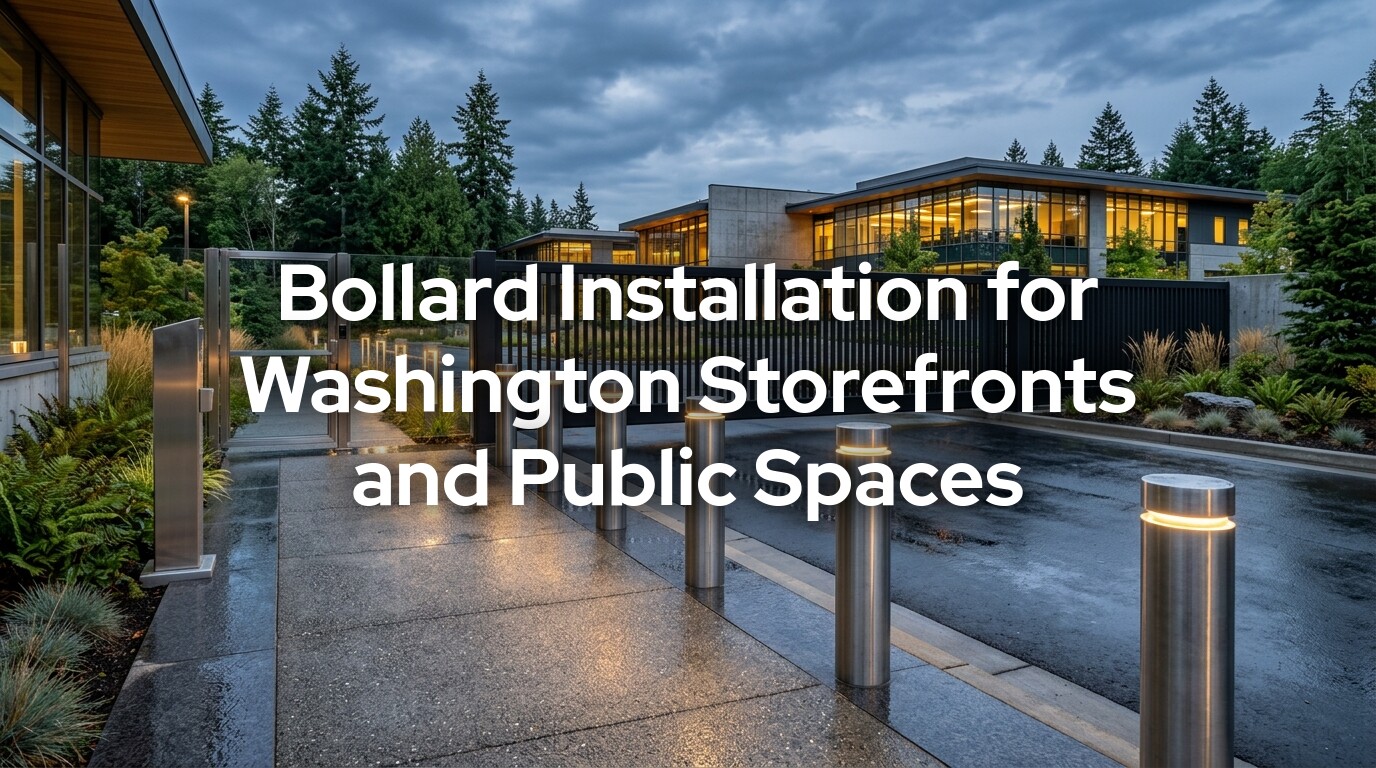
Bollard Installation Washington should begin with a clear question: what are the bollards supposed to control? A decorative post, a fixed traffic-control bollard, a removable access bollard, a powered retractable bollard, and a crash-rated vehicle barrier are different systems with different foundations, approvals, documentation, maintenance, and realistic performance expectations.
Emerald Gate Systems installs fixed, removable, retractable, decorative, and crash-rated bollard systems for storefronts, schools, campuses, municipal spaces, commercial sites, managed properties, public-facing entrances, and vehicle-control areas across Skagit, Whatcom, and Snohomish counties, Whidbey Island, Camano Island, the San Juan Islands, and the greater Puget Sound region.
The company is family-owned, licensed and insured, headquartered in Sedro-Woolley, and backed by more than 15 years in the trade. Emerald Gate Systems designs, fabricates, installs, automates, controls, and services entry systems through one accountable Washington team. That matters because bollards often need to coordinate with gates, doors, access control, ADA routes, storefront layouts, utilities, drainage, fire access, and future maintenance.
A bollard is not automatically a crash barrier because it is steel, filled with concrete, or placed in front of a building. Real vehicle-control performance depends on the bollard design, steel, wall thickness, embedment, foundation, reinforcement, spacing, pavement, soil, approach speed, vehicle type, installation method, and whether the complete assembly matches tested or engineered documentation.
This page covers bollard installation in full. For local examples and site conditions, our Mukilteo and Everett pages carry that detail.
What Is Bollard Installation Washington?
Bollard Installation Washington is the planning and installation of posts or barrier systems used to separate vehicles from people, buildings, storefronts, sidewalks, service areas, entrances, equipment, or public spaces. The work may include layout, excavation, foundations, reinforcement, drainage, sleeves, removable hardware, retractable equipment, controls, permits, and documentation.
Bollards are used for many reasons. Some guide traffic. Some protect building corners. Some keep vehicles out of pedestrian zones. Some allow controlled service access. Some are architectural and decorative. Some are engineered or tested for specific vehicle impact conditions.
The first step is not choosing a bollard style. The first step is defining the purpose. A property owner should be able to explain whether the goal is:
- Visual separation
- Parking control
- Storefront protection
- Pedestrian-zone protection
- School or campus vehicle separation
- Municipal plaza protection
- Utility or equipment protection
- Loading-zone control
- Occasional fire-lane or service access
- Restricted vehicle entry
- Crash-rated performance
- Decorative site design
- Access-control integration
Those goals lead to different products and different installation methods. A decorative streetscape bollard may look appropriate near a sidewalk but may not be intended to resist vehicle impact. A removable bollard may provide flexible access but requires a sleeve that drains and remains clean. A powered retractable bollard may solve access control but introduces electrical work, controls, drainage, moving parts, and maintenance.
Bollards should also be planned as part of the full site. Pedestrians, wheelchair users, strollers, delivery carts, bicycles, emergency responders, snow removal, drainage, underground utilities, storefront glazing, doors, curb ramps, and traffic approach all affect the layout.
When Does a Property Need Bollards?
A property may need bollards when vehicles must be guided, slowed, excluded, separated, or prevented from reaching a building, pedestrian area, utility, gate equipment, storefront, campus entrance, outdoor seating area, or public space. The need may come from daily traffic control, repeated vehicle encroachment, risk assessment, code review, insurance concerns, or site security planning.
Common bollard applications include:
- Protecting storefront glass from parking-lot vehicles
- Separating sidewalks from drive lanes
- Protecting school drop-off zones
- Defining public plazas and pedestrian areas
- Protecting utility meters and mechanical equipment
- Protecting gate operators, keypads, and access pedestals
- Controlling service-lane access
- Allowing removable access for fire lanes or maintenance routes
- Protecting trash enclosures and loading areas
- Guiding vehicles around drive-throughs or tight corners
- Protecting building corners from delivery trucks
- Controlling access to municipal or campus spaces
- Creating a visible boundary near outdoor seating
- Supporting higher-security vehicle mitigation plans
Not every vehicle-control problem requires crash-rated bollards. Some sites need better layout, signage, curbs, wheel stops, lighting, striping, gates, access control, or landscaping in addition to or instead of bollards.
The strongest bollard plan begins with the movement problem. Are vehicles accidentally jumping a curb? Are delivery trucks clipping a corner? Are drivers using a pedestrian path as a shortcut? Is there a realistic vehicle-impact threat? Does the site need to document rated protection for an owner, municipality, school, insurer, or security consultant?
The answer affects the product, spacing, foundation, permit path, and documentation.
Request a free bollard review when a storefront, school, municipal area, or commercial site needs vehicle-control options compared before excavation begins.
Which Type of Bollard Does a Property Need?
The right bollard depends on whether the goal is visual separation, parking control, storefront protection, removable vehicle access, automated restriction, or documented crash performance. Fixed, removable, retractable, decorative, and crash-rated bollards are different systems, not interchangeable names for the same post.
| Bollard type | Best fit | Main advantage | Main limitation |
|---|---|---|---|
| Fixed bollard | Permanent vehicle separation, storefront protection, building corners, equipment protection | Simple, durable, and always in place | Does not allow vehicle access through the protected line |
| Removable bollard | Occasional service access, fire lanes, events, seasonal access, restricted driveways | Allows authorized temporary vehicle passage | Sleeves need drainage, cleaning, and maintenance |
| Retractable bollard | Frequent controlled access, campuses, secure lanes, municipal zones | Can open and close the vehicle path without removing a post | Requires deeper foundations, drainage, mechanical service, and controls |
| Decorative bollard | Streetscapes, storefronts, plazas, pedestrian guidance, architectural site design | Improves appearance and visual boundary control | Should not be described as crash-rated unless tested or engineered for that purpose |
| Crash-rated bollard | Defined vehicle-impact mitigation where documentation is required | Tested or engineered for specific impact conditions | Performance depends on the complete assembly and installation |
The appearance of a bollard does not prove its function. Two bollards may look similar above ground while having completely different underground construction. One may be a decorative sleeve over a shallow post. Another may be part of a reinforced foundation designed around documented vehicle-impact conditions.
Spacing also changes function. Bollards must be close enough to restrict the intended vehicle, but not so close that they block people, wheelchairs, strollers, carts, emergency movement, or required accessible routes.
Site conditions can override the first product choice. Underground utilities, shallow foundations, existing slabs, drainage, frost, tree roots, sidewalks, curb ramps, storefront doors, traffic direction, and pedestrian flow may all change the layout.
What Are Fixed Bollards?
Fixed bollards are permanently installed posts used for building protection, pedestrian separation, storefront vehicle control, utility protection, and site organization. They are often the simplest bollard type because they do not move or require routine removal, but their protective capability depends on design, foundation, spacing, and installation.
Fixed bollards can be useful for:
- Storefronts near parking stalls
- Building corners struck by delivery vehicles
- Pedestrian plazas
- School walkways
- Municipal sidewalks
- Utility meters and mechanical units
- Trash enclosures
- Gate operator and keypad protection
- Retail service yards
- Loading zones
- Outdoor seating areas
The advantage of a fixed bollard is reliability. It is always in place. No one has to unlock it, lower it, store it, or remember to put it back after a service vehicle leaves.
The limitation is access. A fixed bollard permanently blocks a vehicle path. If fire access, maintenance access, snow removal, deliveries, or event setup must pass through the line, a removable or retractable solution may be better.
Fixed bollards are not automatically crash-rated. A surface-mounted decorative post, a shallow embedded post, and a tested crash-rated system are not equivalent. The underground work matters as much as the visible post.
Washington site conditions also matter. Saturated soil, drainage, existing concrete, utilities, coastal corrosion, and snow storage can affect foundation design and long-term durability.
After identifying whether the protected line must stay closed permanently, ask Emerald Gate Systems whether fixed bollards or a controlled-access alternative fits the site better.
What Are Removable Bollards?
Removable bollards are posts that can be taken out of a sleeve or receiver to allow occasional authorized vehicle access. They are useful where the site normally needs a barrier but sometimes needs fire access, maintenance access, event setup, seasonal service, loading, or utility access.
Removable bollards may fit:
- Fire lanes that must remain clear but accessible
- Service roads
- Maintenance yards
- School or campus service areas
- Municipal event spaces
- Seasonal pedestrian zones
- Outdoor seating areas that need occasional setup access
- Utility access paths
- Restricted driveways
- Private roads with controlled service entry
The main advantage is flexibility. The site can remain protected during normal use and open when authorized vehicles need to pass.
The trade-off is maintenance and procedure. The receiving sleeve must stay clean, drained, and usable. Dirt, gravel, water, ice, salt, and corrosion can make a removable bollard difficult to remove or reinstall. Someone also needs to control the key, lock, storage location, and procedure.
A removable bollard that is left out after a delivery or event no longer controls the vehicle path. Properties should decide who removes it, who replaces it, and how that responsibility is documented.
Removable bollards can also create trip or accessibility concerns if sleeves, covers, or changes in level are not handled correctly. The surface condition should be safe when the bollard is installed and when it is removed.
For public spaces and commercial sites, the removable hardware should be selected for real use. A heavy post that employees cannot lift safely or a lock that corrodes after one winter will not support the intended access plan.
What Are Retractable Bollards?
Retractable bollards lower into the ground or move out of the vehicle path to provide controlled access without physically removing the post. They may be manually operated, semi-automatic, or powered. Retractable systems are useful where vehicle passage changes frequently or where staff cannot remove and store posts repeatedly.
Retractable bollards may fit:
- Campus vehicle-control points
- Municipal plazas
- Commercial service lanes
- Restricted facility entrances
- Event spaces
- High-use access points
- Security- controlled vehicle lanes
- Loading areas with scheduled access
- Sites where removable bollards are too labor intensive
The benefit is controlled flexibility. A retractable bollard can open the path for authorized vehicles and restore the barrier afterward without removing a post from the site.
The trade-offs are depth, drainage, controls, power, maintenance, and cost. Retractable bollards usually require more excavation than fixed or removable bollards. The receiver or cassette must handle water, debris, and mechanical movement. Powered systems may require electrical permits, control wiring, safety devices, and access-control integration.
Drainage is one of the most important design issues in Western Washington. A retractable bollard pit that fills with water, mud, or leaves will not remain reliable. The site should be reviewed for groundwater, stormwater, slope, surrounding pavement, and maintenance access before the product is selected.
Manual retractable systems still need real-world testing. If staff cannot raise, lower, lock, or reset the bollard safely and consistently, the system will not be used as intended.
Powered retractable bollards should be treated like other controlled entry systems. They need a power plan, control plan, emergency plan, maintenance plan, and clear user responsibility.
For powered retractable bollards, review access control systems for gates and doors so credentials, controls, safety, and outage behavior are planned together.
What Are Crash-Rated Bollards?
Crash-rated bollards are bollards or vehicle barriers that have been tested or engineered for defined vehicle-impact conditions. The rating applies to a specific product, foundation, spacing, installation method, vehicle condition, and penetration performance. A decorative steel post should not be described as crash-rated without supporting documentation.
Crash-rated bollards may be considered for:
- High-risk storefronts
- Schools and campuses
- Municipal buildings
- Courthouses and public facilities
- Critical utility areas
- High-value commercial sites
- Pedestrian plazas near traffic
- Sites with a documented vehicle threat
- Facilities requiring security consultant review
- Projects with insurer or owner documentation requirements
ASTM F3016 and ASTM F2656 are two common testing references used in vehicle protective device and perimeter barrier discussions. The correct standard and rating depend on the project, vehicle threat, approach speed, owner requirements, and authority or consultant involved.
A crash rating does not automatically transfer to every installation. The complete assembly matters. That includes the bollard, foundation, reinforcement, concrete, spacing, soil, pavement, drainage, embedment, and installation quality.
Approach geometry also matters. A vehicle that can accelerate directly toward a protected line creates a different problem from a vehicle maneuvering slowly in a parking stall. Curbs, islands, parking layout, driveway alignment, and approach distance affect the realistic threat.
Crash-rated systems may require engineering review, submittals, special inspection, owner approval, municipal review, or project documentation. The proposal should identify who is responsible for those items.
Use the term crash-rated carefully. If the bollard is decorative, traffic-guiding, or non-rated, call it that. Overstating performance creates risk for the property owner, designer, contractor, and installer.
Why Decorative Bollards Are Not the Same as Crash-Rated Bollards
Decorative bollards are designed primarily for appearance, wayfinding, pedestrian guidance, or light traffic organization. Crash-rated bollards are designed and documented for defined vehicle-impact conditions. A decorative bollard can be helpful and appropriate, but it should not be sold or described as crash protection unless the product and installation support that claim.
Decorative bollards may be used to:
- Frame a walkway
- Match a streetscape
- Guide pedestrians
- Discourage casual vehicle encroachment
- Protect landscaping from parking mistakes
- Separate outdoor seating from circulation areas
- Create a visual boundary near a storefront
- Coordinate with lighting or signage
The problem begins when appearance is confused with performance. A post can look solid but have a shallow foundation. A sleeve can look strong but not be reinforced. A cover can make a non-rated post look like a security device.
Crash-rated performance must be supported by documentation and installed according to the requirements of the tested or engineered assembly. The foundation is not a minor detail. It is often the reason the system performs as intended.
Decorative bollards still need careful layout. They can create obstacles, narrow an accessible route, interfere with carts and strollers, create tripping hazards, or block emergency access if placed without a site plan.
The right approach is to state the intended purpose clearly. If the property needs visual separation, use decorative or architectural language. If it needs documented vehicle impact resistance, define the vehicle threat and required performance before choosing the product.
When a site needs documented vehicle-impact performance, ask for the bollard product data, rating basis, foundation requirements, spacing, and installation documentation before approving the proposal.
How Do Bollards Protect Storefronts?
Bollards protect storefronts by creating a physical or visual line between vehicle movement and vulnerable building areas such as glass, doors, outdoor seating, pedestrian paths, utilities, and checkout or lobby zones. The correct design depends on parking orientation, curb height, vehicle approach, storefront layout, and required performance.
Storefront bollards are often considered when parking stalls face the building. A vehicle in a forward parking space, angled space, drive aisle, or delivery lane can strike glazing, columns, entries, outdoor seating, or utility areas if the layout provides little separation.
Storefront planning should review:
- Parking stall orientation
- Drive aisle direction
- Curb height and condition
- Distance from curb to storefront
- Pedestrian route width
- Door swing and entry clearance
- Outdoor seating or merchandise areas
- Utility meters and gas equipment
- Snow storage or landscape areas
- Vehicle overhang
- Drainage toward the building
- Underground utilities
- Foundation and slab conditions
- Whether crash-rated performance is required
Bollards can be placed near storefronts, but they should not make the sidewalk unusable. Customers need to move through the area with wheelchairs, strollers, carts, walkers, mobility aids, and deliveries. A bollard line that protects glass while blocking the accessible route is not a successful design.
Decorative sleeves can help the bollards match the storefront. They should not be used to imply performance that the core post and foundation do not provide.
Storefront work may also require coordination with property owners, tenants, franchise standards, insurers, local permits, utility locating, and accessibility review.
How Do Bollards Protect Schools, Campuses, and Public Entries?
Bollards protect schools, campuses, and public entries by separating vehicle areas from walking routes, queues, play areas, drop-off zones, entry plazas, bike areas, outdoor gathering spaces, and building approaches. The design should support safety, circulation, emergency access, accessibility, maintenance, and daily school or campus operations.
School and campus bollard planning may include:
- Drop-off and pickup queues
- Bus circulation
- Emergency vehicle access
- Accessible routes
- Student walking paths
- Outdoor gathering areas
- Service and delivery access
- After-hours events
- Snow removal and maintenance
- Visitor entrances
- Building entries
- Existing gates or access-control systems
School and campus sites are different from storefronts. They often have changing traffic patterns by time of day, large pedestrian surges, buses, parents, staff, service vehicles, and emergency routes. A bollard layout must protect people without creating confusion or blocking necessary movement.
Crash-rated bollards may be appropriate on some higher-risk projects, but not every campus bollard needs a crash rating. The owner, design professional, security consultant, insurer, or authority may define the required performance.
Coordination with accessible routes is essential. Bollards should not create narrow choke points, hidden obstacles, or difficult navigation patterns for people using wheelchairs, walkers, canes, strollers, or carts.
Maintenance staff should also be included. A layout that blocks snow removal, groundskeeping, fire access, or service deliveries may be defeated or removed after installation.
For school, campus, or public-entry projects, coordinate bollards with accessible routes, fire access, delivery paths, gates, doors, and long-term maintenance before the layout is finalized.
How Do Bollards Fit Municipal and Public Spaces?
Bollards fit municipal and public spaces by defining pedestrian areas, controlling vehicle access, protecting plazas, guiding event traffic, supporting streetscape design, and restricting vehicles from sidewalks, parks, civic entries, or public gathering zones. Public-space bollards must balance protection, accessibility, aesthetics, maintenance, emergency response, and service access.
Municipal and public-space bollards may be used for:
- Sidewalk extensions
- Pedestrian plazas
- Public buildings
- Event streets
- Parks and trails
- Transit stops
- Civic entries
- Outdoor markets
- Utility protection
- Bike and pedestrian separation
- Restricted vehicle routes
- Maintenance and emergency access points
Public spaces create more user types than a private site. People may be walking, rolling, biking, pushing strollers, carrying items, using mobility aids, managing children, unloading equipment, or navigating in low light.
That means spacing and contrast matter. Bollards should be visible, consistent, and positioned so people understand the intended route. In some cases, decorative finishes, reflective bands, lighting, or contrasting colors may be appropriate.
Municipal projects may require design review, right-of-way permits, utility coordination, traffic control, engineered drawings, procurement procedures, and documentation. The proposal should identify what Emerald Gate Systems provides and what must be supplied by the owner, engineer, municipality, or general contractor.
Removable and retractable bollards can be useful for public spaces that change during events. The maintenance procedure is just as important as the hardware. A removable post that is never replaced after an event leaves the site unprotected.
Public work should also account for vandalism, corrosion, plow damage, debris, and the cost of future replacement.
How Do Bollards Fit Commercial Gates and Access Control?
Bollards often work with commercial gates and access control by protecting readers, intercoms, gate operators, equipment, storefronts, service yards, employee entrances, delivery areas, and pedestrian routes. They can prevent vehicles from striking the very equipment that controls the entrance.
Bollards may protect:
- Gate operators
- Keypad pedestals
- Card readers
- Video intercom stations
- Phone entry stations
- Camera poles
- Electrical cabinets
- Utility meters
- Door-control equipment
- Building corners
- Loading docks
- Roll-up doors
- Pedestrian gates
Commercial gate lanes are busy places. Trucks, trailers, delivery vans, employees, visitors, vendors, and maintenance vehicles may all use the same entrance. A reader pedestal placed without protection can be struck during normal turns.
Bollards should be placed so they protect equipment without blocking the driver’s reach or vehicle path. A bollard too close to a reader may prevent the driver from reaching the credential device. A bollard too far away may fail to protect the pedestal.
Access-controlled retractable bollards introduce another layer. They may use keypads, cards, fobs, intercoms, vehicle loops, cameras, schedules, and emergency override. That system should be designed like any other controlled entry system, with power, controls, safety, maintenance, and emergency procedure included.
Review commercial gate installation when bollards need to coordinate with high-cycle gates, vehicle loops, badge entry, phone entry, cameras, and managed access.
When bollards are protecting gate equipment, ask Emerald Gate Systems to review vehicle turning paths, reader reach, operator access, and future service clearance at the same time.
Security Bollards in Mukilteo
Security bollards in Mukilteo should be handled as a local section on the Mukilteo post and linked back to this bollard service page. Mukilteo properties may involve waterfront exposure, compact commercial sites, schools, pedestrian areas, storefronts, apartments, marina-related traffic, slope, salt air, and tight vehicle approaches.
Mukilteo bollard planning may include:
- Storefront protection
- Pedestrian route separation
- Waterfront and marina-area traffic
- Parking-lot vehicle control
- School or public-entry protection
- Commercial reader or intercom protection
- Salt-air material planning
- Accessible route preservation
- Emergency and service access
- Drainage and corrosion review
Coastal conditions matter. Salt air can affect fasteners, decorative sleeves, locks, removable sleeves, retractable components, and exposed steel. A bollard that looks strong at installation still needs a corrosion plan and maintenance access.
Mukilteo also has constrained sites where the sidewalk, road, parking, storefront, and pedestrian movement may be close together. The bollard line should not solve vehicle control by creating an accessibility or circulation problem.
Local content should avoid becoming a separate thin service page. The Mukilteo page should explain local conditions, then route the buyer here for full bollard types, foundation, crash-rating, accessibility, and installation guidance.
Security Bollards in Everett
Security bollards in Everett should become a section on the Everett location page and link back to this bollard installation service page. Everett properties may involve commercial facilities, apartments, warehouses, storefronts, schools, municipal sites, delivery lanes, managed access, compact lots, and higher traffic.
Everett bollard planning may include:
- Warehouse and facility protection
- Storefront and glass protection
- Apartment and managed-property entrances
- School and campus access points
- Municipal sidewalks and public entries
- Loading and service lanes
- Gate operator and access pedestal protection
- Vehicle loop and reader placement
- Pedestrian circulation
- Emergency vehicle access
- Crash-rated performance where required
Everett commercial sites may have more delivery traffic, shift traffic, and pedestrian interaction than rural or low-cycle properties. That changes the layout. A bollard line near a loading zone should account for truck sweep, trailer angle, and repeated service movement.
Apartment and managed properties should also consider resident behavior. Bollards that protect an entry point should not force residents, guests, or delivery drivers into awkward movement patterns.
Like Mukilteo, Everett should not receive a standalone security-bollard service URL. The city page should carry local search relevance, while this service page carries the full technical and conversion intent.
What Should a Bollard Site Review Include?
A bollard site review should define the vehicle-control purpose, vehicle approach, pedestrian movement, accessible routes, required access, underground utilities, foundations, drainage, paving, slope, doors, storefront glazing, emergency access, permits, crash-rating needs, controls, and maintenance procedure. The review should happen before product selection.
- Define the problem. Identify whether the issue is parking control, storefront protection, pedestrian separation, equipment protection, restricted access, or crash-rated mitigation.
- Identify vehicle types. Include cars, pickups, delivery vans, box trucks, emergency vehicles, buses, forklifts, trailers, and maintenance equipment where relevant.
- Review approach geometry. Look at drive aisles, parking angles, slopes, curb cuts, sight lines, vehicle speed, and potential acceleration paths.
- Map pedestrian flow. Confirm sidewalks, doorways, accessible routes, crosswalks, waiting areas, outdoor seating, carts, strollers, and wheelchairs.
- Locate underground utilities. Confirm gas, electrical, communications, water, sewer, irrigation, drainage, and structural conflicts before excavation.
- Check pavement and foundations. Review slab thickness, asphalt, concrete, soil, curbs, building foundations, and whether reinforcement is required.
- Plan drainage. Determine where water will collect around fixed, removable, or retractable bollards.
- Choose access type. Decide whether the line should remain fixed, be removable, retract manually, or operate through powered controls.
- Define rating requirements. If crash-rated performance is needed, identify the required standard, product data, foundation, and documentation.
- Review accessibility. Confirm clear width, protruding-object issues, cane detection, route continuity, and avoiding obstacle patterns.
- Confirm permits and approvals. Identify owner, city, right-of-way, electrical, fire, school, municipal, or property-management requirements.
- Plan maintenance. Determine who cleans sleeves, checks locks, tests retractable units, maintains finish, and replaces damaged posts.
A good site review may recommend fewer bollards than expected, more bollards than expected, a different line, a gate instead of bollards, or a combination of bollards and access control.
It may also identify that the project needs an engineer, civil review, traffic review, owner approval, or municipal coordination before installation can be priced accurately.
Call (360) 657-9975 to schedule a bollard site review that evaluates vehicle approach, access needs, foundations, drainage, accessibility, and documentation before installation.
How Do Foundations, Drainage, and Utilities Affect Bollards?
Foundations, drainage, and utilities affect bollards because the visible post is only one part of the installation. The underground work determines whether the bollard stays upright, resists the intended force, drains properly, avoids damaging utilities, and remains serviceable through Washington rain, freeze events, corrosion, and pavement movement.
Foundation planning may need to account for:
- Soil type
- Existing concrete slab
- Asphalt thickness
- Subgrade condition
- Building foundations
- Curbs and sidewalks
- Utility conflicts
- Reinforcement
- Embedment depth
- Concrete dimensions
- Spacing
- Surface restoration
- Vehicle approach
- Required performance documentation
Drainage matters for every bollard type, but especially removable and retractable systems. Sleeves can fill with water, dirt, gravel, leaves, and ice. Retractable units may require deeper pits that need serious drainage planning.
Utility locating is not optional. Bollard lines are often installed near buildings, sidewalks, parking lots, storefronts, landscaping, and access points where utilities are common. Excavation can conflict with electrical lines, gas, communications, water, irrigation, storm drains, sewer laterals, building footings, and sign wiring.
Washington soil and moisture also matter. Wet or disturbed soil may not support the foundation assumptions used for another site. A bollard near a waterfront, sloped parking lot, or old downtown sidewalk may require added review.
A surface-mounted bollard can be appropriate for visual guidance or light-duty site control, but it should not be sold as equivalent to an embedded or crash-rated system unless documentation supports the claim.
How Should Bollards Preserve Accessible Routes?
Bollards should preserve accessible routes by maintaining required clear width, avoiding protruding-object hazards, supporting cane detection, leaving door and curb-ramp access usable, and avoiding obstacle patterns that make a sidewalk or plaza difficult to navigate. Vehicle control should not create a pedestrian access problem.
The U.S. Access Board explains that protruding-object requirements apply to circulation paths, including exterior circulation paths. Bollards, signs, covers, sleeves, chains, rails, and decorative elements should be reviewed with those rules in mind.
Accessible-route planning should consider:
- Minimum clear walking width
- Wheelchair and mobility-device movement
- Strollers and carts
- Door approach and door swing
- Curb ramps
- Crosswalk connections
- Outdoor seating
- Queueing lines
- Trip hazards
- Detectability for cane users
- Color contrast and visibility
- Snow storage
- Maintenance equipment
Spacing must balance vehicle restriction and pedestrian movement. Bollards spaced too far apart may allow the vehicle movement the owner wants to prevent. Bollards spaced too tightly may create a barrier for people, carts, wheelchairs, strollers, or emergency movement.
Chains between bollards can create additional hazards if they are difficult to detect, block circulation, or sag into a walking path. Decorative elements should not be added without considering the route.
For public-facing buildings, schools, campuses, municipal areas, and commercial properties, accessibility review should occur before layout approval. Moving installed bollards after concrete work is much more expensive than adjusting a plan.
For pedestrian entrances, controlled doors, and accessible routes, coordinate bollard work with ADA entry and door automation before the site layout is finalized.
How Should Bollard Spacing Be Planned?
Bollard spacing should be planned around the smallest vehicle or path that must be restricted and the people, wheelchairs, carts, emergency responders, and service equipment that must still move through the area. Spacing is not a decoration decision. It affects performance, access, circulation, and code review.
Spacing decisions depend on:
- Vehicle type to be restricted
- Approach angle
- Vehicle speed
- Crash-rating or engineering requirements
- Pedestrian route width
- Accessible route requirements
- Doorway locations
- Curb ramps
- Outdoor seating
- Shopping carts
- Strollers
- Maintenance access
- Snow removal
- Emergency access
- Removable or retractable sections
Crash-rated systems may have specific spacing requirements in their tested or engineered documentation. Changing spacing can change performance. The installer should not improvise spacing for appearance when a documented barrier system is required.
For non-rated bollards, spacing should still be intentional. A line may guide drivers visually without fully stopping a small vehicle. That may be acceptable if the goal is wayfinding, but it is not acceptable if the owner expects physical vehicle restriction.
Openings in the bollard line should be deliberate. If service vehicles need occasional passage, a removable or retractable bollard may be better than leaving a wide gap that undermines the layout.
Where bollards are near storefronts, the layout should consider vehicle overhang. A car can extend beyond the face of a curb or wheel stop. The bollard line should protect the real vulnerable point, not just align with the pavement edge.
Which Permits and Approvals May Apply to Bollard Installation?
Bollard installation may require owner approval, right-of-way permits, building permits, electrical permits, utility locating, traffic control, fire access review, accessibility review, school or municipal approval, engineering documentation, or property-management approval. Requirements depend on the address, property type, location, bollard type, and whether powered or crash-rated systems are involved.
Electrical permits may apply when bollards are powered, retractable, illuminated, access-controlled, connected to a gate system, or tied into controls. Washington L&I handles many electrical permits, while certain cities operate their own electrical inspection programs.
Right-of-way work may involve city, county, or state review if bollards are installed on or near sidewalks, public streets, public plazas, curb ramps, or municipal property.
Fire access review may be required when bollards restrict a drive aisle, fire lane, service road, building approach, gate, or emergency route. Removable or retractable bollards may need an approved operating method.
Crash-rated bollard projects may require engineered drawings, product submittals, tested-system documentation, special inspection, or owner security-consultant approval. The proposal should identify who provides those documents.
Accessibility review may be required when bollards affect sidewalks, public entries, school paths, municipal areas, or routes used by employees, customers, residents, students, or visitors.
HOA, landlord, franchise, school district, municipal, or campus approval may be separate from government permits. A tenant should not assume the right to install bollards without property-owner approval.
Confirm approvals before excavation. A bollard line can affect utilities, accessible routes, fire access, storefront operations, and public right-of-way conditions.
How Do Powered Bollards Connect to Access Control?
Powered bollards connect to access control through controllers, keypads, card readers, fobs, intercoms, vehicle loops, cameras, schedules, emergency overrides, and power systems. They should be planned like controlled entry equipment because they move, restrict vehicles, require safe operation, and depend on reliable power and maintenance.
Powered or retractable bollard systems may include:
- Control panels
- Electric or hydraulic operators
- Manual release
- Key switches
- Keypads
- Card or fob readers
- Remote controls
- Vehicle loops
- Presence sensors
- Warning lights
- Audible alerts
- Emergency stop controls
- Fire or emergency override
- Battery backup where appropriate
- Drainage and pit maintenance
The access method should fit the site. A municipal service entrance may need staff credentials and manual emergency override. A campus entrance may need scheduled access and security control. A commercial site may need vendor entry and event-based operation.
Vehicle loops and sensors may be needed to reduce the chance of a bollard rising under a vehicle. The appropriate protection depends on the system and the manufacturer requirements.
Power-loss behavior should be defined. Does the bollard stay up, lower, remain locked, or require manual operation? The correct answer depends on security needs, emergency access, property operations, and the system type.
Connected controls also require administration. Someone must manage credentials, schedules, keys, emergency procedures, passwords, software, and service contacts.
Review access control systems when a bollard system needs keypads, credentials, intercoms, cameras, schedules, or emergency override.
How Do Washington Weather and Site Conditions Affect Bollards?
Washington weather and site conditions affect bollards through rain, standing water, saturated soil, corrosion, salt air, snow, ice, leaf litter, fir needles, storm drainage, pavement movement, and winter maintenance. These conditions affect foundations, sleeves, locks, retractable mechanisms, finishes, controls, and long-term serviceability.
Rain and standing water
Water can collect around fixed bollards, inside removable sleeves, and in retractable bollard pits. Drainage should be planned before installation. A sleeve full of water and gravel can become unusable after repeated freeze, dirt, and corrosion cycles.
Wet soil and pavement movement
Bollard foundations depend on stable support. Wet fill, disturbed soil, old asphalt, thin slabs, and patched sidewalks may not support the same assumptions as new engineered concrete.
Coastal salt
Coastal properties near Anacortes, Whidbey Island, Camano Island, Mukilteo, Everett waterfront areas, and the San Juan Islands need corrosion planning. Salt can affect exposed steel, decorative sleeves, fasteners, locks, removable sockets, retractable mechanisms, and damaged coatings.
Leaves, fir needles, and debris
Debris can collect in sleeves, drains, retractable housings, and around bollard bases. This is especially important for wooded sites, schools, campuses, parks, and public spaces with seasonal leaf fall.
Snow and ice
Snow storage and plow paths should be planned. Bollards can be damaged by plows, hidden by snow, or surrounded by packed ice. Removable and retractable systems can become difficult to operate when sleeves or pits freeze or fill with debris.
Maintenance should match exposure. A decorative fixed bollard in a protected entry may need simple inspection and finish care. A retractable coastal bollard in a public space may require frequent cleaning, drainage checks, lock service, and operational testing.
Ask Emerald Gate Systems to review drainage, corrosion, debris, snow storage, and maintenance access before selecting bollard type or finish.
What Does Bollard Installation Cost?
Bollard installation cost depends on bollard type, quantity, spacing, product rating, foundation design, excavation, reinforcement, concrete, drainage, utilities, electrical work, access controls, permits, surface restoration, traffic control, engineering, documentation, travel, and site conditions. Emerald Gate Systems does not publish one universal bollard price because scopes vary widely.
A basic decorative fixed bollard and a powered crash-rated retractable bollard are not comparable installations. One may involve shallow site work and architectural finish. The other may require deep foundations, electrical permits, controls, drainage, tested product documentation, engineering review, and ongoing service.
Cost drivers include:
- Number of bollards
- Fixed, removable, retractable, decorative, or crash-rated type
- Product material and finish
- Crash-rating or engineering documentation
- Foundation depth and reinforcement
- Existing concrete or asphalt removal
- Utility locating and conflict resolution
- Drainage requirements
- Removable sleeves or covers
- Powered mechanisms
- Control wiring and access devices
- Electrical permits
- Right-of-way or municipal approvals
- Traffic control
- Surface restoration
- Special inspections
- Travel, ferry, or staging requirements
- Maintenance plan
Responsible simplification is possible. A property may not need crash-rated bollards if the goal is visual guidance. A fixed bollard may be better than a powered system if access is not required. A removable section may avoid unnecessary automation where access is infrequent.
Cost should not be reduced by mislabeling decorative bollards as security barriers, ignoring utilities, skipping drainage, narrowing accessible routes, or changing the foundation of a rated system without review.
The proposal should make the purpose clear. If the owner expects vehicle-impact performance, the quote should identify the rating basis and installation requirements. If the purpose is decorative separation, the quote should say that clearly.
How Long Does Bollard Installation Take?
Bollard installation timing depends on site review, product selection, utility locating, permits, engineering, foundation work, concrete cure, electrical controls, surface restoration, weather, traffic control, and owner or municipal approval. A simple fixed bollard project can move faster than a powered, crash-rated, public-space, or right-of-way installation.
The process may include:
- Initial site review
- Vehicle and pedestrian movement review
- Product selection
- Layout and spacing approval
- Utility locating
- Permit or right-of-way review
- Engineering or product submittals where required
- Traffic control planning
- Concrete or asphalt removal
- Excavation
- Foundation installation
- Drainage work
- Electrical or control installation where included
- Bollard setting
- Surface restoration
- Operational testing
- Owner training and documentation
Weather can affect excavation, concrete, coatings, surface repair, and traffic control. Public sites may require more scheduling coordination than private commercial property.
Utility conflicts can also delay the work. A bollard line drawn on a site plan may need to shift after locating gas, electrical, water, communication, or drainage lines.
Powered retractable systems need extra coordination. The bollard, control panel, conduit, power, drainage, access devices, loops, and emergency controls must work as one system.
Request a written bollard sequence so the proposal separates product lead time, utility locating, permits, excavation, concrete, controls, and surface restoration.
What Maintenance Do Bollards Need?
Bollards need maintenance based on type, finish, exposure, traffic, and whether they move. Fixed bollards need inspection for impact, corrosion, loose covers, coating damage, and concrete condition. Removable bollards need sleeve cleaning and lock service. Retractable bollards need drainage, mechanical, electrical, and control testing.
Maintenance may include:
- Inspecting for vehicle impact
- Checking alignment
- Cleaning sleeves
- Removing dirt, gravel, leaves, and ice
- Checking drainage
- Lubricating approved moving parts
- Testing locks and keys
- Checking decorative covers
- Inspecting coatings and corrosion
- Testing retractable operation
- Checking powered controls
- Testing access devices
- Confirming emergency override
- Inspecting surrounding concrete or asphalt
- Replacing damaged posts or sleeves
Removable bollards should be tested before the moment they are needed. A post that has not been removed in two years may be stuck when a service vehicle, fire route, or event setup requires access.
Retractable bollards should be tested more often because they rely on moving parts, controls, power, drainage, and user procedures. Public and commercial sites should document who performs those checks.
Coastal and winter-exposed bollards need special attention. Salt, water, freeze, sand, gravel, and deicing residue can shorten the life of locks, sleeves, coatings, and mechanisms.
Damaged crash-rated bollards should not be assumed to retain their documented performance after impact. The product, foundation, and surrounding surface may require inspection or replacement.
Review gate repair and maintenance when bollards are part of a larger gate, access-control, commercial entry, or controlled-site maintenance plan.
What Happens During the Bollard Installation Process?
The bollard installation process moves from site review and purpose definition through layout, utility locating, approvals, excavation, foundation work, bollard setting, drainage, surface restoration, controls where required, testing, and handoff. The exact sequence depends on bollard type and site conditions.
- Define purpose. Confirm whether the bollards are decorative, access-control, vehicle-restriction, storefront-protection, municipal, school, or crash-rated systems.
- Review site movement. Study vehicles, pedestrians, doors, accessible routes, parking, delivery lanes, and emergency access.
- Select bollard type. Compare fixed, removable, retractable, decorative, and crash-rated options.
- Lay out spacing. Mark the line, openings, pedestrian paths, vehicle approaches, and required access points.
- Locate utilities. Confirm gas, electric, communication, water, sewer, irrigation, and drainage conflicts.
- Confirm approvals. Identify owner, city, right-of-way, electrical, school, municipal, HOA, or engineering review.
- Prepare the surface. Cut or remove concrete, asphalt, pavers, or landscaping as required.
- Excavate foundations. Dig to the required depth and dimensions for the specified bollard system.
- Install reinforcement and sleeves. Place reinforcement, receivers, drainage details, or retractable housings where specified.
- Set bollards. Install posts, sleeves, covers, hardware, or retractable assemblies according to the scope.
- Install controls where included. Add power, conduit, keypads, readers, loops, switches, panels, or access-control equipment.
- Restore surfaces. Repair concrete, asphalt, pavers, landscaping, striping, or protective finishes.
- Test operation. Confirm removable, retractable, powered, access-controlled, or emergency functions where included.
- Document the system. Provide product information, keys, procedures, maintenance notes, and rating documentation where applicable.
The installation should be checked after the site is restored. Finished concrete or asphalt should not create trip hazards, drainage traps, or accessible-route conflicts.
For complex public, school, municipal, or crash-rated projects, confirm documentation requirements before ordering materials or scheduling excavation.
What Common Bollard Installation Mistakes Should Be Avoided?
Common bollard installation mistakes include choosing appearance before purpose, calling non- rated posts crash-rated, ignoring underground utilities, blocking accessible routes, using poor drainage, installing removable sleeves that cannot be cleaned, placing bollards where snowplows hit them, and failing to assign maintenance responsibility.
Mistake 1: Choosing a bollard by appearance alone
A decorative post may look appropriate but fail to provide the vehicle restriction the owner expects. The purpose should define the bollard type, not the catalog photo.
Mistake 2: Misusing the term crash-rated
Crash-rated performance requires supporting documentation and proper installation. A steel pipe, decorative sleeve, or concrete-filled post should not be described as crash-rated unless the product and installation support that claim.
Mistake 3: Ignoring accessible routes
Bollards should not protect a building by narrowing or blocking a sidewalk, curb ramp, school path, or building entry. Accessibility and vehicle control must be solved together.
Mistake 4: Forgetting drainage
Removable sleeves and retractable pits can fill with water, gravel, leaves, and ice. Drainage and cleaning access should be part of the design.
Mistake 5: Blocking needed access
Fire lanes, service routes, snow removal, deliveries, utility access, and event setup may require removable or retractable openings. Fixed bollards can create operational problems if access needs are ignored.
Mistake 6: Installing before utility locating
Bollards are often installed near buildings and sidewalks where utilities are common. Excavation without proper locating can damage electrical, gas, communication, water, irrigation, or drainage systems.
Mistake 7: Treating maintenance as optional
Locks, sleeves, covers, coatings, retractable mechanisms, controls, and foundations need inspection. A bollard system that cannot be maintained will eventually stop working as intended.
Why Choose Emerald Gate Systems for Bollard Installation?
Emerald Gate Systems installs bollards as part of complete gate, access-control, entry, and vehicle- control planning. The company can evaluate how bollards interact with gates, storefronts, doors, accessible routes, commercial lanes, access pedestals, cameras, utilities, drainage, foundations, and future service.
The one-team model matters because bollards often solve the same site problems as gates and access control. A commercial property may need a sliding gate, vehicle loops, badge access, bollards protecting reader pedestals, and an ADA pedestrian route. Treating those items as separate purchases can create conflicts in lane geometry, conduit, controls, and circulation.
Emerald Gate Systems is based in Sedro-Woolley, fabricates and installs entry systems across Northwest Washington, and serves properties in Skagit, Whatcom, and Snohomish counties, Whidbey Island, Camano Island, the San Juan Islands, and greater Puget Sound.
The company can evaluate fixed, removable, retractable, decorative, and crash-rated bollard options without pretending they are the same product. That honesty matters. A decorative post may be the right choice for a streetscape. A removable bollard may be right for a fire lane. A crash-rated system may be required when documented performance is part of the project.
Emerald Gate Systems also installs commercial gates, access control, automatic gates, ADA entries, solar gate systems, and repair services. That broader entry-system experience helps when bollards are part of a larger site, not a standalone post order.
No bollard contractor should promise performance without knowing the vehicle risk, approach geometry, product documentation, foundation, spacing, and installation requirements. A free review gives the team a chance to understand the purpose before recommending the type.
Call Emerald Gate Systems at (360) 657-9975 or request a free bollard review for fixed, removable, retractable, decorative, or crash-rated bollard installation in Washington.
Bollards rarely stand alone. When the same entrance also needs controlled vehicle access, commercial gate installation in Washington State covers high-cycle operators and vehicle loops, and access control systems in Northwest Washington explains how credentials and cameras tie the perimeter together.
Frequently Asked Questions About Bollard Installation
What is bollard installation?
Bollard installation is the planning and placement of posts or barrier systems used to control vehicle movement, protect buildings, guide pedestrians, define public spaces, or restrict access. The work may include layout, excavation, foundations, reinforcement, sleeves, drainage, controls, permits, and documentation.
The correct installation depends on the purpose. Decorative, fixed, removable, retractable, and crash-rated bollards have different requirements and should not be treated as the same system.
What type of bollard do I need?
The right bollard depends on the goal. Fixed bollards support permanent separation. Removable bollards allow occasional vehicle access. Retractable bollards provide controlled openings. Decorative bollards improve appearance and guidance. Crash- rated bollards address defined vehicle-impact conditions with supporting documentation.
A site review should define the vehicle risk, access frequency, pedestrian movement, utilities, foundation conditions, drainage, permits, and whether documented performance is required.
What is the difference between fixed and removable bollards?
Fixed bollards remain permanently in place and are best where the vehicle path should stay closed. Removable bollards can be taken out of a sleeve or receiver for occasional authorized access. Removable systems add flexibility but require drainage, cleaning, locks, storage, and a clear procedure.
If the route must open often, a retractable bollard or gate may be more practical than repeated manual removal.
What is a retractable bollard?
A retractable bollard lowers into the ground or moves out of the vehicle path to allow controlled access. It may be manually operated or powered. Retractable systems are useful for campuses, municipal spaces, service lanes, and controlled entries where access changes frequently.
They require careful drainage, foundations, maintenance, controls, and, for powered systems, electrical planning and possible permits.
What is a crash-rated bollard?
A crash-rated bollard is tested or engineered for defined vehicle-impact conditions. The rating applies to a specific product, foundation, spacing, installation method, and penetration performance. A steel or decorative post should not be called crash-rated without supporting documentation.
The complete assembly matters. Changing the foundation, spacing, pavement, or installation method can affect whether the system matches its documented performance.
Are decorative bollards protective?
Decorative bollards can provide visual separation, guide pedestrians, discourage low-speed encroachment, or match a streetscape, but they should not be represented as crash protection unless the product and installation are documented for that purpose. Appearance does not prove impact performance.
A decorative cover can hide a stronger core, but the protective claim must be based on the actual bollard, foundation, and installation, not the cover.
Where are bollards commonly installed?
Bollards are commonly installed near storefronts, schools, campuses, municipal buildings, public plazas, sidewalks, utility areas, loading zones, gate operators, access pedestals, commercial yards, outdoor seating, service roads, and building corners. They can protect people, structures, equipment, and restricted routes.
The layout should be planned around vehicles, pedestrians, doors, accessible routes, emergency access, utilities, and maintenance.
Do storefronts need bollards?
Storefronts may need bollards when parking stalls, drive aisles, delivery routes, or vehicle approaches are close to glass, doors, outdoor seating, utilities, or pedestrian areas. Bollards can create separation, but the required level of protection depends on the vehicle risk and site layout.
Storefront bollards should not block customer movement, accessible routes, carts, strollers, or door approaches.
Do schools and campuses need bollards?
Schools and campuses may use bollards to separate vehicles from students, staff, visitors, drop-off zones, walking routes, public entries, and outdoor gathering areas. The layout should support safety, accessibility, bus circulation, emergency access, maintenance, and daily operations.
Some projects may need crash-rated systems, while others need fixed, removable, or decorative bollards for circulation and control.
Do municipal spaces need bollards?
Municipal spaces may need bollards for sidewalks, plazas, public buildings, event streets, parks, transit areas, civic entries, and restricted vehicle routes. Public-space bollards must balance protection, accessibility, aesthetics, maintenance, service access, emergency response, and right-of-way requirements.
Municipal projects may require permits, utility coordination, traffic control, design review, or engineered documentation.
How much does bollard installation cost?
Bollard installation cost depends on type, quantity, spacing, foundation, excavation, reinforcement, drainage, utilities, crash rating, controls, electrical work, permits, traffic control, engineering, surface restoration, and site conditions. Emerald Gate Systems does not publish one universal bollard price because scopes vary widely.
A decorative fixed bollard and a powered crash-rated retractable system are completely different projects. A responsible proposal starts with the purpose and site conditions.
How long does bollard installation take?
Bollard installation timing depends on site review, product selection, utility locating, permits, engineering, excavation, concrete, drainage, electrical controls, surface restoration, weather, and owner or municipal approval. Simple fixed bollard work may move faster than powered, crash-rated, public-space, or right-of-way projects.
The schedule should separate product lead time, permits, foundation work, concrete cure, controls, and final restoration.
Do bollards require permits?
Bollards may require permits or approvals depending on location, property type, electrical work, right-of-way impact, fire access, accessibility, engineering, or municipal review. Powered retractable bollards may require electrical permits. Public sidewalks and municipal spaces often require additional coordination.
Permit responsibility should be confirmed before excavation, foundation work, conduit, or product ordering begins.
Do powered bollards require electrical permits?
Powered bollards may require electrical permits when they include motors, controllers, access devices, conduit, wiring, communication equipment, or related electrical work. Washington L&I handles many electrical permits, while certain cities operate their own electrical inspection programs.
The project address and scope determine the correct jurisdiction. Permit responsibility should be written into the proposal.
How far apart should bollards be spaced?
Bollard spacing depends on the vehicle being restricted, required pedestrian movement, accessible route width, product documentation, crash-rating requirements, site layout, and whether removable or retractable access is needed. There is no one universal spacing that fits every property.
Crash-rated systems may have specific tested or engineered spacing requirements. Changing those requirements can affect documented performance.
Can bollards block an accessible route?
No. Bollards should not block or narrow an accessible route, create protruding-object hazards, interfere with curb ramps, or make building entries difficult to use. Vehicle protection and pedestrian access must be planned together, especially at storefronts, schools, campuses, municipal spaces, and public-facing buildings.
Spacing, contrast, cane detection, surface restoration, and route continuity should be reviewed before installation.
What foundation does a bollard need?
The required foundation depends on the bollard type, soil, slab, asphalt, vehicle risk, rating documentation, spacing, embedment, reinforcement, drainage, and nearby utilities or building foundations. A surface-mounted decorative post does not have the same foundation needs as a crash-rated bollard.
The visible post is only part of the system. Underground work often determines actual performance.
Can bollards be installed in existing concrete?
Bollards can sometimes be installed in existing concrete, but the slab thickness, reinforcement, condition, subgrade, utilities, drainage, and required performance must be evaluated first. Existing concrete may need cutting, removal, added foundation work, or replacement around the bollard line.
Crash-rated or engineered systems may require specific foundation dimensions that existing concrete does not provide.
Can bollards be installed in asphalt?
Bollards can be installed in asphalt areas, but asphalt alone usually does not provide the same support as a properly designed concrete foundation. The installation may require cutting asphalt, excavating, placing reinforced concrete, setting the bollard, and restoring the surface.
Traffic, drainage, subgrade, utility conflicts, and required performance determine the final method.
How do bollards affect drainage?
Bollards can affect drainage by interrupting pavement, creating low points, or introducing sleeves and pits that collect water. Removable and retractable bollards are especially sensitive because sleeves, locks, and mechanisms can fill with water, dirt, gravel, leaves, or ice.
Drainage should be planned before installation, particularly in Western Washington rain and coastal conditions.
Do bollards need maintenance?
Yes. Bollards need maintenance based on type and exposure. Fixed bollards need inspection for impact, corrosion, coating damage, and concrete condition. Removable bollards need sleeve cleaning and lock service. Retractable bollards need drainage checks, mechanical service, control testing, and emergency-function review.
Coastal, public, school, municipal, and high-traffic sites usually need more frequent inspection.
Can bollards be removed for emergency access?
Some bollards can be removable, retractable, or designed with emergency access procedures, but the method must be approved for the property and use. Fire lanes, service roads, and public spaces may require a specific removable, lockable, or controlled-access approach.
Do not assume a removable bollard is acceptable for emergency access without confirming the local requirement.
Can bollards protect gate operators and access pedestals?
Yes. Bollards can protect gate operators, keypads, intercoms, card readers, phone-entry pedestals, camera poles, electrical cabinets, and control equipment from vehicle impact. Placement should protect the equipment without blocking driver reach, vehicle movement, service access, or the gate path.
This is especially useful for commercial gates, apartment entries, warehouse yards, and managed access lanes.
What is the difference between bollards and gates?
Bollards control or restrict vehicle paths at specific points, while gates open and close a defined entrance. A fixed bollard line may permanently block a path. A gate may control daily entry. Removable or retractable bollards can provide limited or controlled access in ways a gate cannot.
Many commercial sites use bollards and gates together to protect equipment, guide lanes, and manage access.
Can bollards be decorative and functional?
Yes. Bollards can be decorative and functional when the visible design is coordinated with the required post, sleeve, foundation, spacing, and protection goal. Decorative covers or finishes can help the system match storefronts, campuses, municipal spaces, and public entries.
The decorative appearance should never imply crash- rated performance unless the complete system is documented for that purpose.
Where does Emerald Gate Systems install bollards?
Emerald Gate Systems installs bollards across Skagit, Whatcom, and Snohomish counties, Whidbey Island, Camano Island, the San Juan Islands, and the greater Puget Sound region. Projects may include storefronts, schools, campuses, municipal spaces, commercial facilities, public entries, gates, and managed properties.
Scheduling and scope depend on location, approvals, utilities, site access, product type, and whether engineering or documentation is required.
How do I start a bollard installation project?
Start by calling Emerald Gate Systems at (360) 657-9975 or using the contact form to request a free bollard review. Share the property address, vehicle-control problem, desired access, photos, existing plans, utility concerns, crash-rating requirements, and any owner, school, municipal, fire, or accessibility requirements.
You do not need to choose a bollard type before the review. The site purpose should guide the recommendation.
Start With the Vehicle-Control Problem, Then Choose the Bollard
Bollard installation works best when the site team defines the problem before choosing the post. A storefront with vehicles facing glass, a school drop-off area, a municipal plaza, a warehouse reader pedestal, and a waterfront commercial site do not need the same bollard system.
Fixed bollards provide permanent separation. Removable bollards provide occasional access. Retractable bollards support controlled openings. Decorative bollards improve appearance and visual organization. Crash-rated bollards require documented performance and proper installation of the complete assembly.
The right choice depends on vehicle approach, foundation, drainage, utilities, spacing, pedestrian movement, accessible routes, permits, controls, maintenance, and whether the owner needs documentation for defined impact conditions.
Emerald Gate Systems brings bollards into the broader entry-system conversation. The same site may need commercial gates, access control, ADA entries, cameras, vehicle loops, or gate operator protection. Planning those pieces together prevents conflicts in traffic, conduit, controls, accessibility, and service access.
That approach is especially valuable in Washington, where rain, wet soil, coastal salt, snow, debris, public right-of-way conditions, and compact sites can affect both installation and long-term maintenance.
Call Emerald Gate Systems at (360) 657-9975 or schedule a free bollard installation review for fixed, removable, retractable, decorative, or crash-rated bollards in Washington.
Frequently Asked Questions: Bollard Installation in Washington
Do bollards require permits in Washington?
Bollards may require permits depending on location, whether electrical work is involved, right-of-way impact, fire access, or municipal review. Powered retractable bollards often require an electrical permit through Washington L&I. Installations near a public sidewalk or in a right-of-way typically need additional city or county coordination before work begins.
Can bollards protect gate operators and access pedestals?
Yes. Bollards can protect gate operators, keypads, intercoms, card readers, phone-entry pedestals, camera poles, electrical cabinets, and control equipment from vehicle impact. Placement should protect the equipment without blocking driver reach, vehicle movement, service access, or the gate path. This is a common addition when installing or upgrading an automatic gate system.
Do bollards need ongoing maintenance?
Yes. Fixed bollards need periodic inspection for impact damage, corrosion, and concrete condition. Removable bollards need sleeve cleaning and lock service. Retractable bollards require drainage checks, mechanical service, control testing, and emergency-function review. In Northwest Washington, standing water and seasonal debris in sleeves are the most common service issues.
Where does Emerald Gate Systems install bollards?
Emerald Gate Systems installs bollards across Skagit, Whatcom, and Snohomish counties, Whidbey Island, Camano Island, the San Juan Islands, and the greater Puget Sound region. Projects include storefronts, schools, campuses, municipal spaces, commercial facilities, public entries, and managed properties throughout Northwest Washington.