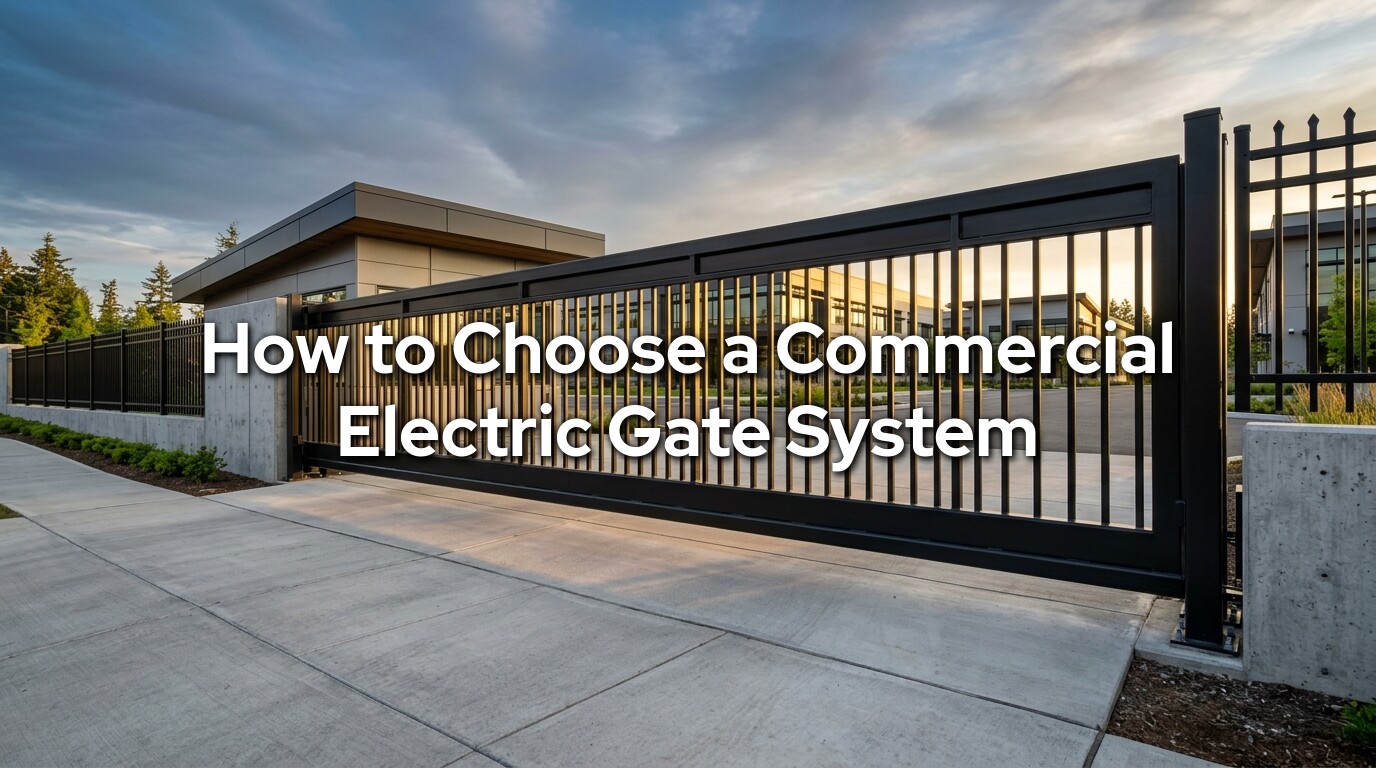
Knowing how to choose a commercial gate starts with a simple realization: a commercial electric gate should do more than open and close on command. It must control vehicles without creating a traffic bottleneck, recognize authorized users, handle visitors and deliveries, protect people near the moving gate, continue operating through expected disruptions, and remain practical to service years after installation.
That is a much larger responsibility than most property owners realize at the beginning of a project.
A gate can look substantial while being poorly matched to daily traffic. A powerful operator can still fail early if the gate drags, the foundations move, or the duty rating does not fit the number of cycles. A sophisticated badge reader adds little value if former employees are never removed from the system. A fast closing time may discourage tailgating but increase the risk of vehicle contact if the detection zones are poorly planned.
Commercial properties in Washington State have another layer of complexity. Rain, wet soil, wind, coastal exposure, leaves, gravel, freezing conditions, and power interruptions all affect gates, operators, wiring, sensors, access-control pedestals, and underground infrastructure. A warehouse entrance in Marysville has different needs from a healthcare property in Bothell, a processing facility near Sedro-Woolley, or a waterfront commercial site in Mukilteo.
The correct system begins with the operation of the property, not with a product catalog.
This guide explains how to compare sliding gates, cantilever gates, swing gates, barrier arms, and specialty systems. It also covers commercial traffic calculations, badge and RFID access, keypads, intercoms, cameras, vehicle detection, operator selection, safety standards, Washington permits, weather protection, installation costs, maintenance, emergency repairs, warranties, and repair versus replacement decisions.
Emerald Gate Systems is positioned around custom gate fabrication, automatic gate installation, access control, security integration, repair, and maintenance for commercial and facilities buyers across retail, office, warehouse, healthcare, corporate, government, agricultural, institutional, and managed-property settings. Our strongest local focus includes Sedro-Woolley, Skagit County, Whatcom County, Snohomish County, island communities, Northwest Washington, and the greater Puget Sound region, with one connected path from gate design and fabrication through automation, access control, safety equipment, and ongoing service.
The goal is not to buy the most elaborate gate. It is to select a complete entrance system that fits the property, supports daily operations, protects users, and can be maintained without unnecessary disruption.
What Is a Commercial Electric Gate System?
A commercial electric gate system is a powered vehicle-control entrance designed for a business, institution, multi-tenant property, industrial site, managed community, or other higher-use location.
The term electric gate usually refers to the powered movement. The term automatic gate describes the larger system that determines when the gate moves, who may activate it, how hazards are detected, and what happens when normal power or communication is unavailable, a distinction covered in our guide to powered gate systems.
The Physical Gate
The gate is the moving barrier. It may slide, swing, fold, lift, pivot, or travel overhead. The frame, infill, welds, hinges, wheels, rollers, guides, posts, and foundations must be designed for the opening, material, wind exposure, and expected use.
The physical gate should move correctly before an operator is attached. Automation should guide a stable, balanced gate. It should not be expected to pull a sagging leaf, force a damaged wheel through a track, or compensate for a moving foundation.
The Gate Operator
The operator supplies the mechanical movement. It includes the motor or hydraulic system, drive components, limits, controls, and other equipment needed to move the gate.
Commercial operator selection depends on more than gate weight. Length, balance, geometry, wind area, slope, operating speed, daily cycles, peak traffic, environmental exposure, and service requirements also matter.
Safety and Vehicle Detection
Commercial systems may use photo eyes, monitored sensing edges, vehicle loops, gate-position sensors, obstruction detection, warning devices, and other protective equipment.
These devices do not all perform the same job. A loop that detects a vehicle for free exit is different from a safety device protecting an entrapment area. A camera can help document an event, but it is not a substitute for a properly designed gate-safety system.
Access Control
Access control decides who may open the gate and under which conditions. Commercial options include employee badges, RFID cards and fobs, long-range vehicle credentials, keypads, mobile credentials, video intercoms, telephone entry, license plate recognition, staff release stations, visitor codes, scheduled vendor access, and cloud or locally managed control panels.
The correct choice depends on the number of users, how frequently permissions change, whether access records are needed, and how the property handles visitors.
Power, Communication, and Backup
A commercial entrance may require utility power, low-voltage wiring, data connections, cellular service, network equipment, battery backup, surge protection, grounding, and an approved manual-release process.
Each supporting system creates a possible failure point. The design should explain what continues to work during a power outage, internet interruption, cellular failure, damaged cable, or controller problem.
Management and Service
The system also includes credential administration, software accounts, user records, maintenance schedules, emergency procedures, warranties, training, and service contacts.
A commercial gate is not finished when the installer demonstrates one successful opening. It is finished when the owner understands how to operate, administer, test, and obtain service for the complete entrance.
Begin With the Property’s Business and Security Goals
Before comparing gate models, define what the entrance must accomplish. The same gate cannot be evaluated properly without knowing whether it is serving a contractor yard, apartment community, office campus, storage facility, warehouse, healthcare property, school, agricultural operation, municipal site, or retail building.
Identify the Main Problem
Commercial gates are commonly installed to prevent unauthorized vehicle entry, protect fleet vehicles, equipment, inventory, or loading areas, control employee parking, manage tenant or resident entry, restrict after-hours access, improve visitor verification, organize deliveries and vendors, reduce dependence on guards or manual locks, create records of entry activity, separate customer, employee, and truck traffic, protect a building frontage from vehicle intrusion, and improve the appearance and organization of an entrance.
Those goals are related, but they do not lead to identical systems. A property focused on employee parking may need quick badge or vehicle-tag access during shift changes. A storage yard may place greater value on strong perimeter closure and after-hours records. A healthcare campus may need controlled vehicle access without delaying patients, service vehicles, and emergency responders.
List Every User Group
Do not design around employees alone. The property may also serve customers, tenants, residents, contractors, vendors, delivery drivers, fleet operators, cleaning teams, maintenance crews, security staff, waste collection, rideshare drivers, utility providers, fire and emergency personnel, and pedestrians and cyclists.
Each group may need different permissions, schedules, lanes, and communication methods. A permanent employee may use a badge. A delivery driver may call through an intercom. A cleaning contractor may receive access only during approved hours. A fire department may require a locally approved emergency-access method that does not depend on the normal credential platform.
Define What Successful Operation Looks Like
Useful commercial goals are measurable. Employee vehicles should enter without creating a public-road queue. Unauthorized credentials should be disabled immediately. Visitors should reach a staffed contact without receiving permanent access. A delivery truck should clear the moving gate without reversing. The property should remain accessible during a normal power outage. Access activity should be reviewable after a security incident. The system should support future buildings or additional lanes. A failed gate should have a documented temporary-access procedure. Maintenance should occur without closing the entrance for an entire business day.
These operating goals help the designer choose equipment and allow the owner to evaluate whether the completed project works.
Understand the Required Security Level
A standard automated gate is a vehicle-access control device. It can discourage casual entry and support perimeter management, but it should not be represented as a crash-rated barrier unless the complete tested system carries the appropriate rating.
Properties concerned about intentional or high-energy vehicle intrusion may need engineered barriers, rated equipment, or commercial bollard installation in addition to a gate, with fixed, removable, retractable, and crash-rated options for different commercial and municipal applications.
Turn operational goals into a buildable entrance plan. Call (360) 657-9975 or schedule a commercial gate consultation to review users, vehicles, security concerns, traffic peaks, emergency access, and service expectations before equipment is selected.
Compare the Main Types of Commercial Electric Gates
There is no universal best commercial gate. Each movement solves a different space, traffic, security, and maintenance problem.
ASTM F2200-24 addresses automated vehicular gate construction for several gate types, including horizontal slide, horizontal swing, vertical lift, vertical pivot, overhead pivot, and horizontal bifold gates. UL 325 applies to operators for slide, swing, pivot, vertical lift, barrier-arm, bifold, and other powered gate systems.
Ground-Track Sliding Gates
A ground-track sliding gate rolls sideways across a track installed through the vehicle opening. This design can support wide and heavy gates. It also uses less storage length than some cantilever systems because it does not require the same counterbalance tail.
A ground-track gate works best where the track can remain straight, supported, drained, and reasonably clean. Mud, leaves, gravel, ice, damaged pavement, or repeated heavy-vehicle impact can affect wheel movement. For a paved commercial entrance with controlled drainage and routine maintenance, a track slider can be effective. It may be less appropriate where loose aggregate constantly migrates across the opening.
Cantilever Sliding Gates
A cantilever gate also moves sideways, but it is suspended above the driveway by roller assemblies beside the opening. It does not require a track across the traffic lane.
That can be valuable at contractor yards, rural commercial properties, processing facilities, and managed entrances where gravel, mud, leaves, or surface irregularities would make a ground track difficult to maintain.
The trade-off is space and structure. A cantilever gate needs a longer frame because part of the gate serves as a counterbalance tail. It also places concentrated loads on its roller posts and foundations. A site may have a 24-foot clear opening but need substantially more side room for the full gate, tail, guides, operator, and safe travel zone.
Swing Gates
Swing gates rotate through an arc. They may use one leaf or two coordinated leaves. A swing gate can work well at a lower-volume commercial entrance with a relatively level driveway and generous setback. It may also be chosen when the property wants a more traditional or architectural appearance.
The main limitation is movement space. Vehicles, pedestrians, parked equipment, landscaping, and snow storage must remain outside the arc. The gate should not swing into a public road or create a situation where vehicles stop in moving traffic while waiting for it to open. Wind also deserves attention, since a tall, solid swing gate can place substantial loads on the frame, hinges, operator arms, posts, and foundations. Our comparison of sliding gate vs swing gate covers the trade-offs in this climate.
Barrier Arms
A barrier arm raises and lowers a lightweight arm across the lane. It can process vehicles quickly and is commonly used for parking, employee entry, garages, ticketing systems, and staffed checkpoints.
Barrier arms manage traffic efficiently but provide limited perimeter closure. A person can often walk around one, and the arm does not offer the same physical boundary as a full sliding or swing gate. Some sites use a barrier arm during business hours and a full security gate after hours. That combination can improve traffic flow without giving up overnight perimeter closure.
Vertical, Bifold, and Specialty Gates
Vertical pivot, vertical lift, bifold, telescoping, and other specialty systems can solve problems where side storage or swing clearance is limited. They can also introduce specialized foundations, controls, parts, and maintenance requirements.
A specialty gate should be chosen because the site requires it, not because it appears more advanced. The owner should ask who services the equipment locally, how quickly parts are available, and what temporary-access plan applies if a specialty component fails.
Overhead and Garage-Type Systems
Parking garages and enclosed entrances may use overhead doors, grilles, rolling doors, or other systems rather than a conventional exterior gate. These systems must be selected for opening dimensions, cycle volume, headroom, ventilation, fire and egress requirements, building structure, and vehicle clearance. Integration with parking access, badges, intercoms, and building security should be planned from the beginning.
Match the Gate to Site Geometry and Traffic Flow
A commercial gate that fits the measured opening can still fail operationally if it does not fit vehicle movement. The design should evaluate the complete path from the public road to the controlled area.
Measure the Largest Real Vehicle
Do not design only around passenger cars unless the property truly serves only passenger cars. The entrance may need to accommodate tractor-trailers, box trucks, waste collection vehicles, fire apparatus, delivery vans, pickup trucks with trailers, agricultural equipment, maintenance vehicles, snow-removal equipment, and emergency utility vehicles.
A 20-foot opening can still be difficult to use if the road is narrow, the turn is sharp, or the reader pedestal forces the driver into an awkward approach. A swept-path review or field test with representative vehicles is often more useful than measuring opening width alone.
Calculate Vehicle Stacking
A vehicle may need to stop while a badge is read, a visitor calls through an intercom, or a security check is completed. There should be enough room for that vehicle and the expected queue without blocking a public roadway, pedestrian route, fire lane, loading area, or nearby intersection.
Compact sites in Bothell, Lynnwood, Brier, Mill Creek, and Mountlake Terrace may have limited depth between the road and the gate. In those conditions, a sliding gate may preserve more stacking room than a swing gate, but only if sufficient side storage exists.
Examine Entry and Exit Separately
Entry and exit may not need identical equipment. Employees might enter through badge access and leave through a free-exit loop. Delivery vehicles might use an intercom on entry but receive staff-directed exit. A high-volume property may benefit from separate lanes, while a lower-volume site may use one controlled lane with clear traffic logic. The system should prevent two vehicles from meeting in a narrow opening without a defined right of way.
Position Access Devices for the Driver
A reader pedestal should be reachable without forcing the driver to open the door, climb a curb, lean dangerously, or place the vehicle in the gate’s movement zone.
Truck and passenger-car users may need different mounting arrangements. A single low pedestal may be inconvenient for a truck driver. A tall pedestal may be unusable from a car. Dual-height pedestals, long-range vehicle credentials, intercom placement, lane markings, protective curbs, and bollards can help when a lane serves mixed vehicles.
Protect Pedestrians
A vehicular gate is not a pedestrian entrance. Employees, residents, visitors, and cyclists should have a separate route when foot traffic is expected. That route should not pass through a slide-gate travel area, between a swing gate and a fixed object, or across the space where vehicles wait for access.
Plan Around Utilities and Drainage
Side-storage areas that appear open may contain buried utilities, drainage structures, easements, roots, slopes, or property-line restrictions. The site review should locate likely power and communication routes, operator pads, loop locations, pull boxes, foundations, reader pedestals, and drainage paths before the final gate type is approved.
Do not select a gate from the closed position alone. Explore custom gate design and commercial site planning to map the full travel path, truck turns, vehicle queues, access devices, pedestrian routes, and service clearances.
Match the Operator to Traffic Capacity and Duty Cycle
A commercial operator should be chosen around the gate’s real workload, not around a residential demonstration or a motor-horsepower comparison.
Count Daily Cycles
One cycle generally includes an opening and closing sequence. The property should estimate normal daily cycles, peak-hour cycles, shift-change traffic, seasonal traffic, weekend and after-hours use, visitor and delivery activity, future growth, and extra cycles caused by testing or security patrols.
A gate that opens 80 times across a full day experiences a different workload from one that opens 80 times during a 45-minute shift change. Peak concentration matters because the operator may have little time to cool between movements.
Include Every Source of Movement
Owners often count employees but forget vendors, tenants, cleaners, waste collection, security patrols, delivery drivers, service contractors, and automatic exit movements. A gate serving 100 employees can easily experience far more than 100 daily cycles if people arrive and leave at different times, visitors enter, and the system reopens for closely spaced vehicles.
Consider Gate Resistance
An operator rating assumes the gate is mechanically suitable. The technician should evaluate gate weight, gate length, frame stiffness, wind area, wheel or hinge condition, track alignment, cantilever balance, slope, drive-system resistance, closing and opening stops, seasonal debris, and foundation stability.
A larger motor cannot permanently solve a dragging gate or unstable post. It may simply transfer higher force into failing components.
Balance Speed With Safety and Longevity
Faster movement can reduce vehicle queues and the time an entrance remains open. It can also change the safety design, detection distances, operating forces, and wear.
The correct question is not, which operator is fastest? It is, what opening time safely supports this lane and traffic pattern? A large truck needs more time and distance to clear the opening than a passenger car. A gate should not begin closing because the front of the vehicle has passed one sensor while the trailer remains in the movement zone.
Plan for Critical Access
A gate serving a secondary parking lot may tolerate more downtime than the only entrance to a distribution center, healthcare facility, or secured fleet yard. Critical entrances may justify commercial-duty or continuous-duty equipment, documented spare parts, remote diagnostics, backup power, a redundant lane, a separate emergency opening, a stocked manual-release key, a defined service-response agreement, and staff training for temporary operation.
The cost of downtime should influence operator and service decisions. Equipment that can move the gate during a demonstration may still be unsuitable for sustained commercial use, which is why our commercial guidance identifies heavy-duty operators, vehicle detection, safety sensors, and planned maintenance as connected parts of commercial gate design.
Choose Badge, RFID, Keypad, Intercom, and Mobile Access Carefully
Access control should reflect who uses the property, how often permissions change, and what management needs to know after entry occurs.
Employee Badge and Card Access
Badge access works well when the property already issues employee credentials or needs individual entry records. A badge can be assigned to a person and disabled without affecting every other user. Permissions can be limited by gate, time, day, department, or role when the platform supports those functions.
The physical appearance of a badge does not determine its security. The underlying credential technology, reader communication, enrollment process, encryption, and administration all matter.
RFID Vehicle Access
RFID may refer to short-range cards and fobs or longer-range vehicle credentials. Long-range tags can provide convenient hands-free entry, particularly at employee parking or fleet lanes. Reader range and lane geometry must be planned so that the system identifies the intended vehicle rather than a credential in an adjacent lane or nearby parking space. Vehicle credentials should be assigned to a specific employee, tenant, fleet vehicle, or approved business use.
Keypad Entry
Keypads can be useful for vendors, visitors, contractors, and lower-volume sites. The weakest arrangement is one permanent code shared by employees, former employees, delivery companies, cleaners, and contractors. Once that code spreads, changing it creates disruption for every legitimate user. A better platform supports individual, temporary, scheduled, or one-time codes, a comparison covered in our guide to RFID access vs keypad entry.
Mobile Credentials
Mobile access can reduce physical-card distribution and allow administrators to issue or revoke credentials remotely. It also introduces dependencies. Phones can be lost, uncharged, replaced, incompatible, or disconnected. Users may disable Bluetooth or app permissions. The platform may rely on internet, cellular service, or a cloud account. Commercial properties should define an alternative for people who cannot use the preferred mobile method.
Video and Telephone Intercoms
An intercom allows an unknown visitor to contact security, reception, a tenant, or another authorized person. The design should answer who receives the call, what happens after business hours, whether the operator can see the driver and vehicle, whether the call can be transferred, whether the visitor receives access to only the required area, what happens if cellular or internet service is unavailable, whether the directory is easy to update, and whether the visitor blocks traffic while waiting.
A video intercom improves verification only when the camera angle and lighting show useful information.
License Plate Recognition
License plate recognition can support vehicle lists, entry records, incident review, and visitor management. It should not be treated as infallible. Plate condition, temporary plates, glare, darkness, weather, camera position, vehicle speed, and database accuracy can affect performance. Many commercial properties use plate recognition as one layer rather than the sole authorization method.
Reader Communication and OSDP
The connection between the reader and controller deserves attention. The Open Supervised Device Protocol, maintained by the Security Industry Association, is a modern alternative to the legacy Wiegand interface, supporting bidirectional communication, device supervision, interoperability, and Secure Channel encryption when compatible equipment is properly configured.
A property owner does not need to become a protocol engineer, but should ask whether the proposed readers and controllers support modern supervised communication and whether encryption will actually be enabled.
Credential Administration
The software should make routine tasks practical: add an employee, remove a former employee, replace a lost card, set vendor schedules, review denied entries, export an incident report, assign administrator roles, disable a compromised credential, manage multiple properties, and preserve records according to policy.
A technically capable system can still become a management burden if only one person knows how to administer it. For multi-tenant residential settings, our guide to apartment access control modernization covers the credential lifecycle in depth.
Make access convenient without losing control. Review commercial access-control systems to compare badges, RFID, keypads, vehicle tags, mobile access, visitor entry, intercoms, and camera integration.
Build Safety Around the Actual Gate Hazards
Commercial gate safety is a design responsibility, not an accessory package added after the gate type has been chosen.
UL 325 is commonly used to certify automatic gate and door operators and addresses operator safety, including entrapment protection. UL 294 applies to access-control system units and complements UL 325 when readers, keypads, communication links, and other authorization equipment control an automatic gate. ASTM F2200-24 addresses the construction of gates intended for vehicular automation.
Identify Every Hazard Zone
Different gates create different hazards. A sliding gate can create draw-in or entrapment areas where the moving panel passes fixed fencing, posts, guides, or roller assemblies. A swing gate creates a broad impact and crushing zone throughout its arc, with hazards between the moving leaf and a wall, fence, parked vehicle, or grade change. A vertical or bifold system has its own movement and support zones. The installer should be able to point to each hazard and explain the protective strategy.
Use Safety Devices for Defined Purposes
A commercial system may include monitored photo eyes, monitored sensing edges, inherent obstruction detection, vehicle-presence loops, exit loops, gate-position sensors, warning lights or alarms, and physical guards and screening.
No one device protects every situation. A photo eye placed across the driveway may detect an object in that beam but not a person beside a sliding gate’s rear travel area. A vehicle loop may identify metal in a defined zone but should not be treated as a complete pedestrian-protection system.
Keep Access Controls Away From Moving Parts
A user should not be able to reach through or around the gate to operate a keypad, card reader, or release device. Controls should be positioned so the person using them remains outside the moving gate, pinch points, and vehicle conflicts.
Provide Separate Pedestrian Access
Employees and visitors should not be instructed to walk through a vehicular gate. A separate pedestrian gate or building entrance should be included where foot traffic is expected. That route may need access control, door hardware, accessible clearances, lighting, and emergency egress planning.
Do Not Solve Tailgating With Unsafe Closing
Property owners often want the gate to close immediately behind each authorized vehicle. An overly aggressive timer can cause vehicle impacts, especially with trailers, closely spaced traffic, or hesitant drivers.
Anti-tailgating measures may include better lane geometry, security cameras, barrier arms, staff monitoring, credential rules, vehicle detection, signs and employee training, separate visitor handling, and faster equipment designed for the application. The solution should control unauthorized following without increasing the risk to legitimate users.
Never Bypass a Safety Device
A gate that will not close because of a safety input requires diagnosis. The cause may be a blocked photo eye, damaged edge, water intrusion, loose mount, failed cable, detector problem, or mechanical resistance. Bypassing the device removes protection and leaves the underlying problem unresolved, as our troubleshooting guide explains.
Plan Power, Backup, Network, and System Integration
A gate may be mechanically sound and still become unusable because of poor supporting infrastructure.
Utility Power
Commercial gates commonly use hardwired power because it can support frequent operation, batteries, access control, intercoms, cameras, heaters where appropriate, network equipment, and other accessories.
The design should identify required voltage and circuit, disconnect location, conduit routes, wire sizing, grounding, surge protection, pull boxes, operator and control-panel locations, electrical-permit responsibility, and future expansion pathways. Power requirements should be coordinated before concrete, paving, curbs, and landscaping are completed.
Battery Backup
Battery backup can support operation during a power interruption, but it is not unlimited. Runtime and available cycles depend on battery type and age, temperature, gate weight, mechanical resistance, daily traffic, operator design, access-control load, cameras and intercoms, cellular or network devices, and the programmed outage behavior.
The owner should know whether the gate remains controlled, opens, closes, or requires manual operation after utility power fails.
Generator Integration
A generator may support a critical gate, but the design must address transfer behavior, power quality, connected loads, startup delay, and what the gate does before generator power becomes available. Battery backup may still be useful during the transition.
Solar Power
Solar gate automation can be practical at remote, low-traffic commercial entrances where extending utility power would be expensive. It is less likely to be the preferred solution for a high-cycle apartment, warehouse, or employee gate with large accessory loads. A solar design must include winter sunlight, shading, panel orientation, battery storage, gate cycles, operator efficiency, and continuous loads from readers, radios, cameras, and intercoms.
Network and Cellular Connections
Cloud management, video intercoms, cameras, remote diagnostics, and mobile credentials may depend on internet or cellular service. Signal quality should be measured at the actual gate, not assumed from coverage at the main building.
For a site near Darrington, Granite Falls, Index, Sultan, or Gold Bar, terrain and distance may affect cellular or wireless performance. A long-range wireless bridge, fiber, wired data, or another arrangement may be more dependable than a weak cellular connection.
Cybersecurity
A connected gate is part of the property’s operational technology. NIST includes physical access-control systems within operational technology and recommends protecting these systems while accounting for reliability and safety requirements. Property owners should consider network segmentation, controlled remote access, asset inventories, software updates, account management, backups, and incident procedures.
The owner should control the primary administrator account. Vendor access should be documented and removable. Shared administrator passwords should be avoided.
Integration With Cameras and Building Systems
A gate event can be linked to video, an intercom call, an employee credential, an alarm, a building-access platform, or a parking system. Integration should have a defined purpose.
For example, one camera may provide a general approach view, while another captures license plates. A wide overview camera may not identify a driver’s face. A plate camera may not show the full incident. The system should be tested as a connected workflow rather than as separate devices.
Plan the infrastructure before the pavement is finished. Call (360) 657-9975 about utility power, backup, conduit, data, cellular service, cameras, access control, and system integration.
Design for Washington Weather, Terrain, and Corrosion
A commercial gate in the Pacific Northwest should be designed for the actual environment, not merely rated for outdoor use.
Rain and Drainage
Outdoor equipment should be selected for its intended exposure, but product ratings do not correct poor drainage or installation details. Water can enter through damaged enclosure seals, poor conduit transitions, unsealed cable entries, low pull boxes, cracked foundations, underground splices, open junction boxes, condensation, improperly sloped conduit, and standing water around operators.
Commercial gate pads, foundations, tracks, reader pedestals, loops, and control cabinets should be located and drained so that water is managed rather than trapped.
Wet Soil and Foundation Movement
Saturated or poorly compacted soil can allow posts and pads to shift. A small amount of movement can change swing-gate alignment, cantilever roller geometry, slide-gate guide pressure, chain or rack alignment, sensor positioning, gate clearance, and closing limits.
Skagit County and parts of Whatcom County include properties where wet ground, agricultural soils, drainage ditches, and seasonal water require careful site preparation.
Wind Exposure
A solid gate carries more wind load than an open design. Wind affects the frame, hinges, rollers, guides, operator, posts, foundations, and stopping behavior. A solid privacy gate that appears reasonable during calm weather can place substantial force on its equipment during a storm.
Open farmland around Sedro-Woolley, Arlington, and Stanwood may experience strong crosswinds. Waterfront properties near Edmonds, Mukilteo, and island communities can combine wind with coastal moisture. A more open infill, shorter panel, stronger structure, or different gate movement may be more practical than increasing operator size alone.
Coastal Corrosion
Salt exposure can accelerate deterioration of steel, fasteners, hardware, coatings, and electrical equipment. Material and finish options may include properly prepared and coated steel, galvanized components where appropriate, powder-coated systems, aluminum fabrication, suitable stainless hardware, protected electrical enclosures, and drainage details that prevent trapped moisture.
Aluminum resists red rust and can reduce moving weight, but it still requires correct framing, welding, compatible hardware, and coating care.
Leaves, Gravel, Mud, and Ice
Ground tracks and optical sensors can be affected by leaves, gravel, mud, and ice. A cantilever gate may be preferable where the lane cannot be kept clean enough for reliable track operation. A swing gate avoids a track across the roadway but still needs a clear arc and ground clearance.
The gate should never be used to push through packed debris or ice. Repeated operation against an obstruction increases wear and can damage drive components or mounting points.
Gate Materials
Steel is widely used for commercial gates because it is strong and easy to fabricate into security, industrial, ornamental, and custom frames. Its long-term performance depends heavily on preparation, coating, drainage, and repair of finish damage.
Aluminum offers lower weight and corrosion resistance. It may be valuable at coastal sites or wide openings, although it requires adequate member size and bracing to prevent flex. Ornamental iron is often a descriptive term for decorative fabricated steel, and open picket designs can reduce wind area while creating a finished appearance. Wood is less common for heavy industrial entrances but may be used as infill at offices, mixed-use properties, or managed communities, adding moisture movement, maintenance, and weight.
Understand Permits, Fire Access, Electrical Inspection, and Accessibility
Commercial gate requirements vary by address, jurisdiction, property use, access-road function, and project scope. A system accepted at one property should not be assumed acceptable at another.
Washington Building and Fire Codes
Washington’s current statewide building-code framework remains based on the 2021 model-code editions with state amendments. Those editions became effective on March 15, 2024, and local jurisdictions have enforcement authority, as published by the State Building Code Council. A project may require review under building, fire, electrical, land-use, right-of-way, or other local rules.
Electrical Permits
Washington Labor and Industries states that electrical work generally requires a permit and inspection, subject to limited exceptions. The permit must be obtained through the correct jurisdiction, which may be L&I or a city with its own electrical program. L&I currently inspects under the 2023 National Electrical Code, and the electrical permit must be purchased before work begins.
The proposal should identify who provides and permits branch circuits, disconnects, grounding, surge protection, operator power, control panels, low-voltage pathways, vehicle loops, network equipment, battery systems, and solar components. Responsibility should not be left as an undefined statement such as power by others.
Fire Apparatus Access
A gate across a required fire-access route may need specific approval, clear dimensions, an approved emergency opening device, and documented outage behavior.
Skagit County states that security gates across fire access roads require Fire Marshal approval and an approved means of emergency operation. Whatcom County lists gates and barricades across fire apparatus access roads as a fire-system construction permit category and requests the gate location, dimensions, access controls, and emergency vehicle access-device information. Those are local examples, not statewide design instructions, and the applicable city, county, or fire district should be consulted for the actual property.
Public Roads and Vehicle Queues
A commercial gate should not cause entering vehicles to stop in a public travel lane while a driver presents a badge or contacts an intercom. Setback, sight distance, road speed, turning movement, drainage, sidewalks, utility easements, and right-of-way restrictions may all affect gate placement.
Accessibility
Where applicable, access-control devices and pedestrian routes should be reviewed for accessibility. The federal ADA Standards establish requirements for newly designed, constructed, or altered public accommodations, commercial facilities, and government facilities covered by Titles II and III. The applicable scoping depends on the property and work being performed.
Reader height alone is not enough. A usable installation also needs an appropriate route, clear approach space, reachable controls, understandable feedback, and door or pedestrian-gate hardware that can be operated as required.
Egress and Building Integration
When a commercial gate project also controls doors, elevators, or building entrances, free egress, fire-alarm interfaces, emergency release, and locking arrangements must be coordinated with the applicable code officials and trades. A vehicle gate should not be used as the normal pedestrian egress route.
Resolve local requirements before fabrication and excavation. Call (360) 657-9975 to coordinate site planning, electrical responsibilities, emergency access, pedestrian entry, and permit questions for your Washington commercial property.
Estimate Commercial Gate Cost and Compare Quotes Correctly
There is no dependable statewide average that represents every commercial electric gate. A small operator retrofit on a structurally sound existing gate is different from a new cantilever gate with foundations, high-cycle automation, badge access, cameras, loops, intercoms, trenching, and software.
Gate type, size, material, operator, access-control equipment, cameras, intercoms, safety sensors, electrical work, site conditions, and maintenance needs are the major commercial cost factors. For general budgeting context, see our guide to automatic gate cost in Washington State.
Gate and Fabrication Costs
The physical gate budget may include design and drawings, steel or aluminum, cutting and welding, infill or screening, hinges, wheels, rollers, or guides, posts and support steel, surface preparation, galvanizing or powder coating, shipping and mobilization, fence connections, and protective guards. Custom fabrication costs more than a light stock panel because it is built around the opening, traffic, operator, and environment.
Civil and Site Costs
Site work may include demolition, excavation, concrete, reinforcing, drainage, track foundations, operator pads, curbs, islands, reader pedestals, bollards, pavement cutting, asphalt or concrete restoration, landscaping repair, and traffic control. These items are easy to underestimate because much of the work disappears below ground.
Automation and Safety Costs
The operator budget should include the correct commercial duty level, drive hardware, control equipment, limits, monitored safety devices, vehicle loops, gate-position devices, battery backup, and commissioning. A quote that lists a motor without describing the safety and detection system is incomplete.
Access-Control and Technology Costs
Technology costs may include readers, badges or cards, vehicle tags, keypads, intercoms, cameras, controller panels, power supplies, software, cellular service, cloud subscriptions, network equipment, licensing, credential enrollment, and staff training. Ask for recurring costs, not only installation costs.
Electrical, Communication, and Professional Costs
Long power or data routes can become a major part of the project. The proposal should explain trenching, conduit, conductors, branch circuits, disconnects, grounding, surge protection, fiber or network connections, cellular equipment, permits, and inspection. Depending on the project, the budget may also include site surveys, engineering, permit fees, fire review, traffic studies, utility locating, security consulting, drawings, project management, and testing documentation.
Total Cost of Ownership
The lowest installation cost is not always the lowest ownership cost. Consider preventive maintenance, battery replacement, credential replacement, software subscriptions, cellular service, coating maintenance, roller, wheel, chain, or hinge wear, emergency service, downtime, temporary guards, lost productivity, future integration costs, and parts availability. A less expensive proprietary system may become costly if only one distant vendor can service it.
Compare Equal Scopes
A complete commercial quote should identify gate type and dimensions, material and finish, posts and foundations, operator make, model, and duty, safety devices, vehicle detection, access-control equipment, cameras and intercoms, power and data responsibilities, permit responsibilities, site restoration, programming, testing, training, documentation, warranty, maintenance recommendation, exclusions, and the change-order process. A low proposal may simply exclude work contained in another contractor’s price.
Plan Installation, Phasing, Testing, and Commissioning
Commercial installation affects employees, tenants, customers, deliveries, and security. The project sequence should be designed around continued operation.
Site Evaluation, Approvals, and Fabrication
The first phase should document property objectives, user groups, vehicle types, traffic peaks, gate geometry, utilities, drainage, soil, wind exposure, existing equipment, access credentials, network availability, emergency requirements, and service access. The result should be a defined system, not a collection of separate products.
Final drawings, equipment selections, finish samples, access workflows, electrical requirements, and permit responsibilities should be approved before fabrication. Long-lead equipment, custom operators, specialty readers, steel, coatings, and access-control panels should be identified early.
Gate fabrication may occur while the site is prepared. Civil work can include foundations, conduit, drainage, islands, track bases, operator pads, and reader pedestals. Coordination matters because one misplaced conduit can interfere with foundations or leave the intercom on the wrong side of the driver.
Temporary Access
The owner should know how traffic will move while the existing gate is removed or the lane is under construction. Possible arrangements include temporary fencing, a staffed opening, one-lane traffic, scheduled delivery windows, alternate entrances, temporary credentials, after-hours work, security patrols, and clearly posted detours. The temporary plan should not create an uncontrolled or unsafe entrance.
Mechanical, Electrical, and Access-Control Installation
The gate should be installed, aligned, and moved manually before automation is commissioned. The technician should confirm smooth movement, stable posts and supports, proper stops, correct clearances, chain or rack alignment, roller and guide adjustment, swing geometry, operator mounting, and service access.
Power, controllers, readers, intercoms, cameras, loops, safety devices, and communication systems are then installed and connected. Account ownership, passwords, credential formats, schedules, and administrator permissions should be decided before final programming.
Commissioning
Commissioning should test realistic scenarios, including an authorized employee badge, a disabled credential, a visitor intercom call, a vendor schedule, vehicle free exit, closely spaced vehicles, a long truck or trailer, an object in the gate path, safety-edge activation, photo-eye activation, power loss, battery operation, network loss, cellular loss, emergency access, manual release, gate-position reporting, camera recording, and alarm or system integration.
The owner should receive a written record of testing and any limitations.
Handover and Training
Handover should include equipment models, manuals, warranty documents, as-built drawings, permit records, administrator credentials, credential inventory, software ownership, emergency procedures, manual-release instructions, service contacts, maintenance schedule, spare parts or keys, and approved operating policies.
Training should involve the people who will actually administer and respond to the system, not only the project manager who approved the purchase.
A commercial gate project needs an operational cutover plan, not only an installation date. Request a site-specific commercial gate proposal that covers design, fabrication, civil work, automation, access control, commissioning, and ongoing service.
Build a Preventive Maintenance, Emergency Repair, and Warranty Plan
Commercial gates are high-use mechanical and electronic systems. Maintenance should be planned before failure.
Base Maintenance on Use and Exposure
A low-volume secondary gate does not need the same schedule as a primary employee entrance operating throughout the day. Service frequency should account for cycle count, gate type, operator requirements, property risk, weather exposure, coastal conditions, track contamination, vehicle impact history, access-control complexity, battery age, and the consequences of downtime. A property may also use staff observations between professional visits, and our seasonal maintenance guide covers the inspection cadence.
Inspect the Mechanical Gate First
A maintenance visit should not begin and end at the control board. The technician should evaluate frame condition, welds, hinges, wheels, rollers, guides, tracks, chains or racks, posts, foundations, alignment, stops, operator mounting, corrosion, drainage, and manual movement. Mechanical resistance often causes or accelerates operator and battery problems.
Test Safety, Detection, and Access Control
Photo eyes, sensing edges, loops, obstruction response, gate-position devices, and warning equipment should be tested in accordance with the system requirements and manufacturer instructions. A sensor should not be assumed functional because its indicator light is on.
Maintenance should also cover badge and reader operation, keypad condition, vendor codes, intercom directory, camera views, cellular or network status, account access, backup power, disabled credentials, time schedules, and software alerts. Commercial access problems often appear to be gate problems, and the reverse is also true.
Prepare for Emergency Failure
A stuck-open gate creates a security problem. A stuck-closed gate may block employees, tenants, customers, deliveries, or emergency access.
The emergency plan should identify who calls for service, who can authorize temporary operation, who communicates with users, how security is maintained, how the gate is manually released, how traffic is redirected, how emergency responders enter, which vendors can respond after hours, and what repairs require management approval.
Understand Warranty Boundaries and Service Expectations
A commercial system may have separate warranties for gate fabrication, welds, finish, operator, control board, batteries, safety equipment, readers, intercom, cameras, software, and installation labor. Ask what is covered, for how long, and under what conditions.
Normal wear, battery aging, vehicle impact, vandalism, corrosion caused by damaged coatings, flooding, neglected maintenance, utility problems, and owner modifications may be handled differently from manufacturing or installation defects. A warranty is not a maintenance plan or guaranteed response time.
A service agreement should address inspection frequency, included testing, reporting, priority response, after-hours availability, travel, labor, parts, software support, credential administration, emergency procedures, repair authorization, and recommended spare parts. For a critical entrance, vague statements such as service available should be replaced with clear expectations.
Avoid Common Mistakes and Know When to Repair or Replace
The most expensive commercial gate problems often begin with decisions made before installation.
Mistake 1: Choosing the gate before mapping traffic. A gate selected from an architectural drawing may not accommodate truck turns, shift queues, visitor stops, or emergency access. Traffic should shape the gate type and placement.
Mistake 2: Using residential equipment. A residential operator may move a commercial gate during a demonstration but fail under frequent cycles or peak traffic. Duty, parts support, diagnostics, and maintenance requirements should match commercial use.
Mistake 3: Relying on one shared code. A shared code eventually reaches former employees, vendors, visitors, and unrelated users. Individual credentials are easier to remove and manage.
Mistake 4: Treating speed as the only traffic solution. A faster gate does not correct a poorly placed reader, short stacking distance, confusing visitor process, or insufficient lane width. Traffic improvements usually require several coordinated changes.
Mistake 5: Ignoring drainage. Water problems may not appear during installation. They appear during long periods of rain, freeze-thaw weather, or saturated soil. Raised equipment, sealed pathways, drainage, and stable foundations are part of reliability.
Mistake 6: Treating cameras as safety devices. Cameras help with awareness and incident review. They do not replace monitored entrapment protection or properly designed vehicle detection.
Mistake 7: Assuming cloud access always works. Cloud systems can provide useful remote administration, but internet, cellular, account, and vendor outages should be anticipated. Local access behavior and manual procedures should be documented.
Mistake 8: Buying specialty equipment without local support. A unique gate may solve a site problem but create long waits for parts or technicians. Ask who services it and what happens during failure.
Mistake 9: Calling a standard gate crash rated. A heavy-looking gate is not automatically engineered or tested for vehicle impact. Sites needing hostile-vehicle mitigation should use appropriate rated barriers or bollards and professional security design.
Mistake 10: Comparing only the bottom-line price. A proposal without foundations, safety devices, electrical work, permits, programming, or maintenance may look inexpensive because the scope is incomplete.
When Repair, Upgrade, or Replacement Makes Sense
Repair is usually reasonable when the gate frame is sound, posts and foundations are stable, the gate moves freely, the operator is correctly sized, parts remain available, safety can be restored, the access system still meets operational needs, and the failure is isolated. Examples include replacing a damaged reader, worn roller, failed battery, sensor, chain, hinge, or control component.
An upgrade may be appropriate when the physical gate remains suitable but the owner needs a commercial-duty operator, new monitored safety devices, battery backup, badge access, RFID, mobile credentials, video intercom, camera integration, better vehicle detection, remote diagnostics, or modern controller communication.
Replacement deserves consideration when the gate is severely corroded or distorted, foundations are moving, the frame repeatedly cracks, parts are obsolete, the operator is substantially undersized, repairs occur frequently, the opening no longer fits vehicles, safety cannot be corrected reasonably, the gate type conflicts with the site, the system cannot support required traffic, the access platform is unsupported, or downtime costs more than modernization.
The decision should compare immediate repair cost, remaining life, operational risk, parts support, safety, future needs, and total ownership cost, a comparison covered in our guide to repair cost vs replacement.
Use inspection findings to make a defensible repair, upgrade, or replacement decision. Book a commercial gate and access-control assessment before recurring failures become a complete access interruption.
Frequently Asked Questions About Commercial Electric Gate Systems
1. What is the best type of electric gate for a commercial property?
The best commercial gate is the one that fits the traffic, space, opening width, security level, and maintenance conditions of the property.
Sliding and cantilever gates are common at commercial and managed sites because they preserve lane depth and work well with controlled traffic. Swing gates can be appropriate at lower-volume properties with generous setback. Barrier arms are useful where speed matters more than full perimeter closure. Specialty gates solve constrained sites but may require more specialized service.
2. Is a sliding gate better than a swing gate for commercial use?
A sliding gate is often better for busy entrances, sloped approaches, or sites with limited vehicle-stacking depth. A swing gate may be more economical when the entrance is level and has a protected opening arc.
A slider requires side-storage space. A swing gate needs permanent clearance through its arc. Neither is better without examining the full site.
3. What is the difference between a ground-track and cantilever gate?
A ground-track gate rolls on a track across the vehicle lane. A cantilever gate is suspended above the lane and does not use a ground track.
Track gates can support wide, heavy openings but require a clean, stable travel surface. Cantilever gates handle gravel, mud, leaves, and uneven surfaces better, but need a longer frame, more side room, and substantial support foundations.
4. When should a commercial property use a barrier arm?
A barrier arm is appropriate when rapid traffic control is more important than complete physical closure.
Parking facilities, employee lots, staffed checkpoints, and garage entrances often use barrier arms. They process vehicles quickly but provide limited protection against pedestrians or determined vehicle entry. Some properties combine a barrier arm with a full gate used after hours.
5. How wide should a commercial gate be?
The gate should be wide enough for the largest expected vehicle to enter through the real approach angle without striking posts, readers, curbs, or safety equipment.
A truck may need more clear width than its body measurement suggests because it turns through the entrance. Fire apparatus, trailers, waste vehicles, and snow equipment should also be considered. Site-specific vehicle-path analysis is more reliable than choosing a standard width.
6. How do I calculate the required gate traffic capacity?
Count expected opening and closing cycles during a normal day and during the busiest hour.
Include employees, visitors, vendors, deliveries, tenants, security patrols, maintenance crews, and automatic exit movements. Then account for future growth. Peak traffic matters because repeated cycles with little recovery time can place more demand on the operator than the same number spread across a full day.
7. What is a high-cycle gate operator?
A high-cycle operator is equipment designed for frequent commercial or managed-property use.
The exact capability depends on the operator and application. Selection should consider gate weight, length, wind, resistance, opening speed, daily cycles, peak cycles, environmental exposure, and maintenance. The term high cycle should not be accepted without a specific equipment rating and explanation.
8. Can employees use existing building badges at the gate?
Often, yes, when the gate access-control system can integrate with the existing credential platform.
The integrator should verify credential technology, reader compatibility, controller capacity, communication protocol, software licensing, network architecture, and administrative ownership. Using one credential can simplify management, but the gate should still have its own access groups, schedules, and emergency behavior.
9. Is RFID better than a keypad?
RFID is usually easier to manage for permanent employees because each credential can be assigned and disabled individually. A keypad is useful for selected visitors, vendors, or temporary users.
A permanent shared code offers little accountability and becomes difficult to change. Many commercial systems use RFID or badges for staff and scheduled keypad codes or intercom approval for temporary access.
10. Are mobile gate credentials secure?
Mobile credentials can be secure and convenient when the platform, enrollment, reader communication, administrator accounts, and phone protections are configured correctly.
They still require a practical backup for lost, uncharged, incompatible, or unavailable phones. The property should understand whether access works during internet or cellular interruption and how credentials are revoked from old devices.
11. Should a commercial gate use license plate recognition?
License plate recognition can be useful for fleet access, parking management, visitor verification, and incident review.
It should generally be treated as one layer rather than an infallible credential. Weather, glare, plate condition, temporary plates, vehicle speed, and camera placement can affect results. A separate credential or staff process may be needed for exceptions.
12. Does a commercial gate need cameras?
A camera is not required for every gate, but it can provide valuable visitor verification, incident review, delivery oversight, and security awareness.
Camera design should follow the information needed. A general overview may not capture a readable plate. A plate camera may not show the driver. Multiple views may be justified at higher-risk or high-traffic entrances.
13. What safety devices should a commercial gate have?
The required safety design depends on the gate type, operator, site layout, user group, and hazard areas.
Common devices include monitored photo eyes, sensing edges, vehicle loops, inherent obstruction detection, guards, screening, and gate-position sensors. UL 325 addresses operator safety and entrapment protection, while ASTM F2200-24 addresses automated vehicular gate construction.
14. Can employees walk through the vehicle gate?
Employees should have a separate pedestrian route rather than using the automated vehicle gate as their normal entrance.
A person walking through the vehicle opening may enter a swing arc, sliding-gate travel area, roller zone, or vehicle conflict. A controlled pedestrian gate or building entrance can provide access without placing people in the vehicular system.
15. How much does a commercial electric gate system cost?
Cost depends on the gate, opening, material, fabrication, foundations, operator, traffic capacity, safety devices, access control, cameras, intercoms, electrical work, communication infrastructure, permits, and site conditions.
A retrofit on a sound gate may cost much less than a complete custom entrance. A dependable budget requires an on-site evaluation and itemized scope. Compare ongoing software, battery, maintenance, and downtime costs in addition to installation price.
16. How long does commercial gate installation take?
The active installation may take days, but the complete project can take several weeks or longer.
Design, approvals, custom fabrication, coatings, foundations, concrete curing, electrical work, access-control integration, equipment lead times, inspections, weather, and commissioning all affect the schedule. The contractor should distinguish fabrication lead time from the time the entrance will be disrupted.
17. Does a commercial gate require a permit in Washington?
It may require electrical, building, fire, right-of-way, land-use, or other local review depending on the address and project.
Washington electrical work generally requires the applicable permit and inspection. Gates across fire apparatus access routes may require Fire Marshal approval and an approved emergency access method. Requirements should be confirmed with the applicable city, county, fire district, and electrical jurisdiction.
18. What happens during a power outage?
The gate may continue operating on batteries, follow a programmed opening or closing behavior, remain controlled for a limited time, or require manual release.
The correct response depends on the property, equipment, fire-access needs, security plan, and backup capacity. The owner should know how many cycles are expected, what happens after batteries are depleted, and who is authorized to release the gate manually.
19. Can a commercial gate run on solar power?
Yes, but solar is most practical where traffic and accessory loads are compatible with the available energy.
A remote, lower-use gate may be a good candidate. A high-cycle employee or apartment entrance with cameras, intercoms, lighting, and constant network equipment usually requires a much larger system and may be better served by utility power. Winter production and shading must be calculated.
20. Will a commercial gate work reliably in Washington rain?
Yes, when the complete system is designed, installed, and maintained for the site.
Reliable performance depends on drainage, raised and sealed equipment, protected conduit, stable foundations, corrosion control, suitable materials, clean movement paths, and preventive service. Repeated wet-weather failures usually indicate a correctable installation, wiring, drainage, or mechanical problem rather than rain alone.
21. How often should a commercial gate be maintained?
Maintenance frequency should follow cycle count, gate type, manufacturer guidance, weather exposure, equipment age, failure history, and the consequences of downtime.
A busy primary entrance may require quarterly or more frequent attention. A lower-use secondary gate may need less. Property staff should also report unusual sound, slower movement, alignment changes, sensor problems, standing water, and credential failures between professional visits.
22. What warranty should a commercial gate include?
The proposal should separate warranties for fabrication, finish, operator, controls, batteries, safety devices, readers, cameras, software, and installation labor.
Ask about duration, exclusions, required maintenance, travel, diagnostic charges, claim responsibility, and response procedure. Do not assume every component has the same coverage.
23. Can an existing commercial gate be automated or upgraded?
Often, yes, when the gate, posts, foundations, hinges, rollers, guides, and frame are structurally suitable.
The gate should move smoothly and remain aligned before automation is added. Older systems can often receive new operators, safety equipment, battery backup, RFID, badge readers, keypads, cameras, or intercoms. A structural and mechanical inspection should come first.
24. Should I repair or replace an old commercial gate?
Repair is usually appropriate when the structure is sound, parts are available, safety can be restored, and the problem is isolated.
Replacement may be better when the gate is severely corroded, foundations are failing, the operator is obsolete, repairs repeat, traffic has outgrown the entrance, or the existing movement does not fit the property. Compare repair cost with remaining life, downtime, safety, and future compatibility.
25. What should I ask before accepting a commercial gate quote?
Ask why the gate type fits the site, how traffic capacity was calculated, which operator is specified, what safety devices protect each hazard, how badge and visitor access will work, who provides electrical and network infrastructure, which permits apply, what happens during an outage, how the system will be commissioned, and who will maintain it.
Also ask for all exclusions, recurring fees, warranty terms, administrator-account ownership, as-built documentation, and emergency-repair procedures.
Choose a Commercial Gate as an Operating System, Not an Isolated Product
The right commercial electric gate is not selected by appearance, motor size, or purchase price alone.
Begin with the property. Identify what must be protected, who needs access, which vehicles use the entrance, when traffic peaks, how visitors are handled, and what happens when the system fails. Measure the largest vehicle, the road setback, the available side storage, the swing arc, the turning path, and the queue.
Then select the gate movement. A cantilever gate may be the right answer for a gravel or debris-prone entrance. A ground-track slider may suit a paved industrial lane. A swing gate may work at a lower-volume office or institutional property with generous depth. A barrier arm may be appropriate for parking traffic, perhaps combined with a full security gate after hours.
After that, size the operator for the gate and real cycle demand. Select safety equipment around each identified hazard. Choose badges, RFID, keypads, intercoms, mobile access, and cameras based on the people who will administer them. Plan utility power, backup operation, network behavior, emergency access, and service pathways before concrete and paving are complete.
Washington conditions belong in every one of those decisions. Rain affects drainage and enclosures. Soft ground affects foundations. Coastal exposure affects materials and coatings. Wind affects solid gate panels. Leaves, mud, gravel, and ice affect tracks and sensors. Power and communication limitations affect remote and foothill properties near places such as Darrington, Granite Falls, Gold Bar, Index, and Sultan.
Local use matters too. A warehouse in Marysville needs a different traffic plan from a commercial campus in Bothell. A managed entrance in Lake Stevens or Mill Creek needs dependable credential administration. A waterfront property in Edmonds, Mukilteo, or Woodway needs corrosion planning. A processing, agricultural, or contractor site near Sedro-Woolley, Arlington, Stanwood, Snohomish, or Monroe may need wide equipment access and durable fabrication.
Finally, evaluate ownership. The property should know who maintains the gate, who supports the access-control platform, who responds after hours, how credentials are managed, what the warranty covers, and when repair should give way to modernization.
Emerald Gate Systems combines commercial gate solutions, custom fabrication, automation, badge and RFID access, intercoms, cameras, safety integration, bollards, repair, and preventive maintenance for commercial and managed properties across Washington State. We are based in Sedro-Woolley and focus heavily on Skagit County, Whatcom County, Snohomish County, island communities, Northwest Washington, and the greater Puget Sound region.
Build the entrance around the way your property actually operates. Call (360) 657-9975 or contact Emerald Gate Systems to request an on-site commercial gate consultation covering gate type, traffic capacity, access control, safety, Washington weather, power, integration, maintenance, and long-term service.