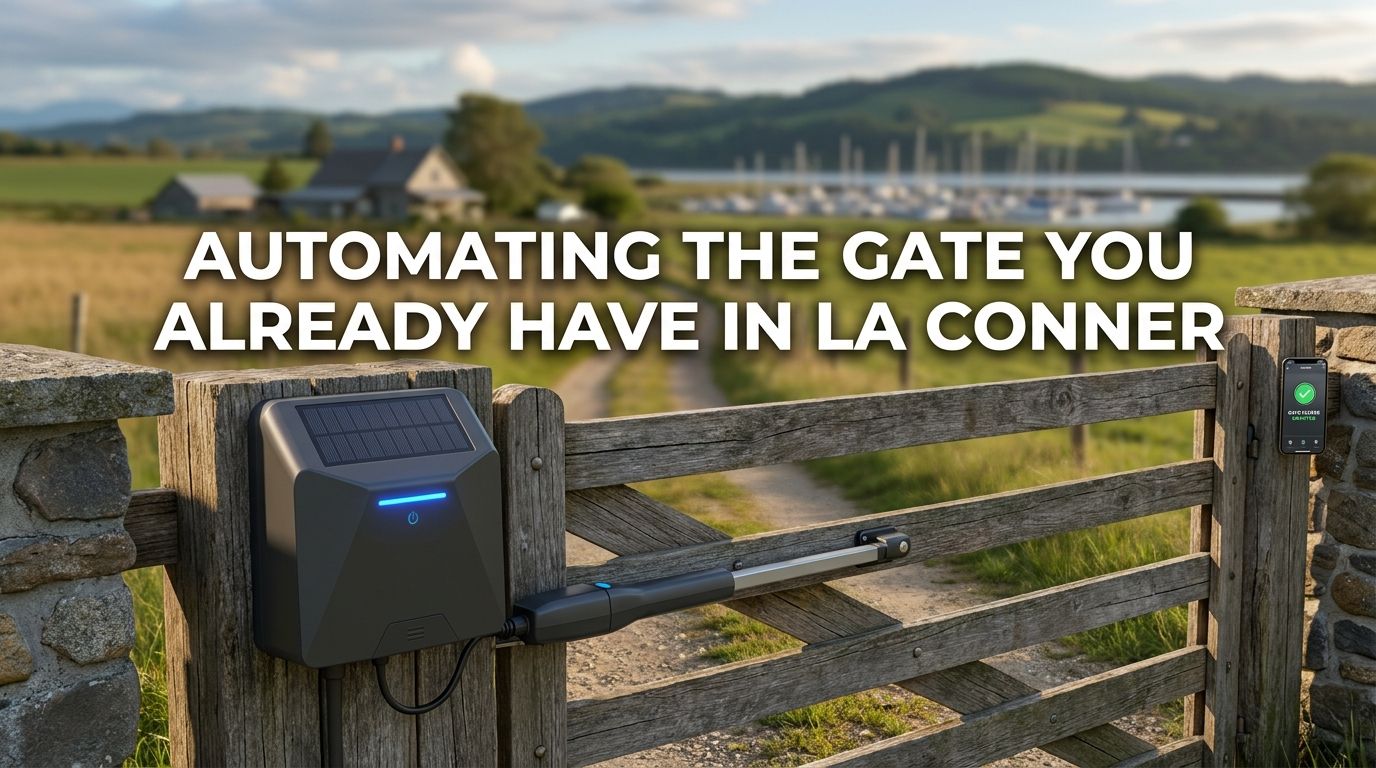
Gate automation La Conner WA usually starts with a gate that already exists. This is an old town by Washington standards, and plenty of properties around the waterfront, the historic district, and out across the flats have had a gate for decades. The owner is not looking to replace it. They want to stop getting out of the car in the rain to open it.
Emerald Gate Systems evaluates, automates, and services existing gates from our own shop in Sedro-Woolley, fifteen minutes up the road. Retrofitting a sound gate is frequently better value than replacing it, and on a property where the gate suits the house and the neighborhood, keeping it is the right answer aesthetically as well as financially.
This page covers what gate automation La Conner WA actually involves: how we tell a good retrofit candidate from a bad one, what the Swinomish Channel and the flats do to hardware, how historic character constrains the work, and when replacing the gate is the more honest recommendation. Call (360) 657-9975 or use the contact page.
What Makes a Gate Worth Automating
The evaluation is straightforward and we do it before quoting anything, because putting a capable operator on a failing structure produces a system that fights itself.
A good candidate is straight and stable, with no visible sag in the leaf. The posts are properly set and have not shifted, which on La Conner’s soft delta soil is worth checking rather than assuming. It moves easily by hand through its full travel, with no binding, dragging, or point where it catches. There is a sensible place to attach an operator. And it can accept the safety devices that current standards require.
A poor candidate sags, drags on the ground, has posts that have moved, is corroded through at the joints, or was built in a way that leaves nowhere practical to mount an operator. Some ornamental gates fall in this category not because they are weak but because the pattern leaves no solid attachment point.
The hand test is the one that tells you the most. If a gate is hard to move by hand, it will be hard for an operator too, and the operator will absorb that resistance on every cycle until something wears out. Owners are often surprised by how much resistance they had stopped noticing.
Where a gate is close but not quite there, the middle path is repairing the structure first and automating it after. A hinge replacement, a post reset, or realignment is frequently inexpensive relative to the automation, and it converts a poor candidate into a good one. We give you the numbers for repair plus retrofit against the numbers for replacement.
What Gate Automation La Conner WA Costs and What Drives It
Retrofit cost comes from four places, and knowing which one dominates on your property tells you most of what you need.
The operator itself is sized to the gate. Weight, movement type, span, and how many times a day it will run all decide which unit is appropriate. Specifying one that is marginal for the gate is the most common way a retrofit fails early, and it is a false economy.
Power is frequently the largest line and the most variable. A gate near an existing panel is straightforward. A gate at the end of a long driveway out on the flats means trenching, conductors sized for voltage drop over distance, burial depth and separation that will be inspected, and restoration of whatever the trench crossed. Where that run is long, solar gate automation can be the better answer, sized honestly for winter.
Safety devices are not optional and they are frequently what surprises owners on an older gate. Current standards expect monitored entrapment protection, and a gate that has never had photo eyes or edge sensors needs them plus the wiring to support them.
Access control is the fourth and it is the one with the widest range. A keypad and a couple of remotes is modest. Video intercom, cameras, and cloud managed credentials is a different number. Our access control systems page covers what each option is actually good at.
Talk with Emerald Gate Systems. We will tell you which of those four is going to dominate your budget before you commit to anything. Call (360) 657-9975 or use the contact page.
Delta Soil, Channel Air and What They Do to an Old Gate
La Conner sits where the Skagit flats meet the Swinomish Channel, and both halves of that geography work on a gate.
The soil is the first factor and it is the one that quietly ruins gates. Delta ground holds water and moves. Posts that were set adequately in firmer soil settle, lean, or shift over years, and the symptom is a gate that no longer aligns with its strike or that drags at one point in its travel. Owners frequently blame the gate when the problem is under it.
Before automating, post condition deserves an honest look. An operator makes a gate cycle far more often than a hand operated one did, and a marginal post that survived twenty years of occasional use will not survive automation for long. Resetting a post before automation is inexpensive. Doing it after, with an operator mounted, is not.
Channel air is the second factor. Salt reaches properties near the water and accelerates corrosion at fasteners, hinge pins, and any point where two different metals meet. On an older gate, those are already the weakest points, and adding automation adds terminal blocks, enclosures, and connections that salt will find.
Drainage ties both together. Water pooling at a post base undermines the footing and keeps the metal wet. Correcting drainage during a retrofit costs very little and prevents the failure that costs the most.
Our gate repair and maintenance page covers what moisture does to control electronics and how we address the source rather than only the symptom.
Automating a Gate Without Ruining How It Looks
La Conner has genuine architectural character, and a retrofit that solves the convenience problem while spoiling the entrance is not a success.
Operator type is the main lever. Arm style swing operators are visible but can be mounted discreetly and painted to disappear against the post. Underground operators are essentially invisible when the gate is closed, at the cost of higher installation complexity and more exposure to water, which on delta soil is a real consideration rather than a theoretical one. Pad mounted units sit low and can be screened.
Device placement is the other lever and it is where most retrofits go wrong visually. A keypad on a raw pedestal in the middle of a period entrance is jarring. Integrating a pedestal into an existing pillar, matching finishes, or positioning devices where they are reachable from a car but not the first thing you see all help.
Safety devices have to be visible enough to work, which is a real constraint. Photo eyes need line of sight across the opening and cannot be hidden. What can be done is choosing housings that are discreet, painting them to match, and mounting them where they read as part of the structure rather than as an afterthought.
Conduit and wiring are the details that separate a tidy job from an obvious one. Runs concealed in or behind posts, entries sealed properly, and no surface conduit stapled across a masonry pillar.
Where an owner wants both automation and a visual upgrade, sometimes the honest answer is a new gate built to look right with automation designed in from the start. Our custom gate fabrication page covers that path.
Talk with Emerald Gate Systems. We fabricate as well as automate, so the answer is not limited to what can be bolted onto what exists. Call (360) 657-9975.
Safety Devices on a Gate That Never Had Them
This is the part of a retrofit owners least expect and it is not negotiable.
A hand operated gate has no entrapment risk because a person is controlling it directly and can see what is happening. The moment it becomes powered, that changes. Current standards expect two independent means of entrapment protection in each direction of travel, coming from different types so a single failure does not disable both.
In practice that usually means the operator’s inherent sensing as primary, plus monitored photo eyes and often edge sensors as secondary. Monitored matters specifically: the operator supervises those devices and detects when one has failed, rather than continuing to cycle with no protection while a dead photo eye sits there looking fine.
On an older gate this also raises construction questions. The gate itself has to be guarded appropriately: positive stops on a slide gate so it cannot leave its track, guarding around rollers, and screening near the operating zone where an ornamental pattern would otherwise let a hand reach into a closing gap. Those are the requirements a modern operator cannot detect or compensate for.
None of this means an old gate cannot be automated. It means the quote includes items that a cheaper quote will have left out, and it is worth asking any contractor what safety devices are included and whether they are monitored. Our page on automatic gate safety standards covers UL 325 and ASTM F2200 in detail.
Permits, Emergency Access and the Flats
Automating an existing gate triggers approvals that installing the gate originally may not have.
The electrical work is the main one. Running a new circuit, extending an existing one, or adding a disconnect generally requires a permit and inspection, with requirements published by Washington L&I. A gate that has stood unpowered for thirty years and is now getting a circuit is new electrical work.
Fire access is the second and it applies to the gate regardless of whether it is powered. The district cares about clear width for apparatus, approach and turning, and specifically about how the gate opens when there is no power and nobody is home. Automating a gate that previously swung open by hand changes that answer, which is why emergency access method belongs in the design rather than in an afterthought.
On long driveways out across the flats, access requirements apply along the route rather than only at the gate, covering width, surface, and turnarounds. Worth confirming when the retrofit is planned.
Our page on gate permits in Washington State covers all of it together, including who pulls what and how the sequence should run.
Talk with Emerald Gate Systems. Automating an existing gate is still a permitted electrical job, and we handle that as part of the project rather than leaving it to you. Call (360) 657-9975.
When Replacement Is the More Honest Answer
Sometimes the right recommendation is not to automate the gate you have, and we would rather say so at the quoting stage than after taking the job.
Structural failure is the clearest case. A gate that sags visibly, has corroded through at joints, or has posts that have leaned in the soft ground is not going to hold up under automated cycling. Money spent automating it is money spent on a structure with limited life left.
Size mismatch is the second. If the opening was always too narrow for the vehicles that now use it, automating it locks in that problem rather than solving it. Owners who add a boat, a trailer, or a larger vehicle after installing a gate discover this, and it is not a retrofit issue.
No practical attachment point is the third. Some gates simply have nowhere to mount an operator without either compromising the structure or producing something that looks wrong.
Safety geometry is the fourth. A gate that opens into a pedestrian area, sits too close to the road, or creates hazards that cannot be adequately guarded is a gate that should be reconsidered rather than powered.
In those situations, our automatic gate installation page covers planning a new entrance properly, and repair cost versus replacement works through the comparison with real numbers.
Access Control After the Retrofit
Automation solves getting the gate open. Access control solves who gets it open, and on a La Conner property that list is usually short but specific.
Residents need something instant, which means remotes or smartphone control. Regular service providers need something repeatable, which usually means a keypad code. Deliveries need something that works when nobody is home. Guests need something that can be granted once.
For properties near the historic district and the waterfront, seasonal patterns matter. Owners who are away part of the year need remote credential control so contractors and caretakers can be granted and removed from anywhere, and the entry log matters more than it does for a full time residence.
Video intercom is worth its cost on properties where the gate cannot be seen from the house, which is most of the long driveways out on the flats. Being able to see and speak to whoever is at the gate answers the actual question.
Whatever the system, insist on holding the administrative account yourself so you can add and remove users without a service call. We transfer that at handover as part of the job.
Talk with Emerald Gate Systems. Tell us who comes through in a normal month and we will design the access around that. Call (360) 657-9975 or use the contact page.
Maintenance After Automating an Older Gate
A newly automated gate cycles far more than it did as a hand operated one, and that changes the maintenance picture.
The first year matters most. Hinges, posts, and alignment settle under the new cycling pattern, and a check a few months in catches the adjustment that prevents a year of accelerated wear. We build that into retrofit projects rather than leaving it to chance.
After that, twice a year suits most properties in this climate, timed before and after winter. What gets checked: alignment, hinges and rollers, fastener tightness, path clearance, operator mounting and condition, battery under load, charging circuit, safety device alignment and function, access devices, enclosure sealing, drainage, and coating.
On an older gate, coating condition deserves particular attention because the retrofit did not renew it. Rust starting at a hinge or under a scratch spreads under the finish, and catching it early is far cheaper than dealing with it later.
Between visits, watch for the gate sounding different, movement slowing, a leaf no longer meeting its strike, rust staining below a hinge, or water standing where it did not before. Our preventive gate maintenance page covers a reasonable program.
Working in La Conner From Fifteen Minutes Away
We are headquartered in Sedro-Woolley, which puts La Conner well inside our regular territory rather than at the edge of it.
Everything structural is fabricated in our own shop, which matters on a retrofit because the work frequently includes a bracket, a post repair, a mounting plate, or a screening panel that has to be made rather than bought. Having a shop means those get fabricated properly rather than improvised on site.
One team handles evaluation, structural repair, automation, access control, and service. On a retrofit that consolidation is worth more than on a new installation, because the questions of whether the gate is sound, what operator suits it, and how the safety devices mount are all the same conversation rather than three companies’ opinions.
La Conner sits alongside Mount Vernon, Burlington, Anacortes, and Sedro-Woolley in our Skagit coverage. Our Skagit County gate installation page covers the county, and you can verify our license and bond status through Washington L&I contractor verification.
Frequently Asked Questions About Gate Automation La Conner WA
Can my existing gate be automated?
Often yes, if it is straight, stable, properly supported, moves easily by hand through full travel, has a sensible place to mount an operator, and can accept required safety devices. The hand test tells you the most. If it is hard to move by hand, an operator will fight it on every cycle.
How much does gate automation cost?
Four things drive it: the operator sized to the gate, power to the gate, safety devices, and access control. Power is usually the most variable, ranging from straightforward near an existing panel to dominant on a long driveway. A site visit produces a real number.
Is automating cheaper than a new gate?
Usually, when the existing gate is sound. When it sags, has shifted posts, is corroded through, or is too narrow for current vehicles, automating it locks in a problem rather than solving it, and replacement is the better value. We give you both numbers.
Do I need new safety devices on an old gate?
Yes. A hand operated gate has no entrapment risk because a person controls it directly. Once powered, current standards expect monitored entrapment protection. This is frequently what separates a complete quote from a cheap one, so ask any contractor what is included.
What does monitored mean?
The operator supervises its safety devices and detects when one has failed, rather than continuing to cycle with no protection. Older systems could lose a photo eye silently. It matters enough that non monitored devices are not an acceptable substitute.
Will the operator look bad on my historic gate?
It does not have to. Arm operators can be mounted discreetly and painted to disappear against a post. Underground units are essentially invisible when closed, though water exposure is a real consideration on delta soil. Device placement and concealed wiring matter as much as the operator choice.
Does the soft ground here affect gate posts?
Considerably. Delta soil holds water and moves, and posts settle or lean over years. A marginal post that survived decades of occasional hand operation often will not survive automated cycling. Resetting a post before automation is inexpensive; doing it afterward is not.
Does salt from the channel matter this far in?
Yes for properties near the water. Salt accelerates corrosion at fasteners, hinge pins, and any point where different metals meet, which on an older gate are already the weak points. Automation adds enclosures and connections that salt will also find, so sealing and hardware selection matter.
My gate is a long way from power. What are my options?
Trenching a long run can cost more than the automation itself. Solar is the practical alternative on remote entrances when sized around winter conditions rather than summer sun. We evaluate exposure, cycle count, and accessories before recommending it.
Do I need a permit to automate an existing gate?
The electrical work generally requires a permit and inspection. A gate that has stood unpowered and is now getting a circuit is new electrical work. Fire access requirements also apply, and automating changes how the gate opens without power, which the district cares about.
How do emergency responders get through an automated gate?
Through whatever method your fire district accepts, which may be a key switch, a lock box, or a radio activated receiver. Confirm it before selecting equipment. A gate that previously swung open by hand needs a deliberate answer once it is powered.
What happens during a power outage?
With functioning battery backup the gate keeps working for a number of cycles. Batteries fail quietly because the gate keeps running on utility power, so testing under load rather than at rest is the only reliable check. Manual release is the fallback and it has to actually work.
How long does a retrofit take?
The gate evaluation and any structural correction come first, then power, then the operator and safety devices, then access control. Permitting and any trenching usually drive the schedule more than the automation work itself.
Will the gate need more maintenance once automated?
It cycles far more than it did by hand, so yes. The first few months matter most as hinges and alignment settle under the new pattern. After that, twice a year suits most properties in this climate.
Can you add access control at the same time?
Yes, and doing both together is more efficient than separately because the wiring path and the trenching overlap. Keypads, remotes, video intercom, phone entry, and cloud credentials are all options depending on who needs access.
Do you work on gates another company installed?
Yes, including equipment from any manufacturer. Most retrofits by definition involve a gate we did not build.
What if the evaluation says my gate is not worth automating?
We tell you, with the reasons and with numbers for the alternative. Taking a retrofit job on a failing structure produces an unhappy owner in two years, which is worse for us than an honest conversation now.
What should I have ready for the evaluation?
Try moving the gate by hand through its full travel and note where it binds or drags. Note whether power is nearby, who needs access, and what vehicles use the entrance. Photos of the gate, the posts, and the hinges help. We handle the rest.
When a La Conner property has a gate that was built solidly and moves well, the retrofit path is often straightforward. For a broader guide to gate automation retrofits across Washington, including operator sizing, structural checks, safety devices, and access control options, the full retrofit guide covers each step in detail.
Keep the Gate, Lose the Inconvenience
Gate automation La Conner WA works best when the existing gate is genuinely sound, the posts are checked before rather than after, the safety devices are included rather than skipped, and the operator and access control are chosen for how the property is actually used.
Emerald Gate Systems evaluates honestly, fabricates what a retrofit needs in our own Sedro-Woolley shop, and handles the automation, access control, and service with one team. When the answer is that your gate is not worth automating, we say that too.
Call Emerald Gate Systems at (360) 657-9975 or schedule a free evaluation for your La Conner gate.