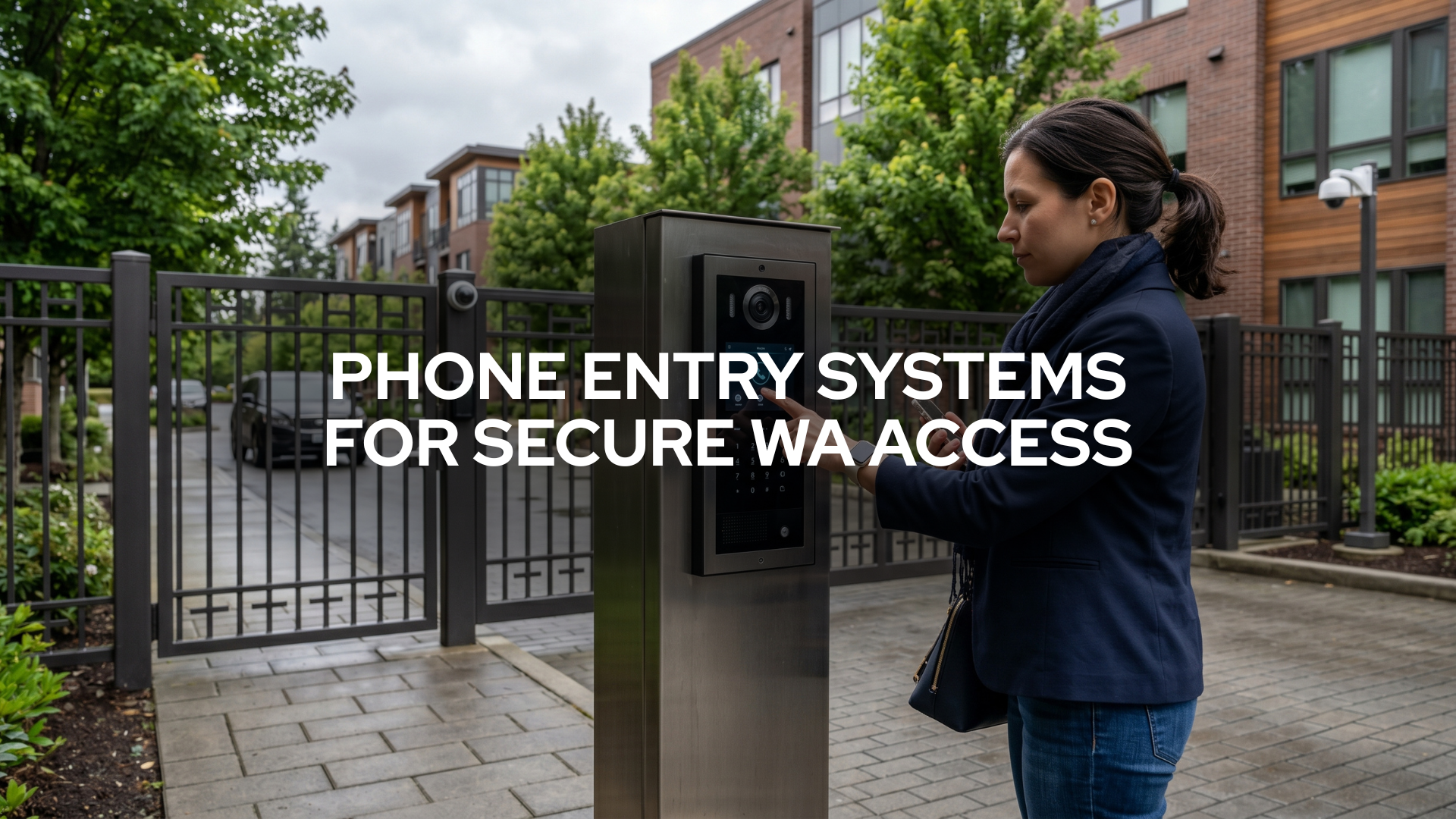
Phone Entry Systems Washington State for Secure Property Access
Phone entry systems Washington State is a practical planning topic for commercial owners who need safer, more reliable, and easier-to-manage entrances across Washington commercial and multifamily access points. Whether the project involves phone entry systems, a malfunctioning entry point, new construction, or a security upgrade, the right plan should connect the hardware decision to daily operations. In Washington, that means thinking about rain, corrosion, drainage, winter visibility, seismic awareness, emergency access, accessibility, and local code review before equipment is ordered.
This guide is written for decision-makers who do not want a generic sales pitch. It explains what to compare, what can go wrong, how to plan a site visit, and how to turn an entry problem into a durable system. It also keeps the conversion goal clear: the best way to move from research to a workable scope is to book a site visit, confirm the property conditions, and match the solution to the actual users. For Emerald Gate Systems, the strongest opportunities are commercial owners, schools, general contractors, healthcare facilities, and managed properties that need dependable gate automation, ADA doors, access control, badge readers, keypad entry, RFID entry, phone entry, or parking garage security.
Phone entry systems Washington State: Benefits for Commercial owners
Phone entry system Washington should be evaluated by how well it improves daily operations, not just by the price of the device. For commercial owners, the best system is the one that solves the actual property problem without creating a new maintenance burden.
Better visitor management. The project can support better visitor management while reducing the amount of manual work required from the management team.
Remote release options. The project can support remote release options while reducing the amount of manual work required from the management team.
Fewer front-desk interruptions. The project can support fewer front-desk interruptions while reducing the amount of manual work required from the management team.
Cleaner gate and door communication. The project can support cleaner gate and door communication while reducing the amount of manual work required from the management team.
The return on investment is usually easiest to see in avoided disruption: fewer complaints, fewer shared-code problems, fewer emergency calls, fewer unauthorized vehicles, fewer accessibility barriers, and fewer last-minute construction conflicts. A good entry system also protects the reputation of the property. A visitor, patient, resident, student, delivery driver, or tenant forms an opinion at the entrance before they ever reach the lobby.
Phone entry system Washington: Comparison and Selection Criteria
Direct answer: compare options by user volume, security risk, climate exposure, compliance triggers, and maintenance capacity. The best option is rarely the fanciest device; it is the option that the property team can operate reliably after installation.
| Option | Best Fit | Planning Note |
| Telephone entry panel | Apartments and offices | Familiar visitor workflow |
| Video intercom | Higher-security entries | Improves visitor verification |
| Mobile app entry | Modern tenant communities | Flexible remote release |
| Integrated gate/door entry | Mixed-use properties | Unifies visitor flow across access points |
Phone entry system Washington: Step-by-Step Planning Process
A strong phone entry system Washington plan follows a disciplined process. The sequence matters because a decision made too early, such as choosing a reader, gate operator, or door package before measuring the entrance, can create change orders later.
1. Define the trigger. Clarify whether the project is driven by security concerns, broken equipment, new construction, ADA compliance, visual improvement, or tenant complaints.
2. Map the users. List residents, employees, visitors, vendors, patients, students, contractors, emergency responders, and administrators who need access.
3. Document the site. Measure clearances, slopes, approach paths, traffic stacking, door swings, gate travel, power access, conduit routes, mounting conditions, and drainage.
4. Choose the access method. Compare keypad entry, RFID access, badge readers, phone entry, mobile credentials, remotes, and camera integration.
5. Review safety and compliance. For gates, review entrapment protection and gate construction principles. For doors and public entries, review accessible routes, maneuvering clearances, thresholds, actuators, and local building requirements.
6. Coordinate with trades. General contractors, electricians, low-voltage teams, concrete crews, door hardware suppliers, fire officials, and property managers may all affect the final scope.
7. Plan turnover. The project is not done when the device powers on. Commercial owners need documentation, user training, credential rules, emergency procedures, maintenance expectations, and a clear path for service calls.
This process is also why a site visit is the preferred call to action. A site visit protects the budget because it turns assumptions into measurable conditions.
Phone entry system Washington: Washington-Specific Code, Climate, and Site Factors
Washington projects need practical local planning. The same phone entry system Washington solution that works in a dry, low-use setting may fail early when exposed to Western Washington rain, marine air, mud, wind, winter darkness, and high daily cycles.
Across Washington commercial and multifamily access points, the strongest plans account for Western Washington rain, winter darkness, drainage, power routing, seismic awareness, and local review by the authority having jurisdiction. Emerald Gate Systems serves Skagit, Whatcom, Snohomish, Island and San Juan counties, and works south through the Puget Sound corridor into King County.
Decision-makers should also remember that Washington construction contractors are expected to be registered with Labor and Industries, and many projects involve bonded and insured construction work, electrical coordination, or specialty trades. The Washington State Building Code is the minimum construction requirement in the state, and current accessibility planning should account for adopted accessibility standards and local interpretation. For public-facing doors, entrances, and gates, ADA guidance also matters because accessible entrances are not simply hardware choices; they involve approach, clear width, opening force, maneuvering clearance, thresholds, controls, and user independence.
For automated vehicular gates, the strongest safety conversations include ASTM F2200 construction principles and UL 325 operator and entrapment-protection concepts. For automatic doors, the conversation should include door type, actuator location, safety sensors, daily cycle counts, power, locking, fire/life-safety coordination, and serviceability.
The safest way to handle these variables is to involve the installer before final drawings or budgets are locked. That is especially important for schools, healthcare facilities, apartments, parking garages, and commercial properties where downtime affects many people.
Phone entry system Washington: Real-World Example for Washington commercial and multifamily access points
A Washington commercial and multifamily access points property team contacted a gate and entry specialist after repeated complaints about unreliable access and unclear visitor procedures. The site had phone entry systems, but the system had been added in pieces over several years. The property had no clean credential policy, the wiring was not well labeled, and the team could not easily tell whether a problem came from the hardware, the controller, the user credential, or the gate or door itself.
During the site visit, the technician documented user groups, measured the entry geometry, reviewed the power and low-voltage pathway, inspected existing hardware, and asked the management team what outcome mattered most. For this example, the priorities were uptime, simpler administration, better security, and fewer after-hours calls.
The recommended scope included replacing worn hardware, updating the access control interface, labeling wiring, adding user-specific credentials, reviewing safety devices, and creating a maintenance plan. The team also received a short turnover guide so new staff could remove old users, issue new credentials, and recognize early warning signs.
The important lesson is not that every property needs the same equipment. The lesson is that phone entry system Washington succeeds when it is scoped around the property, the users, and the long-term operating plan. For commercial owners, this turns a purchase decision into a risk-reduction decision.
Phone entry system Washington: Maintenance and Upgrade Tips
Maintenance protects the investment in phone entry system Washington. In Washington, preventive service is especially important because moisture, grit, wind, and high daily cycles can gradually turn a small issue into a disruptive failure.
A practical maintenance routine should include:
- Inspecting visible hardware, hinges, rollers, tracks, arms, closers, operators, and mounting points.
- Testing safety devices, sensors, request-to-exit devices, readers, keypads, and release functions.
- Cleaning around tracks, drains, thresholds, pedestals, and exterior device housings.
- Checking for corrosion, loose fasteners, water intrusion, conduit damage, and impact marks.
- Reviewing user lists, inactive credentials, shared codes, vendor permissions, and temporary access.
- Confirming that managers understand manual release, emergency procedures, and service escalation.
The upgrade question should be asked when failures repeat. If the same repair returns every season, the root cause may be an undersized operator, failing control board, poor drainage, misalignment, weak foundation, outdated credential system, or equipment that was never designed for the use level. A site visit can separate a simple repair from a replacement that will save money over the life of the system.
Phone entry system Washington: 2026 Trends for Washington Properties
The 2026 trend for phone entry system Washington is integration. Property teams increasingly want one entry strategy instead of separate gate, door, garage, camera, and credential systems that do not talk to each other.
Important trends include:
Smart integration. Cloud-managed access control, mobile administration, and remote troubleshooting can reduce site visits for simple user changes.
Mobile credentials. Many properties are moving beyond shared codes and physical keys to app-based access or flexible credential options.
AI-assisted video review. Cameras can help identify after-hours activity, repeated tailgating, gate strikes, or suspicious vehicle behavior when used responsibly.
Solar-supported options. Solar can help in remote gate locations, but Western Washington design must account for cloud cover, battery sizing, duty cycle, and backup power.
Biometric upgrades. Biometrics may fit selected high-security interior applications, although most Washington commercial and multifamily sites will still rely on badges, RFID, keypads, phone entry, and mobile access.
Better lifecycle planning. Owners are asking more questions about warranties, parts availability, US-made equipment options, and serviceability before approving a proposal.
These trends do not remove the need for good field work. The smartest system still depends on correct mounting, safe layout, weather-aware installation, labeled wiring, trained users, and realistic maintenance.
Phone entry system Washington: Decision Checklist for Commercial owners
Use this checklist before approving a proposal for phone entry systems:
- What exact problem are we solving: security, compliance, convenience, aesthetics, repeated failure, or new construction coordination?
- Who owns user administration after turnover?
- How will former employees, former tenants, inactive vendors, and temporary users be removed?
- What happens during a power outage, network outage, gate impact, door failure, or emergency response event?
- Can the system be serviced without disrupting the entire property?
- Are the reader, keypad, actuator, gate operator, or door components located where users can reach them safely?
- Does the design account for rain, wind, corrosion, drainage, and winter visibility?
- Is the equipment strong enough for the expected cycle count?
- Are warranty, parts availability, and long-term support documented?
- Is there a clean handoff package with manuals, user training, and maintenance expectations?
For Washington commercial and multifamily access points, the most common mistake is treating the entry point as a single device. It is better to treat it as a connected system: structure, operator, controls, credentials, sensors, power, network, user rules, emergency access, and maintenance. That mindset helps commercial owners avoid cheap fixes that do not last.
Phone entry system Washington: Budget and ROI Considerations
Price matters, but the lowest initial price is not always the lowest total cost. A poorly scoped system can generate repeat service calls, user complaints, security gaps, and early replacement. A better budget compares installation cost, downtime risk, staff time, user support, parts availability, expected service life, warranty value, and the cost of doing nothing.
For commercial owners, property managers, schools, healthcare facilities, and general contractors, ROI often appears in operational stability rather than a single line item. Reliable access reduces interruptions. Better credential control reduces unauthorized use. ADA-aware door planning improves usability. Gate automation improves traffic control. Parking garage security reduces tenant frustration. Access controller upgrades make audits and administration easier.
A professional site visit helps clarify these costs before the scope is approved. It also gives the installer a chance to identify hidden conditions: poor drainage, inadequate posts, failing door hardware, worn operators, missing safety devices, electrical limitations, outdated controllers, or user flows that will not work with the first product someone suggests.
Want smarter entry? Our guide to access control systems in Northwest Washington explains video intercoms, RFID, keypad access, and security integration.
Frequently Asked Questions About phone entry system Washington
1. How do I know whether a phone entry system Washington project in Washington commercial and multifamily access points needs a site visit?
Book a site visit when the entrance affects security, accessibility, daily traffic, tenant experience, or emergency access. Photos help, but a site walk confirms measurements, power, drainage, mounting, user flow, and safety details that can change the scope.
2. What should we review before budgeting?
Review the user groups, traffic volume, access method, safety devices, power availability, weather exposure, code triggers, and maintenance expectations. A budget built only around hardware can miss trenching, concrete, controls, permits, and integration work.
3. Can this connect to our existing access control system?
Often, yes. The installer should verify the current controller, reader format, credential type, wiring, network access, software administration, and door or gate hardware before promising integration.
4. What access method is best for vendors and deliveries?
Temporary keypad codes, scheduled phone entry, RFID credentials, or mobile permissions can all work. The best option depends on how often vendors arrive, whether staff are onsite, and how much audit history the manager needs.
5. How does Washington weather affect the phone entry system Washington system?
Rain, wind, winter darkness, and moisture exposure affect hardware selection, drainage, corrosion resistance, sensor placement, and maintenance schedules. Western Washington sites need equipment and installation details selected for wet conditions.
6. What safety standards matter for automated gates?
Automated vehicular gates should be designed with recognized safety practices, including ASTM F2200 gate construction principles and UL 325 operator and entrapment-protection concepts. A qualified installer should select safety devices for the actual gate layout.
7. Do we need to coordinate with local code officials?
For many commercial projects, yes. Requirements may involve building, electrical, accessibility, fire access, and site-work review. The authority having jurisdiction makes final determinations, so early coordination reduces surprises.
8. How long does planning usually take?
Planning depends on site complexity, product availability, permits, electrical scope, concrete work, and access-control integration. Larger commercial, healthcare, school, and apartment projects should begin planning early to avoid late construction changes.
9. What causes repeat failures?
Repeat failures often come from undersized equipment, poor drainage, worn hardware, misalignment, power issues, shared-code misuse, damaged sensors, weak foundations, or lack of preventive maintenance.
10. How often should we maintain the system?
High-cycle gates, doors, garages, and access systems should be inspected more often than low-use entries. Many commercial sites benefit from quarterly or semiannual service, plus winter readiness checks.
11. What makes a system easier to manage after installation?
Clear documentation, labeled wiring, admin training, credential policies, spare parts planning, remote support options, and a preventive maintenance schedule all make ownership easier.
12. What is the best next step?
The best next step is a site visit. The installer can verify the problem, compare equipment options, identify compliance and safety issues, and propose a plan that fits the building, users, and budget.
Plan phone entry system Washington With a Site Visit
Phone entry system Washington is not just a hardware decision. It is a property-performance decision that affects security, access, compliance planning, maintenance, daily user experience, and the first impression people have when they arrive. For commercial owners in Washington commercial and multifamily access points, the best results come from matching the solution to the site instead of forcing a generic product into a complex entrance.
Emerald Gate Systems is positioned for projects where reliability, local reputation, fast response, practical pricing, US-made product preference, long warranties, and professional before-and-after results matter. The strongest next step is to book a site visit so the team can evaluate the entrance, confirm user needs, identify code or safety concerns, and recommend a system that fits the property.
What are phone entry systems Washington State?
Phone entry systems Washington State are access control systems that allow visitors to contact residents or staff and gain remote entry through a phone or mobile device.