
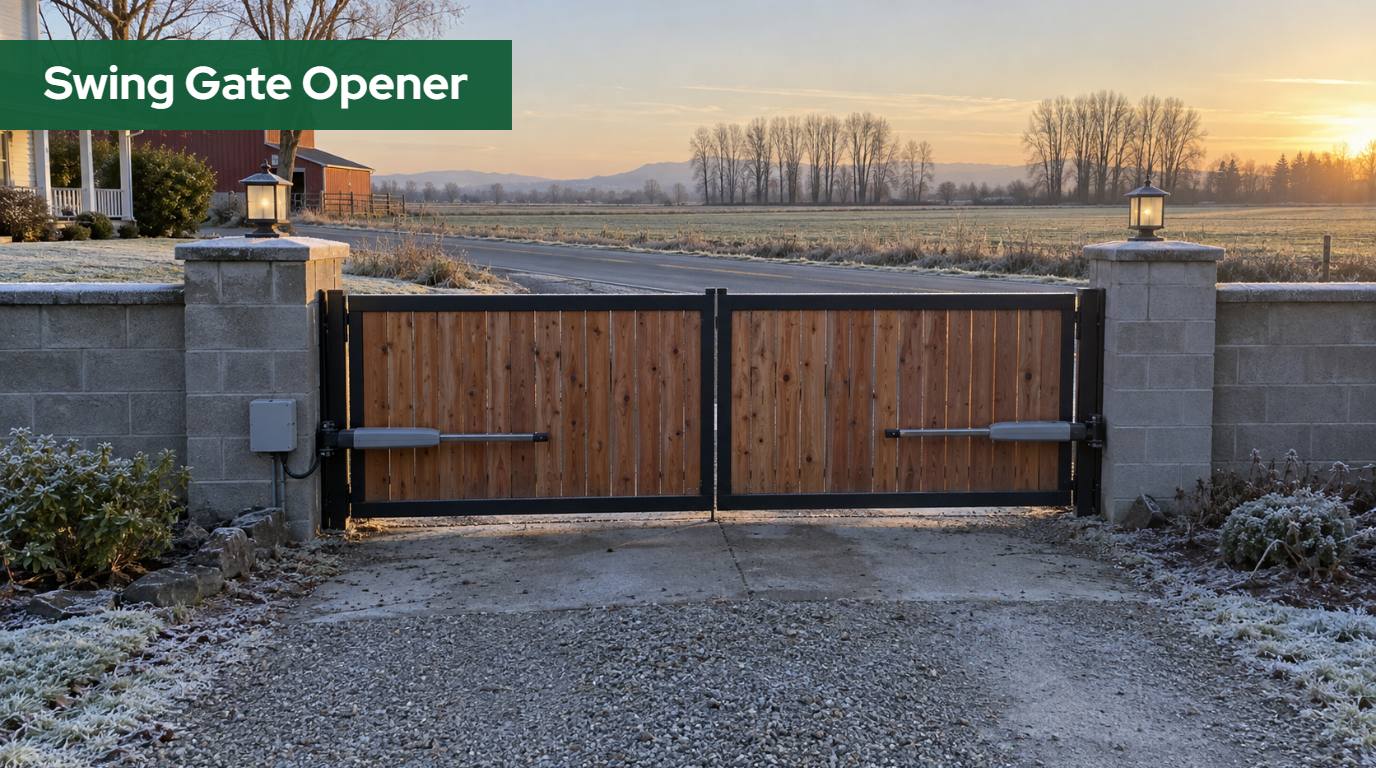
A swing gate opener in Washington has to do more than move a gate. It has to match the weight and length of the leaf, fit the hinge and post layout, protect anyone standing in the swing path, keep working through wet and windy winters, and meet the fire access and electrical rules that apply in this state. Choose the wrong type or mount it in the wrong place and the opener strains, the gate drifts, or the safety devices never stop tripping.
This guide compares the two common above-ground designs, the linear actuator and the articulated arm, and explains how to size the opener, whether the gate should pull or push open, how single and dual gates differ, what UL 325 and ASTM F2200 ask of a swing gate, and how slopes, weather, power, locks and Washington permits shape the final design. It is written for homeowners, farm owners, HOA boards and property managers in Skagit, Whatcom, Snohomish, Island, San Juan, King and Pierce counties.
Quick answer
A swing gate opener in Washington is usually a linear actuator, which suits most residential gates and narrow pillars, or an articulated arm, which suits wide pillars and heavier or busier gates. Match the opener to the gate’s weight, length and usage class, add UL 325 entrapment protection, and plan power, fire access and L&I wiring.
In this guide
- What a swing gate opener in Washington does
- Linear, articulated arm and underground openers
- Sizing the opener to the gate
- Is your gate ready for an opener?
- Pull to open or push to open
- Mounting geometry, hinges and opening angle
- Single or dual swing gates
- UL 325 and ASTM F2200 for swing gates
- Slopes, wind, rain and cold
- Power, solar, batteries and outages
- Gate locks and fire department access
- Access control and vehicle detection
- Digging, wiring and L&I rules
- Maintenance and common problems
- How we approach swing gate openers
- Frequently asked questions
What a Swing Gate Opener in Washington Does
A swing gate opener is a motorized drive that pushes or pulls a hinged gate leaf through its arc, usually about 90 degrees, and then holds it open or closed. Every system has an operator (motor and gearbox), a control box with the board, receiver and usually a battery, entrapment protection devices such as photo eyes and edges, and activation devices such as remotes, keypads and exit sensors.
Swing gates are the most common driveway gate in Northwest Washington because they work with traditional designs, they need no track across the driveway, and they fit openings where there is no room to slide a panel sideways. They also need clear space for the whole arc, catch wind when solid, and create entrapment zones between the moving leaf and nearby walls, pillars and the ground.
If you are still deciding between a swing and a slide, our comparison of sliding gates versus swing gates in the Pacific Northwest covers space, slope and wind side by side.
Linear Actuator, Articulated Arm and Underground Openers
Linear actuator. A linear swing gate opener is a straight arm, often called a ram, that mounts between a bracket on the gate post and a bracket on the gate frame. A motor drives a screw inside the tube, and the arm extends or retracts to swing the leaf. Linear actuators are compact, light and easy to place on most residential gates. LiftMaster’s LA412UL is a common example: its installation manual lists a 12-volt battery system charged by solar or a transformer, a 90-degree travel time under 23 seconds and a maximum travel range of 115 degrees. Because the arm lies close to the gate, a linear opener works best where the hinge is close to the face of the post and the post is not very wide.

Articulated arm. An articulated arm gate opener has a motor housing on the post or on its own concrete pad and a folding arm with an elbow, like a human arm, that connects to the gate. The elbow lets the operator reach around wide brick or stone pillars and hinges set back from the pillar face, which is where linear actuators struggle. DoorKing’s model 6004 is a residential example: its manual describes a drive arm and a linking arm, mounts for gates that open to the inside or the outside, and a 90-degree opening in about 18 seconds. Heavier commercial operators of this type, such as LiftMaster’s CSW24UL, sit on a pad and are rated for continuous duty.
Underground. A below-ground opener sits in a steel box under the hinge, out of sight. It suits estates and historic designs where an arm would spoil the look, but drainage and water are the main design problem in this climate. We cover the drainage, the box and the trade-offs in our guide to the underground gate opener in Washington.
| Question | Linear actuator | Articulated arm |
|---|---|---|
| How it moves the gate | A straight arm extends and retracts between post and gate | A folding arm with an elbow pushes and pulls the leaf |
| Best fit | Most residential gates, hinges close to the post face | Wide pillars, hinges set back from the face, heavier or busier gates |
| Where it mounts | On the inside of the post and gate, at least 12 inches above the ground on the model we reviewed | On the post, a wall or its own concrete pad |
| Visual impact | Slim arm along the gate | Larger housing and a visible folding arm |
| Hazard to watch | The space between the leaf and the post as the gate swings | The scissoring arm and the space near the hinge |
Sizing the Opener to Gate Weight, Length and Use
Every swing gate opener carries a manufacturer rating that ties maximum gate weight to maximum leaf length. The longer the leaf, the more leverage it has against the operator, so the allowed weight falls as length rises. An opener that is too small for the leaf overheats, wears its gears, trips its own obstruction sensing and drifts in the wind.
The figures below come from manufacturer documents we reviewed and show why the gate has to be weighed or calculated, not guessed.
| Opener (source) | Type | Weight and length rating | Other limits stated |
|---|---|---|---|
| LiftMaster LA412UL (installation manual) | Linear actuator | 850 lb at 10 ft, 750 lb at 12 ft, 650 lb at 14 ft, 550 lb at 16 ft | Up to 50 cycles per day; -4°F to 140°F |
| DoorKing 6004 (installation manual) | Articulated arm | Up to 300 lb and 8 ft | UL 325 Class I; about 20 cycles per hour on AC |
| LiftMaster CSW24UL (data sheet) | Pad-mounted arm operator | 1,600 lb at 8 ft, 800 lb at 16 ft, 600 lb at 18 ft | Continuous duty; UL 325 Classes I to IV |
Two more ratings matter as much as weight. The first is the UL 325 usage class. Class I covers residential use, Class II commercial or general access such as an apartment or HOA entrance, Class III industrial or limited access, and Class IV restricted access. A residential-only opener does not belong on a community entrance even if the gate is light. The second is the duty cycle, which is how often the opener can run.
We explain how operator brands and classes compare in our gate operator comparison for Northwest Washington. When the rating is borderline, the safer choice is the next size up, not a stiffer clutch or a less sensitive force setting.
Is Your Gate Ready for an Opener?
An opener cannot fix a bad gate. Manufacturers say this plainly. LiftMaster’s LA412UL manual says the gate must be level, the gate and post must be plumb, the gate must swing freely and be supported entirely by its hinges, any wheels must be removed from the bottom of the gate, and the gate must not hit or drag across the ground. DoorKing’s 6004 manual says the gate must work freely in both directions before the operator is installed, and warns against tightening the clutch or reducing the reversing sensitivity to make up for a damaged gate.
Before we quote an opener on an existing gate, we check these points:
- Hinges. Worn or undersized hinges let the leaf sag, so the opener ends up lifting the gate as well as swinging it.
- Posts. A post that leans or rocks moves the opener’s mounting point every cycle. In wet Western Washington soils, posts that were set shallow or without proper drainage are a common cause of sag.
- Frame strength. The opener applies its force at one point on the frame. LiftMaster recommends welding a horizontal bar across the entire gate for strength, and warns against welding a crossbar to only a few pickets.
- Bottom edge. The gate needs a smooth bottom edge with no protrusions, both for safety and so it does not catch on gravel, frost heave or snow.
If the gate already sags or drags, start with our guide to sagging gate repair in Washington. For a sound manual gate that you want to motorize, our page on automating an existing gate explains what a retrofit involves.
Want to know if your gate can take an opener?
We check the hinges, posts, frame and swing path on site, weigh up the leaf, and tell you whether it can be automated as it is or needs work first.
Pull to Open or Push to Open?
Most swing gates open inward, onto the property. In that layout the opener sits on the inside, behind the gate, and pulls the leaf toward itself to open. This is the standard configuration. LiftMaster’s LA412UL ships with the hardware for a pull-to-open gate and calls for a separate push-to-open bracket, model 50-19503, when the gate has to be pushed open. DoorKing’s 6004 manual shows separate layouts for gates that open to the inside and gates that open to the outside.
Inward opening is preferred for two reasons. The first is safety. Both LiftMaster’s and DoorKing’s manuals state that swinging gates should not open into public access areas, which in practice means a gate should not swing out over a public sidewalk or road. The second is security: with an inward swing, the opener and control box stay inside the fence line.
Outward opening still has a place. On a driveway that climbs steeply from the road, an inward swing can hit the rising grade, so the gate has to open outward or be redesigned. In that case the leaf must stay entirely on private property throughout its arc, and the opener is mounted for push-to-open. Our guide to the driveway gate on a slope covers raked gates, outward swings and when a slide gate is the better answer.
Mounting Geometry, Hinges and Opening Angle
Where the opener’s brackets go decides how smoothly the gate moves, how far it opens and how much force reaches the leaf. Manufacturers publish mounting dimensions for each model, measured from the center of the hinge, and the installer works from those numbers or the paper template that comes with the opener.
A few rules from the manuals we reviewed show why geometry is not a guess:
- Hinge to post edge. LiftMaster’s LA412UL manual says there should be no more than 4 inches from the center of the hinge to the edge of the post or column. Beyond that, the gap between the leaf and the post becomes an entrapment area that needs protection. On wide masonry pillars with a set-back hinge, this is often the deciding reason to choose an articulated arm or a different hinge position.
- Opening angle. The same manual sets the pull-to-open bracket with the gate opened to the desired position, no more than 100 degrees.
- Level mounting. The operator arm must be level, or it will not work properly. On a sloped approach, that may mean adjusting bracket heights rather than following the grade.
- Height and water. LiftMaster says the LA412UL must be mounted at least 12 inches above the ground, never upside down, and not next to sprinklers or anywhere that exposes the bottom of the operator to water.
Hinges matter as much as the opener: free-swinging, heavy-duty hinges reduce strain on the motor, and the hinge position decides where the hinge-side entrapment zone sits. When we fabricate a new gate in our Sedro-Woolley shop, we plan the hinges, the opener brackets and any reinforcement at the drawing stage instead of adding them after the gate is hung. Our custom gate design and fabrication page describes that process.
Single or Dual Swing Gates
A dual swing gate opener system uses one opener on each leaf of a double gate, which meets in the middle. Splitting a wide opening into two leaves halves the leaf length, which reduces leverage, wind load and the arc each leaf needs. That is why most wide driveway entrances in Northwest Washington use a pair of leaves rather than one long gate.
Dual systems add a few design questions:
- Communication between the two openers. Traditionally a cable runs under the driveway between the posts. Some current systems offer a wireless link instead; the LiftMaster data sheets we reviewed for the LA412 and CSW24UL list wireless dual-gate communication. Where we trench anyway, we still add conduit for a cable.
- Close timing. One leaf often overlaps the other where they meet, so the leaves must close in order. Both LiftMaster data sheets list a choice of bi-part delay or synchronized close.
- Center stop and latch. A center stop or drop rod keeps the leaves from overtraveling and holds them aligned, and a lock may be added at the meeting point.
- Two sets of safety zones. Each leaf has its own swing path and hinge-side zone, so the entrapment protection plan covers both.
A single leaf is simpler and has one opener to maintain. It needs more clear space for its arc and puts more leverage on the opener, so single gates longer than an opener’s chart allows are usually split into two leaves or changed to a slide. Opening width also matters for farms that move wide equipment; our guide to driveway gate width and layout in Washington explains how to size the opening first and the leaves second.
UL 325 and ASTM F2200 for Swing Gates
Automatic gates can produce high levels of force, and the industry standards treat the swing gate’s path as a set of specific hazards. UL 325 covers the operator. ASTM F2200 covers how the gate itself is built and installed. The Door and Access Systems Manufacturers Association summarizes both in its Gate System Safety guide, which shows the entrapment zones of a swing gate on both the public and the secure side, in both the opening and the closing direction.
The main points for a swing gate, from that guide and the operator manuals:
- Entrapment protection in every zone. UL 325 requires monitored external entrapment protection, such as photo eyes and edge sensors, for each entrapment zone. DoorKing’s 6004 manual says the operator will not run without one or more monitored type B1 or B2 devices in each entrapment area. Our guides to gate photo eye installation and the gate safety edge explain where each device goes.
- Edges on the leaf. LiftMaster’s LA412UL manual places contact sensors on the inside and outside leading edge of a swing gate, and on the bottom edge if the gap under the gate is more than 4 inches but less than 16 inches at any point in its arc. DASMA’s guide shows the same 4 to 16 inch range for the gap under the gate.
- Hinge-side zone. DASMA’s guide flags the space between the leaf and a wall or pillar near the hinge: protection is required where the gap at the hinge is more than 4 inches, or where the space between the open gate and a wall is less than 16 inches.
- The arm itself. DASMA warns that a swing gate’s opening mechanism may have arms that overlap with a scissoring effect, so people must stay clear of the mechanism as well as the leaf.
- People on foot. Automated gates are for vehicles only. A separate walk-through entrance must be available and clearly designated, warning signs must be visible on both sides, and access controls must be mounted at least 6 feet from any moving part of the gate, where nobody can reach over, under, around or through the gate to use them.
For a deeper look at the standards, our guide to automatic gate safety standards, UL 325 and ASTM F2200 explains the usage classes and the entrapment protection device types. A pedestrian gate placed next to the vehicle gate is covered in our guide to pedestrian gate access control in Washington.
Want every entrapment zone covered?
We map the swing path, the hinge side and the leading edges of each leaf, then fit and test the photo eyes and edges your gate actually needs.
Slopes, Wind, Rain and Cold in Western Washington
Wind. A solid swing gate, such as a cedar privacy gate or a solid steel panel, acts like a sail. Wind pushes the leaf against the opener while it moves and while it is closed. On exposed sites, such as island properties, farmland in the Skagit and Nooksack valleys, or waterfront homes, wind is a reason to choose an opener with a comfortable margin over the gate’s weight, to split a long leaf into two, to use an open design such as pickets or spaced slats, or to add a positive stop and a lock so the opener is not holding the gate shut on its own.

Rain and water. The opener’s motor, gearbox and wiring must stay dry. That is why LiftMaster warns against mounting the LA412UL near sprinklers or anywhere water reaches the bottom of the operator, and why the control box goes on the high side of the site, sealed, with conduit entries from below.
Cold and snow. Openers carry an operating temperature range. LiftMaster lists -4°F to 140°F for the LA412UL, and its CSW24UL data sheet lists the same range without a heater and down to -40°F with an optional heater. Cold also thickens grease and weakens batteries, so a gate that works well in August can slow down in January. Snow and ice in the swing path are a bigger problem for swing gates than for slide gates, because the leaf has to sweep its whole arc. On properties at higher elevation, such as the foothills east of Sedro-Woolley or along the Mountain Loop, plan the arc, the bottom clearance and snow clearing together.
Slopes. A swing gate on a slope must clear the grade through its whole arc. If the driveway rises inside the gate, an inward swing may strike the pavement before it fully opens. The fixes are a raked gate that follows the grade, rising hinges, an outward swing where the property allows it, or a slide gate. In every case the opener’s arm still has to be mounted level, as the manuals require.
Our seasonal automatic gate maintenance guide for Washington lists the checks to do before the wet season and after a freeze.
Power, Solar, Batteries and Outages
Swing gate openers run on three kinds of power setups. Line-voltage openers, such as the LiftMaster CSW24UL with its 120 or 230 volt input, take an electrical circuit from the house or building. Low-voltage openers run a 12 or 24 volt DC motor from a battery that a transformer keeps charged. Solar openers use the same battery, charged by a panel instead of a transformer. The LA412UL documented in its manual is a 12-volt battery system with solar charging, and DoorKing offers 115 volt and 24 volt solar control boxes for the 6004.
In Western Washington, the short, cloudy days of November through January are the test: the panel has to recover the battery in the season with the least sun. Our guide to solar gate openers in Washington covers panel sizing, placement and winter performance.
Outages are common in many parts of Northwest Washington, especially on islands and rural lines during wind storms. A battery backup lets the opener keep cycling for a time without utility power. LiftMaster’s CSW24UL data sheet, for example, states up to 146 cycles or 24 days of standby with two 7Ah batteries, and up to 876 cycles or 105 days with two 33Ah batteries. When the batteries are exhausted, the opener needs another behavior: stay closed, open once and stay open, or be released by hand. Both LiftMaster data sheets we reviewed describe a setting that lets the gate open automatically when AC power is lost or the battery runs down, which some fire departments require.
Every opener also has a manual release so a trained person can disconnect the drive and move the gate by hand. For outage planning in detail, see our guide to automatic gate battery backup in Skagit County.
Gate Locks and Fire Department Access in Washington
Some sites add a lock for security and wind resistance. The two common choices are a magnetic lock, which holds the leaf to a post or to the other leaf with an electromagnet, and a solenoid or electric drop bolt. The lock has to release before the opener moves, and its power failure behavior must fit the site. DoorKing describes its magnetic gate lock kit as fail-safe, allowing emergency vehicle access upon a power outage.
That last point matters because gates across fire apparatus access roads are regulated. Washington adopts the International Fire Code statewide with its own amendments in chapter 51-54A WAC. The amendment to section 503, WAC 51-54A-0503, says fire apparatus access roads are provided and maintained according to locally adopted street, road and access standards. The model code’s gate provisions, as local fire marshals reproduce them, require electric gate operators to be listed to UL 325, require gates intended for automatic operation to meet ASTM F2200, and require security gates across an access road to be approved with an approved means of emergency operation.
Each jurisdiction sets its own details, such as a key switch or lock box, a strobe sensor, clear width and power failure behavior. A swing gate adds one more question: the leaves must open fully and stay out of the clear width the fire code official requires. Whether your driveway counts as a fire apparatus access road depends on the property and the local standard, so we confirm it with the fire marshal before a gate goes in. Our guide to gate permits in Washington State explains how permits and fire access reviews work across the counties we serve.
Access Control and Vehicle Detection
A residential driveway usually uses remotes or a phone app plus a keypad for visitors; a shared or commercial entrance may add card readers, telephone entry, video intercoms or license plate recognition. Our access control systems page compares the main options.
Placement is where swing gates differ. The DASMA guide and the operator manuals say access controls must be mounted at least 6 feet from any moving part of the gate. With a swing gate, the moving part includes the full arc of each leaf, so the keypad pedestal on the approach has to sit outside the area the leaves sweep when they swing outward, and at a distance where the driver can reach it from the window. Our guide to automatic gate keypad height in Washington covers pedestal height, setback and turning space.
Vehicle detection lets the gate open for departing cars and keeps it from closing on a vehicle in the opening. In-ground loops cut into the driveway are the most reliable option; LiftMaster’s LA412UL manual says loops are not required but are recommended, and suggests them for vehicles 14 feet or longer. Exit wands buried beside the driveway are an alternative where cutting the pavement is not possible. On a swing gate, the loop that keeps the gate open, often called a shadow or safety loop, is usually laid to cover the area the leaves swing through, not just the threshold. Our guide to the gate loop detector in Washington explains loop layouts in detail.
Planning the keypad, loops and opener together?
We lay out the swing path, the safety zones, the pedestal and the loops on one site plan, so every device sits where the standards and your driveway allow.
Digging, Wiring and L&I Rules
Installing a swing gate opener usually involves digging, for post footings, an operator pad, conduit to the control box, a trench between dual gate posts or loops cut into the pavement. In Washington, excavation is governed by the underground utility damage prevention law, chapter 19.122 RCW. Under RCW 19.122.030, an excavator must notify the one-number locator service, reached by calling 811, at least two full business days and not more than 10 full business days before the scheduled start, unless an exemption or written agreement applies. LiftMaster’s manual gives the same practical advice: contact the utility locating service before digging deeper than 18 inches.
Conduit and cable. Low-voltage wiring to photo eyes, edges, keypads and the second operator runs best in its own conduit, separate from line-voltage power. DoorKing specifies class 2 rated cable, such as type CL2, or equivalent for the external devices on the 6004. Running spare conduit under a new driveway before it is paved costs far less than cutting it later; our guide to automatic gate planning before paving in Burlington, WA shows what to lay in first.
Wiring and licensing. Washington regulates who may connect gate operators. Under WAC 296-46B-920, the Department of Labor and Industries recognizes a door, gate and similar systems specialty, specialty (10), whose holders may install, service, maintain, repair or replace door, gate and similar systems electrical operator wiring and equipment, within the limits the rule sets. The line-voltage branch circuit that feeds a hardwired opener from the electrical panel is outside that specialty and needs an electrical contractor licensed for that work. Washington also requires construction contractors to be registered with L&I. Our page on choosing a licensed gate contractor in Northwest Washington explains how to check a license before you hire.
Maintenance and Common Problems
DASMA’s guide says to follow the manufacturer’s maintenance schedule and to check all entrapment protection devices on that schedule. A practical routine for a residential swing gate looks like this:
- Monthly: walk the swing path, test the photo eyes by breaking the beam during a close, press each edge sensor during travel, and watch for the gate stopping and reversing.
- Each season: check hinges for wear and play, check posts for lean, clear leaves and gravel from the arc, clean photo eye lenses, check the bracket bolts and the arm pivots, and check the control box seal.
- Before winter: test the battery under load, check solar panels for shade and grime, and confirm the manual release works.
The problems we see most often on swing gate openers in Northwest Washington follow a pattern. A gate that stops and reverses for no clear reason usually has a dirty or misaligned photo eye, a damaged edge cable, or a leaf that has sagged and now binds. A gate that opens slowly or stalls in cold weather points to a tired battery or a gate that is too heavy for the opener. A leaf that drifts open in the wind needs a lock or a stop, not a tighter clutch. Our automatic gate troubleshooting guide walks through those checks, and our LiftMaster and Viking gate opener repair page covers brand-specific service.
When an opener wears out, replacement is a chance to fix what caused trouble, such as hinge geometry or a power setup that never kept up in winter. Our guide to how long automatic gates last in Washington explains what wears out first.
How We Approach Swing Gate Openers
Emerald Gate Systems designs, fabricates, installs, automates and services gates from our shop at 7557 Alpine Lane in Sedro-Woolley, Washington, and works across Skagit, Whatcom, Snohomish, Island, San Juan, King and Pierce counties. Because one team handles CAD planning, welding, installation, automation, access control, testing and future service, the opener is chosen together with the gate, the hinges, the posts and the safety devices, instead of being bolted on at the end.
A swing gate opener project with us starts with a free on-site consultation. We measure the opening, the leaf and the grade through the whole arc, look at the posts, the hinges, wind exposure, drainage and where power can come from, and check how vehicles and people use the entrance. Then we recommend the opener type, the gate layout, the entrapment protection plan, the access control and the power and battery setup, and confirm fire access requirements with the local fire marshal where they apply. We install and service LiftMaster, Viking and FAAC operators and access control equipment including keypads, intercoms, telephone entry, card readers and license plate recognition. Before we leave, we test every safety device, the force settings, the power failure behavior and the manual release, and show you how the system works. For new installations, our automatic gate installation page explains the full process.
Washington requires contractors to show their registration in advertising: Emerald Gate Systems is registered with the Washington State Department of Labor and Industries as a construction contractor (EMERAGS748D6) and holds an electrical contractor license in the Doors and Gates specialty (EMERAGS747KE).
Frequently Asked Questions
What is the difference between a linear and an articulated arm gate opener?
A linear opener is a straight arm that extends and retracts between the gate post and the gate. It is compact and suits most residential gates with hinges close to the post face. An articulated arm opener has a folding arm with an elbow, which reaches around wide pillars and set-back hinges and often comes in heavier, busier-duty models.
How do I know if a swing gate opener can handle my gate?
Compare the gate’s actual weight and leaf length with the manufacturer’s chart for that opener, then check the usage class and duty cycle. The allowed weight drops as the leaf gets longer. For example, LiftMaster’s LA412UL manual allows 850 pounds at 10 feet but 550 pounds at 16 feet. Solid gates in windy spots need extra margin.
Should my driveway gate open in or out?
Inward, onto your property, whenever the site allows. Opener manuals say swinging gates should not open into public access areas, and an inward swing keeps the opener inside the fence. An outward swing can make sense on a driveway that rises steeply inside the gate, as long as the leaves stay on private property and a push-to-open bracket is used.
Do I need one opener or two for a double swing gate?
A double gate normally uses one opener per leaf, in a dual swing gate opener system. The two openers communicate by a cable under the driveway or, on some current models, a wireless link, and are set to close in sequence so overlapping leaves meet correctly. Each leaf also needs its own entrapment protection.
Do swing gate openers work in Washington winters?
Yes, when the opener is sized with margin and the site is planned for the weather. Check the opener’s operating temperature range, keep the motor and control box away from standing water, test batteries before winter, size solar panels for short December days, and keep snow and ice out of the swing path, which matters more for swing gates than for slides.
Who can install a gate opener in Washington?
Washington L&I regulates gate operator wiring. Under WAC 296-46B-920, a door, gate and similar systems specialty electrical contractor may install and service gate operator wiring and equipment within the rule’s limits, while the line-voltage circuit feeding a hardwired opener needs an appropriately licensed electrical contractor. Contractors must also be registered with L&I.