
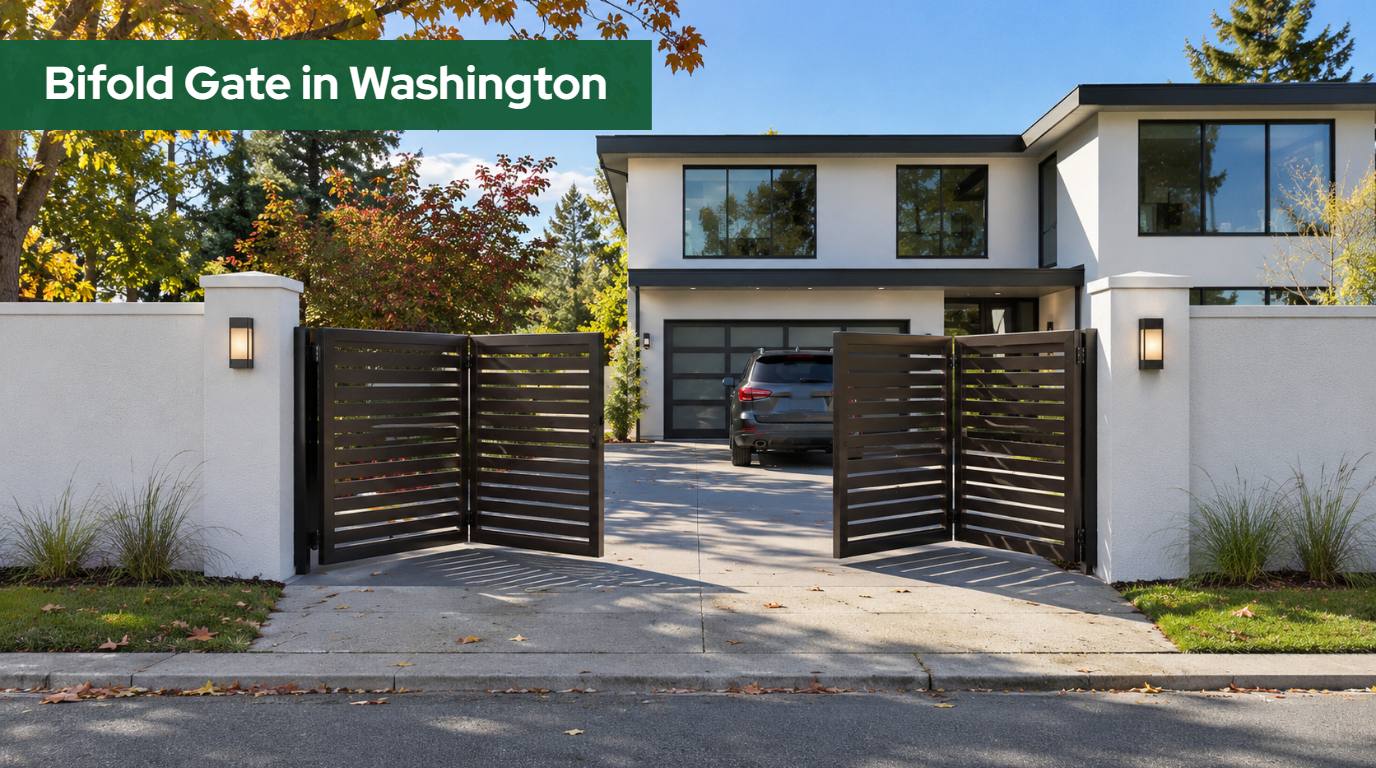
A bifold gate in Washington is usually the answer to one specific problem: the driveway is too short for a swing gate and the property line is too crowded for a slide gate. Each leaf is split into two panels joined by a hinge, so the gate folds in half as it opens and needs roughly half the swing room of a conventional gate.
That space saving comes with trade-offs that brochures rarely mention. A bifold has more hinges, more pinch points and more panel area facing the wind than a plain swing gate. The safety standard groups it with slide gates, not swing gates, which changes the sensors it needs. And at least one Washington fire code that governs gates across fire access roads does not list bifold gates among the accepted types. This guide covers how bifolds work, when they fit, the rules that apply and what to plan before anyone digs a footing in Skagit, Whatcom, Snohomish, Island, San Juan, King or Pierce County.
Quick answer
A bifold gate folds each leaf in half as it opens, so it needs about half the clear space of a swing gate. It suits short driveways and tight setbacks. In Washington, the operator must be UL 325 listed, the gate must meet ASTM F2200, and fire access gates need local fire marshal approval.
In this guide
- What a bifold gate is
- How a bifold gate opens: tracked and trackless
- Bifold vs. swing, slide and vertical pivot
- How much space a bifold gate needs
- UL 325 safety rules for bifold gates
- ASTM F2200 and how the gate is built
- Fire access roads and bifold gates in Washington
- Wind, rain and snow in Western Washington
- Bifold gate openers and hardware
- Materials and design choices
- Posts, footings, wiring and site prep
- Maintenance and what wears first
- What drives the cost of a bifold gate
- Planning checklist
- How we approach bifold gate projects
- Frequently asked questions
What Is a Bifold Gate in Washington Driveways?
A bifold gate is a swinging gate whose leaf is made of two panels hinged together. One panel is hinged to the post like a normal swing gate. The second panel is hinged to the first. As the gate opens, the joint between the two panels moves inward and the panels fold against each other, a lot like a closet door on a bigger scale.
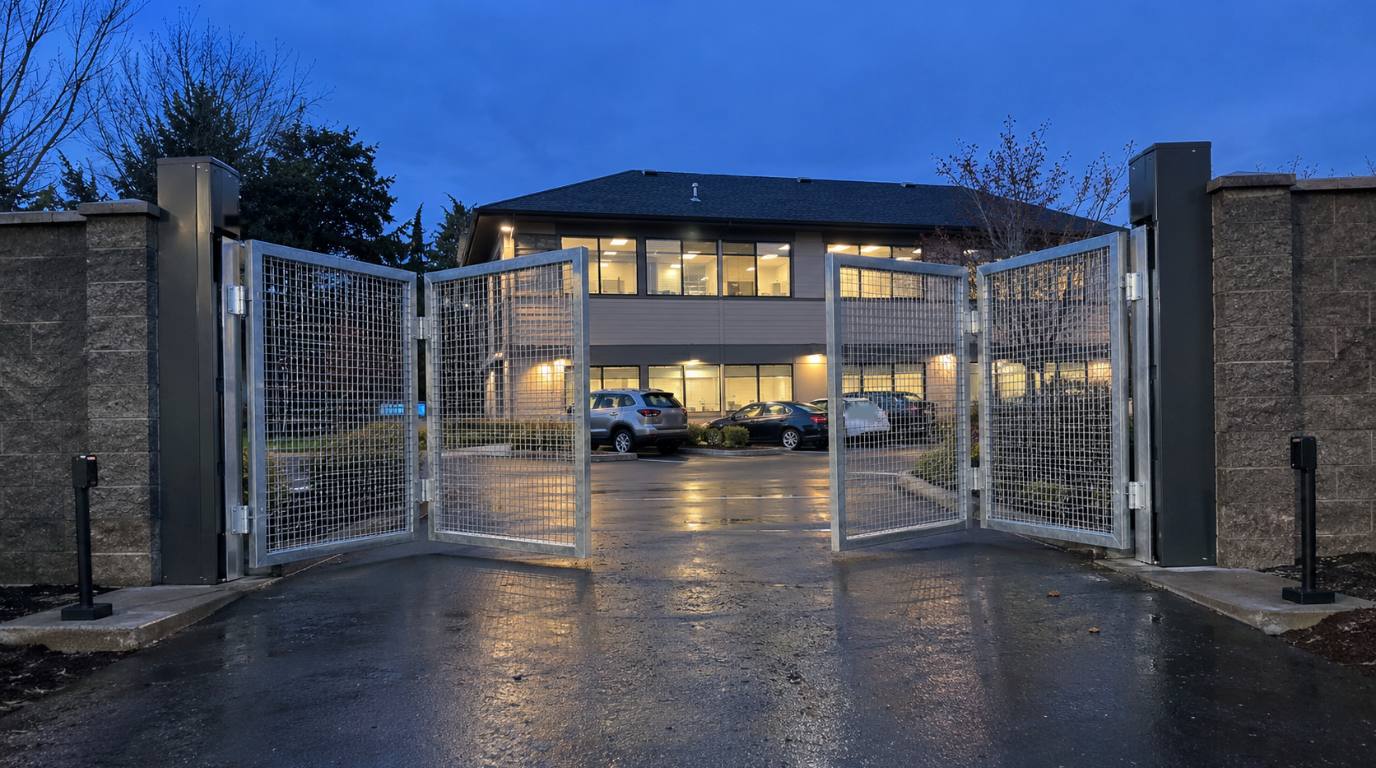
Most driveway bifolds come in one of two layouts. A single bifold has one folding leaf that covers the whole opening and stacks against one post. A bi-parting bifold, sometimes called a double bifold, has a folding leaf on each side that meet in the middle, so four panels in total. The bi-parting layout cuts the swing room again, because each side only covers half the opening.
The term gets used loosely. Some suppliers call any folding gate a bifold, including multi-panel accordion gates with three or more panels per side. In the safety standards, the category is the horizontal bifold gate, and that is the type this guide covers: panels that fold horizontally on vertical hinges, moved by an operator, across a vehicle entrance.
How a Bifold Gate Opens: Tracked and Trackless
Every automatic bifold has to solve the same problem: the operator pushes the first panel, and something has to make the second panel fold instead of just swinging out like a long, floppy leaf. There are two main ways to do it.
Tracked bifolds guide the free end of the second panel along a track or channel. The track can be in the ground, in a curb or overhead on a beam. As the first panel swings, the guide wheel or roller on the second panel follows the track, which forces the fold. Tracks give very controlled motion, but ground tracks collect gravel, leaves and ice, and overhead tracks need a beam across the opening, which limits the height of vehicles that can pass.
Trackless bifolds use a linkage arm, a second articulated arm or a gear set at the post to control the fold. Nothing crosses the driveway, so there is no track to clear of debris, no trip hazard and no height limit from a beam. The trade-off is that the hinge and linkage hardware carry more load, and the panels must be stiff enough to fold without sagging or twisting.
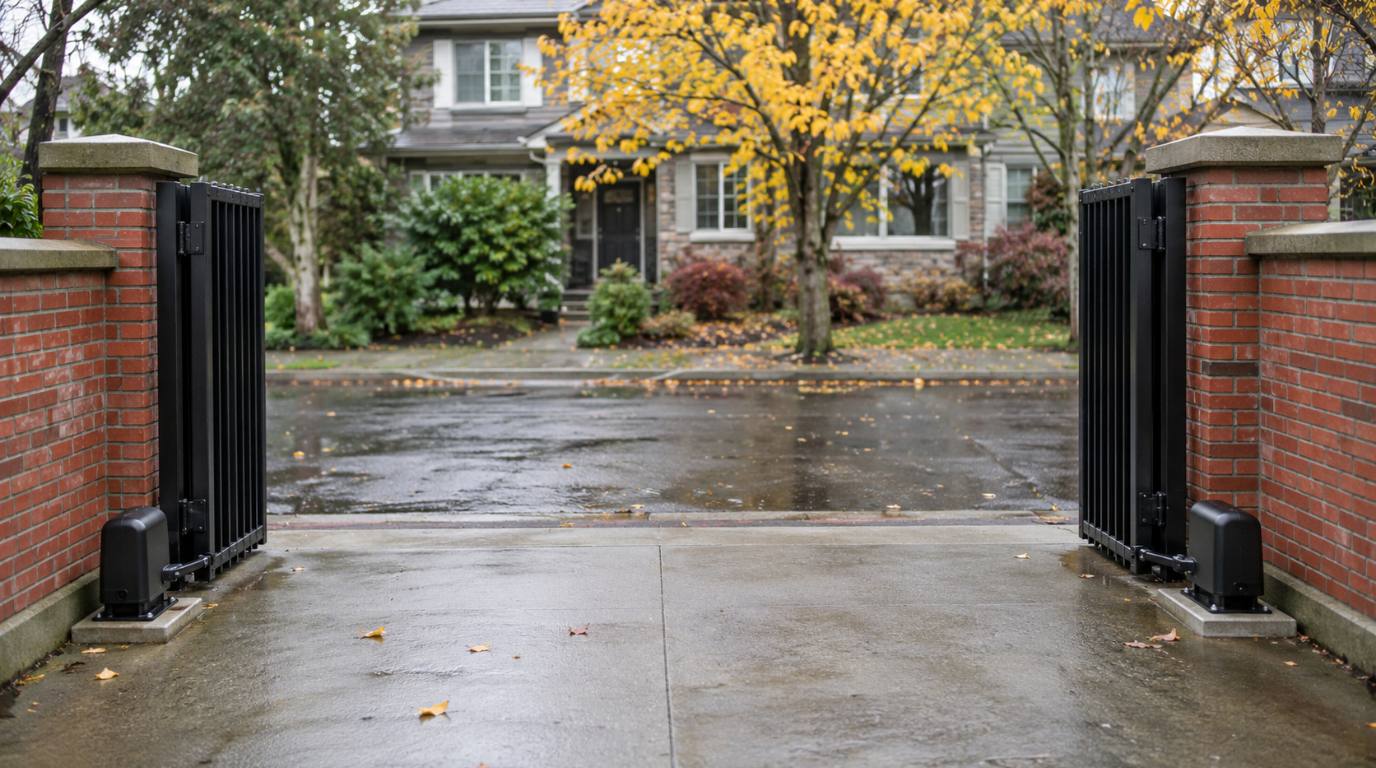
The operator itself is usually mounted at the hinge post. Some systems use a tower operator, a tall housing that contains the motor and drive and turns the first panel through a vertical shaft. Others use an articulated arm operator on the inside of the gate, similar to a residential swing gate opener, with extra hardware for the fold. A few use underground operators below the hinge post, which keep the hardware out of sight but bring the drainage concerns that come with any buried motor.
Bifold Driveway Gate vs. Swing, Slide and Vertical Pivot
The bifold is one of five gate types the safety standards recognize for vehicle entrances. Choosing between them is mostly about the space you have and the way the site is used. The table compares them for a typical Washington residential driveway.
| Gate type | Space it needs | Strengths | Watch for |
|---|---|---|---|
| Swing (single or pair) | A clear arc as deep as each leaf is wide | Simple, familiar, many operator choices | Needs room behind the gate; slope and wind load on long leaves |
| Bifold (single or bi-parting) | About half the swing depth of the same opening | Fits short driveways; opens fast; nothing crosses the road edge | More hinges and pinch points; slide-type sensor rules; fire code acceptance |
| Slide (rolling) | A run along the fence at least as long as the opening | No swing arc; good on long, level frontage | Ground track needs a level, clean path; debris and ice |
| Cantilever slide | A longer run along the fence, including the counterbalance tail | No ground track; handles gravel and snow better | Needs the most side room; heavier frame |
| Vertical pivot | Overhead clearance as the gate rises; very little side room | Very compact footprint; fast | Height clearance, power lines and trees; specialized operators |
If the driveway is short but the frontage is long and level, a slide or cantilever gate installation often beats a bifold, because it has fewer moving joints. If there is neither depth nor frontage, the choice is usually between a bifold and a vertical pivot gate. Our comparison of sliding gates and swing gates in the Pacific Northwest covers the two most common types in more detail.
How Much Space Does a Bifold Gate Need?
The space a bifold needs follows from simple geometry. A swing leaf sweeps a quarter circle whose radius is the leaf width. A bifold leaf made of two equal panels folds so that the moving joint travels inward, and the folded pair ends up projecting roughly one panel width from the post, which is about half the leaf width.
A worked example makes it concrete. Take a 16-foot opening:
- Single swing gate: one 16-foot leaf sweeps about 16 feet deep into the property.
- Pair of swing gates: two 8-foot leaves sweep about 8 feet deep.
- Single bifold: one 16-foot leaf in two 8-foot panels folds to about 8 feet deep.
- Bi-parting bifold: two leaves of two 4-foot panels each fold to about 4 feet deep.
Those are approximate. Real clearance also depends on hinge offsets, panel thickness, the operator arm or tower, and the folded stack sitting against the post. Add space for the gate to clear landscaping, lights, a keypad post and anything else inside the fence line. The operator manufacturer’s installation drawings give the actual numbers for a given system, and they are the ones to design to.
Stacking width matters too. When a bifold opens, the folded panels stack against each post. That stack takes up part of the opening, so the clear width you can drive through is the post-to-post width minus the stacks. On a driveway where the clear width matters, such as a fire access road or a lot where trucks deliver, measure the opening with the gate fully open, not the distance between posts. Our guide to how wide a driveway gate should be covers vehicle widths and turning room in Washington.
Slopes change the math. A bifold folding inward on a driveway that climbs behind the gate needs the ground under the whole fold path to clear the bottom of the panels. Because the joint between panels travels inward, it can hit a rising grade sooner than you might expect. Our article on building a driveway gate on a slope explains raked frames and swing-path checks that apply to bifolds as well.
Not sure your driveway has room for a swing gate?
We measure the opening, the fold path, the slope behind the gate line and where cars stop, then show you which gate types fit before anything is built.
UL 325 Safety Rules for Bifold Gates
UL 325 is the safety standard for gate operators. In Washington it is not optional: the state fire code adopted through WAC 51-54A includes IFC section 503.6, which requires electric gate operators to be listed in accordance with UL 325 and gates to be designed, constructed and installed to ASTM F2200.
The detail that surprises people is how UL 325 classifies a bifold. Table 32.1 of the 7th edition, as reprinted in the Door and Access Systems Manufacturers Association’s technical data sheet on gate operators and UL 325 (revised January 2025), places horizontal bifold gates in the same group as horizontal slide, vertical lift and vertical pivot gates. Swing gates and barrier arms are in the other group.
That grouping matters because of what each group may use for entrapment protection:
- Slide, vertical lift, vertical pivot and bifold: Type A (inherent sensing in the operator), Type B1 (non-contact sensors such as photo eyes), Type B2 (contact sensors such as safety edges) or Type D (constant-pressure controls).
- Swing and barrier arm: the same types plus Type C, which is inherent force limiting or an adjustable clutch.
So even though a bifold swings like a swing gate, it cannot rely on a Type C clutch or force limiter as one of its protection means. Table 32.2 of the same standard sets the minimum number of protection means for a horizontal bifold gate at two in the opening direction and two in the closing direction. The same type of device cannot count for both means, and every external sensor must be monitored, which means the operator checks that it is present and working on each cycle.
On a bifold, the entrapment zones are not only at the leading edge. The fold joint closes like scissors as the gate opens, the panels sweep an arc inside the property, and the folded stack closes against the post. Each of those zones has to be protected the way the operator’s instructions describe. That often means photo eye installation across the opening and the swing path, plus a gate safety edge on leading or folding edges, all of models the operator manufacturer names as compatible.
A few other UL 325 provisions summarized in that DASMA sheet apply to every bifold:
- After sensing an obstruction, the gate must start to reverse within 2 seconds and travel at least 2 inches.
- Controls that open the gate must sit at least 6 feet from the gate, so nobody can reach through to press a button.
- At least two warning signs must be posted, visible from both sides of the gate.
- Vehicle gate operators are for vehicle gates only. People need a separate pedestrian gate, which is why many bifold driveways sit next to a walk gate.
- The operator has a usage class, from Class I for homes of one to four families to Class IV for guarded industrial sites, and it must match the site.
Our overview of UL 325 compliance and ASTM F2200 explains these rules for every gate type, including how the standards were revised over the years.
ASTM F2200 and How a Bi-Fold Gate Is Built
UL 325 covers the operator. ASTM F2200 covers the gate itself. The current edition, ASTM F2200-24, lists the gate types it addresses: horizontal slide, horizontal swing, vertical lift, vertical pivot, overhead pivot and horizontal bifold gates. A bi-fold gate is therefore inside the scope of the construction standard, not a gray area.
The full text of the standard is sold by ASTM, and the detailed construction requirements differ by gate type. A few principles run through it and matter for any bifold:
- No openings that trap hands, arms or heads where the gate moves past posts, the folded stack or adjacent fencing. The gaps between panels, between panel and post, and at the fold joint all deserve attention.
- No sharp protrusions on the bottom edge or the faces that could catch clothing or skin as the gate moves.
- Manual latches removed on automated gates, so a latch cannot fight the operator or trap someone who tries to open it by hand.
- A gate that stays put if a hinge fails, designed so a leaf cannot fall over.
For bifolds, the panel structure carries more of the load than on a plain swing gate. The first panel holds the second one cantilevered out from its hinge, and the joint takes twisting forces every time the gate folds. Frames need to be square and stiff, hinges rated for the panel weight, and the panels balanced so the fold stays level. A bifold built from two off-the-shelf swing panels hinged together rarely holds alignment for long.
Fire Access Roads and Bifold Gates in Washington
This is the part that can stop a bifold project, and it is specific to the jurisdiction. When a driveway or private road is also a fire apparatus access road, the gate across it must satisfy the local fire code, not only the safety standards.
Appendix D of the International Fire Code lists the gate types accepted on fire apparatus access roads, and some Washington cities adopt it with local amendments. The 2021 Seattle Fire Code Appendix D, section D103.4, is a clear example. It says gates securing fire apparatus access roads shall be of the horizontal swing, horizontal slide, vertical lift or vertical pivot type. A bifold is not on that list.
The same section sets other requirements that affect bifolds:
- A single gate must be at least 20 feet wide, and a gate on a divided roadway at least 12 feet. Access roads serving no more than two Group R-3 or Group U occupancies need an unobstructed width of at least 12 feet.
- The gate must be made of materials that allow manual operation by one person.
- Electric gates must have a means of opening by fire department personnel for emergency access, approved by the fire code official.
- Gate components must be kept in working order and repaired when defective.
Outside Seattle, rules come from the city or county that has the property. Skagit County’s driveway and access road standards, updated in 2018, say security gates across fire access roads must be approved by the Skagit County Fire Marshal and must have an approved means of emergency operation by fire personnel. Other counties and cities in our service area have their own versions.
The practical advice: if the gate crosses a fire access road, ask the fire marshal before choosing a bifold. Describe the gate type, the clear open width measured past the folded stacks, the emergency opening method and the manual release. Some officials accept a bifold as an alternative with the right details; others will point you to a swing or slide gate. Our guide to fire department gate access in Washington covers Knox boxes, key switches, strobe sensors and how the rules differ from city to city.
Wind, Rain and Snow: Bifolds in Western Washington Weather
Western Washington weather is hard on any moving gate, and bifolds have a few specific weak spots.
Wind. A solid bifold leaf is a sail with a hinge in the middle. When it is half open, wind can push the two panels in different directions and load the fold joint and the operator in ways a single swing leaf does not. Design wind speeds published by local building departments in our area run from 98 mph in Seattle under the 2021 Seattle Residential Code to 110 mph in San Juan County, Island County and the City of Snohomish, and 115 mph (ultimate) in Oak Harbor. The Torxun QuickFold specification sheet, from a California maker of folding gate systems, recommends picket or perforated panels for airflow. The reason is simple: an open face lets gusts pass through instead of loading the fold joint and the operator. Our guide to driveway gates for windy areas in Washington goes deeper on panel design and operator sizing.
Rain. Annual precipitation normals from NOAA for 1991 to 2020 are 48.53 inches at Sedro-Woolley and 71.24 inches at Concrete, and November is the wettest month at every station we checked across the region. Water collects in hinge barrels, pools around tower operators set low and soaks wood panels. Hinges with grease fittings, drained operator housings and sealed or well-finished panels make a difference. Ground tracks in tracked bifolds need drainage so they do not fill with water and silt.
Snow and ice. A bifold sweeps an arc inside the property, and that arc must be clear for the gate to open. Plowed snow, ice ridges and frozen slush in the fold path can stop the gate or overload the operator. Nights at or below freezing average 58.6 per year at Bellingham International Airport, the most of the stations in our climate data, so ice is a real concern in Whatcom County. Trackless bifolds avoid a frozen track, but the swing area still needs to be shoveled or kept clear. Our article on driveway gates for snow in Washington covers heaters, sensor placement and plowing around gates.
Our Northwest Washington gate climate atlas collects the rain, freeze, snow, frost depth and design wind data by station and county.
Need a gate that keeps working through a Northwest winter?
We plan panel design, drainage and clearances for wind, rain and snow at your entrance, and check fire access rules with you before a design is final.
Bifold Gate Openers and Hardware
A bifold gate opener has to do more than a standard swing opener. It moves a leaf whose shape changes as it travels, and it has to be listed for that use. When you compare operators, ask the manufacturer for documentation that the operator is listed under UL 325 for horizontal bifold gates, and for the list of compatible entrapment protection devices it names, since the standard requires manufacturers to specify those by brand and model.
Published specifications give a sense of what the equipment looks like. Torxun’s Model 3 tower operator brochure, revised in November 2022, describes a UL 325 listed tower operator for folding and swing gates with a 1/3 HP DC motor, a 90-degree opening time of 13 seconds with a 7-second option, continuous duty, and maximums of 1,200 pounds, 24 feet wide and 15 feet high, on 110 volt, 20 amp power. The company’s QuickFold sheet lists a maximum leaf of 6 feet wide by 15 feet high, a minimum leaf width of 3 feet, a maximum leaf weight of 600 pounds and a maximum post-to-post opening of 24 feet 8 1/4 inches, with either a guided track or a trackless arm. Those are figures for one manufacturer’s commercial system, not limits that apply to every bifold, but they show the scale of hardware involved.
Beyond the operator, the hardware list for a bifold includes:
- Post hinges rated for the full leaf weight, including the cantilevered second panel.
- Fold hinges between panels, heavy enough to resist sag and twist over thousands of cycles.
- A guide system: a track and guide wheel for tracked designs, or a linkage arm for trackless ones.
- Stops and a lock where the leaves meet, often an electric lock or a positive stop that holds the leaves against wind.
- Entrapment protection devices that the operator manufacturer names as compatible.
- Vehicle detection, such as loops or exit wands, sized so the gate does not close on a car still in the fold area.
- Battery backup and a manual release that one person can use.
Our swing gate opener guide for Washington covers arm, articulated and underground operators that share parts of their design with bifold systems.
Materials and Design Choices for a Bifold
Because each panel carries part of the leaf and the fold joint takes twisting loads, material choice affects a bifold more than a plain swing gate.
Aluminum is light, which helps the hinges and the operator, and it does not rust in the wet Northwest climate. It needs a frame design stiff enough to keep the panels square. Powder-coated aluminum with horizontal slats or vertical pickets is a common choice for modern homes.
Steel is stiffer and stronger, which suits wider openings and commercial use, but it adds weight to every panel. In Western Washington, steel needs galvanizing, a good coating system and attention to drainage in hollow sections so water does not sit inside the frame.
Wood, such as Western Red Cedar, gives a warm look, but it moves with moisture and adds weight. On a bifold, cedar usually works best as infill in a steel or aluminum frame, so the frame holds the geometry and the wood stays decorative. Our guide to the cedar driveway gate in Washington covers species, finishes and fasteners for wet climates.
Design choices that help a bifold work over time:
- Equal panel widths on each leaf, so the fold is balanced. Unequal panels change the swing room and the loads.
- Open or partly open faces, pickets or slats with gaps, to cut wind load.
We design and fabricate custom gates in our own shop in Sedro-Woolley, in wrought iron, laser-cut steel and Western Red Cedar. Our custom gate design page shows the materials and styles we work with.
Posts, Footings, Wiring and Site Prep
The hinge posts on a bifold carry the full leaf, including the second panel hanging off the first. They also resist the twisting forces when the fold moves. Post size, footing depth and the way the post is anchored are engineering decisions, not guesswork.
Footings. Footing depth must at least reach below the local frost depth. Published frost depths in our area include 12 inches in San Juan County, Island County, Oak Harbor, Seattle and Lakewood, and 18 inches in the City of Snohomish. We did not find a published frost depth in the Skagit or Whatcom County handouts, so we ask the building department for the address. Wind and gate weight often push footings deeper than frost alone would. Our guide to gate post installation in Washington covers footing types and depths.
Tower and pad. A tower operator needs a solid pad and anchor bolts set to the manufacturer’s template. Set it slightly above grade, with drainage, so it does not sit in standing water during a wet November.
Utilities. Before digging, Washington’s underground utility law, RCW 19.122, requires a locate request through the 811 system. Driveway entrances often hide water lines, power to outbuildings and communication cables close to the surface.
Power and wiring. Line-voltage wiring to the operator, low-voltage runs to sensors and keypads, and conduit under the driveway for the second side of a bi-parting gate should all be planned before paving. Electrical work in Washington is regulated by the Department of Labor and Industries, and a permit is usually needed for new circuits. Our article on gate opener wiring in Washington explains wire sizes, conduit and who can do the work.
Paving and grade. The fold path inside the gate must stay at or below the bottom of the panels as they travel. Set the paving grade, drainage and any curbs before the gate is hung, not after. A small rise across the fold path can be enough to make a bifold drag.
Maintenance: What Wears First on a Bifold
A bifold has more moving parts than a single swing gate, so a regular maintenance schedule pays off. What to check first on any folding gate:
- Fold hinges. These take the most wear. Look for play, sag, squeaking and uneven gaps between panels.
- Alignment. Watch the gate fold and close. The panels should fold flat, the leaves should meet evenly in the middle, and the bottom edge should stay level.
- Guide hardware. On tracked gates, clean the track and check the guide wheel. On trackless gates, check the linkage for wear, bent parts and loose fasteners.
- Entrapment protection. Test the photo eyes and edges as the operator’s instructions describe. Clean the lenses, check that edges are intact, and confirm the gate reverses.
- Operator and battery. Check for water inside the housing, corrosion on terminals and the condition of the backup battery, especially before winter.
- Panels. Look for loose slats or pickets, failing finish, rust on steel and moisture damage on wood.
Small problems on a bifold spread quickly. A loose fold hinge lets the second panel drop, the panel drags, the operator works harder, and the next storm finishes the job. Catching that early is usually a quick adjustment. Our seasonal automatic gate maintenance guide lays out what to check through the year in Washington.
Folding gate dragging, sagging or reversing for no reason?
We check fold hinges, alignment, sensors and the operator, and tell you what needs adjusting and what needs repair.
What Drives the Cost of a Bifold Gate
We do not publish prices for custom work, because every entrance is different. What we can do is explain what moves the number, so you can compare quotes on the same basis.
- Single or bi-parting. A bi-parting bifold has four panels, more hinges and usually two operators or drives.
- Opening width and height. Larger panels need heavier frames, hinges, posts and operators.
- Material and design. Aluminum, steel, cedar infill and custom patterns all change fabrication time.
- Tracked or trackless. Tracks add concrete and drainage work; trackless systems add linkage hardware.
- Operator type and duty. Tower, arm or underground operators, residential or commercial class.
- Safety devices. The number of photo eyes and edges depends on the entrapment zones of the layout.
- Site work. Footings, pads, conduit under paving, trenching, power and grade corrections.
- Access control and fire access. Keypads, intercoms, emergency opening devices and anything the fire marshal requires.
Our guide to the automatic driveway gate cost in Washington State explains how these factors add up for automatic gates in general.
Planning Checklist for Bi Folding Gates for Small Driveways
- Measure the opening post to post, and estimate the clear width with the folded stacks in place.
- Measure the space behind the gate line and walk the fold path with a tape: walls, steps, cars, slope.
- Decide single or bi-parting, and tracked or trackless.
- Ask whether the driveway is a fire access road. If it is, talk to the fire marshal before choosing a bifold.
- Choose an operator listed under UL 325 for bifold gates, in the right usage class.
- Plan two entrapment protection means in each direction with devices the operator manufacturer names, and no Type C clutch counted as one of them.
- Keep controls at least 6 feet from the gate and post warning signs on both sides.
- Add a separate pedestrian gate if people walk in.
- Choose open panels on exposed sites, and design for local wind speeds.
- Plan footings, a drained operator pad, conduit and power before paving, and call 811 before digging.
- Plan for winter: drainage at hinges and pads, and a clear fold path in snow and ice.
- Set a maintenance schedule for fold hinges, alignment and sensors.
How We Approach Bifold Gate Projects
Emerald Gate Systems is a family-owned gate company based at 7557 Alpine Lane in Sedro-Woolley, Washington. Our team has more than 15 years in the trade, and the same people handle CAD planning, welding, installation, automation, access control, testing and future service, so the gate is not handed between separate companies.
When a customer asks about a bifold, we start with a free on-site consultation and measure before recommending anything. We map the opening, the space behind the gate line, the slope, where cars park and how the approach meets the road. If a plain swing or slide gate fits, we say so, because fewer moving joints means less to maintain. If the bifold is the right answer, we plan the panel layout, the operator, the entrapment zones and the site work together, and we check fire access requirements with the local fire marshal when the driveway serves as a fire access road.
We install and service LiftMaster, Viking and FAAC operators, and we fabricate gates in hand-forged wrought iron, laser-cut steel and Western Red Cedar. Our automatic gate installation page describes the full process. We serve Skagit, Whatcom, Snohomish, Island, San Juan, King and Pierce counties.
Washington requires contractors to show their registration in advertising: Emerald Gate Systems is registered with the Washington State Department of Labor and Industries as a construction contractor (EMERAGS748D6) and holds an electrical contractor license in the Doors and Gates specialty (EMERAGS747KE).
Frequently Asked Questions
What is a bifold gate?
A bifold gate is a swinging gate whose leaf is split into two panels joined by a hinge. As the gate opens, the joint moves inward and the panels fold against each other, so the gate needs about half the swing room of a conventional gate. A bi-parting bifold has a folding leaf on each side, four panels in total.
How much space does a bifold driveway gate need?
Roughly half the depth of a swing gate for the same opening. A single 16-foot bifold leaf folds to about 8 feet deep, and a bi-parting bifold across 16 feet folds to about 4 feet. Hinge offsets, panel thickness and operator hardware add to those figures, so design to the manufacturer’s drawings.
Are bifold gates allowed on fire access roads in Washington?
It depends on the jurisdiction. The 2021 Seattle Fire Code Appendix D lists horizontal swing, horizontal slide, vertical lift and vertical pivot gates for fire apparatus access roads, and bifolds are not on that list. Skagit County requires Fire Marshal approval for security gates across fire access roads. Ask the local fire marshal before choosing one.
What safety sensors does a bifold gate opener need?
UL 325 requires at least two independent entrapment protection means in each direction for a horizontal bifold gate. Bifolds are grouped with slide gates, so they can use inherent sensing, photo eyes, safety edges or constant-pressure controls, but not a Type C clutch or force limiter. External sensors must be monitored by the operator.
Is a bifold gate better than a sliding gate?
Not in general. A sliding or cantilever gate has fewer moving joints and handles wind well, but it needs a run along the fence at least as long as the opening. A bifold fits where there is neither room to swing nor room to slide. If a slide gate fits your frontage, it is usually simpler to maintain.
Can I convert my swing gate into a bifold gate?
Sometimes, but it is a redesign rather than a hardware change. The leaf must be split into two framed panels, the hinges and fold guide engineered for the extra loads, and the operator listed and set up for a bifold, with new entrapment protection. In many cases a new gate built as a bifold costs less effort to get right.