
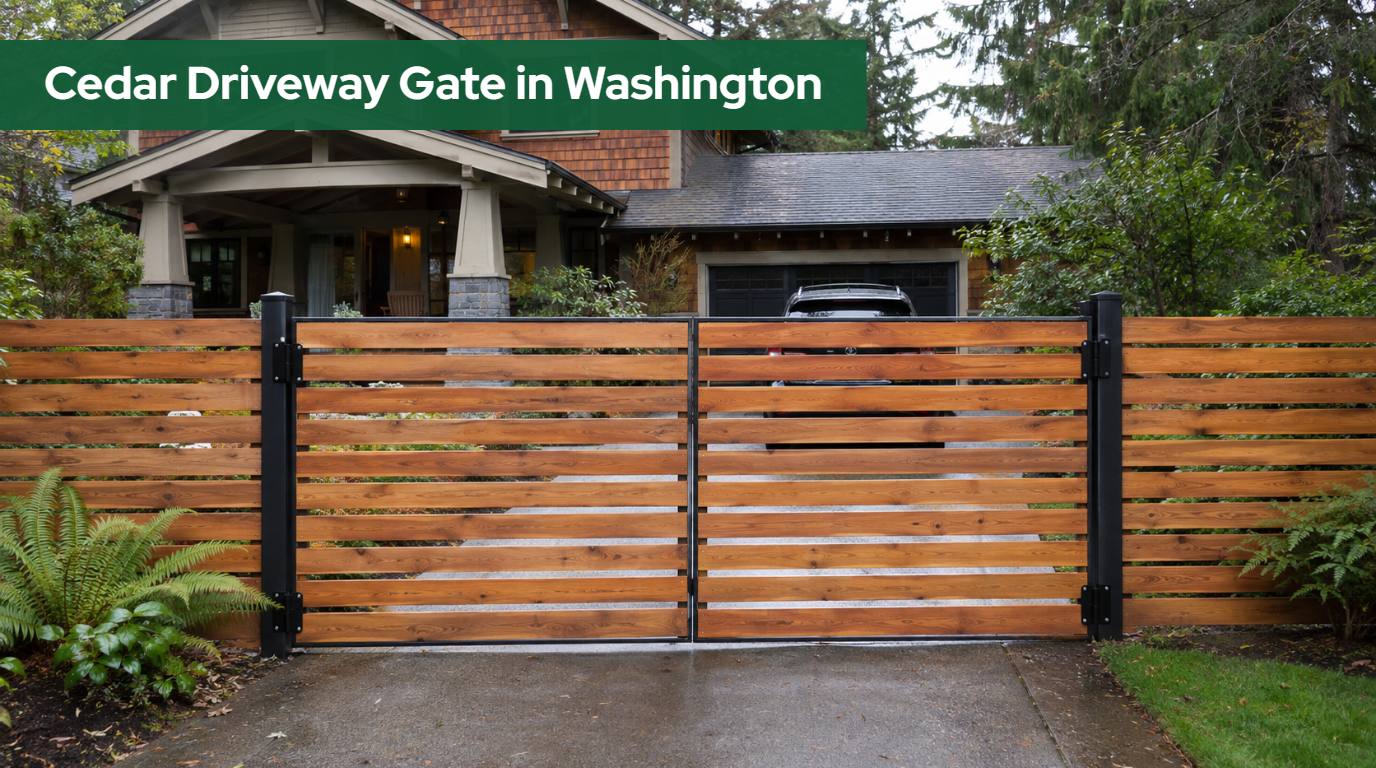
Cedar is the wood most people picture when they think of a Pacific Northwest entrance. It grows here, it smells like the woods behind the house, and it goes gray and soft-looking in a way that suits a farmhouse in Skagit County as well as a modern home in Bellingham. A cedar driveway gate in Washington can last for many years, but only when it is designed for what our climate does to wood: months of rain, shade that never lets boards dry, wind off the water and the extra weight and stress an automatic opener puts on a gate.
This guide explains what Western Red Cedar does well and where it falls short, how to choose boards, why most wide cedar gates are built on a steel frame, which fasteners and finishes hold up, how wind and automation change the design, and what Washington cities expect for height and placement. It is written for homeowners, farms and HOAs in Skagit, Whatcom, Snohomish, Island, San Juan, King and Pierce counties.
Quick answer
A cedar driveway gate in Washington works best as cedar boards over a welded steel frame, hung on steel posts with heavy hinges. Use heartwood boards, stainless or hot-dipped galvanized fasteners and a finish you will maintain. Solid cedar catches wind, so automated gates need an operator sized for it and full safety protection.
In this guide
- Why choose a cedar driveway gate in Washington
- What Western Red Cedar does well, and what it does not
- Heartwood, sapwood and grade: choosing the boards
- How Western Washington weather works on cedar
- Why wide cedar gates need a steel frame
- Posts, hinges and hardware for a cedar gate
- Fasteners: stainless or hot-dipped galvanized
- Cedar driveway gate designs that suit Washington homes
- Finishing a cedar gate: gray, stained or painted
- Solid cedar gates and wind
- Automating a cedar driveway gate
- Safety rules when a cedar gate is automated
- Height, placement and permits in Washington
- Maintaining a cedar driveway gate
- What drives the cost of a cedar driveway gate
- How we build cedar gates
- Frequently asked questions
Why Choose a Cedar Driveway Gate in Washington?
Most people who ask us for a cedar driveway gate want three things: a gate that looks warm instead of industrial, a gate that blocks the view into the yard, and a gate that matches a cedar fence, a cedar-sided house or a barn. Cedar does all three. It can be built as a full privacy panel, as spaced horizontal slats or as a classic board-and-frame farm gate, and it takes a stain, a paint or no finish at all.
There is also a local reason. Western Red Cedar is a Northwest tree. The Virginia Tech dendrology fact sheet for the species, drawing on the USDA Forest Products Laboratory’s Wood Handbook, notes that Western Red Cedar lumber is produced principally in Washington, followed by Oregon, Idaho and Montana. A cedar driveway gate in Washington is, in that sense, a regional material used close to where it grows.
Cedar is not the right answer for every entrance, though. Compared with steel or aluminum, a wood gate needs more attention to drainage, finish and hardware, and a solid cedar gate behaves very differently in wind and under an operator than an open iron gate. The rest of this guide is about building it so those differences do not turn into a sagging, dragging or cracked gate a few winters later.
If you are still choosing between materials, our comparison of ornamental iron, steel and cedar for Washington weather explains how each one handles moisture, salt air, wind and freeze and thaw. Our page on wood gate installation and repair covers wood gates in general, including repairs on gates already standing.
What Western Red Cedar Does Well, and What It Does Not
The Wood Handbook data summarized in the Virginia Tech fact sheet gives a fair picture of the species. It is useful to read both columns, because the weaknesses decide how a gate should be built.
| Property (as described in the fact sheet) | What it means for a driveway gate |
|---|---|
| Heartwood rated resistant to very resistant to decay | Heartwood boards hold up well above ground in a wet climate, as long as water can drain and dry. |
| Very small shrinkage (about 5.0 percent tangential and 2.4 percent radial from green to oven-dry) | Boards move less with the seasons than many woods, so gaps and joints stay more stable. |
| Generally straight grained, uniform texture | Boards plane, stain and paint well and stay fairly flat. |
| Light in weight and moderately soft | A cedar face adds less weight than many hardwoods, but the surface dents and scuffs more easily. |
| Low in strength as a beam or post, low in shock resistance | Cedar is a poor choice for the structure of a wide gate or for the posts that carry it. |
| Not immune to termites and furniture beetles; resistant to preservative treatment | Keep cedar off the ground and out of soil contact rather than relying on treatment. |
Put together, the data says cedar makes an excellent face and a weak skeleton. That is why the gates that last in our area tend to share one design idea: cedar boards for the look and the privacy, and steel for the frame, the posts and the hinges.
Heartwood, Sapwood and Grade: Choosing the Boards
Not every cedar board is equal. The decay resistance people count on is in the heartwood, the reddish or pinkish brown to dull brown core of the log. The sapwood near the bark is nearly white and, according to the same fact sheet, narrow, often not over one inch wide. On a gate, that pale strip is the first place to look when choosing boards.
When we pick boards for a cedar driveway gate, we look for:
- Heartwood on the exposed faces and edges, especially along the bottom of the gate where splash and standing water are worst.
- Straight grain without large loose knots, because a knot that falls out leaves a hole in a privacy face and a weak spot in a slat.
- Dry, stable stock, so the boards do not cup or twist after they are fastened to the frame.
- Consistent thickness and width across the gate, so spacing and shadow lines look even and the hardware lines up.
- The right surface texture for the finish. A smooth planed face looks crisp; a rougher textured face holds stain longer, as the finishing section below explains.
Cedar is sold in appearance grades, from clear, knot-free boards to knotty grades with a more rustic look. Clear boards suit a modern horizontal-slat gate; tight-knot boards suit a farm gate or a cabin entrance. The grade changes the look and the price more than the durability, so the choice is mainly about the style of the property and the budget.
How Western Washington Weather Works on Cedar
Wood fails in our climate for the same reason metal does: water that stays put. A cedar gate in Sedro-Woolley, Mount Vernon or Arlington sees long wet seasons, mornings of fog and dew and, under firs and maples, shade that keeps boards damp for days. Cedar heartwood resists decay, but resistance is not immunity. Rot starts where water sits against wood and cannot dry.
On a cedar gate, those places are predictable:
- The bottom edge, close to wet pavement, gravel and leaves, and hit by splash every time it rains.
- End grain, the cut ends of boards, which soak up water much faster than the face.
- Flat horizontal surfaces, such as the top of a rail or a cap board, where water pools.
- Tight joints and overlaps, where two pieces trap a film of water between them.
- Anywhere wood touches soil, such as a post set straight into the ground.
Sun matters too, in the other direction. Ultraviolet light breaks down the surface of unprotected wood and turns cedar silver gray. On the sunny side of a gate the color changes faster than on the shaded side, so an unfinished gate may weather unevenly for a while. Real Cedar, the industry website of the Western Red Cedar Lumber Association, presents that silver gray as a low-maintenance option, but it also cautions that bare cedar left exposed even for a few weeks holds paint or stain less well if you later decide to finish it.
Island and waterfront properties add salt air, which is hard on fasteners and hardware more than on the wood itself. Our guide to the best gate materials for Anacortes and other coastal properties covers that side of the problem.
The design lesson is to let water leave. Keep the bottom of the gate off the ground, cap or bevel the top so rain runs off, leave small gaps where boards meet so they can dry, and seal the end grain when the gate is built.
Planning a cedar gate for a wet, shaded driveway?
We look at the opening, the drainage, the sun and shade on the site and the posts you have now on a free on-site visit, then explain how a cedar gate should be built for that spot.
Why Wide Cedar Gates Need a Steel Frame
A wood gate is a cantilever. On a swing gate, the whole weight hangs from one side, and gravity pulls the latch side down every day of the year. In a narrow walk gate, a wood frame with a diagonal brace can carry that load. In a driveway gate that may be ten, twelve or sixteen feet wide, the lever arm is long, the boards are often wet and heavy, and the joints of a wood frame slowly loosen. The result is the most common complaint we hear about wood gates: the gate drags at the latch side.
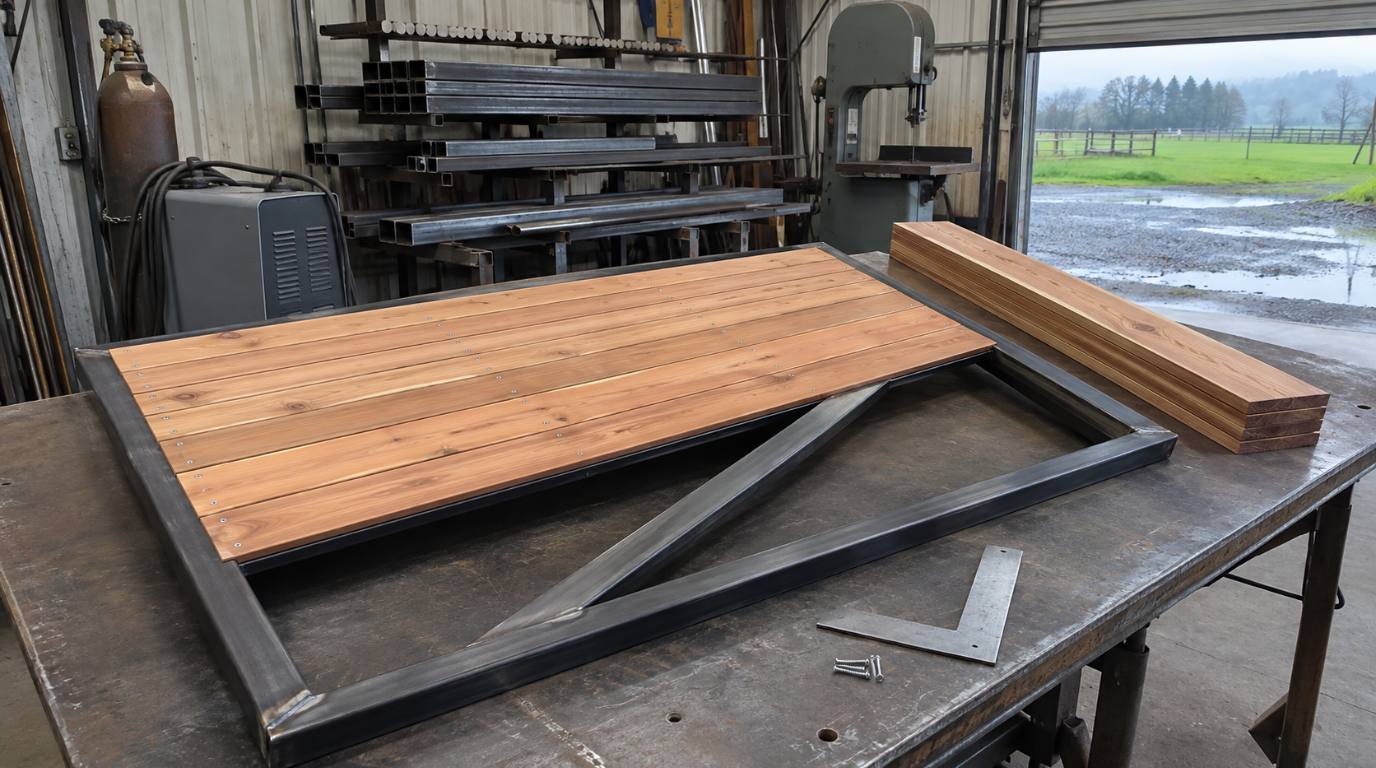
Because cedar is low in strength as a beam, a cedar frame is the weak link. That is why we usually suggest a welded steel frame with cedar on the face. The steel frame carries the load, stays square and gives the hinges, latch and operator bracket solid metal to bolt to. The cedar provides the look, the privacy and the warmth. Done well, the steel barely shows: it sits behind the boards, is set back from the edges or is finished dark to disappear against the shadow lines.
A steel frame also helps with water. Boards can be fastened with small gaps between them and with spacers off the frame, so water drains and the back of each board can dry. In a wood frame, the boards usually lie flat on the rails, which traps water along every rail.
For gates that are already sagging, our guide to sagging gate repair in Washington explains how to tell a hinge problem from a post or frame problem. Often the boards on an old cedar gate are still good and the frame is what failed; reskinning a new steel frame with the existing or new cedar can be an option.
Posts, Hinges and Hardware for a Cedar Gate
A gate is only as good as what holds it up. Many cedar gates fail at the post, not in the gate. Wood posts set directly in soil sit in the worst possible conditions for any wood, and cedar’s low strength as a post means a wide gate can lean the post over time even if it does not rot. For driveway gates, we generally recommend steel posts in concrete footings, or masonry columns, with the cedar look carried by cladding or by the fence around them.
The post has to resist the weight of the gate, the leverage of its width, wind on a solid face and, on an automated gate, the push and pull of the operator. Our guide to gate post installation in Washington covers footing depth, frost, utility locates and soil conditions in more detail.
Hinges deserve the same attention. Decorative strap hinges made of thin stamped steel look right on a rustic cedar gate, but many of them bend or wear under a heavy, wide leaf. A better approach is a heavy-duty hinge rated for the gate’s weight, welded or bolted to the steel frame and post, with decorative straps added on the face if the style calls for them.
Other hardware to plan for on a cedar driveway gate:
- A gate stop at the closed position, so the gate is not held only by the latch or the operator.
- A drop rod or cane bolt for the inactive leaf of a double gate, set into a sleeve in the driveway.
- A latch that catches without lifting the gate, and that can be reached from both sides if needed.
- An open-position stop or holdback, so wind does not slam the open leaf against a wall or car.
Hardware should be galvanized, stainless or otherwise rated for exterior use, for the same reasons fasteners are, as the next section explains.
Fasteners: Stainless or Hot-Dipped Galvanized
Cedar contains natural extractives that help it resist decay and insects. Those same extractives react with iron. Real Cedar’s guidance on fasteners says plain or poorly coated steel fasteners can rust and react with the natural oils in cedar, producing stains and streaks. On a gate, those show up as dark lines running down from every screw head, and they are difficult to clean once they form.
Real Cedar’s recommendations, written for decking but based on the same chemistry, are clear:
- Hot-dipped galvanized, aluminum and stainless steel nails are corrosion resistant.
- Stainless steel is the best choice; hot-dipped galvanized is the most widely used and economical.
- Electroplated nails are not recommended, and copper nails also react with cedar and should not be used.
- Double hot-dipped galvanized screws can be used, but stainless steel screws are recommended.
- For most applications, 304 (18-8) stainless provides adequate corrosion resistance; for salt air exposure, use 316.
On a cedar driveway gate, that translates into stainless steel screws or bolts for attaching boards to the frame, with 316 stainless on island and waterfront sites in places like Anacortes, Coupeville, Camano Island and the San Juan Islands. Screws hold better than nails on a gate that moves and vibrates every day.
Two more details matter. First, where stainless fasteners pass through a steel frame, the steel needs a sound coating, because dissimilar metals in contact with water can speed corrosion. Second, fastener holes should be placed so they do not trap water, and pre-drilled near board ends to avoid splitting, since cedar can split along the grain near the end.
Cedar Driveway Gate Designs That Suit Washington Homes
Cedar is flexible, and the same wood can look rustic, traditional or modern depending on how it is laid out. The most common designs we see for a cedar driveway gate in Washington are:
- Modern horizontal slats. Clear or tight-knot boards run horizontally with even gaps between them, often over a black steel frame. This style suits newer homes in Bellingham, Lake Stevens or Snohomish and gives partial privacy with some airflow.
- Full privacy panel. Boards are set tight or with a small overlap, so the gate is a solid face. It gives the most privacy and the most wind load.
- Board-on-board or shadowbox. Boards alternate on each side of the frame, so the gate looks solid straight on but lets air through at an angle. It is a common compromise between privacy and wind.
- Farm and ranch gates. A cedar frame look with diagonal or X bracing, often with knotty boards, at acreage in Skagit and Whatcom counties. On wide farm openings, the bracing is often steel behind the cedar.
- Cedar and metal mix. A steel frame with cedar infill, laser-cut steel panels, or a cedar lower half with a metal upper section. It combines the warmth of wood with the durability of steel where it counts.
- Arched or stepped tops. An arch, a reverse arch or a stepped top that follows a sloped driveway, framed in steel so the shape holds.
A gate should also match its surroundings. A cedar gate between stone or stucco pillars, a gate that continues the line of a cedar privacy fence, or a gate that picks up the siding color of the house all look intentional. Our collection of gate design ideas for Washington homes, farms and commercial properties shows more options.
Width and layout come first, though. Before choosing a style, measure the vehicles that use the driveway, including trailers, RVs, delivery trucks and fire apparatus. Our guide on how wide a driveway gate should be covers turning room, setbacks and single versus double leaves.
Want a cedar gate designed for your home and opening?
We draw the gate, the frame and the posts for your opening and your style, then fabricate the steel and the cedar in our Sedro-Woolley shop. Start with a free on-site consultation.
Finishing a Cedar Gate: Gray, Stained or Painted
The finish is the choice owners live with the longest, because it decides how often the gate needs work. Real Cedar’s finishing guidance lists the main options and the typical service life it expects for each:
| Finish | Look | Service life Real Cedar lists |
|---|---|---|
| No finish (weathered) | Silver gray over time | Low maintenance, but bare wood holds a later finish less well |
| Water-repellent preservative or oil | Natural color, darkens with age | 1 to 2 years |
| Semi-transparent oil-based stain | Grain shows through color | 1 to 3 years planed, 2 to 4 years textured |
| Bleaching oil | Speeds an even gray | 3 to 5 years planed, 5 to 6 years textured |
| Solid-color stain | Opaque color, some texture | 3 to 5 years planed |
| Paint over stain-blocking primer | Full color | Up to 10 to 12 years |
A few practical points for a cedar driveway gate in Washington:
- Finish all sides and ends. Real Cedar recommends applying stain to all surfaces. On a gate, that includes the back of boards that sit against the frame and the end grain, which should be sealed before assembly.
- Use a stain-blocking primer under paint or solid stain. Real Cedar recommends an alkyd stain-blocking primer, with high-quality water-based primers as an alternative, because cedar’s extractives can bleed through light colors.
- Pick a finish with a mildewcide, since mildew grows readily on shaded, damp wood in our climate.
- Textured faces hold stain longer than smooth planed faces, according to the same ranges.
- Think about recoating access. A semi-transparent stain is easy to renew with a brush; a painted gate that starts peeling needs scraping and priming first.
Solid Cedar Gates and Wind
A full privacy cedar gate is, in engineering terms, a sail. A 14-foot leaf with no gaps presents its whole face to the wind, and on exposed sites in the Skagit Valley, on Whidbey Island or in the open farmland around Lynden, winter storms push hard on that face. The load goes into the hinges, the posts, the latch and, on an automated gate, the operator and its brackets.
Wind changes the design in several ways:
- Infill choice. Spaced slats or board-on-board let air through and cut the load compared with a tight privacy face.
- Frame stiffness. A steel frame resists twisting under gusts far better than a wood frame.
- Posts and footings. They must handle not just the gate’s weight but the sideways push of wind on a large face.
- Positive stops and holdbacks, so the gate is held at both open and closed positions instead of flapping.
- Gate type. On very exposed sites, a slide gate may be easier to control in wind than a pair of swing leaves; our comparison of sliding and swing gates in the Pacific Northwest covers the trade-offs.
Our guide to driveway gates for windy areas in Washington goes into wind exposure, local design wind speeds and operator settings. For a cedar gate, the summary is simple: the more solid the face, the more structure and operator capacity it needs.
Automating a Cedar Driveway Gate
Cedar gates can be automated, and many of the gates we build are. An operator does not care what the gate looks like, but it cares a great deal about weight, width, wind, balance and how freely the gate moves. A cedar gate that drags or flexes by hand will fight an operator every day and wear it out early.
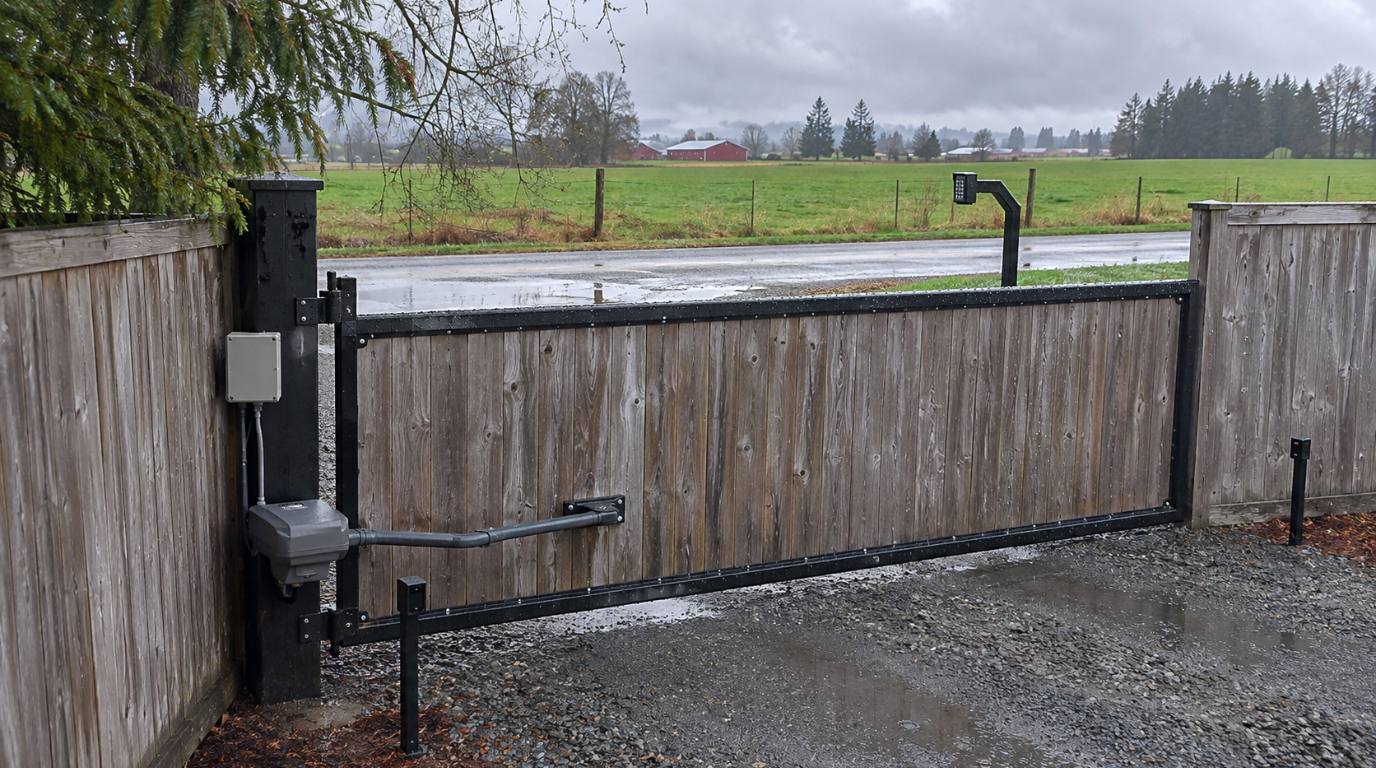
Operators are rated by both weight and leaf length, and the allowed weight drops as the leaf gets longer. LiftMaster’s installation manual for its LA412UL residential swing operator, for example, allows 850 pounds at 10 feet but only 550 pounds at 16 feet. A wide cedar privacy gate on a steel frame can approach those limits, and wind load comes on top of the static weight, so the operator choice should be made with the finished gate in mind, not just its width.
The same manual lists conditions that apply directly to wood gates:
- The gate must be level, the gate and post plumb, and the gate must swing freely and be supported entirely by its hinges, with no wheels on the bottom.
- There should be no more than 4 inches from the center of the hinge to the edge of the post or column, which affects how cedar cladding on a post is detailed.
- The operator must be mounted at least 12 inches above the ground and not where sprinklers or standing water reach the bottom of it.
- LiftMaster lists an operating temperature range of -4°F to 140°F for the LA412UL.
The operator’s arm and bracket must attach to something solid. Bolting a bracket through a cedar board alone is a common mistake: the wood crushes, the bolt loosens and the gate starts to rack. On a steel frame gate, the bracket attaches to the frame. Our guide to swing gate openers in Washington explains operator types, power options and placement, and our page on automatic gate installation covers the whole process.
Safety Rules When a Cedar Gate Is Automated
Once a cedar gate has an operator, it is a machine, and the safety rules for automatic gates apply to it the same way they apply to a steel gate. Two standards matter most. UL 325 covers gate operators and requires external entrapment protection: the operator’s built-in sensing is not enough on its own, so non-contact sensors such as photo eyes or contact sensors such as safety edges are required. ASTM F2200 covers the gate itself, including openings in the gate, guarded rollers on slide gates and placement of controls at least 6 feet away from the gate. DASMA’s gate system safety guide summarizes both.
Washington’s adopted fire code ties them together. Through WAC 51-54A, Washington adopts the International Fire Code, whose section 503.6 requires electric gate operators to be listed to UL 325 and gates to meet ASTM F2200 where gates are installed on fire apparatus access roads.
For a cedar gate, several design details come from these standards:
- Openings in the face. ASTM F2200 limits openings in automated gates using 4-inch and 2.25-inch test sizes in certain zones, so a gap between slats that looks fine on a manual gate may need to be narrowed or screened once the gate is automated.
- Sensors on a solid gate. A solid cedar leaf blocks the view, so photo eye placement and contact edges need planning. LiftMaster’s LA412UL manual places contact sensors on the leading edges of a swing gate, and on the bottom edge if the gap under the gate is more than 4 inches but less than 16 inches at any point in its arc.
- Protrusions. Decorative hardware, bolt heads and trim that stick out can catch clothing or a hand, and should be avoided or covered on automated gates.
- A separate pedestrian gate, so people walking in do not use the vehicle gate.
Our guides to UL 325 and ASTM F2200 and to gate photo eye installation in Washington go into these requirements in detail.
Automating a new or existing cedar gate?
Our licensed team sizes the operator for the gate’s weight, width and wind exposure and installs the photo eyes, edges and controls the standards call for. Ask for a free on-site consultation.
Height, Placement and Permits in Washington
Washington adopts the International Residential Code statewide through chapter 51-51 WAC, but fence and gate height limits, setbacks and permit thresholds are mostly set by each city and county through zoning and local rules. That means the same cedar gate can be fine in one town and need a permit or a lower height in the next.
Kirkland is a good example of how detailed the local rules can be. The city’s fence requirements handout says that building any fence over 6 feet in height requires a building permit. It also limits fences to 3.5 feet in the front yard on properties abutting a neighborhood access or collector street, keeps side and rear fences in required yards to 6 feet, keeps fences at least 15 feet from the street curb or pavement edge unless the property line can be shown, and limits fences over 3 feet in the sight triangle at streets and driveways.
Those numbers belong to Kirkland, not to every city, but the questions are the same everywhere:
- How tall can a fence or gate be in the front yard, and does a gate count toward that height?
- Does a gate or column above a certain height need a building permit?
- How far back from the street or the property line must the gate sit?
- Are there sight distance limits at the driveway?
- Does the fire department need access through the gate, and with what device?
- Are there HOA or covenant rules on materials and colors?
Our guide to gate permits in Washington State walks through permits, electrical work and fire access rules.
Maintaining a Cedar Driveway Gate
Cedar is forgiving, but a gate needs regular care, especially in a wet climate. Most of it is quick and can be done by the owner:
- Clear the bottom. Keep leaves, needles, gravel and soil away from the bottom edge so it can dry.
- Wash gently. Real Cedar suggests cleaning surface dirt from time to time with a mild non-phosphate detergent solution. Avoid pressure washing at close range, which can tear soft cedar fibers.
- Treat mildew before recoating. Real Cedar recommends killing mildew with an oxygen bleach solution or a commercial mildew remover, rinsing and letting the wood dry before refinishing. It also warns never to mix bleach with detergent containing ammonia, because the fumes can be harmful or fatal.
- Recoat on schedule. Renew stain before it wears through, paying attention to the top edges and the sunny side.
- Check fasteners. Look for loose screws, popped boards or dark stains that suggest a failing fastener.
- Watch the gate’s line. A gap that changes at the latch side, a gate that starts to drag or a post that leans means the structure needs attention before the boards do.
- Test automated gates. Test photo eyes and edges and the manual release regularly, following the operator manual.
What Drives the Cost of a Cedar Driveway Gate
We do not publish prices for custom gates, because every opening, site and design is different. What we can explain is what moves the cost up or down, so you can compare quotes on the same basis:
- Width and height, which decide how much cedar and steel the gate needs and how heavy it is.
- Design. A simple horizontal slat gate takes less shop time than an arched, stepped or shadowbox design.
- Board grade. Clear boards cost more than knotty grades.
- Frame. A welded steel frame adds fabrication but saves on repairs; the coating choice on the steel adds or saves too.
- Posts, columns and footings, including whether existing posts can be reused.
- Single swing, double swing or slide, and the hardware each needs.
- Automation: operator capacity, power source, battery backup, safety sensors and access control such as keypads, intercoms or remotes.
- Site conditions: slope, soil, distance to power, trenching and paving.
- Finish: factory stain, paint or natural.
For a broader look at automatic gate costs in our area, see our guide to automatic driveway gate cost in Washington State.
Ready to price a cedar driveway gate?
We measure the opening, review the site and give you a written scope for the gate, posts, hardware and any automation, so you know exactly what is included.
How We Build Cedar Gates
Emerald Gate Systems is a family-owned gate company based at 7557 Alpine Lane in Sedro-Woolley, Washington, in Skagit County. We design, fabricate in our own shop, install, automate and service residential, farm and commercial gates across Skagit, Whatcom, Snohomish, Island, San Juan, King and Pierce counties. Our shop works in hand-forged wrought iron, laser-cut steel and Western Red Cedar, so a cedar gate and its steel frame are built under one roof.
Every project starts with a free on-site consultation. For a cedar driveway gate, we look at the opening, the slope, the drainage, the wind exposure, the existing posts and the power available, then design the gate in CAD. Because one team handles planning, welding, installation, automation, access control, testing and future service, the gate, the posts and the operator are planned together. We install and service LiftMaster, Viking and FAAC operators, and our custom gate design page shows the kind of work our shop produces.
Washington requires contractors to show their registration in advertising: Emerald Gate Systems is registered with the Washington State Department of Labor and Industries as a construction contractor (EMERAGS748D6) and holds an electrical contractor license in the Doors and Gates specialty (EMERAGS747KE).
Frequently Asked Questions
Is cedar a good material for a driveway gate in Washington?
Yes, for the face of the gate. Western Red Cedar heartwood is rated resistant to very resistant to decay and moves little with moisture, which suits our wet climate. It is low in strength as a beam or post, though, so wide cedar driveway gates last longest with a welded steel frame, steel posts and heavy hinges carrying the load.
How do I keep a cedar gate from sagging?
Carry the weight on steel, not wood. A welded steel frame behind the cedar stays square, steel posts in proper footings resist leaning, and hinges rated for the gate’s weight keep the leaf in line. Keep the gate level and plumb, add a closed-position stop and fix small drops at the latch side early, before they stress the frame.
What screws should I use on a cedar gate?
Use stainless steel screws, 304 grade for most sites and 316 near salt water, or double hot-dipped galvanized screws. Real Cedar warns that plain or electroplated steel fasteners react with the natural oils in cedar and leave dark stains and streaks, and that copper fasteners should not be used. Pre-drill near board ends to avoid splitting.
Should I stain or seal a cedar driveway gate?
It depends on the look you want. Left bare, cedar turns silver gray but holds a later finish less well. Real Cedar lists 1 to 3 years for semi-transparent stain on planed wood, 3 to 5 for solid stain and up to 10 to 12 for paint over a stain-blocking primer. Finish all sides and seal end grain.
Can a cedar driveway gate be automated?
Yes. The operator must be rated for the gate’s weight and leaf length, since allowed weight drops as leaves get longer, and solid cedar adds wind load. The gate must swing freely on its hinges and be level and plumb. Operator brackets should attach to a steel frame, and UL 325 sensors and ASTM F2200 rules apply.
Do I need a permit for a cedar gate in Washington?
It depends on the city or county. Washington adopts the residential building code statewide, but height limits, setbacks and permit thresholds are local. Kirkland, for example, requires a building permit for any fence over 6 feet and limits front yard fences on some streets to 3.5 feet. Automated gates may also need electrical permits and fire access approval.