
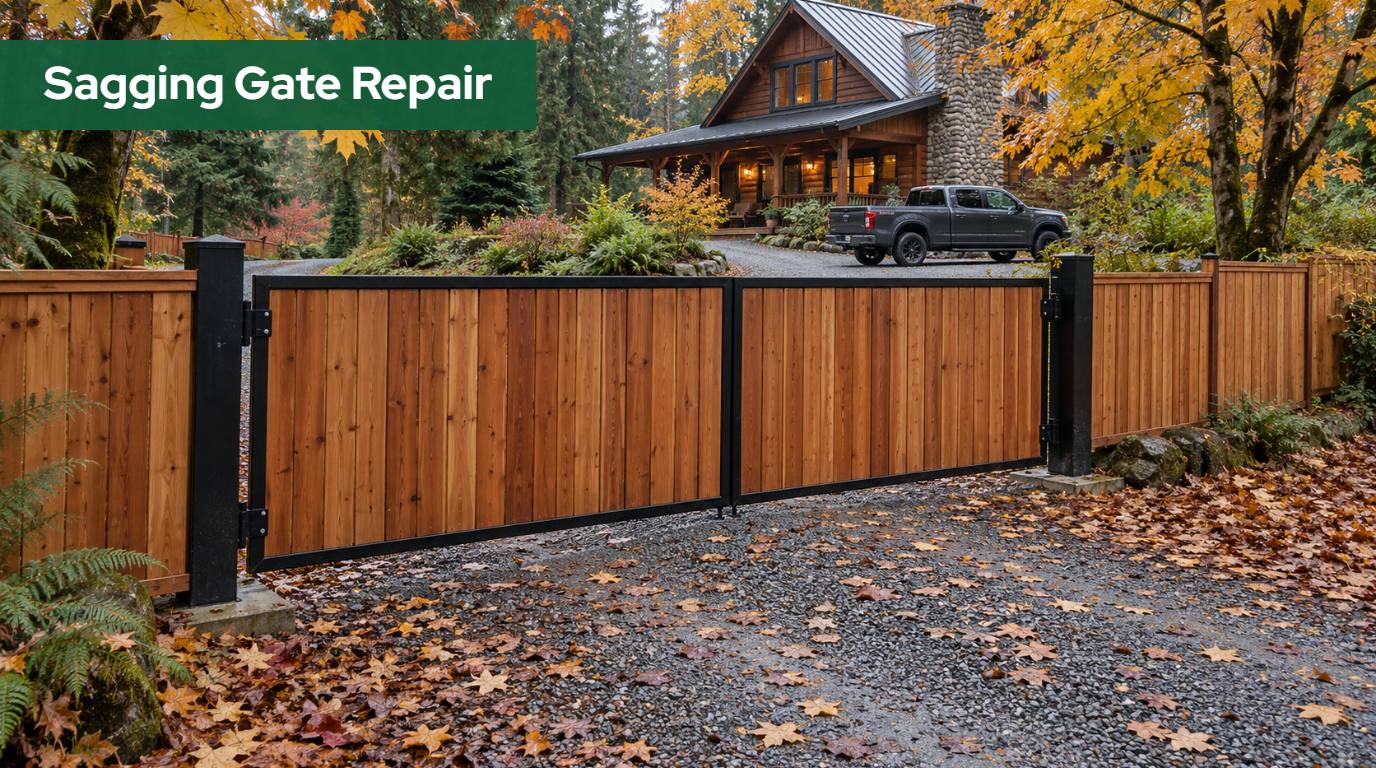
Sagging gate repair in Washington usually starts the same way: a gate that used to swing shut with one hand now drags on the gravel, the latch no longer meets the keeper, and someone has to lift the end of the gate every time it closes. On an automatic gate the first sign is often different. The opener starts stopping and reversing for no clear reason, or it works in August and struggles in January. In both cases the gate is telling you that something in the hinge side has moved, and the fix depends on finding out what moved before anyone adds a brace or a new hinge.
This guide covers why gates in Western Washington drop, how to check the post, hinges and frame in order, which repairs hold, and what a sag does to an opener. It is written for homeowners, farms and HOA boards in Skagit, Whatcom, Snohomish, Island, San Juan, King and Pierce counties.
Quick answer
A sagging gate drops at the latch end because the hinge post leans, the hinges are worn or loose, or the frame has racked out of square. Check them in order. In Washington, wet soil and rot at the post base are common causes. On automatic gates, the gate must be level and swing freely before the opener is adjusted.
In this guide
- What counts as a sagging gate?
- Why gates sag in Western Washington
- A step-by-step check before any repair
- Leaning and loose hinge posts
- Worn, loose or undersized hinges
- When the gate frame itself has dropped
- Sagging gate repair options compared
- Sagging wood gate repair
- Steel, iron and aluminum gates that drop
- What a sag does to an automatic gate opener
- Safety rules that apply to repairs in Washington
- What you can fix and what needs a pro
- Preventing the next sag
- Repair or replace?
- How we approach sagging gate repair in Washington
- Frequently asked questions
What Counts as a Sagging Gate?
A gate sags when the free end, the latch side of a single gate or the meeting edges of a double gate, sits lower than it did when the gate was hung. The drop can be a fraction of an inch or several inches. What matters is not the number but the effect: once the gate is out of level, it stops closing the way it was designed to, and every cycle after that adds a little more strain to the same weak point.
The signs are easy to spot once you know them. The bottom corner on the latch side scrapes the driveway or leaves an arc in the gravel. The latch bar rides under the keeper or has to be lifted to engage. On a double swing gate, the two leaves no longer meet at the same height, and the center drop rod or cane bolt misses its hole. The gap between the gate and the latch post is wider at the top than at the bottom, or the other way around. On a wood gate, the boards may show a slight diamond shape where the frame has racked.
A true sag is progressive. It tends to show up after a wet winter, a wind storm or a bump from a vehicle. If the gate was fine last year and is worse this year, look for the cause rather than moving the latch to match. On an automated gate, a sagging leaf is heavier to move and may drag, which is why our troubleshooting guide for gates that will not open or close lists binding and drag among the first things to rule out.
Why Gates Sag in Western Washington
Gates sag everywhere, but in the Pacific Northwest the common thread is water. Months of rain soften the soil around posts, keep wood damp and work into joints, hinge pins and fasteners.
Saturated soil. A hinge post is a lever. The weight of the gate pulls on the top of the post, and the soil around the footing has to resist that pull. When the ground is soaked, it resists less. On heavy valley soils and silty floodplain ground the water table can sit close to the surface for much of the winter; the USDA soil series description for the Skagit series, a common soil in the Skagit valley, describes a seasonal high water table close to the surface from November through March. A post footing in that kind of ground can creep a little each winter until the gate drops.
Shallow or undersized footings. Many gate posts are set like fence posts, even though a hinge post holds a whole gate leaf hanging off one side, plus the leverage of that leaf swinging. Footing depth is set by the local building department; Skagit County’s own design criteria map, for example, lists a frost depth of 12 inches for Skagit County along with its other design values, and a gate post footing is normally designed well beyond the bare minimum because of the leverage involved.
Rot at the base of wood posts. Wood decays when it stays wet. The worst spot on any wood post is the zone right at grade, where the wood meets the soil or the top of the concrete collar, because water collects there and dries slowly. A post that looks sound above ground can be soft an inch below the surface. When it gives way, the gate drops with it.
Wind on solid gates. Privacy gates in cedar, composite or solid steel act like a sail. The same county design map lists a design wind speed of 85 mph for Skagit County, and island and waterfront properties on Whidbey, Camano and the San Juans see strong gusts off the water. A solid gate slammed by gusts puts sudden loads on its hinges and post.
Wet hinges and corroded fasteners. Ungreased hinge pins wear faster in wet weather, screws in damp wood lose their grip, and rust at a hinge knuckle adds friction and play. Our guide to gate materials for Washington weather goes deeper into how each material handles the rain.
A Step-by-Step Check Before Any Repair
The biggest mistake with a sagging gate is fixing the symptom. Moving the latch or adding a wheel can make the gate close for a while, but if the post leans, the sag returns. A short check in the right order avoids that.
1. Look at the gate closed, from a distance. A wedge-shaped gap at the latch post, wider at the top or the bottom, tells you something has rotated.
2. Check the hinge post for plumb. Hold a level on two adjacent faces. Look for cracked soil or a tipped concrete collar around the base.
3. Push on the post. With the gate closed and supported, push the top of the hinge post by hand. A sound post in a sound footing should not move. If it rocks, the footing or the post base has failed, and no hinge work will hold until that is fixed.
4. Check the hinges. Lift the latch end gently and watch for play at the pins, straps pulling away or bolts moving in their holes.
5. Check the gate for square. Measure the two diagonals of the frame. If they differ, the frame has racked.
6. Swing the gate through its full travel. A gate that swings easily one way and hard the other is out of balance, usually because the hinges are out of line.
Write down what you find and take photos of each hinge and the post base; they help a technician bring the right parts. On an automatic gate, do this check with the opener in manual release.
Is It the Post? Leaning and Loose Hinge Posts
On most sagging gates we see, the post is part of the problem. A hinge post can fail in three ways: the whole footing tips in the soil, the post rots or corrodes at its base, or the post itself bends or twists above ground. Each one calls for a different repair.
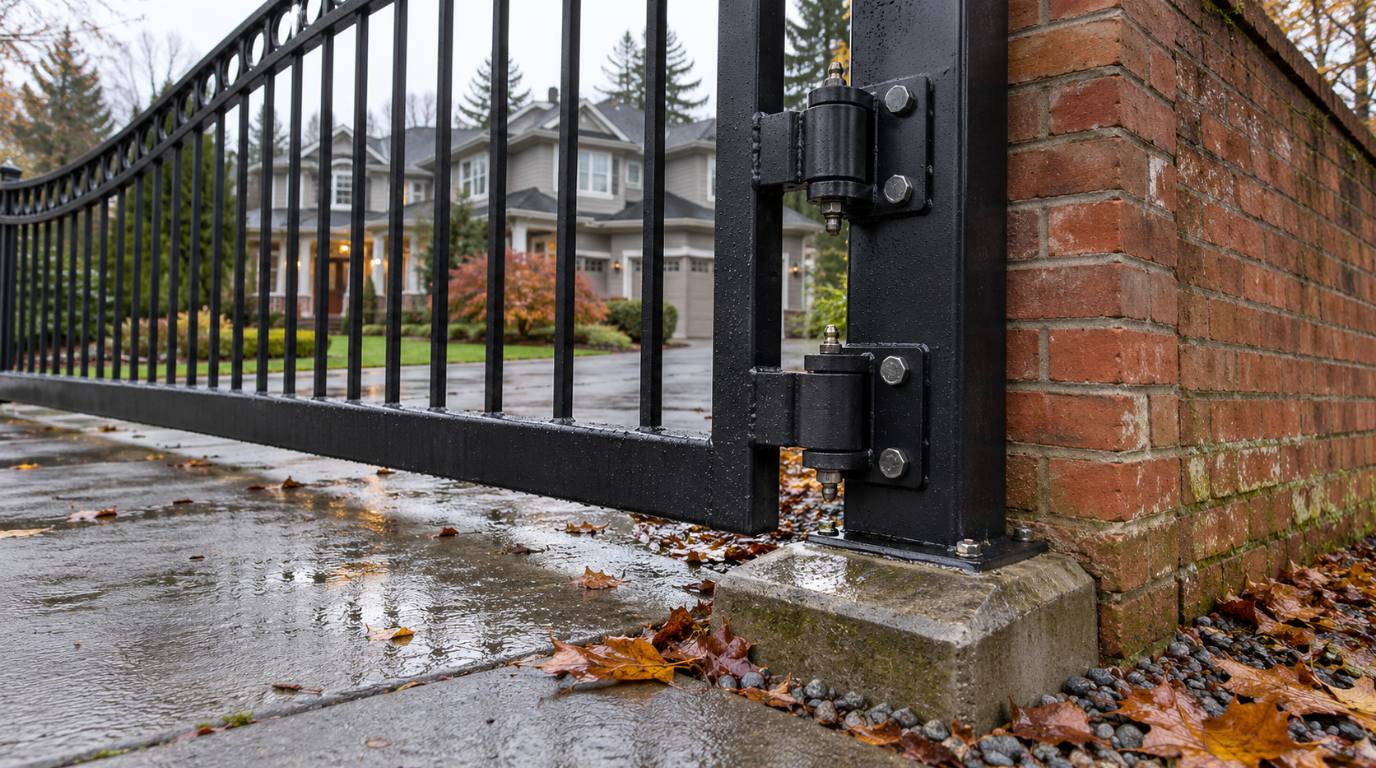
Footing tipped in the soil. The post and its concrete have rotated together. The concrete may still be intact, but the soil around it has given way, often on the side away from the gate. Straightening the post without addressing the footing usually fails, because the soil that let it tip is still there. A lasting repair typically means excavating the footing, resetting the post plumb, and pouring a larger or deeper footing that suits the gate and the soil, with drainage so water does not sit against it.
Base rotted or corroded. A wood post soft at grade, or a steel post rusted through where it meets the concrete, cannot be braced back into service. The section at the base is what carries the load. That post needs to be replaced. On wood gates many owners take the chance to move to a steel hinge post, or to a wood post clad over a steel core, which handles the wet base zone far better.
Post bending or twisting. A post can be set solidly in a good footing and still be too light for the gate. You will see it flex when the gate is lifted, or twist slightly when the gate swings. The answer is a heavier post, not more bracing on the gate.
Be wary of pulling the post back with a cable to the next fence post: it moves the load to a post never meant to carry it. On masonry or stone pillars, a leaning pillar is a structural issue that needs a mason or a structural assessment before the gate hardware is touched. If you are rethinking the whole entrance, our guide to a driveway gate on a slope covers how grade affects post and hinge layout.
Not sure if the post or the hinges are to blame?
We can check the hinge post, footing, hinges and frame on site and tell you which repair will actually hold before any work starts.
Worn, Loose or Undersized Hinges
When the post is sound, the hinges are the next suspect. Hinges sag a gate in a few ways, and each one has a typical look.
Loose fasteners. Screws and lag bolts in wood loosen as the wood shrinks and swells through wet and dry seasons. The hinge strap pulls away slightly from the post or the gate, and the gate drops at the far end. Re-tightening into the same holes rarely lasts. Through-bolts with washers on the far side, or carriage bolts through the post, hold far better than screws on any gate of real weight.
Worn pins and knuckles. On barrel hinges and strap hinges, the pin and the knuckle wear oval over thousands of cycles, especially when they are never greased. A little play at each hinge becomes a noticeable drop at the latch end, because the gate multiplies the movement over its length. Replacing worn hinges with a heavier, greaseable design usually fixes this cleanly.
Undersized hinges. Light garden gate hinges often end up on driveway gates. Heavier gates call for heavy-duty or bearing hinges whose published rating covers the real weight, including infill and hardware.
Hinges out of line. The top and bottom pins must share one vertical axis. If not, the gate swings heavy one way and binds. Realigning, sometimes with adjustable hinges, fixes balance and sag.
Hinge spacing matters too: the farther apart the top and bottom hinges are, the less force each one sees.
When the Gate Frame Itself Has Dropped
Sometimes the post is plumb and the hinges are tight, but the far end of the gate still sits low. Measure the diagonals. If one is longer than the other, the frame has racked into a parallelogram, and the gate itself has dropped.
On a wood gate, the classic cause is a brace that is missing or installed backward. A diagonal brace in compression runs from the bottom corner on the hinge side up to the top corner on the latch side, so the weight of the latch end pushes down along the brace and into the bottom hinge. When the brace runs the other way, from the top hinge corner down to the bottom latch corner, it is in tension, and a wood brace held only by nails or screws pulls apart under that load. Many sagging wood gates have a brace that was simply installed upside down.
Steel cable and turnbuckle kits work the opposite way. A cable is good in tension, so it runs from the top corner on the hinge side down to the bottom corner on the latch side, and the turnbuckle pulls the latch end back up. These kits can square a racked wood gate well, but only if the hinge post is solid. A cable kit on a leaning post pulls the post further over.
On metal gates, a racked frame usually means a failed weld, a cracked joint, a bent rail from an impact, or a frame that was too light for its length from the start. Welded steel and wrought iron frames can often be repaired by cutting out the damaged section and re-welding, adding a diagonal member or a truss, or reinforcing the hinge stile. That is shop or field welding work, and our page on welding and fabrication for custom gates explains how we handle it.
A wheel at the latch end supports a sag rather than fixing it, and on an automatic swing gate operator makers want it gone, as covered below.
Sagging Gate Repair Options Compared
The table below lines up the common causes with what you will see and the repair that usually addresses it. It is a starting point for the conversation, not a substitute for looking at the gate.
| Cause | What you see | Repair that usually holds | Quick fixes to avoid |
|---|---|---|---|
| Hinge post footing tipped | Post out of plumb, soil or concrete cracked, post rocks when pushed | Excavate, reset post plumb, larger or deeper footing with drainage | Cable to next fence post, wheel at latch end |
| Post rotted or rusted at grade | Soft wood or rust at ground line, post flexes at base | Replace the post, often with steel or a steel core | Sistering a board, bracing the gate |
| Loose hinge fasteners | Hinge straps pull away, bolts move in holes | Through-bolts or carriage bolts, new holes in sound material | Longer screws into the same holes |
| Worn hinges | Play at pins and knuckles, oval bushings | Replace with heavier, greaseable or bearing hinges | Shims behind the hinge strap |
| Hinges out of line | Gate swings heavy one way, binds at one point | Realign or fit adjustable hinges | Forcing the latch to meet |
| Wood frame racked | Diagonals unequal, boards in diamond shape | Correct compression brace or cable kit on a solid post | Brace in tension held by screws |
| Metal frame damaged | Cracked weld, bent rail, frame twist | Weld repair, added truss or diagonal, stiffer hinge stile | Bolting on a flat plate |
Causes often stack up: a leaning post wears the hinges, then the frame racks. A good repair addresses every item the check turned up.
Sagging Wood Gate Repair: Cedar and Timber Gates
Wood gates are popular across Washington for good reason. Western Red Cedar looks right on a farm, a cabin or a craftsman home, and it handles the climate better than many woods. But wood gates sag more often than metal ones, because wood moves with moisture, fasteners loosen in it, and the base of a wood post sits in the wettest zone on the property.
A few patterns come up again and again on sagging wood gates.
The gate is too wide for an all-wood frame. A wide wood gate is a long, heavy lever, and every wet season loosens its joints. Many wide wood gates hold up better with a welded steel frame inside and cedar boards on the face. From the street it reads as a wood gate; on the hinge side it behaves like a steel one. That is the approach we usually suggest for wide driveway openings.
The post rots at grade. Wood posts set directly in soil or in concrete with no drainage trap water at the base. Once the base softens, the gate follows. Replacing the post, ideally with steel, or with a wood post set so water drains away from the base, is the only real answer.
The hardware is too light. Many decorative strap hinges are thin stamped steel that bends on a heavy cedar gate. Heavier hinges behind decorative straps keep the style and carry the load.
Our page on wood gate installation and repair in Washington covers wood gate options and upkeep in more detail.
Have a cedar gate that drops every winter?
We can look at the frame, the hinges and the post and show you how a steel frame, heavier hinges or a new post would change the way it hangs.
Steel, Iron and Aluminum Gates That Drop
Metal gates do not rack from moisture the way wood does, but they still sag. The causes are usually the post, the hinges, or damage to the frame.
Wrought iron and steel. A heavy ornamental gate puts a lot of weight on its hinges and post. When those are sized right and the post sits in a proper footing, a steel gate can hang true for a very long time. When the hinge post is a light tube in a small footing, the post bends or tips first. Rust at the base of steel posts and at the hinge knuckles is the other common cause in Western Washington, especially where the finish was chipped during installation and never touched up.
Aluminum. Light frames can flex and welds on thin sections can crack. If an aluminum gate sags with no post or hinge problem, the frame may be the limit.
Impact damage. A car or tractor that clips a gate can bend a rail or crack a weld near the hinges. After any impact, check the diagonals and welds even if the gate still works.
On a custom or heirloom gate, a weld repair or added truss keeps the original work in service. Our custom gate design and fabrication page shows the shop side of what we build and repair.
What a Sag Does to an Automatic Gate Opener
Manufacturers are clear about the starting point. LiftMaster’s owner’s manual for its LA412 residential swing gate operator lists the conditions under a section titled “Check your gate”: the gate must be level, the gate and gate post must be plumb, any wheels must be removed from the bottom of the gate, the gate must not hit or drag across the ground, and the gate must swing freely and be supported entirely by its hinges. The same manual’s safety section states that the gate must be properly installed and work freely in both directions before the operator is installed.
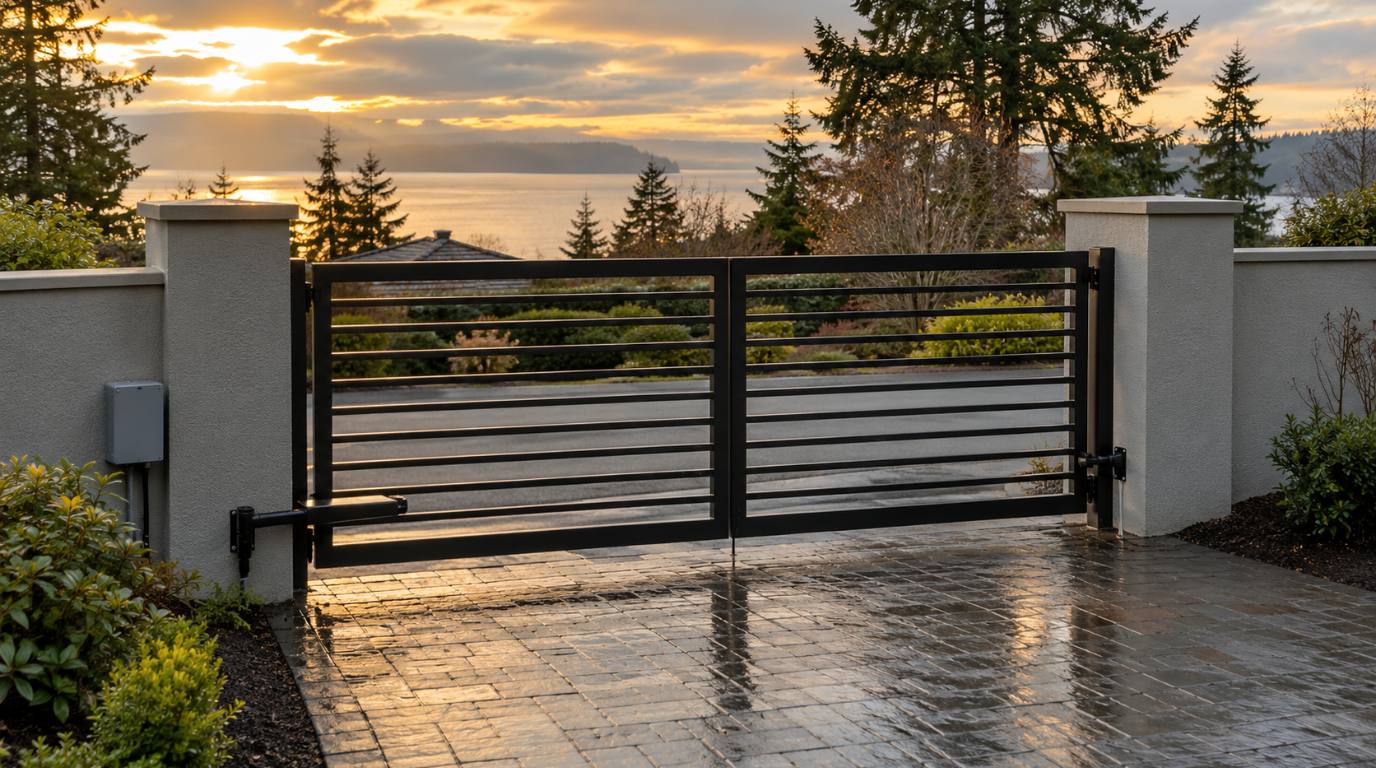
When a gate sags, several of those conditions fail at once. It may drag. It needs more force to move. It may swing harder one way than the other. The opener reads that extra resistance the way it reads an obstruction. The LA412 manual’s troubleshooting chart lists “gate is excessively heavy or hinges are bad” as a cause of problems, with the remedy to disconnect the arms, verify that the gates swing easily, and lubricate or replace hinges as necessary. It also lists an unbalanced gate, one that is harder to move in one direction than the other, and says the hinges must be adjusted in that case. The chart even notes that the force setting may need adjustment in cold weather because the gate will not move freely, which is one reason a marginal gate can work in summer and fail in winter.
The tempting fix is to turn up the force setting so the opener pushes through the extra resistance. That is the wrong answer. The force and reversing settings are part of how the system protects people and property, and raising them to overcome a mechanical problem reduces that margin. The correct order is to fix the gate first, so it is level and swings freely by hand, and then reset the opener’s limits and force to the repaired gate.
A sag also strains the arm, motor and gearbox. The LA412 manual’s warranty language excludes problems with or relating to the gate or gate hardware, including gate alignment and hinges, so damage that comes from a sagging gate is generally the owner’s to fix. For more on what wears out and when to repair or replace, see our guide on how long automatic gates last in Washington.
Finally, photo eyes and edge sensors were aligned for a gate in a certain position, and a gate that has dropped may sit differently in its travel. After any sag repair on an automatic gate, test every safety device again. Our article on gate photo eye installation in Washington explains placement and testing.
Safety Rules That Apply to Repairs in Washington
A manual gate repair is a carpentry or fabrication job. Once the gate is automated, the repair touches a system covered by safety standards and, in Washington, by the fire code and electrical licensing rules.
UL 325 and ASTM F2200. UL 325 is the safety standard for gate operators. It treats the operator’s built-in obstruction sensing as not enough on its own and requires external entrapment protection, such as non-contact photo eyes or contact edge sensors. ASTM F2200 covers the construction of the automated gate, including limits on openings and guarding of rollers. If a repair adds infill, a truss or a brace, check that it creates no new openings or pinch points. Our guide to UL 325 and ASTM F2200 gate safety standards explains both.
Fire code. Washington adopts the International Fire Code through the state building code. The Washington amendment to section 503, WAC 51-54A-0503, deals with fire apparatus access roads, and the fire code’s gate provisions call for electric gate operators listed to UL 325 and automated gates built to ASTM F2200. Fire departments and fire marshals in Washington also set local requirements for gates across access roads, such as emergency opening devices. A sagging gate that no longer opens fully or reliably can block emergency access, so on gated private roads and HOA entrances a sag is a safety issue, not only a nuisance.
Electrical work. Washington licenses electrical work on gate operators. WAC 296-46B-920 sets out the electrical contractor specialties, including the door, gate and similar systems specialty (10), which covers gate operator wiring and controls. If a sag repair means moving the operator, relocating a photo eye, rewiring a control box or adding a new device, that part of the job falls under electrical licensing.
Manual release. During the repair, the opener should be in manual release or disconnected. Our battery backup guide for Skagit County gates covers what happens when the power goes out.
Sagging Gate Repair You Can Do vs Work for a Pro
Many sags on small gates are within reach of a handy owner. Weight and automation change that.
Usually fine to do yourself on a manual gate:
- Tightening or replacing hinge fasteners on a light garden or side yard gate, ideally moving to through-bolts.
- Replacing a light hinge with a heavier one of the same style on a small gate.
- Adding or correcting a compression brace on a small wood gate, or fitting a cable and turnbuckle kit on a gate with a solid post.
- Greasing hinges and checking latch alignment once the gate hangs level.
Usually worth calling a pro for:
- Any automated gate, because the repair and the opener adjustment have to be done together and the safety devices have to be retested.
- Resetting or replacing a hinge post on a driveway gate, especially a heavy one or one in wet ground.
- Steel or wrought iron gates that need welding, a truss or a new hinge stile.
- Gates on masonry or stone pillars that lean or crack.
- Gates across private roads, HOA entrances or commercial lots where fire access rules apply.
Weight is the main DIY risk. A driveway gate leaf can be far heavier than it looks; support it on blocks at both ends before removing any hinge.
Is your sagging gate automated?
We repair the gate, reset the opener to the repaired gate and retest every safety device in the same visit, so the system works as one again.
Preventing the Next Sag
Most sags are designed in at the start, so a repair should build in the features that keep a gate true.
Size the hinge post for the gate, not the fence. It should be heavier than the line posts, in a footing designed for the gate. On a wide or heavy gate, steel is usually the better choice.
Keep water away from the post base. Slope the concrete away from the post, keep soil and mulch off wood, and add gravel and drainage on wet sites.
Use hinges rated for the real weight, and frame the gate properly: a compression brace or steel frame on wood, a stiff frame with sound welds on metal.
Check it before winter. Look at the post for plumb, lift the latch end for hinge play and grease the hinges. On automatic gates, follow the operator maker’s maintenance schedule. The LA412 manual’s maintenance chart, for example, includes checking mounting hardware for tightness, inspecting the gate for wear or damage and testing the entrapment protection and manual release. Our seasonal automatic gate maintenance guide for Washington lays out a full routine.
Repair or Replace? How to Decide
Repair is usually the right call when the frame is sound and the problem is the post, the hinges or the brace. Most sagging gates fall here.
Rebuilding the frame makes sense when the gate’s face is worth keeping but the structure is not, for example a cedar gate whose boards are fine but whose frame has racked again and again. Putting a steel frame behind the existing look often costs less than a new gate and behaves much better.
Replacement is worth considering when the frame is rotted through, badly corroded or cracked in many places, when the gate is simply too large for its construction, or when the owner wants to automate a gate that was never built for it. In those cases, repairs keep adding cost without solving the root problem.
On automatic gates, a gate that sagged for years may have worn the opener too, and planning the post, hinges and operator together is often cleaner. For service, see our automatic gate repair service for Northwest Washington. Our guide on automatic gate repair versus replacement in Washington walks through the factors, and our article on sliding vs swing gates in the Pacific Northwest helps if a slide gate might suit the opening better than a long swing leaf.
How We Approach Sagging Gate Repair in Washington
Emerald Gate Systems is a family-owned gate company based at 7557 Alpine Lane in Sedro-Woolley, in Skagit County. We design, fabricate in our own shop, install, automate and service residential, farm and commercial gates across Skagit, Whatcom, Snohomish, Island, San Juan, King and Pierce counties. The same team handles CAD planning, welding, installation, automation, access control, testing and later service, so a sag repair on an automated gate does not get split between a fence crew and an opener company.
On a sagging gate we run the check above in the same order: post, hinges, frame. We tell the owner what we found and say plainly when a quick fix will not last. Posts are reset plumb in a footing suited to the ground, worn hinges are replaced with hardware rated for the gate, and failed frames are repaired in steel; on wood gates we often suggest a welded steel frame under Western Red Cedar.
If the gate is automated, we put the opener in manual release, repair the gate until it is level and swings freely by hand, then reset the opener’s limits and force to the repaired gate and retest the photo eyes, edge sensors and manual release before we leave. We install and service LiftMaster, Viking and FAAC operators, and our page on automating an existing gate explains what we look for when a manual gate is about to be automated.
Washington requires contractors to show their registration in advertising: Emerald Gate Systems is registered with the Washington State Department of Labor and Industries as a construction contractor (EMERAGS748D6) and holds an electrical contractor license in the Doors and Gates specialty (EMERAGS747KE).
Ready to get your gate hanging level again?
The first step is a free on-site consultation: we check the post, the hinges, the frame and the opener, then recommend the repair that will hold through a Washington winter.
Frequently Asked Questions
Why does my gate keep sagging after I fix it?
Usually because the repair treated the symptom instead of the cause. If the hinge post leans or its footing has moved, tightening hinges or adding a brace only holds for a while. Check the post for plumb and push on it first. In wet Washington soil, a post in a small or poorly drained footing often keeps creeping each winter until it is reset.
How do you fix a sagging wood gate?
Start with the post and hinges, then the frame. A sound post, through-bolted heavy hinges and a diagonal brace in compression, running from the bottom hinge corner up to the top latch corner, fix most small wood gates. A cable and turnbuckle kit works the other way, in tension. Wide wood driveway gates often hold best with a steel frame behind the cedar.
Can a sagging gate damage my gate opener?
Yes. A sagging gate drags or binds, so the opener works harder and may stop and reverse as if it hit an obstruction. LiftMaster’s LA412 manual says the gate must be level, swing freely and be supported entirely by its hinges, and its warranty excludes problems with gate alignment and hinges. Fix the gate first, then reset the opener.
Should I put a wheel on my sagging gate?
A wheel supports a sag rather than fixing it. It can help a heavy manual farm gate crossing smooth, level ground, but on gravel, soft ground or a slope it digs in or hangs in the air. On automatic swing gates, operator makers such as LiftMaster call for removing wheels from the bottom of the gate before the opener is installed.
Is it the post or the hinges?
Hold a level on the hinge post and push on its top with the gate supported. If the post leans or moves, the post or footing is the problem. If it is solid, lift the latch end gently and watch the hinges for play, loose bolts or worn pins. Then measure the frame diagonals to see whether the gate itself has racked.
Do I need a licensed contractor to repair an automatic gate in Washington?
For work on the operator wiring and controls, yes. WAC 296-46B-920 lists a door, gate and similar systems electrical specialty that covers gate operator wiring and controls. Construction work also needs a contractor registered with Washington L&I. Mechanical gate repair and the opener adjustment should be done together, then every safety device retested.