
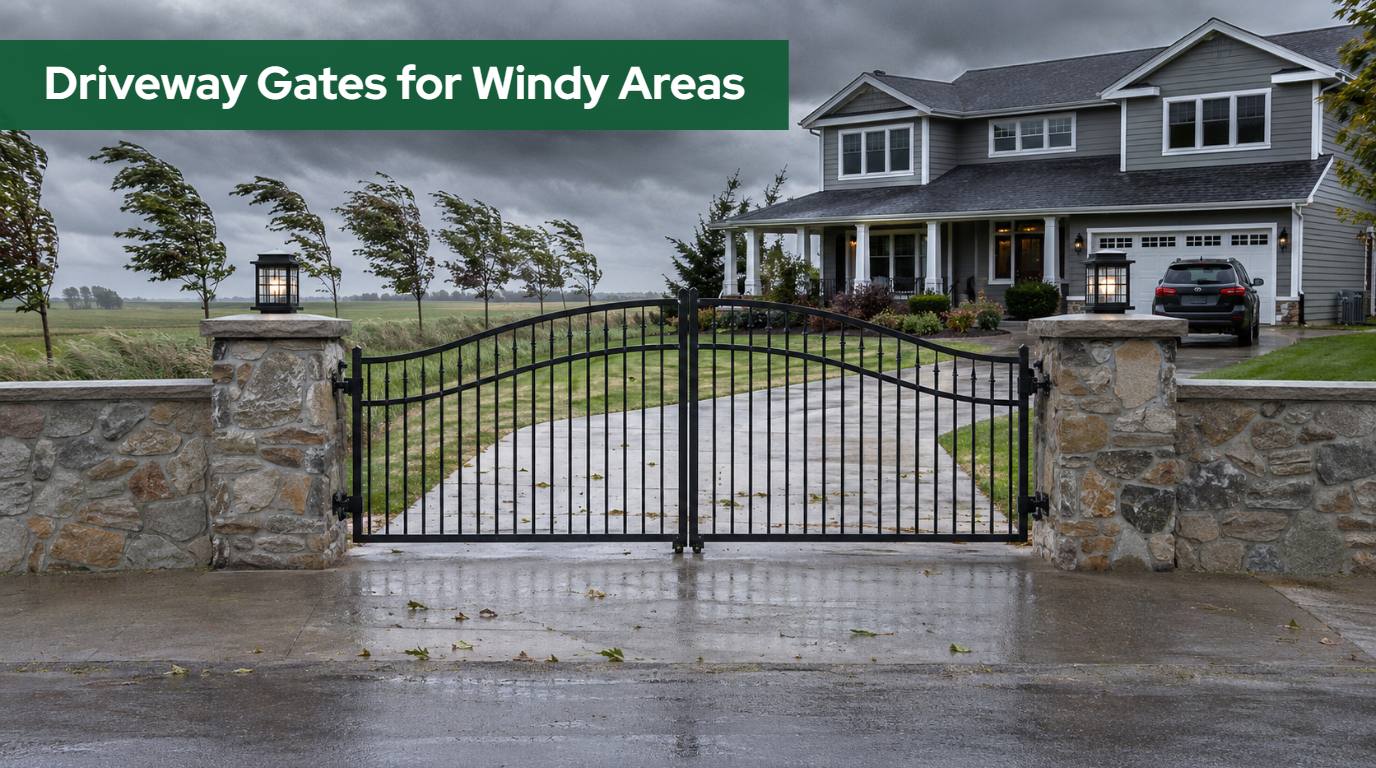
Wind is the load most gate buyers forget until the first big storm. A leaf that swings smoothly on a calm July afternoon can slam against its stop, drag its operator off its limits or tear at its hinges when a winter front pushes through the Skagit flats. That is why driveway gates for windy areas in Washington need a few decisions made differently from the start: the gate type, how open the design is, the size of the posts, the operator and the way the gate is held when the power goes out.
Western Washington gets its strongest winds in fall and winter, often with heavy rain and power outages in the same storm. Whatcom County sees cold northeast wind pouring out of the Fraser River valley. The islands and shorelines take wind straight off open water. This guide is written for homeowners, farms, acreage owners and HOAs in Skagit, Whatcom, Snohomish, Island, San Juan, King and Pierce counties who want a gate that keeps working when the weather turns.
Quick answer
Driveway gates for windy areas in Washington work best as slide or cantilever gates with open picket designs, on heavy posts and deep footings. Swing gates can work with stronger operators and stops. Keep the operator’s force low, add photo eyes or edges instead of raising it, and plan battery backup for storm outages.
In this guide
- What makes driveway gates for windy areas in Washington different
- Where Washington wind hits gates hardest
- What recent Washington windstorms show
- How wind loads a gate: sail area, leverage and exposure
- Slide or swing: which gate type handles wind better?
- Gate designs that let the wind through
- Posts, hinges and footings for windy sites
- Choosing a gate operator for a windy site
- Force settings, false reversals and wind
- Holding a gate open or closed in a gale
- Power outages during windstorms
- Barrier arms and commercial gates in high wind
- Trees, debris and checks after a storm
- A windy-site checklist before you build
- How we approach gates on windy Washington sites
- Frequently asked questions
What Makes Driveway Gates for Windy Areas in Washington Different
Every driveway gate carries its own weight, the push and pull of its operator and the occasional bump from a car. A gate on a windy site carries one more load that changes all the time: the wind pressing on every square foot of the leaf. On a calm day that load is close to zero. In a winter storm it can be the largest force the gate, the hinges, the posts and the operator ever see.
Three things set a windy-site gate apart from a gate in a sheltered suburban lot:
- The load changes direction. Wind can push a swing leaf open, then shut, then open again within a few seconds of gusting. The operator, the hinges and the stops all feel that reversal.
- The load is largest exactly when the gate is most needed. Storms bring outages, fallen limbs and emergency trips, so the gate has to open and close while the wind is blowing.
- Safety settings interact with wind. An automatic gate senses obstructions partly through motor force. Wind can look like an obstruction to the operator, and the wrong fix makes the gate less safe for people.
Gates work every day on open farmland in the Skagit Valley and on bluff lots facing Puget Sound, because the design starts from the wind. If you are at the start of a project, our page on automatic gate installation explains the full process we follow, and the rest of this guide covers what changes when wind is part of the brief.
Where Washington Wind Hits Gates Hardest
Wind exposure in our service area varies a lot from one property to the next, even inside the same county. A gate tucked into a wooded lot in Sedro-Woolley may barely move in a storm that rattles a gate a few miles west on open fields. A few patterns repeat across Northwest Washington.
Whatcom County and the Fraser outflow. When cold, dense air builds up over interior British Columbia, it drains toward the coast through the Fraser River valley and pours into Whatcom County as a strong northeast wind. The National Weather Service office in Seattle issues wind advisories for these events, and the flat farmland north of Bellingham, around Lynden, Ferndale and Blaine, takes the brunt. Outflow wind often brings freezing temperatures and ice with it.
The Skagit flats and open farmland. The delta farmland around Mount Vernon, Burlington, La Conner and the Skagit Valley has few trees or buildings to slow the wind. Southerly storm winds cross those fields with little to break them, and a gate set at the end of a long, open driveway sees most of that force.
Islands and shorelines. Whidbey, Camano and the San Juan Islands, along with waterfront lots on Puget Sound, face wind arriving over open water. Water offers almost no resistance, so shoreline sites are among the most exposed places a gate can sit. Salt air adds corrosion to the list. Our guide to automatic gates on Whidbey Island covers other island conditions, such as long driveways and power supply.
Hills, bluffs and ridgelines. Wind speeds up as it flows over and around hills and bluffs. A gate at the top of a slope or on the edge of a bluff can see stronger gusts than a gate at the bottom of the same road.
The most useful step is simple: watch your own site in a storm. Which way does the rain blow at the end of the driveway, and is there open water, a field or a slope upwind?
What Recent Washington Windstorms Show
Two storms show what a gate in Western Washington has to live through.
On December 14 and 15, 2006, the Hanukkah Eve windstorm crossed the region. The Office of the Washington State Climatologist ranked it as the strongest windstorm to hit the Northwest since the Inauguration Day storm of 1993, with the highest gust at Chinook Pass, 113 mph, and close to 1.5 million electrical customers losing power. Some areas were without power for more than a week.
On November 19, 2024, a rapidly strengthening low, called a bomb cyclone, struck the Pacific Northwest. NASA’s Earth Observatory reported that the National Weather Service in Seattle recorded gusts up to 77 mph in the mountains southeast of Seattle, and that nearly 600,000 people lost power in Washington State on November 20. Its summary of the November 2024 Pacific Northwest storm includes a satellite view of the system.
For gate owners, these storms carry three lessons:
- Wind and power loss arrive together. The gate is pushed hardest at the same moment its main power is most likely to fail. Battery backup and a clear manual plan matter as much as the gate’s strength.
- Trees are part of the load. Many outages come from falling trees and limbs.
- Outages last. When power stays off for days, a battery sized for a short blink will run down. The gate needs a plan for the second and third day, not only the first hour.
How Wind Loads a Gate: Sail Area, Leverage and Exposure
The force wind puts on a gate depends on three things you can see: how much of the gate is solid, how far the load sits from the hinge or support, and how exposed the site is.
Sail area. Wind pushes on solid surface. A 14-foot solid cedar leaf presents its entire face to the wind. An open picket gate of the same size presents only the pickets and rails, and the air passes through the gaps. The more solid the gate, the more it behaves like a sail.
Leverage. On a swing gate, the wind’s push is spread across the leaf, and much of it acts far from the hinge. The longer the leaf, the more twisting force reaches the hinges, the hinge post and the operator arm. A long single swing leaf gives the wind a long lever to work with. A slide gate has no hinge to twist, though the wind still pushes it sideways against its rollers and supports.
Exposure. The building code sorts sites into exposure categories based on the surface around them. Exposure B covers built-up areas such as suburbs and wooded land with closely spaced obstructions. Exposure C covers open terrain with scattered obstructions, such as farmland and open fields. Exposure D covers flat, unobstructed areas facing open water. The more open the surroundings, the higher the design wind pressure at the same wind speed.
Washington’s residential code, adopted in chapter 51-51 WAC, asks each jurisdiction to fill in its own design wind speed in Table R301.2, along with frost depth and other climate criteria. Skagit County’s snow, wind, seismic and soil design criteria map lists a design wind speed of 85 mph. The City of Lake Stevens design sheet lists 110 mph as a 3-second gust. The two numbers come from different methods and are not directly comparable, but both say the same thing: wind is a design load in our region.
Most residential driveway gates are not engineered like a building, but on an exposed site we size the gate, its posts and its footings with that wind in mind. Our guide to gate post installation in Washington covers footing depth, frost lines and soil in more detail.
Building a gate on an open, exposed site?
We look at the wind exposure, the driveway and the power supply on site, then plan the gate, the posts and the operator together so the gate keeps working through a Washington winter.
Slide or Swing: Which Gate Type Handles Wind Better?
On a windy site, a slide gate is usually the stronger choice. A slide gate moves parallel to the fence line, so the wind pushes it sideways against its rollers instead of trying to swing it open or shut.

Cantilever slide gates ride on rollers mounted to posts beside the opening, with a counterbalance section that rolls behind the fence. They have no ground track, so there is nothing to clog with leaves, gravel or ice. Our guide to cantilever gate installation in Washington explains how they are sized and supported.
Track slide gates run on wheels along a track on the ground. They handle wind well too, but the track can collect debris in a storm, and a gate that jumps its track in a gust is a serious problem. DASMA’s gate safety guidance lists physical stops at both ends of a slide gate’s travel and fall-over protection to keep the gate from falling if it comes off its supporting hardware.
Swing gates are common and attractive, and they can work on windy sites. They need more care:
- Shorter leaves catch less leverage. A pair of shorter leaves on a bi-parting swing gate puts less twisting load on each hinge post than one long leaf.
- Heavier posts, heavier hinges and stronger footings carry the extra load.
- A swing operator rated with headroom beyond the gate’s weight and length handles gusts better than one at the edge of its rating.
- Solid stops in the open and closed positions take the wind load off the operator when the gate is at rest.
Space and slope often decide the type before wind does. Our comparison of sliding and swing gates in the Pacific Northwest covers those trade-offs. Where both fit, wind is a good reason to lean toward a slide gate.
Gate Designs That Let the Wind Through
The single most effective way to reduce wind load is to let the air pass through the gate. An open design keeps the gate’s look and security while cutting the force on everything that holds it up.
Open picket and wrought iron designs. A classic wrought iron or steel picket gate is mostly open space. Wind passes through the gaps between pickets, and only the bars and rails catch it. On the most exposed sites, such as shoreline lots and open farmland, this is usually the most wind-friendly style. We fabricate gates in hand-forged wrought iron and laser-cut steel in our Sedro-Woolley shop, and both work well as open designs.
Laser-cut steel panels. Laser-cut steel lets a gate carry a pattern, a landscape or a geometric design. The ratio of cut-out to solid steel changes how much wind the panel catches. A design with generous openings behaves much more like a picket gate than a solid plate does.
Horizontal slat and cedar privacy gates. Modern horizontal slat gates and Western Red Cedar privacy gates are popular for good reason, but a fully closed panel is a sail. Spacing the slats, adding an open band near the top, or combining a solid lower section with an open upper section reduces the load while keeping most of the privacy.
Privacy and wind pull in opposite directions. A fully solid gate on an exposed site is possible, but it asks a lot of the posts, the hinges and the operator, and it needs to be planned that way from the start. One more rule applies on any automatic gate:
- Safety screening. UL 325 and ASTM F2200 require screening of certain openings on automatic gates so a hand or arm cannot reach through into a moving part. A design meant to pass wind still has to meet those rules, and our guide to automatic gate safety standards explains them.
Our custom gate design page shows the materials and styles we build, and any of them can be adapted to a windy site with the right balance of solid and open.
Posts, Hinges and Footings for Windy Sites
Wind load ends up in the posts. Every gust on a swing leaf becomes a twisting force on the hinge post and an overturning force on its footing. On a slide gate, the support posts and roller posts take the sideways push. If the posts lean, everything else goes wrong: the gate sags, the latch side drops, the operator works harder and its limits drift.
Posts. On an exposed site, we size posts for the gate and the wind together, not for the gate alone. A steel post that is plenty for a sheltered pedestrian gate may be too light for a long driveway leaf on open farmland.
Footings. Concrete footings resist the overturning force of the post. In the wet soils west of the Cascades, footings need to be deep and wide enough for the leverage of the gate, the wind and the operator. The local frost depth in Table R301.2 is a minimum for frost, not a footing design for a gate.
Hinges. Heavy-duty hinges rated for the gate’s weight spread the load and resist wear. On windy sites, hinge wear is often the first sign of trouble, because each gust works the hinge back and forth. Ball-bearing or heavy-duty barrel hinges sized for the leaf last longer than light strap hinges. The LiftMaster LA412UL installation manual, for example, calls for the hinges to sit no more than 4 inches from the edge of the post and for the gate to be level and the post plumb, which matters even more when wind adds load.
If an existing gate already droops at the latch end or drags on the ground, wind is often part of the cause. Our guide to sagging gate repair in Washington explains how to tell whether the problem is the hinges, the frame or the post.
Choosing a Gate Operator for a Windy Site
The operator is the motor that moves the gate. Manufacturers publish ratings for the gate weight and length each operator can handle. Those ratings are a starting point, and wind is a reason to leave headroom.
Two examples from operators we install show how the ratings work:
| Operator | Type | Published gate ratings | Usage classes |
|---|---|---|---|
| LiftMaster LA412UL | Residential 12 Vdc linear swing operator | 850 lb at 10 ft, 750 lb at 12 ft, 650 lb at 14 ft, 550 lb at 16 ft | Class I |
| LiftMaster CSW24UL | Commercial 24 Vdc swing operator | 1,600 lb at 8 ft, 800 lb at 16 ft, 600 lb at 18 ft | Classes I to IV |
Two things stand out. The longer the leaf, the less weight the operator can move, because a long leaf has more leverage on the operator arm. And the ratings describe weight and length, not wind. A solid 14-foot leaf in an exposed spot asks more of an operator than an open picket leaf of the same weight, because the wind adds a load the weight chart does not show.
On windy sites we usually choose in one of these directions:
- Go up a size. Pick an operator whose rating sits well above the gate’s weight and length, so a gust does not push it to its limit.
- Use a slide operator. On a slide or cantilever gate, the operator moves the gate along its path and does not fight a twisting wind load at a hinge.
- Shorten the leaf. Two shorter leaves on a bi-parting gate can be better than one long leaf.
We install and service LiftMaster, Viking and FAAC gate operators, and the right model depends on the gate, the power supply, the traffic and the exposure. Our guide to swing gate openers in Washington covers swing operators in more depth.
Not sure your operator can handle the wind at your gate?
We match the operator to the gate’s weight, length, design and exposure, with headroom for winter gusts, and we install and service LiftMaster, Viking and FAAC operators.
Force Settings, False Reversals and Wind
An automatic gate operator watches its own motor effort. If the gate meets more resistance than expected, the operator assumes something is in the way and stops or reverses. That inherent sensing is part of how UL 325 protects people, though on its own it is not enough: the standard also requires external monitored entrapment protection, such as photo eyes or edge sensors, in the entrapment zones.
Wind complicates this. A gust pushing against a closing swing leaf feels to the operator a lot like a car or a person in the way. The gate stops or reverses by itself, which owners call a false reversal or a nuisance trip.
The LiftMaster LA412UL installation manual describes a reversal force dial used for fine tuning the force where wind or environmental changes may affect gate travel. It says the setting should be high enough that the gate does not reverse by itself or cause nuisance interruptions, but low enough to prevent serious injury to a person. That sentence describes the whole problem in one line.
The tempting fix is to turn the force up until the wind can no longer stop the gate. That is the wrong fix. A gate set to push through a gust will also push harder against a child, a pet or a car. The DoorKing installation manual for its 1601 and 1602 barrier gate operators makes the same point about extreme wind, snow and ice: setting the reverse sensor with too much force so the arm keeps working is not recommended, and if more force is continually needed, extra safety devices such as in-ground loops, reverse edges and photocells must be added so the arm reverses with much less force.
The better answers are:
- Reduce the wind load with a more open design, a slide gate or shorter leaves.
- Add external safety devices so protection does not depend on force sensing alone. Our guides to gate photo eye installation and gate safety edges explain how these devices work.
- Use an operator with more margin, so normal gusts stay well inside its working range.
A gate that reverses every time the wind picks up is near its limit. Look at the whole system, not the dial.
Holding a Gate Open or Closed in a Gale
On a manual gate, the answer to wind is simple: a good latch, a drop rod or cane bolt into the ground, and a hold-open catch for when the gate is open.
Automatic gates are different. ASTM F2200, the gate construction standard, says a gate latch shall not be installed on an automatically operated gate, and an existing gate latch shall be disabled when a manually operated gate is retrofitted with an operator. The operator itself, the stops and approved locking devices do the holding.
Several features help an automatic gate stay put in the wind:
- Positive stops. Solid stops at the open and closed positions take the wind load off the operator at rest. DASMA’s gate safety guidance lists physical stops at both ends of travel for slide gates to prevent over-travel.
- Electric locks. Magnetic locks and solenoid locks are made for automatic gates and connect to the operator’s controls. The LA412UL manual describes a bi-part delay setting for dual gates using a mag-lock, solenoid lock or decorative overlap, so one leaf closes before the other.
- Gate design. ASTM F2200 also requires that a swing gate’s movement not be started by gravity when the operator is disconnected. A gate that sits level and balanced does not drift, which helps in wind too.
The manual release needs its own plan. When the operator is released, for service or during an outage, the gate is free to move. On a windy day, a released swing leaf can blow open or shut hard. Before releasing a gate in wind, have a way to hold it: a person at the leaf, a strap to the fence or a temporary prop, and never stand in the swing path.
If you are adding an operator to a manual gate that has a latch and drop rods, those parts should come off or be disabled as part of the conversion. Our page on gate automation retrofits describes how we upgrade an existing gate.
Power Outages During Windstorms
The storms that push gates hardest are also the storms that knock out power. In the November 2024 storm, nearly 600,000 people lost power in Washington. In the 2006 storm, some areas were without power for more than a week. A gate on a windy site needs a plan for working without the grid.
Battery backup. Most modern DC gate operators can run on batteries when power fails. The battery charges from the main supply or from solar, and it keeps the gate cycling during an outage. How many cycles you get depends on the operator, the batteries, the gate’s weight and the temperature. LiftMaster’s data sheet for the CSW24UL, for example, lists different standby results for different battery sizes, which shows how much the battery choice matters. Our guide to automatic gate battery backup in Skagit County explains how to size it.
Fail-open or fail-secure. Some operators can be set to open the gate and hold it open when the battery runs low, and others stay closed. The right choice depends on the property, who needs to get in and the fire agency’s requirements for gates across fire access roads. Our guide to fire department gate access in Washington explains those rules.
Solar. Solar operators keep running when the grid is down, as long as the batteries hold a charge. Western Washington winters have short, cloudy days, so a solar system for a windy, rural site needs enough panel and battery for long gray stretches. The LA412UL manual notes that local geography and weather conditions may require additional solar panels.
Barrier Arms and Commercial Gates in High Wind
HOAs, farms with commercial traffic, businesses and community entrances often use barrier arms or larger commercial gates, and wind affects them too.
Barrier arms. A long barrier arm acts like a lever in the wind. The DoorKing 1601 and 1602 manual notes that extreme wind, snow and ice can impede or even inhibit the operation of the arm, especially with the longest arm option. DoorKing offers a high wind bracket kit to stiffen its break-away arm bracket and prevent unwanted arm release in high winds. On exposed entrances, a shorter arm or a heavier operator is worth considering. Our guide to barrier arm gates in Washington covers how they are planned.
Commercial slide gates. Large commercial slide gates, often chain link or steel mesh, can carry a lot of wind when privacy slats or windscreen fabric are added. A chain-link gate that worked fine open becomes a sail once it is covered. If you plan to add slats or screens, plan the gate, the rollers and the operator for that load.
Fire access. A commercial or community gate across a fire apparatus access road needs fire code approval and an approved means of emergency operation. Wind does not change those rules, but it adds a reason to make sure the emergency opening works in bad weather.
Our commercial gate installation page describes the business and community gates we build.
Running a community or commercial entrance on an exposed site?
We plan gates, barrier arms, operators and access control for HOAs, farms and businesses across Northwest Washington, with wind, outages and fire access in the same plan.
Trees, Debris and Checks After a Storm
After a big wind event, a quick check of the gate can catch small problems before they become breakdowns.

Look before you run it. Before cycling the gate after a storm, walk the path of travel. Look for branches across the track or swing path, debris against the gate, and anything leaning on the fence or the operator.
Check the safety devices. A gust or a falling branch can knock a photo eye out of alignment or damage an edge sensor. If the gate refuses to close, a misaligned photo eye is a common cause. Test the safety devices following the operator manual, and do not bypass them to get the gate moving.
Check the hinges, rollers and stops. Look for bent hinges, loose bolts, a roller that has shifted or a stop that has been hit hard. A swing gate that slammed against its stop all night may have loosened its hardware.
Check the posts. Look for a leaning post or cracked concrete at the footing.
Trees. Large trees next to the gate, the operator or the service line are worth a look from an arborist. Many storm outages come from falling trees, and a tree falling on a gate can bend it beyond repair.
Our seasonal guide to automatic gate maintenance in Washington covers fall and winter preparation, and our gate repair team can help if a storm left damage behind.
A Windy-Site Checklist Before You Build
These are the questions we ask on site before choosing a gate for an exposed property.
- How exposed is the site? Open field, shoreline, bluff, hilltop, foothill gap or sheltered by trees and buildings?
- Which way does the strong wind come from? Southerly storms, Fraser outflow from the northeast, or wind off open water?
- Is there room for a slide gate? If yes, a slide or cantilever gate is usually the stronger choice for wind.
- How solid does the gate need to be? Balance privacy against wind load, and consider open bands, spaced slats or mixed designs.
- Swing gate details: one long leaf or two shorter leaves? Heavy posts, heavy hinges, positive stops?
- Posts and footings: sized for the gate, the operator and the wind, in your soil, not only to the frost line.
- Operator: rated with headroom beyond the gate’s weight and length, and suited to the usage class.
- Safety devices: photo eyes and edges in every entrapment zone, so force can stay low.
- Holding: no mechanical latch on an automatic gate; stops and electric locks instead.
- Power: battery backup sized for multi-day outages, and a decision on fail-open or fail-secure.
- Permits and fire access: local permits, electrical work and fire agency approval where the gate crosses a fire access road.
Permit rules differ by city and county. Our overview of gate permits in Washington State explains the common cases.
How We Approach Gates on Windy Washington Sites
Emerald Gate Systems is a family-owned gate company based at 7557 Alpine Lane in Sedro-Woolley, Washington. We design, fabricate in our own shop, install, automate and service residential, farm and commercial gates across Skagit, Whatcom, Snohomish, Island, San Juan, King and Pierce counties. Because one team handles CAD planning, welding, installation, automation, access control, testing and future service, the gate, the posts and the operator are planned together for the site and its wind.
Every project starts with a free on-site consultation. On an exposed property, we look at the open ground or water upwind, the slope, the trees, the driveway, the power supply and the space for a slide or swing gate. Then we plan the gate design, the balance of solid and open, the posts and footings, the operator, the safety devices and the backup power as one system. We fabricate in hand-forged wrought iron, laser-cut steel and Western Red Cedar, and we install and service LiftMaster, Viking and FAAC gate operators, with our designated electrical administrator on staff.
Washington requires contractors to show their registration in advertising: Emerald Gate Systems is registered with the Washington State Department of Labor and Industries as a construction contractor (EMERAGS748D6) and holds an electrical contractor license in the Doors and Gates specialty (EMERAGS747KE).
Frequently Asked Questions
What type of driveway gate is best for windy areas?
On most windy sites, a slide or cantilever gate with an open picket design holds up best. A slide gate moves along the fence line, so wind does not twist it at a hinge, and open pickets let air pass through. Swing gates can also work with shorter leaves, heavier posts, positive stops and an operator rated with plenty of headroom.
Can electric gates work in high winds?
Yes, when the system is planned for wind. Strong gusts can make an operator think it has hit an obstruction, so the gate stops or reverses. The fix is a lower wind load, an operator with more margin and external safety devices such as photo eyes and edges, not a higher force setting, which makes the gate less safe for people.
How do you keep a double gate from blowing in the wind?
On a manual double gate, drop rods into sleeves in the driveway and a strong center latch hold the leaves. Automatic gates are different: ASTM F2200 says a latch shall not be installed on an automatically operated gate. The operator, positive stops and electric locks, such as magnetic or solenoid locks, hold an automatic double gate in place.
Are solid privacy gates a problem in windy parts of Washington?
A solid gate catches much more wind than an open one, so it puts more load on the hinges, posts, footings and operator. It can still work if it is planned that way, with heavier posts, a stronger operator or a slide design. Spaced slats, an open top band or mixed wood and metal designs keep privacy while reducing the load.
What happens to an automatic gate during a windstorm power outage?
Without backup, the gate stays where it was and must be opened with the manual release. With battery backup, the operator keeps cycling until the battery runs down, and some operators can be set to open and stay open on low battery. In wind, hold the gate before releasing it, because a released swing leaf can blow open or shut hard.
Do I need bigger posts for a gate on a windy site?
Usually, yes. Wind on the gate becomes twisting and overturning force on the posts and footings, especially on long swing leaves. Posts and footings on exposed sites should be sized for the gate, the operator and the wind together, in the local soil. The frost depth in the local code table is a minimum for frost, not a gate footing design.