
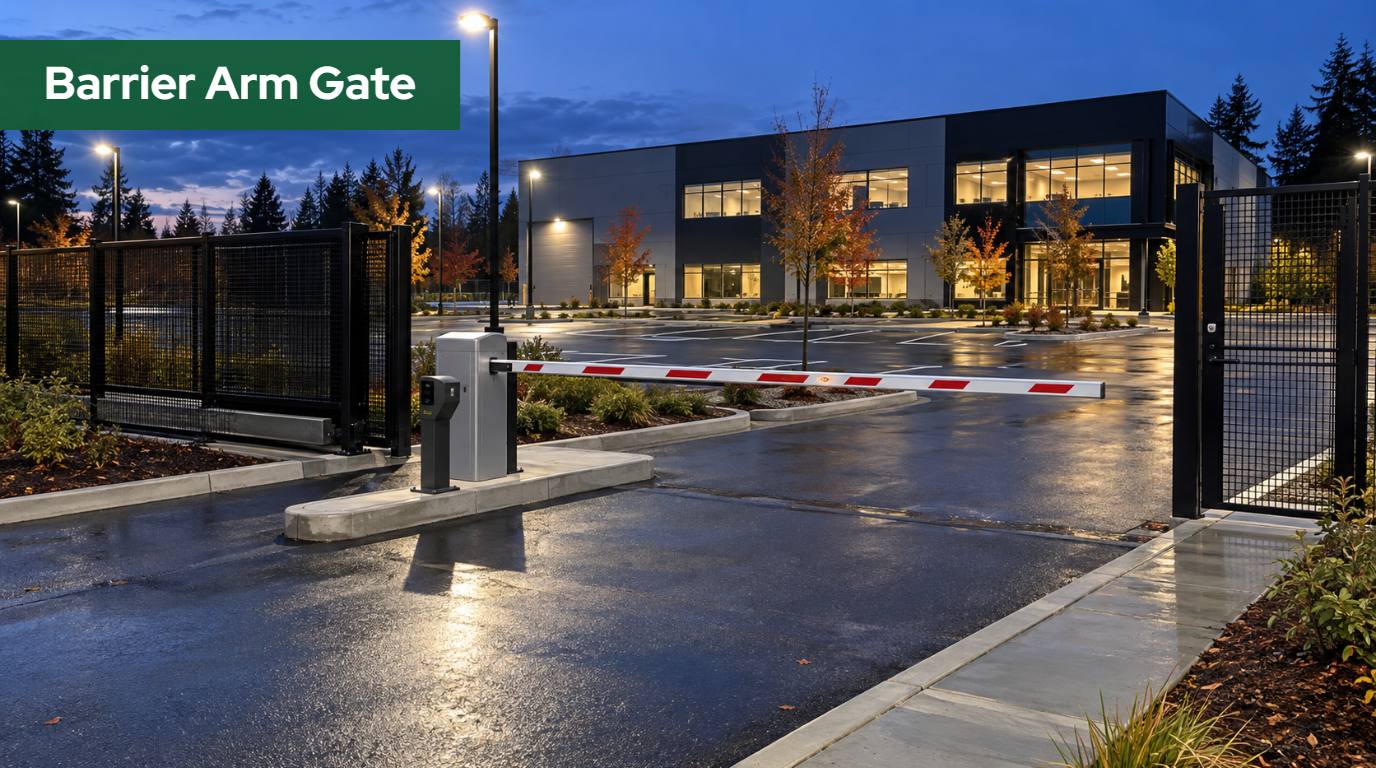
A barrier arm gate in Washington is the quickest way to control cars at a parking lot, an apartment garage, an employee lot or a business park entrance. The arm lifts in a few seconds, lets one vehicle through and drops again, so a busy lane keeps moving without the wait that a full slide or swing gate creates.
An arm controls traffic. It does not close a perimeter, it does not stop someone on foot, and it adds its own safety, fire access and wiring questions to the site. This guide explains how barrier arms work, how to choose the arm and the loop layout, what UL 325 asks of a barrier arm operator, how Pacific Northwest wind, rain and outages affect the equipment, and which Washington rules still apply. It is written for owners, HOA boards and property managers in Skagit, Whatcom, Snohomish, Island, San Juan, King and Pierce counties.
Quick answer
A barrier arm gate in Washington is a motorized arm that lifts to let one vehicle pass, then lowers across the lane. It suits busy parking and commercial entrances where speed matters more than full closure. It needs loops, a photo eye under the arm, separate pedestrian access, UL 325 listed equipment and approved fire department access.
In this guide
- What a barrier arm gate in Washington does
- Barrier arm or full gate?
- Common lane layouts
- Choosing the arm
- Vehicle detection and loops
- UL 325 and barrier arm safety
- Keeping people on foot out of the lane
- Wind, rain and cold
- Power, outages and manual operation
- Fire department access in Washington
- Pairing the arm with access control
- Foundations, conduit and L&I rules
- Maintenance and arm replacement
- How we approach barrier arm projects
- Frequently asked questions
What a Barrier Arm Gate in Washington Does
A barrier arm gate has three main parts. The operator is a cabinet bolted to a concrete pad beside the lane, with a motor, a gearbox or belt drive and a control board inside. The arm is a long, light boom made of wood, aluminum or plastic that pivots up and down from the operator. The control devices are everything that tells the operator when to raise or lower the arm: a card reader, a keypad, a ticket machine, a remote, an exit loop in the pavement, or a key switch for the fire department.
When a credential is accepted, the operator raises the arm. When the vehicle has passed over the loop past the arm, the operator lowers it again. On a well-tuned lane the whole cycle takes a few seconds, which is why barrier arms are the standard for parking garages, hospital lots and busy employee entrances.
The key point is what the arm does not do. It leaves open space under it and around both ends. A determined driver can still break it, and a person on foot can walk around it. The industry treats it as traffic control, not as a security barrier. Our own commercial gate installation page puts it plainly: barrier arms control traffic but do not provide a full perimeter barrier. Where the goal is to keep people and vehicles out after hours, the arm is usually paired with a gate or replaced by one.
A barrier arm is also commercial equipment by design. UL 325 sorts vehicular gate operators into four usage classes, from Class I for homes of one to four families to Class IV for guarded industrial sites. The DoorKing 1601 and 1602 barrier operators, for example, are listed for Classes II, III and IV in the manufacturer’s manual, which means multi-family, commercial, industrial and guarded sites, not a single-family driveway. A homeowner who wants a fast entrance is usually better served by a quick slide or swing gate listed for residential use.
Barrier Arm or Full Gate? Matching the Equipment to the Entrance
Most entrance decisions come down to one question: does the site need to move cars quickly, or keep things out? A barrier arm answers the first need. A slide, cantilever or swing gate answers the second. Many commercial sites in Washington need both, at different hours or in different lanes.
| Question | Barrier arm | Slide, cantilever or swing gate |
|---|---|---|
| Main job | Control vehicle flow, one car at a time | Close the perimeter to vehicles and people |
| Cycle speed | Seconds; suited to frequent use | Slower; the panel has to travel the whole opening |
| People on foot | Does not stop them; separate walkway required | Stops them when closed; separate walkway still required |
| Typical sites | Parking lots and garages, employee lots, amenity lots, staffed checkpoints | Yards, storage, equipment lots, HOA perimeters, after-hours closure |
| Space needed | A pad beside the lane and clearance for the arm to rise | Room for the panel to slide or swing, plus a counterbalance on cantilever gates |
| Usage class | Commercial classes (II, III, IV) on the models we reviewed | Residential and commercial classes available |
A common pattern is to run the arm during business hours and close a full gate after hours. The arm handles hundreds of daily entries, and the gate secures the lot at night.
If you are still comparing every type of entrance, our guide on how to choose a commercial gate system lays out slide, cantilever, swing and barrier arm options side by side, and our guide to cantilever gate installation in Washington covers the most common full-gate choice for wide commercial openings.
Common Lane Layouts: Entry Only, Entry and Exit, Paired Arms
The layout of the lane decides how many operators, loops and control devices the job needs. The arm itself is the easy part. The traffic pattern around it is where most of the planning goes.
Entry lane only. One arm controls cars coming in. Drivers present a card, a code or a ticket at a pedestal on the approach, the arm rises, and a loop past the arm tells the operator when the car has cleared. Exit happens through a separate lane or a free exit lane without an arm.
Entry and exit lanes. Two arms, one per direction, usually on a median island. The exit side often uses an automatic exit loop, sometimes called free exit, so the arm rises when a vehicle pulls up from inside. Some sites require a credential on exit too, for example to count vehicles or to stop tailgating out of a paid lot.
Whatever the layout, every lane needs room for a car to wait at the pedestal without blocking the street. On a site that opens onto a busy road in Everett, Bellingham or Mount Vernon, a short stacking distance means cars back up into traffic while the first driver searches for a card. Moving the pedestal and the arm deeper into the property is often the cheapest fix, and it is much easier before the pad is poured.
Choosing the Arm: Length, Material, Breakaway and Folding
The arm looks simple, but its length, material and mounting decide how the system behaves in daily use and how much it costs to keep running.
Length. Each operator has a maximum arm length set by the manufacturer. In DoorKing’s current 1601/1602 manual, the standard 1601 operators take arms up to 14 feet and raise them 90 degrees in about 2.5 seconds, while the heavier 1602 models handle longer counterbalanced arms of up to 27 feet with a slower cycle. Longer arms are heavier, catch more wind and move more slowly, so they suit lanes with less traffic. For a busy single lane, a shorter arm on a fast operator is the usual choice.
Material. Wood arms are the traditional, low-cost option and are easy to cut to length, but they absorb water. Aluminum arms in round or octagon profiles hold up better in a wet climate and accept reversing edges and LED lights along the arm. Plastic and composite arms are light and flexible.
Breakaway mounts. A breakaway bracket lets the arm swing away from the operator when a vehicle drives into it, instead of bending the arm or damaging the drive. It is common at sites with a lot of first-time drivers, such as visitor lots. The trade-off is that a breakaway mount can release in strong wind. DoorKing addresses this with a high wind bracket kit that stiffens the release rollers to prevent unwanted arm release during high winds, which tells you the issue is real. On exposed sites near open water or on the Skagit flats, ask how the breakaway setting is adjusted for wind.
Folding arms. A folding or articulated arm bends at a joint as it rises. It is used where the ceiling is low, such as a parking garage entrance, so the arm can open without hitting the structure.
Visibility. Arms carry reflective striping, warning decals and often LED lights. DoorKing’s maintenance instructions say that when an arm is replaced, the warning decal must be on both sides of the new arm. A dark arm across a dark lane on a rainy November evening is a hazard for drivers.
Not sure which arm and operator fit your lane?
We measure the lane, the stacking distance and the overhead clearance, then recommend the operator class, arm length and mount that suit the traffic you actually have.
Vehicle Detection: Arming, Reverse and Exit Loops
Most barrier arms depend on inductive loops, wire coils cut into the pavement and connected to a loop detector in the operator. When a large metal object such as a car sits over the loop, the detector senses the change and signals the operator. On a barrier arm lane, each loop has a specific job.
- Arming loop. Placed at the pedestal on the approach. DoorKing explains that an arming loop lets the access control device work only when a vehicle is on the loop, which prevents people on foot from using the card reader or keypad to get through the vehicle lane.
- Reverse or safety loop. Placed under or near the arm. It keeps the arm from coming down on a vehicle that is still in the arm’s path, and it raises the arm if a car rolls onto it while the arm is lowering. DoorKing notes that when two reverse loops are used, a vehicle should not be able to fit in the space between them.
- Down or closing loop. Placed past the arm. When the vehicle clears it, the arm lowers. A timer can lower the arm if a driver presents a card but never pulls forward.
- Exit loop. Placed on the inside approach of an exit lane. It raises the arm automatically for vehicles leaving.
Loops do not see everything. A motorcycle or a bicycle may not trigger them reliably, and they do not see people at all. That is why barrier arm manuals pair the loops with a photo eye under the arm, discussed below, and why DoorKing’s warning signs say the lane is not for pedestrians, bicycles or motorcycles.
On a new project, preformed loops can be set before the concrete or asphalt is placed. Our guide to the gate loop detector in Washington explains loop types, sizes and the most common causes of loop trouble in detail.
UL 325 and Barrier Arm Safety
Barrier arm operators fall under the same safety standard as gate operators. DASMA’s TDS 353 on vehicular gate operators and UL 325 quotes Section 32.1.1 of UL 325 directly: a vehicular gate operator or vehicular barrier (arm) operator must have provisions for, or be supplied with, at least two independent entrapment protection means for each entrapment zone, and must operate only after the required means are installed and enabled.
The standard’s Table 32.1 lists the types of entrapment protection a swing gate or barrier arm operator may use:
- Type A: an inherent system in the operator that senses an obstruction and reverses.
- Type B1: a non-contact sensor, such as a photoelectric eye.
- Type B2: a contact sensor, such as an edge on the arm.
- Type C: inherent force limiting, an adjustable clutch or a pressure relief device.
- Type D: a control that requires continuous pressure to keep the arm moving.
The same type of device cannot count for both required means. TDS 353 also notes that all external entrapment protection devices must be monitored, that operators must reverse within two seconds after sensing an obstruction, and that at least two warning signs must be displayed in the gate area.
In practice, a typical barrier arm lane combines the operator’s inherent reversing system with a photo eye mounted directly under the arm, and often a reversing edge along the arm. DoorKing’s manual describes the photo eye this way: it should be installed to protect pedestrians from the lowering arm, it must be mounted directly under the arm, and it does not protect against tailgating vehicles. Loops handle vehicles; the photo eye and edge handle what loops cannot see.
Two more points matter on site. Controls intended for users must be placed at least six feet from any moving part of the barrier and where a user cannot reach over, under or around the arm to work them, according to the DoorKing manual’s safety instructions. And DoorKing’s lane barrier manual says not to install an operator where the arm moves within 16 inches of a rigid object, or within 10 feet of high voltage power wires with the arm raised. That second rule catches more sites than people expect, because many lot entrances have overhead lines along the street.
Our guides to gate photo eye installation in Washington and the gate safety edge in Washington explain how those devices are mounted and tested, and our overview of automatic gate safety standards, UL 325 and ASTM F2200 covers the standards behind them.
Keeping People on Foot Out of the Lane
The most common barrier arm injury risk is not a car. It is a person who decides the shortest way into the lot is under the arm. Barrier arms are built for vehicles, and every manual we reviewed says so in bold.
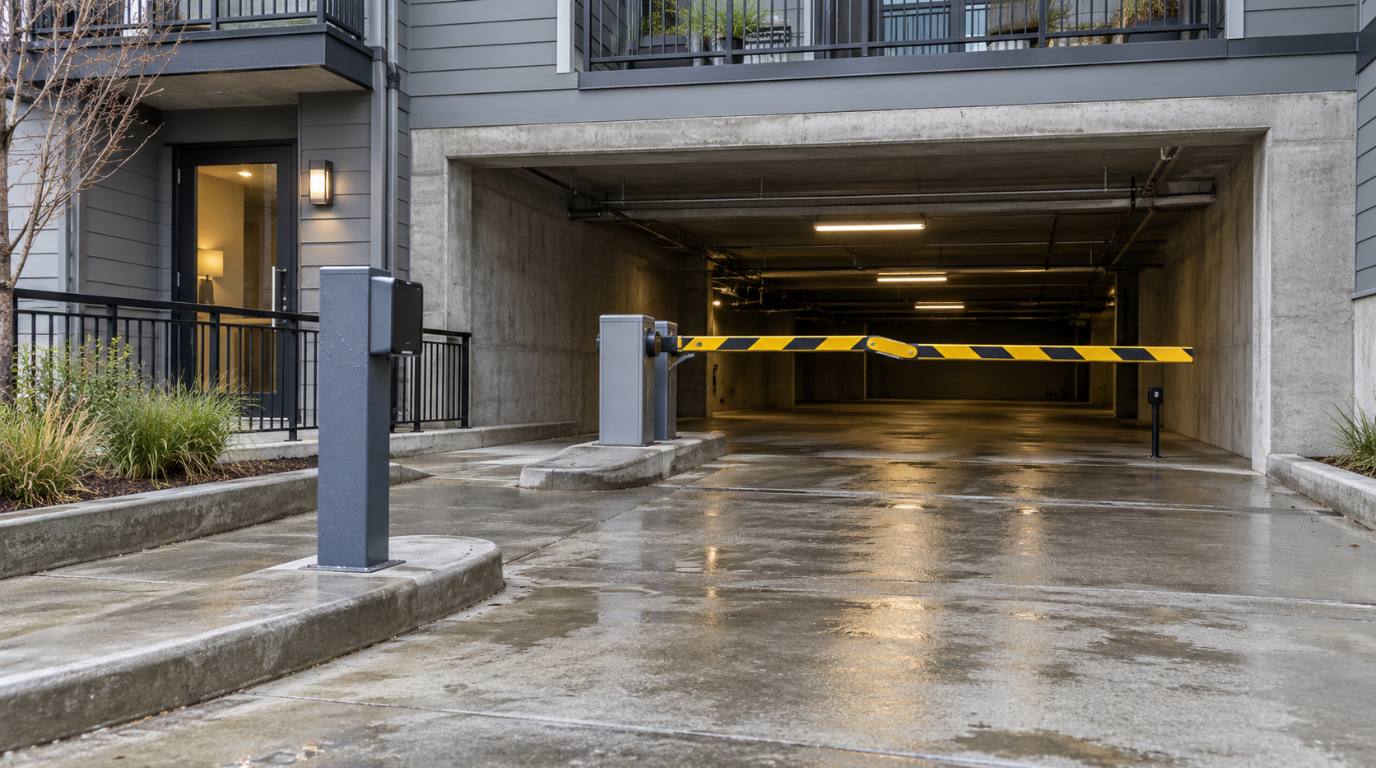
DASMA’s TDS 353 states that all gate operators covered by UL 325 are meant for vehicular gates and not pedestrian gates, and that property owners must provide separate pedestrian access. DoorKing’s signs say the entrance is for vehicles only and that pedestrians must use a separate entrance. DoorKing also recommends painting “NOT A WALKWAY” on the pavement, facing both directions, so people approaching from either side see it.
A separate walkway only works if it is easier to use than the lane. Good practice on a barrier arm site includes:
- A marked pedestrian path or door beside the lane, physically separated from the arm’s swing by a curb, rail or fence.
- A pedestrian gate with its own access control where the lot is restricted, so staff and residents do not shortcut through the vehicle lane.
- Lighting at the walkway as good as the lighting at the lane.
- No pedestal, card reader or call box placed where a person on foot can use it without standing in the lane. An arming loop helps here, because the reader only works when a vehicle is present.
Our guide to pedestrian gate access control in Washington covers walk gates, readers, locks and egress hardware for that separate entrance.
Wind, Rain and Cold in Western Washington
Barrier arms are long, light and exposed, so weather affects them more than it affects a heavy slide gate. In our service area that mostly means wind and rain, with occasional cold snaps.
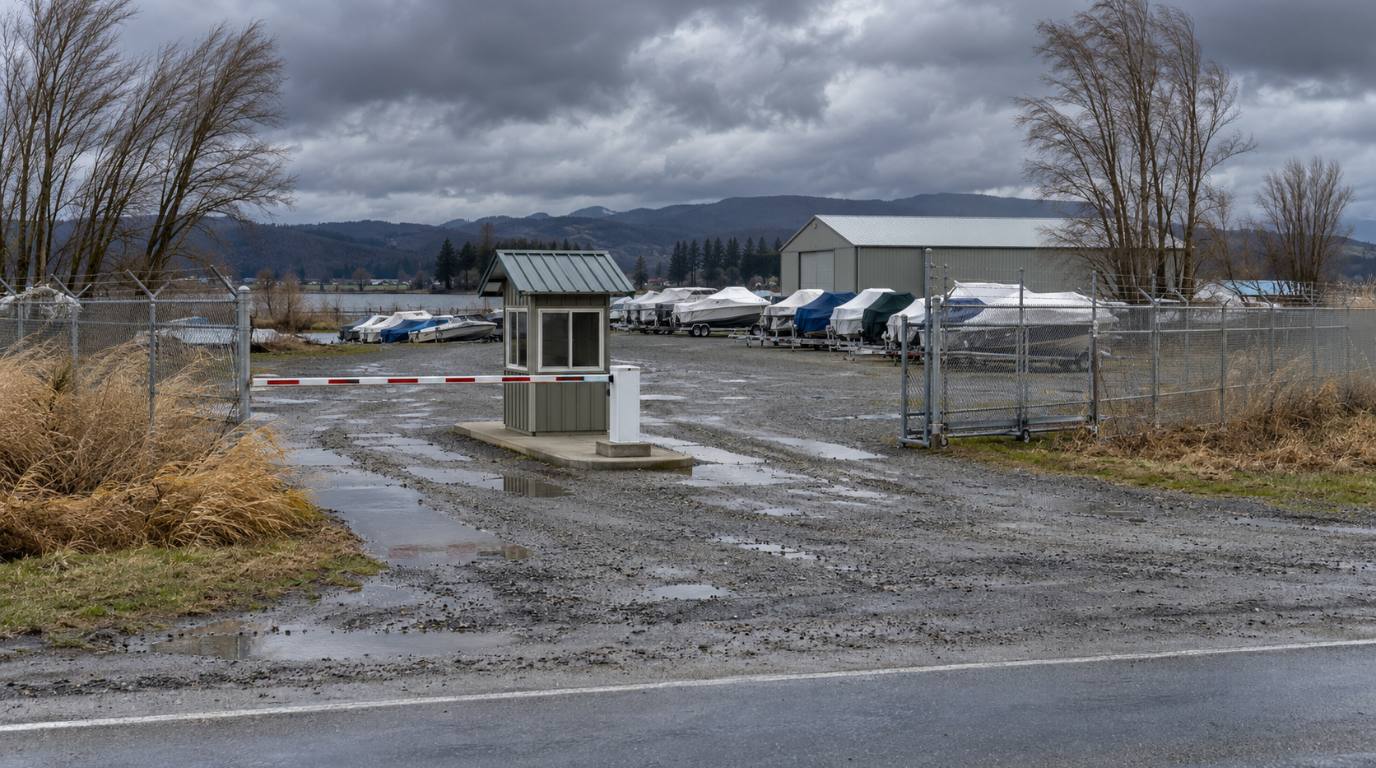
Wind. A long arm acts like a sail. Winter storms that come off the water across Whidbey Island, the San Juan Islands and the Skagit and Whatcom lowlands can push an arm hard enough to stress the drive or trip a breakaway mount. Shorter arms, a solid mounting, the right breakaway adjustment and a manufacturer’s high wind kit where offered are the usual answers. On a very exposed lane, a full gate may be the better choice.
Rain. Steady rain is mostly a problem for wood arms, loops in poorly sealed saw cuts and cabinets with damaged gaskets. Water standing over a loop does not bother the detector by itself, but water that gets into a cracked saw cut and freezes can tear the loop wire. Sealing loop cuts properly and keeping drainage away from the operator pad prevents most of it.
Cold and ice. Snow and ice are less common west of the Cascades than east of them, but they happen, especially in the foothills around Sedro-Woolley, Concrete and Darrington. Batteries lose capacity in cold weather, and DoorKing notes that cold temperatures reduce battery effectiveness. DoorKing, for one, offers thermostatically controlled heater kits for its barrier operators in cold locations. DoorKing’s manual for its surface-mounted lane barrier accessory goes further and says that installation in areas subject to freezing weather with potential for snow and ice accumulation is not recommended. Ask about the specific product’s cold weather limits before you choose it for a site in the hills.
Exposed lane, long arm, stormy winters?
We look at wind exposure, drainage and cold before choosing the arm and mount, so the lane keeps working through a Northwest Washington winter.
Power, Outages and Manual Operation
Winter outages are part of life in Northwest Washington, so every barrier arm plan should say what happens when the power goes out. There are three common answers, and they behave differently.
Raise once and hold. Some operators offer an optional system that raises the arm and holds it open once after AC power fails. DoorKing describes its convenience open system in exactly those terms: it raises and holds the arm open one time only after a power failure, it is not designed for continuous operation during an outage, it needs monthly testing, and its batteries should be replaced about every two years on average. With the arm up, the lane is open to everyone until power returns.
Battery or inverter backup. Other systems keep the operator running from batteries or an inverter for a period of time. That keeps the lane controlled through short outages, but battery runtime depends on the number of cycles, the temperature and the age of the batteries. A busy lane drains batteries much faster than a quiet one.
Manual operation. Barrier operators are available with a manual release, and the instructions explain how a trained person raises the arm by hand, often with a crank or by releasing the drive after the power is shut off. That is a procedure for staff, not for drivers.
The right choice depends on the site. A parking lot can often live with an arm that rises and stays up during an outage. A site that must stay controlled may need battery backup and a plan for longer outages. And where the fire department is involved, the local fire marshal may decide for you, as the next section shows. Our guide to automatic gate battery backup in Skagit County explains batteries, runtime and fail-open versus fail-secure choices in more depth.
Fire Department Access in Washington
A barrier arm across a driveway or private road can count as a gate or barricade across a fire apparatus access road, and Washington’s fire rules apply to it. The details depend on where the site is.
Washington adopts the International Fire Code statewide with its own amendments in chapter 51-54A WAC. The amendment to section 503, WAC 51-54A-0503, is short and important: it says fire apparatus access roads are provided and maintained according to locally adopted street, road and access standards, and it does not adopt several model code subsections on road specifications, marking and obstruction. The model code provisions on gates and barricades are not among the subsections Washington removed. Their text, as reproduced by local fire marshals, authorizes the fire code official to require gates or approved barricades across access roads, requires electric gate operators to be listed to UL 325, requires gates intended for automatic operation to comply with ASTM F2200, and requires security gates across an access road to be approved and to have an approved means of emergency operation.
That leaves a lot to each local fire authority, and the differences are real. The Marysville Fire District’s published Standard for Fire Department Access Gates is a good example of how specific a local standard can be. It says that no gate or other barrier may be installed across a required fire department access road or driveway without a permit and approval, and it sets, among other things:
- A minimum unobstructed gate width of 20 feet, or 12 feet for divided roadways, with smaller residential exceptions.
- An approved fire department override key switch on electronically controlled gates, and a strobe activating device for residential communities.
- Opening to the fully open position within 10 seconds when activated, and staying open until reset by fire personnel.
- A fail-safe requirement: in a power failure, including battery backup, the gate must open automatically by a non-electrical method or be able to be pushed open.
Other cities and counties in our area have their own versions. Some accept a key switch alone, some require a siren or strobe sensor, and some have their own width and power rules. Before a barrier arm goes across a fire lane or a shared private road, we confirm the local requirements with the fire marshal and the permit office. Our guide to gate permits in Washington State explains who reviews what, and our article on the automatic gate permit process in Everett, WA shows how one city handles fire access gates.
Pairing the Arm with Access Control
The arm only moves when something tells it to, so the access control choice shapes the daily experience more than the operator does. The right device depends on who uses the lane and how often.
- Card or fob readers suit employee lots, apartment garages and HOA amenity lots, where the same people come and go every day. Credentials can be added and removed without changing codes.
- Keypads are simple and cheap to manage for small sites, but codes get shared. They work best with an arming loop and a log of entries.
- Long-range readers and license plate recognition open the arm as the car approaches, which keeps traffic moving at busy entrances. Our guide to license plate recognition gates in Northwest Washington explains how that technology works and where it struggles.
Placement matters as much as the device. The reader or keypad pedestal should sit where a driver can reach it from the window without opening the door, at least six feet from the arm’s moving parts, and on the arming loop.
Tailgating is the other access control question. A barrier arm lowers after each vehicle, which discourages tailgating, but a driver can still follow closely if the arm is slow to come down. Faster arms, good loop placement and cameras reduce tailgating. Bypassing safety devices to stop it is never acceptable. For broader options, our page on parking garage access control in Washington State covers garage entrances in detail.
Foundations, Conduit, Wiring and L&I Rules
A barrier arm installation is mostly concrete, conduit and wire. The operator itself goes in quickly once the groundwork is right.
Foundation. The operator bolts to a concrete pad or an existing slab. Manufacturers specify the pad, anchors and layout. As one example, DoorKing’s manual for its lane barrier accessory calls for a concrete pad of 4,000 PSI at least 6 inches deep, on compacted soil. In multi-level garages, DoorKing warns that slabs may be post-tensioned, and drilling or cutting a tensioned cable can endanger the installer and the structure, so the building’s structural engineer has to be consulted before anchors go in.
Conduit. Power, loop leads, the photo eye, the card reader and any network or intercom cable all reach the operator through conduit under the lane and the island. DoorKing’s instructions, for example, call for sweeps instead of tight 90 degree elbows and warn against running low-voltage wiring in the same conduit as line-voltage wiring. Planning conduit before paving is much cheaper than cutting a finished lane later.
Wiring and licensing. Washington regulates who may connect gate and barrier operators. Under WAC 296-46B-920, the Department of Labor and Industries recognizes a door, gate and similar systems specialty, specialty (10), whose holders may install, service, maintain, repair or replace door, gate and similar systems electrical operator wiring and equipment. That covers the operator, its low-voltage control wiring and the devices that connect to it, within the limits the rule sets. The line-voltage branch circuit that feeds the operator from the electrical panel is outside that specialty and needs an electrical contractor licensed for that work.
Electrical permits and inspections apply where L&I rules call for them, and a new barrier across a fire lane may also need a fire construction permit, as described above. Our guide to choosing a licensed gate contractor in Northwest Washington shows how to check a contractor’s registration and electrical license on the L&I website.
Planning a new lot or repaving an entrance?
Bring us in before the concrete and asphalt go down. We lay out the pad, conduit and loops with the paving, then install and test the arm, loops, photo eye and fire access device.
Maintenance and Barrier Gate Arm Replacement
Barrier arms cycle far more often than most gates, so small problems show up quickly.
DoorKing’s maintenance schedule lists monthly checks of warning signs on both sides of the lane, the arm and its decals, the reversing system, batteries and the convenience open system where fitted, and the emergency vehicle access device, with internal parts, loops, edges, the photo eye and a complete system check on longer intervals. The manual also says that if an external reversing device or the inherent reversing system cannot be made to work, the operator should be taken out of service until it is repaired. For the lane barrier accessory, DoorKing adds that debris in the arm channel is the number one cause of breakage and malfunctions.
A practical owner checklist looks like this:
| What to check | What to look for | Who handles it |
|---|---|---|
| Arm and decals | Cracks, bends, missing reflective striping or warning decals on either side | Owner spots it; installer replaces |
| Photo eye under the arm | Arm rises when the beam is blocked while lowering; lenses clean and aligned | Owner tests; installer adjusts |
| Loops | Arm stays up while a car sits under it; no false openings; saw cut sealant intact | Installer |
| Power failure behavior | Arm does what the plan says when AC power is removed; batteries in date | Installer |
| Fire access device | Key switch or strobe sensor opens the arm as approved | Installer, with the owner present |
| Lane and pad | Gravel, leaves and debris cleared; drainage away from the operator | Owner |
Barrier gate arm replacement. When an arm is hit, the fix is usually a new arm of the same length, profile and mounting, with its edge, lights and decals transferred or replaced. Check the operator too: a hard impact can loosen the hub, bend the shaft or upset the arm balance, and an arm that looks fine can still strain the drive. A breakaway mount should be reset and tested after it releases. If arms keep getting hit, the lane layout, the arm’s visibility or the timing usually needs attention more than the arm does.
When the problem is the operator rather than the arm, our automatic gate repair team in Northwest Washington can diagnose the board, the drive, the loops and the safety devices on site.
How We Approach Barrier Arm Projects
Emerald Gate Systems designs, fabricates, installs, automates and services gates from our shop at 7557 Alpine Lane in Sedro-Woolley, Washington, and works across Skagit, Whatcom, Snohomish, Island, San Juan, King and Pierce counties. Because one team handles CAD planning, welding, installation, automation, access control, testing and future service, a barrier arm is planned together with any full gate, pedestrian gate, access control and fire access device at the same entrance.
A barrier arm project with us starts with a free on-site consultation. We watch how vehicles and people actually use the entrance, measure the lane, the stacking distance and the overhead clearance, and look for overhead power lines, slabs that may be post-tensioned, drainage and pedestrian routes. Then we confirm the fire access requirements with the local fire marshal, recommend the operator class, arm, loop layout and access control, and plan the pad and conduit with any paving work. We install and service LiftMaster, Viking and FAAC operators and access control equipment including keypads, intercoms, telephone entry, card readers and license plate recognition. Before we leave, we test the loops, the photo eye, any edge, the power failure behavior and the emergency access device, and show staff how the system works.
Washington requires contractors to show their registration in advertising: Emerald Gate Systems is registered with the Washington State Department of Labor and Industries as a construction contractor (EMERAGS748D6) and holds an electrical contractor license in the Doors and Gates specialty (EMERAGS747KE).
Frequently Asked Questions
What is a barrier arm gate?
A barrier arm gate is a motorized operator beside a traffic lane that raises and lowers a long arm across the lane. It lets one vehicle through at a time after a card, code, ticket or exit loop calls it. It controls traffic quickly but does not close a perimeter, so it is often paired with a full gate.
Is a barrier arm gate secure enough for a commercial property?
For traffic control, often yes. For security, usually not on its own. An arm leaves open space underneath and at its ends, people on foot can walk around it, and a driver can break it. Sites that must be closed after hours typically add a slide, cantilever or swing gate, fencing and a separate pedestrian gate.
Do barrier arm gates need safety sensors?
Yes. UL 325, as summarized in DASMA’s TDS 353, requires a vehicular barrier arm operator to have at least two independent entrapment protection means for each entrapment zone. A typical lane combines the operator’s inherent reversing system with a monitored photo eye directly under the arm, plus loops and often a reversing edge.
Can a barrier arm go across a fire lane in Washington?
Only with approval from the local fire code official. Washington adopts the International Fire Code with local road standards, and local fire authorities set requirements for gates and barriers across access roads, such as permits, key switches, strobe sensors, opening widths and power failure behavior. Check with your fire marshal before installing.
What happens to a barrier arm when the power goes out?
It depends on the system. Some operators raise the arm once and hold it open after a power failure, some keep running on batteries for a time, and others need a trained person to release the drive and raise the arm by hand. Your fire department may require a specific fail-safe behavior.
How long can a barrier arm be?
Each operator has a maximum arm length set by its manufacturer. DoorKing’s 1601 barrier operators, for example, take arms up to 14 feet, while its heavier 1602 models handle counterbalanced arms of up to 27 feet with a slower cycle. Longer arms move more slowly and catch more wind.