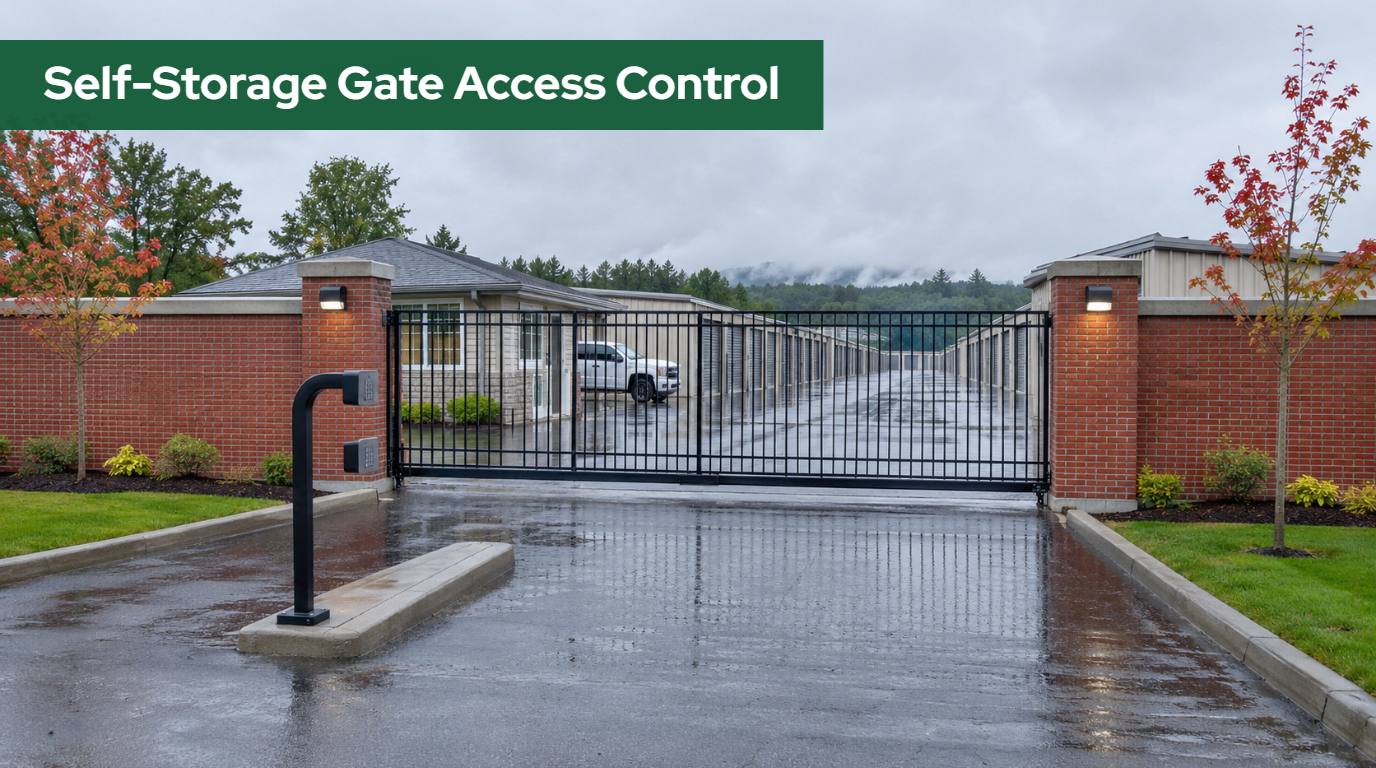
At a self-storage facility, the gate is the front desk that never closes. It decides who drives in, when they can do it, which tenants are locked out for unpaid rent and how the fire department gets through at three in the morning. When the gate or its keypad fails, tenants cannot reach their units, managers field angry calls and the site sits open or shut at exactly the wrong time. That is why self-storage gate access control in Washington deserves as much planning as the buildings themselves.
Washington adds its own rules to the usual equipment choices. The state’s self-service storage law, chapter 19.150 RCW, sets when an owner may deny a tenant access. The state fire code, adopted through chapter 51-54A WAC, governs gates across fire apparatus access roads. Washington’s electrical rules decide who may wire the operator and the keypads. This guide is written for owners, developers and managers of storage facilities in Skagit, Whatcom, Snohomish, Island, San Juan, King and Pierce counties.
Quick answer
Self-storage gate access control in Washington pairs a commercial slide gate and operator with keypads that give each tenant a code tied to their rental. RCW 19.150.030 lets an owner deny access after six days of unpaid rent if the agreement says so. Fire access, UL 325 safety and accessible keypads also apply.
In this guide
- What self-storage gate access control in Washington covers
- How a storage facility entrance is laid out
- Which gate type works best for a storage facility?
- Which UL 325 class applies to a storage gate?
- Keypads, tenant codes and access hours
- Unpaid rent and gate lockouts under RCW 19.150
- Exit control, free exit and tailgating
- Fire department access to storage facility gates
- Accessible keypads and the pedestrian entrance
- Cameras, intercoms and remote management
- Power outages and what the gate does without power
- Wiring and electrical permits for a storage gate
- Maintenance for a high-cycle storage gate
- A planning checklist for owners and developers
- How we approach storage facility gates
- Frequently asked questions
What Self-Storage Gate Access Control in Washington Covers
A storage facility gate is not a single product. It is a small system whose parts have to agree with each other and with the software the office uses to rent units and collect payments. A typical gated storage entrance in Northwest Washington includes:
- The vehicle gate, usually a slide or cantilever gate wide enough for moving trucks and trailers.
- The gate operator, listed to UL 325 for the class of use.
- An entry keypad on a pedestal in the entry lane, and an exit keypad or vehicle detector for leaving.
- Safety devices, such as photo eyes, edge sensors and vehicle loops.
- An access control panel that stores codes, schedules and events.
- Emergency access for the fire department, approved by the fire code official.
- Cameras, an intercom and a pedestrian gate separate from the vehicle gate.
Each piece has its own rules: UL 325 and ASTM F2200 for the operator and gate, the fire code for emergency access, accessibility rules for keypads people reach on foot, Washington’s electrical law for the wiring, and chapter 19.150 RCW plus the rental agreement for cutting off a tenant’s code. Our commercial gate installation page describes the broader range of business gates we build, and this guide focuses on what makes storage different.
How a Storage Facility Entrance Is Laid Out
The layout of the entrance decides more about daily traffic than any piece of equipment. A storage gate sees small cars, pickups with trailers, rented box trucks and the occasional RV or boat headed for outdoor parking, often driven by people who have never seen the site. A few layout decisions shape everything else:
- Stacking space before the gate. The entry keypad should sit far enough from the street that a truck with a trailer can stop at it without blocking the road. A queue that backs onto the street pushes drivers to tailgate.
- Separate entry and exit lanes where space allows, so a tenant leaving does not block one arriving. On tight lots, one gate can serve both directions if the timing and exit detection are set for it.
- A turnaround for a driver with a wrong code or an expired account, so they do not back into the street.
- Keypad position. ASTM F2200, summarized by DASMA, calls for controls at least 6 feet from the gate so a person cannot reach the moving panel from the keypad.
- Drainage at the gate line, because water that sheets across a large paved entrance freezes in a cold snap and pools on loops and track.
For a new facility, these decisions belong in the site plan before paving. On an existing site, they decide whether a new gate fits in the same place. Our guide on how wide a gate should be covers the clearances that apply to vehicle gates in general, and storage sites usually need more than a home driveway because of rental trucks and trailers.
Which Gate Type Works Best for a Storage Facility?
Most storage facilities in Washington use a slide gate, and for good reason. A slide gate moves along the fence line, so it does not swing into the drive lane where a truck may be waiting, and it handles wide openings without the long arc a swing gate needs. Still, each gate type has a place.
| Gate type | Where it fits at a storage site | What to plan for |
|---|---|---|
| Cantilever slide gate | Most entrances, especially where snow, ice, gravel or debris would foul a ground track | Room along the fence for the counterbalance tail, a rigid frame and solid foundations for the rollers |
| Track (V-groove) slide gate | Flat, paved entrances that are kept clean | A track in the pavement that must stay clear of ice, gravel and leaves |
| Swing gate | Narrow sites where there is no room to slide | Clear space for the arc, wind load on a solid leaf and vehicles waiting inside the swing path |
| Barrier arm | Secondary lanes, an RV or boat lot, or traffic control in front of a gate | A barrier arm controls traffic but does not secure a perimeter on its own |
| Bi-parting slide | Very wide openings or two-way traffic through one gate | Two operators that must stay in sync and space for both panels |
In Northwest Washington, the cantilever slide has an extra advantage. Because it rolls on carriages mounted to posts beside the opening instead of on a track in the driveway, it keeps running through leaf season, gravel tracked in by trailers and the frost and ice that a ground track collects. Our cantilever gate installation guide explains how the frame, counterbalance and foundations work.
Barrier arms cycle quickly, but they do not stop someone on foot or a determined driver, so at a storage facility they work best beside a perimeter gate or for an interior vehicle lot. Our article on the barrier arm gate explains where they fit and where they do not.
Steel picket panels let the office and cameras see through the gate, while solid panels block the view but catch more wind. Every option should be designed to ASTM F2200, which sets construction requirements for automated vehicular gates, including openings and guarding that reduce entrapment points.
Planning a gate for a new or existing storage facility?
We design, fabricate in our Sedro-Woolley shop, install and automate commercial gates, so the gate, the operator and the access control are planned as one system for your site and your traffic.
Which UL 325 Class Applies to a Storage Gate?
UL 325 is the safety standard for gate operators, and it sorts vehicular gate operators into four classes of use. The class matters because it decides which entrapment protection the operator must have and which locations the operator is meant for. An operator is marked with every class it is intended for, so the label on the unit tells you where it may be used.
As summarized by DASMA in its technical data sheet on UL 325 gate operator classes, the four classes are:
- Class I, residential: a home of one to four single-family dwellings, or a garage or parking area associated with one.
- Class II, commercial or general access: a commercial location or building such as multifamily housing of five or more units, a hotel, a garage, a retail store, or another building accessible by or servicing the general public.
- Class III, industrial or limited access: industrial locations such as factories and loading docks, or other locations not intended for public use.
- Class IV, restricted access: guarded industrial locations such as airport security areas, where security personnel prevent unauthorized access.
A self-storage facility serves members of the public who rent units, so in practice it is planned as a Class II location in most cases. Tenants, helpers and rental truck drivers use the gate every day. A site used only by a business’s own staff might be different, so the designer and the operator manual make the final call.
The class is not a formality. UL 325 does not accept the operator’s built-in sensing as enough on its own: the installation also needs external entrapment protection, monitored by the operator. On a storage slide gate that usually means photo eyes across the opening and the travel path, contact edges on the gate, guarded rollers and warning signs on both sides. Rental trucks bump photo eye posts and crush edges, so those devices belong on the maintenance schedule. Our guide to automatic gate safety standards explains how UL 325 and ASTM F2200 fit together.
Washington ties these standards into the fire code as well. Section 503.6 of the International Fire Code, adopted statewide through chapter 51-54A WAC, requires electric gate operators on gates across fire apparatus access roads to be listed to UL 325, and the gates themselves to be designed to ASTM F2200. For a storage facility whose drive aisles are fire access roads, that turns the safety standards into a code requirement the fire code official can check.
Keypads, Tenant Codes and Access Hours
The keypad is where tenants meet the access control system, and where most of their complaints start: codes that stop working, keypads that fail in winter rain, and a line of drivers waiting behind someone who cannot read the screen.
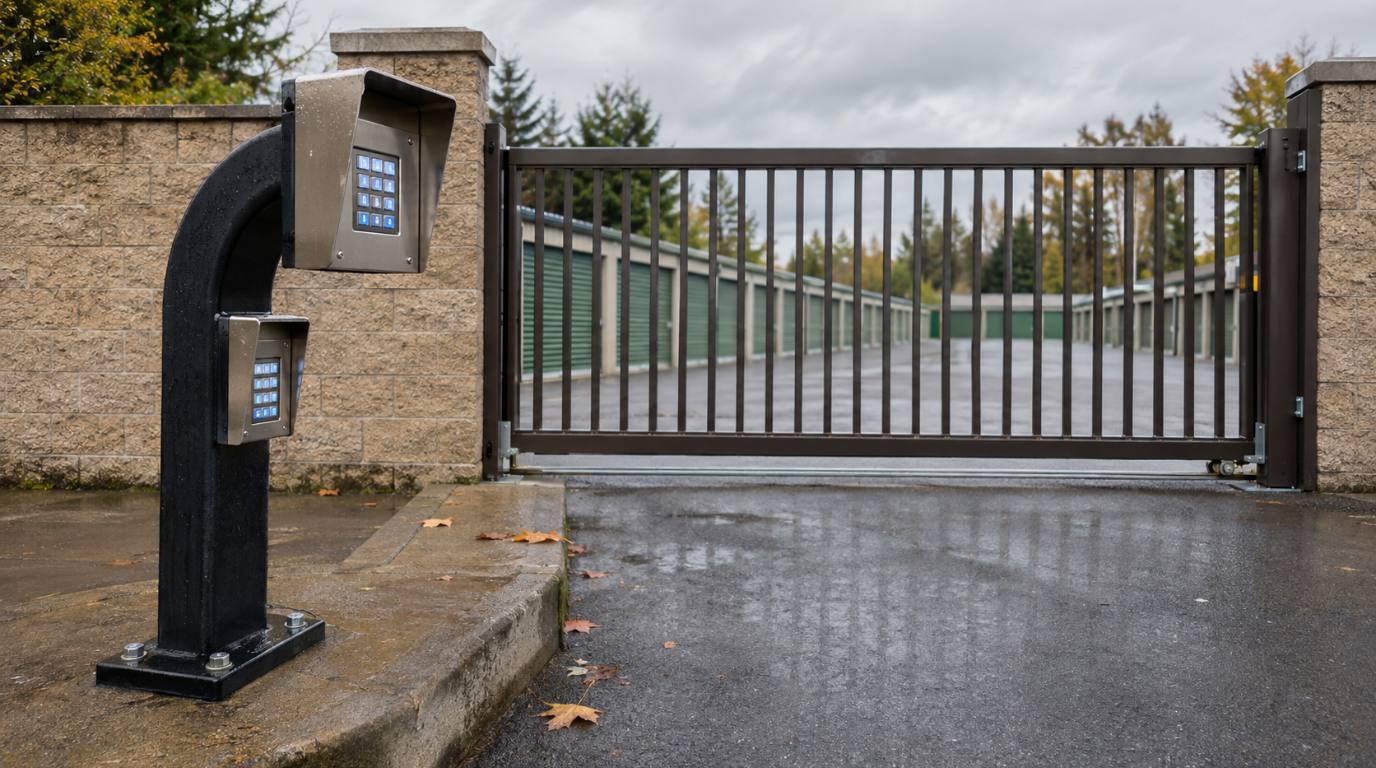
Most modern storage access control systems give each rental its own code. That has several practical benefits:
- Every entry is tied to a tenant. The system records which code opened the gate and when, which helps when a tenant reports a problem with their unit.
- Codes can be turned off one at a time. When a tenant moves out or falls behind on rent, the office can suspend that code without touching anyone else’s.
- Access hours can be set by tenant. The facility can set general gate hours and give extended hours to some tenants, such as business renters, if the system supports it.
- Areas can be zoned. Larger sites can limit a code to a building, a floor, an elevator or an outdoor parking area, so a tenant reaches only the part of the site they rent.
Many facilities connect the access control panel to the management software they use to rent units and take payments. When that link works, a new rental creates a code and a missed payment suspends it without anyone retyping anything at the gate. When the link breaks, the gate keeps working on stale data and the office may not know. Before choosing a keypad and controller, confirm that they support the management software you use and decide who is responsible for that connection when something goes wrong.
Keypad hardware also needs to suit Northwest weather: backlit keys for November dusk, a sealed housing with a hood against sideways rain, and a pedestal protected from rental trucks. Some sites add a card reader or a mobile credential. Our comparison of RFID access and keypad entry explains the tradeoffs between codes, cards and fobs.
Height matters as much as hardware. A keypad on a single post set for a car leaves pickup and truck drivers leaning down, and a keypad set for trucks leaves car drivers opening the door to reach it. Many storage sites use a dual-height gooseneck pedestal so both reach it from the driver’s seat. Our guide to automatic gate keypad height covers standard heights and the setback from the gate.
Unpaid Rent and Gate Lockouts Under RCW 19.150
This is where self-storage gate access control in Washington differs most from other commercial gates. At a storage facility, the gate is often the tool the owner uses to deny a tenant access for unpaid rent. Washington’s self-service storage law, chapter 19.150 RCW, sets the timeline and the notices that go with that decision, and the access control system has to be able to follow it.
Under RCW 19.150.030, if any part of the rent or other charges goes unpaid for six consecutive days, an owner may deny the occupant access to the storage space, as long as the rental agreement provides for it. On a gated facility, that denial usually happens at the keypad: the tenant’s code is suspended so it no longer opens the gate or the building doors.
The rest of chapter 19.150 RCW sets out what comes after that first step. The table below summarizes the main points as we read them. It is a planning guide for how the gate system should behave, not legal advice, and owners should confirm their procedures with their own attorney.
| Stage | What chapter 19.150 RCW says | What the access system needs to do |
|---|---|---|
| Six consecutive days unpaid | RCW 19.150.030: the owner may deny access if the rental agreement provides for it | Suspend the tenant’s code on schedule, and only for that tenant |
| Fourteen consecutive days unpaid | RCW 19.150.040: a preliminary lien notice goes to the occupant’s last known address and alternative address, by first-class mail or by email if the conditions are met | Keep the code suspended and keep a clear record of when access was denied |
| Date in the preliminary notice passes | RCW 19.150.060: the lien attaches, and the owner may deny access, enter the space, inventory the goods and move them to a place of safekeeping | Allow staff access to the unit while the tenant’s code stays off |
| Rent paid in full | The tenant is current again | Restore the code promptly so the tenant is not locked out longer than the account allows |
Two practical points follow. First, the lockout has to be specific: a system that shares codes among tenants cannot deny access to one occupant without affecting others. Second, the system has to restore access as reliably as it removes it, and keep a record of when each code was suspended and restored.
The statute does not say how a gate or keypad must work, and it does not set access hours. Those come from the rental agreement and the owner’s policy.
Need a gate system that follows your lockout policy?
We install access control with individual tenant codes, schedules and event logs, and we plan it with the gate and operator so codes turn off and back on when the account says so.
Exit Control, Free Exit and Tailgating
How vehicles leave a storage facility matters as much as how they enter. There are two common approaches:
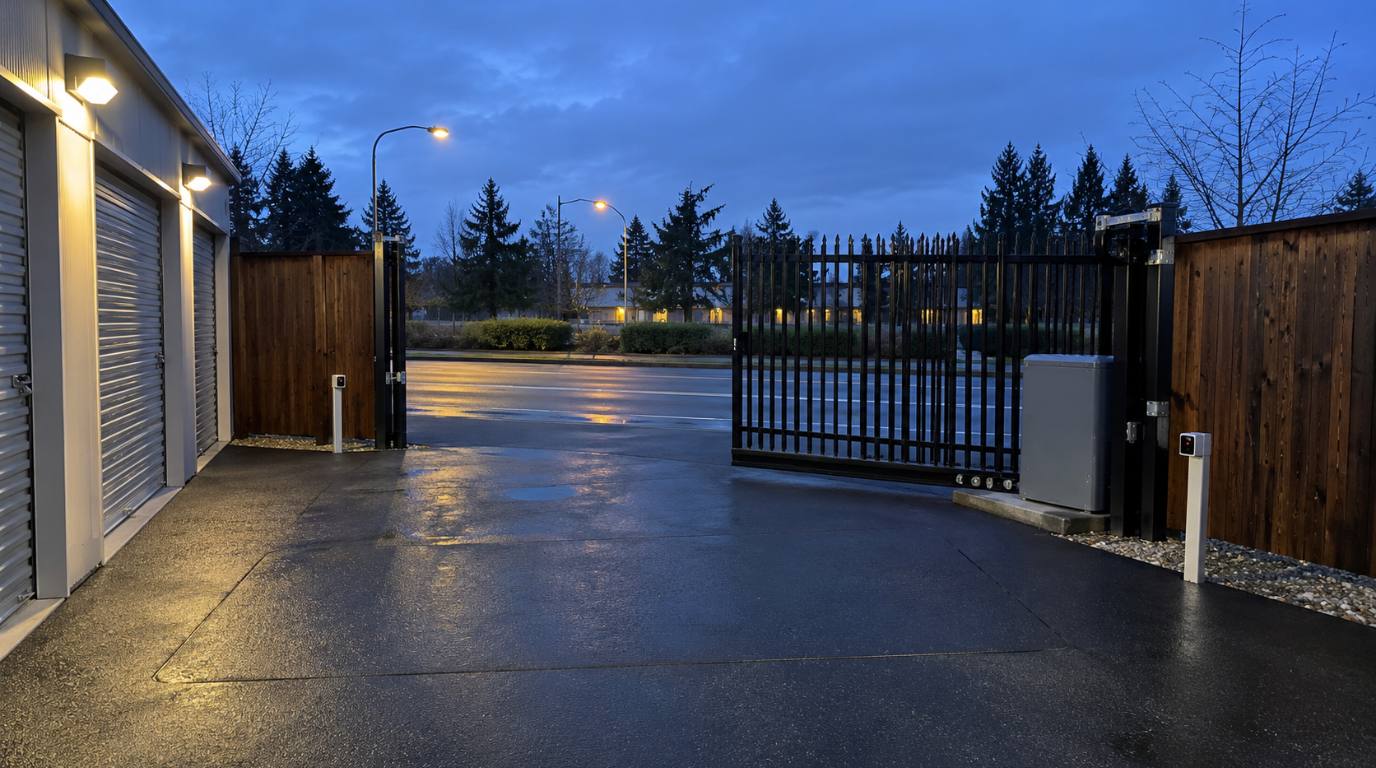
- Free exit. A vehicle loop or exit sensor on the property side opens the gate automatically when a vehicle approaches from inside. It is simple for tenants and avoids anyone being stuck inside. Our guide to the gate loop detector explains how exit, safety and presence loops differ and where each one goes.
- Coded exit. An exit keypad on the inside requires the same code used to enter. It tracks who left and when, and it helps confirm that a tenant has actually left after hours. It needs clear signs and a way for staff or the fire department to open the gate for anyone who cannot.
Tailgating, when a second vehicle follows the first through on a single code, is a common concern. A few measures reduce it without making the gate unsafe:
- Close timing set for the traffic. The gate should close promptly after a vehicle clears it, but never on a vehicle. Loops and photo eyes tell the operator when the opening is clear, and the close timer should be set with them, not against them.
- Cameras that record the gate line. A camera that captures each vehicle passing the gate, matched to the code event, shows whether one code brought in one vehicle or two.
- Anti-passback in the access system. Some controllers can refuse a second entry on a code that has not yet exited, which discourages sharing a code.
No setting should ever make the gate close on a vehicle or a person to stop tailgating. The safety devices are there to stop and reverse the gate when something is in its path, and they must keep working whatever the access control is doing.
Fire Department Access to Storage Facility Gates
Storage facilities hold a lot of material in a small area, and the drive aisles between buildings are often the routes fire apparatus use to reach them. When a gate crosses a fire apparatus access road, the fire code sets requirements for it.
Washington adopts the International Fire Code statewide through chapter 51-54A WAC, with state amendments. Under WAC 51-54A-0503, fire apparatus access roads are provided and maintained in accordance with locally adopted street, road and access standards. Section 503.6 of the code covers security gates: where they are installed across fire apparatus access roads, the fire code official must approve them, and electric gates must have an approved means of emergency operation.
“Approved” is the key word. Each fire agency decides what it accepts, which is why the answer changes from one jurisdiction to the next. Common emergency access devices include:
- A key switch on a post near the gate, opened with a key carried by the responding engines, often a Knox key switch.
- A key box holding a key or code for the gate and the buildings.
- A strobe-activated sensor that opens the gate when it detects the emergency light pattern of an approaching vehicle, where the agency uses that system.
- Radio entry, where the fire agency opens the gate from the vehicle.
Some agencies also set rules for gate width, the distance between the gate and the street, or what the gate does when power fails. For a storage facility, the fire marshal’s review often comes up during site plan or building permit review, and getting the gate approved at that stage is far easier than changing it after it is installed. Our guide to fire department gate access explains how the common devices work and what to ask your local fire agency before ordering equipment.
Accessible Keypads and the Pedestrian Entrance
A storage facility that rents to the public has public areas, such as the office and the routes tenants use, and accessibility rules generally apply to those areas. At the gate, two questions come up: whether a person who uses a wheelchair can reach the controls, and how people on foot get in and out.
The 2010 ADA Standards set the reach range for operable parts on an accessible route between 15 and 48 inches above the ground. A vehicle keypad set for a truck window is above that range, which is one reason many sites add a separate keypad at the pedestrian entrance or on the accessible route. The access control system can give that keypad the same tenant codes, so a tenant who arrives on foot or uses a mobility device has the same access as one in a car.
The pedestrian entrance itself is a safety question too. UL 325 is clear that a vehicular gate is for vehicles, and pedestrians need a separate entrance. A storage facility where tenants walk in from a bus stop, a neighboring lot or the office should have a pedestrian gate or door near the vehicle gate, with its own lock and keypad. Our guide to pedestrian gate access control covers electric strikes, magnetic locks, free egress and how a pedestrian gate ties into the same access system.
The specifics depend on the building and how the local building department applies the rules, and they are confirmed during permit review.
Cameras, Intercoms and Remote Management
Many storage facilities run with a small staff, and some have no one on site for long stretches. Cameras, intercoms and remote access let the office manage the gate from a distance:
- A camera on the entry lane that captures the driver and the vehicle at the keypad, and one on the gate line that captures each vehicle passing through.
- A video intercom at the keypad, so a driver who cannot get in can call the office and the staff can see who is there before opening the gate remotely. Our article on video intercom gates explains how they work.
- Remote gate control from the office or a phone app, so staff can let in a moving company or a vendor without giving out a code.
- Event logs that combine code use, gate cycles and camera clips, so a question about who entered at what time has an answer.
- License plate recognition on some sites, to identify vehicles at the gate. Our article on license plate recognition gates covers where it helps and its limits.
Rural storage facilities in Skagit, Whatcom and the islands sometimes have weak internet or none at the gate. In those cases, a cellular-connected controller can carry codes and events to the office or the cloud. Our guide to the cellular gate opener explains how they work and what coverage to check before relying on one.
Running a storage site with a small staff?
We install keypads, video intercoms, card readers and license plate recognition, and connect them to the gate so the office can manage the entrance remotely.
Power Outages and What the Gate Does Without Power
Western Washington loses power in windstorms every fall and winter, and storage facilities are not immune. When the power goes out, a storage gate has to do something sensible: keep the site secure, let tenants leave, and let the fire department in.
The main decisions are:
- Battery backup for the operator. Many commercial operators can carry a battery backup that keeps the gate running for a number of cycles after the power fails. How many depends on the operator, the gate weight, the battery size and the temperature, so the manual and the site’s traffic decide the size. Our guide to automatic gate battery backup explains the options.
- Backup for the access control. A gate that runs on battery but has a keypad and controller that went dark does not let tenants in. The keypads, controller, network equipment and any cellular modem need backup too.
- The power-failure mode. Many operators can be set to open, close or hold their position when the battery runs low. Some fire agencies have rules about what a gate across an access road must do in a power failure, so this setting should follow the fire code official’s approval.
- Manual release. Every operator has a manual release so staff can move the gate by hand. Staff should know where it is, how it works and who has the key.
Planning ahead avoids a gate stuck closed with tenants inside, or stuck open overnight.
Wiring and Electrical Permits for a Storage Gate
A storage gate carries more wiring than a residential gate. There is the power feed to the operator, the low-voltage wiring to keypads, sensors, loops and edges, the data link to the office and often cameras and lighting at the gate. In Washington, that wiring falls under chapter 19.28 RCW and chapter 296-46B WAC.
A few points shape the job:
- Permit and inspection. Electrical work in Washington generally needs an electrical work permit and inspection, either from L&I or from a city that runs its own electrical program. A gate operator is not on the exemption list, so the operator and its feed are permitted and inspected.
- Who does the work. The work is done by a licensed electrical contractor with the right specialty or a general electrical contractor. The Doors, Gates and Similar Systems specialty covers the gate operator and its control wiring. The feeder and the panel that supply the operator’s own panel are outside that specialty.
- Separation of power and low voltage. Power and low-voltage circuits run in separate conduits. Mixing them causes interference on sensors, loops and keypads, which shows up as a gate that reverses or a keypad that drops codes.
- Conduit before paving. Storage facilities pave large areas at once. Conduit to the keypad islands, across the drive for the second operator or exit devices, and spare conduit with pull strings should go in before the asphalt or concrete.
Our guide to gate opener wiring in Washington covers permits, licensing, wire size and burial depth in more detail. For general permit questions about gates, see our page on gate permits in Washington State.
Want the gate, keypads and wiring planned before you pave?
We hold a Washington electrical contractor license in the Doors and Gates specialty, so the operator, safety devices and access control are wired by the same team that builds and installs the gate.
Maintenance for a High-Cycle Storage Gate
A storage gate cycles for every tenant visit, in all weather, often for large vehicles, so maintenance is part of the operating cost.
A practical schedule includes:
- Safety device tests on photo eyes, edges and loops, confirming that each one stops and reverses the gate as it should.
- Rollers, carriages and track checked for wear and kept clean, especially before the leaf season and after a freeze.
- Keypads and pedestals checked for damage, water inside the housing, worn keys and loose mounting.
- Batteries tested and replaced on schedule, because a battery that has quietly lost its capacity only shows it during an outage.
- Access control and software link checked so codes, schedules and lockouts match the management software.
- Emergency access devices tested so the key switch, strobe sensor or radio entry still opens the gate.
Northwest Washington weather adds its own wear. Rain finds its way into keypad housings and junction boxes, salt air near the water corrodes hardware in Anacortes, the islands and the waterfront, and freezes heave pavement and shift loops. Our guide to planned maintenance for commercial gate systems explains how a service plan works and what it should cover.
A Planning Checklist for Owners and Developers
For a new facility or a gate replacement, work through these questions early:
- Map the traffic: largest vehicles, peak times, where a queue forms.
- Set the layout: lanes, keypad at least 6 feet from the gate, stacking space, turnaround.
- Choose the gate type, starting with a cantilever slide in Northwest Washington.
- Confirm the UL 325 class with the designer and choose an operator marked for it.
- Plan entrapment protection with photo eyes, edges, loops, guarding and signs.
- Pick the access control that gives each tenant a code, supports your management software and can suspend and restore codes on schedule.
- Write the lockout procedure to match the rental agreement and chapter 19.150 RCW, and confirm it with your attorney.
- Ask the fire agency what emergency access device, gate width and power-failure behavior it requires.
- Plan accessibility with a keypad in reach range and a separate pedestrian entrance.
- Add cameras and an intercom that let the office see and talk to the gate.
- Plan power and backup for the operator and the access control, and set the power-failure mode.
- Run conduit before paving and plan the electrical permit.
- Set a maintenance schedule before the gate goes into service.
How We Approach Storage Facility Gates
Emerald Gate Systems is a family-owned gate company based at 7557 Alpine Lane in Sedro-Woolley, Washington. We design, fabricate in our own shop, install, automate and service residential, farm and commercial gates across Skagit, Whatcom, Snohomish, Island, San Juan, King and Pierce counties. Because one team handles CAD planning, welding, installation, automation, access control, testing and future service, a storage facility gate is planned as a whole system instead of pieced together from different trades.
On a storage project, we start with a free on-site consultation. We look at the entrance, the traffic, the existing or planned paving, where power and data can reach the gate, and what the fire agency and the site plan call for. Then we plan the gate, the operator, the safety devices and the access control together. We install and service LiftMaster, Viking and FAAC gate operators and access control including keypads, intercoms, telephone entry, card readers and license plate recognition, and our electrical administrator is on staff. Our access control systems page has more on the systems we install.
Washington requires contractors to show their registration in advertising: Emerald Gate Systems is registered with the Washington State Department of Labor and Industries as a construction contractor (EMERAGS748D6) and holds an electrical contractor license in the Doors and Gates specialty (EMERAGS747KE).
Frequently Asked Questions
Can a storage facility in Washington lock out a tenant at the gate?
Yes, within the law. RCW 19.150.030 lets the owner deny an occupant access to the storage space when rent or other charges go unpaid for six consecutive days, if the rental agreement provides for it. At a gated facility, that usually means suspending the tenant’s gate code. Later steps, such as the lien notice, follow the rest of chapter 19.150 RCW.
What type of gate is best for a self-storage facility?
Most storage facilities use a slide gate because it does not swing into the drive lane and handles wide openings for trucks and trailers. In Northwest Washington, a cantilever slide gate is often the better choice, because it has no ground track to fill with ice, gravel or leaves. Narrow sites may need a swing gate instead.
What UL 325 class is a self-storage gate operator?
UL 325 Class II covers commercial locations accessible by or servicing the general public, and a storage facility that rents units to the public is planned as Class II in most cases. Class III covers industrial sites not intended for public use. The operator is marked with its classes, and the designer confirms the right one for each site.
Does the fire department need access through a storage facility gate?
When the gate crosses a fire apparatus access road, yes. The state fire code, adopted through chapter 51-54A WAC, requires the fire code official to approve the gate and requires an approved means of emergency operation on electric gates. That is often a key switch, sometimes with a strobe sensor or radio entry, depending on the local fire agency.
How do tenants get out of a gated storage facility?
Most facilities use either free exit, where a vehicle loop or sensor opens the gate for vehicles leaving, or coded exit, where tenants enter their code at an exit keypad. Free exit is simpler and avoids anyone being stuck inside. Coded exit gives a complete record but needs a way for staff or the fire department to open the gate.
Do storage gate keypads need to meet accessibility rules?
At a facility open to the public, the routes and controls the public uses generally fall under accessibility rules. The 2010 ADA Standards put operable parts between 15 and 48 inches above the ground. Many sites add a keypad at the pedestrian entrance or on the accessible route, with the same tenant codes as the vehicle keypad.