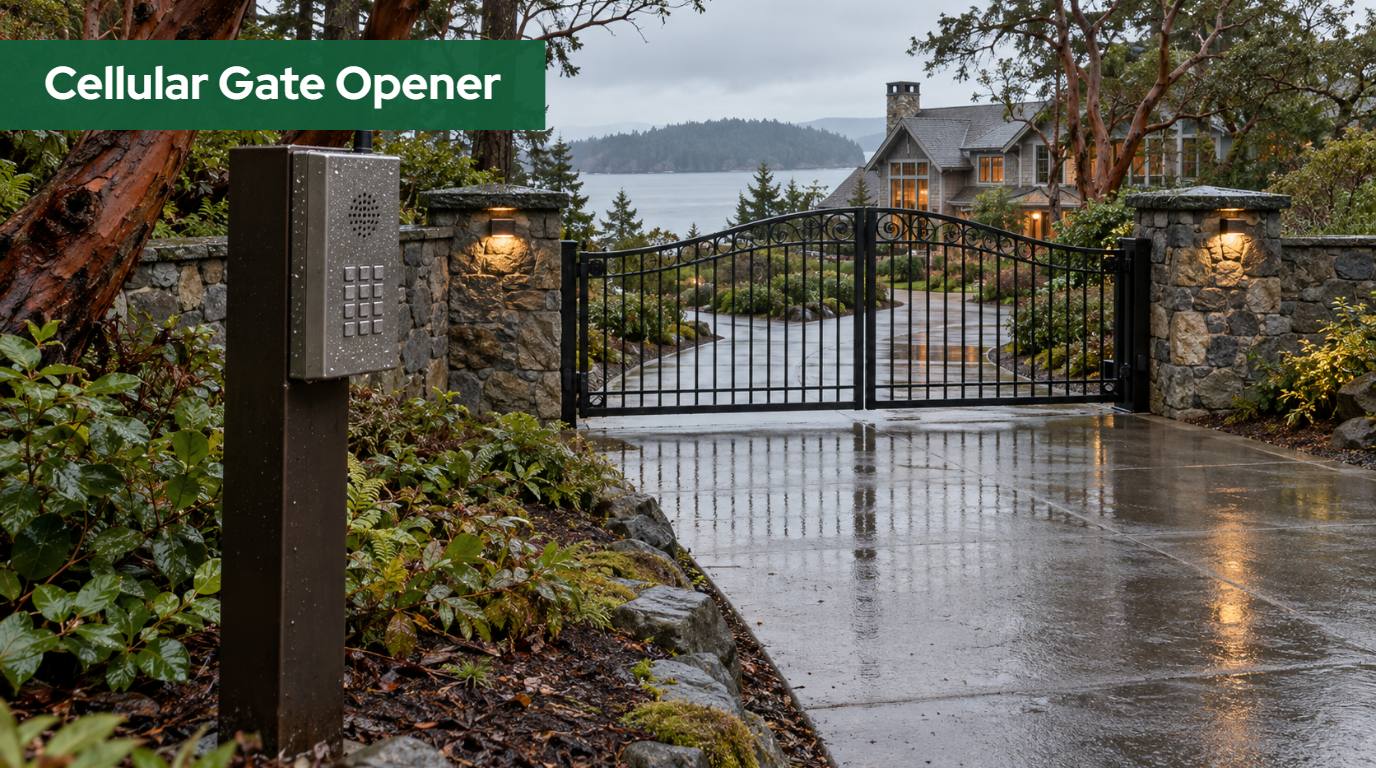
A cellular gate opener in Washington solves a problem that many rural owners, island homeowners and private road associations know well: the gate sits hundreds of feet from the house, there is no phone line at the entrance, and trenching a cable down the driveway is the last thing anyone wants to do. A cellular unit gives the gate its own connection to the mobile network, so a visitor at the call box can ring your phone and you can let them in from wherever you are.
That convenience comes with conditions. The unit only works where the signal is strong enough at the gate itself, it needs steady power, it carries a service subscription, and it does not change the safety and fire access rules that apply to every automatic gate. This guide explains how cellular gate access works, how to check coverage before you buy, how to mount and power the equipment, and what Washington rules still apply. It is written for owners, HOA boards and property managers in Skagit, Whatcom, Snohomish, Island, San Juan, King and Pierce counties.
Quick answer
A cellular gate opener connects a gate’s call box or controller to the mobile network instead of a phone line, so visitors can call you and you can open the gate remotely. In Washington it works well where signal at the gate is strong, power is reliable and UL 325 safety devices, fire access and L&I wiring rules are met.
In this guide
- What a cellular gate opener in Washington actually does
- Three kinds of cellular gate access
- Cellular, phone line, Wi-Fi or wired internet?
- Will cellular work at your gate?
- Mounting the cellular unit and antenna
- Power, batteries and outages
- SIM cards, subscriptions and older networks
- Opening a gate you cannot see: UL 325 still applies
- Fire department access in Washington
- Codes, users and account security
- HOAs, private roads and commercial sites
- Wiring, permits and L&I rules
- When a cellular gate opener stops working
- How we approach cellular gate access
- Frequently asked questions
What a Cellular Gate Opener in Washington Actually Does
An automatic gate has two separate jobs. The operator moves the gate. The access control system decides when the operator should move it. Keypads, remote controls, card readers, loop detectors and call boxes are all access devices: each one, when it is satisfied, sends an open command to the operator. A cellular gate opener is an access device, or an add-on to one, that uses the mobile network to carry that decision.
In practice the term covers a few different products. Some people mean a telephone entry call box at the driveway that dials out over a cellular module instead of a copper phone line. Others mean a small cellular relay inside the operator’s control box that opens the gate when an authorized phone number calls it. Others mean an internet-connected controller that reaches the cloud through a cellular modem, so the owner can open the gate from an app and manage codes from a laptop.
All three share one idea: the gate gets its own path to the outside world that does not depend on a wire back to the house. That is why cellular access is so common on long driveways, farm entrances, island properties, shared private roads and commercial yards where the nearest phone or network jack is far from the gate.
A cellular unit does not replace the operator’s safety devices or the fire department’s means of opening the gate. It is one more way to send an open command. If you are still choosing the rest of the system, our overview of access control services for gates, from keypads to phone entry and smart systems shows where cellular fits among the other options.
Three Kinds of Cellular Gate Access
The three groups below solve different problems, and choosing the wrong group is a common reason a cellular project disappoints.
1. Cellular telephone entry (call box). A visitor walks or drives up to a call box at the gate, finds your name in a directory or presses a button, and the call box rings your phone. You talk to the visitor through the call box speaker and press a key on your phone to open the gate. The cellular module replaces the copper phone line that older call boxes needed. DoorKing’s literature for its cellular connection describes exactly this use: once installed, its 1800 series entry systems use a 4G LTE cellular connection for voice communication instead of the traditional copper phone line, where that service is available.
2. Cellular “call to open” relay. A small unit with a SIM card sits inside the operator’s enclosure and is wired to an input on the operator board. When a phone number on its approved list calls the unit, it triggers the input and the gate opens. There is no visitor conversation. These units suit farm gates, equipment yards and family properties where the same few people come and go.
3. Cellular-connected smart access. Here the call box, keypad or controller is an internet device, and a cellular modem provides its internet link. The owner or manager uses an app or web portal to open the gate, review an activity log, add and delete codes, and sometimes see video from a camera at the call box. These systems need a data connection, not just a voice line.
| Type | Best fit | What the visitor does | What the owner does |
|---|---|---|---|
| Cellular telephone entry (voice) | Homes and communities that get guests and deliveries | Calls a resident from the call box | Answers on any phone and presses a key to open |
| Cellular “call to open” relay | Farm gates, yards, family properties with few users | Nothing; there is no visitor station | Calls the gate from an approved number |
| Cellular-connected smart access (data) | HOAs, rentals, commercial sites, owners who want logs and app control | Uses a code, credential or call button | Manages users and opens the gate from an app or portal |
Voice and data are not the same service. DoorKing’s documents make the distinction plainly: its voice-only cellular model provides voice communication and no programming or data service, while its voice and data models also let the owner program the entry system remotely through its cloud account manager. If you want to update codes or directories from home, you need the data version, and analog dial-up modems used by older programming software do not work over a cellular network.
Cellular, Phone Line, Wi-Fi or Wired Internet?
Cellular is one of four common ways to connect a gate. On some sites two are combined so the gate keeps working if one link fails.
| Connection | Strengths | Limits | Usually fits |
|---|---|---|---|
| Cellular | No cable to the house; works at remote gates; easy to add to an existing call box with the right module | Depends on signal at the gate; service subscription; network changes over time | Long driveways, islands, farms, private roads |
| Copper phone line | Simple; works with older call boxes | Needs a line run to the gate; voice only on most older systems | Sites that still have a working line at the entrance |
| Wi-Fi from the house | No separate subscription; good for app control | Range drops fast through trees, walls and distance; fails if the house router is down | Gates close to the house with a clear line of sight |
| Wired network cable or fiber | Most stable link; carries video well | Needs conduit and a trench; distance limits for copper network cable | New construction, commercial sites, gates planned before paving |
On new projects, the cheapest moment to choose is before the driveway is paved. A conduit laid in the trench during site work keeps every option open later, even if you start with cellular. Our guide to planning an automatic gate before paving in Burlington, WA explains why that sleeve is worth putting in early.
If your gate already has a call box on a phone line, cellular can often be added without replacing the whole station. DoorKing describes retrofit cellular kits for exactly that, as long as the entry system model and circuit board are on the module’s compatibility list. Our page on phone entry systems in Washington State covers call boxes in general, and our guide to the video intercom gate in Mount Vernon, WA explains what changes when you add a camera.
Will a Cellular Gate Opener Work at Your Washington Property?
The single most important question is whether the gate location, not the house, has a strong and steady signal on the network the unit uses. In western Washington, terrain, tall timber and water change reception over short distances, and a phone that works on the porch can show one bar at a gate in a hollow behind a stand of Douglas fir. Island properties in San Juan County, on Whidbey and on Camano often sit at the edge of coverage from towers across the water.
Start with the map. The FCC National Broadband Map lets you enter an address and see the mobile broadband coverage that each provider reports for that location, including 4G LTE and 5G. It is a useful first screen, but it is a model of coverage, not a measurement of signal at a specific spot behind your gate pillar.
Then test at the gate. Manufacturers ask for a real test before installation. DoorKing’s installation manual for its voice-only cellular system says the installation location must be tested for good signal strength before the system is installed, using an active phone on the same carrier network the module uses, because phones on other networks will not show you the right result. It calls for three to four bars of signal at the spot where the enclosure will be mounted, says to try nearby locations if that spot falls short, and warns not to install the enclosure in a weak or no-signal area.
A practical test at a Washington gate looks like this:
- Find out which carrier network the unit you are considering uses. Some products are tied to one carrier; others take a SIM card from several.
- Borrow a phone on that carrier if yours is on a different one.
- Stand where the call box or control enclosure will go, at the height it will be mounted, and check bars and a test call.
- Repeat on a wet day if you can. Heavy, wet foliage in the rainy season can make a marginal location worse.
- If the signal is weak, test a few feet higher and a few feet to either side, and note where it improves.
If no location near the gate is reliable, cellular may still be possible with an external antenna placed higher up, but sometimes the honest answer is a different connection, such as a conduit and network cable back to the house. Remote and off-grid sites in the islands raise the same question for power, which our guide to solar automatic gates in the San Juan Islands covers in detail.
Not sure your gate has enough signal for cellular?
We test reception at the actual gate location, on the network the equipment uses, before recommending a cellular call box, a call-to-open relay or a wired connection.
Mounting the Cellular Unit and Antenna
Once the signal is confirmed, where the unit goes matters almost as much as whether it goes in at all.
Height helps. DoorKing’s manual notes that, generally, the higher the enclosure is mounted, the better the reception, and that height also helps protect against vandalism. On a gate with a low operator pad, the cellular enclosure often belongs on a post or pillar, not at ground level beside the operator.
Keep it away from metal. The same manual says to keep the enclosure away from any metal because metal can disrupt the signal. Steel gates, steel operator housings, metal pedestals and metal enclosures all count. Mounting a cellular module inside a steel control box, or tight against a wrought iron gate, is a common way to lose bars that the test phone showed a few feet away.
Keep wire runs short. DoorKing calls for keeping the wire run between the cellular unit and the entry system as short as possible, with a maximum of 100 feet, to reduce the chance that lightning surges or other electrical interference disrupt the signal. It also specifies twisted pair phone wire for the voice connection and an earth ground connected to a proper ground nearby.
Seal everything. In a climate where rain falls for months at a time, water entry is the enemy. The manual recommends not drilling holes in the plastic enclosure, sealing any holes that must be drilled, and using watertight conduit and connectors for all field wiring when the box is installed outdoors.
Plan the antenna. Where the unit takes an external antenna, mounting it higher with a clear view toward the nearest towers can make the difference at a marginal site.
The call box also has to be reachable from a car window without the driver stopping in the gate’s path. Our guide to automatic gate keypad height in Washington covers setbacks, heights and pedestal placement, and those same principles apply to cellular call boxes.
Power, Batteries and Outages
Cellular units add their own power needs to the operator’s, and in Washington, where winter windstorms knock out power on rural roads, the behavior during an outage deserves a plan.
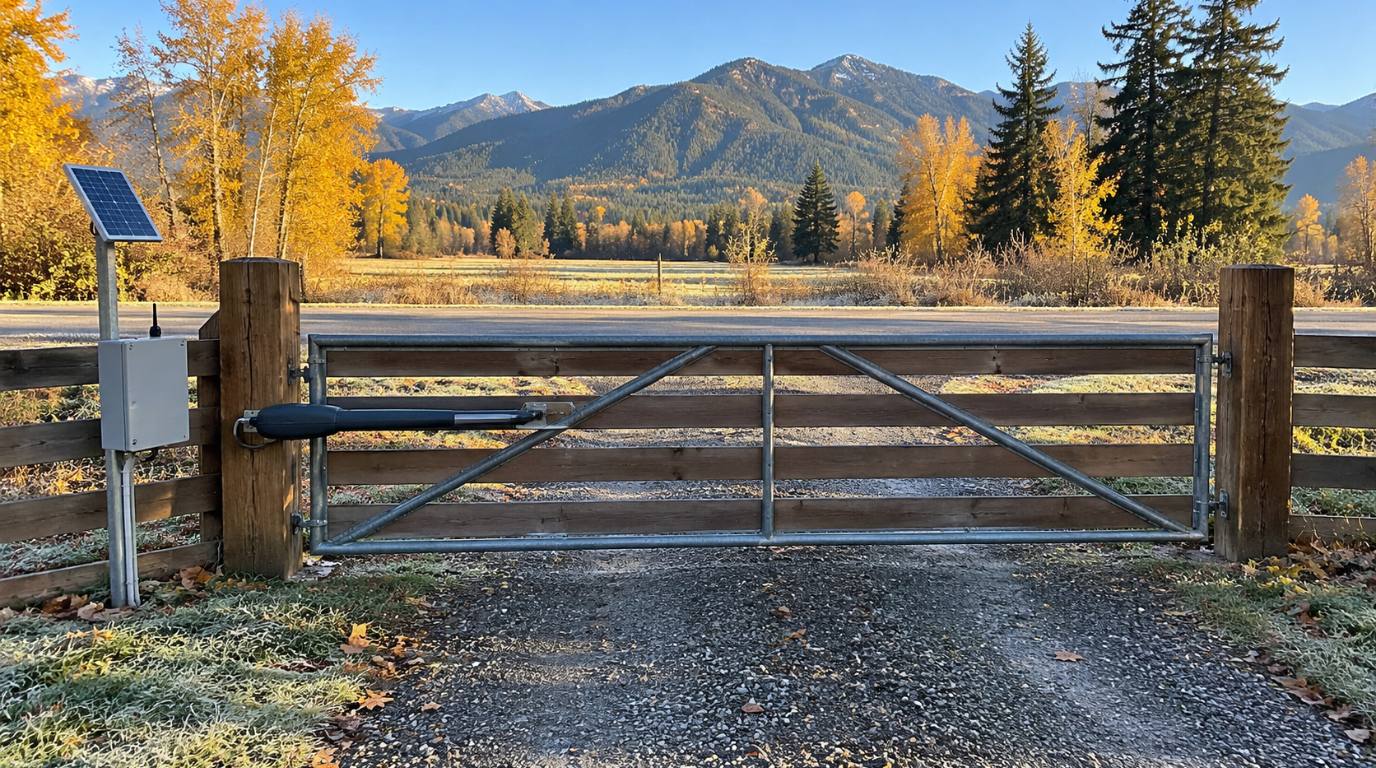
Most cellular modules run from low-voltage power supplied by a plug-in transformer or the operator’s accessory output. DoorKing’s voice-only unit, for example, is powered by a 16.5 VAC transformer supplied with it, and its manual warns not to connect that power to a receptacle controlled by an on and off switch. The same manual notes that the module’s lithium battery needs time to charge, and asks for at least half an hour of charging before the system is used.
During an outage, three things decide whether a visitor can still reach you and whether you can still open the gate:
- The operator’s backup. If the operator has battery backup, it can keep moving the gate for some number of cycles after the power fails. If not, the gate stops where it is.
- The cellular unit’s backup. A call box or relay without its own battery, or a feed from the operator’s battery, goes silent when the power goes out.
- The network. Cell sites have their own backup power, but a long regional outage can still affect service. Your gate cannot be more reliable than the network it depends on.
On solar gates, the cellular unit is one more load on the battery bank. Data-connected units with cameras draw more than a simple voice relay, and short winter days west of the Cascades leave less charging time. The battery and panel sizing has to account for every device on the system, not just the motor. Our guides to automatic gate battery backup in Skagit County and solar gate openers in Washington explain how those systems are sized and what to expect when the grid is down.
SIM Cards, Subscriptions and Older Networks
A cellular gate opener is a cellular device, so it needs an active service plan like any phone. DoorKing’s literature says it directly: a monthly subscription fee applies, just like your cell phone. Some manufacturers sell the service through their own program and tie the unit to one carrier; others let you buy a SIM card or data plan from a carrier of your choice. Ask before you buy which model your product uses, who you pay, and what happens to the gate if the account lapses.
Registration is part of the setup, not a formality. DoorKing’s voice-only system, for instance, will not function until online registration has been completed on its cellular website. Data-connected systems usually also need a cloud account for the property, with an owner login and, for communities, separate logins for managers. Keep those credentials with the property records so a change of owner or board does not leave the gate tied to someone who has moved away.
Older networks retire. Mobile networks change over time, and equipment built for an older generation of cellular service stops connecting when carriers shut that generation down. Call boxes and alarm communicators installed years ago on older networks are a good example. If you inherit a cellular call box with a property, check which network generation and carrier it uses and whether the manufacturer still supports it. Current products generally specify 4G LTE; DoorKing’s documents, for example, describe its modules as operating on the AT&T 4G LTE network where available.
Emergency calls. Do not treat a gate call box as an emergency phone. DoorKing’s voice-only manual states plainly that the cellular device cannot be used for 911 calls. Visitors and residents should use their own phones to reach emergency services.
Opening a Gate You Cannot See: UL 325 Still Applies
With remote opening, the person sending the command may be miles away and unable to see who is standing in the gate’s path. That makes the gate’s own entrapment protection more important, not less.
Automatic vehicular gate operators are listed to UL 325. DASMA’s TDS 353 on vehicular gate operators and UL 325 explains that an operator must have at least two independent entrapment protection means for each entrapment zone, that external devices such as photo eyes and edges must be monitored, and that the operator must not run automatically when a required device is missing or faulty. Those devices are what stop and reverse a gate when nobody is watching it. A cellular opener is only as safe as the photo eyes and edges on the gate it controls. Our guides to gate photo eye installation in Washington and the gate safety edge in Washington explain where those devices go.
Several UL 325 and ASTM F2200 points, as summarized in TDS 353, bear directly on cellular and remote access:
- Controls away from the gate. All gate activation controls must be at least 6 feet from the gate to reduce the chance of reach-through injury. That applies to a call box or keypad pedestal at the entrance as much as to a push button.
- Constant pressure systems are different. For operators that rely on a continuous pressure control (Type D), the controls must be placed so the user has a full view of the gate area while it moves, no other activation device may be connected, and an automatic closing device may not be used. A remote cellular opener does not belong on that kind of system.
- Second obstruction. When an operator’s inherent sensing detects a second obstruction in a row, it must stop, sound an alarm and wait for an intended hardwired input, and a person within sight of the gate must resolve the cause before it runs again. A remote command is not a substitute for someone on site.
- Warning signs. Warning placards must be visible in the gate area from both sides of the gate.
Many owners also pair a cellular call box with a camera so they can see the entrance before they open it. And a vehicle gate operator should never be the way people on foot get in; TDS 353 notes that vehicular gate operators are for vehicular gates only, with separate pedestrian access wherever people are likely to walk. Our guide to pedestrian gate access control in Washington covers that side of the entrance.
Adding remote opening to an older gate?
Before we connect a cellular unit, we check that the operator’s photo eyes, edges and monitoring work in every zone, because nobody may be watching when the gate moves.
Fire Department Access in Washington
A cellular call box lets your guests reach you. It does not give a fire crew a way through the gate, and Washington code expects that way to exist where a gate crosses a fire apparatus access road.
Washington adopts the International Fire Code statewide through the State Building Code, with its amendments in WAC 51-54A. The fire code section on gates across fire apparatus access roads, adopted through WAC 51-54A-0503, calls for electric gate operators listed to UL 325, gates designed and installed to ASTM F2200, and an approved means of emergency operation that the fire code official accepts. Many jurisdictions in our area also add their own requirements, such as a key switch, a lock box, a strobe or siren sensor, or a specific opening width, and those vary from one city or county fire marshal to the next.
For a cellular project, three points follow from that:
- Keep the emergency opening device. Whatever the fire marshal approved, such as a key switch or other device, stays in place and stays wired to the operator. A new call box does not replace it.
- Make sure it works without the network. Fire access cannot depend on a cellular signal or a cloud account. The approved device should open the gate locally even if the network is down.
- Check after any upgrade. When an operator board is replaced or a cellular unit is added, test the emergency opening device along with everything else before the job is closed out.
If you are adding a new gate across a driveway or private road, the permit and fire review usually happen before any access equipment is chosen. Our guide to gate permits in Washington State walks through who reviews what.
Codes, Users and Account Security
A gate that can be opened from anywhere is only as secure as the list of people allowed to do it, and that list needs the same care as a set of house keys.
For call-to-open relays, the approved number list is the lock. Keep it short and remove numbers when someone moves out or changes phones.
For telephone entry, change the factory master code during installation, give each household its own entry code where the system allows it, and delete codes when people leave.
For cloud-connected systems, treat the owner or manager login like a bank login: a strong unique password, two-step sign-in if the product offers it, and separate accounts for each manager so access can be removed without changing everyone’s password. Review the activity log now and then.
Cellular access also works alongside other credentials rather than replacing them. Residents may use remotes or tags, contractors a temporary code, and delivery drivers the call box. Our comparison of RFID access and keypad entry in Washington explains how those credentials differ, and our guide to license plate recognition gates in Northwest Washington covers a camera-based option for frequent users.
Cellular Entry for HOAs, Private Roads and Commercial Sites
Shared entrances are where cellular call boxes are most common, because the gate is often far from any building the association owns.

HOA and gated communities. A community call box needs a resident directory, individual codes, a way for the board or manager to update both, and a record of who opened the gate. That points to a voice and data cellular system or a cloud-connected one, not a simple relay. DoorKing’s literature notes that one cellular connection can be shared between two entry systems, such as a main entrance and a second gate, which can matter where a community has an entrance and an exit or a guard station. Our page on HOA and community gate systems covers the larger planning picture.
Private roads. Several households sharing a gate on a private road need to agree on who holds the service account, who pays for it and who manages the codes. Those questions are easier to settle in the road maintenance agreement than at the gate in the rain. Our article on the private road gate on Camano Island discusses cost sharing and access among neighbors.
Farms and rural acreage. A call-to-open relay is often enough at a farm gate that only family and a few regular helpers use. Our guide to gate systems for farms and rural properties in Washington State covers the rest of the farm entrance.
Commercial and multi-family sites. UL 325 treats operators at multi-family buildings with five or more units and at sites that serve the public as Class II or higher. At a busy commercial gate, cellular is usually a backup, with a wired connection as the main path where practical. Our commercial gate installation page explains how we plan those sites.
Wiring, Permits and L&I Rules in Washington
Connecting a cellular unit to a gate operator is electrical work, and Washington regulates who may do it. The Department of Labor and Industries licenses electrical contractors and specialties, and WAC 296-46B-920 creates a door, gate and similar systems specialty, specialty code (10), whose holders may install, service, maintain, repair or replace door, gate and similar systems electrical operator wiring and equipment.
That specialty covers low-voltage NEC Class 2 operator systems that are not connected to other systems, plus branch circuits from a listed operator control panel that supply only system components, within the limits the rule sets. It does not cover the line-voltage branch circuit that feeds the operator’s control panel; that circuit needs an electrical contractor licensed for that work. Call boxes, keypads, relays and the low-voltage connections to the operator fall within the gate specialty. A new outlet or circuit at the gate for the cellular unit’s transformer is line-voltage work.
Manufacturer instructions add their own requirements; DoorKing’s manual, for example, calls for wiring methods in accordance with the National Electrical Code (NFPA 70) and lists the cable types for external devices.
Whether a permit is needed depends on the scope: L&I electrical permits and inspections apply where the rules require them, and new gates may also need local land use or fire review. Our page on choosing a licensed gate contractor in Northwest Washington explains how to check a contractor’s registration and electrical license on the L&I site.
Want the cellular unit, power and wiring done in one visit?
Our licensed team installs the call box or relay, runs the low-voltage wiring to the operator, tests the emergency opening device and shows you how to manage codes before we leave.
When a Cellular Gate Opener Stops Working
Start by deciding whether the problem is the connection, the access device or the gate itself. If the gate opens normally with a remote but not by phone, the gate is fine and the cellular side needs attention. If nothing opens the gate, start with the operator.
| Symptom | Common causes to check | Who usually fixes it |
|---|---|---|
| Call box does not ring your phone | No power to the module; weak signal; service account lapsed; wrong number in the directory | Owner (account, directory), installer (power, signal) |
| Call connects but the gate does not open | Wrong open key or relay setting; wiring to the operator input; operator in a fault or safety stop | Installer |
| Calls drop or sound broken | Marginal signal; enclosure next to metal; antenna loose or damaged; volume and feedback settings | Installer |
| Relay ignores an approved phone | Number not on the list or changed; caller ID blocked on that phone; SIM or account issue | Owner, then installer |
| App shows the gate offline | Cellular modem without power or signal; data plan used up; cloud account change | Owner (plan), installer (hardware) |
| Everything stopped after a storm | Power outage; tripped breaker or GFCI; lightning surge on long wire runs; water in the enclosure | Installer |
Signal can also change over time as trees grow or the carrier changes its network, so a gate that starts dropping calls deserves a fresh signal test at the enclosure.
Never bypass a safety device to get a gate moving remotely. If the operator refuses to close because of a photo eye or edge fault, the cellular unit is not the problem. Our guide to an automatic gate not opening or closing walks through operator-side checks, and our automatic gate repair team in Northwest Washington can diagnose the operator, access devices and wiring on site.
How We Approach Cellular Gate Access
Emerald Gate Systems designs, fabricates, installs, automates and services gates from our own shop at 7557 Alpine Lane in Sedro-Woolley, Washington, and serves Skagit, Whatcom, Snohomish, Island, San Juan, King and Pierce counties. One team handles CAD planning, welding, installation, automation, access control, testing and later service, so the call box location, conduit, power and antenna are planned with the gate instead of being added after it is built.
On a site visit we start with how people actually arrive: who comes to the gate, how often, and whether you need to talk to them or simply let known people in. Then we test reception at the gate location and look at power, the operator’s safety devices and the fire access requirements for that road. From there we recommend a cellular call box, a call-to-open relay, a data-connected system or a wired connection, whichever fits the site. We install and service LiftMaster, Viking and FAAC operators and access control equipment including keypads, intercoms, telephone entry, card readers and license plate recognition, and we test every device, including the emergency opening method, before we leave. Our access control systems page and our gate automation retrofits page cover the rest of the process.
Washington requires contractors to show their registration in advertising: Emerald Gate Systems is registered with the Washington State Department of Labor and Industries as a construction contractor (EMERAGS748D6) and holds an electrical contractor license in the Doors and Gates specialty (EMERAGS747KE).
Frequently Asked Questions
What is a cellular gate opener?
A cellular gate opener is a gate access device, or an add-on module, that uses the mobile network instead of a phone line or home Wi-Fi. It can be a call box that rings your phone when a visitor arrives, a relay that opens the gate when an approved number calls it, or a modem that connects a smart access controller to the cloud.
Does a cellular gate opener need a monthly plan?
Yes. A cellular unit is a cellular device and needs active service, either through the manufacturer’s own program or a SIM card and plan from a carrier. DoorKing’s literature, for example, states that a monthly subscription fee applies, just like a cell phone. Ask who holds the account and what happens if it lapses.
How do I know if my gate has enough cell signal?
Check the FCC National Broadband Map for your address, then test at the gate itself with an active phone on the same network the unit uses. Manufacturers such as DoorKing ask for three to four bars at the spot where the enclosure will be mounted and warn against installing in weak signal areas. Test at mounting height.
Will a cellular gate opener work during a power outage?
Only if both the gate operator and the cellular unit have backup power. An operator with battery backup can still move the gate, but a call box or relay without its own battery or a feed from the operator’s battery will go silent. A long regional outage can also affect the cellular network itself.
Can a cellular call box replace the fire department key switch?
No. Where a gate crosses a fire apparatus access road, Washington’s fire code, adopted through WAC 51-54A-0503, calls for an approved means of emergency operation. That device must stay in place and open the gate locally, without depending on a cellular signal, an app or a cloud account.
Is it safe to open my gate remotely when I cannot see it?
It can be, if the gate’s UL 325 entrapment protection, such as monitored photo eyes and safety edges, works in every zone. Remote opening means nobody may be watching the gate move, so those devices do the watching. Constant pressure systems that require a view of the gate should not have remote openers.