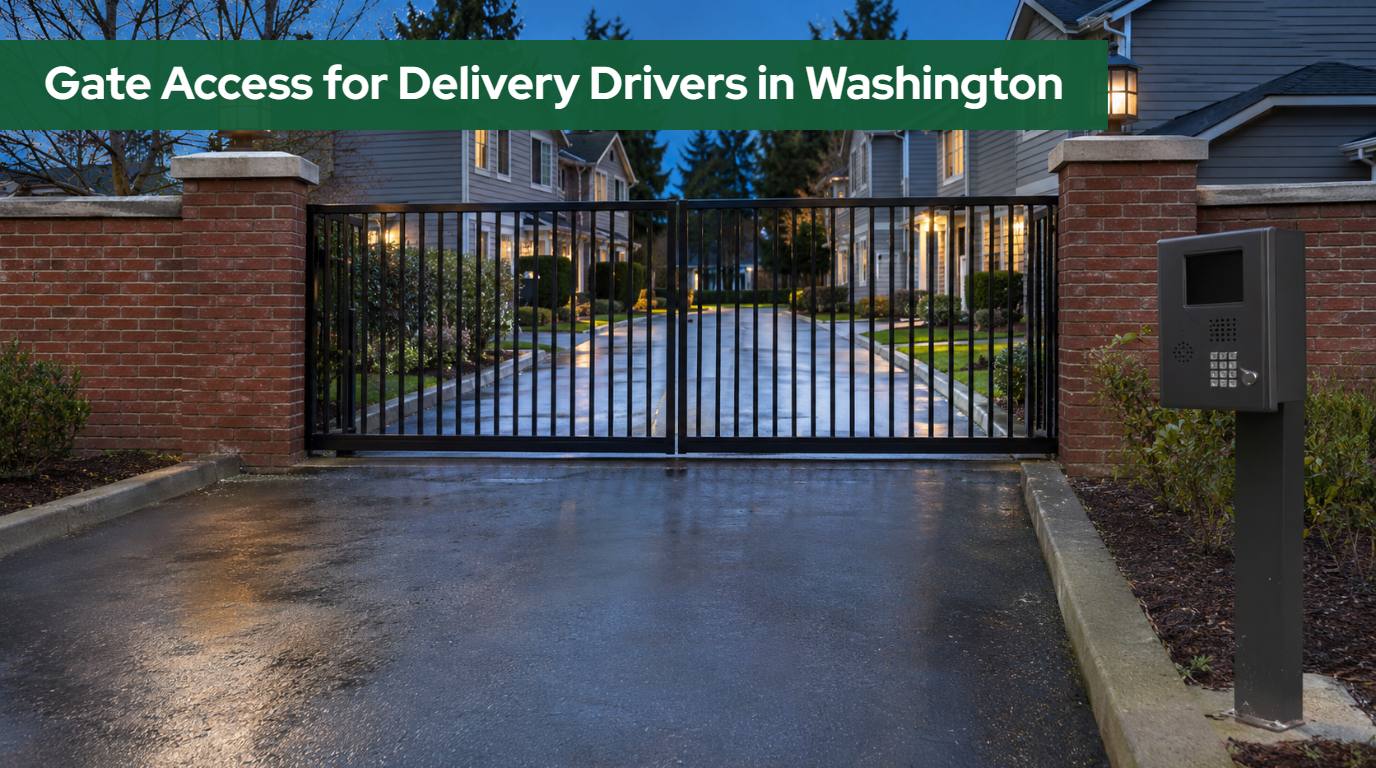
Planning gate access for delivery drivers in Washington starts with a simple fact: a gate that keeps strangers out also keeps out the person bringing your packages, your groceries, your propane and your building materials. Every gated home, farm, townhome community and business park has to decide who gets through, how they prove it and what happens when a driver arrives and nobody is home.
This guide walks through the real options: delivery codes on a keypad, call boxes and video intercoms, carrier apps and delivery instructions, Amazon’s Key program for multi-unit properties, the rules the Postal Service follows for mail, and the simplest answer of all, receiving packages outside the gate. It also covers the parts people forget, such as room for a box truck to pull off the road, a safe way for drivers to leave, and keeping fire access separate from delivery access. It is written for property owners and managers in Skagit, Whatcom, Snohomish, Island, San Juan, King and Pierce counties.
Quick answer
Give delivery drivers their own way in that you can change or cancel: a separate keypad code, a call box that rings your phone, or a carrier access program. Mail follows Postal Service rules, so plan a mailbox or parcel box outside the gate, and make sure trucks can pull off the road and exit safely.
In this guide
- What delivery access has to solve
- Who needs to get through your gate
- The main ways to let drivers through
- Mail is different: what the Postal Service allows
- Delivery codes on a keypad
- Call boxes, telephone entry and video intercoms
- Carrier apps, delivery instructions and Amazon Key
- Receiving packages outside the gate
- Room for delivery trucks at the entrance
- Letting drivers out safely
- Security trade-offs and how to limit them
- HOAs, apartments and business parks
- Fire access, power outages and winter
- Planning checklist
- How we approach delivery access
- Frequently asked questions
What Gate Access for Delivery Drivers in Washington Has to Solve
A delivery driver at your gate has a few minutes, a handheld scanner and a long route ahead. If the gate does not open quickly, the driver will leave the package at the gate, take it back to the depot or mark it as undeliverable. None of those outcomes is what you wanted when you installed the gate.
Good delivery access solves four problems at once. First, the driver needs a fast, reliable way to get in or to hand off the package without getting in. Second, you need to control that access: who has it, when it works and how to cancel it. Third, the entrance itself has to work for the vehicle, which might be a small car, a step van, a box truck or a semi with a trailer. Fourth, the driver has to be able to leave safely, without waiting for someone to let them out and without being put at risk by a closing gate.
Washington adds a few local layers. Many properties in Skagit, Whatcom and Snohomish counties sit at the end of long rural driveways where cell coverage is uneven. Island properties on Whidbey, Camano and the San Juan Islands depend on ferry schedules, so a missed delivery can mean days of delay. Townhome and apartment communities in King and Pierce counties see dozens of drivers a day from many different companies. The right answer differs for each of these, but the building blocks are the same.
Who Needs to Get Through Your Gate
Make a list of everyone who delivers to the property in a normal month. Most owners are surprised at how long it is, and each group has different needs.
Mail carriers. The Postal Service follows its own rules for keys, locks and where mail is delivered. In most cases the mail should not depend on getting through your gate at all. That is covered in its own section below.
Parcel carriers. UPS, FedEx, Amazon delivery drivers and regional couriers bring most packages. They arrive at unpredictable times, the driver may change from day to day, and they need to get in and out quickly.
Freight and large items. Furniture, appliances, building materials, hay, feed and equipment arrive in box trucks, flatbeds and tractor-trailers. These drivers need room to turn in, a surface that can carry the load and a clear path to the house, barn or shop.
Fuel and service deliveries. Rural Washington properties often get propane or heating oil deliveries and septic service. These trucks come on a schedule, sometimes when nobody is home, and they need the same driver access every visit.
Recurring vendors. Landscapers, pool and water treatment services, cleaners and contractors are not deliveries, but they use the same entrance and the same access methods. Planning for them at the same time avoids handing out the resident code to everyone.
Once the list is written, sort it into three groups: people who must come in, people who should hand off at the gate, and people who need access only at certain times. That sorting drives every decision that follows.
The Main Ways to Let Delivery Drivers Through
There is no single best method. Most well-run gates combine two or three of these, matched to the groups on your list.
| Method | How the driver gets in | Strengths | Weak points |
|---|---|---|---|
| Shared delivery code | Types a code on the keypad | Simple; works when nobody is home | Codes spread; hard to know who used it |
| Individual or time-limited codes | Types a code issued to that company or for that day | Can be canceled alone; can limit hours | Needs a keypad or controller that supports it, and someone to manage codes |
| Call box or telephone entry | Calls the resident or office, who opens the gate | No codes to share; a person decides each time | Someone must answer; depends on phone or cellular service |
| Video intercom | Calls and is seen on camera before the gate opens | You see who is there and the vehicle | Needs a network or cellular link and a person to answer |
| Carrier access program | The carrier’s system opens the gate during a delivery | No codes handed to drivers; access tied to an active delivery | Works only for that carrier; the property agrees to the program’s terms |
| Receiving outside the gate | Driver never enters; leaves the package in a box or locker | No access to manage; gate stays closed | Not for large items; box must be big and secure enough |
For a single home, a common setup is a parcel box outside the gate for everyday packages, a call box or cellular gate opener that rings the owner’s phone for anything larger, and a temporary code for scheduled deliveries. For a community, the mix usually adds a staffed or remote-answered call box and a carrier program for the busiest carrier. Our overview of access control systems explains the devices behind each method.
Mail Is Different: What the Postal Service Allows
Mail carriers do not work like parcel drivers, and the Postal Service has written rules about keys and access. Owners sometimes plan to give the carrier a gate remote or a code and are surprised when the local post office says no.
The Postal Operations Manual, section 632.21, says carriers are prohibited from accepting keys for locks on private mail receptacles, buildings or offices. The exception is an electromechanical door lock system or a key keeper box within convenient reach of the door, and both devices must include an Arrow lock, the Postal Service’s own lock, to reach the key or device that opens the building. The Postal Service provides its own “master access lock” for carrier access and coordinates its installation through the local USPS Growth Manager. It is not something a builder or owner installs alone.
The manual also sets how new addresses get mail. A 2018 revision, published in Postal Bulletin 22492, states that centralized delivery is the preferred mode of delivery for all new residential and commercial developments, and that curbside, sidewalk and door delivery are generally not available for new delivery points except in rare cases. Centralized delivery means cluster box units, wall-mounted receptacles and similar equipment at one or more shared points. The local postal manager or district designees approve the mailbox sites and the type of equipment.
What this means in practice:
- For a single home with a gate, keep the mailbox outside the gate, where it is today on most rural Washington roads. Do not plan mail delivery around a code or remote.
- For a new gated community or business park, talk to the local post office before the entrance is designed. Where the cluster boxes go, inside or outside the gate, is a Postal Service decision, and it affects the layout of the entrance, the parking and the walkways.
- For an existing community where mail comes inside the gate, any change to the gate hardware, call box or access system should be coordinated with the post office so carrier access is not lost by accident.
Mail rules come from the Postal Service and can change, so treat this section as a reason to call your local post office early, not as a final answer for a specific property.
Planning an entrance that has to work for every driver?
We look at where mail and packages land, how drivers reach the keypad or call box, and which access method fits each group before anything is installed.
Delivery Codes on a Keypad
A keypad code is the most common way drivers get through gates, and it is also the most commonly misused. The problem is not the keypad. The problem is a single code that everyone shares and nobody changes.
The “universal gate code” myth. Search results and online forums are full of questions about a universal gate code for delivery drivers. There is no such code built into gates. Any code that seems to work everywhere is just a code that someone set on a particular keypad, often a default that was never changed, or a code shared among drivers on a route. If a code you never gave out opens your gate, change the codes and check the keypad’s programming.
Give deliveries their own code. Never give drivers the code your family or residents use. A separate delivery code can be changed without affecting anyone else, and if your access controller keeps a log, you can tell delivery entries apart from resident entries.
Use codes that expire or run on a schedule. Many access controllers can limit a code to certain hours or days, or make it valid for a set period. A code that works only during daytime delivery hours, or only on the day a furniture delivery is scheduled, is far less useful to anyone who learns it later. Check what your keypad or controller supports before relying on this; older stand-alone keypads may not offer schedules.
Give each regular company its own code. If the propane company, the landscaper and the parcel carriers each have a separate code, you can cancel one without disrupting the others. This matters most for properties with many recurring vendors, such as farms, estates and small business parks.
Put the keypad where a driver can reach it. A keypad that a driver cannot reach from the cab means getting out of the truck in the rain, which slows every delivery and tempts drivers to skip the gate. Our guide to automatic gate keypad height in Washington covers reach for cars and trucks, and our comparison of RFID access and keypad entry explains when cards or tags fit better than codes for regular users.
Call Boxes, Telephone Entry and Video Intercoms
A call box puts a person in the loop. The driver presses a button or enters a directory number, the call rings a resident, a homeowner’s phone or a management office, and that person opens the gate with a key on their phone or an app. No code is handed out, so nothing spreads.
Telephone entry for communities. In HOAs and apartment buildings, a telephone entry system with a resident directory lets each driver call the right unit. Residents open the gate for their own deliveries, and the property does not need to manage a delivery code at all. Our guide to phone entry systems in Washington covers how these systems connect and how directories are kept current.
Cellular call boxes for homes and rural properties. Many rural properties in Skagit and Whatcom counties have no landline at the gate and a long trench to the house. A cellular call box rings the owner’s mobile phone, wherever they are. The catch is coverage: check the signal at the gate itself, not at the house, before choosing a cellular unit.
Video intercoms. Adding a camera lets the person answering see the driver, the vehicle and the package before opening the gate. That makes it easier to say yes to a legitimate delivery and no to someone who is not expected. Our page on the video intercom gate in Mount Vernon, WA shows how a video unit fits at a residential entrance.
The weakness of any call-based method is that someone has to answer. If you work away from home or travel often, plan a fallback: a parcel box outside the gate, a second person on the call list, or a time-limited code for expected deliveries. A call box that rings an unanswered phone is just a doorbell at the end of a long driveway.
Carrier Apps, Delivery Instructions and Amazon Key
The large carriers let customers add delivery instructions, and some run programs that open gates directly. These tools can help, but it is worth knowing exactly what they do.
Delivery instructions. UPS lets recipients update delivery instructions, including a gate or entry code, through its “Change My Delivery” option when tracking a package. FedEx directs customers to FedEx Delivery Manager to add delivery instructions. Retailers and food apps have similar fields at checkout. These are convenient, but treat any code you type into them as shared: it is stored in the company’s systems and shown to whichever driver is assigned. Use a delivery-only code that you can change, never the resident code.
Amazon Key for gated communities. Amazon offers a program for apartment buildings and gated communities that connects a device to the property’s existing access control system. When an Amazon driver is on an active delivery, the driver requests access through Amazon’s app and the device tells the access system to open the gate or door for that delivery. Residents keep using their own remotes, cards or codes. Eligibility, terms and the hardware involved are set by Amazon and can change, so a property manager should read the current terms directly from Amazon before agreeing.
For a property manager, the appeal is that no code is handed to drivers and access is tied to an active delivery. The limits are that it covers one carrier, it adds a device that has to work with the existing access controller, and it needs power and a network connection at the controller. If the community later replaces its access system, the carrier device has to be accounted for in the new design.
Receiving Packages Outside the Gate
The simplest way to manage delivery access is not to give any. If everyday packages land in a secure box outside the gate, the gate can stay closed, no codes travel and drivers move on quickly. This approach works especially well on rural properties with long driveways, where driving to the house adds minutes to every stop.
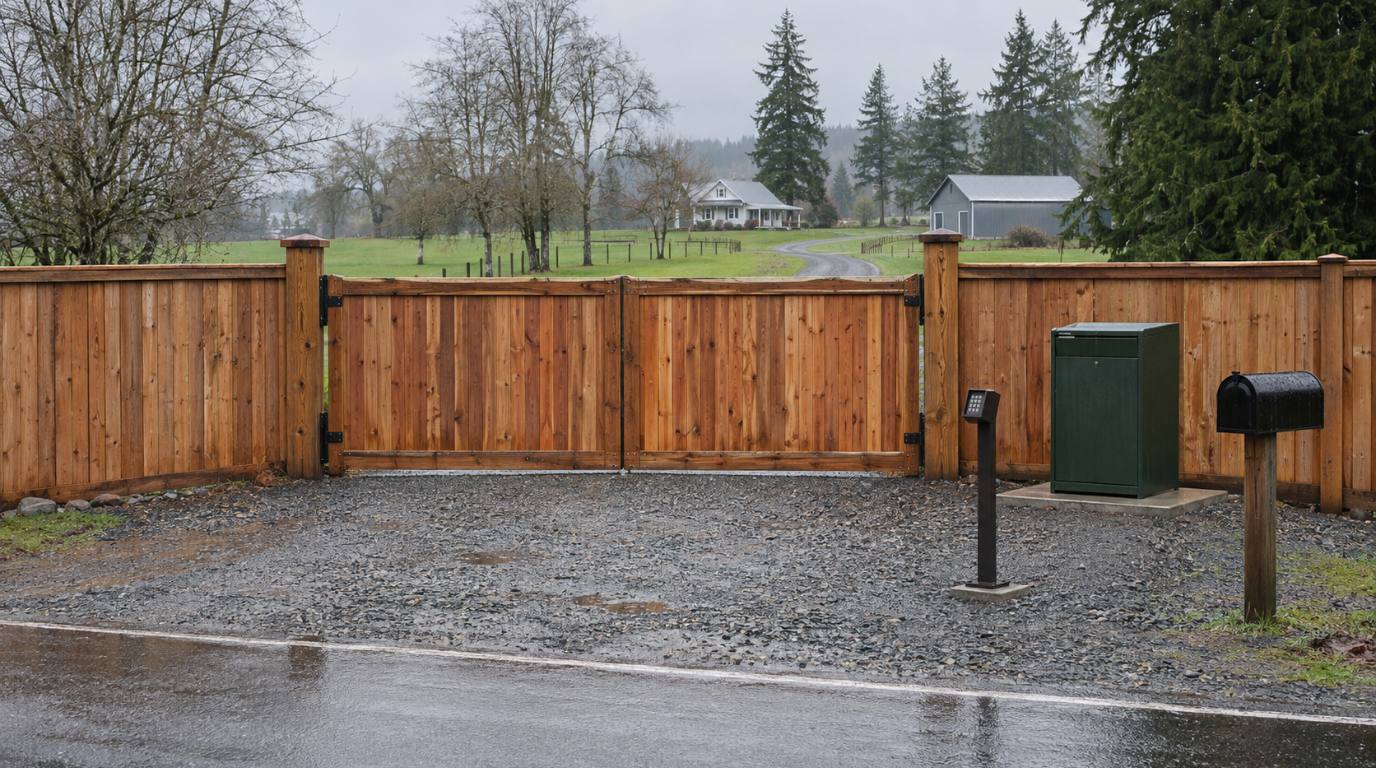
A parcel box at the entrance. A large, lockable parcel box on a concrete pad beside the gate takes most everyday packages. Drivers drop the package in through a slot or door that locks behind it, and the owner opens it with a key or code. Size it for the packages you actually get, and anchor it so it cannot be carried off.
Parcel lockers for communities. Communities with many residents use banks of parcel lockers near the entrance or the mail area. Drivers load the lockers and residents receive a notice with a code to open their locker. Placement matters: lockers outside the gate need lighting and a safe place for drivers to stop, and lockers inside the gate need a way for drivers to get to them.
A pedestrian gate beside the vehicle gate. For homes where drivers should come to the door but not drive in, a pedestrian gate with its own keypad or call box lets the driver walk in without opening the main gate. Our guide to pedestrian gate access control in Washington covers locks, closers and credentials for walk gates.
Receiving outside the gate does not work for everything. Furniture, appliances, building materials, feed and fuel all need to come in. Plan the outside receiving point for everyday parcels and a separate access method for the large deliveries that cannot be left at the road.
Want packages to stop piling up at the gate?
We plan the delivery point at the entrance, the pad, the power and the keypad or call box together, so drivers know where to go and the gate can stay closed.
Room for Delivery Trucks at the Entrance
Many delivery problems are layout problems. A gate set right at the road edge leaves a truck stopped in the traffic lane while the driver enters a code or waits for an answer. On a fast rural road, that is a real hazard, and many drivers will simply not stop.
Setback and stacking room. Set the gate back far enough that the longest vehicle you expect regularly can pull completely off the road while the gate opens. For a home that gets parcel vans, that might be one vehicle length. For a farm that gets feed trucks or a property that gets building materials, it may be much more. Our guide to the ranch entrance gate in Washington covers setback and stacking room for large rigs in more detail.
Width and height. Washington law sets the general maximum vehicle width at 8.5 feet under RCW 46.44.010, and RCW 46.44.020 sets the general maximum height at 14 feet. A gate opening that is barely wider than a truck makes every delivery slow and risks damage to the gate and posts, especially when the truck has to turn in from the road. Any overhead beam, arch or sign at the entrance has to clear the tallest vehicle that delivers, measured at its lowest point.
Turnaround inside the gate. A driver who comes in has to get out. If the driveway ends at a house with no room to turn a box truck, the driver will back all the way to the gate, which is slow and risky. A turnaround or a loop near the house or shop makes large deliveries much easier.
Keypad and call box placement. Place the keypad or call box on the driver’s side of the entry lane, close enough to reach from the cab, far enough back that the vehicle is clear of the gate’s travel, and protected from being clipped by a turning trailer. Bollards beside a pedestal can protect it in tight entrances.
Letting Drivers Out Safely
A gate that lets a driver in but makes them wait to get out will generate complaints and, sooner or later, damage. Plan the exit as carefully as the entry.
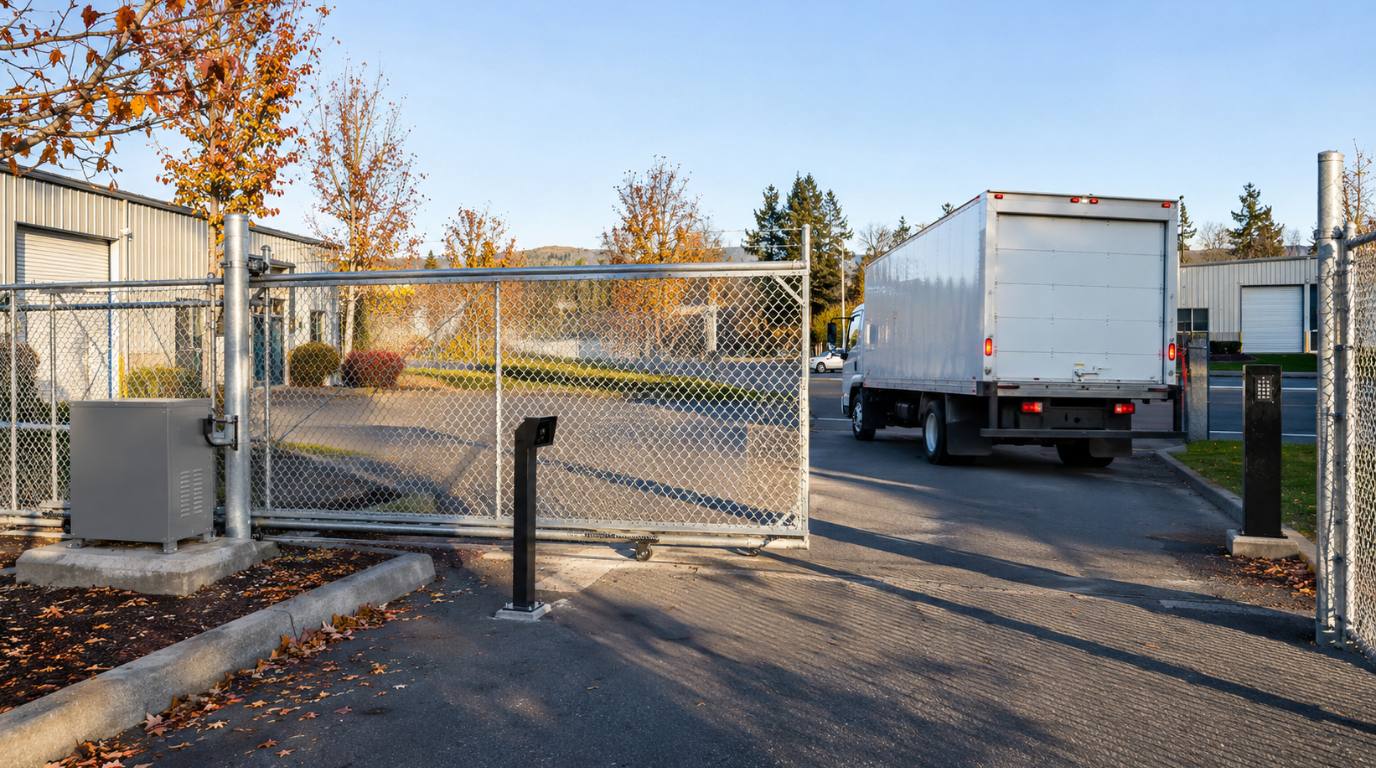
Free exit. On most residential and many commercial gates, vehicles leave without a code. The gate senses the vehicle approaching from the inside and opens. That sensing usually comes from an in-ground vehicle loop or an exit wand, a buried or post-mounted detector that responds to a large metal object. Our guide to the gate loop detector in Washington explains how exit loops, safety loops and exit wands work.
Safety while the gate moves. Delivery drivers are exactly the people most exposed to a moving gate: they are unfamiliar with it, they may walk around their truck, and they may stop in the gate’s path. UL 325 requires external entrapment protection, such as photo eyes or contact edges, in addition to the operator’s own built-in protection, and gates must also be built to ASTM F2200. In Washington, the fire code adopted through WAC 51-54A applies IFC 503.6, which requires electric gate operators to be listed to UL 325 and gates to meet ASTM F2200. Our guide to gate photo eye installation in Washington covers where sensors go for both directions of travel.
Timing. A close timer that is too short can start closing as a long trailer is still passing, and a gate that closes behind a lead vehicle invites drivers to tailgate. Vehicle loops in the gate’s path keep the gate from closing on a vehicle that is still in the opening, and the timer should be set with the longest regular delivery vehicle in mind.
Controls away from the gate. ASTM F2200 calls for controls used to operate the gate to sit at least 6 feet away from it, so that a person using them cannot reach through or touch the moving gate. That applies to keypads and call boxes that drivers use, and it is one more reason to plan the pedestal location with care.
Security Trade-offs and How to Limit Them
Every way you add for drivers to get in is also a way for someone else to get in. The goal is not zero risk; it is to choose methods you can control and to notice when something goes wrong.
Codes spread. Once a code is given to a carrier, assume it will be seen by more people than you intended. Separate delivery codes, schedules and routine changes limit the damage.
Tailgating. A car that follows a delivery truck through an open gate never needed a code. Vehicle loops tuned to close the gate promptly after a vehicle clears, and a camera at the entrance, make tailgating less attractive. On sites where it matters most, a slower but more controlled entrance, such as a barrier arm behind the main gate, can help.
Logs. Many access controllers record which code or credential was used and when. A log lets you see whether the delivery code is being used at 2 a.m. and confirm when a contractor actually arrived. If your system keeps logs, check them now and then; a log nobody reads protects nothing.
License plate recognition. Some properties use cameras that read plates to open the gate for known vehicles. That works well for residents and regular vendors with fixed vehicles, but delivery fleets change vehicles often, so plate recognition rarely replaces a delivery method on its own. Our page on license plate recognition gates explains where it fits.
HOAs, Apartments and Business Parks
Delivery access at a shared entrance is a policy question as much as an equipment question. The board or manager needs to decide how drivers get in and write it down, so residents and tenants are not handing out their own codes.
HOAs and gated neighborhoods. A telephone entry directory, a delivery code with set hours, or a carrier program can each work. What does not work well is every household sharing its own code with every driver, because the board then loses control of who has access. Our HOA and community gate systems page covers entrance design and access policy for associations.
Apartments and townhome communities. High delivery volume, many carriers and frequent resident turnover call for a call box with a current directory, parcel lockers or a package room, and a clear rule on whether drivers may enter the property. In King and Pierce counties, where many communities see heavy daily volume, older access systems are often the bottleneck. Our guide to apartment access control modernization covers upgrading those systems.
Business parks and commercial yards. Commercial sites usually separate visitor and delivery traffic from employee traffic, sometimes with a separate lane or a receiving area outside the secure perimeter. Freight drivers need a known route to the dock or receiving door. Our commercial gate systems page covers gates, operators and access control for these sites, and our guide to self-storage gate access control in Washington shows how individual codes and logs work at a high-traffic gate.
Write the policy down. Whatever the property chooses, write a short delivery access policy: which methods are allowed, who manages codes, how often they change, what drivers should do if the gate does not open, and who to call. Share it with residents or tenants and with the companies that deliver most often.
Managing a community or commercial entrance?
We review the access controller, the call box, the lanes and the delivery traffic, and recommend changes that give drivers a reliable way in without handing out resident codes.
Fire Access, Power Outages and Winter
Keep fire access separate. Emergency access is not delivery access. Fire departments use their own methods to open gates, set by the local fire code official, and those methods should never be shared with drivers. In Washington, WAC 51-54A-0503 adopts the fire code’s access road section with Washington amendments, and local standards decide many of the details, so the gate’s emergency opening method comes from the local fire marshal. Our guide to fire department gate access in Washington covers what different jurisdictions ask for.
Power outages. Western Washington storms knock out power regularly, and a gate without backup power either stays closed or has to be released by hand. Drivers cannot do either. Battery backup keeps the gate, the keypad and the call box working through shorter outages, and a clear plan for longer ones keeps deliveries moving. Our page on automatic gate battery backup in Skagit County explains how backup is sized and what a gate should do when the battery runs low.
Winter. Snow and ice in the foothills of Skagit, Whatcom and Snohomish counties can block the approach, bury in-ground sensors or hold a gate closed. Drivers will not walk through a snowbank to reach a keypad. Keep the apron, the pedestal and the parcel box clear, and make sure plowed snow is not piled where drivers need to stop.
Island properties. On Whidbey, Camano and the San Juan Islands, deliveries are tied to ferry schedules, and a driver who cannot get in may not come back the same day. A reliable outside receiving point and a delivery method that does not depend on someone answering the phone are worth more there than almost anywhere else.
Planning Checklist
Use this list before choosing equipment or changing an existing gate.
- List everyone who delivers in a normal month and sort them into must come in, hand off at the gate, and access only at certain times.
- Talk to the post office before designing a new community entrance, and keep the mailbox outside the gate on a single home.
- Pick a receiving point outside the gate for everyday packages: a parcel box, lockers or a package room.
- Give deliveries their own access method, never the resident code: a delivery code, a call box, a carrier program or a mix.
- Check what your controller supports: individual codes, schedules, expiring codes, logs and remote opening.
- Confirm the connection for any call box or cellular device at the gate itself.
- Size the approach for the largest delivery vehicle: setback, width, height under any beam, turnaround and surface.
- Place the keypad or call box within reach of a driver’s window, on the driver’s side, protected from turning trailers and at least 6 feet from the gate.
- Plan the exit: free exit loop or wand, safety loops in the gate’s path, photo eyes or edges, and a close timer set for the longest vehicle.
- Keep fire access separate and confirm the emergency method with the local fire marshal.
- Add battery backup and decide what each delivery method does in a power or network outage.
- Write a short delivery policy and set a schedule for changing delivery codes.
How We Approach Delivery Access
Emerald Gate Systems is a family-owned gate company based in Sedro-Woolley, with more than 15 years in the trade. We design, fabricate, install, automate and service gates with one accountable team, so the gate, the operator, the access control and the wiring are planned together instead of passed between separate trades.
On a delivery access project, we start with a free on-site consultation. We look at who delivers, where vehicles stop, how the approach meets the road, where the mailbox and packages land today, what access control is already installed and what it can do, and where power and communication can reach. Then we recommend a mix of methods for the property instead of a single device.
We install and service keypads, intercoms, telephone entry, card readers and license plate recognition, along with LiftMaster, Viking and FAAC operators and Linear and Eagle access control. Our access control page lists the systems we work with, and our guide to gate opener wiring in Washington explains the electrical side of adding a call box or keypad pedestal. We serve Skagit, Whatcom, Snohomish, Island, San Juan, King and Pierce counties.
Washington requires contractors to show their registration in advertising: Emerald Gate Systems is registered with the Washington State Department of Labor and Industries as a construction contractor (EMERAGS748D6) and holds an electrical contractor license in the Doors and Gates specialty (EMERAGS747KE).
Frequently Asked Questions
Is there a universal gate code for delivery drivers?
No. Gates do not come with a universal code that carriers can use. A code that seems to work everywhere is a code someone set on that keypad, often a default that was never changed or a code shared along a route. If your gate opens with a code you never gave out, change the codes and review the keypad’s programming.
Should I give my gate code to UPS, FedEx or Amazon?
Give them a delivery code, never the code your family or residents use. Carriers store codes in their systems and show them to whichever driver is assigned, so treat any code you share as public. A separate code that you can change or limit to daytime hours lets you cancel it without disrupting anyone else.
Will the mail carrier use my gate code or remote?
Usually not. The Postal Operations Manual prohibits carriers from accepting keys to private receptacles, buildings or offices, except electromechanical lock systems or key keeper boxes with the Postal Service’s Arrow lock. For a gated home, keep the mailbox outside the gate. For a new community, ask the local post office where mail delivery will be.
How does Amazon Key work for a gated community?
Amazon’s program connects a device to the property’s existing access control system. During an active delivery, the Amazon driver requests access through Amazon’s app, and the device opens the gate or door for that delivery. Residents keep their usual credentials. Eligibility and terms are set by Amazon, so managers should review the current terms before agreeing.
What is the best way to receive packages at a gated rural property?
For everyday parcels, a large lockable parcel box on a pad beside the gate usually works best, because drivers never need to come in and the gate can stay closed. For furniture, feed, fuel or building materials, add a call box that rings your phone or a time-limited delivery code, plus room for trucks to pull off the road.
How do delivery drivers get out of a gated property?
Most residential gates use free exit: an in-ground loop or an exit wand senses the vehicle and opens the gate. Commercial sites may require a code to leave. Either way, safety loops, photo eyes or edges must protect the gate’s path, and the close timer should allow for the longest delivery vehicle that visits.