
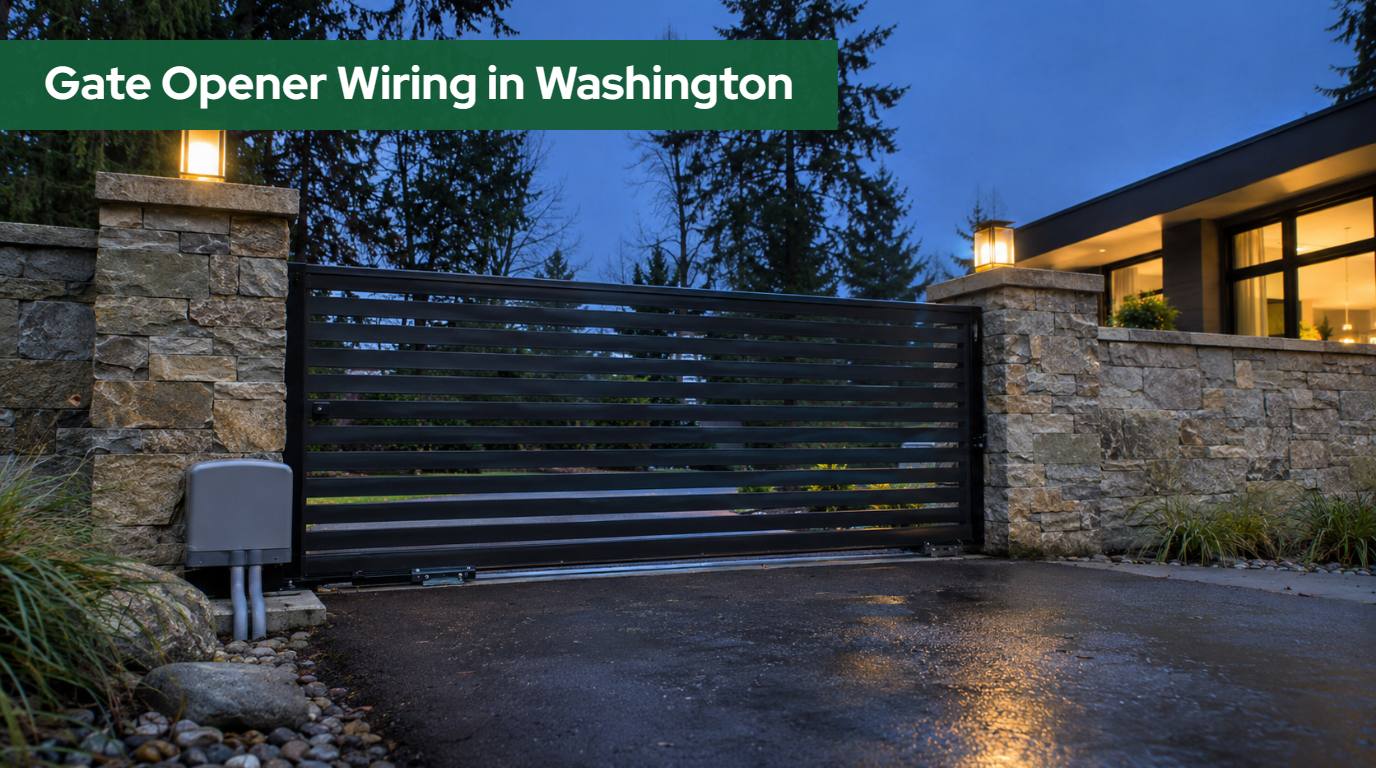
Most automatic gate problems that show up years after installation start underground. A wire that is too small for the run, a control cable pulled into the same conduit as the power feed, a loop lead-in buried too shallow or a splice left to soak in a wet pull box can all turn into a gate that stalls, reverses for no reason or quits after the first big storm. That is why gate opener wiring in Washington deserves as much planning as the gate and the operator. The wire is the part nobody sees, and the part that is hardest to change once the driveway is paved.
Washington also adds its own layer of rules. Electrical work here is licensed, permitted and inspected under chapter 19.28 RCW and chapter 296-46B WAC, and those rules treat a gate operator differently from a garage door opener. This guide explains what power a gate opener needs, who is allowed to wire it, when a permit is required, which cities inspect their own electrical work, how to size and bury the wire, how to keep low-voltage accessories reliable and what changes when the 2026 electrical code takes effect. It is written for homeowners, farm and acreage owners, HOA boards and property managers in Skagit, Whatcom, Snohomish, Island, San Juan, King and Pierce counties.
Quick answer
Gate opener wiring in Washington needs an electrical work permit and inspection, from L&I or from one of the cities that inspect their own work. The installer must be licensed, unless an owner wires their own property under RCW 19.28.261. Wire is sized from the operator manual’s distance table and buried to the cover depth the code requires.
In this guide
- What gate opener wiring in Washington covers
- What power does a gate opener need?
- Do you need an electrical permit for a gate opener?
- Who is allowed to wire a gate opener in Washington?
- City or L&I: who inspects your address?
- What size wire does a gate opener need?
- Low-voltage wiring for keypads, sensors, loops and intercoms
- How deep does gate opener wire need to be buried?
- Planning conduit before paving or concrete
- Wiring a dual swing gate or a slide gate
- Disconnects, grounding and surge protection
- When a long trench makes solar or battery power the better call
- The 2026 electrical code arrives in Washington
- A gate opener wiring checklist
- How we approach gate opener wiring
- Frequently asked questions
What Gate Opener Wiring in Washington Covers
When people talk about wiring a gate, they usually mean the power feed to the operator. On a real installation, that feed is only one of several circuits that meet at the gate. Each one has its own job, its own wire type and its own failure modes, and they all have to share the same trench, the same posts and the same weather.
A typical automatic driveway gate in Northwest Washington includes:
- The power feed. A line-voltage branch circuit from the house, shop or service panel to the operator, or a low-voltage feed from a transformer when the operator runs on DC with a battery.
- The second operator feed. On a dual swing gate, a cable that crosses the driveway from the primary operator to the secondary one.
- Entrapment protection. Photo eyes and safety edges that the operator monitors, wired back to the control board.
- Vehicle detection. Induction loops cut into the pavement or buried under gravel, with lead-in conductors running back to a loop detector in the operator.
- Access control. A keypad, card reader, intercom or telephone entry unit on a pedestal at the approach, often with its own power and data cable.
- Extras. Pillar lights, a camera, a cellular or Wi-Fi module and sometimes a fire department key switch or strobe sensor.
Good gate opener wiring plans all of these at once: the trench is dug one time, each circuit gets the conductor and conduit it needs, and the low-voltage cables stay away from the power feed so the gate does not pick up noise. Our automatic gate installation page explains how the wiring fits into the rest of a new gate project.
What Power Does a Gate Opener Need?
The operator decides the power plan, so the first step is reading its installation manual. Gate operators sold in Washington generally fall into a few groups.
Line-voltage AC operators. Many commercial and heavier residential operators take 120 or 240 volts directly at the operator. Some are built for one voltage, and some can be set for either. The manual lists the current draw and gives a table of how far the operator can be from the power source for each wire size.
DC operators with a transformer and battery. A large share of residential swing and slide operators today run on 24 volts DC. Line voltage reaches a transformer or power supply, which may sit in the operator housing, in a separate enclosure at the gate or back at the house. The operator charges a battery, which keeps the gate working through short power outages. Where the transformer sits changes what runs underground: either a line-voltage branch circuit or a low-voltage DC feed, and those two are wired, sized and protected very differently.
Solar operators. A solar panel charges the battery and no power feed is trenched at all. Accessories still need wiring between the gate, the keypad pedestal and any loops. Solar suits some Washington properties well and others poorly, which we cover in its own section below.
| Power setup | What runs to the gate | What to plan for |
|---|---|---|
| Line-voltage AC operator | 120 or 240 volt branch circuit | Wire size by distance from the manual, a disconnecting means, burial depth for line-voltage wiring |
| DC operator, transformer at the gate | Line-voltage branch circuit to the transformer | Same as above, plus a weatherproof location for the transformer |
| DC operator, transformer at the house | Low-voltage DC or AC feed | Heavier wire for the distance, because low voltage loses more over a long run |
| Solar operator | No power feed; accessory wiring only | Panel exposure, battery capacity, winter sun, accessory power draw |
Follow the specific model’s manual: wiring tables are written for that operator’s current draw and do not carry over to another model, even within the same brand. If you are still choosing a swing operator, our guide to the swing gate opener in Washington compares the main types and how each is powered.
Do You Need an Electrical Permit for a Gate Opener in Washington?
In most cases, yes. WAC 296-46B-901 requires an electrical work permit for the installation, alteration or maintenance of all electrical systems or equipment, and then lists a short set of exemptions. A gate operator is not on that list.
That surprises people who have installed a garage door opener. The same rule does exempt residential low-voltage circuits for garage doors, along with built-in vacuum systems and underground low-voltage circuits for landscape sprinklers, landscape lighting and wireless pet fence antennas. Each of those exemptions has conditions: the power has to come from a listed Class 2 power supply, the line-voltage equipment feeding it still has to be installed by appropriately licensed people, and the conductors cannot pass through fire-rated walls, floors or ceilings outside a residential unit or into pools and fountains. A driveway gate operator is not a garage door, and the exemption does not stretch to cover it.
One gate component does appear in the exemptions. Induction detection loops described in WAC 296-46B-300(2) and used to control gate access devices are listed as Class A basic electrical work, which does not need its own permit. The loop lead-in still has to meet the burial and conductor rules for loops, and the operator and its power feed are still permitted work. Our article on the gate loop detector in Washington covers how loops are laid out and tuned.
Timing matters too. Under WAC 296-46B-901, the permit has to be obtained and posted at the job site, or its number posted, before any electrical work begins, with a narrow exception for owners making emergency like-in-kind repairs. The inspection request is due no later than three working days after the installation is complete, or one working day after any part of it is energized, whichever comes first.
An electrical permit is separate from any building, right-of-way or fire department approval the gate itself may need. Those depend on where the gate sits and who has to get through it. Our guide to gate permits in Washington State walks through the other approvals.
Who Is Allowed to Wire a Gate Opener in Washington?
Washington licenses electrical contractors and certifies electricians, and both licenses come in general and specialty versions. Three paths are common for gate work.
A general electrical contractor. A general (01) electrical contractor with certified general electricians can run the line-voltage supply from the panel to the gate and wire the rest of the system.
The Doors, gates and similar systems specialty (10). WAC 296-46B-920 says this specialty may install, service, maintain, repair or replace the electrical operator wiring and equipment of door, gate and similar systems. That includes the low-voltage Class 2 accessories that are not connected to other systems and certain branch circuits that start at a listed operator control panel, capped at 600 volts and 20 amperes. The same entry excludes the line-voltage supply conductors, feeders, panelboards and disconnects that feed the control panel. In practice, a gate contractor with the 10 specialty wires the operator and everything downstream of it, while the feed from the house or shop panel to the gate is general electrical work.
The Limited energy system specialty (06). This specialty is restricted to low-voltage, power-limited circuits. It fits keypads, intercoms, card readers and similar signaling work, but not the line-voltage feed.
The property owner. RCW 19.28.261 lets an owner do electrical work at their own residence, farm, place of business or other property they own without a license. It does not apply to a new building intended for rent, sale or lease, or to property offered for sale within 12 months after the owner obtained it. The exemption covers the license, not the permit: owner work still needs an electrical work permit and an inspection.
Washington also requires construction contractors to register with L&I and to show the registration number in their advertising. A contractor installing a gate may need both a construction registration for the gate, posts and concrete and an electrical license for the wiring. When you compare bids, ask which license will cover the electrical part and who will pull the permit. Our page on choosing a licensed gate contractor in Northwest Washington explains how to look up both on the L&I site.
Want the gate and its wiring planned together?
We hold a Washington electrical contractor license in the Doors and Gates specialty, so the operator and its accessories are wired by the same team that builds and installs the gate, with the power feed coordinated from the start.
City or L&I: Who Inspects Your Address?
L&I issues electrical permits and performs inspections across most of Washington. A short list of cities runs their own electrical permit and inspection programs inside city limits, and L&I does not permit or inspect work in those cities. Tacoma Power also issues permits and performs inspections for properties it serves, so L&I suggests checking whether a Pierce County address falls in Tacoma Power’s area before applying.
On L&I’s city electrical permits page, the cities that issue their own permits include several in the counties we serve:
| County | Cities that issue their own electrical permits (L&I list) | Everywhere else in the county |
|---|---|---|
| Whatcom | Bellingham | L&I |
| Snohomish | Everett, Marysville, Lynnwood, Mountlake Terrace | L&I |
| King | Seattle, Bellevue, Burien, Des Moines, Federal Way, Kirkland, Mercer Island, Normandy Park, Redmond, Renton, Sammamish, SeaTac, Tukwila | L&I |
| Pierce | Milton; Tacoma Power for properties it serves | L&I |
| Skagit, Island, San Juan | None on the list | L&I |
So a gate in Sedro-Woolley, Mount Vernon, Burlington, Anacortes, Oak Harbor, Coupeville or Friday Harbor goes through L&I, while a gate inside Bellingham or Everett city limits goes through the city. The address matters, not the mailing city: a rural property with a Bellingham or Marysville mailing address can sit outside city limits and fall under L&I. The list can change, so confirm it on the L&I page before applying.
Either way, the standard is the same. Cities that inspect their own electrical work must meet or exceed the state’s inspection standards, and the inspector checks the same things on a gate job: the permit, the conductor sizes, the overcurrent protection, the disconnecting means, the grounding and the burial depth. Plan for the inspector to see the trench or conduit before it is backfilled or paved over, and ask the permitting office how it wants buried work inspected before the trench is closed.
What Size Wire Does a Gate Opener Need?
There is no single answer, and anyone who gives one without asking about the operator and the distance is guessing. The right size depends on four things: the operator’s current draw, the supply voltage, the length of the run and the voltage drop the manufacturer allows.
Voltage drop is the reason distance matters so much. Every foot of wire has resistance, and a long run of thin wire turns some of the voltage into heat before it reaches the operator. A motor that gets less voltage than it was designed for starts slower, runs hotter and may stall against wind on a solid gate. A control board that sees low voltage can reset or behave erratically. Battery-backed DC operators can mask the problem for a while, because the battery helps the motor through each cycle, until the battery wears out.
Manufacturers handle this with distance tables. LiftMaster’s CSW24UL installation manual, for example, lists the maximum wire length for each wire gauge, with separate columns for 120 and 240 volt supply. Its LA100 linear swing operator manual gives a table of 24 volt run lengths by gauge, and its SW490 manual includes a control wiring chart that notes it was calculated using NEC guidelines. The pattern in all of them is the same:
- Longer runs need heavier wire, which means a lower AWG number.
- For the same operator, a 240 volt supply can usually run farther than 120 volts on the same wire size.
- Low-voltage feeds lose a much larger share of their voltage over distance, so a transformer at the house with a long low-voltage run to the gate needs much heavier wire than a line-voltage run of the same length.
- Communication and accessory cables have their own tables and wire types, often stranded copper or a specific shielded cable.
On the long driveways common in Skagit and Whatcom County, the run from the house to the gate can be the deciding factor in the whole power plan. When the manual’s table says the run is too long for a practical wire size, the usual answers are to move the transformer closer to the gate, switch to a 240 volt supply if the operator supports it, add a subpanel or choose a solar setup. The wire size goes on the permit and in front of the inspector, so it should come from the table, not from what was left over on the truck.
Low-Voltage Wiring for Keypads, Sensors, Loops and Intercoms
The low-voltage side of a gate is where most intermittent problems come from. A keypad that sometimes does not respond, photo eyes that drop out in the rain or a loop that detects phantom cars are often wiring problems rather than bad parts.
Washington treats this wiring as real electrical work. Under WAC 296-46B-300(1), cables and raceways for power-limited, Class 2 and Class 3 conductors must be installed in compliance with Chapter 3 of the National Electrical Code unless other methods are specifically required. In plain terms, low-voltage gate wiring follows the same wiring-method rules as other installed cable, including the underground rules.
Habits that keep low-voltage gate circuits reliable:
- Separate the power feed from the accessory cables. The code requires separation between power conductors and Class 2 circuits, and in practice that means separate conduits. Running a keypad or loop lead-in alongside a motor feed invites interference and false triggers.
- Use the cable the manual calls for. Photo eyes, safety edges and communication links between operators often specify a wire type, a minimum gauge or shielded cable. Substitutes can work on the bench and fail at the gate.
- Keep splices out of the ground. Splices belong in a junction box or in the operator housing, made with connectors rated for wet or direct-burial locations.
- Label both ends. When a service tech opens the operator years later, labeled conductors save time.
- Plan the pedestal. The keypad or intercom post needs conduit placed before the concrete and a run that the manual’s distance table supports.
Monitored entrapment protection deserves extra care. Operators listed to UL 325 require external photo eyes or edges and will not run normally without them, so a broken or noisy sensor circuit stops the gate. Our guide to gate photo eye installation in Washington covers sensor placement, and our automatic gate keypad height guide covers where the pedestal goes.
How Deep Does Gate Opener Wire Need to Be Buried?
Burial depth is measured as cover: the distance from the top of the cable or conduit to the finished grade. The National Electrical Code sets minimum cover in Table 300.5 by wiring method and location, and Washington adopts the NEC through chapter 296-46B WAC, with its own amendments.
For general locations, Table 300.5 sets these familiar minimums:
| Wiring method | Minimum cover in a general location (NEC Table 300.5) |
|---|---|
| Direct burial cable or conductors | 24 inches |
| Rigid PVC or other listed nonmetallic raceway | 18 inches |
| Rigid metal conduit or intermediate metal conduit | 6 inches |
The same table has separate rows for wiring under driveways, roads, parking areas and buildings, and separate columns for some residential and low-voltage circuits. Those cells change the answer, and a gate trench crosses a driveway almost by definition, so the exact depth comes from the table for the specific location and wiring method, confirmed with the inspector before the trench is dug.
Washington adds a specific rule for gate loops. WAC 296-46B-300(2) says the lead-in conductor from an induction loop needs at least six inches of cover when it runs in an electrical raceway, and at least 18 inches of cover when it is direct-buried, in which case the lead-in must be listed for that use. The same section sets conductor rules for the loop itself: preformed direct-burial loops use rated conductor of at least No. 16 AWG, saw-cut loops use cross-linked polyethylene or EPR Type USE stranded conductor of at least No. 18 AWG, splices are soldered and insulated, and the finished loop has to pass an insulation resistance test at 500 volts DC with at least 50 megohms between conductor and ground.
Before any of this, the trench needs an 811 locate request. Washington’s dig law applies to a wiring trench the same way it applies to a post hole, and our article on gate post installation in Washington explains the RCW 19.122 timing.
Trenching across a driveway soon?
We lay out the conduit, burial depth and loop lead-ins for your gate before the trench is dug, so the inspector sees it right the first time.
Planning Conduit Before Paving or Concrete
The cheapest moment to wire a gate is before the driveway is paved. Once asphalt or concrete is down, every new cable means saw cutting, boring under the slab or running conduit on the surface. If a gate is even a possibility, conduit placed during construction keeps that option open.
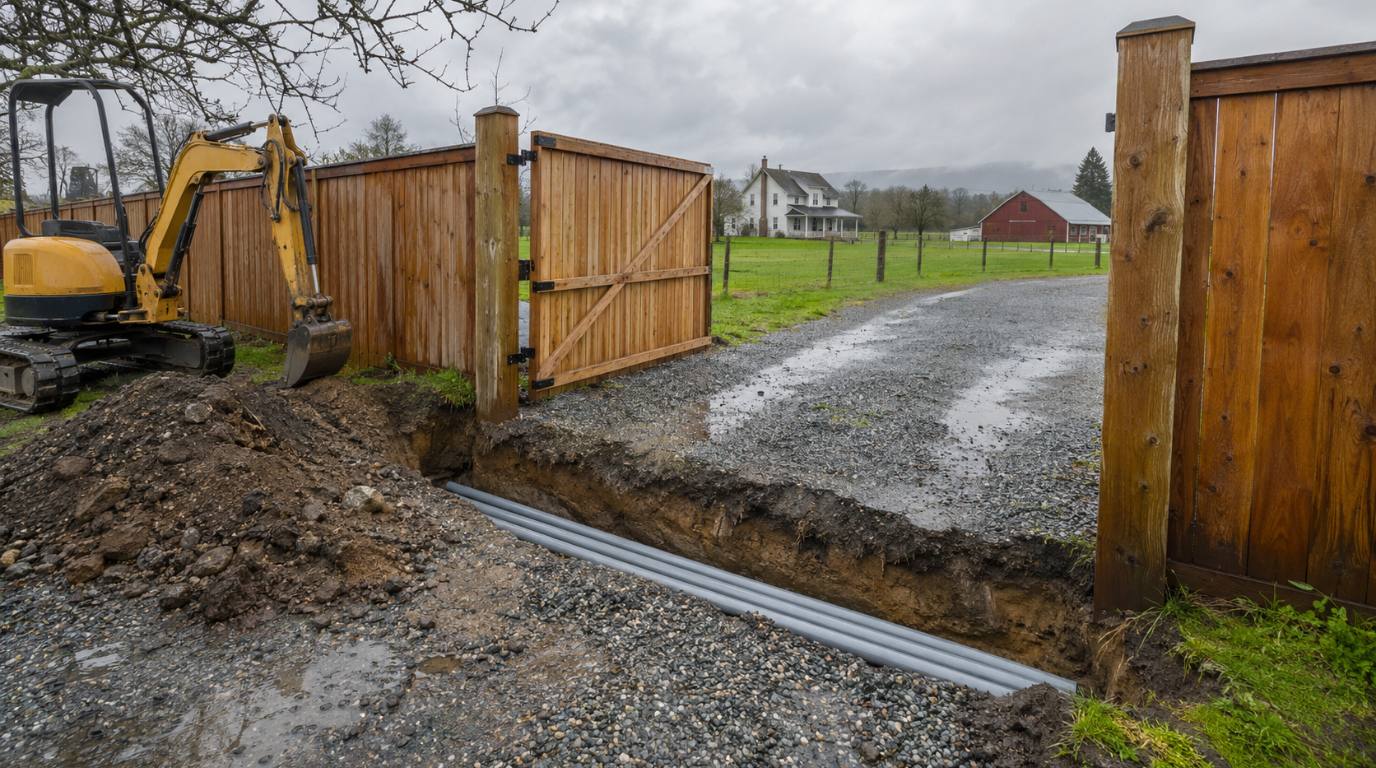
A practical conduit plan for an automatic gate usually includes:
- A power conduit from the panel or subpanel to the operator location, sized for the conductors the manual’s table calls for.
- A separate low-voltage conduit for photo eyes, edges, loops and access control, kept apart from the power conduit.
- A sleeve across the driveway for a dual swing gate’s second operator, and for photo eyes or edges mounted on the far side.
- A conduit to the keypad or intercom pedestal at the approach, placed so a driver can reach the keypad from the window.
- A spare conduit with a pull string, for the camera, extra sensor or network cable someone will want later.
- Sweeping bends instead of sharp elbows, so long cables can be pulled without damage, and caps on the open ends so mud and water stay out.
Loops are part of this plan too. A loop can be preformed and buried under new paving or cut into finished asphalt later, but the lead-in path and the loop location relative to the gate have to be decided early. Our guide to automatic gate planning before paving in Burlington WA walks through the full pre-paving checklist with a builder or paving contractor.
In Western Washington, plan for water: conduit that runs downhill into the operator or pedestal carries rain into the housing, so seal the entries and drain the low points.
Wiring a Dual Swing Gate or a Slide Gate
The gate type changes the wiring layout as much as the operator does.

Dual swing gates. Two operators, one on each post, usually share one control board. The board sits with the primary operator, and a cable crosses the driveway to the secondary operator. That cable carries motor power and, on many models, limit or encoder signals, so it follows the manual’s gauge table for that distance. It needs a sleeve or conduit under the driveway, placed at the depth the code requires for that location. A bi-parting slide gate follows the same idea with two slide operators.
Single swing gates. One operator at the hinge post, with the power and accessory conduits arriving at that post. If photo eyes or an edge sit on the far side of the opening, a sleeve across the driveway is still needed.
Slide and cantilever gates. The operator sits on a concrete pad beside the opening, inside the property line, and the power and low-voltage conduits come up through that pad. Pad position matters for the wiring: it sets where the conduit stubs come up and how far the run is from the power source. Our guide to cantilever gate installation in Washington covers pad and track layout.
Underground swing operators. Operators buried in a foundation box under the hinge put the motor and its wiring below grade, where drainage is critical. The cable entry, the box drain and the location of the control board all need planning before the pad is poured. We cover those details in the underground gate opener in Washington guide.
Disconnects, Grounding and Surge Protection
A disconnecting means. Service techs need to be able to shut off power at the gate before they open the operator. Some operators have a power switch built in, and the manual explains what it disconnects. The branch circuit also needs its overcurrent protection at the panel. Where the operator is far from the panel, a lockable disconnect near the gate makes service safer and is something the inspector will look at.
Grounding. Gate operators come with grounding instructions, and many call for an equipment grounding conductor with the power feed and a ground connection at the operator. A metal gate, metal posts and long buried cables make a large conductive system, and the manual’s grounding steps are part of how the operator is protected. Follow them exactly, and let the inspector see them.
Surge protection. Long runs to a gate at the end of a rural driveway pick up surges from storms and utility switching, and control boards take the damage. Surge protection for the power feed and the loop and accessory inputs is worth discussing on those runs.
If a gate starts acting up after a storm or an outage, our automatic gate troubleshooting guide lists the checks to make before calling for service.
When a Long Trench Makes Solar or Battery Power the Better Call
On farms, acreage and island properties, the gate can sit hundreds of feet from the nearest panel. Trenching that far means more permit scope, heavier wire, more excavation and more driveway or pasture to restore. Before committing to it, it is worth comparing a solar operator.
Solar works well when the panel gets open sky to the south, the gate does a modest number of cycles per day and the accessories draw little power. It struggles under tall evergreens, on north-facing slopes and through the short, gray days of a Northwest Washington winter, and it struggles with power-hungry accessories such as heated intercoms, cameras and bright lighting. Our pages on solar gate openers in Washington and on automatic gate battery backup in Skagit County cover panel sizing and outage behavior in detail.
There is also a middle path. A DC operator with a battery can be fed by a modest low-voltage run, or by a line-voltage circuit to a transformer near the gate, so the battery covers outages while the hardwired feed keeps it charged in December. For access, a cellular gate opener can replace a long data cable back to the house where cell coverage is good.
Even a solar gate needs wiring: photo eyes, loops and a keypad pedestal still connect to the control board under the same conduit and burial rules. Solar removes the power trench, not the electrical work.
Hardwire or solar for a long driveway?
We compare the trench, the wire size and the winter sun at your gate, and recommend the power setup that fits the site.
The 2026 Electrical Code Arrives in Washington
Washington adopts the National Electrical Code by reference in WAC 296-46B-010 and amends it in the rest of the chapter. The 2023 edition of the NEC has applied since April 1, 2024, under the rule filed as WSR 24-05-085.
A newer rule, WSR 25-23-069, filed November 18, 2025, adopts the 2026 edition of the NEC, NFPA 70-2026, including Annexes A, B and C, effective December 31, 2026. On that date it replaces the 2023 edition for electrical work in Washington. The same rule package amends other sections of chapter 296-46B as well.
What that means for a gate project:
- Projects that start this year follow the code in effect when the work is permitted and inspected. If a project spans the changeover, ask the permitting office which edition it will inspect to.
- Cities that inspect their own work adopt the state’s minimum standard and can add their own requirements, so confirm with the city.
For most residential gates the practical effect is small: wire to the operator manual, pull the permit, get the inspection and keep the documents with the property.
A Gate Opener Wiring Checklist
Use this list before the trench is dug and again before it is closed:
- Choose the operator first. Read its manual for power, current draw, wire tables and grounding.
- Decide the power plan. Line-voltage at the gate, transformer at the gate, low-voltage from the house or solar.
- Measure the real run. Follow the trench path, not a straight line, and size the wire from the manual’s table.
- Confirm who inspects. L&I or the city, based on the property address, and Tacoma Power in its service area.
- Confirm who is licensed for each part. A general electrical contractor or the owner under RCW 19.28.261 for the supply to the gate, and a general or Doors and Gates (10) specialty contractor for the operator and its accessories.
- Pull the permit before work begins and post it at the site.
- Request an 811 locate before digging the trench.
- Lay out separate conduits for power, low voltage, the cross-driveway sleeve, the pedestal and a spare.
- Bury to the required cover for the wiring method and location, and follow WAC 296-46B-300(2) for loop lead-ins.
- Plan the disconnect, grounding and surge protection before the operator is mounted.
- Request the inspection on time and keep the trench or conduit visible until it is approved.
- Record and label. Photograph the trench, mark conduit routes on a site sketch and label both ends of every conductor.
How We Approach Gate Opener Wiring
Emerald Gate Systems is a family-owned gate company based at 7557 Alpine Lane in Sedro-Woolley, Washington. We design, fabricate in our own shop, install, automate and service residential, farm and commercial gates across Skagit, Whatcom, Snohomish, Island, San Juan, King and Pierce counties. Because the same team handles CAD planning, welding, installation, automation, access control, testing and future service, the wiring is planned along with the gate instead of added at the end.
On a gate opener wiring project, we start with a free on-site consultation. We look at where power is available, how long the run will be, where the operator and keypad will sit and what the driveway surface will be, then plan the operator, the wire, the conduit layout and the permit together. We install and service LiftMaster, Viking and FAAC gate operators and access control including keypads, intercoms, telephone entry, card readers and license plate recognition, and our electrical administrator is on staff. For the overall process on a new installation, our gate operator installation page has the details.
Washington requires contractors to show their registration in advertising: Emerald Gate Systems is registered with the Washington State Department of Labor and Industries as a construction contractor (EMERAGS748D6) and holds an electrical contractor license in the Doors and Gates specialty (EMERAGS747KE).
Frequently Asked Questions
Do I need a permit to install a gate opener in Washington?
In most cases, yes. WAC 296-46B-901 requires an electrical work permit for electrical installations unless the work is on its exemption list, and gate operators are not on it. Induction loops for gate access are exempt as Class A basic electrical work, but the operator and its power feed still need a permit and an inspection.
Can I wire my own gate opener in Washington?
An owner can do electrical work on their own residence, farm, business or other property under RCW 19.28.261, except on a new building meant for rent, sale or lease or on property sold within 12 months. The exemption covers the license only, so the owner still needs an electrical work permit and an inspection.
What size wire do I need for a gate opener?
Use the wire table in the operator’s installation manual. It lists the maximum run length for each wire gauge based on the operator’s current draw and supply voltage. Longer runs need heavier wire, low-voltage runs lose more over distance than line-voltage runs, and accessory cables have their own tables and wire types.
How deep should gate opener wire be buried?
It depends on the wiring method and location. NEC Table 300.5 lists 24 inches for direct burial cable, 18 inches for PVC conduit and 6 inches for rigid metal conduit in general locations, with different values under driveways. In Washington, a loop lead-in needs 6 inches in raceway or 18 inches direct-buried.
Who inspects gate opener wiring in my city?
L&I inspects most of Washington, but some cities run their own electrical permits, including Bellingham, Everett, Marysville, Lynnwood, Mountlake Terrace, Seattle and Bellevue. Tacoma Power inspects properties it serves. Skagit, Island and San Juan counties have no cities on that list, so L&I handles them.
Can gate opener wire share a trench with other wiring?
A trench can carry several conduits, but power and low-voltage circuits should run in separate conduits, because the code requires separation and mixed cables cause interference with sensors and loops. Plan a power conduit, a low-voltage conduit, a sleeve across the driveway and a spare with a pull string.