
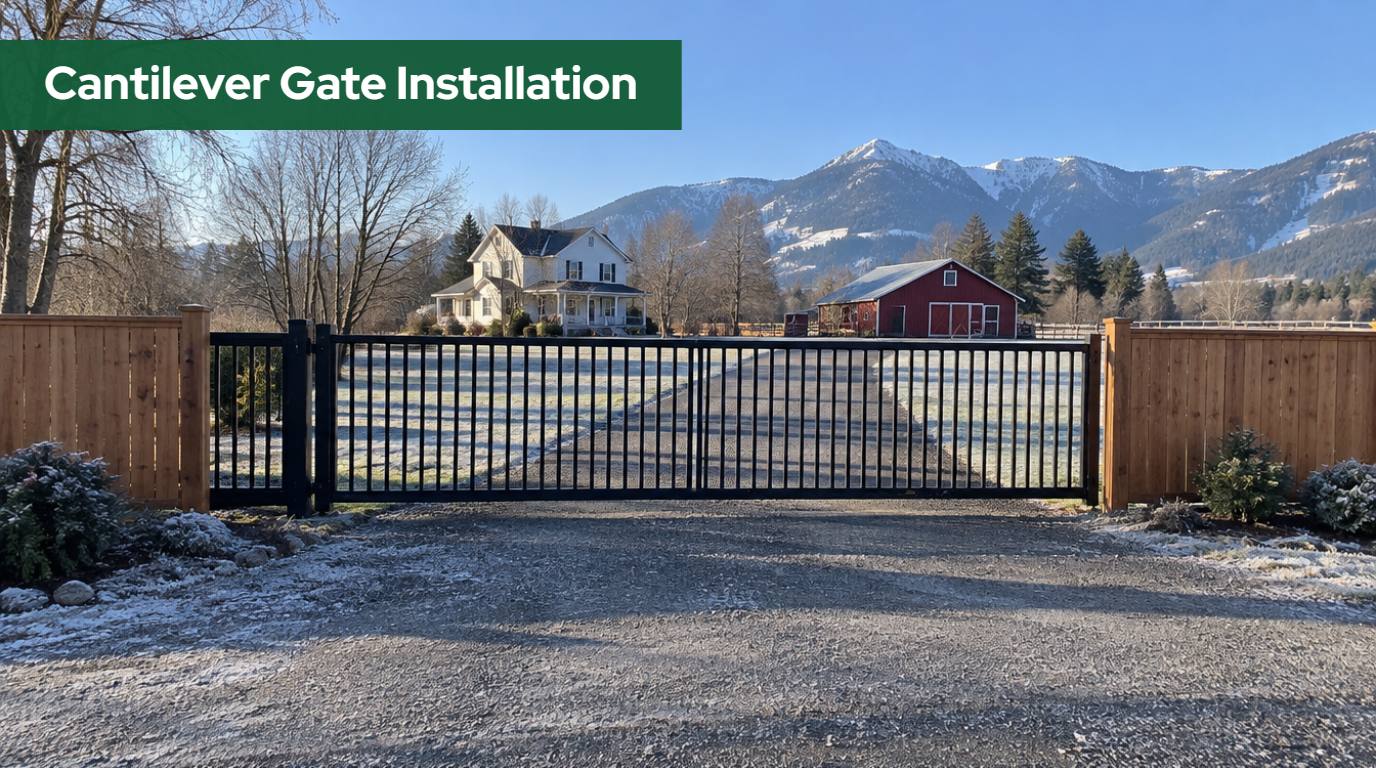
Cantilever gate installation in Washington starts with a question most people never ask until the gate is ordered: where does the rest of the gate go? A cantilever gate is a slide gate that hangs from rollers on two posts beside the opening and never touches the driveway. That one design choice solves real problems on gravel, on frozen mornings and on long rural entrances, and it creates others, mainly the extra length of gate and fence line it needs beside the opening.
This guide explains how a cantilever gate works, how it compares with a ground-track slide gate and a swing gate, how much room it needs, what the posts and footings carry, which rollers and openers suit it, the safety rules that apply to every automated slide gate, and the Washington rules on fire access and electrical work. It is written for homeowners, farms and acreage, HOA boards and commercial property managers in Skagit, Whatcom, Snohomish, Island, San Juan, King and Pierce counties.
Quick answer
A cantilever gate is a trackless slide gate carried by rollers on two posts beside the opening, so nothing rides on the driveway. It needs a counterbalance tail, often about half the opening, plus clear room to slide. In Washington, automated gates follow UL 325 and ASTM F2200, and fire access rules are set locally.
In this guide
- What is a cantilever gate?
- How a cantilever gate carries its weight
- Cantilever gate vs ground-track sliding gate
- Cantilever gate vs swing gate
- How much space does a cantilever gate need?
- Posts and footings: where the load really goes
- Rollers, trucks and frame types
- Choosing an opener for a cantilever gate
- Safety rules for automated cantilever gates
- Fire access and permits in Washington
- Rain, wind, frost and snow in Northwest Washington
- Gravel driveways, slopes and uneven ground
- Wiring, conduit and L&I licensing
- Keeping a cantilever gate running
- A planning checklist before installation
- How we approach cantilever gate installation
- Frequently asked questions
What Is a Cantilever Gate? Cantilever Gate Installation in Washington Explained
A cantilever gate is a horizontal slide gate that spans its opening without any support from the ground or from overhead inside that opening. The leaf is longer than the opening. The extra length, called the counterbalance or tail, stays behind the posts and rides in a set of rollers, so the front of the gate can reach across the driveway with nothing underneath it.
ASTM F1184, the standard specification for industrial and commercial horizontal slide gates, gives this design its own category. It calls cantilever slide gates Type II and describes them as gates spanning an opening that lacks a top or bottom support within that opening. Type II is then split into Class 1, frames running on external rollers, and Class 2, frames running on internal rollers. The same standard lists the parts a Type II gate must address: shape and size, gate posts, guide posts for Class 1, the roller assembly with top roller guards and bottom protective plates, performance, field adjustment and latching.
On residential and farm properties in Washington, the word “cantilever” covers everything from a chain-link yard gate to a custom steel or aluminum driveway gate with an ornamental face. What they share is the absence of a track. If you see a slide gate with a steel rail or V-track set in the concrete across the opening, it is a ground-track gate, not a cantilever.
How a Cantilever Gate Carries Its Weight
The whole gate hangs on two support posts set beside the opening, on the side where the gate will slide. Each post carries roller assemblies, often called trucks. The rollers grip a rail built into the gate frame, either outside the frame (external rollers) or inside a channel in the frame (internal rollers).
When the gate is closed, the leading edge reaches across the opening and rests in a latch or receiver on the far post. The counterbalance tail sits between and behind the support posts. Its job is to balance the long front section so the rollers are not asked to hold the gate like a crowbar.
That balance is never perfect. The front of the gate always wants to drop, which pushes the front roller up and the rear roller down. Those forces go into the posts and from the posts into the footings. This is why cantilever gates are more sensitive to post size, post spacing and concrete than any other gate type, and why a cantilever gate that sags is almost always telling you something about its posts or rollers.
As the gate opens, it rolls back through the trucks. The tail moves away from the opening, so the space behind the posts must be clear for the full travel: no landscaping, no parked cars, no woodpile, no fence corner. A gate that is perfectly built but runs into a rockery on the third day is a planning failure, not a hardware failure.
Cantilever Gate vs Ground-Track Sliding Gate
A ground-track slide gate rolls on wheels that run along a rail or V-track installed across the opening and along the slide path. A cantilever gate hangs from posts and runs on no track at all. Both slide sideways, both are common in Washington, and the choice between them usually comes down to the ground, the climate and the space beside the opening.
| Factor | Cantilever slide gate | Ground-track slide gate |
|---|---|---|
| Contact with the driveway | None; the gate hangs above grade | Wheels ride on a rail across the opening |
| Driveway surface | Works over gravel, grass, uneven or sloping ground | Needs a level, solid surface for the track |
| Debris, leaves, ice and snow | Nothing on the ground to jam | Track must be kept clear or the gate binds |
| Gate length | Longer than the opening because of the counterbalance tail | About the width of the opening |
| Space beside the opening | Room for the gate plus the tail to roll back | Room for the gate to roll back |
| Posts and footings | Heavy demand on the two support posts | Lighter demand; the track carries the weight |
The table explains why so many Northwest Washington properties end up with cantilever gates. Rain carries fir needles, leaves and grit onto the driveway for months. A ground track collects all of it, and on a cold morning a film of ice in the V-groove can stop a gate that worked the night before. A cantilever gate has nothing on the ground to collect debris or freeze.
The ground-track gate still has a place. It uses less material and needs less room beside the opening, so on a paved, level driveway with a tight side yard it can be the better fit. It also puts less load on the posts. We compare both slide styles with swing gates in our guide to sliding vs swing gates in the Pacific Northwest, and for commercial sites the commercial gate system buying guide covers traffic volume and duty cycle.
Cantilever Gate vs Swing Gate
A swing gate turns on hinges and sweeps an arc into or out of the property. A cantilever gate slides along the fence line. The deciding factors are slope, room in front of and behind the gate line, wind, and how the gate meets the traffic using it.
- Slope. A driveway that rises behind the gate can stop a swing leaf from opening fully. A cantilever slides parallel to the fence, so the grade of the driveway itself matters less than the grade along the slide path.
- Swing room. A swing gate needs clear space for the arc of each leaf. Vehicles waiting at the gate, mailboxes and keypad pedestals all have to sit outside that arc. A cantilever needs no arc, only room along the fence.
- Wind. A solid swing leaf acts like a sail when it is open at an angle. A slide gate moves edge-on along the fence line, which keeps the face of the gate out of most of the wind as it travels.
Steep driveways have their own set of options and trade-offs, including when a cantilever is the right answer and when it is not. Our guide to the driveway gate on a slope walks through them in detail.
Not sure if a cantilever, track or swing gate fits your entrance?
We walk the opening, the slide path and the grade with you, then recommend the gate type that suits the ground, the space and the traffic.
How Much Space Does a Cantilever Gate Need?
This is the most common question about cantilever gates and the one that decides whether the design works on a given lot. The gate needs space for three things: the opening itself, the counterbalance tail, and the full length of the gate once it has rolled open.
Manufacturer installation instructions give a rule of thumb for the tail. One chain-link fence manufacturer’s cantilever installation manual says the counterbalance should be about half the length of the gate opening, with a minimum of 4 feet, and notes that it may need to be longer when an automatic operator is installed. That means the gate leaf itself is roughly one and a half times the width of the opening. The exact figure comes from the gate maker’s engineering for that frame, weight and opening, so treat the rule of thumb as a planning number, not a fabrication dimension.
| Space item | What it is | What to check on site |
|---|---|---|
| Clear opening | The drivable width between the support side and the receiver post | Widest vehicle that must pass, turning path, fire access rules |
| Counterbalance tail | Gate length behind the support posts that balances the leaf | Gate maker’s figure for that frame and opening |
| Slide path | The length the gate rolls into when open | Clear of trees, rockeries, structures, parked vehicles and fence corners |
Getting the opening width right is its own subject. Washington law sets a general maximum vehicle width of 8.5 feet on public highways (RCW 46.44.010), and farm implements can be wider under the conditions in RCW 46.44.130, which is why farm and equipment entrances usually need much more than a car-width opening. Our guide to driveway gate width and layout in Washington works through the sizing, and the slide path then grows with whatever opening you choose.
If the space beside the opening is short, there are options. A bi-parting pair of cantilever gates splits the opening into two shorter leaves that slide in opposite directions, each with its own tail. That needs room on both sides of the driveway instead of a long run on one side. On a very tight lot, a swing gate or a different layout of the entrance may be the honest answer.
Posts and Footings: Where the Load Really Goes
Because the gate hangs from two posts, those posts and their footings carry the full weight of the gate plus the leverage of the leading edge. The front support post is pushed up at its top roller and the rear support post is pulled down, and every opening and closing cycle repeats those forces.
That is why cantilever posts are larger and set deeper than the posts of a light swing gate. The right size depends on the gate’s weight and length, the frame material, the soil and the gate maker’s engineering. A cantilever kit or a custom gate drawing specifies post size and spacing; installers who shorten the spacing between support posts to save fence length increase the leverage on the rollers and posts.
Soil matters as much as steel. Many low-lying properties in the Skagit and Nooksack river valleys stay wet through the rainy season, while island and upland properties can sit on sandy or rocky ground. A footing that is fine in dense, dry ground can rock slowly in saturated soil. On a site visit we look at drainage, standing water and how the ground behaves after rain, and size the footings for the worst season, not the day of the visit.
Rollers, Trucks and Frame Types
The roller assembly is the heart of a cantilever gate. It is what the gate actually rides on, and it is where most wear shows up. ASTM F1184 separates Type II gates into two classes by roller type, and the difference is practical.
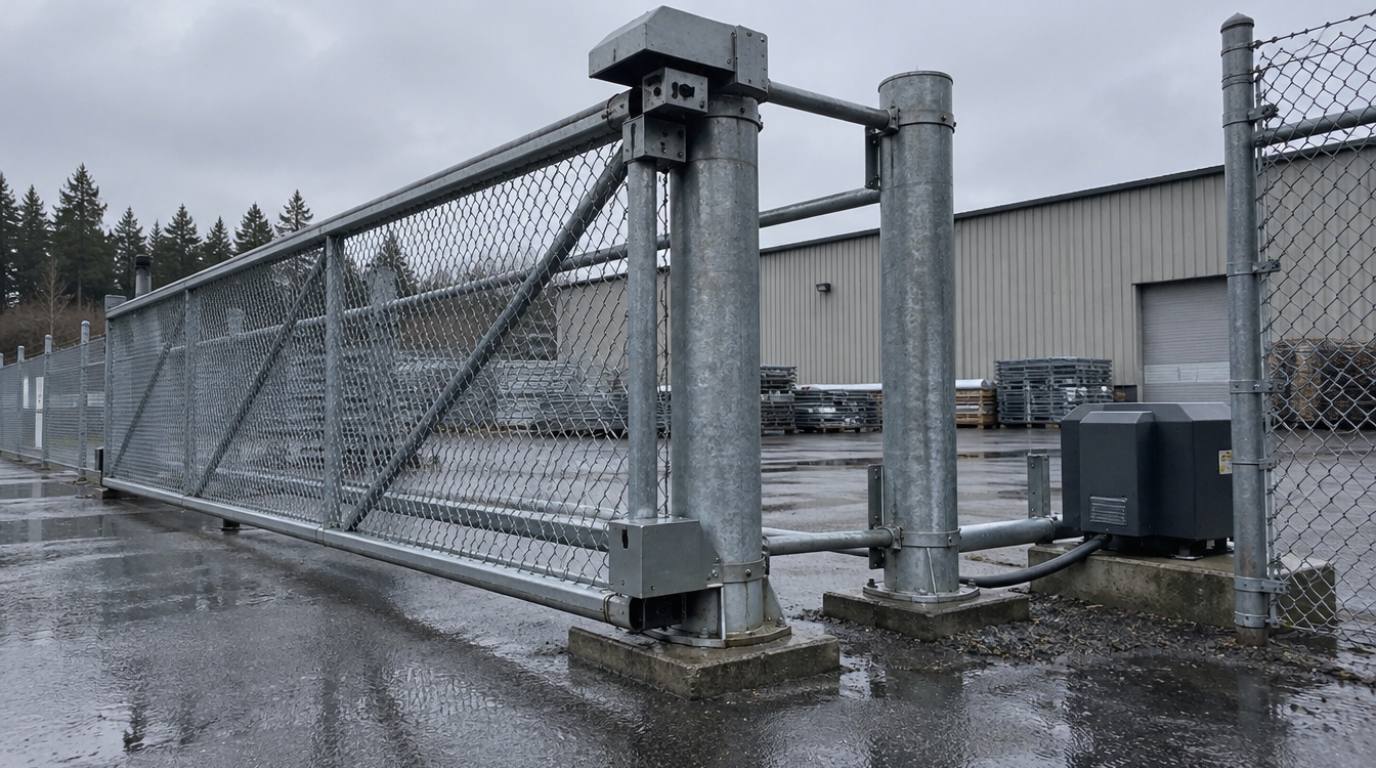
- External rollers (Class 1). Roller trucks bolt to the support posts and grip a rail on the outside of the gate frame, top and bottom. They are common on chain-link and heavy steel gates and are easy to see and service.
- Internal rollers (Class 2). The rollers run inside an enclosed channel built into the frame, usually aluminum. The track is protected from weather and fingers, and the gate has a cleaner look.
Roller guarding is a safety requirement, not decoration. DASMA’s installer checklist for automated vehicular gates says roller covers must be installed on all weight-bearing rollers located 8 feet or less above grade. On a cantilever gate, that means every truck on the support posts. Hands and clothing can be drawn into an unguarded roller as the gate moves.
Material choice affects weight, and weight affects everything else: posts, rollers, the operator and the counterbalance. Aluminum frames are lighter and resist corrosion; steel frames are stronger and suit heavy security or ornamental work. Wood can be added as a face over a metal frame, but a cantilever frame itself is almost always metal. Our guide to gate materials for Washington weather covers coatings, salt air and how each material ages here.
Choosing an Opener for a Cantilever Gate
A cantilever gate uses a slide gate operator, the same family of openers used on ground-track slide gates. The operator usually sits inside the fence line near the support posts and drives the gate with a chain or a rack and pinion. With a chain drive, the chain is fixed to both ends of the gate and runs through the operator; with a rack drive, a toothed rack is fixed along the gate frame and a gear in the operator drives it.
Choosing the operator comes down to the gate and the use:
- Gate weight and length. Every slide operator has a maximum gate weight and length in its specifications. The counterbalance tail adds to both, so a cantilever gate weighs more than a track gate for the same opening.
- Cycles per day. A private driveway might see a handful of cycles; an HOA, apartment or commercial entrance can see hundreds. Operators are rated for duty, and commercial sites need operators built for continuous use.
- UL 325 class. UL 325 groups gate operators by use, from residential to commercial and restricted-access industrial. The operator must be listed for the class of the site.
- Power. Line power, solar with batteries, or line power with battery backup. Long rural driveways in Skagit and Snohomish counties often lean on solar or on a battery backup sized for outages.
We install and service LiftMaster, Viking and FAAC operators, and compare their slide models for Washington conditions in our gate operator comparison for Northwest Washington. For outage planning, see automatic gate battery backup in Skagit County.
Want the gate, posts and opener drawn as one system?
We size the frame, the counterbalance, the rollers and the slide operator together, so the opener is matched to the real weight and length of the gate.
Safety Rules for Automated Cantilever Gates
An automated cantilever gate is a large, heavy object moving on its own. The safety rules come from two standards. UL 325 covers the operator and its entrapment protection. ASTM F2200 covers the construction of the gate itself. Washington’s fire code, through the International Fire Code as adopted in the state, requires electric gate operators to be listed under UL 325 and gates intended for automation to meet ASTM F2200.
DASMA, the door and access systems manufacturers’ association, publishes an installer checklist that summarizes the main points for slide gates. Among them, from its Automated Vehicular Gate Systems: Checklist for Installers (TDS 373):
- The slide gate must be designed, guarded or screened from the bottom of the gate to the top, or to at least 72 inches above grade, whichever is less, so a 2.25-inch sphere cannot pass through openings in the gate. The same applies to the part of the adjacent fence the gate covers, open or closed.
- Roller covers on all weight-bearing rollers 8 feet or less above grade.
- No controls on the gate operator or within 6 feet of the gate.
- Physical gate stops and fall-over protection in place, and gaps over 2.25 inches and protrusions over half an inch reduced, guarded or made inaccessible.
- Entrapment zones protected by contact or non-contact sensors as the operator manufacturer requires.
- If people walk through the area, a separate pedestrian access where a person will not contact the moving gate.
- Warning signs on both sides of the gate.
The screening rule matters more on a cantilever gate than most people expect. The tail section passes the support posts and the fence every time the gate moves, and that is where an arm or a hand can be caught between a moving picket and a fixed post. Mesh or screening on the lower part of the gate and on the fence it slides past closes that hazard.
Entrapment protection for slide gates is usually a combination of photo eyes across the opening and along the slide path, and edge sensors on the leading and trailing edges. Placement is covered in our guide to gate photo eye installation in Washington, and the full standards in automatic gate safety standards: UL 325 and ASTM F2200.
Fire Access and Permits in Washington
A gate across a driveway or private road can also be a gate across a fire apparatus access road, and that is where Washington’s rules become local. Washington adopts the International Fire Code statewide as chapter 51-54A WAC, with state amendments. For fire apparatus access roads, the state amendment in WAC 51-54A-0503 says these roads are provided in accordance with locally adopted street, road and access standards, and it lists several IFC subsections in section 503 as not adopted. The current version took effect on March 16, 2024.
In practice, this means a gate on a fire access route in Mount Vernon, Bellingham, Everett or unincorporated Skagit County is reviewed against that jurisdiction’s own access standards and its fire code official. Requirements such as minimum gate width, setback from the road, emergency opening devices like key switches or key boxes, and how the gate opens in a power failure vary from one jurisdiction to the next.
For a cantilever gate, a few of those local questions come up often:
- Clear width. The clear opening is the distance between the leading edge and the receiver post when the gate is fully open, not the length of the gate. Some installs lose width to a receiver or guide post that sits inside the opening.
- Emergency opening. Fire departments often require a way to open the gate without a code, and a way to open it when the power is out. A cantilever gate is heavy to push by hand if the operator’s release is hard to reach.
Electrical permits for the operator and its circuit are a separate matter from the fire review. Our guide to gate permits in Washington State covers both, and we check the local requirements for each address before a design is final.
Rain, Wind, Frost and Snow in Northwest Washington
Cantilever gates earn their place in Northwest Washington because of the weather. The things that stop ground-track gates here are on the ground: fir needles and leaves in the track, gravel washed across the driveway by heavy rain, and ice in the V-groove on a clear winter morning. A cantilever gate hangs above all of it.
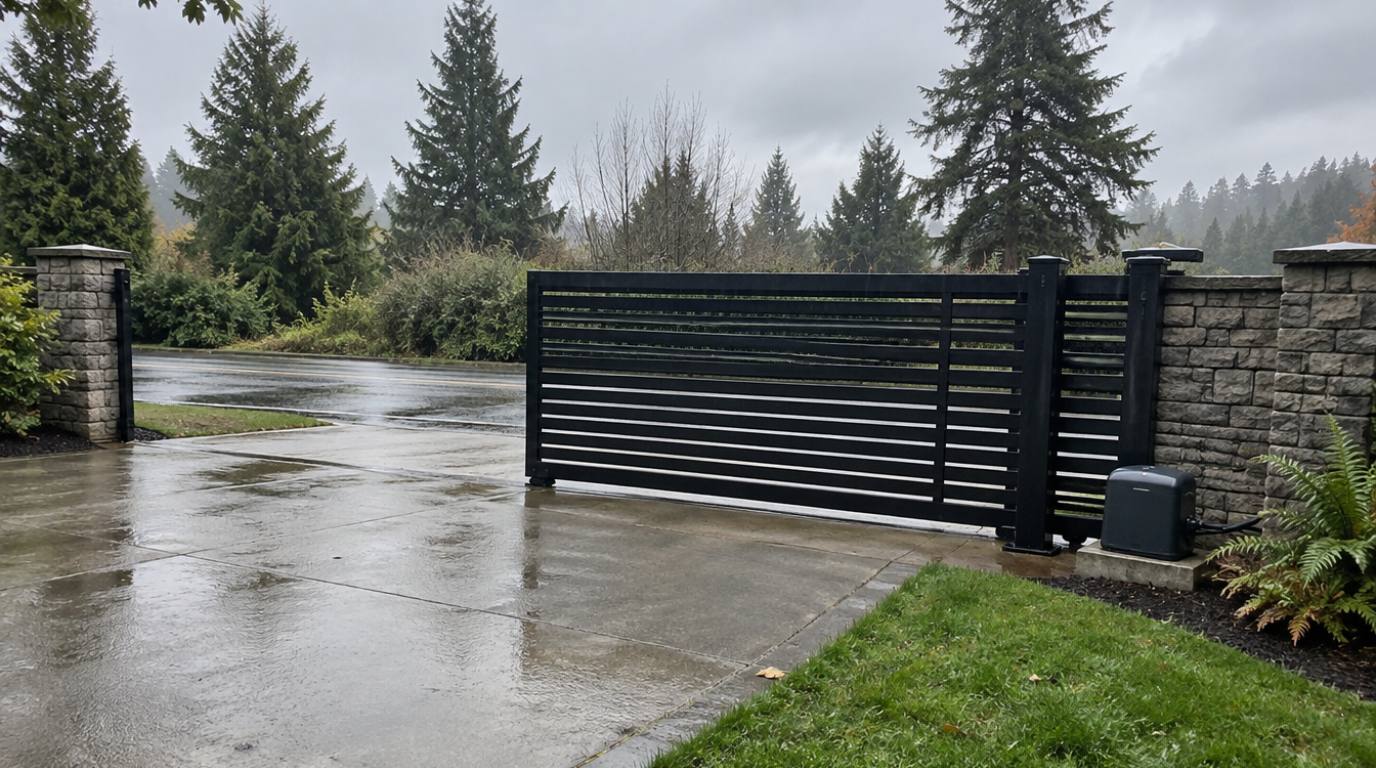
That does not make the cantilever immune to weather. The parts that need attention are different:
- Wet soil and footings. Months of rain soften soil around footings. Posts that are undersized or poorly drained can lean slowly, and on a cantilever gate a small lean at the support posts shows up as a large drop at the leading edge.
- Wind. A solid-faced gate catches wind even while sliding. Exposed sites in the Skagit Valley flats, on Whidbey and Camano islands and along the water in Anacortes see strong winds in storms. Solid infill, privacy panels and long leaves all increase the load on rollers and posts. Open or semi-open designs reduce it.
- Corrosion. Salt air on island and waterfront properties attacks bare steel, fasteners and roller bearings. Galvanizing, powder coating and stainless or sealed hardware are worth their cost there.
- Frost and snow. Higher ground in eastern Skagit and Whatcom counties and the foothills can see frost and snow in winter. The gap under a cantilever gate has to clear the snow that actually falls on that site, and frost heave can lift a high spot in the slide path into the bottom rail.
Gravel Driveways, Slopes and Uneven Ground
Many rural driveways in Skagit, Whatcom and Snohomish counties are gravel. Gravel moves: tires push it, rain washes it, plows scrape it. A ground track in gravel is a constant maintenance problem because the track needs a solid, level base and stays clear only as long as someone keeps it that way. A cantilever gate avoids the problem because nothing touches the driveway.
Slope is more nuanced. A cantilever gate tolerates a driveway that rises or falls through the opening, because the gate is hung above the ground. What it does not tolerate well is a slide path that changes grade along its length. The bottom of the gate travels in a straight line. If the ground along the fence beside the opening rises, the gate’s bottom rail needs to clear the highest point, which can leave a large gap at the low point.
There are ways to handle this:
- Grade the slide path. Where it is practical, the ground along the slide path is leveled so the gate runs over a consistent clearance.
- Raked or stepped bottom. A custom frame can be fabricated with a bottom edge that follows the grade under the closed gate, as long as the bottom still clears the ground along the full path of travel.
- Screening the gap. A gap under the gate that a child or animal could pass through may need a fixed screen or a different layout, both for security and for the safety screening rules.
- A different gate type. On a steep hillside driveway, a swing gate with rising hinges, a vertical pivot gate or a different gate location can work better than a cantilever.
Gravel driveway, slope or a long farm entrance?
We measure the grade along the slide path and the clearance under the gate before anything is fabricated, so the gate clears the ground in every season.
Wiring, Conduit and L&I Licensing
An automated cantilever gate needs power at the operator and low-voltage wiring to its accessories: photo eyes, edge sensors, the keypad or intercom, vehicle detection loops or exit wands, and sometimes lights or a camera. Planning the conduit early saves cutting the driveway later.
- Power. A dedicated circuit to the operator location, or a solar panel and battery arrangement sized by the operator maker’s guidance.
- Across the opening. Photo eyes on both sides of the opening, and any receiver-side accessories, need conduit under the driveway. On a cantilever install, this is the only reason to cut across the driveway, so it is worth doing once.
- Along the slide path. Photo eyes protecting the path where the gate rolls open need wiring along the fence line.
- Vehicle detection. Exit and safety loops are cut into paved surfaces; on gravel, exit wands or other detectors are used instead. We explain the options in our guide to the gate loop detector in Washington.
Washington licenses electrical work through the Department of Labor and Industries. WAC 296-46B-920 sets out the electrical contractor specialties, including the door, gate and similar systems specialty (10), which covers gate operator wiring and controls. Line-voltage work that feeds the operator may need a different license, and electrical work is permitted and inspected through L&I or the local jurisdiction where it has its own electrical program.
Keeping a Cantilever Gate Running
A cantilever gate has fewer parts on the ground to fail than a track gate, but the parts it has carry a lot of load. Most problems on older cantilever gates start small and grow.
| Symptom | Common cause | What to check |
|---|---|---|
| Leading edge drops or misses the latch | Worn rollers, loose trucks, a leaning support post or a sagging frame | Roller wear, truck bolts, post plumb, frame straightness |
| Gate stops or reverses partway | Binding in the rollers, a misaligned receiver, or an obstruction sensed by the operator | Roller alignment, guide rollers, photo eyes and edges |
| Grinding or squealing | Dry or damaged roller bearings, debris in an internal track | Bearings, lubrication per the maker, track channel |
| Bottom rail scrapes the ground | Frost heave, gravel build-up, a sagging leaf | Grade along the path, frame, rollers |
| Chain slack or jumping | Stretched chain or loose chain brackets | Chain tension, idlers, brackets on both ends of the gate |
The DASMA checklist expects the installer to explain that a regular maintenance schedule for both the gate and the operator is recommended, including regular testing of entrapment protection as the operator manufacturer describes. Owners can do simple things between visits: keep the slide path clear, look at the rollers and roller covers, watch for a change in how the gate meets the latch, and test the photo eyes as the manual instructs.
A Planning Checklist Before Installation
Before a cantilever gate is ordered or fabricated, these are the questions we answer with the owner. Each one changes the design.
- Opening width. What is the widest vehicle that must pass, and does a fire access standard set a minimum?
- Slide side. Which side of the opening has the room for the gate plus its tail, and is that run straight and clear?
- Grade along the path. How much does the ground rise or fall along the slide path, and what clearance does the bottom of the gate need in winter?
- Soil and drainage. Where does water run, and what does the soil look like at the post locations?
- Gate design and weight. Chain link, aluminum, steel or a custom ornamental face, and how much wind the infill will catch.
- Operator and power. Line power, solar or battery backup, and the duty cycle the entrance will see.
- Access control. Keypad, intercom, remotes, card readers or license plate recognition, and where the pedestal sits on the approach.
- Safety. Screening, roller covers, photo eyes, edges, stops and a separate pedestrian access where people walk.
- Local review. Fire access requirements and permits for the address.
- Future service. Room to reach the operator, the trucks and the rollers for maintenance.
How We Approach Cantilever Gate Installation
Emerald Gate Systems is a family-owned gate company based at 7557 Alpine Lane in Sedro-Woolley, in Skagit County. We design, fabricate in our own shop, install, automate and service residential, farm and commercial gates across Skagit, Whatcom, Snohomish, Island, San Juan, King and Pierce counties. The same team handles CAD planning, welding, installation, automation, access control, testing and later service, so the gate frame, the counterbalance, the posts and the operator are drawn together instead of being added by different trades at the end.
On a site visit we start with the checklist above, then walk the slide path with a level and a tape. We look at the soil and the water, the fence line the gate will run along, the traffic using the entrance and where the keypad or intercom belongs. If the space beside the opening is too short for a cantilever, we say so before anyone orders a gate, and we show the options: a bi-parting pair, a ground-track gate, a swing gate, or a different gate location.
When a custom face is wanted, we fabricate the gate in laser-cut steel, hand-forged wrought iron or with Western Red Cedar over a metal frame, and we size the frame and rollers for that weight. Our custom gate design and fabrication page shows the process, and automatic gate installation covers the automation side. Before we leave, we test the gate, the operator, the sensors and the stops together, show the owner how to use the manual release, and go over the maintenance the gate needs.
Washington requires contractors to show their registration in advertising: Emerald Gate Systems is registered with the Washington State Department of Labor and Industries as a construction contractor (EMERAGS748D6) and holds an electrical contractor license in the Doors and Gates specialty (EMERAGS747KE).
Ready to plan a cantilever gate for your property?
The first step is a free on-site consultation: we measure the opening and the slide path, check the ground, and lay out the gate, posts and opener.
Frequently Asked Questions
What is the difference between a cantilever gate and a sliding gate?
Both slide sideways along the fence line. A standard sliding gate rolls on wheels that ride a track or rail across the opening. A cantilever gate is a sliding gate with no track: it hangs from rollers on two posts beside the opening, and a counterbalance tail behind those posts holds the leading edge up, so nothing touches the driveway.
How much room do I need beside the opening for a cantilever gate?
Plan for the full length of the gate to sit beside the opening when it is open. Because of the counterbalance tail, the gate is longer than the opening; manufacturer instructions often put the tail at about half the opening, with a minimum of 4 feet, and sometimes longer with an operator. The gate maker’s drawings set the exact figure.
Is a cantilever gate good for a gravel driveway?
Yes, it is often the best slide option for gravel. A ground track needs a solid, level base and stays clear only with regular cleaning, while a cantilever gate hangs above the surface. The ground along the slide path still needs a consistent grade, so the bottom of the gate clears high spots, gravel build-up and frost heave in winter.
Do cantilever gates work in snow and ice?
They handle snow and ice better than ground-track gates because there is no track to fill or freeze. The gate still needs enough clearance underneath for the snow that falls on that site, a clear slide path, and rollers and covers kept free of packed ice. On higher ground in Skagit and Whatcom counties, that clearance is planned before fabrication.
What safety features does an automatic cantilever gate need?
The operator must be listed under UL 325 and the gate built to ASTM F2200. DASMA’s installer checklist calls for screening so a 2.25-inch sphere cannot pass up to 72 inches, covers on weight-bearing rollers 8 feet or less above grade, no controls within 6 feet of the gate, stops, sensors for entrapment zones and warning signs on both sides.
Do I need a permit for a cantilever gate in Washington?
It depends on the address. The operator’s electrical work needs a permit through L&I or a local electrical program. If the gate crosses a fire apparatus access road, Washington sends those roads to locally adopted access standards, so the city or county fire code official may review width, setback and emergency opening. We check both for each property.