
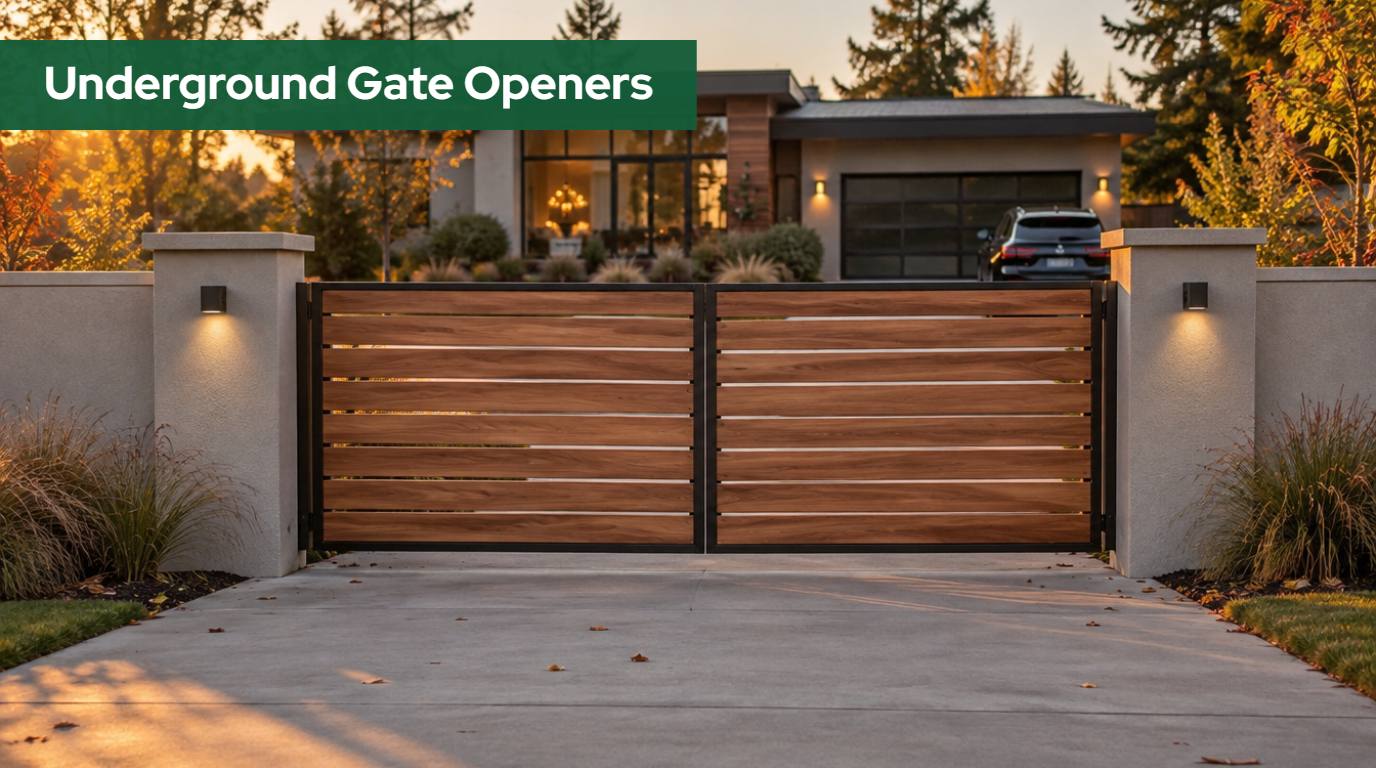
An underground gate opener in Washington sounds like the perfect answer for a beautiful swing gate: no arms on the posts, no boxes on the gate, nothing to spoil the look of a cedar or wrought iron entrance. The motor sits in a steel box buried at the hinge, under the driveway, and the gate seems to open on its own. The catch is the same thing that makes Western Washington green. A box set into the ground fills with water if the water has nowhere to go, and in a wet valley or on heavy soil that is the detail that decides whether the opener lasts.
This guide explains how in-ground swing gate operators work, how they compare with arm-style openers on the post, which gates they suit, how the foundation box and its drainage are built, what groundwater in places like the Skagit valley means for a buried motor, and the safety, fire access and electrical rules that apply in Washington. It is written for homeowners, estates and farms, and HOA boards in Skagit, Whatcom, Snohomish, Island, San Juan, King and Pierce counties who want a clean entrance without a wet surprise in February.
Quick answer
An underground gate opener is a swing gate motor housed in a foundation box at the hinge, below the driveway, so nothing shows on the gate. It suits moderate residential gates. In Washington the deciding factor is drainage: the box needs a working outlet for water, and the system still follows UL 325 and ASTM F2200.
In this guide
- What is an underground gate opener?
- How an in-ground operator moves the gate
- Underground vs above-ground swing gate openers
- Which gates suit an underground opener?
- The foundation box: level, flush and plumb
- Drainage: the make-or-break detail
- High groundwater, floodplains and heavy soil
- Power, wiring and solar
- Safety rules for in-ground swing gates
- Manual release and power outages
- Fire access and permits in Washington
- Leaves, needles, frost and snow
- Maintenance and service access
- Questions to settle before you choose one
- How we approach underground gate openers
- Frequently asked questions
What Is an Underground Gate Opener in Washington?
An underground gate opener, also called an in-ground or below-ground swing gate operator, is a motor and gearbox that sits inside a steel or composite foundation box buried at the hinge point of a swing gate. The top of the box is set flush with the driveway or the paving beside the post. The gate leaf sits on a pivot or lever on top of the box, and when the motor turns, the gate turns with it.
From the street you see the gate, the posts or pillars and a flat cover plate at the base of the hinge. There is no actuator arm reaching from the post to the gate and no operator box bolted to the leaf. That is the whole appeal. On a custom gate, where the face of the gate is the point of the project, an arm across the frame can look like an afterthought.
In Washington the term covers a few different products. Some are sold as complete kits with their own boxes, some are motors that drop into a separate load-bearing box, and some are European designs adapted for the US market. They share three things: the motor is below grade, the gate pivots at the hinge, and the hardware depends on a box that has to stay drained, level and solid for as long as the gate is in use.
How an In-Ground Operator Moves the Gate
The basic layout is the same across most brands. A foundation box is set in concrete at the hinge side of each leaf. The motor and gear reduction sit inside the box, or in a motor housing inside it. A drive lever or linking arm connects the motor output to a pivot, and the bottom of the gate leaf sits on that pivot. A top hinge on the post holds the gate upright and keeps it in line.
One detail surprises people: on several designs the motor does not carry the weight of the gate. DoorKing’s quickstart guide for its Model 6400 underground operator states plainly that the gate weight is not on the gate operator, and it calls for heavy-duty hinges to carry the leaf. The operator turns the gate; the hinges and the box structure hold it up. That is why the hinges and the operator pivot point have to line up exactly, and why the same guide says they must be plumb.
Because the drive point sits right at the hinge, an in-ground operator works with very little leverage. An arm-style opener pushes on the gate some distance out from the hinge, which gives it a mechanical advantage. An underground unit has to twist the leaf at its pivot. For a light or moderate leaf this is no problem. For a long, heavy or wind-catching gate, the torque needed climbs quickly, which is the main reason in-ground openers have tighter size and weight limits than many post-mounted models.
Underground vs Above-Ground Swing Gate Openers
Most automated swing gates in Northwest Washington use an above-ground opener: a linear actuator or an articulated arm mounted between the post and the gate. An underground opener is a specialist choice. Here is how the two compare on the points that usually decide it.
| Question | Underground opener | Above-ground arm or actuator |
|---|---|---|
| What you see | A flat cover at the hinge; nothing on the gate | An arm or actuator between the post and the leaf |
| Where the motor lives | In a foundation box below grade | On the post or pillar, above the ground |
| Main risk in a wet climate | Water standing in the box | Rain on exposed parts, which they are built to shed |
| Gate size and weight | Tighter limits, because it drives at the pivot | Wider range, with more leverage on the leaf |
| Installation work | Excavation, concrete, a drainage outlet and conduit at each hinge | Brackets on post and gate, conduit to the post |
| Service access | Lift the cover; work below grade | Work at waist height on the post |
| Best timing | New gate or new paving, when the hinge area is open | New or existing gate, any time |
Neither choice is better in general. An arm opener is easier to reach and less sensitive to the soil. An underground opener gives a cleaner entrance and keeps the motor out of sight, at the cost of more site work and a drainage design that has to be right the first time. Our gate operator comparison for Northwest Washington covers the above-ground options and brands.
Which Gates Suit an Underground Opener?
An in-ground operator works best on a residential swing gate of moderate width and weight, with a solid hinge post or pillar, on a site where the hinge area can be drained. Manufacturers publish the limits for each model: DoorKing’s quickstart guidelines for the Model 6400 are written for a gate up to 10 feet and 300 pounds, and a FAAC 770N manual lists a maximum leaf length of 3.5 meters at a 110 degree opening. The manual for the model being installed, checked against the real leaf, sets the number.
Several things push a gate outside the comfortable range:
- Solid infill. A gate with solid cedar boards or a full steel panel catches wind like a sail. Manufacturers limit in-ground units by wind load as well as weight, and Western Washington gets real wind events from the coast to the foothills.
- Long single leaves. A single wide leaf is harder on a pivot drive than a matched pair. Splitting a wide opening into two leaves often brings each one back inside the limits.
- Heavy decorative work. Hand-forged wrought iron, thick laser-cut steel panels or stone-clad frames add weight that the hinges and the operator both feel.
- Slopes. A gate that swings over a rising driveway needs rising hinges or a raked bottom. That geometry has to be compatible with the pivot of the operator, which is not always the case. Our guide to a driveway gate on a slope explains the options.
Wondering if your gate is a fit for an in-ground opener?
We measure the leaves, check the hinge posts and look at the ground, then tell you whether an underground or an arm opener suits the gate you have or want.
The Foundation Box: Level, Flush and Plumb
Everything about an underground opener depends on the foundation box. It holds the motor, carries the pivot and sets the geometry of the gate. Once it is in concrete, it is very hard to correct, so this is where most of the care goes.
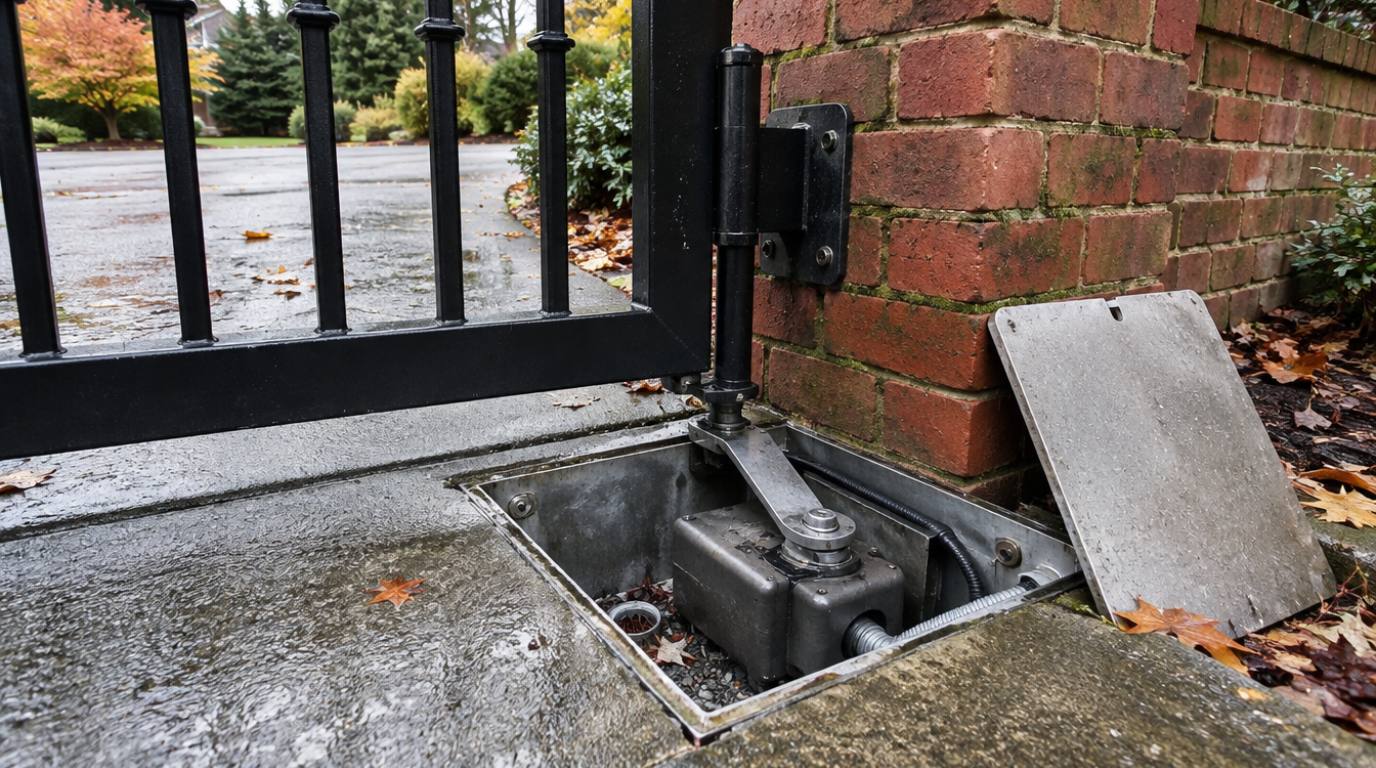
The manuals agree on a few non-negotiable points. DoorKing’s 6400 guide says the foundation box must be level and flush with the driveway, and that the gate hinges and the operator pivot point must be plumb. The FAAC 770N manual has the installer choose the orientation of the box from its dimension drawings and adjust the size of the hole to the type of ground. Concrete depth is not one fixed number either: DoorKing notes that it depends on the installation, the soil and local codes.
In practice, setting a box well means:
- Locating the pivot first. The box goes where the hinge axis is, not where it is convenient to dig. On an existing gate, that may mean resetting the hinges.
- Getting the top flush. A box that sits high is a trip hazard and a snowplow catch. A box that sits low collects water from the whole driveway.
- Setting it level in both directions. A box out of level makes the gate swing uphill or drift, and it strains the motor.
- Bringing in conduit and drainage before the pour. Power, control wiring and the drain all enter the box, and all have to be placed before the concrete closes around it.
- Checking against the gate. The leaf, the top hinge and the box pivot are aligned with the actual gate in place, not from a drawing alone.
This is also why timing matters. If a driveway is about to be paved or a new gate built, the hinge area is open and the box can go in cleanly. Retrofitting a box into a finished stamped concrete or paver driveway means cutting it out and patching it. Our guide to automatic gate planning before paving covers the conduit and sleeves worth placing before any driveway work, even if automation comes later.
Drainage: The Make-or-Break Detail in Western Washington
A foundation box is a hole in the ground with a lid. Rain that runs across the driveway, water that seeps through the soil around the box and snowmelt in a cold snap all end up in the same place. If that water cannot leave, it sits around the motor. Every manufacturer treats this as an installation requirement, not an option.
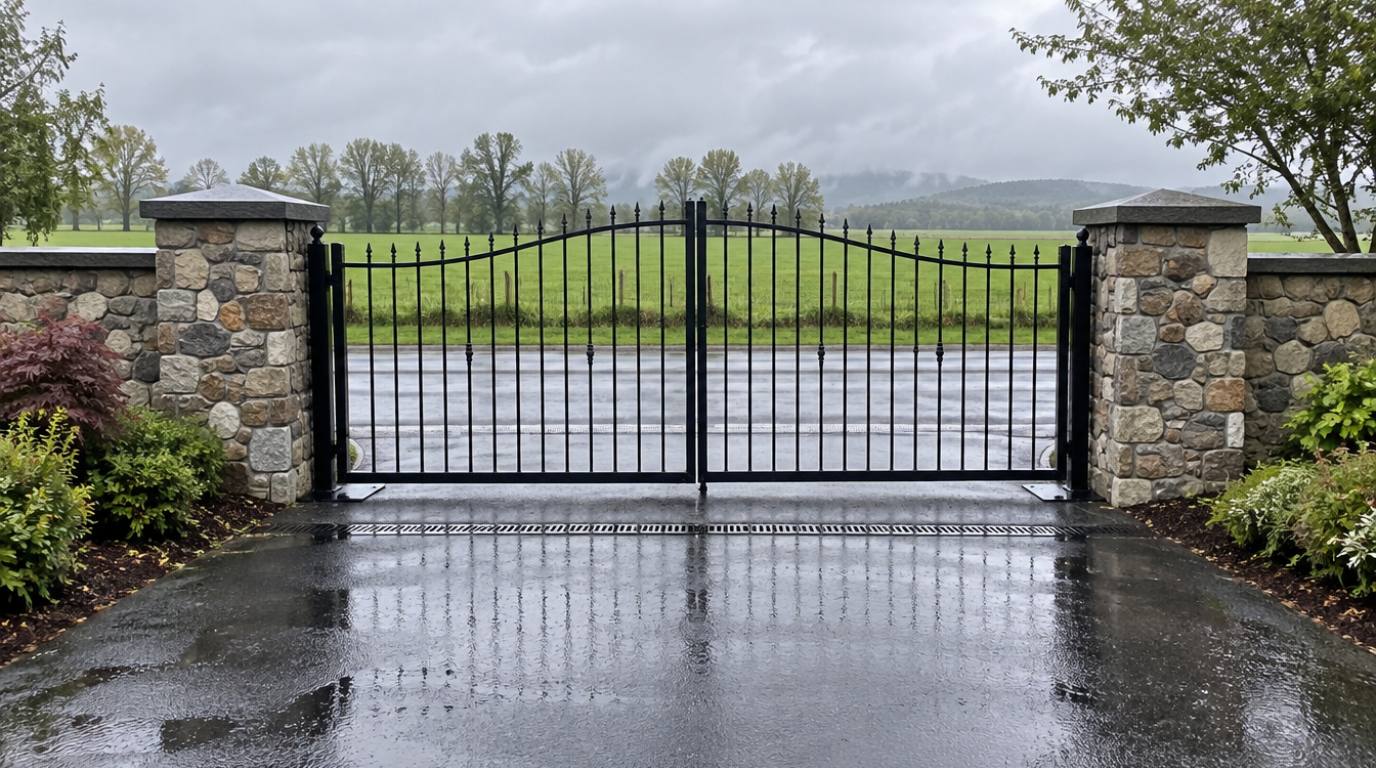
The FAAC 770N manual tells the installer to place a tube to drain rainwater from the box. DoorKing’s 6400 guide is more specific about where it goes: the drain pipe must slope away from the foundation box, and it can connect to an existing drain pipe or be routed to a good drainage area. The same guide says a deep hole filled with good gravel is an acceptable drainage source, and it tells installers to check local building codes before installation.
The words “good drainage area” carry a lot of weight in Western Washington. A gravel pocket works when the surrounding soil can take the water away. When the soil is saturated or the water table is close to the surface, a gravel pocket can fill up and stay full for weeks, and then it drains nothing. The options get more serious from there:
- A gravity drain to daylight. On a sloped site, a pipe that falls steadily from the box to an outlet lower down the property is the most reliable choice, because it needs no power and has nothing to wear out.
- A connection to an existing drain. Where the property has a working storm or footing drain system at the right depth, the box drain can tie into it, if that system is allowed to take the water.
- A drywell or gravel pit. Workable on free-draining soil, such as some glacial outwash sands and gravels, and the weakest choice on clay or in a high water table.
- A pump. On flat, wet sites some installers add a small sump pump. It works only while it has power and is maintained, so it is a fallback, not a design.
Where the drain discharges is part of the design too. Water from the box should not be sent onto a neighbor’s property, into a septic drain field or across a walkway where it will freeze. If no reliable outlet exists, that is the clearest sign that an above-ground opener is the better choice for the site.
High Groundwater, Floodplains and Heavy Soil
The soil under a gate in Washington can be anything from free-draining glacial gravel to dense clay to river silt. For an underground opener, the question is not only how much rain falls but where the water in the ground sits during the wettest months.
The Skagit valley is a clear example. The USDA’s official description of the Skagit soil series describes these floodplain soils as poorly drained, subject to flooding, and found on flood plains at elevations from 5 to 50 feet. It also states that the water table is at a depth of 0.5 to 2.0 feet from November to March. A foundation box is often deeper than that. On those soils, in winter, the box can sit in groundwater no matter how well the surface water is handled.
The U.S. Geological Survey found a similar pattern in its study of shallow groundwater in the Skagit River delta area. Water levels in the wells it measured generally ranged from less than 3 feet below the surface in the west to about 15 feet in the east, and they rose in fall and winter when precipitation was high, then fell in spring and summer. A site that looks dry when the gate is designed in August can be wet at gate depth in January.
That does not mean every property in Mount Vernon, Burlington or Sedro-Woolley is wrong for an in-ground opener. Upland sites, sloped lots and properties on well-drained outwash can be fine. It does mean the soil and the seasonal water level are checked before the box is chosen, especially:
- on river and delta floodplains in Skagit, Snohomish and Whatcom counties,
- on flat sites where a gravity drain has nowhere to fall,
- on dense clay or hardpan, which holds water around the box,
- near the shoreline on Whidbey, Camano and the San Juan Islands, where low-lying lots can stay wet, and
- at the bottom of a sloped driveway, where surface runoff collects at the gate.
Manufacturers rate their in-ground motors for water exposure, and some carry high ingress ratings: the FAAC 770N manual lists protection class IP 67. A rating like that describes how the housing resists dust and temporary immersion under test conditions. It is not a reason to leave a motor sitting in water through a Washington winter, and long submersion is exactly what a good drainage plan avoids.
Power, Wiring and Solar for an Underground Opener
An underground motor still needs a control box above ground. The control board, the power supply, the receiver for remotes and the connections for safety devices and access control live in that box, usually on a post or pedestal inside the property. Cables run from it, through conduit, down into each foundation box.
The supply voltage depends on the product. DoorKing’s 6400 connects to either a 115 VAC control box or a solar control box. The FAAC 770N manual describes a 230 V, 50 Hz supply, which is a European mains standard, alongside a 24 V motor version. That difference is worth noticing: some in-ground operators sold online are built for other markets. In the US, the operator should be a model sold and listed for US use, with a control system rated for the power available on site.
For the wiring itself:
- Conduit to every box. Each foundation box needs its own conduit run from the control box, sized for the motor cable and sealed so it does not become a second drain path into the box.
- Low-voltage and line-voltage kept apart. Photo eyes, loops, keypads and intercoms usually run on separate low-voltage wiring.
- Licensed work. In Washington, electrical work on gate operators falls under L&I licensing. The Doors and Gates specialty (10) under WAC 296-46B-920 covers this type of work, and most installations need an electrical permit.
Solar is possible with some in-ground models, but a motor that twists a gate at its pivot can draw more current than an arm opener on the same gate, and short winter days in Northwest Washington limit charging. Our pages on solar gate openers and automatic gate battery backup in Skagit County explain how to size panels and batteries for the real duty, which applies to buried motors as well.
Want the drain, the conduit and the box planned together?
We lay out the foundation boxes, the drainage outlet and the wiring as one plan before any concrete is poured, so nothing has to be cut out later.
Safety Rules for In-Ground Swing Gates
Hiding the motor does not change the safety rules. An automated swing gate is a heavy leaf moving on its own, and the hazards are the same whether the motor is on the post or under the driveway. Two standards set the rules. UL 325 covers the operator and its entrapment protection, and ASTM F2200 covers how the gate itself is built. Washington’s fire code, through the International Fire Code as adopted in the state, requires electric gate operators to be listed under UL 325 and gates intended for automation to meet ASTM F2200.
Under UL 325, the operator’s own sensing is not enough. External entrapment protection is required: non-contact sensors such as photo eyes, or contact sensors such as edges. DoorKing’s 6400 guide spells this out: the operator will not run without monitored entrapment protection, and one or more monitored type B1 or B2 devices go in each entrapment area. On a swing gate that usually means photo eyes across the opening and in the swing path, and edge sensors where the leaf can trap someone against a post, wall or fence.
Other points from ASTM F2200 and the DASMA guidance for installers apply as well:
- Controls that people use to operate the gate belong at least 6 feet away from it, so no one reaches through or stands in the swing to press a button.
- Openings in the gate are limited by the screening rules in ASTM F2200, so hands and arms cannot pass through where the gate can trap them.
- Warning signs go on both sides of the gate.
- The swing area on the inside must stay clear. A leaf that opens into a parked car, a planter or a person is a design problem, not a sensor problem.
Placement of photo eyes on a swing gate has its own geometry. Our guide to gate photo eye installation in Washington covers it, and the full standards are in automatic gate safety standards: UL 325 and ASTM F2200.
Manual Release and Power Outages
Winter windstorms often knock out power in parts of Northwest Washington, and island and rural properties can wait longer than most for it to come back. When that happens, a gate has to open somehow. With an arm opener, the release is on the post. With an underground opener, it has to be reachable without digging.
Designs differ. DoorKing’s 6400 uses a key release with a handle that can be pulled from either side of the gate to move the gate by hand. The FAAC 770N manual describes opening a release lever. Other models use a key at the cover plate or a release inside the box. Before choosing a model, ask three questions:
- Can the release be reached from both sides of the gate, or only from inside?
- Does it need a special key, and where will that key live?
- Is it still easy to reach when the box cover is covered in snow, leaves or ice?
A battery backup keeps the gate working through most outages so the manual release is a last resort. It still matters, because batteries run down in a long outage and fire crews may need the gate open whatever the state of the power. The battery backup guide linked above covers sizing for Washington winters.
Fire Access and Permits in Washington
A gate across a driveway or a private road can also be a gate across a fire apparatus access road, and that is where Washington’s rules become local. Washington adopts the International Fire Code statewide as chapter 51-54A WAC, with state amendments. For fire apparatus access roads, WAC 51-54A-0503 says these roads are provided in accordance with locally adopted street, road and access standards, so each city or county sets the details.
In practice, a gate on an access route in Everett, Bellingham, Mount Vernon or unincorporated Skagit County is reviewed against that jurisdiction’s own standards and its fire code official. The items that vary include clear width, setback from the road, emergency opening devices such as key switches or key boxes, and how the gate opens in a power failure.
For an underground opener, two of those questions come up most:
- Emergency opening. A fire crew needs a fast way to open the gate. If the release on your model is in the box or needs a special key, a key switch or another device approved by the fire department may be required.
- Clear width. In-ground operators leave the posts free of arms, which helps, but the clear opening is still measured between the open leaves, not between the posts.
The operator’s electrical work needs a permit through L&I or a local electrical program, separate from any fire review. Our guide to gate permits in Washington State covers both, and we check the requirements for each address before a design is final.
Leaves, Needles, Frost and Snow
An underground opener moves the motor out of the rain, but it puts the cover plate right where everything that falls on a driveway ends up. Fir needles, maple leaves, gravel and grit collect around the pivot and on the cover. In fall, a wet mat of leaves can sit over the box and hold water against it.
Frost and snow bring a different set of issues:
- Freezing water in the box. Water that stays in a box can freeze around the drive parts in a cold snap. Good drainage is the protection here too.
- Ice at the pivot. Ice around the bottom of the leaf can make the gate harder to move. Most openers will stop or reverse when they meet unexpected resistance, which is correct behavior, but it means the gate may not open until the ice is cleared.
- Snow clearing. A cover plate that sits even slightly above the driveway is easily hit by a plow blade or a shovel. Flush installation protects the box and the plow.
On higher ground in Whatcom and Skagit counties, and on the foothills toward the Cascades, snow and ice are more frequent than on the valley floor. We plan the cover height, the drain outlet and the location of the release with that in mind. The seasonal guide to automatic gate maintenance in Washington covers fall and winter checks for every gate type.
Building a new gate and want the cleanest look possible?
We design the gate leaves, the hinges and the opener together, so a custom gate gets the operator that suits its weight, its site and the weather.
Maintenance and Service Access
An underground opener needs less cleaning of the motor itself than you might expect, because the motor is sealed in its housing. What it needs is regular attention to the parts around it: the drain, the box, the cover and the pivot.
A practical maintenance routine looks like this:
- Before the wet season. Clear leaves and debris from the cover and the area around the pivot. Check that the drain outlet is open and not buried by landscaping or blocked by roots.
- After heavy rain. Lift the cover, if your model allows it, and look for standing water. A box that holds water after a storm has a drainage problem that will not fix itself.
- Safety checks. Test the photo eyes and edges on a regular schedule, and confirm the gate reverses when the beam is blocked.
Service is where the trade-off of an in-ground unit shows. Working on an arm opener happens at waist height on a post. Working on a buried motor means opening the box, keeping water out while it is open and lifting parts out of a hole. Repairs take longer, and a box that was poorly drained for years can hold a corroded motor. That is not a reason to avoid in-ground openers, but it is a reason to choose a model with good parts support and to keep the drainage working. Our guide on how long automatic gates last in Washington explains what tends to shorten or extend the life of gate operators.
Questions to Settle Before You Choose One
An underground opener is a good choice when the gate, the site and the expectations line up. Before ordering one, settle these points:
- Gate size and weight. Is each leaf inside the published limits of the model, with margin, including wind on solid infill?
- Hinges and posts. Are the posts or pillars strong enough, and can the hinges be set plumb with the operator pivot?
- Soil and water. What is the soil at the hinge, and where is the water table in winter? Is the site on a floodplain?
- Drainage outlet. Is there a real place for the box drain to go, by gravity if possible, that does not affect a neighbor or a septic system?
- Driveway surface. Is the hinge area open for new work, or will finished paving have to be cut and patched?
- Power. Is line power available at the gate, or will the system run on solar with a battery bank sized for winter?
- Safety layout. Where will the photo eyes and edges go, and is there a separate walk gate for people?
- Release and fire access. How is the gate opened in an outage, and does the address need a fire department key switch or other device?
- Access control. Keypad, intercom, remotes or a vehicle exit loop, and where the pedestal sits on the approach. Our guide to the gate loop detector in Washington covers free exit.
- Service. Who will maintain the box and the drain, and are parts available for the model?
How We Approach Underground Gate Openers
Emerald Gate Systems is a family-owned gate company based at 7557 Alpine Lane in Sedro-Woolley, in Skagit County. We design, fabricate in our own shop, install, automate and service residential, farm and commercial gates across Skagit, Whatcom, Snohomish, Island, San Juan, King and Pierce counties. The same team handles CAD planning, welding, installation, automation, access control, testing and later service, so the gate leaves, the hinges and the operator are designed together instead of being matched at the end.
When an owner asks for an underground opener, we start with the site rather than the product. We walk the entrance, look at the soil and where water runs during rain, find where a drain could go and check the posts and hinges. If the hinge area sits in a wet spot with no outlet, we say so before anything is ordered, and we show the alternatives: a well-placed arm opener, a different gate layout, or a slide gate where the space allows.
When a custom gate is part of the project, we fabricate it in laser-cut steel, hand-forged wrought iron or with Western Red Cedar over a metal frame, and we size the frame for the operator that will move it. Our custom gate design and fabrication page shows the process, automatic gate installation covers the automation side, and automating an existing gate explains what changes when the gate is already in place. Before we leave, we test the gate, the operator, the sensors and the release together, show the owner how to open the gate by hand, and go over the maintenance the box and the drain need.
Washington requires contractors to show their registration in advertising: Emerald Gate Systems is registered with the Washington State Department of Labor and Industries as a construction contractor (EMERAGS748D6) and holds an electrical contractor license in the Doors and Gates specialty (EMERAGS747KE).
Ready to talk about an underground opener for your gate?
The first step is a free on-site consultation: we check the gate, the hinge posts, the soil and the drainage, then recommend the opener that will hold up on your site.
Frequently Asked Questions
Are underground gate openers a good idea in Washington?
They can be, on the right site. An underground opener suits a moderate residential swing gate where the foundation box can drain. In Western Washington the deciding factor is water: on floodplains, flat lots or heavy clay with a high winter water table, the box may sit in water for months, and an above-ground opener is usually the better choice.
How do you drain an underground gate opener box?
Manufacturers require a drain from the foundation box. DoorKing’s guide for its Model 6400 says the drain pipe must slope away from the box and can tie into an existing drain or run to a good drainage area, and a deep gravel pit is acceptable. On wet sites, a gravity drain to daylight is the most reliable choice.
What size gate can an underground opener handle?
Each model has published limits. DoorKing’s quickstart for the Model 6400 is written for a gate up to 10 feet and 300 pounds, and a FAAC 770N manual lists a 3.5 meter maximum leaf at a 110 degree opening. Solid infill that catches wind, a long single leaf or heavy decorative work can push a gate past what an in-ground unit should move.
Can I add an underground opener to my existing gate?
Sometimes. The hinges must line up with the operator pivot, so existing hinges often have to be reset, and a foundation box has to be set in concrete at each hinge. On finished paving that means cutting and patching. When the gate or the driveway is new, the box, conduit and drain go in far more cleanly.
How do you open an underground gate opener when the power is out?
Each model has a manual release. DoorKing’s 6400 uses a key release with a handle you pull from either side of the gate, and other designs use a lever or a key at the cover plate. A battery backup keeps the gate working through most outages, and some fire departments require a key switch for emergency access.
Do underground gate openers need safety sensors?
Yes. Under UL 325, automated gates need external entrapment protection such as photo eyes or edge sensors, and Washington’s fire code requires UL 325 listed operators and gates built to ASTM F2200. DoorKing’s 6400 will not run without monitored entrapment devices, and pedestrians need a separate walk gate rather than the vehicle opening.