

Choosing driveway gates for snow in Washington is less about surviving a blizzard and more about getting through the handful of mornings each winter when the driveway is white, the wind is coming down the Fraser River valley or off the Cascades, and the gate still has to open for you, for a delivery and for a fire engine. Snow in Western Washington is usually wet, heavy and short-lived, and it often arrives with ice, freezing rain or a power outage.
This guide explains how snow and ice affect each type of driveway gate, which designs hold up best at homes, farms and rural properties across Skagit, Whatcom, Snohomish, Island and San Juan counties, how plow berms and cold temperatures change the layout, what operator ratings and heater options really mean, and how to keep safety sensors and fire access working when the weather turns.
Quick answer
For snow in Washington, cantilever slide gates and vertical pivot gates hold up best because nothing runs on the ground. Swing gates work when the arc stays clear and they open inward, away from plow berms. Track slide gates need the track kept clear. Check the operator’s cold rating, battery backup and heated sensors.
In this guide
- How snow affects driveway gates
- Where it snows in Western Washington
- Which gate type handles snow best?
- Swing gates in snow
- Track slide vs cantilever gates in snow
- Plows, berms and where the gate sits
- Cold ratings, heaters and batteries
- Photo eyes, edges and loops in winter
- Freezing rain and ice on the gate
- Power outages during snowstorms
- Fire access gates in winter
- Design and material choices for snowy sites
- Setup checklist before the first snow
- How we approach gates for snowy sites
- Frequently asked questions
How Snow and Ice Affect Driveway Gates for Snow in Washington
A driveway gate fails in snow for one of a few reasons, and almost none of them is the cold alone. The common problems are physical: something blocks the path of the gate, ice binds a moving part, a sensor sees snow or frost as an obstruction, or the power goes out and the battery runs down before the lines are back up.
Each gate type has its own weak point. A swing gate needs the full arc in front of it to be clear, so a few inches of packed snow or a plow berm can stop a leaf partway. A slide gate on a ground track needs the track and the wheel groove to be clear, so slush that freezes overnight can lock it in place. A cantilever slide gate and a vertical pivot gate do not touch the ground while they move, which is why they are usually the first recommendation where snow is common.
The operator itself also matters. Gate operators are rated for a temperature range, their batteries lose capacity in the cold, and the grease and oil in gearboxes and hinges thicken. The safety devices required by UL 325 and ASTM F2200, such as photo eyes and contact edges, can be fooled by snow, frost or ice. A gate that stops and reverses because a sensor is covered is doing what it was designed to do, but it still leaves you waiting in the driveway.
Where It Snows in Western Washington (and Why It Varies So Much)
Snow in Western Washington is uneven. Most of the lowlands along the I-5 corridor see only a few snow days in a typical winter, and the snow that falls is often wet and gone within a day or two. Move a few miles inland or a few hundred feet uphill, and the picture changes quickly.
Whatcom County and the Fraser outflow. When cold air builds up over interior British Columbia, it drains toward the coast through the Fraser River valley and arrives in Whatcom County as a cold northeast wind. Lynden, Everson, Sumas, Bellingham and the county’s northern farmland can sit below freezing for days during these events, and snow that falls there drifts against anything standing across its path, including a closed gate. We cover the wind side of these events in our guide to driveway gates for windy areas in Washington.
Skagit County. The Skagit Valley flats around Mount Vernon and Burlington usually see light snow, while Sedro-Woolley, Lyman, Hamilton, Concrete and the roads up into the foothills see more of it, and it stays longer on north-facing slopes and in shaded driveways.
Snohomish County. Arlington, Granite Falls, Darrington, Sultan, Gold Bar and Index sit at the foot of the Cascades and get more snow and colder nights than Everett, Lynnwood or Edmonds near the Sound. Long rural driveways in these areas often climb, which adds the problems of a sloped approach.
The practical point is that a gate on a valley floor and a gate five miles away up a foothill road can face very different winters. The design should follow the actual site, not the county average. The Office of the Washington State Climatologist also describes how freezing rain forms in the region: cold, below-freezing air near the ground with warmer air above it while precipitation falls. That pattern, more than deep snow, is what coats gates and operators in ice.
Which Gate Type Handles Snow Best?
There is no single best driveway gate for snow, but there is a clear order for sites where snow and ice are a regular part of winter. The table below compares the common types.
| Gate type | What it needs to move | Snow and ice weak point | Fits best where |
|---|---|---|---|
| Cantilever slide | Clear space beside the opening for the gate and its tail; nothing on the ground in the opening | Snow piled along the fence line where the gate rolls back; ice on the rollers | Rural and foothill driveways, farms, sites with regular snow |
| Vertical pivot | Room beside the opening for the operator and clear space overhead | Snow pushed against the receiver post; snow load on the closed panel | Tight entrances, gravel or mud, commercial and storage sites |
| Track (V-groove) slide | A level, clear ground track across the opening | Slush freezing in the track and wheel groove; plowed snow on the track | Flat, paved driveways where the track can be cleared and drained |
| Swing (single or double) | The whole arc in front of each leaf clear of snow | Snow and berms in the arc; wind on the leaf; ice at the latch and stop | Flat driveways with room to clear the arc, inward opening |
| Barrier arm | Clear space for the arm to swing up | Ice on the arm adding weight; snow at the pedestal | Commercial lanes and private roads where a full barrier is not needed |
A cantilever gate carries its weight on roller trucks mounted on posts beside the opening, with a counterbalance tail behind it. Because it never rolls across the driveway, snow on the driveway surface does not stop it. Our page on cantilever gate installation in Washington covers the posts, footings and clearances it needs.
A vertical pivot gate lifts from one end and clears the lane from above. It also ignores snow on the ground, but it is a more industrial-looking choice and needs overhead space, so it appears more often at storage yards, farms and commercial gates than at homes.
Swing and track slide gates are not wrong for snowy sites. They simply need a layout and a routine that respect their weak points, which the next two sections explain.
Swing Gates in Snow: The Arc, the Berm and the Direction They Open
A swing gate needs every inch of the arc in front of each leaf to be clear. In a heavy wet snowfall, a modest layer of snow in the arc can be enough to stall a leaf, and once a car or a plow has packed it down, the resistance grows. An operator that senses the resistance will stop and reverse, as UL 325 requires it to, and the gate will sit half open until someone clears the path.
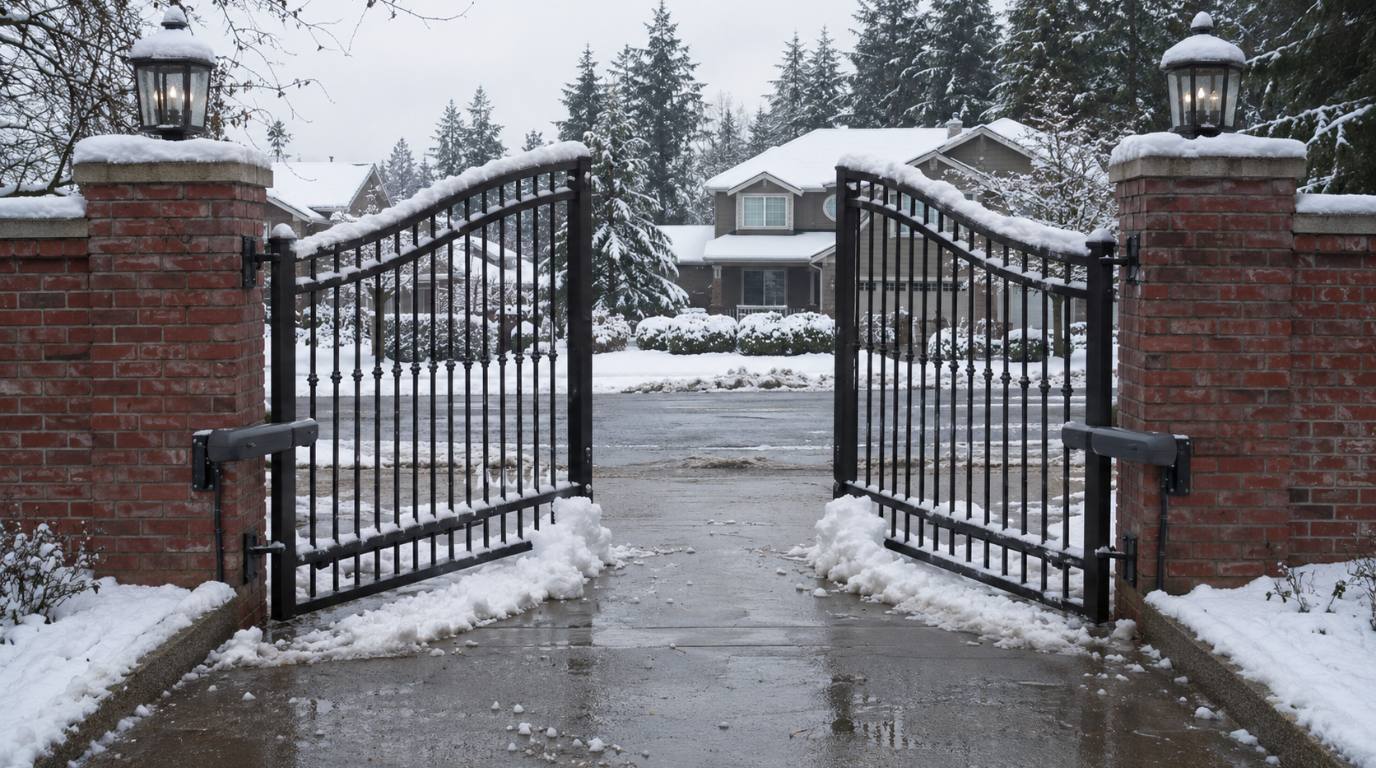
Open inward, away from the road. A swing gate that opens toward the street is a poor fit for snow country. The street side is where the plow berm builds up, where blown snow collects and where a car waiting to enter stands. An inward-opening gate swings into the property, where you control the snow clearing. On a driveway that climbs toward the house, an inward swing needs extra care, because the leaf moves uphill into the grade; our guide to a driveway gate on a slope explains the clearance and hinge options.
Give the arc more clearance at the bottom. A swing gate leaf set tight to the pavement for looks has no margin for snow or ice. Where snow is common, the bottom rail can be set higher above the driveway surface, within the limits of the gate’s screening rules and the look the owner wants, and the driveway under the arc should be paved, level and drained so meltwater does not freeze into a ridge.
Double leaves halve the arc. A pair of shorter leaves each sweeps a smaller arc than one wide leaf, so there is less snow to clear and less leaf area for wind to push against. It does add a center stop and a center latch, which need to be kept free of ice.
Operators and stops. Linear arm operators and articulated arm operators both need the arm path clear of snow, and a gate stop or a drop rod receiver in the pavement can fill with ice. Underground operators sit in a foundation box below the hinge and need that box to drain; we explain those in our guide to the underground gate opener in Washington. For the operator side of a swing gate, including arm geometry and force settings, see our swing gate opener guide.
Not sure a swing gate will work through your winters?
We look at the driveway, the grade, the road edge and where the snow piles up, and tell you whether a swing, slide or cantilever gate fits the site best.
Track Slide Gates vs Cantilever Gates in Snow
Both are slide gates, and both move sideways along the fence line, but they behave very differently in snow and ice. The difference is the ground track.
Track slide gates. A conventional slide gate rides on V-groove wheels along a steel track set in or on the driveway. Snow on the track is usually not the problem, because the wheels push light snow aside. The problem is slush that settles into the track and the wheel groove, then freezes overnight. In the morning the gate either will not move or climbs the ice and binds. Plowed or shoveled snow thrown onto the track has the same effect. A track slide gate can work on a snowy site if the track sits on a level, well-drained concrete beam, the track area is cleared after each snowfall, and nobody piles snow across it.
Cantilever gates. A cantilever gate carries its weight on enclosed roller trucks mounted on two posts beside the opening. It hangs above the driveway as it moves, so snow on the surface does not affect it, as long as the bottom of the gate clears the snow depth the site sees. What does need attention is the run beside the opening where the gate rolls back: snow plowed or blown along the fence line can pile up against the gate’s travel path, and ice can build up on the rollers in a freezing rain event.
Side space. A cantilever gate needs more space beside the opening than a track gate, because the counterbalance tail adds length behind it. On a narrow lot that space may not exist, which is one reason track gates are still common. If the space is there and snow is a regular part of winter, the cantilever is usually the better choice.
The operator. Slide gate operators drive the gate with a chain or a rack. Ice on the chain or the rack adds load, and the operator’s sensing may read the extra resistance as an obstruction. The operator pad should sit above the snow line, with the chain or rack protected from plowed snow. Our sliding gate opener guide covers operator sizing, mounting and safety.
If you are deciding between slide and swing in general, our comparison of the sliding gate vs swing gate for the Pacific Northwest lays out the wider trade-offs beyond snow.
Plows, Berms and Where the Gate Sits
On many rural driveways, the biggest snow problem is not what falls from the sky but what the plow leaves at the end of the driveway. County crews clear the road, and the blade pushes a ridge of snow, slush and gravel across every driveway entrance it passes.

Snohomish County Public Works, which maintains about 1,650 miles of county roads, plows by priority, with arterials, transit and school bus routes and steep access roads ahead of lower-priority residential streets. Its snow and ice response page advises residents clearing driveways and berms to pile the snow to the left side as they face the house, so the plow blade does not push it back into the driveway, and asks them not to shovel snow into the roadway. Other counties in the region follow similar priority systems, and lower-priority roads and private roads can wait a while.
That has direct consequences for where a gate goes:
- Set the gate back from the road. A gate right at the road edge sits in the berm. A setback gives room to clear the berm without reaching the gate, and room for a car to pull fully off the road while the gate opens. It also helps with deliveries and with the stacking space many commercial and fire access gates need.
- Keep the keypad pedestal out of the berm. A keypad or intercom post on the approach should stand where the plow and the snow pile will not bury or strike it, on the side where you are not stacking snow, and at a height that works from a car window; our guide to automatic gate keypad height in Washington covers the placement.
- Decide where the snow goes before the gate goes in. If the left side of the entrance, facing the house, is where the snow pile will live, do not put the cantilever tail, the operator pad or the swing arc there.
- Protect loops and tracks from plow blades. Saw-cut loops and surface tracks near the road can be scraped by plows. Preformed loops set in the base before paving, and gates set back from the road edge, avoid the problem.
Cold Ratings, Heaters and Batteries: What the Specs Mean
Every gate operator has a rated temperature range. For example, LiftMaster’s data sheet for the CSW24UL swing gate operator lists -4°F to 140°F without a heater and -40°F to 140°F with its optional HTR heater, and the company lists the same -4°F to 140°F range for the LA412UL residential swing operator. Other makers publish their own ranges for each model, and the manual for the specific operator is the reference that counts.
Most of lowland Western Washington rarely reaches -4°F, so a standard operator usually covers the temperature itself. Where a heater kit earns its place is on colder, more exposed sites, such as high foothill properties or open Whatcom County farmland during a long Fraser outflow, and on commercial gates that cannot afford to stop. A heater keeps the gearbox and the batteries warm enough to work normally.
Cold affects batteries more than motors. A battery holds and delivers less energy when it is cold, so a backup system that runs a gate through many cycles in October may run it through fewer during a January outage. That matters most when cold and outages arrive together, which is common when wet snow brings down branches and power lines.
There is one trade-off that is easy to miss on solar gates. LiftMaster’s CSW24UL data sheet notes that the heater option for its LMRRUL and LMTBUL photo eyes is not recommended for solar applications, because a heater draws power the panel cannot replace in short, gray winter days. A solar gate on a snowy foothill site needs its power budget planned for December, not June. Our guide to solar gate openers in Washington explains how panel size, battery size and daily cycles fit together.
Photo Eyes, Edges and Loops Under Snow and Frost
UL 325 requires automatic gates to have external entrapment protection, such as photo eyes or contact edges, because the operator’s own sensing is not enough by itself. ASTM F2200 adds rules for the gate itself, including screening and keeping controls at least 6 feet away from the moving gate. These protections work in winter too, but snow and ice can make them trip when nothing is in the way.
Photo eyes. A photo eye fails safe: if the beam is blocked, the gate will not close or will reverse. Snow stuck to the lens, frost on the reflector or a plow pile that covers a low-mounted sensor all block the beam. Mounting the eyes on posts at the right height, with a hood or a heated model on exposed sites, keeps them working. LiftMaster describes its current through-beam and retro-reflective photo eyes as having a heater. Our guide to gate photo eye installation in Washington covers heights and placement.
Contact edges. A safety edge is a sensing strip on the leading or trailing edge of the gate that stops and reverses it on contact. Ice that builds up on the edge, or a frozen ridge of snow the edge drives into, can trigger it. Edges on the bottom of a gate or near the ground are most exposed. See our guide to the gate safety edge in Washington for types and where they go.
Vehicle loops. Inductive loops in the driveway detect the metal of a vehicle, not its weight, so snow on the pavement does not stop them from working. A properly installed loop keeps detecting through a layer of snow. Problems come from loops that are damaged, such as a saw-cut loop cracked by frost heave or scraped by a plow. Our guide to the gate loop detector in Washington explains the difference between safety, exit and arming loops.
Never bypass a safety device to get through a snowy morning. If a sensor keeps tripping, clear it, check its alignment, and call for service if the problem stays. A gate with its sensors bypassed is a gate that can close on a person or a car.
Gate stopping and reversing every time it snows?
We check the operator, the sensors, the loops and the power so the gate works through winter without anyone bypassing the safety devices.
Freezing Rain and Ice on the Gate
Freezing rain is harder on a gate than snow. It coats every surface, including the gate frame, the hinges, the rollers, the latch and the operator arm, with a layer of clear ice that adds weight and locks moving parts together.
What to do. Let the operator try once. If it stops or reverses, do not keep cycling it, because repeated attempts strain the motor and drain the battery. Clear the ice by hand where you can do so safely, using warm water carefully on hinges or a plastic scraper, and avoid hitting the gate or the operator arm, which can bend parts or knock sensors out of alignment. If the gate needs to be opened before the ice clears, use the manual release, following the manufacturer’s procedure.
What not to do. Do not spray de-icing salt on the gate, the operator or the hinges. Chloride salts speed up corrosion on steel and on galvanized and painted finishes, and the residue keeps working long after the ice is gone. If you need traction on the driveway, use sand or a de-icer the hardware maker accepts, and keep it off the gate. If your gate is near a road treated with salt or brine, rinsing the lower part of the gate after the season helps.
The manual release. Every automatic gate owner should know where the manual release is and how it works before winter. On most swing operators it is a release on the arm; on slide operators it is a release on the operator that frees the drive. Some releases are locked with a key, which should be stored where you can reach it during an outage, not hanging inside the operator cabinet. Our guide to automatic gate not opening or closing walks through what to check when the gate will not move.
Power Outages During Snowstorms
In Western Washington, heavy wet snow and wind bring down trees and power lines, and an outage on a rural road can last for a long time. An automatic gate without backup power stops where it is, and the only way in or out is the manual release.
Battery backup. Most current residential and commercial operators can run on batteries when the power is off. The number of cycles depends on the operator, the gate weight, the battery size and the temperature, and it is lower in the cold. The battery charger keeps the batteries full while the power is on, and the batteries themselves need to be tested and replaced on the maker’s schedule. Our page on automatic gate battery backup in Skagit County explains how backup systems work and how long they last.
Fail open or fail secure. Many operators can be set to open and stay open when the battery runs low, or to stay closed. Fail open keeps the driveway usable for you and for emergency crews; fail secure keeps the property closed. The right choice depends on the property, the fire department’s requirements and whether someone is home to open the gate by hand. Decide it before winter, not during the outage.
Solar gates. A solar gate is not affected by a grid outage, but it depends on the sun, and a snowy week in December delivers very little. Snow sitting on the panel cuts it off completely. Panels should be mounted where they can be reached and cleared safely, at a steep enough angle to shed snow, and sized for the darkest weeks of the year.
Generators. Some commercial operators accept a generator connection. If you plan to power a gate from a generator, the connection must be installed to code, which in Washington falls under the electrical rules for the Doors and Gates specialty. Our guide to gate opener wiring in Washington covers who can do that work.
Fire Access Gates in Winter
Many rural driveways and private roads in Washington are fire apparatus access roads, and a gate across one has to work in winter as reliably as in summer. Washington adopts the International Fire Code through WAC 51-54A. Section 503.6 of that code requires security gates across fire access roads to be approved by the fire code official, requires electric gate operators to be listed to UL 325, and requires gates intended for automatic operation to meet ASTM F2200.
Local rules add details. Many fire districts and cities require an approved emergency opening device, such as a key switch, a lock box, a siren sensor or a radio receiver, and many require that the gate can be opened manually by one person. Snow and ice can defeat all of these: a key switch buried in a plow berm, a lock box frozen shut or a gate held by ice is a gate the fire department cannot open quickly.
For a gate on a fire access road, winter planning means mounting the emergency device where snow will not bury it, keeping the approach and the gate line clear after each snowfall, setting the power failure behavior the fire code official accepts, and making sure the manual release works in the cold. Our guide to fire department gate access in Washington explains the rules city by city and county by county.
If you are not sure whether your driveway is a fire access road, check with your local fire marshal or the county permit office before installing a gate. Our page on gate permits in Washington State explains where to start.
Design and Material Choices for Snowy Sites
The way a gate is built changes how it behaves in snow, wind and ice. A few choices make a real difference.
Solid panels catch snow and wind. A solid privacy gate stops drifting snow, which piles against it, and it catches wind, which adds load on the operator. On an exposed site, a gate with some openness lets wind and snow pass through. If privacy matters, the gate and its posts, hinges or rollers and operator need to be sized for the full wind load. Our guide to the privacy driveway gate in Washington covers that trade-off.
Steel, aluminum and wood. Steel gates need a good coating system, especially at the bottom rail and wherever meltwater collects, and they need to be kept away from road salt. Aluminum is light, which helps operators in ice, and does not rust, though it can corrode in contact with salt and certain metals. Wood such as Western Red Cedar handles cold well but absorbs water, so the bottom edge needs clearance from the snow and the ground. Our guide to gate materials for Washington weather compares them in more detail.
Drainage under the gate. Meltwater that pools under a gate refreezes at night. The driveway at the gate line should slope away from the opening or drain to the sides, and track beams, operator pads and loop slots should never sit in a low spot.
Footings below frost depth. Posts and operator pads need footings deep enough for the local frost depth and soil, so frost heave does not tip a post or crack a pad and throw the gate out of alignment. Our guide to gate post installation in Washington explains how footings are sized and why calling 811 before digging is required under RCW 19.122.
Building a new gate for a snowy or exposed site?
We design and fabricate gates in our Sedro-Woolley shop, with the panel, posts, footings and operator chosen for the snow and wind your property actually gets.
A Setup Checklist Before the First Snow
This checklist is about how the gate is set up for winter, not a full maintenance schedule. For seasonal maintenance, see our automatic gate maintenance seasonal guide.
- Know the manual release. Find it, try it with the power off, and store the release key where you can reach it during an outage.
- Test the battery backup. Turn off the power and run the gate through a few cycles. If it struggles in mild weather, it will struggle more in the cold.
- Confirm the power failure setting. Fail open or fail secure, and whether it matches what the fire department expects.
- Mark where the snow goes. Decide which side of the entrance gets the snow pile, and keep the swing arc, the cantilever tail, the operator pad and the keypad pedestal off that side.
- Tell the plow driver. Whoever plows the driveway or the private road should know where the gate, the loops, the photo eye posts and the keypad are.
- Check sensor heights and hoods. Photo eyes and edges should be clear of the snow line and aimed correctly.
- Clear the track or the arc. On a track gate, check the track drains; on a swing gate, check the arc is level and clear.
- Look at the solar panel. Can you reach it to clear snow safely? Is it angled to shed snow?
- Keep salt away. Plan for sand or an approved de-icer near the gate, and rinse road salt off the lower gate after the season.
- Write down the service number. If the gate stops during a storm, you want to know who to call. Our automatic gate repair page explains how service calls work.
How We Approach Driveway Gates for Snowy Sites
Emerald Gate Systems designs, fabricates, installs, automates and services gates from our own shop in Sedro-Woolley, in Skagit County. The same team handles CAD planning, welding, installation, automation, access control, testing and future service, so the gate is not passed between separate companies.
Every project starts with a free on-site consultation. On a site that sees snow, we look at the grade, the road edge, where the plow leaves its berm, where snow drifts and where meltwater runs, and whether the driveway is a fire access road. We then compare the realistic options for that site, which may be a cantilever, a swing or a track slide gate, and explain the trade-offs. Our automatic gate installation page explains the full sequence.
We install and service LiftMaster, Viking and FAAC operators, and we choose the operator, the battery backup, any heater option and the sensors for the coldest conditions the site sees. Before we leave, we test the entrapment protection, the power failure behavior and the manual release with you. We serve Skagit, Whatcom, Snohomish, Island, San Juan, King and Pierce counties.
Washington requires contractors to show their registration in advertising: Emerald Gate Systems is registered with the Washington State Department of Labor and Industries as a construction contractor (EMERAGS748D6) and holds an electrical contractor license in the Doors and Gates specialty (EMERAGS747KE).
Frequently Asked Questions
What is the best driveway gate for snow?
Where snow and ice are regular, a cantilever slide gate is usually the best choice, because it hangs above the driveway on rollers mounted beside the opening and never rolls across the snow. A vertical pivot gate also avoids the ground. Swing gates work when the arc is kept clear and they open inward, and track slide gates work when the track is kept clear and drained.
Do sliding gates work in snow?
A cantilever sliding gate works well in snow because it has no ground track. A conventional sliding gate on a ground track can work, but slush that freezes in the track or the wheel groove can stop it, and snow plowed onto the track has the same effect. The track should sit on a level, drained concrete beam and be cleared after each snowfall.
Will an automatic gate opener work in cold weather?
Yes, within its rated range. For example, LiftMaster lists -4°F to 140°F for its CSW24UL swing operator without a heater and down to -40°F with its optional heater. Most of lowland Western Washington rarely gets that cold. Batteries deliver less energy in the cold, so a backup system runs fewer cycles in winter.
Why does my gate stop and reverse when it snows?
Usually because something is in its path or a safety device sees an obstruction. Snow or ice in a swing arc or a track adds resistance, which the operator reads as an obstruction. Snow on a photo eye lens or ice on a safety edge can also trip them. Clear the path and the sensors, and never bypass a safety device.
How do I open my automatic gate during a power outage in the snow?
If the gate has battery backup, it should keep working for a limited number of cycles. If the battery is flat, use the manual release, following the manufacturer’s procedure, and clear snow and ice from the path first. Many operators can be set to open automatically when the battery runs low. Store the release key where you can reach it.
Should a driveway gate open inward or outward in snowy areas?
Inward, away from the road, in almost every case. The road side is where the plow berm and blown snow collect, and where a waiting car stands. An inward-opening gate swings into the property, where you control the snow clearing. On a driveway that climbs toward the house, the leaf needs enough clearance above the rising grade.