
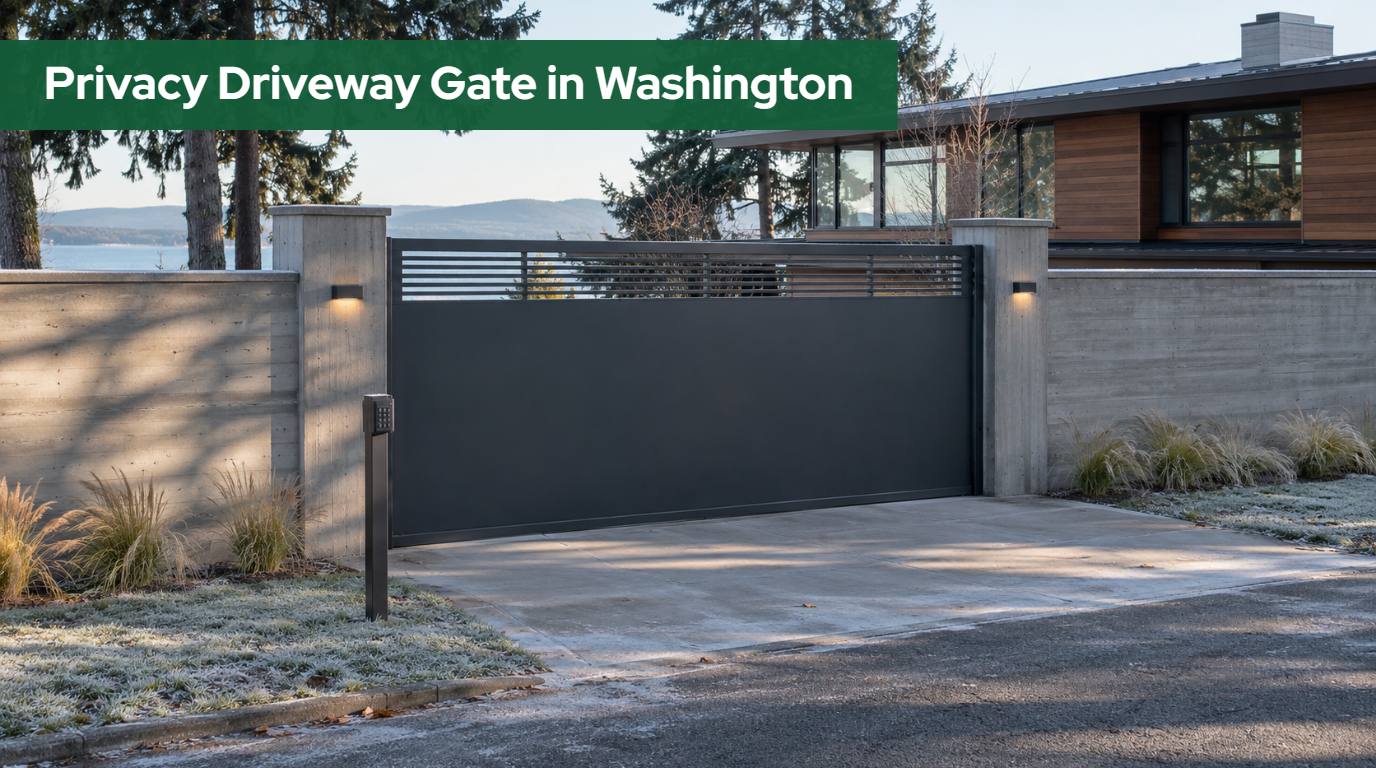
A privacy driveway gate in Washington has to do two things that pull against each other. It has to block the view from the street, which means a solid or nearly solid face. And it has to stand up to wet winters, wind off the Sound, local height limits and the safety rules for automatic gates, all of which get harder the more solid the gate becomes.
This guide covers how much privacy each design really gives, which materials suit Western Washington, how tall cities and counties let you build, what a solid face does to posts and operators, and how to keep a gate you cannot see through safe for people and cars on the other side.
Quick answer
A privacy driveway gate in Washington is a solid or closely slatted gate that blocks the view into a property. Check your city or county height limit and sight triangle first, since front yard limits are often lower than six feet. Solid gates catch wind and weigh more, so posts, operator and safety sensors must be sized for that.
In this guide
- What a privacy driveway gate in Washington is
- How much privacy each design gives
- Materials for a solid gate in wet weather
- How tall can it be? Local height rules
- Sight triangles and distance from the road
- Wind on a solid gate
- Swing or slide?
- Frame, posts, hinges and footings
- Sizing the operator
- Safety on a gate you cannot see through
- Knowing who is at the gate
- Fire access and power failure
- Finish and upkeep
- Planning checklist
- How we approach privacy gates
- Frequently asked questions
What a Privacy Driveway Gate in Washington Is
A privacy gate is defined by what a person standing at the street can see through it. A picket or wrought iron gate marks the entrance and controls who drives in, but the house, the cars and the yard stay in plain view. A privacy gate closes that view with boards, slats or sheet metal across most or all of its face.
It helps to separate privacy from security. A solid gate hides what is behind it, but a gate is only as secure as the fence or wall on each side, the way it locks and who has the code. A solid face also hides the driveway from neighbors and passersby who might otherwise notice something wrong. Plan the two goals separately, and treat cameras, lighting and access control as part of the same project.
A solid gate also changes the engineering. It is heavier than an open one of the same size, it catches far more wind, and nobody on either side can see what is in its path. Most of this guide is about handling those three facts well.
How Much Privacy Each Design Gives
Privacy is not all or nothing. The right amount depends on where the view comes from. A sedan passing at road speed sees less than a person walking a dog, and a neighbor’s second-floor window looks over any gate you are allowed to build. Stand at the street, and at any uphill vantage point, before choosing a design.
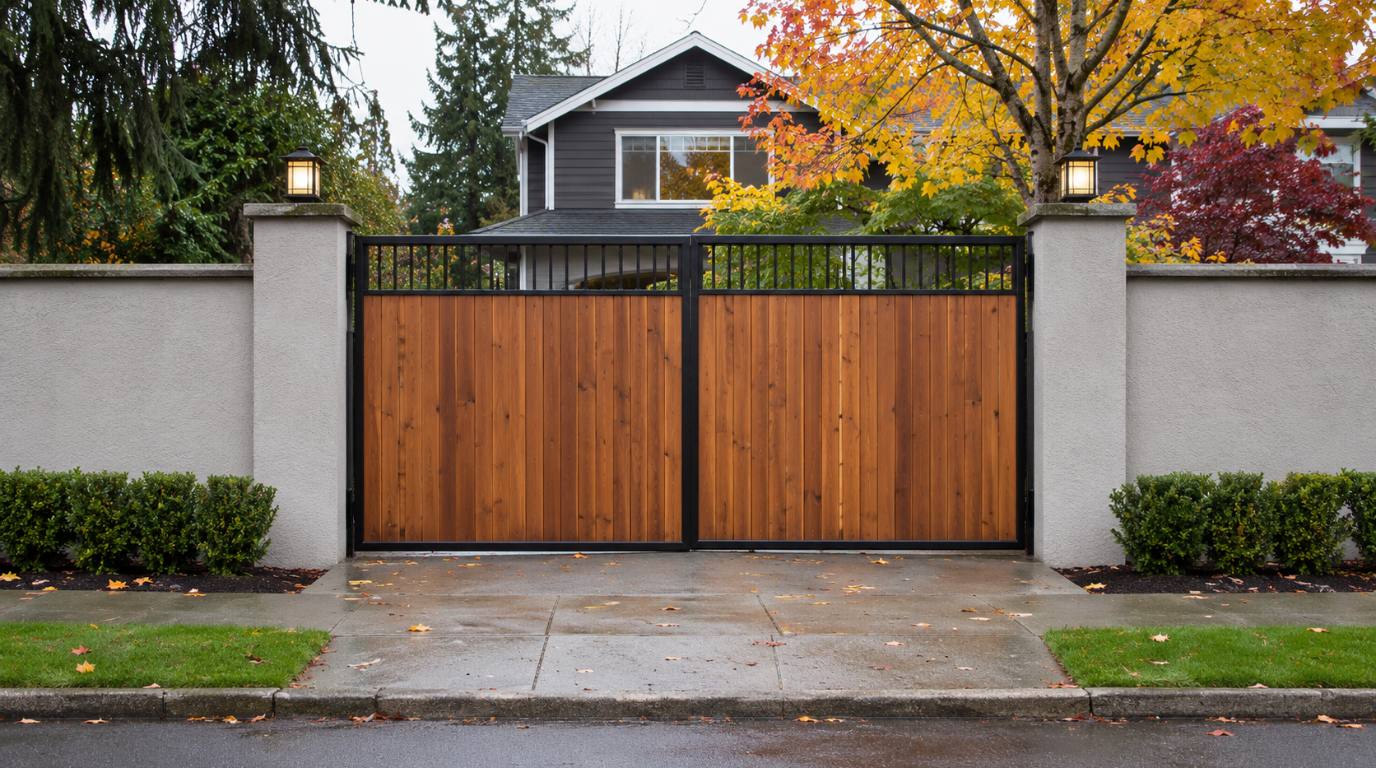
| Design | View blocked | Wind load | Notes |
|---|---|---|---|
| Full solid panel (tight boards or sheet steel) | Complete | Highest | Heaviest option; needs the strongest posts and the most careful safety layout |
| Board on board (overlapped boards on both faces) | Complete head on, slight at an angle | High, with some air passing | Stays private as wood shrinks; looks finished from both sides |
| Louvered or angled slats | Complete from the street, open from above or below | Moderate | Air moves through; angle the slats so the street view is the blocked one |
| Spaced horizontal slats | Partial; shapes and movement show | Moderate to low | Narrow gaps read as private from a moving car |
| Solid lower section, open top band | Complete at car and eye level | Reduced | Open band lets drivers see lights and movement |
| Laser-cut steel with backing sheet | Complete | Highest | Pattern is decorative; backing does the screening |
Two details decide whether a design stays private over time. The first is shrinkage. Wood boards installed tight in a wet November open small gaps by August, so a gate that must be fully sight-proof needs overlapped boards, tongue and groove or a backing layer. The second is the perimeter. The gap under the gate, the gap at each post and the first few feet of fence on each side are where the view leaks. A solid gate between open pickets hides very little.
Materials for a Solid Gate in Wet Weather
A solid gate presents a large flat surface to nine months of rain, so material choice matters more than it does on an open gate. Three families cover most privacy gates in Northwest Washington.
Cedar on a steel frame. Western Red Cedar boards over a welded steel frame is the most common privacy gate we see from Bellingham to Tacoma. The steel carries the load and keeps the gate square, and the cedar does the screening. Boards can run horizontal for a modern look or vertical for a traditional one. Our guide to the cedar driveway gate in Washington covers grades, fasteners and finishes in detail.
Steel sheet and laser-cut steel. A steel frame skinned with sheet steel gives complete privacy with no boards to move or stain. Laser-cut panels add a pattern, such as trees, mountains or a geometric screen, and a solid backing sheet behind the cutouts restores the privacy. Without the backing, a laser-cut panel is a decorative screen and people can see through it up close. Steel needs a sound coating on every face and edge, because water sits on flat sheet and finds any bare spot.
Whatever covers the frame, three rules hold in our climate. Fasteners into cedar should be stainless or hot-dipped galvanized so they do not streak the boards. The bottom rail needs drain paths so water does not sit inside the frame. And on saltwater sites around Anacortes, Whidbey Island and the San Juans, coatings and hardware need to be chosen for salt air, as our Anacortes article on the best gate materials for coastal sites explains. For a wider comparison, see our guide to gate materials for Washington weather.
How Tall Can It Be? Local Height Rules
Height is the first thing people want from a privacy gate and the first thing local code limits. Washington has no single statewide fence height. Each city and county sets its own, and the limit in the front yard, where a driveway gate usually sits, is often lower than the six feet people expect.
These rules are written for fences, walls and hedges. A driveway gate sits in the same line and does the same screening, so plan on the gate being held to the same limits and ask the planning desk to confirm. Here is what five local governments publish.
| Jurisdiction | Front yard or street side | Elsewhere | Building permit |
|---|---|---|---|
| Seattle | 4 feet in a front or street side setback | 6 feet, plus 2 feet of architectural features such as an arbor or trellis | Not needed at 8 feet or less with no masonry or concrete above 6 feet |
| Bellingham | 54 inches on an interior lot; 42 inches on a corner lot or flanking street | 72 inches in interior side and rear yards | Over 8 feet, or masonry or concrete above 6 feet |
| Kirkland | 3.5 feet on properties abutting a neighborhood access or collector street | 6 feet in required side and rear yards | Over 6 feet |
| Lynnwood | Solid fences over 3 feet not allowed in the first 15 feet from the property line | 6 feet, with an adornment to 8 feet total | Over 6 feet |
| Skagit County (unincorporated) | 6 feet or less may sit at the property line in most zones | Same | Over 7 feet |
The Seattle figures come from the city’s fence permit page, which also allows 8 feet on a sloping site if the average height between posts is 6 feet. Bellingham’s come from its handout on fences, walls and hedges under BMC 20.30.110, and Skagit County’s from its Planning and Development Services handout on fences and retaining walls. Skagit County adds a rule for Guemes Island: a fence more than three feet tall must be 50 percent open to sit within 10 feet of the front lot line.
Three things follow from the table. First, the height limits apply inside the required yard or setback. Set the gate farther back, behind the setback line, and the taller limit usually applies. That is often the simplest way to get a six-foot gate. Second, measure the way the city does. Bellingham measures from the ground at the outside edge and counts a wall and the fence on top of it together. Third, there is usually a way to ask for more. Bellingham accepts over-height requests, with written consent from the abutting owners, though its handout discourages sight-obscuring over-height fences across the full width of a lot on the street side.
Homeowner associations add their own limits, on top of the city’s. Our guide to gate permits in Washington State explains which office handles which approval.
Not sure how tall your gate can be?
We look at where the gate will sit, check the local height and setback rules for that spot and show you which designs fit before anything is drawn.
Sight Triangles and Distance From the Road
The second local rule that shapes a privacy gate is the sight triangle, sometimes called the vision clearance triangle. It is the wedge of ground at a corner or a driveway where a driver needs to see cross traffic and people on the sidewalk. Anything solid in that wedge above a low height is restricted, and a privacy gate is as solid as it gets.
Local governments draw the triangle differently:
- Lynnwood defines a driveway sight triangle in its residential fence and hedge guide: measure 15 feet along the side of the driveway and 15 feet along the property line, and join the ends. Only fences that do not obscure vision are allowed inside it, which means solid fences no taller than 3 feet or open fences up to 6 feet. Street corners get a 30-foot triangle.
- Bellingham limits fences, walls and hedges to 36 inches inside its vision clearance triangle.
- Skagit County says that on a corner lot nothing may materially impair vision between 2.5 and 10 feet above the centerline grades of the intersecting streets, inside a triangle measured 30 feet along the right-of-way lines.
- Kirkland limits fences over 3 feet in the sight triangle at streets and driveways.
The practical effect is that a solid gate usually cannot sit right at the street. It has to be set back until the gate, its pillars and the solid fence beside it are out of the triangle. That also gets a waiting vehicle off the road and puts the gate behind the front setback, where the taller height limit usually applies.
Distance from the pavement is a separate rule in some places. Bellingham’s handout calls for a 10-foot setback from the paved edge of the road where there is no sidewalk, and 3 feet from the back of the sidewalk where there is one. Fences in the public right-of-way need an encroachment permit there, and the property line is often farther from the pavement than owners think.
How far back to set the gate also depends on the vehicles that use it. Our guide to driveway gate width and layout in Washington covers stacking room, turning paths and keypad position.
Wind on a Solid Gate
Wind pushes on solid surface. A picket gate lets most of the air through. A privacy gate stops it, and the whole face becomes a sail that loads the hinges, the posts, the footings and the operator. On a calm day the difference is nothing. In a November storm it can be the largest force the gate ever sees.
Exposure matters as much as design. A solid gate behind firs on a wooded lot in Sedro-Woolley lives an easy life. The same gate on the Skagit flats, on a bluff on Camano Island or in the Fraser outflow north of Bellingham takes the full push. Washington’s residential code asks each jurisdiction to publish its own design wind speed, and Skagit County’s design criteria map lists 85 mph. Wind is a design load here.
There are four practical ways to keep privacy and cut the load:
- Open the top. A band of pickets or spaced slats above eye level spills some of the wind and leaves the view at eye level blocked.
- Use louvers or board on board. Both let air bleed through while blocking the straight-on view.
- Split the opening. Two shorter swing leaves give the wind less leverage on each hinge post than one long leaf.
- Slide the gate. A slide gate has no hinge for the wind to twist. The load goes into its rollers, guides and posts.
Wind also affects how the operator behaves. An automatic gate senses obstructions partly through motor force, and a gust on a solid leaf can look like an obstruction. The wrong fix is turning the force up until the gate stops reversing, because that same setting is what protects a person. The right fix is an operator with headroom for the leaf, plus external sensors. Our guide to driveway gates for windy areas in Washington goes deeper on all of this.
Swing or Slide?
Both gate types can be built solid. They handle the weight and the wind differently, and the site usually makes the choice.
Swing gates suit level driveways with room for the leaf to open inward. They are simple and quiet, and a double swing gate between pillars is the classic estate look. The costs of going solid show up at the hinge post. All the weight hangs from one side, and the wind’s push acts along the full length of the leaf. Operator makers treat long or wind-loaded leaves as a special case. FAAC’s specification sheet for its S800H hydraulic operator, for example, recommends an electric or magnetic lock on gates longer than 12 feet and notes that wind factor and gate design affect performance. Our guide to the electric gate lock in Washington explains when a lock belongs on a swing gate.
Slide gates carry their weight along the bottom or on cantilever rollers, so a heavy solid panel is easier on the structure. They also work where the driveway rises behind the gate or where parked cars leave no room for a swing. What they need is space along the fence line for the gate to travel, plus room for the counterbalance section on a cantilever design. Our guide to cantilever gate installation in Washington explains that layout.
A solid slide gate has one advantage under the safety standard. Slide gates must be screened so a 2.25-inch sphere cannot pass through, from the bottom to 72 inches above grade, and a solid face meets that by design. The fence the gate slides past has to meet the same rule over the length the gate covers, which a solid privacy fence also does.
On a slope, a swing leaf that opens toward rising ground needs clearance under it, which is a view gap when closed. Our guide to a driveway gate on a slope covers the options, and our comparison of sliding and swing gates in the Pacific Northwest covers the rest.
Frame, Posts, Hinges and Footings
A privacy gate fails at the structure long before it fails at the boards. The cladding is the part people see, and the frame, posts and footings are the parts that decide whether the gate still closes square in five winters.
Frame. A solid gate needs a welded steel frame with enough bracing to stay square under its own weight and under wind. Wood-only frames in wide driveway spans tend to rack and drop at the free end. The frame also has to provide flat, solid steel wherever hardware mounts: hinges, the operator bracket, a lock if one is used, and safety edges.
Posts. The hinge post of a solid swing gate carries the full weight plus the wind’s twisting force. Steel posts sized for that load, set plumb, are the baseline. Masonry pillars look right with a privacy gate, but the pillar is a shell. The gate should hang from a steel post inside or beside it, not from the stone or brick itself.
Hinges. Heavy solid leaves need hinges rated for the weight, with bearings, and with adjustment so the leaf can be trued after the first season. LiftMaster’s LA412UL manual adds a geometry rule for automated swing gates: no more than 4 inches from the center of the hinge to the edge of the post or column, so the gap at the hinge side does not become a place where someone can be caught.
Footings. Concrete footings resist the overturning force on each post, and in the wet soils west of the Cascades they need to be sized for the leverage of the gate and the wind. The local frost depth, 12 inches on Skagit County’s design criteria map, is a minimum for frost and not a footing design. Before any digging, Washington law requires a utility locate request through 811. Our guide to gate post installation in Washington covers depth, soil and conduit.
Want privacy without a gate that fights the wind?
We design the frame, posts and footings around the finished weight and your site’s exposure, and build the gate in our Sedro-Woolley shop.
Sizing the Operator
Operators are rated by leaf weight and leaf length together, and a privacy gate pushes on both. The ratings also assume a gate that moves freely by hand. Wind comes on top.
Published ratings show how fast capacity drops as a swing leaf gets longer. These are two LiftMaster swing operators and one slide operator, from the manufacturer’s manuals and data sheets:
| Operator | Type | Published capacity |
|---|---|---|
| LiftMaster LA412UL | Residential 12 Vdc linear swing | 850 lb at 10 ft, 750 lb at 12 ft, 650 lb at 14 ft, 550 lb at 16 ft |
| LiftMaster CSW24UL | Commercial 24 Vdc swing | 1,600 lb at 8 ft, 800 lb at 16 ft, 600 lb at 18 ft |
| LiftMaster RSL12UL | Residential 12 Vdc slide | 800 lb, up to 50 ft of travel |
Read the table with a solid gate in mind. A 16-foot single leaf is at the bottom of the residential swing operator’s range before any wind is counted, and a steel-framed cedar leaf that long is not light. That is why wide privacy openings are usually built as two leaves, as a slide gate or with a commercial operator.
Three habits keep the choice honest:
- Weigh the finished gate. Use the weight with cladding, hardware and finish, not the bare frame. Wet cedar weighs more than dry cedar.
- Leave headroom. An operator working near its limit on a calm day has nothing left for a gust, and it will reverse or stall when the weather turns.
- Set force by the book. The force setting should be high enough that the gate does not reverse by itself and low enough that it still protects a person. External sensors, not extra force, are how a wind-loaded gate is made reliable.
Our guide to the swing gate opener in Washington and our guide to the sliding gate opener in Washington compare operator types and ratings in more depth.
Safety on a Gate You Cannot See Through
Every automatic gate has to protect people from being struck or trapped. A privacy gate adds a problem that open gates do not have: the driver cannot see what is on the other side, and a person on the other side cannot see the car coming.

The rules are the same as for any automatic gate. Washington adopts the International Fire Code statewide through chapter 51-54A WAC, and that code’s section on security gates requires electric gate operators to be listed to UL 325 and automatic gates to be built to ASTM F2200. In practice that means the following.
- External entrapment protection. The operator’s own force sensing is not enough. Each zone where a person could be trapped needs monitored external devices: photo eyes, contact edges or both.
- Photo eyes on both sides. On a solid gate, eyes across the opening on the street side and the property side matter more than usual, because they are the only thing that “sees” through the gate. Our guide to gate photo eye installation in Washington covers placement.
- Edges where the gate meets something. The leading edge, the bottom edge where the gap under a swing gate is between 4 and 16 inches, and the post side of a slide gate are the usual places. See our guide to the gate safety edge in Washington.
- No hand latch. ASTM F2200 does not allow a manual latch on an automatic gate. A solid gate that needs extra holding gets an electric lock the operator controls.
- A separate walk gate. The industry association’s Gate System Safety guide calls for a separate pedestrian entrance, so nobody on foot uses the vehicle gate. On a privacy fence line this is easy to plan and easy to forget.
- Controls away from the gate. Keypads and buttons go at least 6 feet from the moving gate, so nobody can reach through or around it while operating it.
The swing direction matters as well. Operator manuals say swing gates should not open into public access areas, so a solid leaf should swing into the property and not out over a sidewalk where a pedestrian would never see it coming. Our overview of UL 325 and ASTM F2200 for automatic gates explains both standards in plain terms.
Knowing Who Is at the Gate
An open gate lets you glance out a window and see who pulled up. A privacy gate takes that away along with the view in. Access control fills the gap, and it works best when planned with the gate, since every device needs conduit under the driveway.
Video intercom. A camera and call button on a pedestal outside the gate show who is there and let you talk before opening. For a solid gate this is the single most useful add-on. Our Mount Vernon article on the video intercom gate explains the options, and where there is no wired internet at the gate, a cellular gate opener can carry the call.
Keypad and credentials. Family uses remotes or a phone app. Regular visitors and service providers get codes that can be changed. The keypad pedestal belongs where a driver can reach it without leaving the car and without blocking the road, as our guide to automatic gate keypad height in Washington describes.
Exit detection. From inside, nobody wants to stop and press a button. A loop in the driveway or an exit sensor opens the gate as a car approaches. Our guide to the gate loop detector in Washington compares the choices. On a solid gate, a second loop or photo eye that holds the gate open while a vehicle is in the path is worth having, because the driver behind cannot see the first car through the gate.
Lighting and house numbers. A solid gate with no light is a dark wall at night. Low pillar lights help visitors find the keypad. The address should be visible from the road on the street side of the gate, since the house itself no longer is.
Fire Access and Power Failure
A privacy gate is built to keep people out and views blocked. Firefighters and medics still have to get in, and the gate still has to open when the power is off.
Fire access. Under the fire code Washington adopts, a gate across a fire apparatus access road needs the fire code official’s approval and an approved means of emergency operation. What counts as approved is local: a key switch, a key box, a radio or strobe-activated opener, and specific behavior on power loss all appear in published standards from agencies in our service area. A single home on a short driveway may never be asked, and long driveways, shared private roads and gated communities usually are. Our guide to fire department gate access in Washington compares what several agencies require.
Power failure. Windstorms take out power across Western Washington most winters, and the gate is usually closed when it happens. A heavy solid gate is also the hardest kind to move by hand once the operator is released. Plan for three things: a battery backup sized for the leaf, a setting that decides whether the gate stays closed or opens when the battery runs low, and a manual release that every adult in the house has tried at least once. Our Skagit County article on automatic gate battery backup covers the details.
Electrical work. Wiring a gate operator is electrical work in Washington and falls under the state’s licensing and permit rules. Our guide to gate opener wiring in Washington explains permits, trench depth and who may do the work.
Planning a solid gate on a long driveway or shared road?
We confirm what the local fire agency expects, plan the battery backup and intercom, and lay out the conduit before any concrete is poured.
Finish and Upkeep
A solid face shows weather sooner than an open one, and in Western Washington the two sides of the same gate age differently. The side facing south and west takes sun and driving rain. The side facing north stays damp and grows algae and moss.
Wood cladding. Cedar can be left to weather to silver gray, stained or painted. Each choice has its own upkeep, and the choice should be made before the gate is built, because bare cedar left exposed for even a few weeks holds a finish less well afterward. Stain both faces and all edges, including the end grain at the bottom of vertical boards, where water wicks up first.
Steel. Sheet steel and frames need an intact coating. Check the bottom edge, weld seams and any spot where hardware was added after finishing. A chip touched up early does not become a rust streak. Our guide to wrought iron gate repair in Washington explains how rust repair is done properly.
Routine care. A simple schedule suits most privacy gates here:
- Wash both faces once or twice a year with a soft brush and mild cleaner. Go easy on cedar: high pressure can damage the soft surface.
- Keep soil, bark and plants clear of the bottom rail so it can dry.
- Clear drain holes in the frame and the track or stops of leaves and needles in fall.
- Test the photo eyes and edges monthly, and after any storm.
The operator and safety devices need the same seasonal attention as on any automatic gate, covered in our seasonal automatic gate maintenance guide.
Planning Checklist
Most problems with privacy gates trace back to a question nobody asked before the gate was built. This list covers the ones that matter most.
- Where does the view you want to block come from: the road, the sidewalk, a neighbor’s window?
- What height does your city or county allow at the spot where the gate will sit, and does an HOA add limits?
- Is the gate out of the driveway and corner sight triangles?
- Where is the property line, and how far is it from the pavement?
- How exposed is the site to wind, and from which direction?
- Is there room for a slide gate to travel, or for swing leaves to open inward on level ground?
- What will the finished gate weigh, and which operator handles that with headroom?
- Where do the photo eyes, edges, walk gate and keypad go?
- How will visitors be seen and let in?
- Does the fire agency need to approve the gate?
- What happens when the power is out?
- Is the fence on each side as solid as the gate?
How We Approach Privacy Gates
Emerald Gate Systems designs, fabricates, installs, automates and services gates from our own shop in Sedro-Woolley. The same team handles CAD planning, welding, installation, automation, access control and testing, so the gate is not handed between separate companies.
Every project starts with a free on-site consultation. For a privacy gate we stand at the street to see what needs screening, check the local height and sight rules for the gate’s position, and look at wind exposure, slope and where power comes from. Then we design the frame and cladding together, in laser-cut steel, hand-forged wrought iron, Western Red Cedar or a combination, coordinated with stone or masonry where the entrance has it. Our custom gate design page shows how that process works. We install and service LiftMaster, Viking and FAAC operators, and we test the entrapment protection, the power failure behavior and the manual release with you before we leave. Our automatic gate installation page explains the full sequence.
Washington requires contractors to show their registration in advertising: Emerald Gate Systems is registered with the Washington State Department of Labor and Industries as a construction contractor (EMERAGS748D6) and holds an electrical contractor license in the Doors and Gates specialty (EMERAGS747KE).
Frequently Asked Questions
How tall can a privacy driveway gate be in Washington?
It depends on the city or county and on where the gate sits. Many places allow about six feet in side and rear yards but less in the front yard or street side setback: Seattle lists 4 feet there, and Bellingham lists 54 inches on an interior lot. Setting the gate back behind the front setback often allows the taller limit.
Do I need a permit for a privacy gate in Washington?
Often not for the structure itself at ordinary heights. Seattle and Bellingham require a building permit for fences over 8 feet, Kirkland and Lynnwood over 6 feet, and unincorporated Skagit County over 7 feet. An automated gate can still need an electrical permit, and a gate across a fire access road needs fire agency approval.
Is a solid gate a problem in wind?
It can be. A solid face catches wind like a sail and passes that load to the hinges, posts, footings and operator. An open band at the top, louvers, two shorter leaves or a slide gate all reduce it. On exposed sites the posts and operator should be sized for wind, not just for the gate’s weight.
Should a privacy gate swing or slide?
Either can work. A swing gate is simpler on a level driveway with room to open inward, but a long solid leaf loads its hinge post heavily. A slide gate carries a heavy panel more easily and handles wind and slopes better, and it needs space along the fence line for the gate to travel.
Can a privacy gate be automated safely?
Yes, with the right devices. Because nobody can see through the gate, photo eyes on both sides and contact edges matter more than on an open gate. The operator must be listed to UL 325 and the gate built to ASTM F2200, with a separate walk gate for people on foot and controls at least 6 feet away.
How do I know who is at a solid gate?
Use a video intercom on a pedestal outside the gate, so you can see and talk to a visitor before opening. Add a keypad with changeable codes for regular visitors, lighting on the pillars and a visible house number on the street side. Plan the conduit for all of it before the driveway is paved.