
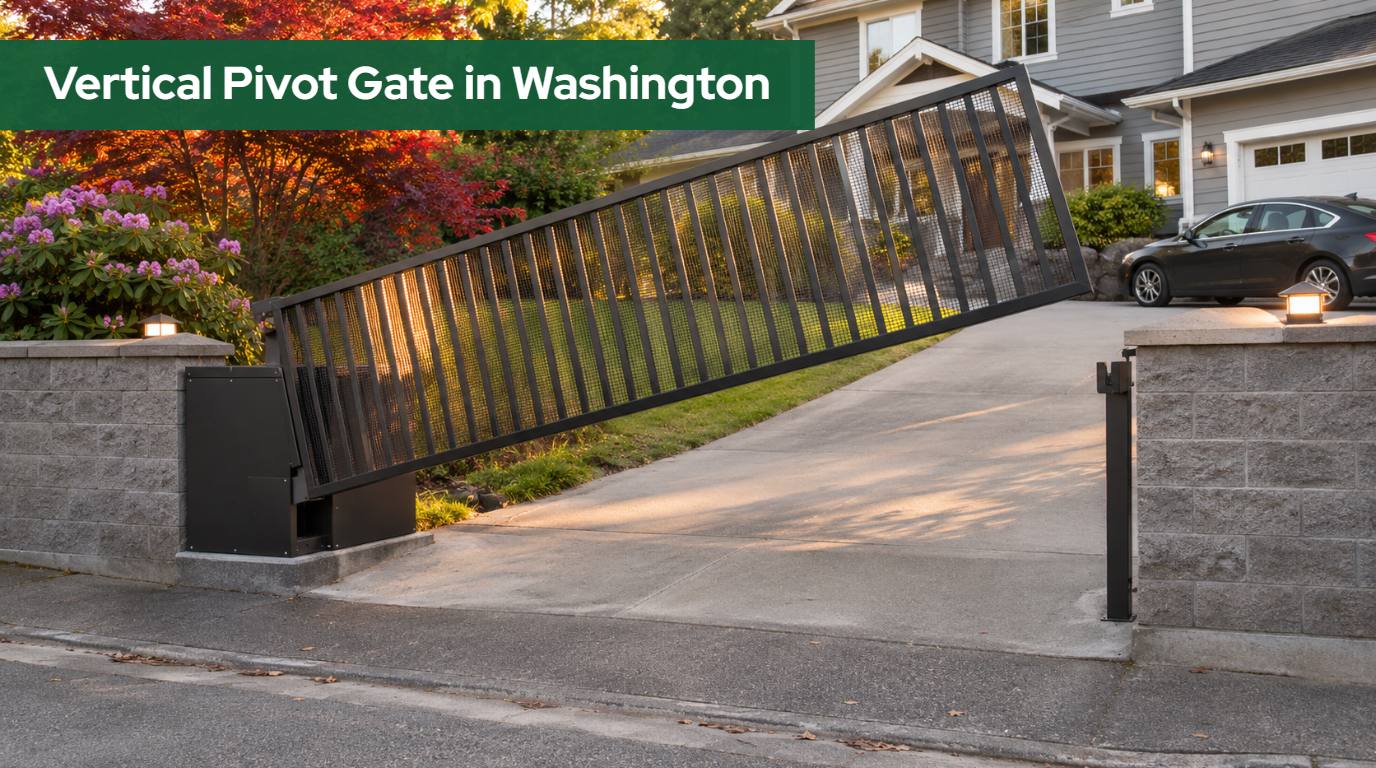
A vertical pivot gate in Washington solves a problem that slide and swing gates cannot: an entrance with no room to the side, no room to swing and a ground surface that fills with snow, gravel or mud. Instead of moving across the driveway, the gate panel tips up from one end, like a long arm rising, and clears the lane from above.
This guide explains how a vertical pivot gate works, where it fits better than other gate types, what it asks of the site, how the safety standards treat it, and what Washington’s fire code and electrical rules mean for one at your driveway, farm, storage facility or commercial yard.
Quick answer
A vertical pivot gate in Washington is a gate panel that rotates upward from a counterbalanced operator at one side of the opening, so it needs no track and almost no side space. It suits tight entrances, snow, mud and gravel. It needs a heavy footing, overhead clearance, screening and two entrapment protection means in each direction.
In this guide
- What a vertical pivot gate in Washington is
- How a vertical pivot gate works
- Vertical pivot vs slide, swing and barrier arm
- Where it makes sense in Washington
- Limits and trade-offs
- Snow, rain and mud
- Gate size, weight and materials
- Foundation, pad and site layout
- Safety rules for vertical pivot gates
- Fire access rules in Washington
- Power, battery backup and manual operation
- Access control and vehicle detection
- Maintenance through the seasons
- Planning checklist
- How we approach vertical pivot gates
- Frequently asked questions
What a Vertical Pivot Gate in Washington Is
A vertical pivot gate is a vehicular gate that moves in a vertical plane. One end of the panel is fixed to a pivot point on top of, or inside, an operator cabinet beside the opening. When the gate opens, the free end swings upward through an arc until the panel stands at a steep angle or nearly upright. When it closes, the panel comes back down and its free end settles into a receiver post on the far side of the lane.
The gate industry treats it as its own type. DASMA, the trade association for door and gate operator makers, explains in its rationale for the ASTM F2200 gate construction standard that gates are divided into five basic designs: horizontal slide, horizontal swing, vertical lift, vertical pivot and overhead pivot. Each design has requirements unique to it. That matters, because a vertical pivot gate is not a barrier arm with a fancier boom, and it is not a slide gate turned on its side. It has its own construction rules, its own sensor rules and its own screening rules, covered later in this guide.
In Washington, vertical pivot gates are most common at self-storage facilities, utility and equipment yards, airports, campuses and industrial sites. They also show up at homes and acreage where the driveway is narrow, hemmed in by walls or slopes, or covered in gravel and snow for part of the year. For a broad overview of every gate type, our guide on how to choose an automatic gate in Northwest Washington is a good starting point.
How a Vertical Pivot Gate Works
Every vertical pivot gate has the same four parts: the panel, the operator, the counterbalance and the receiver. How they are built varies by manufacturer, but the logic is the same.
The operator. The operator is a heavy cabinet bolted to a concrete foundation at the hinge end. Inside are the motor, a gear reduction or belt drive, the control board, limit sensing and, on many models, a battery backup. The pivot shaft passes through or sits on top of the cabinet, and the panel is clamped to it. When the motor turns the shaft, the panel rotates.
The counterbalance. A long panel sticking out from a pivot creates a large turning force. Without help, the motor would have to lift the full weight at the end of a long lever every time. Vertical pivot operators are built around a counterbalance, usually a weight or spring arrangement inside or behind the cabinet that offsets the weight of the panel. D.H. Pace, which sells vertical pivot gates, describes its gate as counterbalanced to let up to a 20-foot gate raise on an angle. A properly balanced gate takes far less force to move, which is easier on the motor and makes manual operation possible when the power is out.
The receiver. On the far side of the lane, a receiver post catches the free end of the panel when the gate closes. The receiver holds the gate in line so it cannot be pushed sideways, and on many systems it carries a lock or a bottom guide. ASTM F2200, as summarized by DASMA, requires a vertical pivot gate to have enough lateral stability to enter a receiver guide in the closed position, to prevent someone from pushing the gate horizontally to get in.
Vertical Pivot vs Slide, Swing and Barrier Arm
Most people looking at a vertical pivot gate are comparing it with three other choices: a slide gate, a swing gate and a barrier arm. Each fits a different site. The table below compares them on the points that usually decide the question.
| Factor | Vertical pivot | Slide or cantilever | Swing | Barrier arm |
|---|---|---|---|---|
| Side space needed | Very little; the panel rises in place | About the length of the gate, plus more for a cantilever tail | None to the side, but a full arc in front or behind | Very little |
| Overhead space needed | Yes; the panel rises into the air | No | No | Yes, for the arm |
| Ground track | None | Track on a V-groove slide; none on a cantilever | None | None |
| Snow, gravel and mud | Not pushing anything along the ground | A track can fill; a cantilever needs a clear path under the gate | Snow or a rising grade in the arc can stop it | Not affected by the ground |
| Stops people on foot | Yes, with a full panel and fence on both sides | Yes | Yes | No; it controls vehicles only |
| Foundation | One heavy operator footing plus a receiver | Track or roller posts plus operator pad | Hinge posts sized for the leaf | Operator pad |
| Typical sites | Narrow entrances, storage, yards, snowy or gravel sites | Commercial lots, HOAs, long driveways | Homes, farms, estates | Parking lots, garages, staffed entrances |
A cantilever gate is the closest competitor, because it also avoids a ground track. The trade-off is space: a cantilever needs room along the fence line for the whole panel plus its counterbalance tail. A vertical pivot gate needs only the footprint of its operator beside the opening, but it needs open air above.
A barrier arm gate looks similar when it rises, and some people assume a vertical pivot gate is just a heavier arm. The difference is what it stops. A barrier arm controls cars and leaves the lane open to anyone on foot. A vertical pivot gate is a full fence panel that closes the opening, so it secures a perimeter in a way an arm cannot.
Where a Vertical Pivot Gate Makes Sense in Washington
A vertical pivot gate is a specialist. It is rarely the default choice, but at the right site it is the only gate that works well. These are the situations where it earns its place.
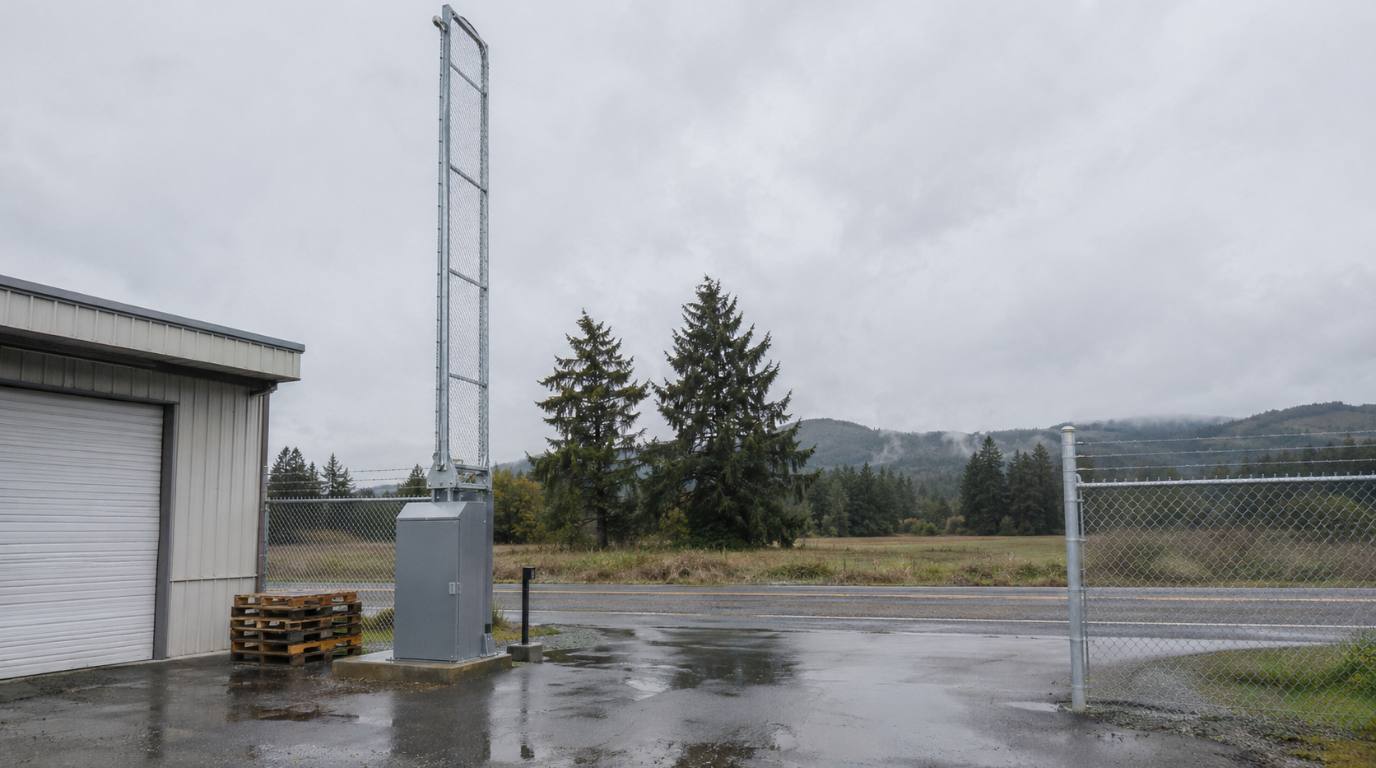
Narrow entrances with no room to the side. A driveway that runs between a building and a property line, a lane squeezed between two walls, or an urban lot where the fence meets a neighbor’s structure leaves no space for a slide gate to stack. If the opening also has no room to swing, the vertical pivot gate becomes the practical answer. The operator still needs a footprint beside the opening, so measure that before anything else.
Long, narrow corridors. Self-storage facilities often have long drive aisles with buildings on both sides, and D.H. Pace lists self-storage among the places its vertical pivot gates are found, along with military installations, airports and colleges. Inside a storage facility or a business park, a gate that rises instead of sliding can close an aisle without needing a parking space worth of fence line for the panel. If you run a storage site, our guide to self-storage gate access control in Washington covers the keypads and software that usually go with the gate.
Gravel, snow and mud. A gate that does not travel along the ground is not bothered by what is on the ground. That is a real advantage on gravel drives in Skagit and Whatcom County farm country, at equipment yards where mud and debris collect, and at higher elevation sites in the Cascade foothills where snow stays on the ground for days at a time. More on that in the weather section below.
Security perimeters. At commercial and industrial sites, a vertical pivot panel can be built to match a tall chain-link or mesh fence, with no ground gap for a person to crawl under along a track. Crash-rated versions exist for high-security sites. For more on commercial choices, see our page on commercial gate systems.
Tight entrance and no room for a slide or swing gate?
We measure the opening, the space beside it and the space above it, and tell you whether a vertical pivot gate or another type fits the site best.
Limits and Trade-offs
The same design that saves space at ground level creates demands elsewhere. Every one of these should be checked before a vertical pivot gate is chosen.
Overhead clearance. When the gate opens, its free end rises roughly as high as the panel is long. A long panel that opens close to upright needs open air well above the operator, and the whole arc of travel must be clear. Tree limbs, gutters, eaves, light fixtures, signs, wires and building overhangs all count. In Western Washington, trees grow fast and lean in storms, so think about where branches will be in five years, not just today.
Overhead power lines. If utility lines cross the entrance, a rising metal panel is a serious hazard. That alone can rule out the gate type at some rural driveways. Ask the utility about clearances before you design around a line, and never assume a sagging line will stay where it is in an ice storm.
The operator footprint. The panel may need no side space, but the operator does. One crash-rated AutoGate vertical pivot operator lists a cabinet 68 inches long, 51 inches high and 36 inches wide. Standard models vary, but plan for a substantial box on a substantial pad beside the lane, on the secure side of the fence, with room to open its access panels for service.
A heavy footing. Because the entire panel hangs from one end, the operator footing has to resist a large overturning force, especially when the gate is raised and wind is pushing on it. That usually means more concrete than a slide or swing operator pad needs. The manufacturer’s foundation drawing sets the minimum, and the local soil, frost depth and wind exposure can push it higher.
Wind on a raised panel. A panel standing up in the air is a sail. Mesh and pickets let more air through than a solid sheet, but screening still adds surface area. On exposed sites near Puget Sound, on ridges or in the islands, the panel design and the footing should account for wind. Our guide to driveway gates for windy areas in Washington explains how designers think about wind on a gate.
Snow, Rain and Mud: What Changes in Western Washington
Weather is the strongest argument for a vertical pivot gate in parts of Washington, and it is also where a careless install gets into trouble.
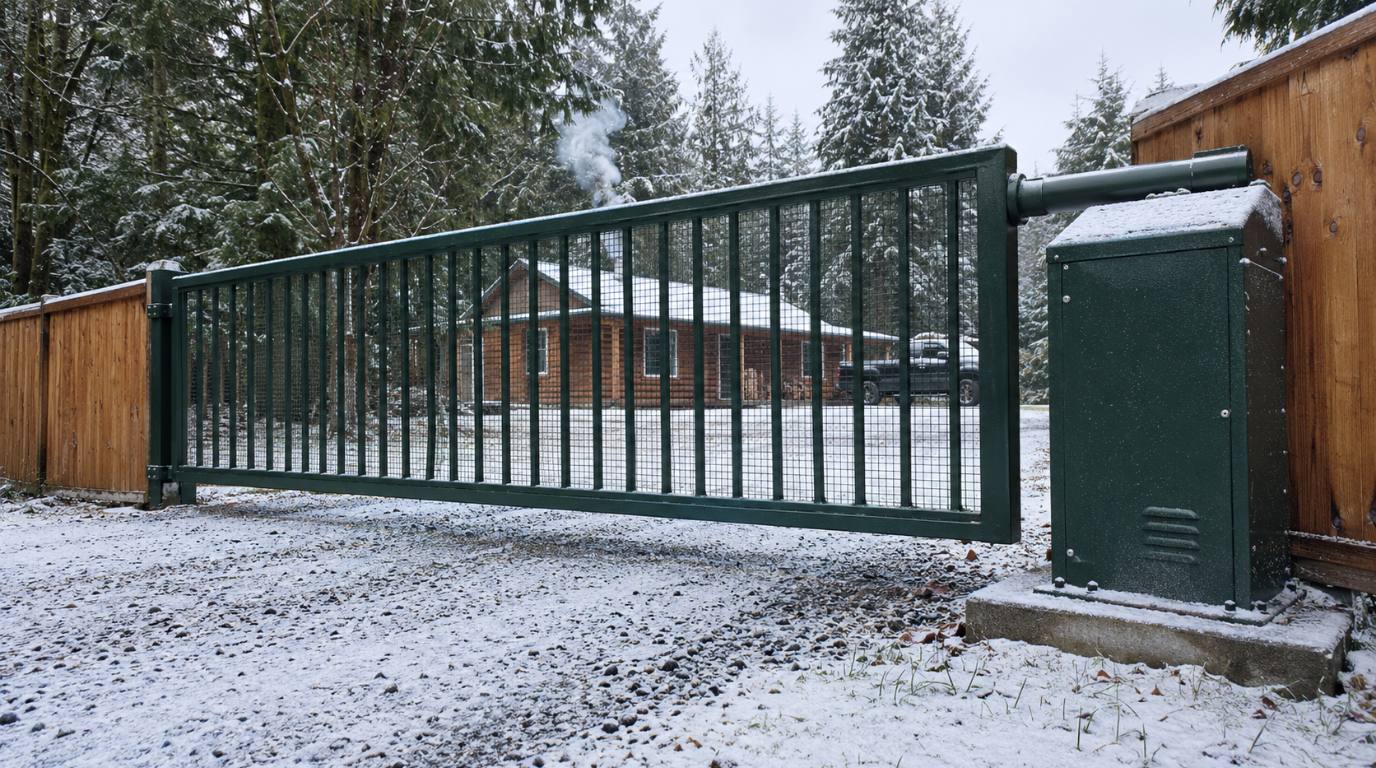
No track to fill. A V-groove slide gate runs on wheels in a ground track. Snow, ice, gravel and leaves all collect in that track, and the gate can jam or derail. A cantilever gate avoids the track but still needs a clear path beneath the panel as it rolls past the opening. A vertical pivot gate never travels along the ground, so it does not plow snow, drag gravel or ride over debris. Manufacturers market this as the main reason to choose the type in snowy climates, and the logic holds: the only part of the gate that meets the ground is the closed position over the lane and the receiver.
Snow still matters. No track does not mean no snow problems. Snow can pile on the closed panel, add weight and throw off the balance. Drifts can build against the receiver post or the bottom rail and freeze the gate shut. Plowing the driveway can push a ridge of snow across the gate line or bury the receiver. Keep the receiver and the closed panel area clear, and do not let a plow bank snow against the operator.
Know your snow zone. Snow loads in Washington change a lot over short distances. Skagit County publishes a snow load zones map for building design, and it shows how much the design snow load can change within a single county. A gate on Chuckanut Drive, at Concrete, at Darrington or near Mount Baker sees a different winter than one in Mount Vernon or Burlington. Tell the designer where the gate is, and expect the panel, the footing and any heater option to be chosen for that site.
Rain and drainage. Rain is the everyday condition. The operator pad should sit slightly above the surrounding grade, shed water away from the cabinet and never sit in a low spot where runoff collects. Conduit entries should be sealed and sloped so water does not wick into the cabinet. On clay and silt soils, which are common in the river valleys, poor drainage around the footing can lead to settlement, and a settled operator throws off the closed position at the receiver.
Gate Size, Weight and Materials
The panel and operator are designed together, so sizing starts with the opening and works back to the operator.
Length. Measure the clear opening the vehicles need, then add the overlap at the receiver. Manufacturers publish maximums. D.H. Pace lists its vertical pivot gates at up to 20 feet in steel and 24 feet in aluminum. Other makers publish their own limits, and those limits assume the panel they designed, not any panel you might build. For a sense of how wide a driveway gate really needs to be for cars, trucks, trailers and fire apparatus, see our guide to driveway gate width and layout in Washington.
Aluminum. Aluminum is light, does not rust and suits long spans because less weight hangs at the end of the lever. That is why the same maker can offer a longer gate in aluminum than in steel. Welded aluminum needs good design at the joints, and its finish should be suited to the rain and, near the water, salt air.
Foundation, Pad and Site Layout
Most problems with vertical pivot gates trace back to the foundation and the layout, because everything rides on one footing and one closed position.
Operator footing. Follow the manufacturer’s foundation drawing for the exact model. It sets the pad size, depth, anchor bolt pattern and concrete strength. Local conditions can require more. Skagit County, for example, publishes design criteria that list a design wind speed and a frost depth for the county, and saturated valley soils can be weaker than the default assumption. Set anchor bolts with a template so the operator sits level and square to the lane.
Receiver post. The receiver needs its own footing, set so the closed panel enters the guide cleanly without binding. If the receiver post moves, leans or heaves, the gate will not close properly, and on some systems it will not lock. Our guide to gate post installation in Washington explains how footings behave in wet ground.
Gaps to fixed objects. ASTM F2200, as explained by DASMA, aims to limit the opening between any fixed object and the framing of the moving gate, so a person cannot be trapped between them. That affects how close the operator, the receiver, walls, bollards and fence posts can sit to the panel’s path. The exact limits are in the standard and in the manufacturer’s instructions, and they should be checked at the layout stage.
Call 811. Washington’s underground utility law, chapter 19.122 RCW, requires notifying the one-number locator service at 811 at least two full business days before digging, unless an exemption applies. A vertical pivot operator footing is one of the deeper holes in a gate project, so locates are not optional.
Permits. Fence and gate permit rules vary by city and county. The electrical work almost always involves a permit through L&I or the local electrical program, and a gate across a fire apparatus access road needs fire agency approval. Our overview of gate permits in Washington State lists the questions to ask your jurisdiction.
Planning the footing and conduit for a new gate?
We lay out the operator pad, receiver, conduit and sensor positions before the driveway is poured, so the gate closes level and the wiring is in place.
Safety Rules for Vertical Pivot Gates: UL 325 and ASTM F2200
Two standards govern an automatic vertical pivot gate. UL 325 covers the operator. ASTM F2200 covers the gate construction and installation. Washington’s fire code ties them together for gates across fire access roads, as explained in the next section, and most reputable installers apply both to every automated gate.
Screening. DASMA’s frequently asked questions on UL 325 state that guarding or screening applies to horizontal sliding gates, vertical pivot gates and vertical lift gates, and that vertical pivot gates, like slide gates, must prevent a 2-1/4 inch sphere from passing through. DASMA’s rationale for ASTM F2200 adds that vertical pivot gates are unique in that screening is not required along the full length of the gate. The screened area is where a person could reach through the moving gate into the path of the operator, the fence or a fixed object. The manufacturer’s instructions show the exact area for each model. You can read both points in DASMA’s UL 325 and gate installations FAQ.
Entrapment protection. UL 325 requires the operator to have entrapment protection, and it sets the minimum number of means by gate type. As reprinted by DASMA, a vertical pivot gate needs two means in the opening direction and two in the closing direction. The operator’s own sensing usually counts as one. The rest come from external devices: contact sensors, such as edges, and non-contact sensors, such as photo eyes. DASMA notes that UL 325 calls for one or more contact sensors on a vehicular vertical pivot gate, and that every installation is different, so the installer has to identify where the risk of entrapment exists. Our guides to the gate safety edge and to gate photo eye installation explain how those devices work.
Smooth surfaces and protrusions. DASMA’s rationale explains that a vertical pivot gate must have smooth surfaces on its bottom, top and side framing members, free of protrusions that can cut, scrape or puncture a person when the gate moves. Because a vertical pivot gate moves upward, top pickets and decorative tops are not treated as protrusions, and a gate lock normally mounted on the bottom horizontal edge of a vertical pivot gate is not considered a protrusion either. Everything else on the panel should be smooth.
Speed. DASMA notes that UL 325’s speed limit of 1 foot per second applies to Class I and II slide gates and to the last 16 inches of bifold gates, and that there is no speed limit on swing gates or on vertical pivot gates. The entrapment protection rules still apply in full.
Controls and pedestrians. Controls meant for users must be at least 6 feet from any moving part of the gate and placed so a user cannot reach over, under, around or through the gate to operate them. A vehicular gate is not for people on foot, and a separate pedestrian entrance should be provided. Warning signs must be visible in the area of the gate. For the full picture, see our guide to automatic gate safety standards and DASMA’s rationale for ASTM F2200.
Fire Access Rules for Vertical Pivot Gates in Washington
If the gate crosses a fire apparatus access road, the fire code applies. Washington adopts the International Fire Code through chapter 51-54A WAC, and section 503.6 of that code requires the fire code official to approve security gates across fire access roads. Where the gates are automatic, the operator must be listed to UL 325 and the gate built to ASTM F2200.
Some local codes go further and list the gate types they accept. Seattle’s 2021 fire code, for example, carries a gate section in its Appendix D that requires gates on fire apparatus access roads to be of the horizontal swing, horizontal slide, vertical lift or vertical pivot type. The same section requires gates to be built of materials that allow manual operation by one person, to be maintained in operative condition, and, if electric, to have an emergency opening device approved by the fire code official. It also sets a minimum gate width of 20 feet for a single gate, or 12 feet for a divided roadway, with an exception allowing 12 feet of unobstructed width on access roads serving not more than two Group R-3 or Group U occupancies. You can read the text in Seattle’s 2021 fire code Appendix D.
So a vertical pivot gate is an accepted type, but the width rules can be hard to meet with a single pivot panel, and the manual operation rule means the balance and release have to work in practice, not just on paper. Other Washington jurisdictions adopt their own versions of these rules or rely on the fire marshal’s approval. The approved emergency opening device varies: some agencies require a Knox key switch, others accept radio entry or a strobe sensor. Our guide to fire department gate access in Washington compares what several cities and counties ask for, and it is worth reading before the gate is designed.
Check early whether your driveway or private road is a required fire access road. Long rural driveways and shared private roads often are. If it is, involve the fire marshal before ordering the gate, so the width, the emergency device and the manual release are approved up front.
Power, Battery Backup and Manual Operation
A vertical pivot gate that stops in the closed position during an outage blocks the only way in. Plan for power loss from the start.
Power supply. Most vertical pivot operators run from a line-voltage circuit with a low-voltage motor and control system. AutoGate’s crash-rated specification sheet lists a 120 volt supply with 24 volt DC battery backup, using two 12 volt sealed batteries, and lists solar power and a generator plug among its options. Other models differ, so use the sheet for the operator you choose.
Battery backup. D.H. Pace lists battery backup and a built-in battery charger as features of its vertical pivot gate. A backup lets the gate keep cycling for a while after the power goes out, which matters in Western Washington, where winter windstorms knock out power regularly. How many cycles a battery delivers depends on the gate, the cold, the battery’s age and how the system is set to behave. Our guide to automatic gate battery backup in Skagit County explains how to plan for longer outages.
Manual operation. Each manufacturer has its own manual release procedure. Because the panel is counterbalanced, a balanced gate can be raised by hand once the drive is released. Never release a vertical pivot gate without following the procedure, and never stand under a raised panel. A gate that is out of balance can drop or rise suddenly when released. Seattle’s rule that a fire access gate must be operable manually by one person is a good test for any vertical pivot gate.
Who does the wiring. In Washington, gate operator wiring is electrical work. WAC 296-46B-920 creates the door, gate and similar systems electrical specialty (10), which may install, service, maintain, repair or replace the electrical operator wiring and equipment of gate systems within that rule’s limits. The line-voltage circuit that feeds the operator may need an electrical contractor licensed for that work. Our guide to gate opener wiring in Washington covers circuits, conduit and permits in detail.
Access Control and Vehicle Detection
The gate is only half the system. How it decides to open matters as much as how it moves.
Keypads and card readers. Most vertical pivot gates at storage sites and commercial yards open from a keypad or card reader on a pedestal at the approach. The pedestal has to sit where a driver can reach it from the window without leaving the car, and at least 6 feet from the moving gate. Our guide to automatic gate keypad height in Washington covers placement for cars, trucks and accessibility.
Vehicle loops. Inductive loops in the pavement detect vehicles. A free exit loop opens the gate for vehicles leaving. Safety or reversing loops near the gate keep it from closing on a car in the lane. With a rising gate, the loop layout should account for where a long vehicle or a truck with a trailer sits while the gate closes. Our guide to the gate loop detector explains layouts in detail. Loops alone do not satisfy the entrapment rules for people, so photo eyes and edges are still needed.
Need a gate that works with your keypad, loops and fire access?
We plan the gate, the operator, the sensors and the access control as one system and test the entrapment protection and power failure behavior with you.
Maintenance Through the Seasons
A vertical pivot gate has fewer wear parts on the ground than a slide gate, but the parts it has carry a lot of load. Follow the manufacturer’s maintenance schedule, and include these checks.
- Balance. With the drive released and following the manufacturer’s procedure, a balanced panel should move smoothly and hold steady. A gate that wants to drop or rise has lost balance.
- Pivot and fasteners. Check the pivot shaft, clamps and mounting bolts for play, wear and corrosion. Movement here grows quickly under a long lever.
- Receiver and lock. Clear debris, leaves, snow and ice from the receiver. Check that the panel enters the guide without striking it and that any lock engages.
- Safety devices. Test photo eyes and edges in both directions, clean photo eye lenses and check edge wiring for damage. Test the reverse on contact and on obstruction.
- Battery. Test the backup under load before winter, and replace batteries on the manufacturer’s schedule. Cold reduces capacity.
Our seasonal automatic gate maintenance guide for Washington covers a full year of checks, and our guide to how long automatic gates last in Washington explains what wears out first and why.
Planning Checklist
Before you commit to a vertical pivot gate, answer these questions. If any answer is uncertain, check it on site before ordering.
- How wide is the clear opening, and what is the widest vehicle that must pass?
- Is the full arc of travel clear overhead, including trees, wires, eaves and lights, now and in the future?
- Does the gate cross a fire apparatus access road, and what will the fire agency require?
- What emergency opening device does the local fire agency accept?
- Where will loops, photo eyes and edges go to give two means of protection in each direction?
How We Approach Vertical Pivot Gates
Emerald Gate Systems designs, fabricates, installs, automates and services gates from our own shop in Sedro-Woolley. The same team handles CAD planning, welding, installation, automation, access control, testing and future service, so the gate is not passed between separate companies.
Every project starts with a free on-site consultation. At a tight entrance we measure the opening, the space beside it and the space above it, look at the grade, the drainage, the wind exposure and any overhead lines, and check whether the driveway is a fire access road. Then we compare the realistic options for that site, which may be a vertical pivot gate or may be a cantilever, slide or swing gate, and explain the trade-offs. Our automatic gate installation page explains the full sequence, and our custom gate design page shows how we plan and build gates in steel, aluminum and wood.
Whatever the gate type, we plan the footing, conduit, sensors and access control together, and we test the entrapment protection, the power failure behavior and the manual release with you before we leave. We serve Skagit, Whatcom, Snohomish, Island, San Juan, King and Pierce counties.
Washington requires contractors to show their registration in advertising: Emerald Gate Systems is registered with the Washington State Department of Labor and Industries as a construction contractor (EMERAGS748D6) and holds an electrical contractor license in the Doors and Gates specialty (EMERAGS747KE).
Frequently Asked Questions
What is a vertical pivot gate?
It is a vehicular gate whose panel is fixed at one end to a pivot on a counterbalanced operator. To open, the free end rises through an arc until the panel stands at a steep angle, clearing the lane from above. To close, it comes back down into a receiver post. It needs no ground track and very little space beside the opening.
How is a vertical pivot gate different from a vertical lift gate?
A vertical pivot gate rotates up from one end, like a rising arm. A vertical lift gate rises straight up between two towers and stays horizontal, like a guillotine. They have different overhead needs, different structures and different screening rules: DASMA lists a 2-1/4 inch sphere test for vertical pivot gates and a 4 inch sphere test for vertical lift gates.
Is a vertical pivot gate good for snow in Washington?
It is one of the better choices, because it does not travel along the ground and has no track to fill with snow, ice or gravel. Snow can still pile on the closed panel, drift against the receiver or be pushed there by a plow, so the receiver and gate line need to be kept clear in winter.
Can a vertical pivot gate be used at a home?
Yes, where the site suits it, such as a narrow driveway between walls or buildings, a gravel drive or a sharp grade behind the gate. It needs room for the operator cabinet beside the opening and clear overhead space for the rising panel. At many homes a swing, slide or cantilever gate is simpler and looks more traditional.
What safety devices does a vertical pivot gate need?
UL 325, as reprinted by DASMA, requires two means of entrapment protection in the opening direction and two in the closing direction. The operator’s own sensing usually counts as one, and photo eyes and contact edges supply the rest. The gate also needs screening against a 2-1/4 inch sphere where people could reach through, and controls at least 6 feet away.
Can a vertical pivot gate be used on a fire access road in Washington?
Yes, if the fire code official approves it. Washington’s fire code requires approval of security gates across fire access roads, a UL 325 listed operator and an ASTM F2200 gate. Seattle’s Appendix D lists vertical pivot gates as an accepted type, and also requires manual operation by one person and an approved emergency opening device.
What happens to a vertical pivot gate when the power goes out?
With a battery backup, it keeps working for a limited number of cycles, then opens or stays closed depending on how it is set. Without backup, it stops where it is. A balanced panel can be raised by hand after the drive is released, following the manufacturer’s procedure. Never stand under a raised panel during a manual release.