
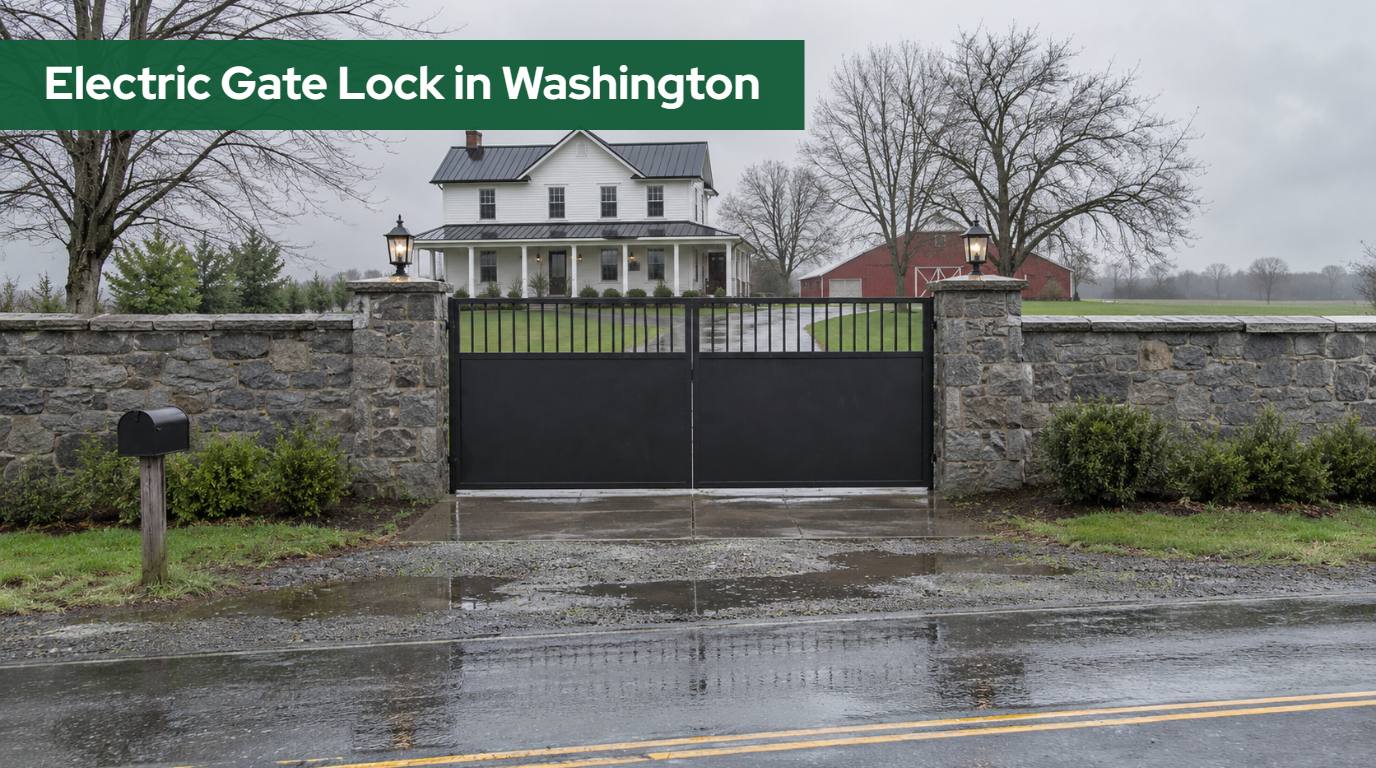
An electric gate lock in Washington does one narrow job: it holds a closed automatic gate shut, and it lets go a moment before the operator starts to open it. Many driveway gates never need one, because the operator itself holds the leaf. Others do, and the usual reasons here are long leaves, double gates that meet in the middle, and winter wind off the Sound or down the Skagit Valley pushing on a closed gate all night.
This guide explains when a lock is worth adding, how magnetic locks and solenoid locks differ, why the old latch and padlock have to come off an automated gate, how the lock is wired and powered, what happens when the power fails, and how Washington’s fire access and electrical rules shape the choice.
Quick answer
An electric gate lock in Washington is a magnetic or solenoid lock wired to the gate operator so it releases just before the gate moves. It is used on long, wind-loaded or double swing gates that the operator alone cannot hold. Choose it by how it behaves when power fails, and confirm fire access requirements first.
In this guide
- What an electric gate lock in Washington does
- Does your gate need a lock?
- Magnetic locks
- Solenoid and latching electric locks
- Maglock or solenoid lock: how to choose
- Why the latch, chain and padlock come off
- Swing, double swing, slide and walk gates
- How the lock is wired and powered
- Power failure and manual release
- Fire department access in Washington
- The gate has to be right first
- Rain, rust, frost and wind
- Permits, wiring rules and L&I
- Maintenance and common problems
- How we approach electric gate locks
- Frequently asked questions
What an Electric Gate Lock in Washington Does
On a manual gate, a latch or a chain and padlock keeps the gate shut. On an automatic gate, that job normally belongs to the operator. A gear-driven operator resists being pushed backward, a hydraulic operator can hold oil pressure against the leaf, and the gate rests against a positive stop. For a short, light leaf on a sheltered driveway, that is usually enough.
An electric lock adds a second hold at the free end of the leaf, the end farthest from the hinge, where a push has the most leverage. It is wired to the operator’s control board, so nobody has to walk to the gate to work it. When the board receives an open command, it releases the lock first and then starts the motor. When the gate closes and stops, the lock holds again.
Does Your Gate Need a Lock?
The honest answer for many residential gates is no. The question is whether the operator can hold the leaf closed against the forces the site puts on it. Three things push the answer toward yes.
Leaf length. A swing leaf is a lever. The longer it is, the more a push at the latch end multiplies at the operator. Manufacturers say so in their own documents. FAAC’s specification sheet for the S800H in-ground hydraulic operator, which is rated for leaves of 13 or 16 feet depending on the version, notes that an electric or magnetic lock is recommended for any gate longer than 12 feet. The same sheet says mounting dimensions, wind factor and gate design all affect performance.
Whether the operator locks on its own. Some operators hold the leaf when the motor is off and some do not. FAAC’s S450H manual puts it plainly: the model with a hydraulic lock can automate leaves up to 2 meters, about six and a half feet, without electric locks, because the leaf is mechanically locked when the motor is not running. The model without the hydraulic lock always needs one or more electric locks. The S800H sheet makes the same split: one version has hydraulic locks included, and the version without them is described as being for areas subject to strong winds.
Wind and surface area. A solid cedar or steel-clad leaf catches wind like a sail. An open picket leaf of the same size catches far less. A gate on an exposed rise above Samish Bay or on the west side of Whidbey Island lives a different life than one tucked behind firs in Snohomish County. If your site is exposed, our guide to driveway gates for windy areas in Washington explains how design, hinges, stops and operators share that load.
There are also cases where a lock is the wrong fix. If the leaf moves because the posts lean, the hinges are worn or the gate has dropped, a lock hides the symptom for a season and then fails with it. That gate needs the repair described in our guide to sagging gate repair in Washington before anything is added to its free end.
Magnetic Locks: Simple, Strong and Dependent on Power
A magnetic lock, usually shortened to maglock, has two parts. An electromagnet is fixed to the post, or to the other leaf on some double gates. A flat steel plate called the armature is fixed to the gate. When the gate closes, the plate meets the magnet face. With current flowing, the magnet holds the plate. With current cut, it lets go at once.
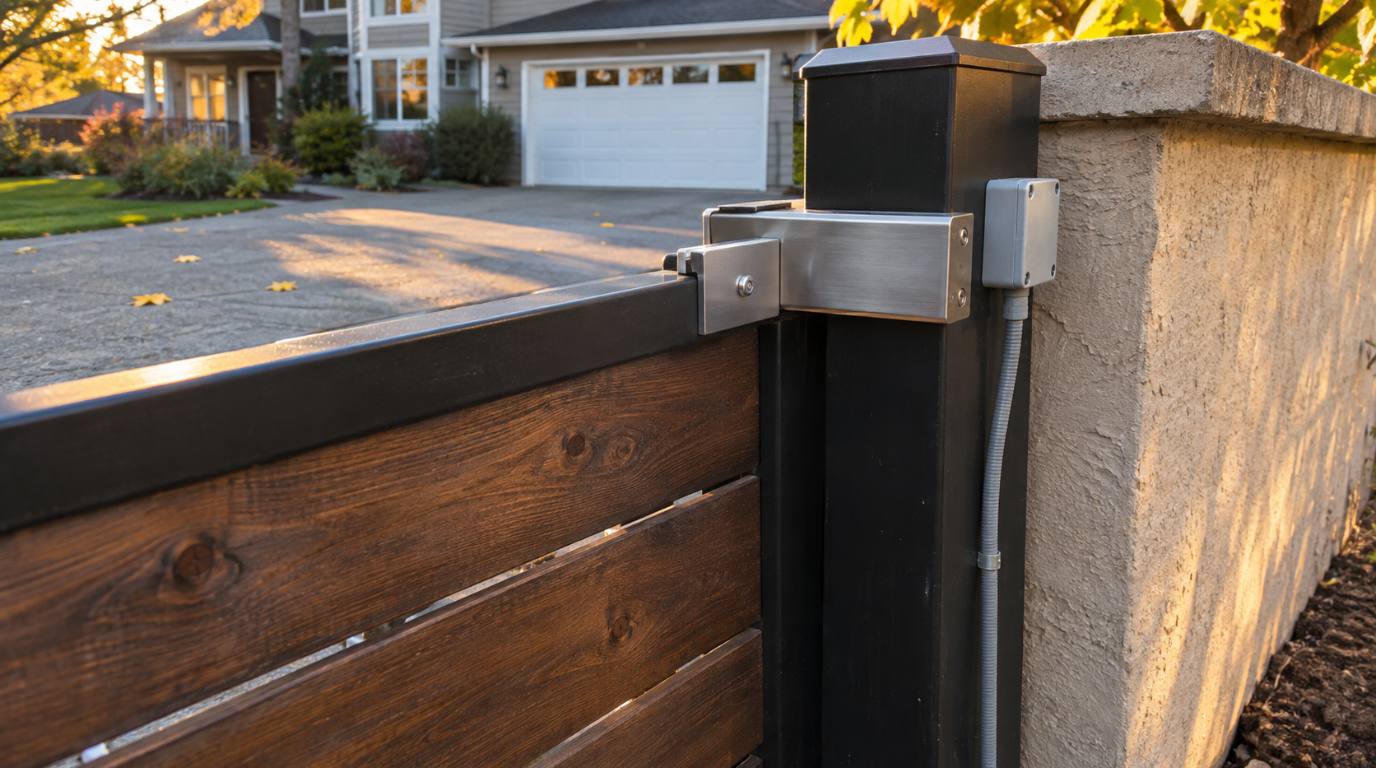
LiftMaster’s wiring and mounting sheet for its MG1300 outdoor magnetic lock shows what a gate-rated unit looks like. The housing is stainless steel, with a steel junction box and magnet plate. A 12 volt DC transformer is provided, and the lock can also run on 24 volts DC from a transformer that is not included. The sheet lists current draw as 500 milliamps at 12 volts and 250 milliamps at 24 volts.
The same sheet is specific about wire. At 12 volts it calls for 18 gauge wire on a 50 foot run and 14 gauge at 150 feet. At 24 volts it calls for 22 gauge at 50 feet and 18 gauge at 150 feet, and it says not to use wire smaller than 22 gauge. Long driveways are common on acreage in Skagit and Whatcom counties, and the run from the power supply to the far post is often longer than people guess, so this table matters.
It also carries a handling note that decides how well a maglock ages in our climate: the magnet face and the plate face must stay free of dirt, rust, burrs, paint or anything else that keeps them from making good contact. A magnet holds through direct steel-to-steel contact. A film of rust or a coat of paint between the faces weakens the hold.
One limit is worth knowing before you plan power. In the accessory list of LiftMaster’s LA412UL swing operator manual, the MG1300 is described as not for use with solar applications, and as a lock that must be powered separately. A magnet that draws current the entire time the gate is closed is a poor match for a small solar and battery budget in a Western Washington December.
Solenoid and Latching Electric Locks
The second family uses a mechanical catch. A latch or bolt on one part engages a strike or receiver on the other, and a solenoid, which is a coil that pulls a plunger when powered, moves the catch out of the way on command. Some designs drop a bolt into a ground receiver. Others grab a strike pin on the post as the gate closes, the way a car door latch grabs its striker.
Because the hold is mechanical, a latching lock can stay locked with no power at all. It only needs current for the moment it releases. That is the reverse of a maglock, and it is the main reason to pick one.
Securitron’s installation instructions for its GL1 gate lock are a useful example of the type. The document lists a holding force of 2,000 pounds. On 12 volts DC it draws a peak of 870 milliamps for about one second and then settles to 290 milliamps. On 24 volts it peaks at 720 milliamps and settles to 170.
The GL1 can be set up in either of two power failure modes, and the instructions define them clearly. In fail locked mode, on loss of power the mechanism locks when the gate closes and stays locked until power returns or someone uses the manual override. In fail safe mode, on loss of power the mechanism will not lock a closing gate and releases a gate that was already secured. The unit can be converted from one mode to the other.
Not sure whether your gate needs a lock at all?
We check the leaf length, the wind exposure, the operator model and how the gate sits when closed, then tell you plainly whether a lock would help or whether the fix is somewhere else.
Maglock or Solenoid Lock: How to Choose
Start with one question: when the power stops, should this gate hold or let go? The trade uses two terms. Fail safe means the lock releases when it loses power. Fail secure, which some manufacturers call fail locked, means it stays locked when it loses power. Neither word is a quality rating. They describe behavior, and the right behavior depends on the site.
A maglock is fail safe by nature, since a magnet with no current holds nothing. A latching lock can usually be either, depending on the model and how it is set up. Everything else in the comparison follows from the mechanism.
| Question | Magnetic lock | Solenoid or latching lock |
|---|---|---|
| How it holds | Electromagnet on the post holds a steel plate on the gate | Mechanical catch engages a strike, pin or ground receiver |
| When it uses power | The whole time the gate is locked | Mainly at the moment it releases, depending on the model |
| On loss of power | Releases, unless its supply has its own backup | Stays locked or releases, depending on the mode chosen |
| Tolerance for a gate that moves | More forgiving of small changes in height | Catch and strike must meet at the same point every time |
| What needs attention | Clean, rust-free contact faces and a steady supply | Alignment, debris in the receiver, lubrication the maker allows |
| Getting in with no power | Already released | Keyed override, where the lock has one and the mode allows it |
In practice, the choice tends to sort itself by site. A residential gate where the fire agency wants the gate free on power loss, and where the owner wants the simplest hardware, often suits a maglock on a separate supply. A farm, a storage yard or a remote entrance where a closed gate must stay closed through an outage leans toward a fail secure latching lock with a keyed override and a clear plan for emergency access.
Last, check compatibility in both directions. The operator manual says which lock types its board supports and how. The lock’s own instructions say which gate types it suits. If either document says no, the answer is no, however well the parts seem to fit on the bench.
Why the Latch, Chain and Padlock Come Off
People who automate an existing gate often ask to keep the old latch as a backup. The standard for automated gate construction says otherwise. ASTM F2200, as reprinted in LiftMaster’s operator manuals, contains two short rules: an existing gate latch shall be disabled when a manually operated gate is retrofitted with a powered gate operator, and a gate latch shall not be installed on an automatically operated gate.
The reason is practical. A hand latch has no idea what the operator is doing. If the latch is engaged when the board calls for open, the motor drives against a gate that cannot move. If someone drops the latch while the gate is cycling, it can catch mid-travel. The door and gate industry association, DASMA, publishes a technical data sheet on the rationale behind the provisions of ASTM F2200 that walks through the reasoning for each clause.
The Washington connection is direct. Washington adopts the International Fire Code statewide through chapter 51-54A of the Washington Administrative Code, and that code’s section on security gates, 503.6, requires electric gate operators to be listed to UL 325 and gates meant for automatic operation to be designed, constructed and installed to ASTM F2200. So the latch rule is not just a manufacturer’s preference. Our overview of UL 325 and ASTM F2200 for automatic gates explains both standards in plain terms.
An electric lock is the answer the standards leave room for, because the operator commands it. It releases before the motor runs, and the board knows its state. That is the difference between a lock and a latch on an automated gate. If you are converting a manual gate, our page on how to automate an existing gate covers what else changes.
Swing, Double Swing, Slide and Walk Gates
Single swing gates. The lock mounts at the latch post, near the free end of the leaf. A maglock sits on the post with its armature on the gate frame. A latching lock sits on the post or the gate with its strike on the other. It should sit high enough to stay out of splash and standing water.
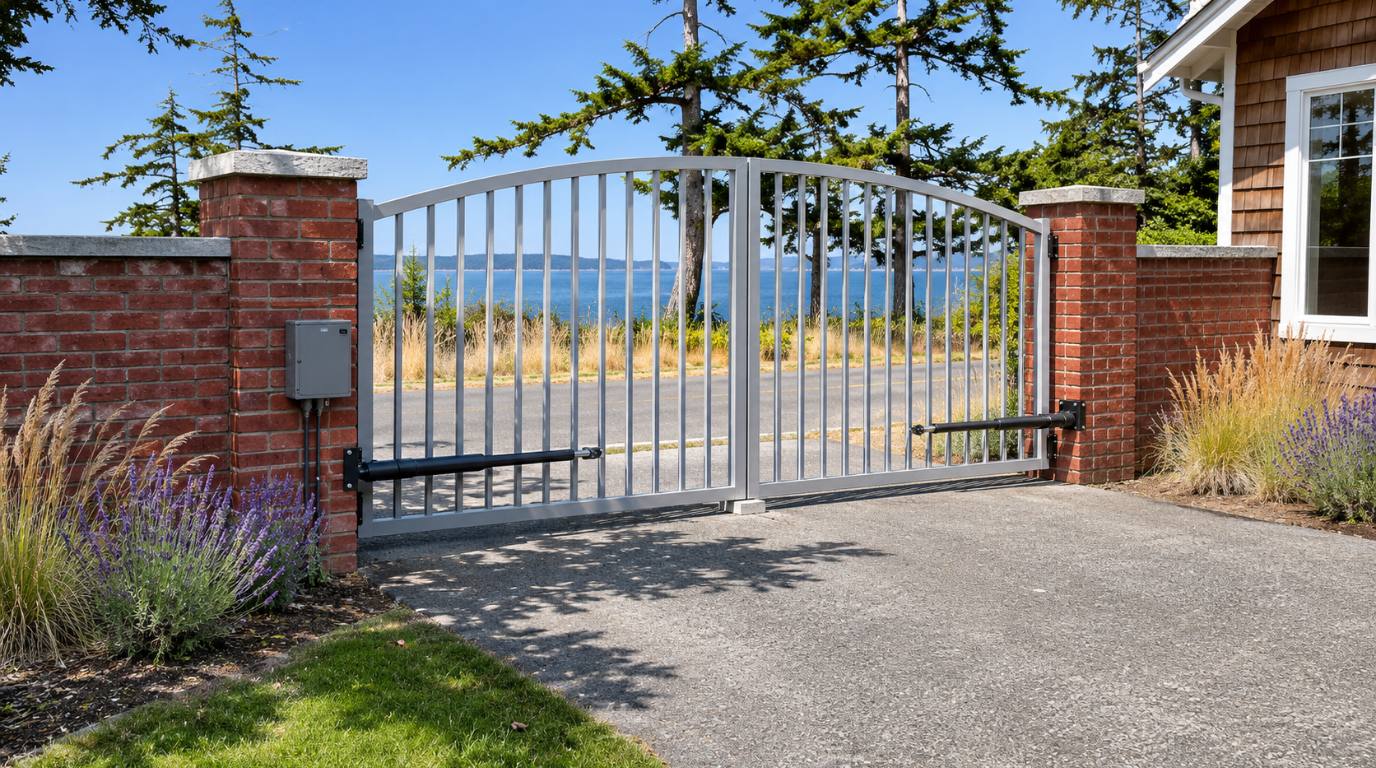
Double swing gates. Two leaves meeting in the middle are the classic case for a lock, because neither leaf has a post to close against. There are two common layouts. One fixes the lock between the leaves so they hold each other. The other holds one leaf to the ground with a powered bolt and lets the second leaf close against the first.
Either way, the leaves have to move in order. LiftMaster’s LA412UL manual describes a bipart delay setting for exactly this: it is used where a mag-lock, a solenoid lock or a decorative overlay requires one gate to close before the other. The leaf set as primary waits a moment when opening and is the first to close. Get that order wrong and the leaves collide at the meeting point or the lock parts never line up.
Slide gates. Most slide gates do not use a separate lock. The operator’s chain or rack holds the gate at the closed limit, and the receiver guide at the latch post keeps the leading edge from being pulled out sideways. Securitron does list a sliding gate mounting kit for the GL1, so a second hold is possible where a site needs one. Our guide to the sliding gate opener in Washington explains how a slide operator holds the gate and what it does at the limits.
Walk gates. A pedestrian gate beside the driveway is a different problem with different rules. It may be on an accessible route or an exit path, and it has its own guide: pedestrian gate access control in Washington. Gates in a pool barrier have their own latch rules as well, covered in our guide to pool gate requirements in Washington.
How the Lock Is Wired and Powered
An electric lock connects to a relay on the operator’s control board. A relay is an electrically operated switch, and the board uses it to cut or apply the lock’s power at the right moment. The lock does not take its commands from the keypad or the remote. Those tell the board to open, and the board handles the lock.
LiftMaster’s LA412UL manual describes its lock output this way: a relay contact with a normally closed output for maglocks, which activates prior to motor activation and during the motor run, and is off when the motor is off. In plain terms, the magnet’s circuit is complete while the gate rests, the relay breaks it just before the motor starts, and it is restored after the gate stops.
A solenoid lock is the mirror image. The troubleshooting section of the same manual tells the technician to check that a maglock is wired to the normally closed and common terminals, and that a solenoid lock is wired to the normally open and common terminals. A solenoid that releases when powered gets power only while the relay is active. Swap the two and the lock does the opposite of what the gate needs.
The manual repeats one instruction for both types: do not power the lock from the control board’s accessory power terminals. A lock gets its own supply. That is why the MG1300 ships with its own transformer, and why its sheet sizes wire for the lock circuit separately. Sharing the board’s small accessory supply with a device that draws hundreds of milliamps is a common cause of odd behavior on boards that otherwise test fine.
That separate supply changes the planning. The transformer needs a weatherproof place near the control box, and the low-voltage cable to the lock runs in conduit that should go in before the concrete or asphalt does. Our guide to gate opener wiring in Washington covers conduit, trench depth and wire types, and our Burlington article on planning an automatic gate before paving explains why the sequence matters.
Adding a lock to a gate that is already automated?
We read the operator’s manual for the lock output, check the supply and the conduit route, and confirm the lock suits your gate type before anything is welded on.
Power Failure and Manual Release
Western Washington loses power in windstorms most winters, and rural feeders in Skagit, Whatcom and Island counties can stay down longer than city ones. A lock adds one more thing to think through for those days, and it is better thought through at design than discovered at the gate in the dark.
There are three states to plan for. In the first, utility power is out but the operator is running on its battery. Whether the lock still works depends on where the lock gets its power. A maglock on a plug-in transformer with no backup has already let go, and the operator is holding the gate alone. A lock fed from a battery-backed supply keeps working as long as that supply does.
In the second state, the operator’s battery is low too. Many boards have a setting for this moment that either leaves the gate where it is or opens it and holds it open. Our Skagit County article on automatic gate battery backup explains how those settings work and how long a battery realistically carries a gate.
In the third state, someone has to move the gate by hand. Every operator has a manual release for this. On the FAAC S450H, for example, the manual describes lifting a protective lid, turning a key and then turning a release knob before the leaf can be moved by hand. But releasing the operator does not release a fail secure lock. That takes the lock’s own keyed override, if it has one.
LiftMaster builds a helper into its boards for this. The LA412UL manual says that when the operator is put in manual mode, the lock relay activates and then turns off after two minutes to conserve power. That gives a person a window to push the gate open while the lock is released, provided the lock circuit still has power to work with.
Fire Department Access in Washington
A lock exists to keep a gate closed. Fire code exists, in part, to make sure a closed gate does not delay a fire engine or an aid car. The two have to be reconciled on purpose, and in Washington the fire code official has the final say.
Washington’s version of the fire code leaves access road standards to local government under WAC 51-54A-0503, and keeps the model code’s section on security gates. That section, 503.6, says the installation of security gates across a fire apparatus access road must be approved by the fire code official, that gates must have an approved means of emergency operation, and that the gates and the emergency operation must be maintained operational at all times. It is the same section that calls for UL 325 listed operators and ASTM F2200 gates.
“Approved” is a local word. Fire agencies in our service area differ on the emergency device they accept and on what the gate should do when power fails, and some want a gate that opens by itself, or can simply be pushed open, when both utility power and the battery are gone. Our guide to fire department gate access in Washington compares what several agencies publish.
The effect on lock choice is direct. Where the agency expects a gate to be free on power failure, a fail secure lock that needs a key works against that expectation, and a fail safe lock fits it. Where the agency accepts a locked gate with an approved key switch or key box, a fail secure lock may be fine, but the emergency device has to release the lock as well as run the operator.
Not every driveway is a fire apparatus access road, and a single home on a short driveway may hear nothing from the fire agency. Long private roads, gated communities and commercial sites usually will. If the gate needs a permit or a review, our guide to gate permits in Washington State explains who to ask. Ask before buying the lock.
The Gate Has to Be Right First
A lock is the last link in a chain that starts at the footing. If the post moves, the hinge wears or the frame racks, the lock is the part that shows it, because it is the part with the tightest alignment.
Posts and footings. The latch post carries the lock, and on a windy night it carries the wind load the lock is holding back. Securitron’s instructions for the GL1 say the mounting surfaces should be strong enough to meet or exceed the holding force of the lock. Our guide to gate post installation in Washington covers footing depth and soil.
Positive stops. The gate should come to rest against a fixed stop with the lock parts just meeting. If the lock itself is what stops the gate, every close cycle hammers it. If the stop holds the gate a half inch short, a magnet never makes full contact.
The frame at the lock. The armature or strike needs flat, solid steel behind it. On a wood-clad gate, that means a steel frame member at the right height, planned when the gate is built. On a retrofit, it usually means welding on a mounting plate, which burns the finish, and the bare spot has to be repaired or it will rust first, as our guide to wrought iron gate repair in Washington explains.
Operator settings. After a lock is added, the operator’s limits, force and timing need to be checked again. The gate now has to arrive at one exact point, and the board has to release the lock before the motor loads it. The obstruction test and the entrapment devices get tested again too, since any change at the closing edge can affect them.
Rain, Rust, Frost and Wind
Rust on the contact faces. West of the Cascades, bare steel left outdoors picks up surface rust quickly in the wet months. The MG1300 sheet’s requirement that the magnet and plate faces stay free of rust and paint is easy to meet in a dry climate and takes regular attention here. A wipe-down belongs in every seasonal visit.
Debris in receivers. A ground receiver for a drop bolt is a small hole at the lowest point of a driveway, which is where fir needles, gravel and silt collect. A bolt that cannot seat leaves the gate free. A bolt that seats in packed debris and then freezes there leaves it stuck. Receivers need drainage and need to be cleaned out through fall and winter.
Frost and ice. Our freezes are usually short, but they often follow rain, so water that got into a latch mechanism or a receiver freezes in place. A gate that will not release on a frosty morning and works by noon is giving a clear hint. Mounting the lock above standing water and splash, with drain paths open, prevents most of it.
Wind. A lock earns its keep in a November blow, and that is also when it is loaded hardest. Loose fasteners and cracked tack welds show up after storms, so a quick look at the lock and its mounts belongs on the list after a big wind, along with the checks in our seasonal automatic gate maintenance guide.
Gate rattling or drifting open in winter wind?
We look at the stops, the hinges, the operator’s holding ability and the exposure, and recommend a lock only where it is the right fix for that gate.
Permits, Wiring Rules and L&I
A gate lock runs on low voltage, and it is still electrical work in Washington. The lock’s transformer plugs into or is wired to a 120 volt circuit, and the lock circuit ties into a listed gate operator. The state’s electrical rules for licensing and permits, including WAC 296-46B-920, set out the specialty licenses that cover this kind of work, among them a specialty for doors, gates and similar systems.
People often assume gate wiring is exempt the way a garage door opener’s low-voltage wiring can be in a home. Our wiring guide, linked above, explains why a driveway gate operator is treated differently and when an electrical permit and inspection apply. Adding a lock to an existing operator is a smaller job than a new installation, but the same rules decide who may do it.
Maintenance and Common Problems
A gate lock needs little care, but it needs it on a schedule, because the first sign of neglect is usually a gate that will not open or will not stay shut on the worst day for it.
A reasonable routine for our climate, done in fall before storm season and again in spring:
- Wipe the magnet and armature faces clean and check for rust, paint or burrs.
- Clear ground receivers and strike pockets of needles, grit and standing water.
- Look at every weld and fastener on the lock, the plates and the post.
- Watch one full cycle: the lock should release before the gate moves and hold after it stops.
- Test the power failure plan with the lock’s supply switched off.
Lubricate a mechanical lock only with what its maker specifies. The wrong product collects grit or stiffens in the cold. A maglock’s faces get no lubricant at all.
When something does go wrong, the symptom usually points at the cause.
| Symptom | Likely cause | What to check |
|---|---|---|
| Gate starts to open, then stops or reverses at once | Lock has not released before the motor loads it | Relay wiring and timing, lock supply, stuck bolt or catch |
| Closed gate can be pushed open by hand | Magnet not making full contact, or no power at the lock | Contact faces, stop position, transformer, wire size on a long run |
| Lock hums or buzzes | Low voltage or poor contact | Supply voltage at the lock under load, corroded terminals |
| Works in summer, sticks in winter | Gate has dropped or lifted, or water is freezing in the lock | Hinge adjustment, post movement, drainage at the receiver |
| Double gate leaves clash at the center | Closing order lost | Bipart delay setting, which leaf is primary |
| Lock stopped working after a storm | Supply tripped or damaged, or a weld cracked | Outlet and transformer, mounts and plates, surge damage |
If the gate will not open at all and you need in, use the operator’s manual release and the lock’s override as the manuals describe. Forcing a leaf against an engaged lock bends frames and tears mounts. Our guide to an automatic gate that is not opening or closing covers the wider checklist, and our automatic gate repair page explains how service works.
How We Approach Electric Gate Locks
Emerald Gate Systems designs, fabricates, installs, automates and services gates from our shop in Sedro-Woolley, and the same team handles the welding, the operator and the access control.
Every project starts with a free on-site consultation. We look at the leaf, the wind exposure, the posts and hinges, the operator model and where power comes from, then say whether a lock is needed at all. When it is, we recommend the type by how it should behave in a power failure, confirm the fire access requirements with the local fire marshal where they apply, and plan the supply and conduit along with the rest of the access control. We install and service LiftMaster, Viking and FAAC operators. Before we leave, we test the lock timing, the entrapment protection, the power failure behavior and the manual release, and show you how each one works. Our automatic gate installation page explains the full process.
Washington requires contractors to show their registration in advertising: Emerald Gate Systems is registered with the Washington State Department of Labor and Industries as a construction contractor (EMERAGS748D6) and holds an electrical contractor license in the Doors and Gates specialty (EMERAGS747KE).
Frequently Asked Questions
Do I need an electric lock on my automatic driveway gate?
Often not. Many operators hold a short, light leaf closed without help. A lock becomes worth adding on long leaves, solid gates in windy spots, double swing gates that meet in the middle, and operators built without internal locking. Check the operator’s own documents: some recommend or require a lock past a stated leaf length.
What is the difference between a maglock and a solenoid gate lock?
A maglock holds a steel plate on the gate with an electromagnet on the post, so it needs power the whole time it is locked and lets go when power stops. A solenoid or latching lock holds with a mechanical catch and uses power mainly to release, so it can stay locked through an outage.
Can I keep the old latch or padlock on a gate after it is automated?
No. ASTM F2200, the construction standard for automated gates, says an existing latch must be disabled when a manual gate gets an operator and that a latch must not be installed on an automatic gate. A hand latch can jam the gate against the motor. An electric lock controlled by the operator replaces it.
What happens to an electric gate lock when the power goes out?
It depends on the lock and its supply. A magnetic lock with no backup power releases, leaving the operator to hold the gate. A fail secure latching lock stays locked and needs its keyed override. Decide which behavior you want before choosing, and confirm what your local fire agency expects the gate to do.
Does a sliding gate need an electric lock?
Usually not. A slide gate operator holds the gate at the closed limit through its chain or rack, and a receiver guide at the latch post keeps the leading edge in line. Some lock manufacturers offer mounting kits for slide gates, so a second hold can be added where a site calls for it.
Who can wire a gate lock in Washington?
Wiring a lock into a gate operator is electrical work under Washington’s rules, even though the lock runs on low voltage. The state licenses electrical contractors in general and specialty categories, including one for doors, gates and similar systems. Ask any contractor for their L&I registration and electrical license numbers and verify them with the department.