
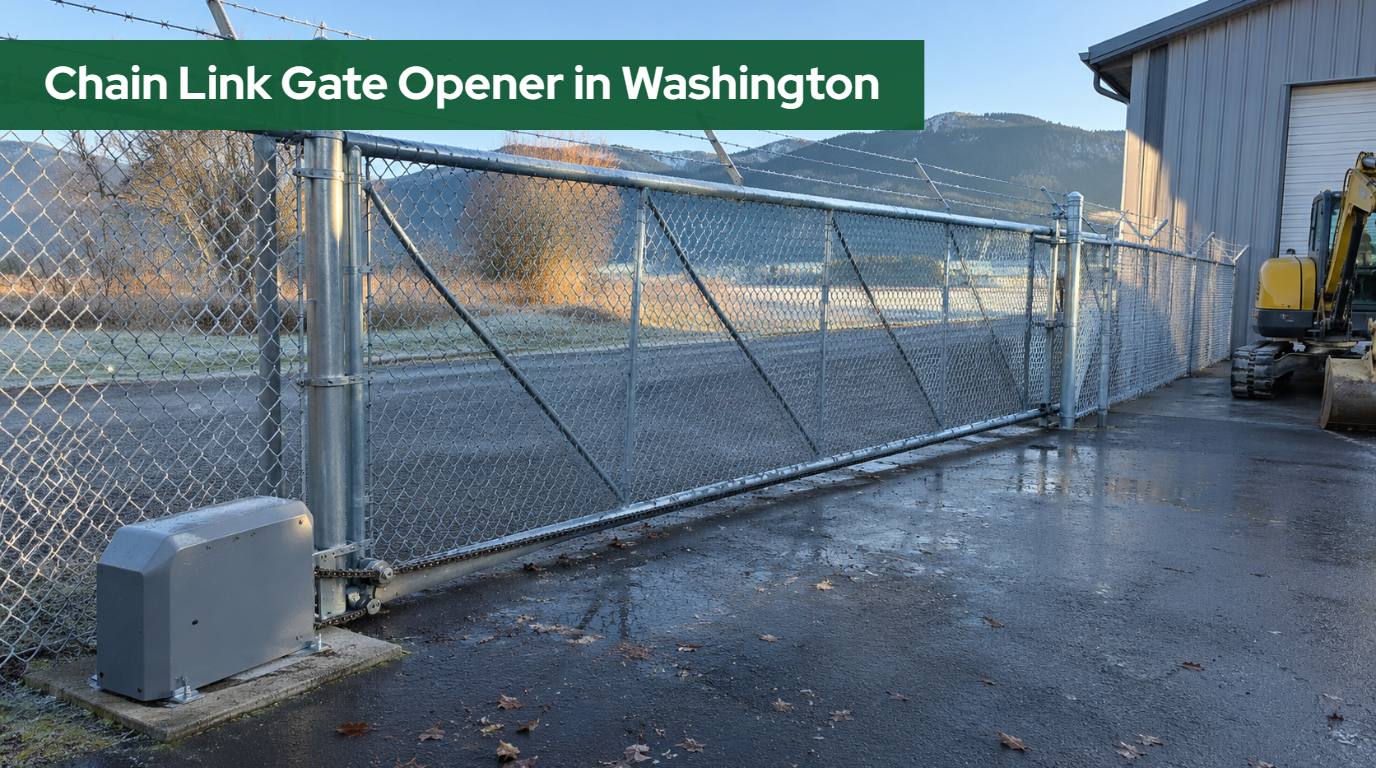
Chain link gates are everywhere in Washington: across farm lanes in the Skagit Valley, around equipment yards in Whatcom County, at shop buildings in Snohomish County and in front of storage lots on Whidbey Island. Most of them started life as manual gates that someone walks out to open. Adding a chain link gate opener in Washington is a common upgrade, but a chain link gate is a light, flexible frame covered in open mesh, and it has to be checked before a motor starts pushing and pulling on it every day.
This guide covers the standards, how to tell whether an existing gate can be automated, operator choices, screening, safety devices, posts, power and permits under Washington rules. It is written for farm owners, businesses, property managers and homeowners in Skagit, Whatcom, Snohomish, Island, San Juan, King and Pierce counties.
Quick answer
A chain link gate opener in Washington needs a gate built for automation: a welded, square frame that moves freely, heavy enough posts and a UL 325 listed operator. Slide gates must be screened so a 2.25-inch sphere cannot pass. Add photo eyes or edges, and plan wiring and the electrical permit before installing.
In this guide
- What a chain link gate opener in Washington has to handle
- Where chain link gates get automated in Washington
- The standards behind chain link gates
- Can an existing chain link gate be automated?
- Swing or slide: matching the opener to the gate
- Swing gate openers on chain link leaves
- Slide gate openers for chain link cantilever and rolling gates
- Mesh, screening and the 2.25-inch rule
- Barbed wire, privacy slats and other add-ons
- Photo eyes, edges and entrapment zones
- Gate posts and footings for an automated chain link gate
- Power, wiring and permits in Washington
- Access control and fire department access
- Keeping an automated chain link gate running through Washington weather
- How we approach chain link gate automation
- Frequently asked questions
What a Chain Link Gate Opener in Washington Has to Handle
A gate opener does one simple job: it moves a gate from closed to open and back, thousands of times. What makes chain link different is the gate itself. A typical chain link gate is a frame of round galvanized pipe, welded or joined with fittings, with chain link fabric stretched inside the frame and tied to it. It is light for its size, it lets wind pass through, and it is easy to repair. Those are good traits. But the same frame can rack out of square, sag at the latch side, flex when it is pushed at one point, and drag on the ground once a hinge wears.
A person opening a gate by hand lifts a sagging leaf or shoves it past a high spot without thinking. An operator cannot. It pushes at one bracket and expects the gate to move the same way every time. If the gate binds, the operator trips its obstruction sensing or wears out early. So a chain link gate opener in Washington has to deal with the frame, the hinges and rollers, the site (gravel, mud, frost, slope and wind), safety around open mesh and barbed wire, and the rules: UL 325 for the operator, ASTM F2200 for the gate, electrical permits and, on many sites, fire access.
If you want the general picture of automating a gate that is already in place, our page on automating an existing gate covers the basic process for any gate type.
Where Chain Link Gates Get Automated in Washington
In our service area, the chain link gates owners most often want automated are on farms and acreage in the Skagit Valley, Whatcom County and rural Snohomish County, where someone climbs out of a truck several times a day; on contractor yards, equipment storage and truck lots, often with barbed wire and wide slide gates; on RV, boat and storage lots, covered in our guide to self-storage gate access control in Washington; and on service entrances behind businesses where a manual gate stays open all day because closing it is a hassle.
The reason is the same everywhere: a gate that is hard to open gets left open. The use also sets the requirements. A farm gate with a handful of users is a very different system from a gate that serves the public. UL 325 sorts vehicular gate operators into usage classes. Class I covers residential use, Class II commercial or general access such as an apartment or HOA entrance, Class III industrial or limited access, and Class IV restricted access with security staff. The class affects which operators can be used and which safety devices are required, so it is one of the first questions to answer.
The Standards Behind Chain Link Gates: ASTM F900, F1184 and F2200
Chain link has its own family of standards. The Chain Link Fence Manufacturers Institute (CLFMI) product manual lists them: ASTM F900 for industrial and commercial swing gates, ASTM F1184 for industrial and commercial horizontal slide gates, ASTM F567 for chain link installation, and ASTM F2200 for automated vehicular gate construction. The same manual says plainly that electrically operated gates and accessories must be manufactured and installed to comply with the safety requirements of ASTM F2200 and UL 325.
So a gate that meets F900 or F1184 as a manual gate is not automatically ready for an operator.
Washington adds a code layer on top. The state adopts the International Fire Code through chapter 51-54A WAC, and IFC section 503.6 says electric gate operators on fire apparatus access roads must be listed in accordance with UL 325, and gates intended for automatic operation must be designed, constructed and installed to comply with ASTM F2200. Many local fire agencies also have their own gate standards on top of that.
Here is how the main standards divide the work:
| Standard | What it covers | Why it matters for an opener |
|---|---|---|
| ASTM F900 | Industrial and commercial swing gates | Frame members, hinges and gate post sizes by leaf width and height |
| ASTM F1184 | Industrial and commercial horizontal slide gates (overhead slide and cantilever) | Frame, back section, roller design and post sizes for slide gates |
| ASTM F567 | Chain link fence installation | Post setting, footings, fabric attachment and gate installation |
| ASTM F2200 | Automated vehicular gate construction | Screening, roller guards, stops, no latch on automatic gates and other safety rules |
| UL 325 | Gate operators | Operator listing, usage classes and entrapment protection |
| IFC 503.6 (WAC 51-54A) | Gates on fire apparatus access roads | Requires UL 325 operators and ASTM F2200 gates where the gate crosses a fire access road |
Our overview of UL 325 and ASTM F2200 gate safety standards goes deeper into the operator and gate rules that apply to every automatic gate, chain link or not.
Can an Existing Chain Link Gate Be Automated?
Often, yes, after some repair or reinforcement. Some cannot, and it is better to know before buying an opener.
The CLFMI guide specification gives a useful baseline for what a gate in good condition looks like. For slide gates, it calls for gates that open or close with an initial pull force no greater than 40 pounds. For swing gates, it calls for a gate that is plumb in the closed position, with about 3 inches of bottom clearance where the grade allows, and no more than 3 inches of hinge and latch offset space between the gate frame and the post when closed. A gate that needs a hard shove, scrapes the ground or hangs out of plumb is not ready for a motor.
These are the checks we run on an existing chain link gate before recommending an opener:
- Frame type. CLFMI’s specification calls for welded frames on both swing and slide gates. A frame assembled with fittings often racks under an operator.
- Square and plumb. Measure the diagonals and check the leaf with a level.
- Free movement. Move the gate through its full travel by hand, with no tight spots, scraping or bouncing.
- Hinges and rollers. Worn hinges, flattened rollers and loose fittings get replaced first.
- Posts. A post that moves when you push the gate will move more under a motor.
- Fabric. Loose fabric flaps, catches and leaves gaps that matter for slide gate screening.
- Space and site. Room inside the fence line for the operator, and stable ground that does not heave or wash out.
If a gate fails on several of these points, a new gate built for automation may cost less over time than repairing the old one. Sagging leaves are the most common problem we see on older chain link swing gates; our guide to sagging gate repair in Washington explains the usual causes and fixes.
Wondering if your chain link gate can take an opener?
We check the frame, hinges, rollers, posts and site on a free on-site visit, then tell you whether the gate can be automated as it is, needs repairs first, or should be replaced with a gate built for automation.
Swing or Slide: Matching the Opener to the Gate
The gate you have sets the operator: a swing gate needs a swing operator, a slide gate a slide operator. Swing gates are common at farm lanes because they need no space along the fence, but the leaf must clear the ground and snow through its arc, and LiftMaster’s and DoorKing’s manuals state that swinging gates should not open into public access areas. Slide gates suit commercial yards and wide openings; they need a clear run along the fence for the gate and, on a cantilever gate, its back section.
| Factor | Swing chain link gate | Slide chain link gate |
|---|---|---|
| Space needed | A clear arc inside the property | Clear run along the fence line for the gate and back section |
| Wind | Wind acts on the leaf and twists it at the hinges | Wind pushes sideways against the rollers |
| Slope and snow | Leaf must clear the ground through the whole arc | Cantilever gate clears the ground across the opening |
| Typical operator | Linear arm or articulated arm, post or pad mounted | Pad-mounted chain drive or rack drive |
| Main safety concerns | Area swept by the leaf, hinge side pinch points | Rollers, the gap at the posts, and the mesh as the gate passes the fence |
Our guides to the swing gate opener in Washington and to cantilever gate installation in Washington cover each gate type in more depth.
Swing Gate Openers on Chain Link Leaves
Most automated chain link swing gates use one of two operator styles. A linear operator is a ram that pushes and pulls the leaf, mounted between a bracket on the gate post and a bracket on the gate frame. An articulated arm operator sits on a post or pad and moves the leaf through a folding arm. Heavier commercial operators of this type, such as LiftMaster’s CSW24UL, sit on a pad and are rated for continuous duty.

Mounting on round pipe. Most chain link posts and frames are round pipe, while many brackets are made for flat surfaces. The bracket has to be clamped or welded so it cannot rotate; a bracket that twists changes the geometry and the gate stops short.
Where the arm pushes. On a light leaf, the arm needs a strong horizontal member, often with a welded plate or brace, so the leaf does not flex. CLFMI’s specification calls for 1.900-inch outside diameter frame members spaced no more than 8 feet apart.
Weight, length and hinges. Operators are rated by weight and leaf length: LiftMaster’s LA412UL manual allows 850 pounds at 10 feet but 550 pounds at 16 feet. The same manual allows no more than 4 inches from the hinge center to the edge of the post, and asks for mounting at least 12 inches above the ground, away from water.
Double gates. The center latch and drop rod on a manual double gate have to come off. ASTM F2200 says a latch shall not be installed on an automatically operated gate, so the leaves are held by the operators, positive stops and, where needed, an electric lock instead.
Slide Gate Openers for Chain Link Cantilever and Rolling Gates
Slide gate operators are pad-mounted units inside the fence line that move the gate with a chain or a gear rack. On chain link gates, chain drive is the most common choice. The operator’s sprocket engages a chain that runs along the gate and is fastened at each end with brackets welded or bolted to the frame.
LiftMaster’s CSL24UL is a typical commercial example. Its data sheet rates it for gates up to 50 feet long or up to 1,500 pounds, and it ships with 30 feet of number 41 chain. Its installation manual describes positioning the gate by hand and welding the chain brackets so the chain runs level and parallel to the ground, calls for at least 4 inches of space between the gate and the output sprocket, and allows no more than 1 inch of chain sag for every 10 feet of chain. A gate that bows or sags along its length cannot keep the chain level.
Cantilever gates need particular attention. CLFMI’s specification lists two classes under ASTM F1184 Type II:
- Class 1, external roller design: the gate frame has top and bottom pipe “track” members of 2.375-inch outside diameter that ride on rollers mounted on the posts. The specification calls for safety guards on the top and bottom external rollers.
- Class 2, internal roller design: the rollers, called trucks, ride inside an enclosed track along the top of the gate, which keeps them out of reach and out of the weather.
For both classes, CLFMI calls for a back frame support section at least 40 percent of the opening, gate posts of 4-inch outside diameter, and welded frames with members no more than 8 feet apart.
Rolling slide gates on ground wheels are harder to automate in Western Washington, where gravel shifts, mud builds up and leaves pack into tracks; a concrete track along the travel path helps. For heavy traffic, a barrier arm can handle daytime cars while the slide gate closes the site at night. Our guide to the barrier arm gate in Washington explains when that combination makes sense.
Mesh, Screening and the 2.25-Inch Rule
As a slide gate travels past its posts and along the fence, any opening big enough for a hand or arm becomes a place where a person can be drawn in.
DASMA’s Automated Vehicular Gate Systems: Checklist for Installers (TDS 373) puts the rule this way: a slide gate must be designed, guarded or screened from the bottom of the gate to the top, or to a minimum of 72 inches above grade, whichever is less, so a 2.25-inch diameter sphere cannot pass through the openings anywhere in the gate, and in the part of the adjacent fence that the gate covers in the open and closed positions.
The mesh size itself. Chain link mesh size is defined in the CLFMI manual as the minimum clear distance between the wires forming the parallel sides of the mesh. CLFMI lists 2-inch mesh for residential, commercial and industrial fences, and smaller meshes for heavy industrial, tennis court and security uses. The mesh is only part of the question, though. Gaps between the fabric and the frame, between frame members, at the ends of the gate, and in loose or damaged fabric can all be larger than the mesh. Every opening on the gate has to be checked on the actual gate, not assumed from the fabric label.
The fence the gate covers. The rule includes the section of fence the gate passes as it opens. If the fence beside a cantilever gate has larger openings, damaged fabric or gaps at the posts, those openings are part of the entrapment zone and must be screened too.
Where screening is needed, it can be done with smaller mesh fabric, a welded wire or expanded metal panel on the lower part of the gate, or a guard over the fence section the gate passes. The DASMA checklist also asks that gaps larger than 2.25 inches and protrusions over half an inch be reduced, guarded or made inaccessible, and that roller covers be installed on all weight bearing rollers 8 feet or less above grade.
On swing gates, the DASMA checklist asks that every potential pinch area be guarded or protected; on chain link, start at the hinge side and the gap between leaf and post.
Need an automated chain link gate that meets ASTM F2200?
We check every opening on the gate and the fence it passes, plan the screening, roller guards and stops, and set up the operator so the whole system is ready for daily use.
Barbed Wire, Privacy Slats and Other Add-Ons
Barbed wire and barbed tape. The CLFMI manual shows typical swing and cantilever gates with three strands of barbed wire as an option, and the DASMA checklist lists barbed wire and barbed tape height limitations among the items an installer must confirm for the gate type.
Privacy slats and windscreen. Slats or windscreen fabric add weight and, more importantly, wind load. On an exposed site, an operator that ran smoothly before slats went in may stall or reverse in gusts. Our guide to driveway gates for windy areas in Washington explains how wind load builds on a gate and why solid infill makes such a difference.
Latches and padlocks. The padlock hasp and latch come off, since ASTM F2200 does not allow a latch on an automatic gate; an electric lock tied into the operator does that job.
Pedestrian traffic. The DASMA checklist says that if pedestrian traffic is expected, separate pedestrian access should be provided so a pedestrian will not contact the moving gate. A walk gate beside the vehicle gate is the usual answer. Our guide to pedestrian gate access control in Washington covers that side of the entrance.
Photo Eyes, Edges and Entrapment Zones on Chain Link Gates
UL 325 requires gate operators to have built-in obstruction sensing, but that alone is not enough. External entrapment protection is required as well: non-contact sensors such as photo eyes, contact sensors such as edges, or both, installed for each entrapment zone the manufacturer identifies. DoorKing’s 6004 manual, for example, says the operator will not run without one or more monitored type B1 or B2 devices in each entrapment area.
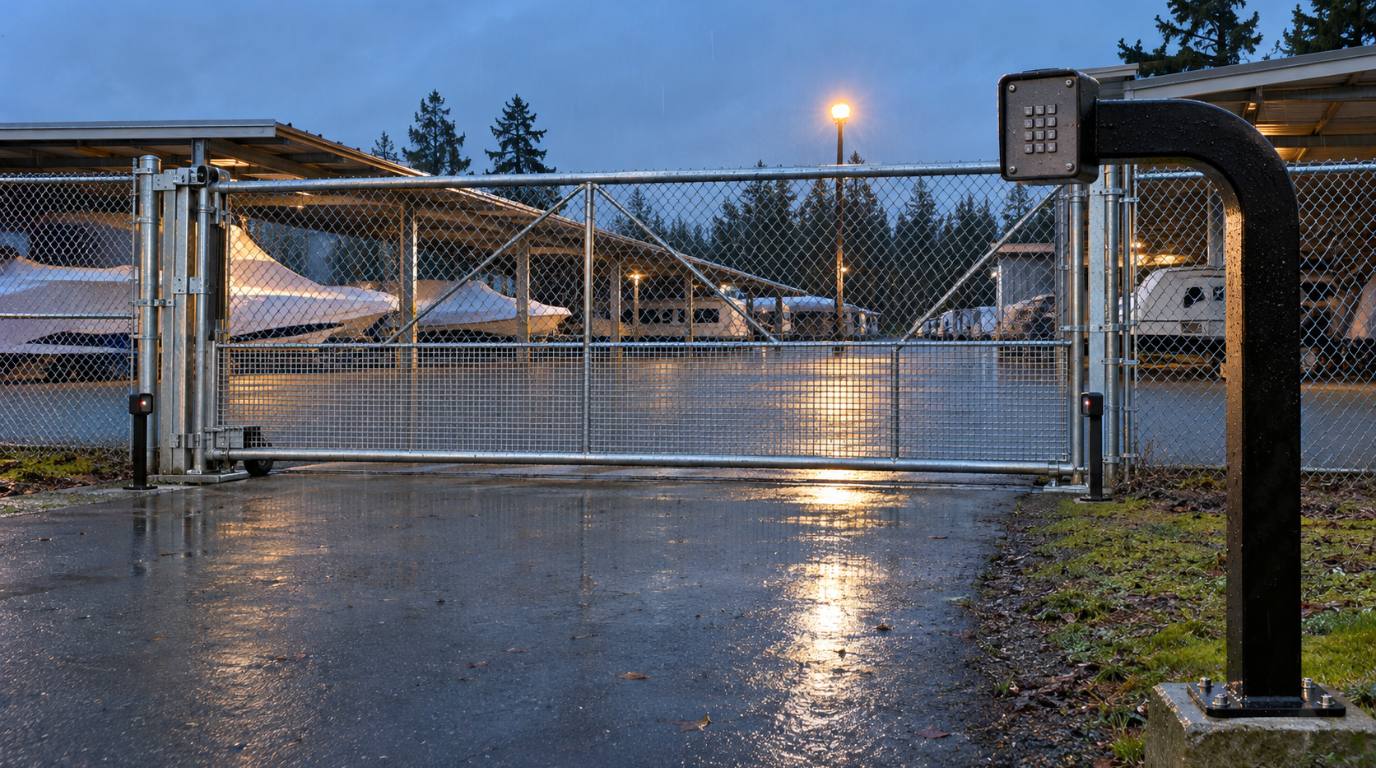
On a chain link gate, the open mesh affects how those devices are placed.
- Photo eyes see through the gate. A beam aimed through the mesh at a shallow angle may be broken by the gate itself, causing false stops, or miss the zone it should protect.
- Edges on a round frame. Edges need mounting channels made for round pipe, or a flat member welded to the frame.
- Both faces of the gate. A person on either side of open mesh can be reached by the gate.
- Signals from a moving gate. Wireless edge transmitters avoid cords that snag in the mesh.
The DASMA checklist adds two simple rules worth repeating. The obstruction sensing must be adjusted and tested so the gate stops and reverses a minimum of 2 inches upon contacting an object. And there must be no controls on the gate operator or within 6 feet of the gate, so a person cannot reach through the mesh or stand next to the gate to work the controls.
Our guides to gate photo eye installation in Washington and the gate safety edge in Washington cover placement, testing and maintenance of each device.
Gate Posts and Footings for an Automated Chain Link Gate
An operator adds new loads to gate posts every cycle, and posts that were fine for a manual gate can loosen.
The CLFMI specification gives gate post sizes for swing gates under ASTM F900, based on gate height and leaf width. For gates with fabric up to 6 feet high, it lists:
| Gate leaf width (fabric up to 6 ft high) | Gate post outside diameter |
|---|---|
| Up to 4 ft | 2.375 in |
| Over 4 ft to 10 ft | 2.875 in |
| Over 10 ft to 18 ft | 4.000 in |
Taller gates need larger posts. For fabric over 6 feet and up to 12 feet high, CLFMI lists 2.875 inches for leaves up to 6 feet wide, 4.000 inches over 6 to 12 feet, 6.625 inches over 12 to 18 feet and 8.625 inches over 18 to 24 feet. For cantilever slide gates, its specification calls for 4-inch outside diameter gate posts. These are guide specification values for the gate itself. An operator does not reduce them, and a heavy or long gate on a soft or exposed site may call for more.
Footings matter as much as the posts. The CLFMI specification calls for posts set plumb in concrete according to ASTM F567, with a minimum footing depth of 24 inches plus 3 inches for each foot of fence height over 4 feet, and notes that gate posts require larger footings, with minimums listed in ASTM F567. It also notes that site soil conditions, local frost depth, fence height and wind load may require larger or deeper footings. In Western Washington, saturated winter soils, peat and silt in the river valleys, and glacial till on the uplands all change how a footing behaves.
The operator pad is a footing too, and it has to stay level and lined up with the gate.
Our guide to gate post installation in Washington covers footing depth, frost, soil and utility locates in more detail.
Power, Wiring and Permits in Washington
Line-voltage commercial operators, such as the LiftMaster CSW24UL with its 120 or 230 volt input, take a circuit from a building. Many farm and residential operators, such as the LiftMaster LA412UL, run on a 12-volt battery charged by solar or a transformer. Solar suits farm gates far from a building, if the panel gets winter sun and the battery is sized for December. Our page on solar gate openers covers sizing and placement.
Whatever the power source, wiring a gate operator in Washington is regulated electrical work. Electrical work here is licensed, permitted and inspected under chapter 19.28 RCW and chapter 296-46B WAC. WAC 296-46B-901 requires an electrical work permit for the installation, alteration or maintenance of electrical systems and equipment unless the work is on its exemption list, and gate operators are not on that list. The permit is issued by the Department of Labor and Industries, or by the city in the cities that run their own electrical inspection program.
Grounding is worth a note on chain link: the CLFMI specification says grounding of the fence and gates is not part of the fence contractor’s scope and, when required, must be installed by a licensed electrical contractor. Conduit for loops, keypads and the far side of the opening is far easier to place before paving or new gravel.
Our guide to gate opener wiring in Washington explains wire sizing, conduit and the L&I permit in more depth.
Planning power to a chain link gate far from the building?
We look at the distance, the power source, solar exposure and the conduit route on site, and we handle the operator wiring under our Doors and Gates electrical license.
Access Control and Fire Department Access
The usual devices are remotes, a keypad pedestal at the approach (never within 6 feet of the gate), card or tag readers, intercoms and vehicle detectors. On truck and trailer sites, loops sized for the longest vehicle help keep the gate from closing on a trailer after the truck clears a photo eye. Our guide to the gate loop detector in Washington covers layout, and our access control page covers keypads, readers and intercoms.
Fire access is the other key question. Many chain link gates sit across driveways and yard entrances that fire trucks would use in an emergency. Under IFC 503.6, as adopted in Washington through chapter 51-54A WAC, gates across fire apparatus access roads must meet the code’s rules, and electric gates must use UL 325 listed operators and be built to ASTM F2200. Local fire agencies set the method of emergency opening, which can be a key switch, a lock box, a siren sensor or another device. The rules differ from one city, county and fire district to the next.
Without battery backup, an operator stays put in an outage and must be opened with its manual release; where fire access is involved, ask the fire agency how the gate should behave when power is lost. Our guide to fire department gate access in Washington explains what local fire agencies typically ask for.
Keeping an Automated Chain Link Gate Running Through Washington Weather
Long wet seasons, mud, leaves, needles, frost and winter wind are hard on moving parts.
The DASMA checklist asks installers to explain to owners that a regular maintenance schedule for both the gate and the operator is recommended, including regular testing of entrapment protection according to the manufacturer’s instructions. On a chain link gate, a practical routine looks like this:
- Test the safety devices. Check that the photo eyes and edges stop and reverse the gate, and that the gate reverses when it meets an obstruction. Clean photo eye lenses, which collect rain spots and spider webs.
- Walk the gate’s path. Clear leaves, needles, gravel and mud from under a cantilever gate, from a rolling gate’s track and from the arc of a swing leaf.
- Check rollers and hinges. Look for flat spots, play and noise. Keep them moving freely according to the manufacturer’s instructions.
- Check the frame and fabric. Look for loose ties, torn fabric, cracked welds and new gaps, especially after a vehicle has bumped the gate.
- Check brackets and chain. Make sure operator brackets have not rotated on round pipe, and that chain on a slide gate is tight and level.
- Check the posts. Push on the gate posts after a wet winter. Any movement at the base is a sign the footing has loosened.
- Test the batteries. Battery backup and solar batteries lose capacity with age and in cold weather. Test them before the storm season.
- Look at the signs. The DASMA checklist says warning signs must not be removed and must be replaced when damaged or broken.
Our seasonal automatic gate maintenance guide for Washington lays out what to check through the year. If a chain link gate starts stopping short, reversing for no reason or running slowly, our team handles gate repair across the region.
Before choosing an opener, it helps to work through a short list:
- What is the gate type? Single swing, double swing, cantilever slide or rolling slide?
- What condition is the gate in? Welded frame, square, plumb, moving freely by hand, with sound hinges or rollers?
- Who uses it? Residential, commercial, industrial or restricted access, which sets the UL 325 class.
- How often does it run? A few cycles a day on a farm, or many cycles a day at a commercial yard?
- What is on the gate? Barbed wire, privacy slats, signs or a padlock latch that must come off?
- Does a slide gate need screening? Check every opening on the gate and the fence it passes against the 2.25-inch rule.
- Are the posts and footings sized for the gate and the site?
- Where does power come from? Line voltage, low voltage or solar, and the electrical permit.
- How will people get in and out? Remotes, keypads, readers, intercoms and vehicle detection, plus separate pedestrian access.
- Does the gate cross a fire access road? If so, check the local fire agency’s rules early.
How We Approach Chain Link Gate Automation
Emerald Gate Systems is a family-owned gate company based at 7557 Alpine Lane in Sedro-Woolley, Washington. We design, fabricate in our own shop, install, automate and service residential, farm and commercial gates across Skagit, Whatcom, Snohomish, Island, San Juan, King and Pierce counties. Because one team handles CAD planning, welding, installation, automation, access control, testing and future service, the gate, the operator and the safety devices are planned together instead of added piece by piece.
Every project starts with a free on-site consultation. On a chain link gate, we look at the frame, the hinges or rollers, the posts and footings, the fabric and every opening, the ground under the gate, the space for the operator, the power source and how the gate is used. Then we tell you whether the existing gate can be automated as it is, needs reinforcement or repair in our shop first, or should be replaced. We install and service LiftMaster, Viking and FAAC gate operators, set up keypads, intercoms, telephone entry and card readers, and have a designated electrical administrator on staff for the operator wiring. For larger sites, our commercial gate systems page describes how we plan entrances for businesses and property managers.
Washington requires contractors to show their registration in advertising: Emerald Gate Systems is registered with the Washington State Department of Labor and Industries as a construction contractor (EMERAGS748D6) and holds an electrical contractor license in the Doors and Gates specialty (EMERAGS747KE).
Frequently Asked Questions
Can you put an automatic opener on a chain link gate?
Yes, many chain link gates can be automated. The gate needs a welded, square frame that moves freely by hand, sound hinges or rollers, posts sized for the gate and room for the operator. A gate that sags, racks or drags should be repaired or replaced first, and every automated gate needs a UL 325 listed operator and ASTM F2200 construction.
What kind of opener works on a chain link swing gate?
Chain link swing gates usually take a linear arm operator mounted between the gate post and the frame, or an articulated arm operator on a post or pad. The brackets must be clamped or welded so they cannot rotate on round pipe, and the arm should push on a strong frame member. The operator must be rated for the leaf’s weight and length.
Does chain link mesh need extra screening on an automatic slide gate?
It can. DASMA’s installer checklist says a slide gate must be screened up to 72 inches, or the top of the gate if lower, so a 2.25-inch sphere cannot pass anywhere in the gate or the fence section it covers. The fabric’s mesh size is only part of that check; gaps at the frame, ends and damaged fabric count too.
Do I need a permit to install a chain link gate opener in Washington?
The wiring usually needs an electrical permit. WAC 296-46B-901 requires a permit for electrical installations unless the work is on its exemption list, and gate operators are not on it. Permits come from L&I or from cities that run their own electrical inspection. Gates across fire access roads may also need fire agency approval.
Can a chain link gate with barbed wire be automated?
Yes, many commercial chain link gates with barbed wire are automated. The DASMA installer checklist includes barbed wire and barbed tape height limitations among the items to confirm for the gate type. The extra weight is small, but the wire’s position near people, the gate’s path and any pedestrian access has to be reviewed during the safety check.
Will privacy slats affect a chain link gate opener?
Yes. Slats or windscreen fabric add weight and greatly increase wind load, because air can no longer pass through the mesh. On an exposed Washington site, an opener that ran fine on an open gate may stall or reverse in gusts after slats go in. Plan the operator, posts and safety devices for the covered gate, not the open one.