
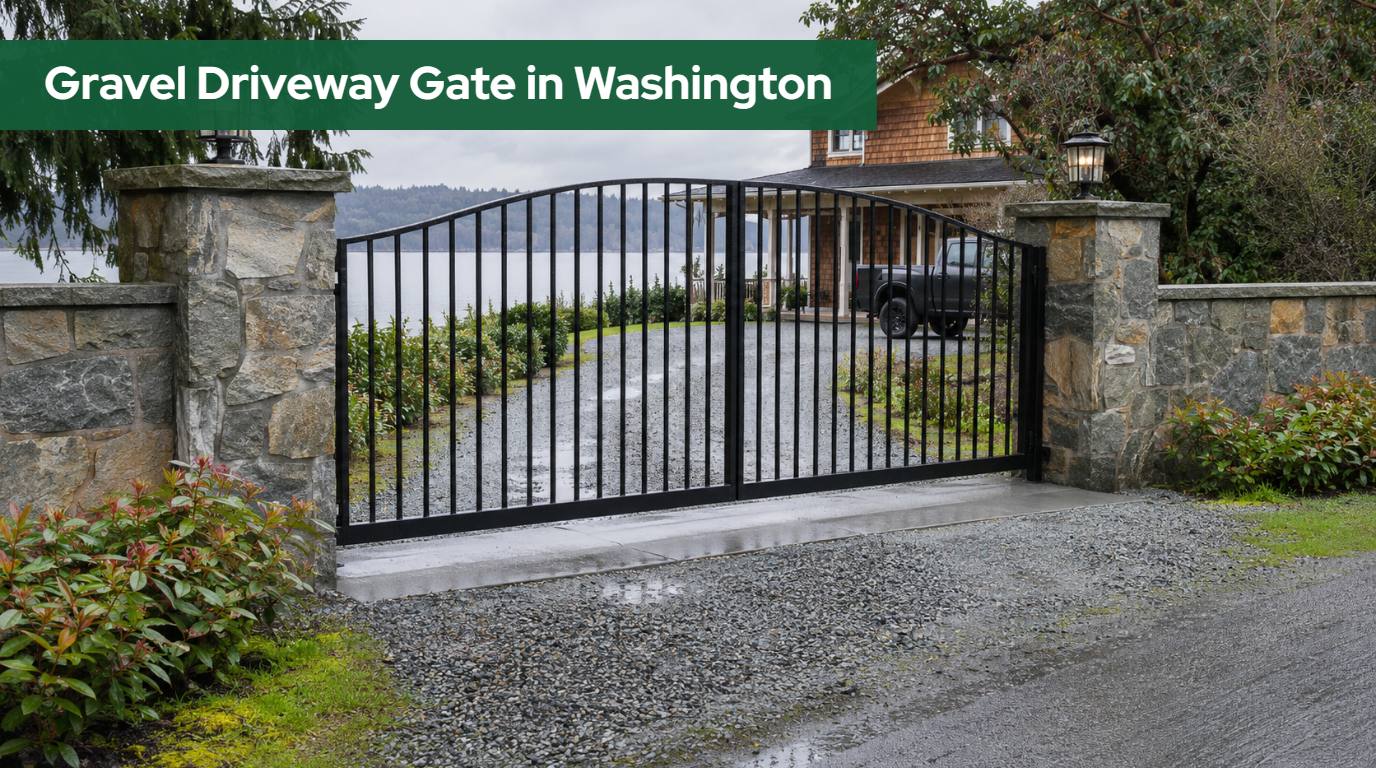
A gravel driveway gate in Washington can work as well as a gate on asphalt or concrete, but only if the design accepts one fact: gravel moves. Tires push it sideways, November rain washes it downhill, plows scrape it into piles and frost lifts it. A gate that assumes a flat, permanent surface under it will drag, jam or stop reversing properly within a season or two.
Most rural and acreage driveways in Skagit, Whatcom, Snohomish and Island counties are gravel, and many owners have no plan to pave them. That is fine. The fix is not paving the whole driveway; it is building a stable zone at the gate line and choosing hardware that does not depend on loose rock. This guide covers which gate types suit gravel, why a concrete apron matters, how sliding gates and vehicle sensors are installed in unpaved ground, what Washington fire access and grade rules say about gravel surfaces, and how to keep the setup working through Western Washington winters.
Quick answer
A gate works on gravel when the gate line is built for it: a concrete apron or strip under the gate, a cantilever or well-guarded slide instead of a track in loose rock, buried preformed loops or exit wands instead of saw-cut loops, and good drainage. In Washington, fire access grade and surface rules are set locally.
In this guide
- What changes with a gravel driveway gate
- Washington rules that touch a gravel driveway
- Which gate type works best on gravel
- The concrete apron at the gate line
- Swing gates on gravel
- Sliding gates on a gravel driveway
- Loops, wands and photo eyes in gravel
- Drainage, rain and frost
- Fire access on gravel driveways
- Conduit, wiring and 811
- Plowing, grading and equipment near the gate
- Maintenance routine
- What drives the cost
- Planning checklist
- How we approach gravel driveway gates
- Frequently asked questions
What Changes With a Gravel Driveway Gate in Washington?
Four things change. First, the height of the surface changes. New rock gets spread every few years, ruts form in the wheel paths, and a grader or tractor blade can raise or lower the surface by inches in an afternoon. A swing gate set with a tight bottom clearance on day one may drag after the next load of crushed rock.
Second, loose material moves into the gate’s path. Stones migrate into ground tracks, pile up against the gate bottom and wedge under the leading edge. A slide gate wheel that rides over a stone lifts, binds or derails. Swing gates push gravel into a berm at the end of their arc and then stop short of fully open.
Third, the usual sensors do not fit. Saw-cut loops need a solid surface to cut into. Gravel cannot hold one. Vehicle detection on gravel needs a buried, preformed loop or a different device altogether.
Fourth, water behaves differently. A paved driveway sheds water. Gravel soaks it up, carries fines downhill and turns soft at low spots. The gate line is often a low spot, because it sits where the driveway meets the road ditch. In a climate where most of the year’s rain falls between October and March, that is where trouble starts.
None of this makes gravel a bad base for an automatic gate. It means the design has to put something stable where stability matters, at the gate line, the operator pad and the sensor locations, and let the rest of the driveway stay gravel.
Washington Rules That Touch a Gravel Driveway
There is no single statewide rule for driveway surfaces under a gate. Washington adopts the International Fire Code through the state building code, but the state amendment in WAC 51-54A-0503 says fire apparatus access roads are provided and maintained according to locally adopted street, road and access standards, and it does not adopt the model code’s general specifications section. So the surface, width and grade rules for a driveway that doubles as fire access come from the county or city.
Skagit County is a good example of how specific those local rules get. Its Driveway Standards for Skagit County (updated October 9, 2018) apply to all building permits and set the surface by grade:
| Driveway grade | Surface allowed | Fire suppression | Water storage |
|---|---|---|---|
| 12% or less | Gravel or equivalent, or concrete, asphalt or equivalent | Not required | Not required |
| Over 12% up to 14% | Concrete, asphalt or equivalent only | Not required | Not required |
| Over 14% up to 16% | Gravel or equivalent, or concrete, asphalt or equivalent | NFPA 13D sprinkler system | Not required |
| Over 16% | Gravel or equivalent, or concrete, asphalt or equivalent | NFPA 13D sprinkler system | 10,000-gallon tank with dry hydrant for each residence |
The same sheet sets a 12-foot driveway width and 13 feet 6 inches of vertical clearance for driveways serving one or two residential lots, 20 feet of width for three or more lots or commercial use, and turnouts 20 feet wide and 30 feet long every 300 feet on longer single-lot driveways. It requires a fire apparatus access road when a building is more than 150 feet from fire apparatus access.
Two lines on that sheet matter directly for gates. Width and clearance must be maintained at all times, and security gates across fire access roads must be approved by the Skagit County Fire Marshal and have an approved means of emergency operation by fire personnel. A gate on a gravel driveway that serves as fire access has to meet those terms like any other gate.
Other jurisdictions phrase the surface rule differently. The 2021 Seattle Fire Code, Appendix D, section D102.1, calls for an asphalt, concrete or other approved driving surface capable of supporting fire apparatus weighing up to 75,000 pounds. Whatcom, Snohomish, Island and San Juan counties and the cities inside them each have their own adopted standards. The practical point is simple: before regrading a gravel driveway or adding a gate to it, find out which local standard applies, what it says about surface and grade, and whether the driveway is a required fire access road. Our guide to gate permits in Washington State covers the permit side in more detail.
The gate operator itself is covered by a statewide rule. Section 503.6 of the fire code, as adopted in Washington, requires electric gate operators to be listed to UL 325 and gates intended for automatic operation to be designed, constructed and installed to ASTM F2200. Gravel does not change that. It does change how hard it is to keep the safety devices working, which later sections cover.
Which Gate Type Works Best on a Gravel Driveway?
Every vehicle gate type can be installed on a gravel driveway. They differ in how much they depend on the ground under them. The table compares them for a typical rural Washington entrance.
| Gate type | Contact with the ground | On gravel | What it needs |
|---|---|---|---|
| Swing (single or pair) | None while moving, if clearance is right | Good choice when the arc behind the gate is clear and level enough | Bottom clearance that allows for future rock, a hard surface or apron in the arc, solid stops |
| Cantilever slide | None; rollers sit on posts beside the opening | Often the best slide option on gravel | Room along the fence for the gate plus its counterbalance tail, a consistent grade along the path |
| Track-type slide | Wheels ride a ground track the whole way | Works only with a solid strip under the track | A concrete strip or beam for the full travel, a clean track, guarded wheels |
| Vertical pivot | None; the panel rises on a pivot | Strong choice for gravel, mud and snow | Space overhead and a heavy foundation for the operator |
| Barrier arm | None | Good for traffic control, not security | A small pad for the cabinet, detection that works in gravel |
For most homes and farms the real choice is between a swing gate and a cantilever slide. A swing gate is simpler and costs less to build, but it needs a clear arc on the inside of the property, and on gravel that arc must stay at the right height. A cantilever slide needs a run along the fence line at least as long as the opening plus its tail, and in exchange it never touches the driveway at all. Our comparison of sliding vs. swing gates in the Pacific Northwest walks through that decision in more depth, and the cantilever gate installation guide explains why the trackless design suits gravel so well.
The Concrete Apron: Why the Gate Line Should Not Be Gravel
The single most useful thing on a gravel driveway gate is a poured concrete apron at the gate line. It is a slab, or a reinforced strip, that runs across the driveway under the gate and extends far enough in each direction to cover everything the gate and its devices depend on. The rest of the driveway stays gravel.
An apron does several jobs at once:
- It fixes the bottom clearance. The gate is set to a surface that will not rise or sink. New rock can be spread on either side and feathered to the edge of the slab without touching the gate’s clearance.
- It gives sensors a stable home. A loop can be cast into the slab or saw-cut into it, photo eye posts can be anchored at its edges, and their alignment holds.
- It stops ruts at the most important spot. Every vehicle that enters slows, stops or turns at the gate. That is where gravel ruts fastest. Concrete there removes the problem.
- It controls water. A slab with a slight crown or cross slope sends water to the sides instead of letting it pond against the gate or soften the base under the posts.
- It keeps the gate path clean. Stones get pushed off a smooth surface by the next vehicle instead of nesting in loose rock where the gate bottom catches them.
How big the apron should be depends on the gate. For a swing gate, it should cover the full arc of each leaf on the side the gate opens, because that is where gravel berms form and where clearance matters most. For a track-type slide, it becomes a strip that carries the track for the whole travel, including the storage run beside the opening. For a cantilever slide, it often needs to cover only the opening itself, plus the pads for the roller posts and the operator.
Want a gate on gravel without paving the whole driveway?
We look at the grade, the drainage and how vehicles use the entrance, then lay out the apron, pads and gate type that fit before anything is poured.
Swing Gates on Gravel: Clearance, Stops and Ruts
A swing gate is the most common choice for a gravel driveway, and it is often the right one. Most problems with swing gates on gravel come from three details.
Bottom clearance. On a paved surface, the gap under a swing gate can be small. On gravel without an apron, it has to allow for the driveway to rise as new rock is spread and for loose stones to sit in the path. If the gap is too small, the gate drags and the operator reads the drag as an obstruction. If the gap is very large, pets and small animals pass under it and the gate looks unfinished. An apron solves this by giving a fixed surface to measure from.
The arc behind the gate. A swing gate needs the ground inside its arc to be lower than the gate bottom at every point of travel. On gravel, tires push rock outward from the wheel paths, and the gate itself shoves stones toward the end of its swing. Over time a ridge builds up where the gate stops, and the gate stops a little earlier each month. On driveways that climb away from the road, the arc may hit the slope even without gravel buildup. Our guide to a driveway gate on a slope explains the clearance math and the hinge and gate options for uphill entrances.
Stops and the closed position. Many swing gates close against a center stop set in the driveway. On gravel, a stop set in loose rock can be knocked out of line by a plow or a tire, and the gate then closes past its correct position. A stop set into the apron, or a design that does not need a ground stop, avoids that. The operator’s own limits should define the open and closed positions where the manufacturer allows it.
Sliding Gate on a Gravel Driveway: Track, Strip or Cantilever
“Sliding gate on gravel driveway” is one of the most common searches on this subject, and the answer depends on which kind of slide gate you mean.
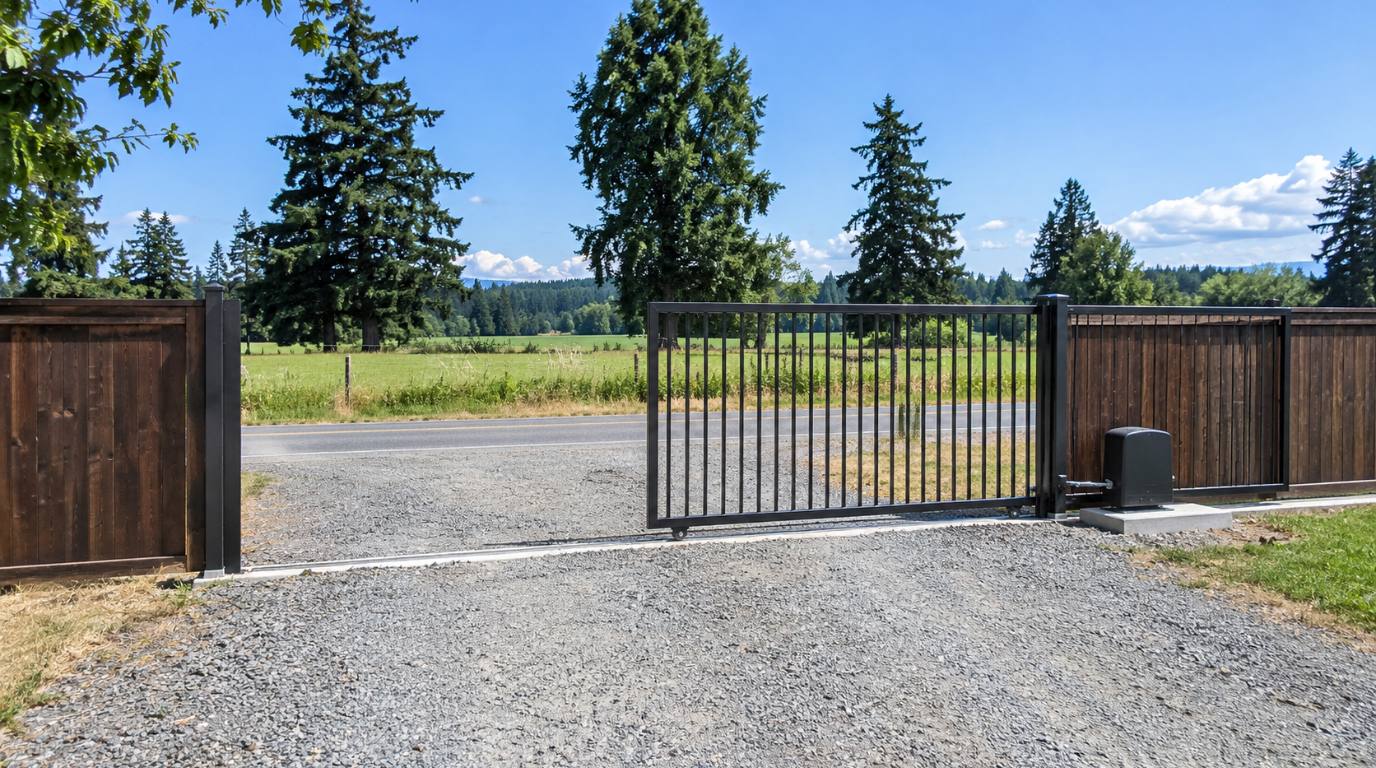
A track-type slide gate rides on wheels along a ground track, usually a V-shaped rail. It cannot run on gravel. The track needs a solid, level base along its whole length, which in practice means a concrete strip or grade beam across the opening and along the storage run beside it. Manufacturer documents reflect this. FAAC’s installation manual for its 746 slide operator rates the operator’s pulling capacity on the assumption of high-quality, lubricated bearing rollers on a level V track. LiftMaster’s manual for its RSL12UL slide operator lists debris on the gate’s track, such as mud, rocks and dirt, among the conditions that make the operator sense an obstruction and sound its alarm.
A cantilever slide gate avoids the problem by carrying the gate on rollers mounted to posts beside the opening. A counterbalance section extends behind the gate, so nothing touches the driveway as the gate moves. On gravel, that is a big advantage. The ground along the slide path still needs a consistent grade so the gate bottom clears high spots, rock buildup and frost heave.
Both types need a solid operator pad. LiftMaster’s RSL12UL instructions call for a concrete pad, with reinforced concrete recommended. FAAC’s 746 manual calls for a concrete mounting slab at least 18 inches below ground level or just below the frost line, whichever is greater, with the top set level with the bottom frame member of the gate, and says to let the concrete set at least two days before mounting the operator. On gravel, the pad also has to stay clear of the drive lane and of plow paths.
Safety rules apply the same way on gravel. Under ASTM F2200, as summarized by DASMA, weight-bearing rollers below 8 feet must be guarded, and protrusions on the bottom of the gate are limited to half an inch. On a gravel site, guards and covers also keep stones out of the rollers. Our sliding gate opener guide covers operator sizing and safety devices for slide gates.
Loops, Wands and Photo Eyes in Gravel
Automatic gates use vehicle detection for two jobs: opening the gate for vehicles leaving the property (free exit) and keeping the gate from closing on a vehicle in its path. On pavement, the usual answer is an induction loop saw-cut into the surface. Gravel cannot hold a saw-cut loop, so the options change.
Preformed direct-burial loops. These are factory-made loops sealed in a jacket and buried under the driveway surface. Installation instructions from BD Loops, one manufacturer of these loops, describe the gravel road method this way: dig a trench 7 to 10 inches deep in the shape of the loop and its lead-in, put a 1-inch sand base in the trench, lay the loop, cover it with sand, compact the sand around the loop and then fill with road base. The lead-in runs through rigid schedule 40 or 80 PVC with glued joints. The same sheet gives layout guidance: exit and reverse loops about 4 feet from the gate, 3 feet from a swing gate’s full open and closed positions, and 4 feet from any other loop. It also notes that detection height is roughly two-thirds of the loop’s short leg, with a 4-foot short leg typical for residential use and 6 feet for commercial sites with higher vehicles.
Exit wands and probes. A vehicle detection wand, sometimes called a probe, is a magnetometer buried beside the driveway instead of under it. It senses a large metal object passing nearby. Wands suit gravel because nothing is installed in the drive lane. They are a common choice for free exit on long rural driveways.
Photo eyes. Photo eyes are non-contact sensors mounted on posts or the gate frame on each side of the opening. On gravel, their posts need footings in stable ground or on the apron edge, because a post set loosely in rock gets bumped out of alignment. UL 325 requires two independent means of entrapment protection for each entrapment zone, as the DASMA technical summary of the standard explains, and external sensors must be monitored by the operator. A photo eye that has drifted out of alignment stops the gate, so alignment on a stable post is part of keeping the gate working.
Our gate loop detector guide covers loops, wands and detector settings in detail, and the photo eye installation guide explains placement for slide and swing gates.
Drainage, Rain and Frost at a Gravel Gate
Western Washington rain is the main reason gravel gate lines fail. NOAA 1991 to 2020 climate normals put Sedro-Woolley’s average annual precipitation at 48.53 inches and Concrete’s at 71.24 inches. Even the drier island stations get real rain: Coupeville averages 21.74 inches. At every station in our climate data, November is the wettest month, and 65 to 76 percent of the year’s precipitation falls between October and March.
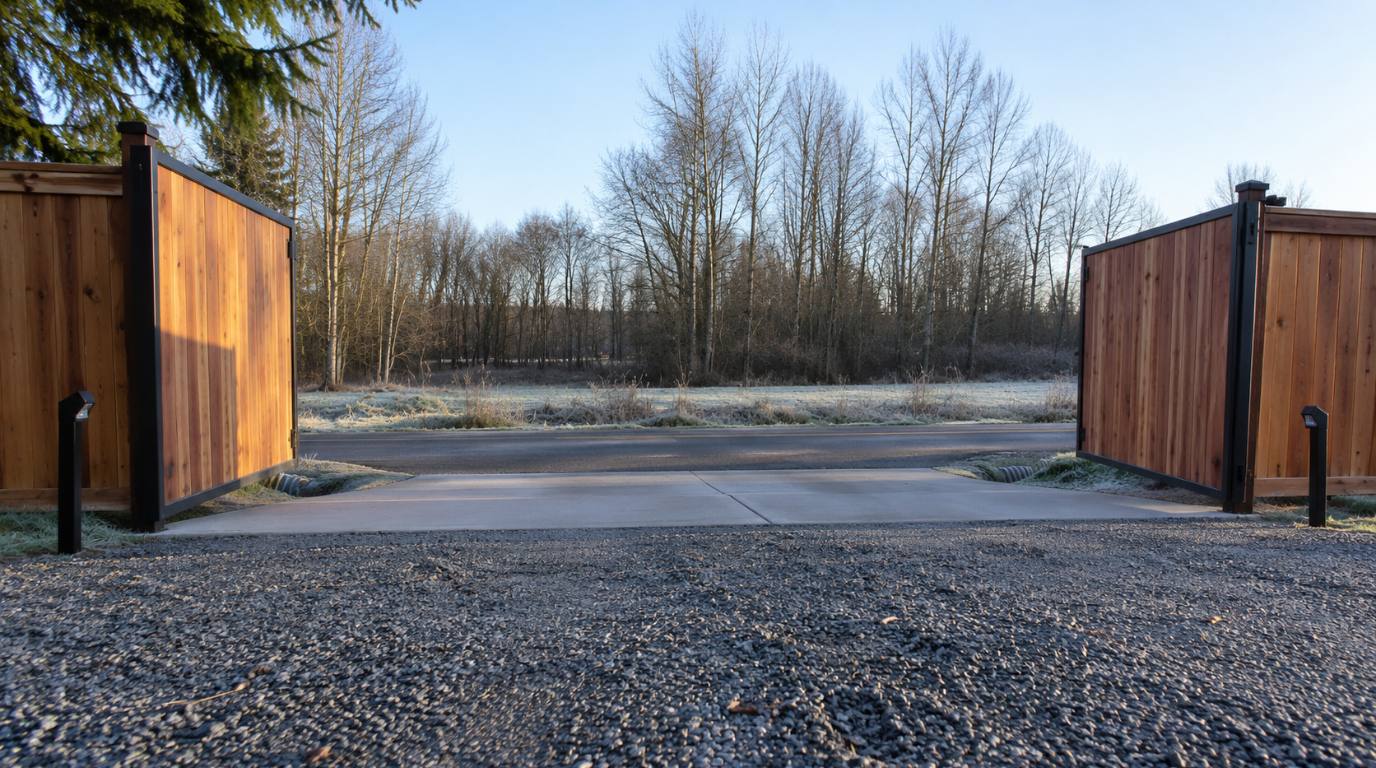
That rain does three things to a gravel entrance. It softens the base at low spots, so ruts deepen quickly. It carries fines out of the rock, which leaves loose, rounded stone that rolls into the gate path. And it ponds where water has nowhere to go, often right at the gate line, because the gate is usually set where the driveway meets the road and its ditch.
A gravel gate line should be planned around water:
- Crown or cross-slope the apron. Water should leave the concrete to the sides, toward vegetated ground or a ditch, not run along the gate bottom.
- Keep the road ditch flowing. Many rural driveways cross a roadside ditch on a culvert. A blocked culvert backs water up into the entrance. Check the culvert at the start of each wet season.
- Protect footings and pads. Gate posts and operator pads set in saturated ground can settle or tilt. Footing depth and drainage around them matter as much as the concrete itself.
Frost adds to the problem in colder spots. Bellingham International Airport averages 58.6 nights a year at or below 32°F, the most of the stations in our data, and foothill sites see more. Water in the gravel base freezes, expands and lifts the surface, which can close the gap under a swing gate overnight. Published frost depths in our service area run from 12 inches in San Juan County, Island County and Seattle to 18 inches in the City of Snohomish; Skagit and Whatcom county handouts do not publish one, so footing depth is set by the local building department and the manufacturer’s instructions. Our Northwest Washington gate climate atlas lists rainfall, freezing nights, frost depths and design wind speeds by area, and the gate post installation guide covers footings in wet ground.
Gate dragging, stalling or reversing on a wet gravel drive?
We check clearance, sensors, the base under the gate and where the water goes, then tell you what to fix first and what can wait.
Fire Access on Gravel Driveways
Many rural gravel driveways in Washington are also the fire access route to the house. When that is the case, the gate becomes part of the fire access road and has to meet local fire rules, not just the owner’s wishes.
In Skagit County, the driveway standards require a fire apparatus access road when a building is more than 150 feet from fire apparatus access. For one or two residential lots, the driveway must be 12 feet wide with 13 feet 6 inches of vertical clearance, and those dimensions must be maintained at all times. Gravel is an accepted surface at 12 percent grade or less. A security gate across the access road needs approval from the Skagit County Fire Marshal and an approved means of emergency operation by fire personnel.
For a gravel driveway gate, that has practical consequences:
- The open gate must not narrow the drive. Swing leaves parked against the fence, slide gates fully stored and posts outside the required width keep the clear opening.
- Overhead parts must clear 13 feet 6 inches. Arches, beams and overhead tracks across a fire access driveway count against vertical clearance.
- Emergency operation must work in all weather. A key switch, lock box or other approved device is useless if the gate is frozen to a gravel berm or jammed by rock in the track. The gravel design choices above are part of fire access, not separate from it.
Fire rules differ by jurisdiction. The 2021 Seattle Fire Code, Appendix D, for example, sets its own gate width, manual operation and approved emergency opening rules. Our fire department gate access guide compares requirements across Northwest Washington jurisdictions and the devices fire departments use.
Conduit, Wiring and 811 Under a Gravel Drive
Gravel driveways are often trenched more casually than paved ones, because “it is just rock.” That is a mistake. Gate power, low-voltage control wiring and loop lead-ins all run under or beside the drive, and so may water lines, power to outbuildings and communication cables.
Washington’s underground utility law, RCW 19.122.030, requires an excavator to mark the excavation area in white and to notify facility operators through the one-number locator service, 811, not less than two full business days and not more than 10 full business days before the scheduled start. LiftMaster’s slide operator manual tells installers to contact underground utility locating companies before digging more than 18 inches deep. Utility locates cover the utilities’ own lines, not private lines the owner installed, so private power and water lines to a shop or well also need to be found before trenching.
Conduit across a gravel driveway needs to sit deep enough that grading and heavy equipment will not crush it, and it should be laid out so the crossing is in a known place. Placing conduit under the future apron before it is poured is the easiest approach. Spare conduit for later additions, such as a keypad, intercom or camera, costs little when the trench is open and saves cutting a finished surface later.
In Washington, gate operator electrical work is licensed work. Our gate opener wiring guide explains the door, gate and similar systems specialty under WAC 296-46B-920, power options for long driveways, and how low-voltage and line-voltage wiring are separated.
Plowing, Grading and Equipment Near the Gate
Gravel driveways get maintained with blades and buckets. Snow plows, box scrapers, tractor blades and graders all move rock around the gate, and each one can damage something that a paved driveway never exposes.
The common damage on gravel sites includes plow blades catching the edge of a concrete apron or track strip, grading that buries or exposes loops and conduit, piles of rock or snow pushed against gate posts and operator housings, and photo eye posts knocked out of line by equipment. A few design choices limit it:
- Set the apron flush with the finished gravel, with a beveled or thickened edge, so a blade rides over it instead of catching.
- Keep operators, control boxes and sensor posts out of the plow path, protected by the fence line or by bollards where vehicles and equipment pass close.
- Mark loop locations and conduit crossings on a simple site sketch kept with the gate manual, and share it with whoever grades the driveway.
- Agree where plowed snow and graded rock will go so it is not piled against the gate leaves, the storage run of a slide gate or the swing arc.
Maintenance Routine for a Gravel Driveway Gate
A gate on gravel needs a little more attention than one on pavement. Most of the work is simple and can be done by the owner; the rest belongs in a scheduled service visit.
Monthly or after storms:
- Sweep or rake stones off the apron and out of any track.
- Look along the gate bottom and the swing arc for rock buildup or a forming berm.
- Check that the gate opens fully and closes fully without dragging or reversing.
- Wipe photo eye lenses and check that their indicator lights show alignment.
- Look at the culvert and ditch at the driveway entrance for debris.
Each fall, before the wet season:
- Check bottom clearance at several points of travel and adjust if new rock has raised the driveway.
- Confirm the free exit loop or wand still detects vehicles reliably.
- Test the reversing function with the safety devices, following the manufacturer’s test procedure.
- Clear leaves and fir needles from tracks, roller guards and the base of the operator.
- Check that the gate’s emergency operation for fire crews still works.
Our seasonal automatic gate maintenance guide for Washington covers the full routine, and if the gate already stalls or reverses, the troubleshooting guide for a gate that will not open or close lists common causes in order.
Want your gravel entrance checked before winter?
We inspect clearance, tracks, loops, photo eyes and emergency operation, and show you what to adjust as the driveway changes.
What Drives the Cost of a Gate on Gravel
A gate on a gravel driveway is priced like any other automatic gate, plus the work that makes the gate line stable. Every site is different, so this section lists what moves the total instead of quoting numbers.
- Apron size and design. A strip under a cantilever opening is much less concrete than a slab covering two full swing arcs or a strip carrying a track for the whole slide travel.
- Base preparation. Soft or saturated ground at the gate line may need excavation and compacted base before any concrete is poured.
- Drainage work. Regrading, a cross slope or work at the ditch and culvert adds to the site work.
- Gate type. A cantilever gate needs more steel and longer foundations along the fence line; a swing gate needs more apron. The right choice depends on the site.
- Detection. Buried preformed loops, loops cast into new concrete and exit wands differ in materials and labor.
- Power and distance. Long trenches to a house or shop, or solar power with battery storage, change the electrical scope.
Our guide to automatic driveway gate cost in Washington State explains how those factors combine into a quote.
Planning Checklist for a Gravel Driveway Gate
Before choosing a gate for a gravel driveway in Washington, work through these questions:
- Is the driveway a required fire access road, and which local standard applies to its width, clearance, grade and surface?
- What is the grade at the gate line, and does any part of the driveway exceed the gravel limits in that standard?
- Where does water go during a November storm? Is the planned gate line in a low spot or next to a ditch and culvert?
- Is there room on the inside of the property for a swing arc, or along the fence for a slide gate and its tail?
- Will the gate line get a concrete apron, and how far must it extend for the chosen gate type?
- How will vehicles be detected for free exit and safety: buried loop, loop in the apron, or wand?
- Where will power come from, and where will conduit cross the driveway?
- Have 811 locates been requested, and are private lines to outbuildings and wells mapped?
- Who plows and grades the driveway, and where will snow and rock be pushed?
- How will fire crews open the gate during a power outage?
How We Approach Gravel Driveway Gate Projects
Emerald Gate Systems is a family-owned gate company based at 7557 Alpine Lane in Sedro-Woolley, Washington. Our team has more than 15 years in the trade, and the same people handle CAD planning, welding, installation, automation, access control, testing and future service, so the gate is not handed between separate companies.
On a gravel driveway, we start with a free on-site consultation and look at the ground before the gate. We note the grade, where water runs and pools, how vehicles approach and turn, who grades and plows the driveway, and whether it serves as fire access. Then we recommend the gate type and the site work together: the apron or strip, the operator pad, the detection method and the conduit route. If the driveway will be paved later, we plan for that too.
We install and service LiftMaster, Viking and FAAC operators, and we fabricate gates in our own Sedro-Woolley shop in hand-forged wrought iron, laser-cut steel and Western Red Cedar. Our automatic gate installation page describes the full process, and our farm and agricultural gates page covers gates for acreage and working properties. We serve Skagit, Whatcom, Snohomish, Island, San Juan, King and Pierce counties.
Washington requires contractors to show their registration in advertising: Emerald Gate Systems is registered with the Washington State Department of Labor and Industries as a construction contractor (EMERAGS748D6) and holds an electrical contractor license in the Doors and Gates specialty (EMERAGS747KE).
Frequently Asked Questions
Can you put an automatic gate on a gravel driveway?
Yes. Automatic gates work on gravel when the gate line is built for it. The usual approach is a concrete apron or strip under the gate, a solid pad for the operator, detection that does not need a saw-cut loop, and drainage that keeps water away from the gate. The rest of the driveway can stay gravel.
Can a sliding gate run on a gravel driveway?
A track-type sliding gate cannot run in loose gravel. Its track needs a solid, level base, usually a concrete strip for the full travel, and it must be kept clear of stones. A cantilever slide gate is often the better choice on gravel because it rides on rollers beside the opening and never touches the driveway.
Do I need a concrete pad under a gate on a gravel driveway?
The operator always needs a solid pad; manufacturers such as LiftMaster and FAAC call for concrete. A concrete apron across the driveway is not always required, but it fixes the bottom clearance, gives sensors a stable home and stops ruts where every vehicle stops. On most gravel entrances it is the most useful upgrade.
How do you install a gate loop in a gravel driveway?
Gravel cannot hold a saw-cut loop, so a preformed direct-burial loop is used. One manufacturer’s gravel road method trenches 7 to 10 inches deep, beds the loop in sand, compacts it and backfills with road base, with the lead-in in glued rigid PVC. A loop cast into a concrete apron or an exit wand beside the drive are other options.
Is gravel allowed on fire access driveways in Washington?
It depends on local standards. In Skagit County, gravel is allowed on driveways at 12 percent grade or less; from over 12 up to 14 percent, the surface must be concrete, asphalt or equivalent. Seattle requires an approved surface that supports 75,000-pound fire apparatus. Check the county or city standard before building.
How much clearance should a gate have over gravel?
There is no single number. The gap must stay clear as new rock is spread, ruts form and frost lifts the surface, while staying small enough to look right and keep animals in. That moving target is the main reason to pour a concrete apron under the gate, so clearance is measured from a surface that does not change.