
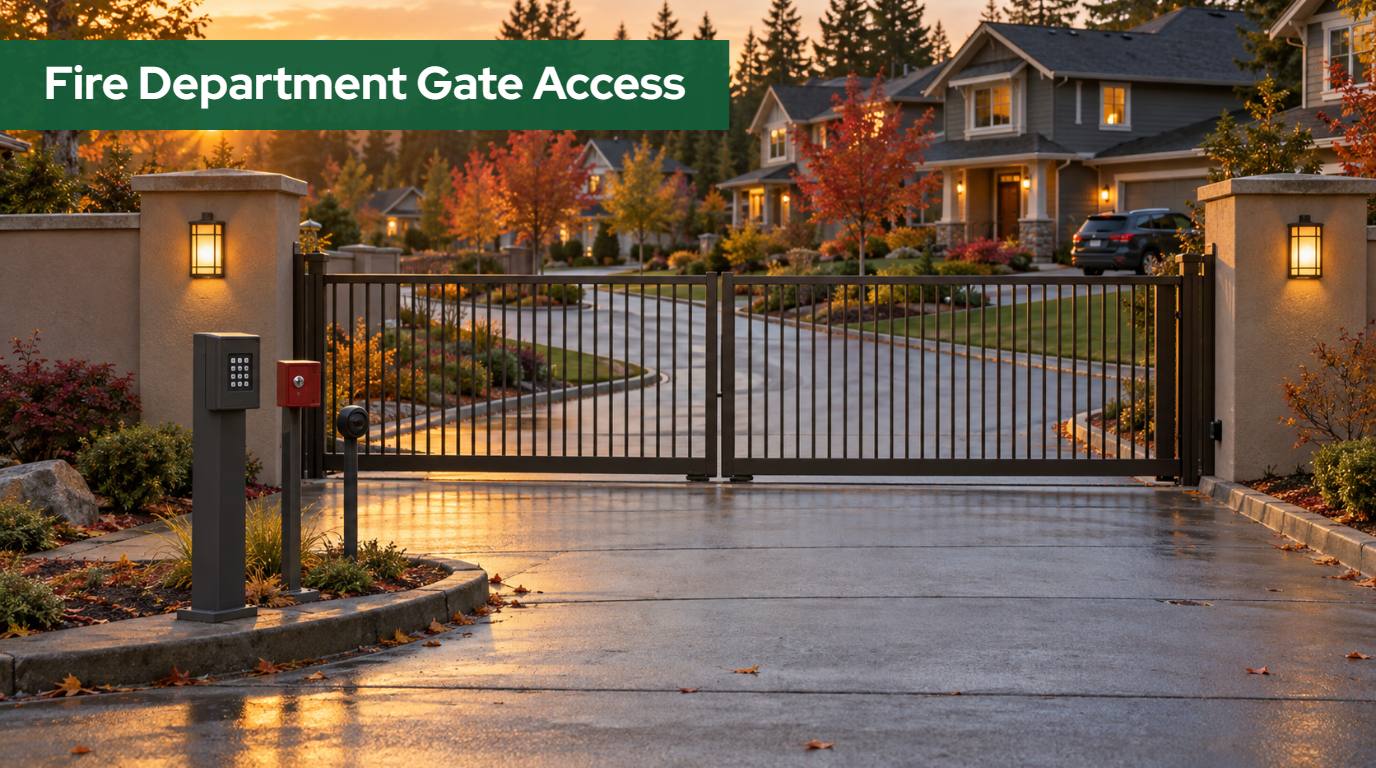
Any gate that closes across a driveway or private road can also close out a fire engine. That is why fire department gate access in Washington is not an afterthought you add once the gate is built. If the road behind the gate is a required fire apparatus access road, the local fire code official has to approve the gate, and the gate has to open for firefighters without anyone at home, without a working phone and, in many places, without power.
This guide explains what Washington’s fire code says about gates, why the answer changes from one fire agency to the next, and how the common emergency access devices work: the Knox key switch, the key box, the fire department padlock, the strobe-activated sensor and radio entry. It also covers width, power failure, manual gates, permits and inspection. It is written for homeowners, farm owners, HOA boards and property managers in Skagit, Whatcom, Snohomish, Island, San Juan, King and Pierce counties.
Quick answer
Fire department gate access in Washington is set locally. The state fire code requires the fire code official to approve any security gate across a fire apparatus access road and an approved means of emergency operation, usually a Knox key switch, plus a strobe sensor or radio entry where the local agency requires it.
In this guide
- What fire department gate access in Washington means
- What Washington’s fire code says about gates
- Why the rules change from one fire agency to the next
- Knox key switch, key box, padlock, strobe sensor and radio entry
- How local Washington standards compare
- Gate width, setback and clearance
- Power failure: open on loss of power or stay closed?
- Manual gates, padlocks, chains and bollards
- HOAs, private roads and rural driveways
- Placing and wiring the emergency access device
- Permit, plan review and inspection
- Adding fire access to an existing gate
- Testing and maintenance
- How we approach fire access on gate projects
- Frequently asked questions
What Fire Department Gate Access in Washington Means
A fire apparatus access road is the route a fire engine, ladder truck or ambulance uses to reach a building. In the code it can be a public street, a private road, a parking lot lane or a long residential driveway, as long as it is the access the fire agency counts on. When a gate crosses that route, the gate becomes part of the fire department’s path, and the fire code treats it that way.
Fire department gate access means two things. First, the gate itself has to be approved: its width, its location, its locking method and how it behaves when the power goes out. Second, the gate needs an approved means of emergency operation, a way for responders to open it in seconds without the owner. On an automatic gate that is usually a key switch wired to the operator, sometimes joined by a sensor that opens the gate when an emergency vehicle approaches. On a manual gate it is usually a fire department padlock or a key box holding the gate key.
Not every gate falls under these rules. A gate on a short driveway where the house is close to the street may not sit on a required fire apparatus access road at all. Skagit County’s driveway standards, for example, require a fire apparatus access road when a facility is more than 150 feet from fire apparatus access. Beyond that distance, the driveway itself becomes the access road, and a gate on it needs the Fire Marshal’s approval. If you are unsure, the local fire marshal’s office can tell you whether your gate is on a required access route before you buy hardware.
Fire access is one layer of a larger safety picture. The gate and operator still have to meet the entrapment protection rules of UL 325 and the construction rules of ASTM F2200, which we explain in our guide to automatic gate safety standards, UL 325 and ASTM F2200.
What Washington’s Fire Code Says About Gates
Washington adopts the 2021 edition of the International Fire Code statewide through chapter 51-54A of the Washington Administrative Code, with state additions, deletions and exceptions. Section 503 of that code covers fire apparatus access roads, and the state’s version is unusual. Under WAC 51-54A-0503, fire apparatus access roads “shall be provided and maintained in accordance with locally adopted street, road, and access standards.” The model code’s sections on access road specifications, marking and obstruction (503.2, 503.3 and 503.4) are listed as not adopted. The current version took effect on March 16, 2024.
In plain terms, Washington does not set one statewide width or design for fire access roads. Each city, county or fire district sets its own road and access standards. The sections that deal specifically with gates were not struck out, so the model code language on gates still applies statewide, and local agencies add their own requirements on top.
The model code sections that matter for a gate are these, as quoted in the Marysville Fire District standard:
- 503.5 Required gates or barricades. The fire code official may require gates or barricades across fire apparatus access roads, trails or other accessways, not including public streets, alleys or highways. Electric gate operators, where provided, shall be listed in accordance with UL 325, and gates intended for automatic operation shall comply with ASTM F2200.
- 503.6 Security gates. “The installation of security gates across a fire apparatus access road shall be approved by the fire code official. Where security gates are installed, they shall have an approved means of emergency operation.” The gates and the emergency operation shall be maintained operational at all times, with the same UL 325 and ASTM F2200 requirements.
- 105.6.11 Gates and barricades across fire apparatus access roads. A construction permit is required to install or modify a gate or barricade across a fire apparatus access road.
Notice what the code does not say. It does not name a device. “Approved means of emergency operation” is whatever the local fire code official approves, which is why one agency asks for a specific Knox key switch, another accepts radio entry, and a third adds a strobe sensor for residential communities.
Many local agencies also adopt Appendix D of the fire code, which lists detailed gate criteria. Seattle’s 2021 fire code, for example, carries a gate section (D103.4 in Seattle’s numbering) that requires a single gate to be at least 20 feet wide, or 12 feet for a divided roadway, with an exception allowing 12 feet of unobstructed width on access roads serving not more than two Group R-3 or Group U occupancies. It also requires gates to be of the horizontal swing, horizontal slide, vertical lift or vertical pivot type, built of materials that allow manual operation by one person, maintained in an operative condition, and, for electric gates, equipped with an emergency opening device approved by the fire code official. You can read the full text in Seattle’s 2021 fire code Appendix D.
Why the Rules Change From One Fire Agency to the Next
Because Washington leaves access road standards to local government, the same gate can be approved in one place and rejected ten miles away. The difference is rarely the gate. It is the device the fire agency carries on its trucks, the way it handles mutual aid, and how its local code amends sections 503.5 and 503.6.
Three questions decide most of it:
- Who is the fire code official for this address? Inside a city it is usually the city fire marshal or a regional fire authority that serves the city. In unincorporated areas it may be the county fire marshal, as in Skagit County, while the local fire district responds to calls. Cities that contract for fire service follow the contracted agency’s standards for keys and access devices.
- Which key system do the responding engines carry? A Knox key switch only helps if the crews that arrive carry the matching key. Some agencies standardize on Knox. Others prefer a radio system that any equipped responder can trigger.
- Has the local code amended the gate sections? Some cities add a strobe sensor, a required power-failure behavior, a setback from the street or a specific key switch model through local ordinance.
Our overview of gate permits in Washington State explains the building and zoning side of the same approval.
Knox Key Switch, Key Box, Padlock, Strobe Sensor and Radio Entry
Emergency access devices fall into two groups: devices a firefighter operates by hand, and devices that open the gate when an emergency vehicle arrives. Most Washington agencies require at least one of the first group, and some require one of the second group as well.
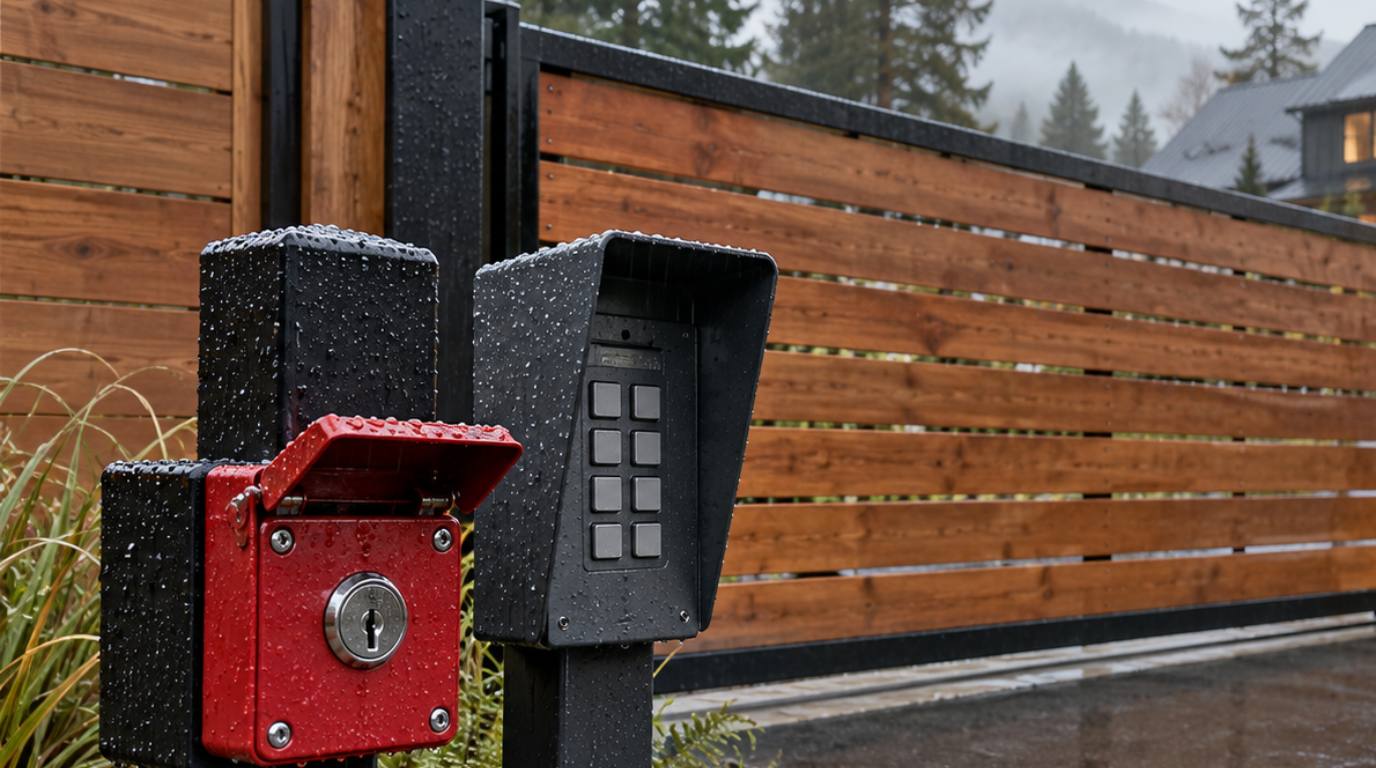
Knox key switch. A Knox key switch, often called a Knox box gate key switch, is a small keyed switch in a tamper-resistant housing, mounted on a post or pedestal near the gate and wired into the gate operator’s open input. Only the fire agency holds the key. When a firefighter turns it, the operator opens the gate. The Marysville Fire District standard requires a Knox Key Switch Model 3502, “Single Lock on Plate,” on gates that block access to a property. South County Fire, which serves Brier, Edmonds, Lynnwood, Mountlake Terrace and parts of unincorporated Snohomish County, names Knox as the only approved key access system in its response area. Model numbers and versions change, so confirm the exact model with the agency before ordering.
Key box and fire department padlock. Manual gates usually get a key box holding the gate key or a fire department padlock interlocked with the owner’s lock, covered in the manual gates section below.
Strobe-activated sensor. Many fire engines carry a strobe emitter that flashes a coded light signal. An optical receiver mounted at the gate detects that signal and opens the gate as the vehicle approaches, so the crew does not have to stop and get out. Marysville’s code requires a strobe activating device on gates in residential communities and links to Tomar’s Strobeswitch as an example. Everett’s handout asks for strobe-activated sensors, in addition to the key switch, on gates serving more than three residences or residential lots.
Radio entry. A radio-based system such as Click2Enter opens the gate when a responder keys a radio on an assigned frequency. The Mercer Island Fire Marshal’s office accepts a Knox key switch, a Knox Box or a Click2Enter system, and explains why it strongly recommends Click2Enter: it gives access to all authorized fire and police agencies, while a Knox key only works for Mercer Island Fire. Its handout notes that the island frequently gets automatic aid from Bellevue and Seattle fire and medic units.
Whatever the device, it must be installed so it is not the weak point. It belongs inside the approved emergency access path, protected from vandalism and weather, and it must not depend on the owner’s phone app, a cellular signal or a keypad code. A cellular gate opener is a good tool for residents and visitors, but it is not an approved emergency access method on its own.
Not sure which device your fire agency wants?
We look at the address, find out which agency reviews the gate, and plan the key switch, sensor or radio entry it approves before any hardware is ordered.
How Local Washington Standards Compare
The table below summarizes published standards from several agencies in or near the counties we serve. It shows how different the requirements are, and it is not a substitute for the current document from the agency that will review your gate. Standards are revised, so always request the latest version.
| Agency | Emergency access device | Extra requirement | Width and other notes |
|---|---|---|---|
| Skagit County (unincorporated) | Approved means of emergency operation by fire personnel | Security gates across fire access roads must be approved by the Skagit County Fire Marshal | Driveways serving 1 to 2 residential lots: 12 ft; 3 or more lots or commercial: 20 ft; 13 ft 6 in vertical clearance |
| Marysville Fire District | Knox Key Switch Model 3502 on electronically controlled gates | Strobe activating device in residential communities; gate fully open within 10 seconds and stays open until reset by fire personnel | 20 ft (12 ft divided roadway); open on power failure; exemption for 5 or fewer dwelling units in the local amendment |
| Everett Fire Department | Knox key switch on electronic gates | Strobe-activated sensors on gates serving more than three residences or lots | 20 ft unobstructed; entry gates set back from the curb line |
| South County Fire | Knox is the only approved key access system | Follows the contracting city or county code | Serves Brier, Edmonds, Lynnwood, Mountlake Terrace and parts of unincorporated Snohomish County |
| Mercer Island Fire | Knox key switch, Knox Box or Click2Enter | Click2Enter strongly recommended for mutual aid access | 20 ft; less may be approved for a single sprinklered residence; 30 ft setback on a main arterial |
| Seattle | Emergency opening device approved by the fire code official | Locking methods submitted for approval | 20 ft single gate; 12 ft where not more than two R-3 or U occupancies are served |
Two patterns stand out. Snohomish County cities lean toward Knox key switches plus a strobe sensor for communities, while Mercer Island openly prefers radio entry because several agencies respond there. And the threshold for the extra strobe sensor differs: more than three residences in Everett’s handout, residential communities with an exemption for 5 or fewer dwelling units in Marysville’s code. Everett’s requirements are covered in detail in our guide to the automatic gate permit in Everett, WA, and the Bellingham side in our page on the automatic gate permit in Bellingham, WA.
Gate Width, Setback and Clearance for Fire Apparatus
The emergency device is useless if the truck cannot fit through the opening. The most common figure in Washington standards is a minimum of 20 feet of clear width for a single gate across a fire access road, with 12 feet for each side of a divided roadway. Several standards add that an open gate must not block any part of the required road width, which matters for swing gates whose leaves fold back into the drive.
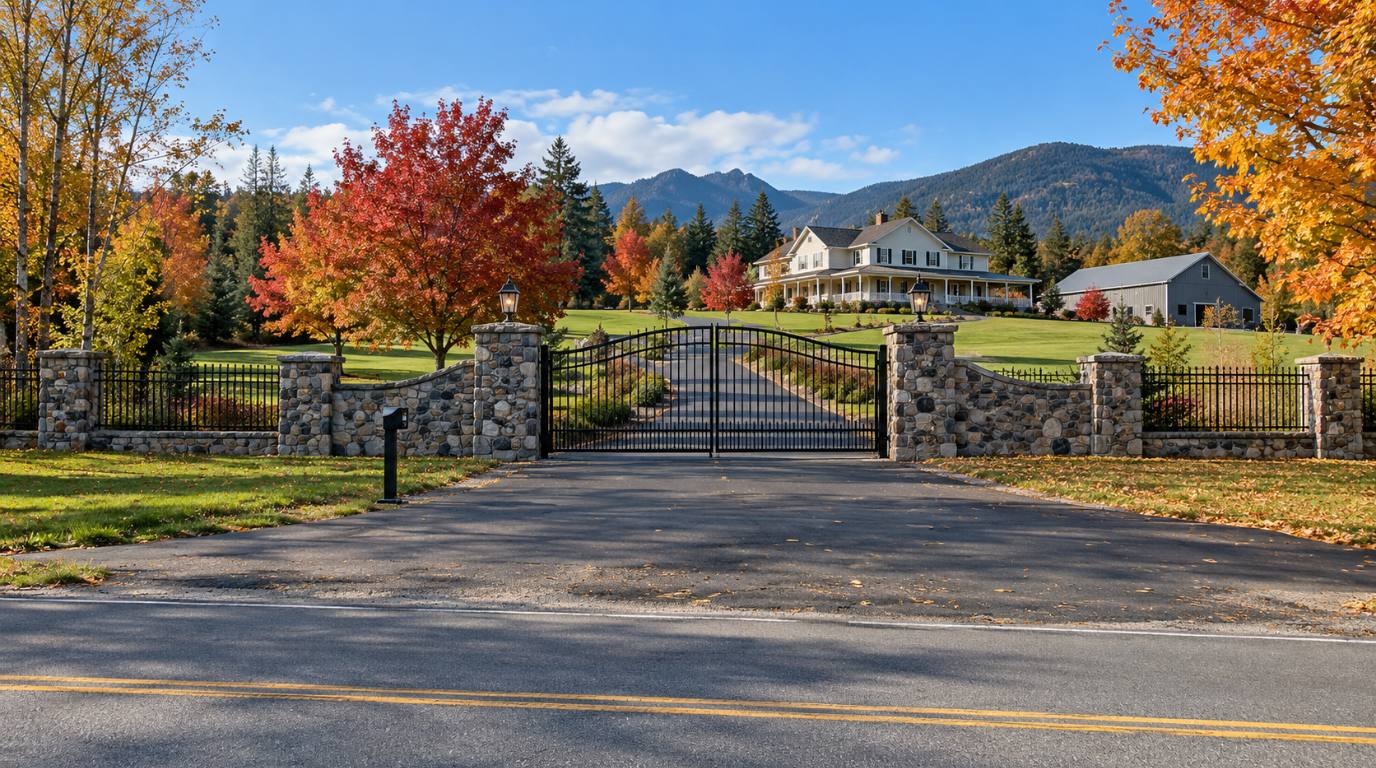
Small residential driveways are where the numbers vary most. Skagit County requires 12 feet of width for driveways serving one or two residential lots and 20 feet for three or more lots or commercial use. Seattle allows 12 feet of unobstructed width on access roads serving not more than two Group R-3 or Group U occupancies. Marysville says that for residential gates serving fewer than three homes, the gate width shall not be less than the driveway width approved for the project. Mercer Island may approve a gate under 20 feet for a single residence protected by a fire sprinkler system or as approved by the Fire Marshal.
Clear width is measured between the obstructions, not post to post. Hinges, gate stops, the leaf thickness when fully open, operator arms and the bollards that protect a keypad pedestal can all eat into it.
Setback. A gate right at the edge of the street forces an engine to stop in traffic while a firefighter gets out. Mercer Island requires gates on a main arterial to be set back at least 30 feet from the roadway, with room for apparatus to pull completely off the road. Everett asks for entry gates to be set back from the nearest curb line so vehicles can queue off the street. The same setback also helps residents and delivery vehicles wait off the road while the gate opens.
For layout questions that go beyond fire access, such as turning room for trailers and farm equipment, see our guide on how wide a driveway gate should be in Washington.
Power Failure: Open on Loss of Power or Stay Closed?
This is where fire access and homeowner expectations collide. Many owners want a battery backup so the gate keeps working, and stays locked, during the long winter outages common in Northwest Washington. Some fire agencies want the opposite: a gate that opens on its own when power fails.
The Marysville Fire District standard is explicit. In the event of a power failure, including battery backup, the gate shall automatically open, by spring tension or another non-electrical method, or the gate must be capable of being pushed open without additional steps. Marysville’s local amendment to section 503.6 adds that, in a residential community, the gate shall open automatically on loss of power and remain open until power is restored, with an exemption for 5 or fewer dwelling units. Everett’s handout also asks electronic gates to open automatically on power failure.
Battery backup and fire access are not always in conflict. The rule above is about what happens when the gate truly has no power left, battery included. A battery system still keeps the gate working during a normal outage; the question is what the gate does when the battery runs flat. Many operators can be set to open on low battery, or to stay where they are. Where the local agency requires open on power failure, the operator must be set that way and the setting has to be tested at inspection.
Where no such rule applies, owners often prefer a gate that stays closed and relies on the manual release and the emergency access device. That choice should be made with the fire marshal, not by default. Our guide to automatic gate battery backup in Skagit County explains battery sizing and outage behavior in more detail.
Manual Gates, Padlocks, Chains and Bollards
Fire access rules apply to manual gates as well. A farm gate or a private road gate that is opened by hand still crosses the access route, so it still needs an approved locking method and an approved way for firefighters to get through.
Marysville’s standard is a clear example. Manual gates shall be designed to remain in the open position when left unattended, so a gust of wind cannot swing a leaf back into the path of a truck. Manual locking devices such as padlocks shall be Knox brand only. Manual gates follow the same width and plan approval process as automatic gates. The approved emergency access method is either a Knox high-security padlock keyed to the district’s emergency access keyway, interlocked with the owner’s padlock, or a Knox rapid access 3200 Series key box containing the gate key, mounted on a pillar or post next to the gate and visible to anyone approaching.
Chains, cables and pipe barriers deserve caution. Some Washington agencies do not accept them as a gate across a fire access road. The model code lists only swinging, sliding and, in some versions, vertical lift or pivot gates. Seattle’s code does allow bollards as an approved alternate if one person can readily remove them, and they shall not be locked with a padlock or chain unless they can be removed with a forcible entry tool or an approved locking device. If removable bollards are part of your plan, our page on bollard installation in Washington covers the fixed, removable and retractable types.
A manual gate also has to be light and smooth enough for one person to open. A heavy, sagging or dragging gate fails that test even with the right padlock. If yours drags, our guide to sagging gate repair in Washington explains the fixes.
Planning a gate on a private road or farm drive?
We check width, setback, clearance and the locking method against the fire agency’s standard, so the gate is approved the first time instead of rebuilt later.
HOAs, Private Roads and Rural Driveways
The type of property changes which rules apply and who is responsible for them.
HOA and community entrances. A gate at a community entrance almost always sits on a required fire access road, because every home behind it depends on that route. This is where local codes add the most: Marysville’s strobe activating device for residential communities, Everett’s strobe sensors for gates serving more than three residences, and in some places radio entry for mutual aid. The HOA, as owner of the gate, is responsible for keeping the emergency operation working at all times, which the code states directly. Board members should keep the permit, the approved plan and the fire agency’s acceptance with the HOA’s records. Our guide to HOA gate planning and access control in Washington covers the resident side of the same entrance.
Shared private roads. A private road serving several rural lots is often the fire access road for all of them. In Skagit County, the standards for driveways serving one or two lots differ from those for private roads serving more than two lots, which must comply with the Skagit County Road Standards. A gate on a shared road needs agreement among the owners on who maintains the device, who pays for repairs and who calls the fire agency if the key switch is damaged. The same logic applies on the islands; see our page on a private road gate on Camano Island.
Single-home rural driveways. On acreage, the house is often far more than 150 feet from the county road, which in Skagit County means the driveway itself is the fire apparatus access road. A gate across it needs the Fire Marshal’s approval and an approved means of emergency operation, even though only one family lives there. The only way to know is to ask before building.
Placing and Wiring the Emergency Access Device
An emergency access device is only as good as its placement and wiring. A key switch that a firefighter cannot find in the dark, or a strobe receiver that cannot see the approaching engine, will not pass inspection.
Placement. The key switch usually goes on the approach side of the gate, where a firefighter reaches it from the driver’s side of the truck without walking into the gate’s path. Many sites put it on the same pedestal as the keypad or on its own post next to it. Each agency has its own placement instructions; Marysville, for example, asks that a key box for a manual gate be mounted on a pillar or post next to the gate and stay visible to anyone approaching. Keep landscaping, mailboxes and snow storage away from the device. For the resident keypad that usually shares that approach, our guide to the automatic gate keypad height in Washington covers reach and post location.
Wiring. The key switch, strobe receiver or radio receiver connects to the operator’s open input, and in many cases to a hold-open function so the gate stays open until fire personnel reset it. Marysville asks for the gate to reach the fully open position within 10 seconds of activation and remain open until reset by its personnel. That behavior depends on how the device is wired and how the operator is programmed, so it needs to be designed in, not improvised at inspection.
Safety devices still apply. An emergency open command does not cancel entrapment protection. The gate still needs its photo eyes and edges per UL 325, and the emergency device should open the gate, not override a safety stop on a closing gate. Our guide to gate photo eye installation in Washington explains where those sensors go.
Permit, Plan Review and Inspection
The permit is the step most often skipped, and it is the step that decides whether the fire agency knows your gate exists. Fire code section 105.6.11 requires a construction permit to install or modify a gate or barricade across a fire apparatus access road. The process varies, but it generally follows the same order.
- Identify the fire code official. City fire marshal, regional fire authority, or county fire marshal for unincorporated land. In Marysville, the fire construction permit application goes through City of Marysville Permit Services, not the fire station.
- Get the current gate standard. Ask for the agency’s written standard for fire department access gates and its approved device list.
- Prepare plans. Mercer Island’s handout, for example, asks for plans drawn to scale that show the gate location, the paved driveway area all the way to the access road, the access easement width if there is one, the control pedestal and any obstructions. Add the gate and operator data sheets, the emergency access device, the power failure behavior and the clear width.
- Submit and wait for review. Mercer Island lists a target fire review time of three weeks for automatic security gates. Other agencies set their own timelines.
- Install to the approved plan. Changes in the field, such as a different device or a narrower opening, can void the approval.
- Electrical inspection. Where the gate is powered, an electrical inspection may be required. Mercer Island lists two inspections, an electrical safety inspection and a final fire department inspection.
- Fire inspection and test. The fire agency tests the device and the opening behavior. Marysville asks for at least 24 hours of advance notice, Mercer Island 48 hours.
Adding Fire Access to an Existing Gate
Many gates in Northwest Washington were installed without a key switch or with a device the local agency no longer accepts. Adding fire access later is common and usually straightforward, but it should follow the same approval path, because section 105.6.11 covers modifying a gate as well as installing one.
Start with the operator, because electric gate operators on fire access roads shall be listed to UL 325, and an old unlisted operator may need replacement rather than a new key switch. Then check that the control board has an input the device can trigger, what the gate does when its battery runs out, and the true clear width with the gate fully open.
If the existing operator is sound, the work is usually limited to a post or pedestal for the device, a cable run to the operator, programming, and the inspection. If the operator is near the end of its service life, it may make sense to replace it at the same time. Our guide on how long automatic gates last in Washington explains how to judge that, and our page on automating an existing gate covers a full retrofit of a manual gate.
Does your gate need a key switch it never had?
We check the operator, the control board and the power failure setting, add the device your fire agency approves, and test it with you before the inspection.
Testing and Maintenance
The fire code requires security gates and their emergency operation to be maintained operational at all times. A key switch that has corroded shut, or a strobe receiver blocked by a hedge, is a code problem and a real risk.
A simple routine keeps the emergency side working:
- Test the opening behavior. With the owner’s permission and without the fire agency’s key, a technician can test the operator input that the key switch uses, confirm the gate opens fully and stays open if it should, and confirm it resets correctly.
- Test power failure behavior. Disconnect main power and confirm the gate does what the approved plan says when the battery is exhausted.
- Keep the approach clear. Trim vegetation around the device and the strobe receiver, and keep snow, firewood and parked vehicles away from the gate and the access road. Marysville’s amendment states that entrances closed with gates and barriers shall not be obstructed by parked vehicles.
- Report damage. If the key switch or padlock is damaged or missing, tell the fire agency. Marysville asks owners to call its help line or email its inspectors as soon as possible.
How We Approach Fire Access on Gate Projects
Emerald Gate Systems designs, fabricates, installs, automates and services gates from our shop at 7557 Alpine Lane in Sedro-Woolley, Washington, and works across Skagit, Whatcom, Snohomish, Island, San Juan, King and Pierce counties. Because one team handles CAD planning, welding, installation, automation, access control, testing and future service, fire access is planned with the gate from the first drawing, not added when an inspector asks for it.
A gate project with us starts with a free on-site consultation. We measure the opening and the approach, note how far the buildings sit from the road, and identify which fire agency reviews gates at that address. Then we plan the clear width, the setback, the emergency access device that agency approves, the power and battery behavior, and the entrapment protection, and we confirm the requirements with the local fire marshal where they apply. We install and service LiftMaster, Viking and FAAC operators and access control equipment including keypads, intercoms, telephone entry, card readers and license plate recognition, so the resident system and the emergency system are designed together. Before we leave, we test every safety device, the emergency open function, the power failure behavior and the manual release, and show you how the system works. For new gates, our automatic gate installation page explains the full process, and our access control systems page covers the resident side.
Washington requires contractors to show their registration in advertising: Emerald Gate Systems is registered with the Washington State Department of Labor and Industries as a construction contractor (EMERAGS748D6) and holds an electrical contractor license in the Doors and Gates specialty (EMERAGS747KE).
Frequently Asked Questions
Does my driveway gate need a Knox box key switch in Washington?
It depends on whether the gate crosses a required fire apparatus access road and on the local fire agency. Washington’s fire code requires an approved means of emergency operation on security gates across those roads, and many agencies, including the Marysville Fire District, specify a Knox key switch. Ask the fire marshal for your address before choosing a device.
How do fire trucks get through a gated community?
Usually through a key switch at the gate that only the fire agency’s key operates, sometimes combined with a sensor that opens the gate as the engine approaches. Some Washington agencies require a strobe-activated sensor for residential communities, and some accept radio entry such as Click2Enter, which any equipped and authorized responder can use.
Do I need a permit to install a gate across a fire access road?
Yes. Fire code section 105.6.11 requires a construction permit to install or modify a gate or barricade across a fire apparatus access road, and section 503.6 requires the fire code official to approve security gates. Where you apply depends on the jurisdiction; in Marysville, for example, the application goes through City Permit Services.
Will my automatic gate open during a power outage for the fire department?
Only if it is set up that way or has a working emergency device. Some Washington codes require the gate to open on power failure, including when the battery runs out. Marysville requires that, with an exemption for 5 or fewer dwelling units. Elsewhere, responders rely on the key switch, the manual release or the approved device.
How wide does a gate have to be for fire department access?
Many Washington standards require at least 20 feet of clear width for a single gate on a fire access road, or 12 feet for each side of a divided roadway. Small residential driveways may be allowed less: Skagit County uses 12 feet for driveways serving one or two lots, and Seattle allows 12 feet where not more than two homes are served.
Can I add a fire department key switch to an existing gate?
Usually, yes. The key switch or receiver is mounted on a post or pedestal and wired to the operator’s open input, then programmed to hold the gate open if the agency requires it. Because the code counts this as modifying the gate, check whether a permit and inspection are needed, and confirm the operator is listed to UL 325.