
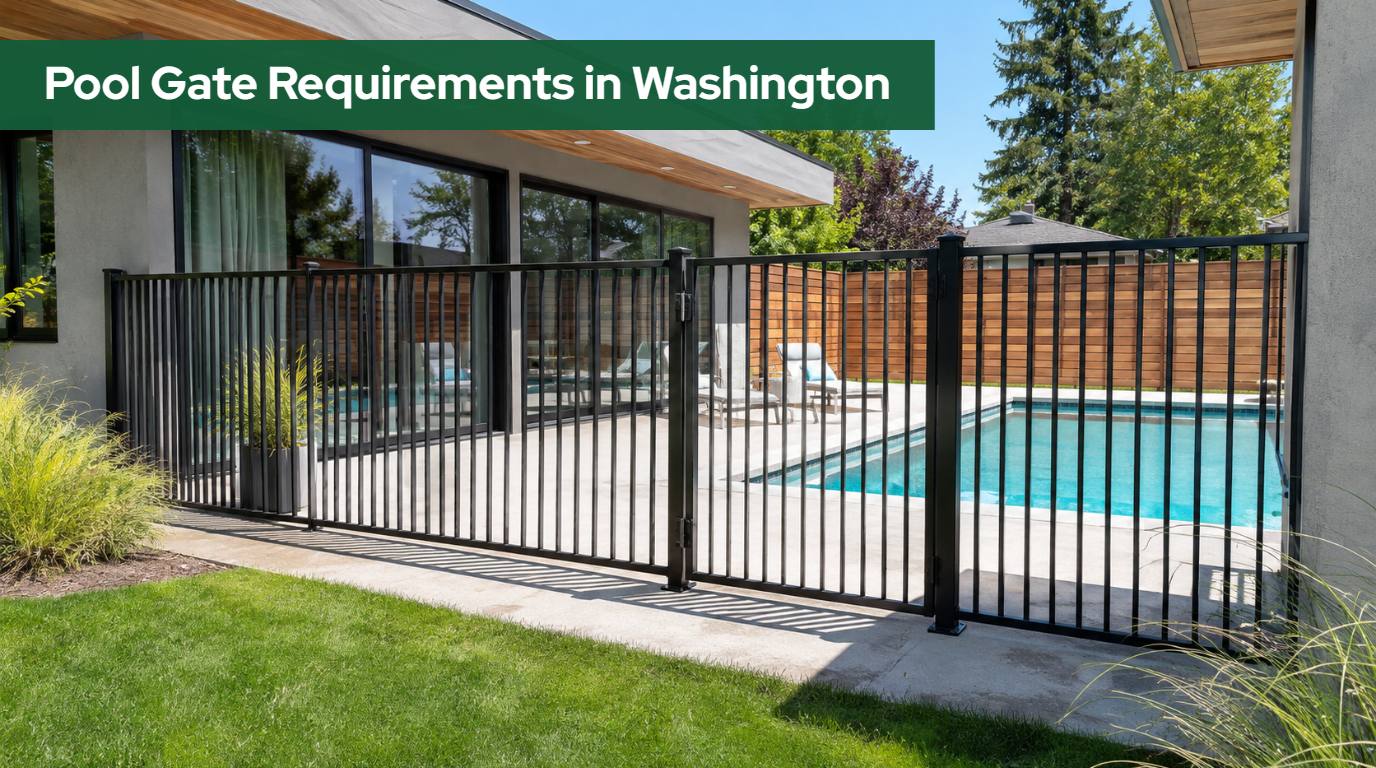
A pool gate looks like a small part of a backyard project, but it is the one part the code treats as a safety device. The fence around a pool only works if the gate in it closes and latches by itself every time, including the day a guest props it open with a cooler or a child pushes on it from the outside. The pool gate requirements in Washington come from two different rulebooks, depending on whether the pool belongs to a single home or to an apartment complex, condominium, HOA or hotel, and the two do not use the same numbers.
This guide covers both: barrier height and gaps, how fence style changes what is allowed, the rules for swing direction, self-closing hinges and latches, house walls, hot tubs and above-ground pools, the state rules for community pools and the latch height question that sits between those rules and the ADA. It is written for homeowners, HOA boards and property managers in Skagit, Whatcom, Snohomish, Island, San Juan, King and Pierce counties.
Quick answer
In Washington, home pools follow the 2021 ISPSC: a barrier at least 48 inches high, no gap passing a 4-inch sphere, and gates that open outward, self-close and self-latch. HOA, apartment and hotel pools follow WAC 246-260: barriers at least 60 or 72 inches high, with a 60-inch latch or a coded lock.
In this guide
- Why pool gate requirements in Washington matter
- Which rules apply to your pool
- Barrier height and gaps for a home pool
- How the fence style changes the rules
- Gate rules: outward swing, self-closing, self-latching
- Latch height and the release
- When the house wall is part of the barrier
- Hot tubs, above-ground pools and shorelines
- HOA, apartment and hotel pools under WAC 246-260
- The latch height puzzle: state rules and the ADA
- Keypads and fobs on community pool gates
- Choosing a pool gate for Western Washington
- Permits, plan review and local rules
- How to check an existing pool gate
- How we approach pool gates
- Frequently asked questions
Why Pool Gate Requirements in Washington Matter
Every pool barrier rule is written around one scenario: a young child who reaches the yard without an adult and heads for the water. A fence slows that child down only if there is no way through, under or over it, and the gate is the weakest point. Fence panels stay put. Gates get opened many times a day by people carrying towels, toys and pool chemicals, and the hardware that swings them shut slowly wears, sags or gets disabled.
That is why the codes spend so much text on the gate: how it swings, how it closes, how high the latch release sits, how big the openings near the latch can be and, for community pools, whether it must stay locked. A gate that misses one of those points can turn a compliant fence into a barrier a child can defeat in seconds. There are practical stakes too: a building inspector can hold a final inspection until the barrier passes, and a health inspector can write up an HOA pool whose gate no longer latches.
If the pool sits behind a walk gate that also needs access control, our guide to pedestrian gate access control in Washington covers keypads, fobs, electric strikes and maglocks for walk gates. This article stays focused on what makes a pool gate legal and safe.
Which Rules Apply to Your Pool?
Washington splits pools into two groups, and the first step on any pool gate project is knowing which one yours belongs to.
Pools at a single home. The state residential code, WAC 51-51-0327, says pools, spas and hot tubs must comply with the 2021 International Swimming Pool and Spa Code (ISPSC) when the facility is for the sole use of the residents and invited guests of a single-family dwelling, or of a duplex owned by those residents. The barrier rules are in Section 305 of the ISPSC, and the city or county building department enforces them.
Pools at apartments, condominiums, HOAs, hotels and similar places. These are water recreation facilities under chapter 246-260 WAC, the State Board of Health rules. A “limited use pool” is one at an apartment, assisted living facility, condominium, fraternity, homeowners association, hotel, mobile home park, motel, RV park, sorority or rental housing unit, for residents and their invited guests. Other regulated pools, such as public pools and swim clubs, are “general use pools.” The barrier rules are in WAC 246-260-031, and local health jurisdictions permit and inspect these facilities.
| Pool type | Main barrier rule | Who enforces it | Minimum barrier height |
|---|---|---|---|
| Single-family home or owner-occupied duplex | 2021 ISPSC Section 305, through WAC 51-51-0327 | City or county building department | 48 inches |
| Limited use pool (apartment, condo, HOA, hotel, motel, RV park and similar) | WAC 246-260-031(4) | Local health jurisdiction, with state plan review for new facilities | 60 inches |
| General use pool (public, club and other pools that are not limited use) | WAC 246-260-031(4) | Local health jurisdiction, with state plan review for new facilities | 72 inches |
One detail matters for associations: under WAC 246-260-010, a limited use pool is treated as a general use pool during organized programs, so a community pool that runs swim lessons or events may face the stricter rules at those times.
Barrier Height and Gaps for a Home Pool
The 2021 ISPSC, as adopted in Washington, sets the basic dimensions for the barrier around a residential pool or spa. The gate is part of that barrier, so every number applies to the gate leaf as much as to the fence beside it.
- Height. At least 48 inches above grade, measured on the side of the barrier facing away from the pool.
- Gap at the bottom. Not more than 2 inches over grass, gravel or other non-solid ground, or 4 inches over a solid surface such as concrete.
- Barrier on a raised pool or spa. Not more than 4 inches between the structure and the bottom of the barrier.
- Openings. No opening may let a 4-inch-diameter sphere pass through.
- Solid barriers. No indentations or protrusions that form handholds or footholds, apart from normal tolerances and tooled masonry joints.
The bottom gap is the most common problem on gates. A pool gate hung high to clear a sloped patio or a lawn edge often ends up with 3 or 4 inches under the leaf over grass, more than the 2 inches allowed there. Soil settles and gravel washes out, so a gate that measured fine at final inspection can fail a few years later.
Height is the second problem. Because the 48 inches is measured on the outside, a planter, retaining wall or raised bed along the outside of the fence can effectively shorten it. On sloped Western Washington lots, the grade outside the gate is often higher at one end, and the leaf must be tall enough at its lowest point. Our article on building a gate on a slope explains racked and stepped frames, and the same ideas apply to a walk gate beside a pool.
The ISPSC also sets a 36-inch clear zone: pumps, filters, heaters and similar equipment outside the barrier must sit at least 36 inches from it, so they cannot be used as a step. That rule often decides where the gate goes, because the equipment pad and the gate tend to end up on the same side of the yard. During construction of an in-ground pool, temporary fencing at least 4 feet tall is required until the permanent barrier is complete.
How the Fence Style Changes the Rules
The ISPSC does not ban any fence style. It changes the allowed spacing depending on how the members are arranged, because horizontal rails on the outside of a fence work like a ladder. That matters for pool gates, since most gates have a top rail, a bottom rail and often a brace.
| Barrier style (2021 ISPSC) | What the code allows | What it means for the gate |
|---|---|---|
| Closely spaced horizontal members (tops less than 45 inches apart) | Horizontal members on the pool side; vertical spacing not more than 1-3/4 inches | Rails and braces go on the pool side of the leaf, with pickets set very close together. |
| Widely spaced horizontal members (tops 45 inches or more apart) | Vertical spacing not more than 4 inches; decorative cutouts not more than 1-3/4 inches wide | A common layout for aluminum and steel pool gates: top and bottom rails, pickets under 4 inches apart. |
| Chain link | Mesh openings not more than 1-3/4 inches, with or without slats | A chain link pool gate needs a smaller mesh than many standard residential fences use. |
| Diagonal members (lattice) | Openings not more than 1-3/4 inches; members not more than 45 degrees from vertical | Lattice panels need tight openings and a steep angle to avoid footholds. |
| Removable mesh pool fence | Bottom not more than 1 inch above deck or grade and at least 20 inches from the water’s edge, plus limits on lifting and attachments | Mesh systems follow their own gate and attachment rules from the manufacturer and the code. |
| Solid wall or panel | No handholds or footholds beyond normal tolerances | A solid wood or composite gate face works if there are no climbable ledges outside. |
The closely spaced rule surprises people who want a wood pool fence. On a cedar gate with horizontal boards, the boards act as rails, and built with gaps on the outside, the gate is a ladder. Built as a solid panel, or with the framing on the pool side and a smooth outside face, it can work. Our guide to a cedar driveway gate in Washington explains how we build cedar faces over steel frames, which is also how a cedar pool gate keeps a smooth outside face and stays square.
Ornamental iron and aluminum pool gates usually follow the widely spaced layout. Decorative scrolls, rings and finials are where they get into trouble: a scroll between pickets can become a foothold, and the 1-3/4-inch cutout limit rules out many details that look harmless on a driveway gate.
Designing a fence and gate around a new pool?
On a free on-site visit we look at the layout, the grade along the fence line, the equipment pad and the style you want, then explain how the gate can meet the barrier rules before anything is fabricated.
Gate Rules: Outward Swing, Self-Closing, Self-Latching
Section 305.3 of the 2021 ISPSC sets the core rules for every access door or gate in a residential pool barrier:
- Open outward, away from the pool. A child pushing on the gate from the yard side should push it closed, not open.
- Self-closing. The gate must return to closed on its own, which in practice means spring hinges or a gate closer adjusted to close it from any open position.
- Self-latching. When the gate closes, the latch must catch without anyone touching it. A latch that needs a hand to drop a bar does not qualify.
- Able to take a lock. The gate must accommodate a locking device for times the pool is not in use.
Two more rules cover special gates. Utility or service gates, such as one that only reaches the equipment pad, must stay locked when not in use. On double gates, at least one leaf must be secured in place and the adjacent leaf must have a self-latching device, which usually means a drop rod on the fixed leaf and the self-closing hardware on the active one.
The self-closing rule is easy to meet on installation day and easy to lose a year later. Hinges lose tension, closers get adjusted too slowly, and a leaf that sags drags on the latch side and stops short. A pool gate needs a frame that stays square and posts that stay plumb, because even a small drop at the latch side can keep the latch from catching. Our guide to sagging gate repair in Washington explains why gates drop and how they are corrected.
Wind is a local factor. A strong gust can slam a light gate or hold a solid one open, so in exposed spots near open water or farmland a solid pool gate may need a stronger closer, a gate stop and a latch that catches reliably even when the leaf arrives fast.
Latch Height and the Release
Section 305.3.3 of the 2021 ISPSC sets the height of the latch release and treats residential and public pools differently. The difference turns on whether the latch is self-locking, meaning operated by a key, an electronic opener or an integral combination lock.
| Latch type (2021 ISPSC 305.3.3) | Residential pools and spas | Public pools and spas |
|---|---|---|
| Release on the outside, latch not self-locking | Not less than 54 inches above the finished surface | 52 to 54 inches |
| Self-locking latch (key, electronic opener or combination) | Not greater than 54 inches | 34 to 48 inches |
| Private pool, release only on the pool side | At least 3 inches below the top of the gate | Not applicable |
The logic is reach. A plain mechanical latch release high on the gate is out of reach for a small child. A latch that locks does nothing without a key or code, so it can sit lower where adults, including people using wheelchairs, can reach it.
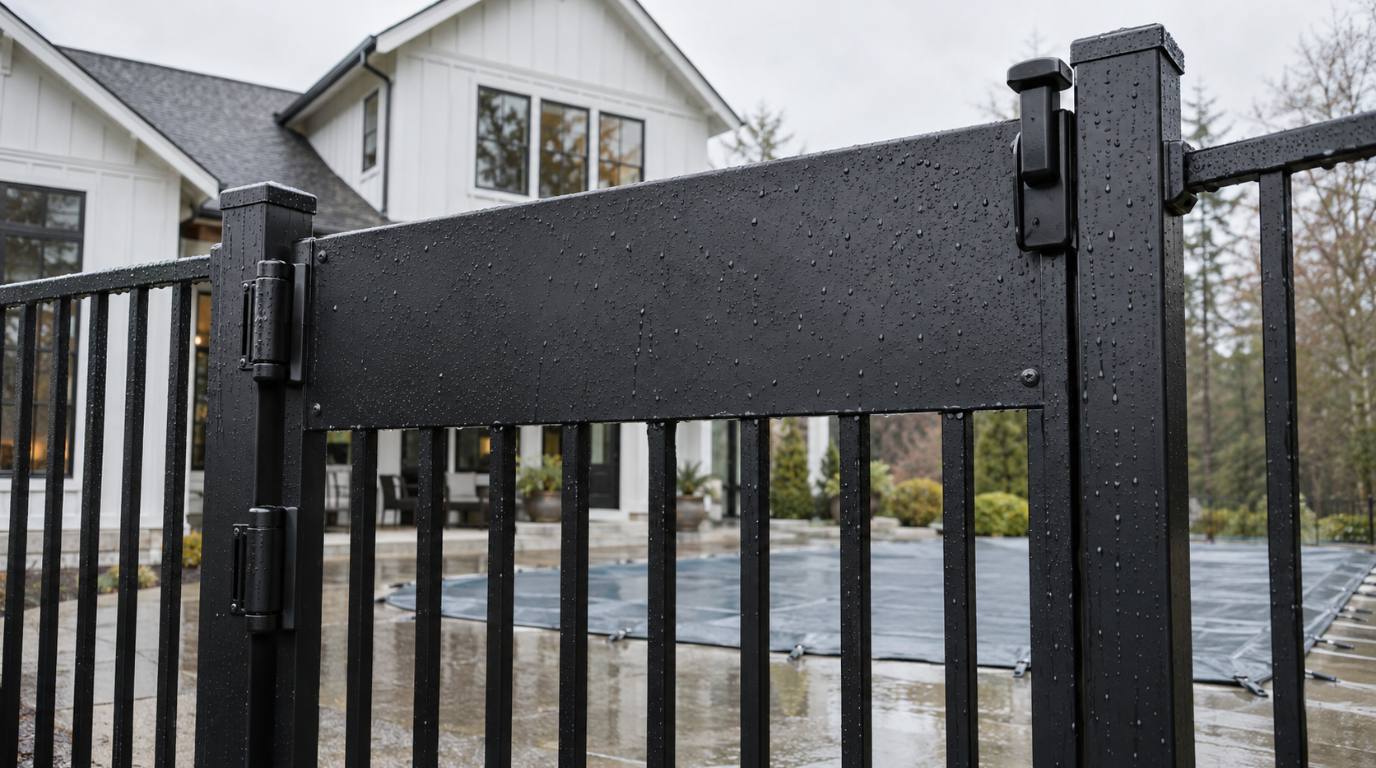
The pool-side release is common at home pools: the latch sits on the inside near the top, and an adult reaches over to lift it. For that design, Section 305.3.4 adds that openings within 18 inches of the latch release may not exceed 1/2 inch in any dimension, so a child cannot reach through the pickets and open it. On an open picket gate, the usual answer is a solid or tight-mesh shield around the latch area, planned as part of the gate rather than added later. The mounting height, the latch type and what surrounds it all have to agree with each other and with the height of the gate.
When the House Wall Is Part of the Barrier
Many backyard pools are fenced on three sides, with the house forming the fourth. When a house wall is part of the barrier and has doors or windows opening directly to the pool area, Section 305.4 of the 2021 ISPSC requires one of several protections:
- A water hazard entrance alarm listed to UL 2017 on doors with direct access, and on operable windows with a sill lower than 48 inches, with the deactivation switch at the height the code sets (at least 54 inches above the floor in a dwelling that is not an accessible unit).
- A pool safety cover listed to ASTM F1346.
- Another means approved by the building official, such as self-closing, self-latching doors, that is not less protective than the alarm or the cover.
This changes where the barrier goes. If the owner does not want door alarms or a powered cover, the alternative is often to run the fence between the house and the pool, with its own self-closing, self-latching gate, so the house sits outside the barrier. That adds a gate, but the family can use the patio and back door without setting off an alarm. For accessible units and non-dwelling buildings, such as some pool houses or rentals, the code sets the alarm switches between 48 and 54 inches, so check the plan with the building department first.
Hot Tubs, Above-Ground Pools and Shorelines
Hot tubs and spas with a safety cover. Section 305.1 of the 2021 ISPSC says a spa or hot tub with a lockable safety cover complying with ASTM F1346 does not have to meet the barrier rules in Sections 305.2 through 305.7, and the same applies to a pool with a powered safety cover complying with ASTM F1346. Many hot tubs on decks rely on that kind of cover instead of a fence, but it has to be the listed kind and actually locked.
On-ground and above-ground pools. Under Section 305.5, the pool wall, or a barrier on top of it, can serve as the barrier only if the top is at least 48 inches above grade around the whole perimeter, the wall meets the barrier rules and the manufacturer allows it. Ladders or steps must be able to be secured, locked or removed, and any opening left may not pass a 4-inch sphere. Otherwise the pool needs a fence and gate like an in-ground pool.
Natural shorelines. Many Washington homes sit on lakes, rivers or saltwater. Section 305.6 says no barrier is needed between a natural body of water and the pool where public access along the shoreline is not permitted, provided the required barriers extend to and beyond the water’s edge by at least 18 inches. The fence still has to run to the water and past it on each side.
Natural topography. Section 305.7 lets the building official approve features such as steep slopes or rock formations as part of the barrier if they protect at least as well. That is a case-by-case approval, not a default.
Not sure your pool or hot tub barrier would pass?
We can look at the gate, the latch, the gaps and the layout around your pool on a free on-site visit and explain what would need to change.
HOA, Apartment and Hotel Pools Under WAC 246-260
For limited use and general use pools, the barrier rules are in subsection (4) of WAC 246-260-031, which applies to new construction and remodeling. They are stricter than the home pool rules in several ways.
| Item (WAC 246-260-031(4)) | Requirement |
|---|---|
| Who must provide barriers | Owners, to keep unauthorized persons from reaching pools. Spray pools without standing water are exempt. |
| Height | At least 60 inches at limited use pools; at least 72 inches at general use pools |
| Openings, including windows | No 4-inch sphere may pass; vertical members no more than 1-3/4 inches apart where the tops of horizontal members are less than 45 inches apart |
| Gates and doors | Self-closing and self-latching, with either a continuously locked latch, coded lock or equivalent access control that always requires a key or code, or a latch at least 60 inches high |
| Locked latch below 60 inches | An 18-inch radius of solid material around the latch, so a child outside cannot reach through and open it |
| Service entrances | Restricted service entrances are exempt from the gate rules if there is no public access |
| Lifeguarded pools | No self-closing, self-latching gate required while in use; gates closed and locked when not in use |
| How height is measured | Outside the enclosure; ground levels, structures and landscaping may not reduce the effective height |
Public Health Seattle and King County’s barrier compliance guidance adds practical points. Doors and gates at pools not continuously lifeguarded must be self-closing and self-latching and repaired immediately when those mechanisms fail. Chain link mesh should not exceed 1-1/4 inches, or should have slats to reduce the openings, which is tighter than the residential number above. The guidance also reminds owners that WAC 246-260-141 requires locked barriers when the facility is not operating.
Two points trip up HOAs and property managers. Because the rules apply to new construction and remodeling, replacing a pool fence or gate can bring the barrier up to the current rule. And a hedge, planter or boulder outside a 60-inch fence can reduce its effective height, which the owner must prevent. Our page on HOA and community gate systems covers how associations plan and maintain shared gates, including amenity gates.
The Latch Height Puzzle: State Rules and the ADA
Community pools face a conflict with no tidy answer. Under WAC 246-260-031, an ordinary self-latching latch must sit at 60 inches or more. But apartments, hotels, clubs and many amenities are also covered by accessibility rules, and the 2010 ADA Standards for Accessible Design generally place operable parts of door and gate hardware between 34 and 48 inches above the floor or ground.
The ADA Standards include one pool exception. Section 404.2.7 allows the latch release on self-latching devices of gates in barriers protecting pools, spas and hot tubs to sit up to 54 inches high, provided the devices are not also self-locking devices operated by a key, an electronic opener or an integral combination lock. The International Building Code carries a matching provision. Even so, 54 inches is below the state’s 60.
The Washington State Board of Health has looked at this directly. In 2023, a petition asked the Board to amend WAC 246-260-031 so latch heights would comply with the ADA. The Board accepted it in August 2023 for consideration in its ongoing water recreation rulemaking and published an overview comparing the WAC, the CDC’s Model Aquatic Health Code, the ADA and the building code. In a later response, it noted the ADA’s 54-inch exception and said its technical advisory committee needed more research on latch height. As of this writing, the rule text we reviewed still uses the 60-inch threshold, so check the current rule before designing around it.
The state rule itself offers the way through. A gate with a continuously locked latch, a coded lock or an equivalent access control system may have its latch below 60 inches if the barrier has an 18-inch radius of solid material around it. That lets the release sit at an accessible height while a child outside still cannot reach through, and it lines up with the 2021 ISPSC rule placing self-locking releases at public pools between 34 and 48 inches. Our article on ADA door requirements in Washington State covers accessibility rules for entries in more detail; for a pool gate, confirm the design with both the health jurisdiction and the building department before hardware is ordered.
Keypads and Fobs on Community Pool Gates
A common way through the latch height puzzle is access control on the pool gate. A keypad, card reader or fob reader controls an electric lock, and the gate stays self-closing and self-latching in the mechanical sense. Some points need care when the gate is a pool barrier:
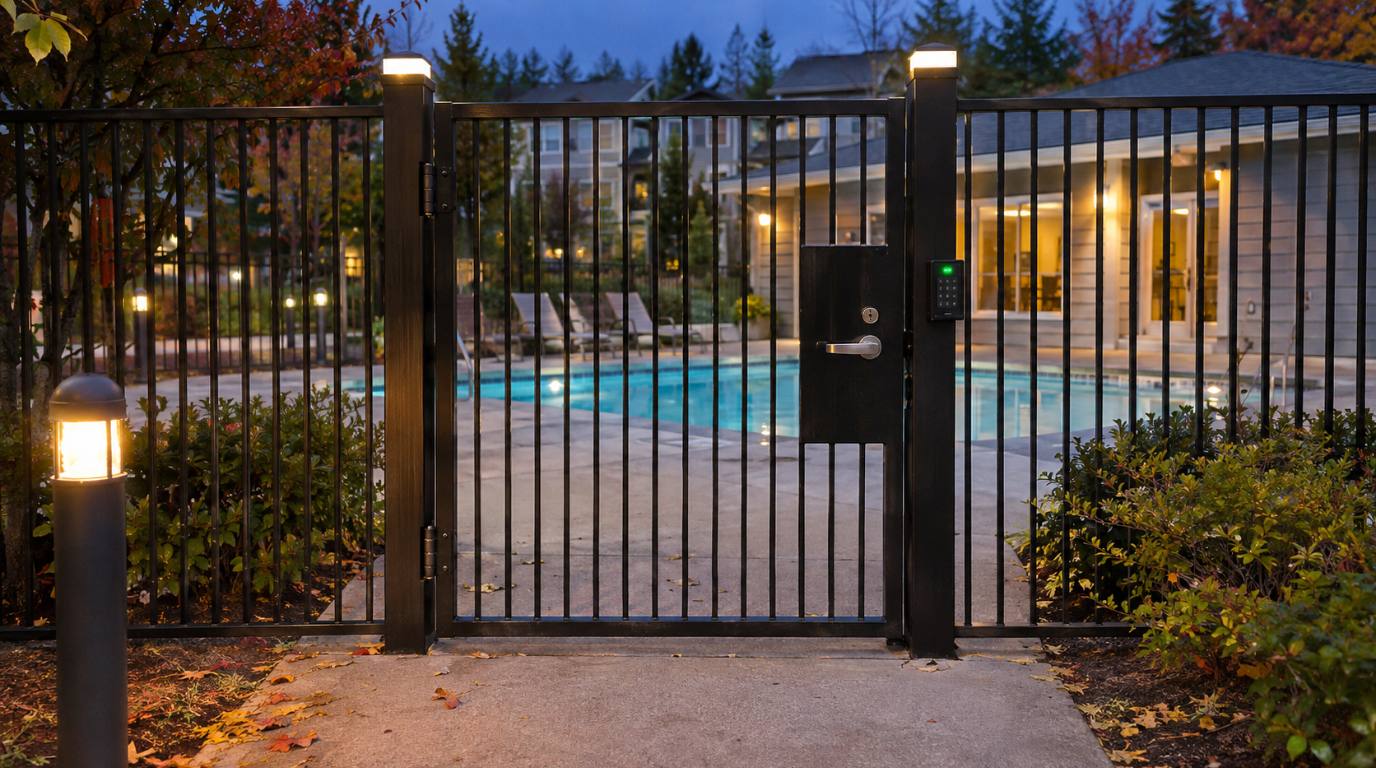
- The lock does not replace the closing hardware. An electric lock only holds a gate that is already closed. The hinges or closer still have to bring the gate back from any open position.
- Fail-safe or fail-secure. A magnetic lock usually releases when power is lost, which would leave a pool gate free to open during an outage. An electric strike can be fail-secure, staying locked without power, with free mechanical exit from the pool side. The right choice depends on the facility and what the local authorities accept.
- A way out. Section 305.8 of the 2021 ISPSC says outdoor public pools with barriers must meet the means of egress rules in Chapter 10 of the International Building Code, so people inside need an exit that does not depend on the reader.
- The 18-inch solid zone. If the reader and release sit below 60 inches on an open picket gate, the solid material around the latch has to be part of the design.
- Schedules and records. Many systems can limit entry to pool hours and log which credential opened the gate.
This is the same family of equipment we install on walk gates and entries. Our pages on access control systems and keypad entry systems for apartments explain how credentials, readers and controllers fit together, and our RFID versus keypad comparison explains why many properties move from shared codes to individual fobs.
Choosing a Pool Gate for Western Washington
A pool gate has to stay square, swing freely and latch every time for years, often in a spot that gets splashed, shaded and rained on.
- Aluminum. Powder-coated aluminum does not rust, is light enough for a self-closing hinge to bring home and suits the widely spaced rail layout. Our page on aluminum gate installation and repair covers aluminum gates in general.
- Steel and ornamental iron. Steel gives a stiffer frame and allows custom designs, but it needs galvanizing and a durable coating, and decorative details must respect the cutout limit.
- Wood. A cedar gate can match a wood privacy fence, but it needs a smooth outside face and a frame that does not sag, since a sagging wood gate is a classic reason a self-latching gate stops latching.
- Posts and hardware. A hinge post that leans a little lets the leaf drop at the latch side. Our guide to gate post installation in Washington covers footings and setting posts in wet soils. Stainless or well-coated hinges and latches resist a damp Pacific Northwest yard better than plain steel.
For a broader look at how iron, steel, aluminum and cedar handle our climate, see our comparison of gate materials for Washington weather.
Need a pool gate built to fit your fence and your rule?
Our shop fabricates gates in steel, wrought iron and Western Red Cedar. Tell us about the pool and the fence, and we will plan a gate that fits the opening and the barrier rules that apply.
Permits, Plan Review and Local Rules
Home pools. The city or county building department issues the pool permit and inspects the barrier. Clark County’s building division, for example, requires a permit for any structure for swimming or bathing that holds water more than 24 inches deep, including above-ground pools, hot tubs and spas, and states that barriers must comply with ISPSC Section 305. Other jurisdictions set their own thresholds, so start with the building department where the pool is located.
Fence height limits. The barrier rules set a minimum height, but local zoning sets maximums. Kirkland, for example, requires a building permit for any fence over 6 feet and limits front yard fences on some streets to 3.5 feet. A 48-inch pool barrier cannot sit where the city caps fences at 3.5 feet, which can shape the layout on a small lot. Our overview of gate permits in Washington State explains how gate and fence permits work across cities and counties.
Community pools. New water recreation facilities, and existing ones making design changes, go through plan review with the Washington State Department of Health before the county issues an operating permit. Skagit County Public Health describes that sequence and requires annual permit applications for pools and spas open to the public. Whatcom County also requires annual operating permits and sends plans to the state first. Replacing a barrier or gate at a regulated pool can count as a design change, so ask the health jurisdiction before work starts. If the gate gets an electric lock or reader, the wiring is electrical work subject to Washington’s electrical rules and permits.
How to Check an Existing Pool Gate
A simple routine, done regularly and after storms, catches most problems early. It is not a substitute for an inspection by the authority that regulates your pool.
- Swing test. Open the gate fully, let go and confirm it closes and latches on its own. Repeat from halfway and from a few inches open, since weak closers often fail on short swings.
- Latch test. Push and pull the closed gate from the outside. It should not pop open or rest closed without the latch caught.
- Gaps. Check the gap under the gate and between the gate and its posts. Settled soil and worn hinges make them grow.
- Climbable objects. Walk the outside of the fence and remove chairs, planters, coolers and anything a child could stand on.
- Latch shield and locks. Confirm the release height, any solid shield around it and, at community pools, that the gate locks after hours and the reader works.
If the gate fails any step, fix it before the pool is used again. Many failures come down to a dropped leaf or worn hinges and closers, which our gate repair team handles.
Pool gate that will not close or latch on its own?
We repair and replace gates across Northwest Washington, including walk gates and community gates. A free on-site visit is the first step.
How We Approach Pool Gates
Emerald Gate Systems is a family-owned gate company based at 7557 Alpine Lane in Sedro-Woolley, Washington, in Skagit County. We design, fabricate in our own shop, install, automate and service residential, farm and commercial gates across Skagit, Whatcom, Snohomish, Island, San Juan, King and Pierce counties. Our shop works in hand-forged wrought iron, laser-cut steel and Western Red Cedar, and our access control work includes keypads, intercoms, telephone entry, card readers and license plate recognition.
Every project starts with a free on-site consultation. For a pool gate, that visit is where we look at the layout, the grade, the existing fence and posts, and whether the pool belongs to a single home or a community facility, because that decides which rule the gate is built to. One team handles CAD planning, welding, installation, access control, testing and future service, so the gate, the hardware and any reader or lock are planned together. Our custom gate design page shows the kind of work our shop produces.
Washington requires contractors to show their registration in advertising: Emerald Gate Systems is registered with the Washington State Department of Labor and Industries as a construction contractor (EMERAGS748D6) and holds an electrical contractor license in the Doors and Gates specialty (EMERAGS747KE).
Frequently Asked Questions
How tall does a pool fence have to be in Washington?
For a pool at a single-family home, the 2021 ISPSC adopted through WAC 51-51-0327 requires a barrier at least 48 inches high, measured on the outside. For pools regulated under WAC 246-260, barriers must be at least 60 inches at limited use pools such as apartments, condos and HOAs, and at least 72 inches at general use pools.
Which way should a pool gate swing?
Outward, away from the pool. The 2021 ISPSC requires pedestrian access gates in a residential pool barrier to open outward, be self-closing and self-latching, and accommodate a locking device. A gate that swings outward closes harder when a child pushes on it from the yard side, instead of opening into the pool area.
How high does a pool gate latch need to be?
For home pools, the 2021 ISPSC requires an outside release on a latch that is not self-locking to be at least 54 inches high, and a self-locking latch no higher than 54 inches. A latch released only from the pool side must sit at least 3 inches below the top, with no opening over 1/2 inch within 18 inches.
Does an HOA or apartment pool gate have to stay locked?
Under WAC 246-260-031, gates at limited use pools must be self-closing and self-latching, with either a latch at least 60 inches high or a continuously locked latch, coded lock or equivalent access control that always requires a key or code. A locked latch lower than 60 inches needs an 18-inch radius of solid material around it.
Does a hot tub need a fence in Washington?
Not if it has the right cover. Under Section 305.1 of the 2021 ISPSC, a spa or hot tub with a lockable safety cover complying with ASTM F1346 is exempt from the barrier rules in Sections 305.2 through 305.7. Without that kind of cover, the hot tub needs a barrier and gate that meet the same rules as a pool.
Can a keypad or fob reader control a community pool gate?
Yes. WAC 246-260-031 allows a coded lock or equivalent access control system that always requires a key or code to enter the pool area. The gate must still self-close and self-latch, people inside need a way out, and a release mounted below 60 inches needs an 18-inch solid zone around the latch.