
A gate loop detector in Washington driveways does one quiet job: it notices a vehicle and tells the gate operator to open, hold or stay put. Most people meet it as the reason a gate opens by itself when they drive out, without a remote. Fewer people know that the same loop of wire can also hold a gate open while a car sits in the opening, keep a swing gate from starting while a vehicle is in its path, or do nothing useful at all if it was cut in the wrong spot.
Loops compete with exit wands (buried probes that sense moving metal) and work alongside photo eyes, which are the safety sensors the operator actually depends on. This guide explains what each device does, where it goes on a Northwest Washington driveway, what concrete, asphalt and gravel change, who is allowed to wire it under Washington rules, and how to choose for a farm, a home, an HOA or a commercial lot.
Quick answer
A gate loop detector is a wire loop set in the driveway plus a detector module that senses a vehicle above it. Exit loops open the gate for departing cars; safety and shadow loops hold it open or stopped. Exit wands are an easier retrofit. Neither replaces the photo eyes or edges that UL 325 requires.
In this guide
- How a gate loop detector in Washington driveways works
- Exit, safety, shadow and center loops
- How an exit wand works
- Loop vs exit wand vs photo eye
- Why loops are not entrapment protection
- Where each loop goes on the driveway
- Saw-cut loops in concrete
- Asphalt, pavers and gravel
- Planning loops before you pave
- Who can wire a gate loop in Washington
- Rain, frost and wet ground
- When a loop or wand misbehaves
- Choosing by property type
- How we approach vehicle detection
- Frequently asked questions
How a Gate Loop Detector in Washington Driveways Works
A loop system has two parts. The first is the loop itself: a continuous run of insulated wire laid in a shallow groove cut into the pavement, or set in place before the pavement is poured, usually wound several times around a rectangle and then twisted into a lead-in that runs back to the gate operator. The second is the detector, a small module that plugs into or wires into the operator’s control board.
The detector drives a small alternating current through the loop, which turns the loop into an inductor with a resonant frequency the detector tracks constantly. When a car, truck or tractor rolls over the loop, the large mass of metal in the vehicle changes the loop’s inductance, and the frequency shifts. The detector compares that shift against its sensitivity setting and, if it is large enough, closes a relay. The operator reads that relay as a command: open, hold open, or do not start.
Three practical facts follow from how this works:
- A loop senses metal, not people. A person, a dog or a child on a bicycle with very little metal does not change the field the way a vehicle does. That is the single most important thing to understand about loops, and it is why they are never counted as safety devices for people.
- A loop senses presence, not just motion. A car parked on a loop keeps the relay closed for as long as it stays there (within the detector’s presence time settings). That is what makes loops good at holding a gate open.
- Everything metal near the loop matters. Rebar, steel plates, buried pipe, the moving gate itself and another loop nearby all affect the field. Good layout keeps the loop where the only large piece of metal that changes is the vehicle.
Exit, Safety, Shadow and Center Loops: Four Different Jobs
“The loop” is often several loops, each wired to its own detector channel and each telling the operator something different. Gate equipment suppliers sell loops by function: exit loops, safety loops and center loops, for example. The names vary a little between manufacturers, but the jobs are consistent.
Exit loop (free exit)
An exit loop sits on the property side of the gate, back up the driveway. A vehicle leaving the property drives over it, the detector trips, and the operator opens the gate without anyone pressing a button. This is the loop most homeowners ask for, because it means guests, delivery drivers and family members can leave without a remote. It is also the loop that decides how secure the gate really is, because anything that triggers it opens the gate.
Safety loop (reversing or obstruction loop)
A safety loop sits in the opening, on one or both sides of the gate line. While a vehicle is over it, the detector tells the operator not to close, and in many configurations to reverse if it is already closing. Its purpose is to keep a closing gate off a car or truck that has stopped in the opening. The word “safety” in the name refers to vehicles and property, not to people.
Shadow loop
A shadow loop is used with swing gates. It sits under the area the leaves sweep through, and while a vehicle is on it, it keeps an open gate from starting to close and, depending on the operator, keeps a closed gate from swinging open into the vehicle. Without it, a car that pulls up close to an inward-swinging gate can be struck by the leaf when someone else enters a code. The shadow loop’s detector is usually set so it is ignored once the gate is already moving toward the open position.
Center loop
A center loop sits directly under the gate line and covers a vehicle that has stopped halfway through. On some commercial slide gates one loop under the gate does the job a pair of safety loops would otherwise do.
A residential driveway in Skagit or Snohomish County might have only an exit loop. A busy HOA entrance often has an exit loop, a safety loop on each side and a shadow loop for the swing leaves. The operator has to support the inputs, and the detector channels have to be configured for the right function, which is why the loop plan is part of the operator choice and not something added at the end.
How an Exit Wand Works and Where It Fits
An exit wand (also sold as an exit probe or vehicle sensor) is a sealed sensor buried beside the driveway instead of a wire cut into it. Most wands are magnetic sensors: they sense the disturbance a large moving mass of metal causes in the Earth’s magnetic field and send a signal through a cable, or wirelessly, to a receiver at the operator.
The appeal is installation. A wand is typically buried in a narrow trench along the edge of the driveway, so nothing is cut into an existing slab and the paving stays untouched. On a long gravel driveway in Whatcom County or a stamped concrete entrance that the owner does not want sawn, that difference is often the whole decision.
The tradeoffs are just as real:
- Wands detect motion better than presence. Most wands respond to a moving vehicle. A car that rolls up and stops may not keep the signal active, which is why wands are used for exit and not for holding a gate open.
- Range is a radius, not a lane. A wand senses within an adjustable distance from where it is buried. Set high enough to catch a car in the far wheel track, it may also catch a car on the road, a tractor in the next field or a vehicle parked beside the driveway. Manufacturers publish their adjustable ranges; the right setting is found on site.
- Stationary metal can cause trouble. Wands react to changes, so a trailer parked near the probe, a metal gate leaf moving close to it or a buried culvert can create false openings or blind spots.
- Manufacturers do not sell them as safety devices. GTO, for example, states that its exit wand is not intended as a safety device. Like an exit loop, a wand is a convenience input.
Wands suit retrofits, gravel and slabs that should not be cut. Loops remain the better tool where presence matters: holding a gate open, shadowing a swing gate or handling a busy commercial entrance.
Loop vs Exit Wand vs Photo Eye: Which Does What?
These three devices are often lumped together as “gate sensors,” but they answer different questions. The loop and the wand ask “is there a vehicle here?” The photo eye asks “is anything in the path of the gate?” and that includes a person.
| Device | What it senses | Typical job | Counts as UL 325 entrapment protection? | Installation |
|---|---|---|---|---|
| Saw-cut or preformed loop | Metal vehicle over the loop (presence) | Free exit, safety, shadow, center | No | Cut into existing pavement or set before paving |
| Exit wand or probe | Moving metal within an adjustable radius | Free exit | No | Buried in a narrow trench beside the driveway |
| Photoelectric sensor (photo eye) | Any object breaking the beam | Entrapment protection in the direction it is installed | Yes, when listed and monitored by the operator | Mounted on posts or the fence line near the gate |
| Contact edge sensor | Physical contact with the gate edge | Entrapment protection on the leading or trailing edge | Yes, when listed and monitored by the operator | Mounted on the gate itself |
Adding an exit loop does not make a gate “see” what is in its way. The photo eyes and edges protect people; the loop adds convenience and some protection for vehicles. Vehicle detection and entrapment protection are two separate plans that share the same operator.
For the full picture of what Washington gates must meet, our guide to UL 325 and ASTM F2200 gate safety standards walks through the operator and gate construction rules in detail.
Not sure which detector your gate needs?
We look at the driveway surface, the traffic and the gate type on site, then lay out where each loop, wand and photo eye should go.
Why Loops Are Not Entrapment Protection Under UL 325
ANSI/CAN/UL 325 is the safety standard that gate operators are listed to. In Washington it is more than a voluntary benchmark: the International Fire Code section on electric gate operators, adopted statewide through WAC 51-54A, calls for operators listed to UL 325 and gates built to ASTM F2200. The standard’s focus is people. Its entrapment rules exist to keep a moving gate from trapping or crushing a person.
The Door and Access Systems Manufacturers Association (DASMA) summarizes the current requirement in its technical data sheet on UL 325 and gate installations: since a 2016 revision, slide and swing gate operators need two means of entrapment protection in both the opening and the closing direction, and they will not run normally unless those means are connected. The recognized means are the operator’s inherent (built-in) protection, non-contact photoelectric sensors and contact edge sensors, with the external ones monitored by the operator so a failed sensor is noticed.
A vehicle loop is not on that list. It cannot reliably sense a person, and it was never designed to. That has three consequences on a real Washington driveway:
- Adding loops never lets you skip photo eyes or edges. If the operator needs a photo eye across the opening and an edge on the leading edge of a slide gate, it needs them whether or not there are four loops in the slab.
- A safety loop protects vehicles, not pedestrians. It keeps a gate from closing on a car that stopped in the opening. A person walking through behind that car is protected only by the entrapment devices.
- An exit loop can create a pedestrian hazard. A gate that opens on its own whenever a vehicle approaches from inside moves while people may be near it. The standard’s rules about controls, warning signs and separate pedestrian gates exist partly for that reason.
If you have an older gate with loops and no monitored photo eyes or edges, the loops are not filling that gap. Our guide to gate safety upgrades for older gates covers how existing operators are usually brought up to current protection.
Where Each Loop Goes on the Driveway
Loop placement is geometry plus the operator manual. The manufacturer of the operator and the detector publish their own layout drawings, and those drawings are the rule for that equipment. What follows is the reasoning behind them, so you can read a proposed layout and tell whether it makes sense for your driveway.
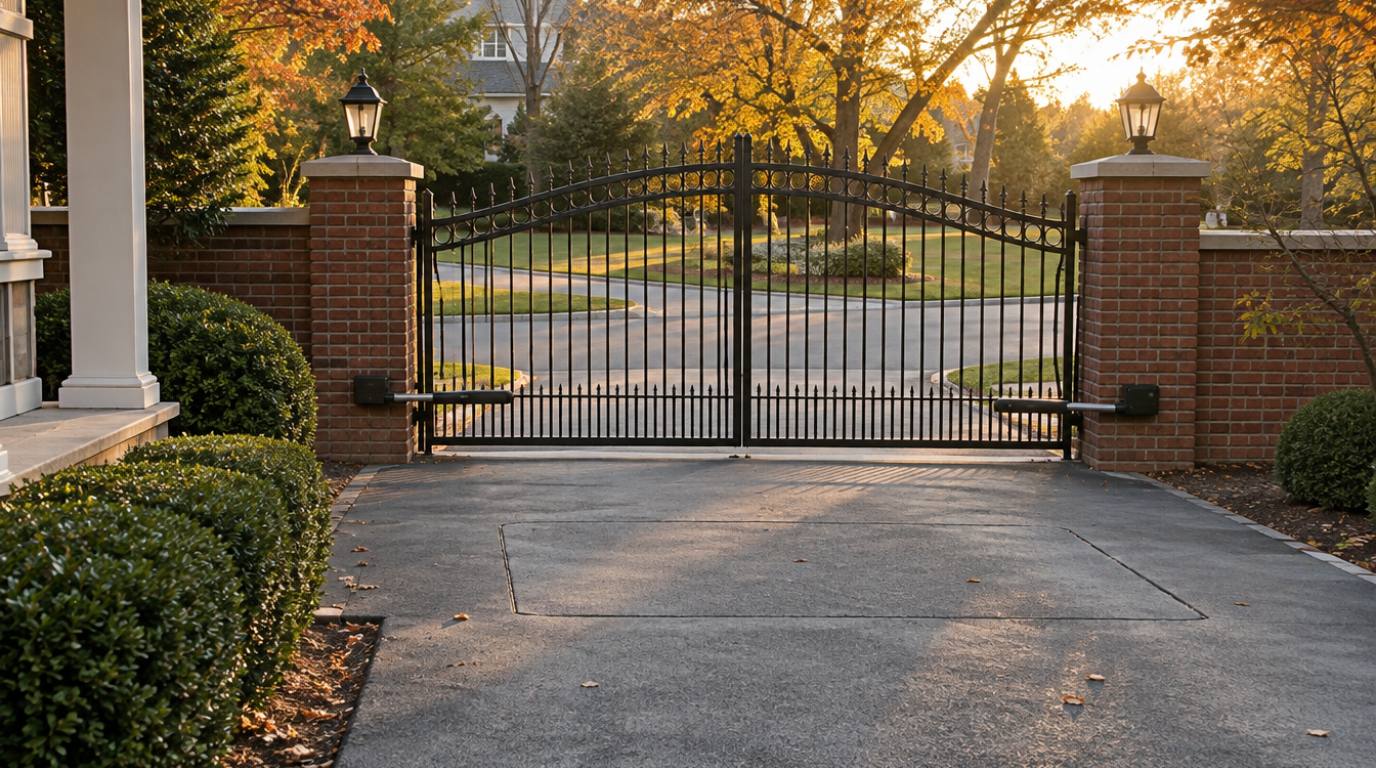
Exit loop distance
The exit loop has to be far enough up the driveway that the gate has time to open before the departing vehicle reaches it. A slow, heavy slide gate needs more lead than a short swing gate. On a downhill driveway the vehicle reaches the gate faster, and on a curved driveway the loop has to sit where every vehicle actually drives, not just where a straight line would put it. Too close, and drivers stop and wait at the gate. Too far, and the gate opens for cars that are only turning around in the yard.
Safety and center loops
Safety loops sit close to the gate line, on the side or sides where a vehicle might stop in the opening. The loop must not be so close to the moving gate that the steel of the gate itself changes the field each time it moves. Detector manufacturers and operator manuals specify that clearance; a slide gate running directly over a loop, for example, can trip it every cycle.
Shadow loop for swing gates
The shadow loop covers the swing zone of the leaves. Its edges follow the arc the gate sweeps through, kept back from the hinge posts and the gate leaves by the clearance the equipment calls for. Inward-swinging gates on a short driveway, the common layout on suburban lots in King and Snohomish counties, benefit most from a shadow loop because cars naturally pull up into the swing zone.
Lead-in and spacing
Each loop has a lead-in, the twisted pair of wires that runs from the loop back to the operator. The lead-in is twisted so it does not act as a loop itself, and it should run in its own groove or conduit, away from line-voltage power. When there are several loops, each has its own detector channel, and the detectors are set to different frequencies so neighboring loops do not interfere with each other.
If you are planning the keypad, intercom and loops at the same time, our guide to automatic gate keypad height in Washington covers where the pedestal sits relative to the gate, which affects where a car stops and therefore where the loops belong.
Saw-Cut Loops in Concrete: The 1-Inch Question
On an existing concrete driveway, the usual method is a saw-cut loop: a groove cut into the slab in the loop’s shape, the wire laid into the groove, and the groove filled with a loop sealant that encapsulates the wire and keeps water out.
DASMA’s technical data sheet on loop systems and depth in road pavements is direct about the risk. It notes that common loop installations call for a groove of about 1.5 inches or 2 inches deep, that grooves up to 1 inch deep are usually of no structural concern, and that deeper grooves risk cutting into the reinforcing steel, because the upper rebar is typically covered by at least one inch of concrete. Where a deeper groove would be needed, DASMA’s advice is to consult a qualified engineer or redesign the loop so the cut stays within 1 inch.
For a residential driveway that means asking a few questions before anyone starts the saw:
- Is the slab reinforced, and how? Rebar or wire mesh close to the surface changes how deep a cut can safely go and also affects the loop’s field.
- Is the slab structural? A driveway on a bridge, over a culvert or on a parking deck is a different case. DASMA notes that modifications to structural surfaces such as bridges and parking garages call for a structural engineer, and often for approval from the agency that owns the structure.
- Where are the control joints? Loops and lead-ins that cross joints need to be detailed so the wire is not stressed when the slab moves.
Asphalt, Pavers and Gravel Driveways
Asphalt
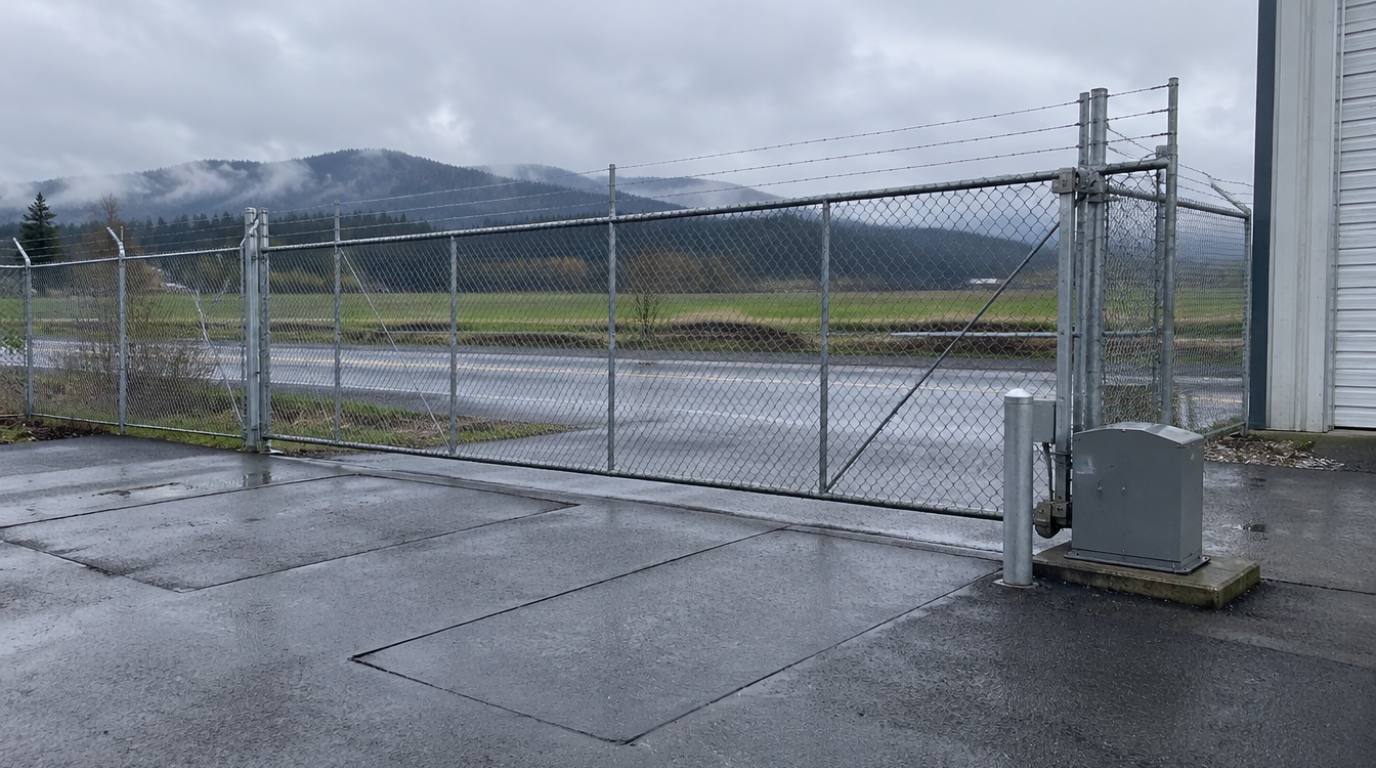
Asphalt behaves differently. DASMA points out that asphalt pavement mainly provides load-bearing support, and that the concern with a loop groove is water. A cut that is too deep can let the asphalt under it crack over time, opening a path for water into the base. The guideline DASMA offers is to try not to exceed 25 percent of the overall asphalt depth when cutting a loop groove.
Preformed loops under new asphalt
A preformed loop is a factory-made loop, often encased in a protective jacket, laid on the base before paving. DASMA notes that hot-mix asphalt can affect a preformed loop’s integrity and performance, and recommends asking the paving contractor for the expected placement temperature so it can be compared with the loop manufacturer’s maximum. Loops sold for “pave-over” use are built for that, but the temperature check still belongs in the plan.
Gravel
Gravel cannot hold a saw-cut loop. The options are a direct-burial loop, a loop built inside protective conduit and buried below the gravel, or an exit wand. Gravel driveways on farms and acreage in Skagit and Whatcom counties also see grading, plowing and heavy equipment, so the depth and protection of anything buried has to account for the driveway being scraped and rebuilt over the years. Our farm and agricultural gates page covers how we plan entrances that tractors and trailers use every day.
Concrete, asphalt or gravel at your gate?
We check the surface, the slab and what is buried before recommending a saw-cut loop, a preformed loop or an exit wand.
Planning Loops Before You Pave
The cheapest loop is the one planned before the concrete truck or paving crew arrives. A new driveway, a repave or a new building is the moment to set loops, sleeves and conduit, because afterward every option involves cutting, trenching or compromising.
DASMA’s technical data sheet on “Gate Operator Pre-Installation and Site Planning” (TDS 366) gives several rules that apply directly to loops:
- Run high-voltage primary power and low-voltage control wires in separate conduits. Loop lead-ins are low-voltage control wiring and should not share a conduit with the operator’s power feed.
- If conduit must cross the driveway, cross it under the gate line. For cantilever and swing gates, DASMA recommends crossing where the gate sits when fully closed, which keeps electrical wires away from loop detectors that may be used as free exit devices.
- Find out who the electrician will be before trenching starts. Gate work is often coordinated with an electrician “by others,” and the checklist of conduits, sizes, routes and wire counts should reach them before they dig.
For a new build in Skagit County or a repave in Snohomish County, the planning list usually looks like this:
- Decide the gate type and operator first, because that sets how many loops are needed and where.
- Mark the exit, safety, shadow and center loop locations on the driveway plan, with the operator manufacturer’s clearances.
- Set preformed loops or loop sleeves before the pour, with lead-ins in conduit to the operator location.
- Stub conduit up where the operator pad, keypad pedestal and any intercom will sit.
- Leave pull strings and label every conduit, so the gate crew knows which is which when they arrive months later.
- Photograph everything before it is covered, with a tape measure in the frame.
We wrote a full guide to planning an automatic gate before paving that covers power, sleeves and conduit for the whole entrance, not only the loops.
Call before you dig
Any trench for a loop lead-in, a wand cable or conduit is excavation. Washington’s underground utility damage prevention law, RCW 19.122, requires excavators to notify the one-number locator service (811) not less than two full business days and not more than 10 full business days before the scheduled start, unless an exemption applies. Rural driveways often carry the house’s own power feed, a well line or a septic line, which are private and not marked by the utility, so the property owner’s own records matter as much as the 811 ticket.
Who Can Wire a Gate Loop in Washington?
Washington regulates electrical work through the Department of Labor and Industries (L&I) under RCW 19.28 and the rules in WAC 296-46B. Gate operator wiring has its own electrical specialty, and its scope says a lot about how loops fit into the system.
WAC 296-46B-920 defines the door, gate and similar systems specialty (10). That specialty may install, service, maintain, repair or replace door, gate and similar systems electrical operator wiring and equipment. The scope covers low-voltage NEC Class 2 operator systems that are not connected to other systems, and line-voltage branch circuits (up to 600 volts and 20 amperes) that originate at the operator control panel and stay within sight of it. It does not include the branch circuit that supplies power to the operator control panel itself.
In plain terms for a homeowner or property manager:
- Loops, wands, photo eyes, edges, keypads and their wiring to the operator fall within the gate specialty’s low-voltage operator system work.
- The power feed to the operator (the circuit from the house panel or a utility meter to the gate) is work for an electrical contractor whose license covers branch circuits, coordinated with the gate contractor.
- Access control tied into a building system may fall outside the “not connected to other systems” limit, which is a reason to plan which contractor does which part before work starts.
Washington also requires contractors to show their registration number in advertising (RCW 18.27.100), so a gate contractor’s registration and electrical license can be checked on the L&I verification portal before you hire. Our page on hiring a licensed gate contractor in Northwest Washington explains what to look for. Permit and inspection requirements for electrical work vary by jurisdiction, so the electrical permit question belongs in the same conversation as the loop layout.
Rain, Frost and Wet Ground in Northwest Washington
Loops and wands are simple devices. What makes them fail in Northwest Washington is usually water, ground movement and the gradual wear of a driveway, not the detector electronics.
Water in the groove
A saw-cut loop survives as long as its sealant keeps water away from the wire and out of the slab. Long wet seasons in the Skagit Valley, Whatcom County and the islands mean the cut is sitting in standing water for months unless the driveway drains well. Sealant that cracked, shrank or pulled away from the edge of the cut lets water in, and a loop wire with damaged insulation will eventually leak to ground. The symptom is a gate that opens or holds open with no vehicle present, often worst after heavy rain.
Frost and freeze-thaw
Freeze-thaw cycles open small cracks in pavement and in the sealant. In the foothills toward Concrete and Darrington, and on higher ground east of Arlington and Granite Falls, a slab that heaves slightly each winter can stretch or break a loop wire where it crosses a joint. Details that help: keeping loops away from joints where possible, crossing joints at a right angle with slack and protection where they cannot be avoided, and choosing a sealant rated for the conditions.
Regular checks are part of the routine maintenance we recommend for every automatic gate in the region; our seasonal automatic gate maintenance guide for Washington includes loops and wands in the fall and spring checks.
When a Loop or Wand Misbehaves
Most detection problems show up as one of two complaints: the gate opens or stays open when nobody is there, or the gate ignores a vehicle that should have opened it. Each has a short list of usual causes.
| Symptom | Common causes to check | Who usually fixes it |
|---|---|---|
| Gate opens by itself or will not close | Damaged loop or lead-in leaking to ground, especially after rain; detector sensitivity set too high; two loops interfering on the same frequency; wand range reaching the road or a parked vehicle | Gate technician (detector and loop testing) |
| Gate does not open for departing vehicles | Broken loop wire; sensitivity too low for high-clearance trucks; loop or wand placed outside the wheel path; detector unplugged or failed | Gate technician |
| Gate works for cars, not for motorcycles or small trailers | Small metal mass; loop shape or detector sensitivity not suited to small vehicles | Gate technician (sensitivity or loop redesign) |
| Swing gate starts moving toward a car parked near it | No shadow loop, shadow loop not covering the swing zone, or shadow input not configured | Gate technician (layout and configuration) |
| Problems began after paving or concrete work | Loop or lead-in cut, crushed or covered too deep; new rebar or steel near the loop | Gate technician, often with a new loop |
A few checks are safe for an owner to do: look at the detector’s indicator lights (most show when a loop is detecting or faulted), look for cracked or missing sealant along the saw cuts, and note whether the problem follows rain, temperature changes or a particular vehicle. That information makes a service visit much faster.
What an owner should not do is disable entrapment devices to “test” a loop, or leave a gate in a mode where it closes without its photo eyes working. If the gate is stuck, use the operator’s manual release as described in its manual. Our automatic gate troubleshooting guide covers the wider list of causes when a gate will not open or close, and the gate repair service page explains how we handle service calls in Northwest Washington.
Gate opening on its own after the rain?
We test the detector, the loop and the lead-in, then explain whether a reset, a reseal or a new loop is the right fix.
Choosing Vehicle Detection by Property Type
The right detection plan depends on who uses the gate, how often, and what the driveway is made of. These are the patterns we see most often across Skagit, Whatcom, Snohomish and Island counties.
| Property | Typical detection plan | Points to decide on site |
|---|---|---|
| Suburban home, concrete driveway, swing gate | Exit loop plus shadow loop, or an exit wand if the slab cannot be cut | Swing direction, where cars stop, slab reinforcement |
| Rural home or farm, long gravel driveway | Exit wand or direct-burial loop well inside the gate | Equipment moving in the yard, grading and plowing, trailer traffic |
| HOA or private road entrance | Exit loop, safety loops on both sides, shadow loop for swing leaves | Traffic volume, tailgating, guest entry, fire access rules |
| Commercial or industrial lot, slide gate | Exit loop, safety and center loops, often with access control on entry | Truck lengths, gate speed, duty cycle, security of free exit |
| Island property with heavy rain exposure | Loops in well-drained concrete or a wand set out of standing water | Drainage at the gate line, salt air on above-ground hardware |
Free exit and security
Free exit makes daily life easier, but it also means anyone who can get a vehicle onto the property side of the exit loop can open the gate. On a commercial yard, that may be acceptable for employees leaving at the end of a shift and unacceptable at night. Many operators and access control systems can disable free exit on a schedule, or require a credential to exit during certain hours. Our access control systems page explains the credential options that can work alongside or instead of free exit.
How We Approach Vehicle Detection
Emerald Gate Systems designs, fabricates, installs, automates and services gates from our own shop at 7557 Alpine Lane in Sedro-Woolley, Washington, and serves Skagit, Whatcom, Snohomish, Island, San Juan, King and Pierce counties. Because the same team handles planning, installation, automation, access control, testing and later service, the loop layout is drawn together with the gate and operator instead of being added by someone else afterward.
On a site visit we start with the questions in this guide: who uses the gate, what vehicles, what the driveway is made of, what is buried in it and what happens on each side of the gate. From there we decide whether loops, an exit wand or a combination fits, where each one goes and how the operator is configured to use them. We install and service LiftMaster, Viking and FAAC gate operators, and we follow each manufacturer’s published layout and clearances for the detectors that go with them.
We also keep the two plans separate on paper: the vehicle detection plan and the entrapment protection plan. Every automatic gate we install or automate gets the photo eyes and edges its operator requires, regardless of how many loops are in the driveway. If you already have a gate and want to add free exit, our page on automating an existing gate explains how retrofits are planned, and the automatic gate installation page covers new systems from the ground up.
Washington requires contractors to show their registration in advertising: Emerald Gate Systems is registered with the Washington State Department of Labor and Industries as a construction contractor (EMERAGS748D6) and holds an electrical contractor license in the Doors and Gates specialty (EMERAGS747KE).
Frequently Asked Questions
What is a gate loop detector?
A gate loop detector is a module connected to a gate operator that drives a small current through a wire loop buried in the driveway. When a vehicle’s metal changes the loop’s inductance, the detector closes a relay that tells the operator to open the gate, hold it open or keep it from starting. It senses vehicles, not people.
Is an exit wand better than a loop?
Neither is better everywhere. An exit wand is easier to retrofit because it is buried beside the driveway instead of cut into it, which suits gravel and finished concrete. A loop detects a vehicle that is stopped as well as one that is moving, so it is the better choice for holding a gate open, shadow loops and busy commercial entrances.
Can a loop detector replace photo eyes on a gate?
No. UL 325 requires slide and swing gate operators to have two means of entrapment protection in each direction, using the operator’s inherent protection, photoelectric sensors or contact edges. A vehicle loop is not one of those means, because it cannot reliably detect a person. Loops add convenience and protect vehicles; photo eyes and edges protect people.
How deep is a gate loop cut into concrete?
DASMA notes that common loop installations call for grooves of about 1.5 or 2 inches, that grooves up to 1 inch are usually of no structural concern, and that deeper cuts risk reaching the rebar. Where more depth seems necessary, it recommends consulting an engineer or redesigning the loop. Always follow the loop manufacturer’s instructions.
Why does my gate open by itself after it rains?
A common cause is water reaching a damaged loop wire or lead-in through cracked or missing sealant, which makes the detector see a change with no vehicle present. Detector sensitivity set too high and two loops interfering on the same frequency can do the same. A technician can test the loop and detector to confirm which one it is.
Do I need a licensed electrician to install a gate loop in Washington?
In Washington, gate operator wiring, including low-voltage Class 2 devices such as loops and photo eyes, is electrical work regulated by L&I. WAC 296-46B-920 creates a door, gate and similar systems specialty for it. The branch circuit that powers the operator panel is outside that specialty and needs an electrical contractor licensed for that work.