
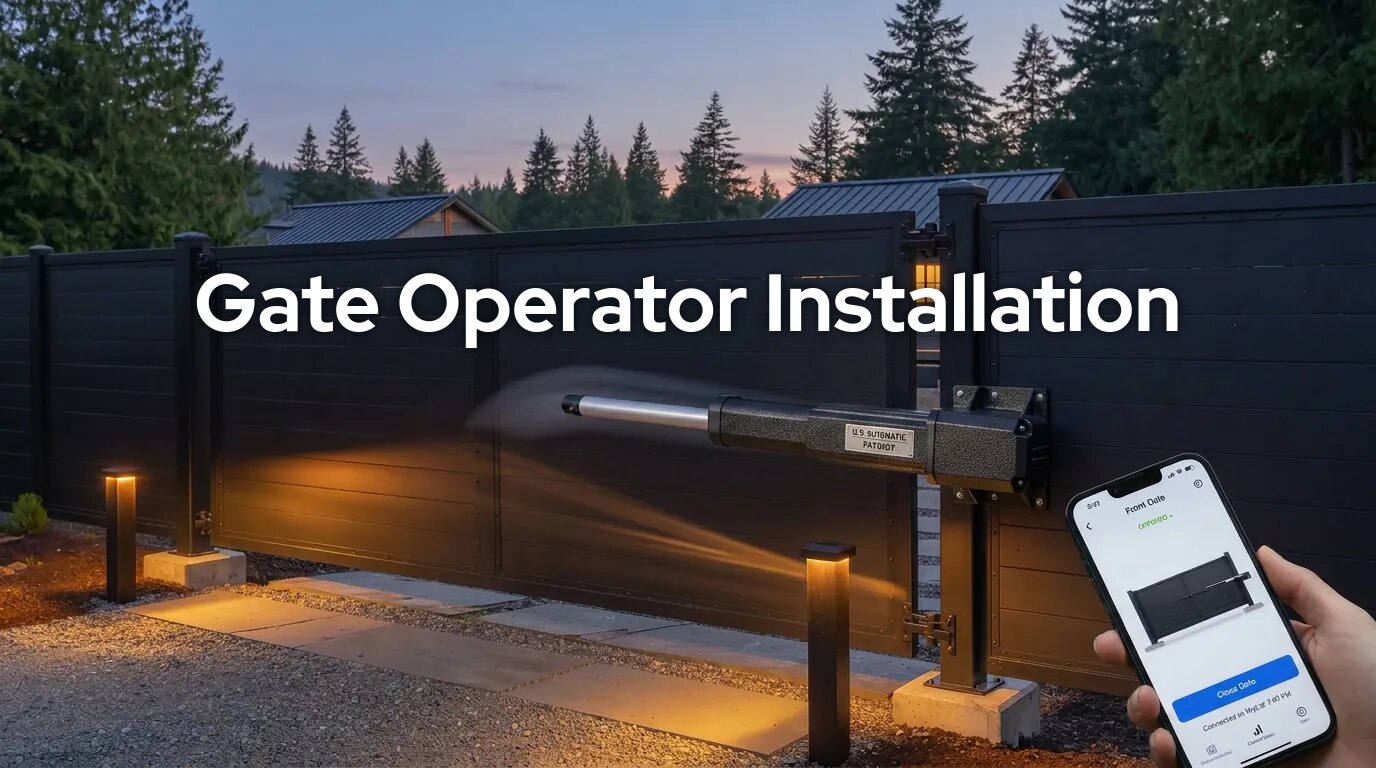
The gate is what people look at. The operator is what makes it work, and it is the part of the system that decides whether a driveway gate is a convenience or a weekly annoyance. This is a working guide to gate operator installation in Washington: how swing and slide operators differ, how one gets sized to a gate, what power and safety devices it needs, and what we look at before we quote one.
It applies whether you are automating a gate that already exists or specifying a new one. The operator decision is the same either way, and getting it wrong is the most common reason an automatic gate ends up propped open with a rock.
What a Gate Operator Does, and What It Does Not
A gate operator is the motor, gearbox and control board that moves the gate. It is not the gate, and it is not the access control. Those are three separate purchases that have to be matched to each other.
The gate is the steel, aluminum or wood structure on hinges or rollers. The operator moves it. The access control, whether a keypad, a remote, an intercom or a phone app, tells the operator when to move. You can replace any one of the three without touching the other two, which is why a sound gate with a tired operator is usually a retrofit rather than a rebuild. Our guide to automating an existing gate covers that decision in detail.
The operator is also where the safety system lives. Photo eyes, safety edges and the obstruction sensing built into the control board all report to it, so an operator installed without them is not finished, regardless of how well the gate moves.
Swing Gate Operators
Swing gates rotate on hinges, so the operator pushes or pulls the leaf through an arc. Three designs cover almost every residential and light commercial swing gate in Washington.
Linear arm operators
A linear arm mounts to the post and to the gate leaf and extends or retracts to move it. It is the most common residential choice because it is simple, visible and straightforward to service. It needs the gate to open inward with a clear arc, and it is the design that struggles most on a rising driveway, because the arm geometry cannot compensate for a leaf that has to climb.
Articulating arm operators
An articulating arm folds at an elbow, which lets it mount on wide posts or pillars where a linear arm would not fit, and it handles heavier leaves at a wider opening angle. It is the usual answer on stone or masonry pillars and on gates that need to open past ninety degrees.
Underground operators
An underground operator sits in a foundation box below the hinge and turns the leaf from beneath. Nothing is visible on the gate. It is the choice when appearance matters more than budget, and it needs proper drainage in the box, which in this climate is not a small detail.
Slide Gate Operators
Slide gates travel sideways along the fence line, and the operator drives them with a chain or a gear rack. They are the answer wherever a swing arc does not fit: short driveways, sloped approaches, and nearly every commercial opening.
A chain drive operator pulls the gate along a chain fixed to the gate frame. It is economical and tolerates a little misalignment, which suits residential slide gates. A rack and pinion operator runs a gear along a toothed rack on the gate, which is quieter, more precise and better suited to heavy gates and high cycle counts. Cantilever slide gates, which carry no ground track, put more load on the operator because the whole gate hangs from the counterbalance, so they are sized with more margin.
| Gate | Operator design | Where it fits |
|---|---|---|
| Swing, single or dual leaf | Linear arm | Level driveways, standard posts, inward opening |
| Swing, heavy or wide angle | Articulating arm | Masonry pillars, leaves that open past 90 degrees |
| Swing, appearance critical | Underground | Estate entrances where hardware must be hidden |
| Slide, residential | Chain drive | Level runs with room alongside the driveway |
| Slide, commercial or cantilever | Rack and pinion | Heavy gates, high cycles, uneven ground |
Sizing a Gate Operator
Every operator carries a maximum gate weight and a maximum gate length, and both limits matter at once. A light gate that is very long puts more leverage on the operator than a heavy gate that is short. Manufacturers publish these limits, and an operator run near the top of both will wear out early.
The number people forget is cycles per day. A residential operator is rated for a handful of openings a day and rests between them. A gate at an apartment building or a distribution yard can cycle several hundred times a day, which calls for a continuous duty operator with a different motor and gearbox entirely. Fitting a residential operator to a commercial gate is the single most common sizing mistake we are called to correct.
| Sizing input | Why it matters |
|---|---|
| Gate weight | Sets the motor and gearbox class |
| Gate length or leaf width | Sets leverage on the operator and the mounting |
| Cycles per day | Separates residential duty from continuous duty |
| Wind exposure | Solid infill panels act as sails and add load |
| Driveway grade | Rules out some swing designs and changes force settings |
| Opening speed required | Commercial sites often need faster travel than residential operators offer |
Wind deserves its own line because it is easy to underestimate here. A solid cedar or panel gate on an exposed site near the water catches a lot of wind, and the operator has to be sized for that load, not for the gate at rest. Our guide to gate materials for Washington weather goes into how the material choice feeds back into this.
Power, Battery Backup and Solar
Most operators run on low voltage supplied by a transformer, which means the run from the house or building to the gate carries mains power to a transformer near the operator, or low voltage over a longer distance with a heavier cable. Which one is right depends on how far the gate is from the panel, and on a long rural driveway that distance is the biggest cost line in the whole project.
Battery backup lets the gate keep cycling through an outage for a set number of openings, and every operator we install has a manual release so the gate can be opened by hand once the battery is exhausted. On properties where outages run long, a larger battery bank is worth specifying up front.
Solar is a genuine option rather than a compromise where the gate is far from power. The panel has to be sized for a Pacific Northwest winter, not a summer afternoon, and the battery has to carry the gate through the dark weeks of December. Undersized solar is the most common fault we correct on solar gates other people installed. Our solar gate opener guide covers the sizing.
Safety Devices Are Part of the Installation
An automatic gate is powered machinery in a place where people, children and pets walk. UL 325 is the safety standard that governs gate operators, and ASTM F2200 governs the gate construction that goes with them. Between them they set out which entrapment protection devices are required for each gate type and usage class.
In practice that means photo eyes across the opening, contact safety edges on the leading edge and often the trailing edge, obstruction sensing in the control board, and a gate design without gaps that could trap a hand or a head. These are not options added at the end; they are part of what an operator installation is. Our guide to UL 325 and ASTM F2200 explains what each device does and where it goes.
Brands We Install and Service
We install and service LiftMaster, Viking and FAAC operators among others, and we service operators from other manufacturers that were installed by someone else. Brand matters less than sizing and installation quality, but it matters for parts availability. An operator whose control board can still be bought in five years is worth more than one that cannot. If you already have an operator that is misbehaving, our LiftMaster and Viking opener repair guide covers the common faults.
Installing an Operator on an Existing Gate
Most gate operator installation in Washington is a retrofit rather than a new build. A manual gate that is straight, properly hung and swings or slides freely by hand can usually take an operator. A gate that binds, sags or drags cannot, because the operator will fight the gate and lose. We check the hinges, the posts and the travel before we quote, and if the gate needs work first, we say so rather than bolt a motor onto a problem.
The retrofit also has to bring the safety devices up to the current standard, even if the gate was fine as a manual gate. That is often the part of the quote people do not expect, and it is not the part to cut.
What the Installation Visit Covers
We come out, measure the gate and the opening, weigh or estimate the leaf, look at the grade and the approach, and find the nearest power. We check the posts and hinges, or the track and rollers on a slide gate. Then we specify the operator, the safety devices and the access control together, and put a written quote together for the actual site rather than for a typical one.
On the day, the installation covers the operator mounting, the power run, the safety devices, the control settings for force and speed, and the access control programming. We hand over with the manual release demonstrated and the settings documented.
Gate Operator Installation in Washington: Where We Work
We are based in Sedro-Woolley and install operators across Skagit, Whatcom and Snohomish counties, the island communities, and the greater Puget Sound, including the King County metro. Gate operator installation in Washington’s rural counties tends to be about power distance and solar; in the Snohomish and Eastside corridors it is more often about grade, swing space and cycle count. Our Snohomish County page and the full service area list the towns.
Frequently Asked Questions
What is the difference between a gate operator and a gate opener?
Nothing in practice. Operator is the industry term and opener is the consumer term for the same motorized unit that moves a gate. Manufacturers and safety standards use operator.
Can a gate operator be installed on my existing gate?
Usually, if the gate is straight, properly hung and moves freely by hand. Gates that bind, sag or drag need repair first, and the retrofit has to include the current safety devices. We assess this on the site visit before quoting.
How do you choose between a swing and a slide operator?
The gate decides. A swing gate needs a swing operator and a slide gate needs a slide operator. If you are choosing the gate as well, the driveway decides: a level driveway with a clear arc suits swing, and a sloped approach or a short driveway suits slide.
What size operator does my gate need?
It depends on gate weight, gate length, how many times a day it will cycle, and how much wind it catches. Residential operators cover a few openings a day; commercial gates that cycle hundreds of times a day need continuous duty operators. We size from measurements taken on site.
Does a gate operator need its own power supply?
It needs a power run from the building or a solar array with a properly sized battery. On long rural driveways the power run is often the largest cost in the project, which is where solar becomes the better answer.
What happens to the gate when the power goes out?
Battery backup keeps the gate cycling for a set number of openings, and a manual release lets you open it by hand once the battery is exhausted. Where outages run long, a larger battery bank is worth specifying up front.
Which safety devices does a gate operator installation need?
UL 325 requires entrapment protection matched to the gate type and usage class, which in practice means photo eyes, contact safety edges and obstruction sensing in the control board, on a gate built to ASTM F2200. They are part of the installation, not an add-on.
Starting With the Gate You Have
If you are weighing an operator for an existing gate or specifying one for a new gate, the first step is a site visit. We measure, check the gate and the power, and put a specification and a written quote together for the actual site. There is no charge for that. Book it on the free consultation page or call (360) 657-9975. If the gate is already automated and misbehaving, start with our gate repair page instead.