
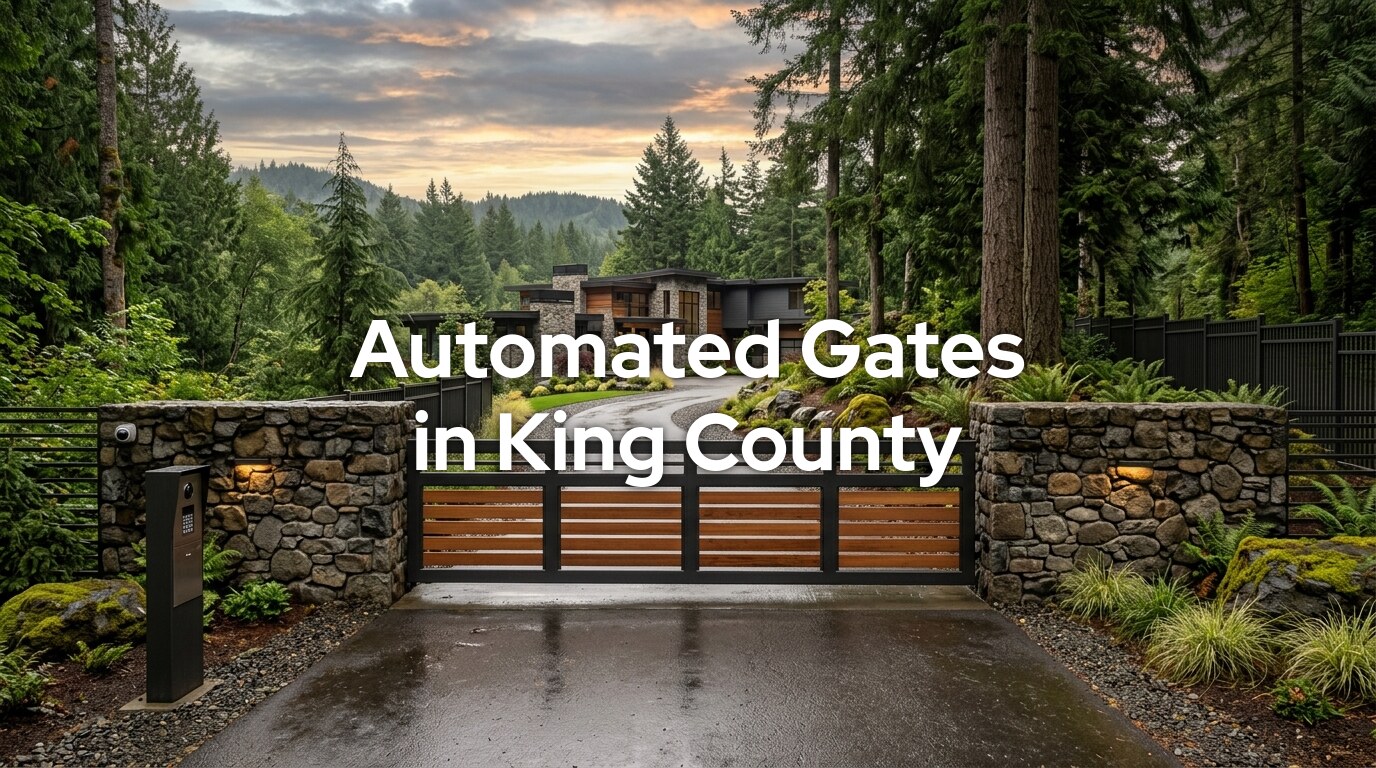
Emerald Gate Systems is based in Sedro-Woolley, about seventy miles north of Seattle, and a fair number of the calls we take now come from the other direction. Automated gates in King County and the wider Seattle metro are a different kind of build than the ones we do on a Skagit Valley farm, and pretending otherwise is how people end up with a gate that fights its own driveway for the next fifteen years.
This is a working guide to what changes once you cross into King County: the four build environments we run into, which gate types actually suit them, what access control looks like on a dense city lot versus a five acre Eastside parcel, and the questions worth settling before anyone cuts steel.
Where We Work in the Seattle Metro
Our home counties are Skagit, Whatcom, Snohomish and the island communities, and that is where most of our fabrication history sits. But the shop travels to where the project is, and the metro corridor has become a regular run.
In King County that means Seattle, Bellevue, Kirkland, Redmond, Sammamish, Issaquah, Woodinville, Mercer Island, Renton, Kent, Tukwila, Auburn, Federal Way, Maple Valley, Shoreline, Snoqualmie, North Bend, Duvall and Carnation. Just outside the county line we work Edmonds, Lynnwood and Bothell to the north in Snohomish County, and Tacoma and Puyallup to the south in Pierce County. The full list of what we cover across the state is on our service areas page.
One practical note before anything else. Distance changes scheduling, not capability. A metro project gets planned around fewer, longer site days rather than a string of short visits, which means the survey and the measurements have to be right the first time. That is a good discipline anywhere, and it is mandatory when the shop is an hour and a half up I-5.
What Automated Gates in King County Have to Deal With
Northwest Washington is not one climate or one kind of lot, and the metro is not one build environment. We sort King County work into four, because each one drives a different set of decisions about gate type, operator, foundation and access control.
The Eastside estate corridor
Bellevue, Kirkland, Redmond, Sammamish, Issaquah, Woodinville and Mercer Island. Large lots, long private drives, mature landscaping that nobody wants disturbed, and very often a homeowners association with written design guidelines. Gates here are as much an architectural element as a security one, and the approval conversation usually happens before the engineering one.
The constraint that catches people out is grade. Eastside driveways climb and fall, and a swing gate on a rising driveway will either bind against the slope or need to swing outward toward the road, which is rarely acceptable and sometimes not permitted. That single fact reroutes a lot of Eastside projects toward slide or cantilever designs.
The city grid and close-in north
Seattle proper, Shoreline, Burien, and up into Edmonds. Short driveways, tight setbacks, alley access, sidewalks with real pedestrian traffic, and a right-of-way you cannot swing a leaf across. Space is the whole problem here.
A gate on a city lot has to open entirely within the property line and it has to clear pedestrians safely, which puts vertical pivot, bi-fold and short slide gates in play where a conventional swing gate simply will not fit. Safety loops and photo eyes are not optional refinements on a sidewalk-adjacent gate, they are the design.
The valley floor and south corridor
Kent, Tukwila, Renton, Auburn, Federal Way and on into Tacoma. This is distribution, light industrial, fleet yards, self storage and multifamily. The properties are flatter and the openings are wider, and the governing number is cycle count.
A commercial gate in the Kent Valley can cycle several hundred times a day. That rules out residential grade operators entirely and pushes the specification toward heavy duty cantilever gates, industrial operators with proper duty cycles, and access control that can handle a lot of credentials and a lot of turnover. Bollards frequently come into the conversation at the same time, because truck traffic and gate posts are a bad combination.
The foothills
Snoqualmie, North Bend, Duvall, Carnation, Maple Valley, Black Diamond and Enumclaw. Rural in character even though it is still King County. Long driveways, power that may be a genuine distance from the gate, elevation that brings snow and ice the lowland cities do not see, and wildlife that will test a gate that closes slowly.
Power is the first question in the foothills, not the last. Running conduit several hundred feet from a house to a gate is a real cost line, and solar with a properly sized battery is often the better engineering answer rather than a compromise.
| Build environment | Typical property | What drives the design |
|---|---|---|
| Eastside estate corridor | Large residential lot, long private drive | Driveway grade and HOA design review |
| City grid and close-in north | Compact urban lot, sidewalk frontage | Available swing space and pedestrian safety |
| Valley floor and south corridor | Commercial, industrial, multifamily | Daily cycle count and credential volume |
| Foothills | Rural acreage, remote entry point | Distance to power and winter conditions |
Choosing the Gate Type for the Opening You Actually Have
Most of the regret we see in gate projects traces back to a gate type chosen for looks and then forced onto an opening that was never going to suit it. The opening decides first. Style decides second, and there is more style freedom inside every one of these categories than people expect.
| Gate type | Suits | Watch for |
|---|---|---|
| Swing, single or dual leaf | Level driveways with room to open inward | Needs a clear arc, struggles on grade |
| Slide, roller track | Level runs with space alongside the drive | Track collects debris and ice |
| Cantilever slide | Wide commercial openings, uneven ground | Needs counterbalance run beside the opening |
| Bi-fold | Fast cycling where side room is short | More moving parts to service |
| Vertical pivot | Tight urban lots, sloped approaches | Overhead clearance and visual mass |
If you want to work through this properly for your own site, our guide on how to choose an automatic gate covers the residential decision in detail, and there is a separate walkthrough for choosing a commercial gate system.
Access Control Changes Shape Across the Metro
The gate is the visible half. The half that determines whether people are happy with the system two years in is how they get through it.
On an Eastside residential property, access control usually means a keypad, a set of remotes, and a video intercom that reaches a phone so a delivery can be handled without walking down the drive. The intercom is the part people underestimate. A driveway long enough to need a gate is long enough that you will not want to walk it.
On multifamily and commercial sites in Kent, Tukwila or Renton, the requirement is different in kind rather than in degree. You are managing credentials for a population that changes, you need an audit trail, and you need to revoke access without recalling hardware. That means card and fob systems, mobile credentials, and often integration with an existing property management platform. Our overview of access control systems goes through the options.
Two related pieces come up constantly on commercial metro work. Bollards, fixed or removable, protect the gate hardware and the building line from vehicle traffic, and they are far cheaper installed alongside the gate than retrofitted after something gets hit. And where a property has public-facing pedestrian entries, ADA-compliant entry systems need to be planned as part of the same access scheme rather than bolted on later.
Permits, HOAs and the Approvals That Slow Projects Down
King County has a lot of jurisdictions in it, and requirements are not uniform. Seattle, Bellevue, Kirkland, Redmond, Kent and unincorporated King County each run their own permitting, and what triggers a permit varies: gate height, whether the structure is attached to a wall or fence, work within the right-of-way, and the electrical for the operator. Electrical for a gate operator generally needs to be permitted and inspected regardless of what the gate itself requires.
We confirm the requirements with the relevant building department for your specific address before fabrication starts, because a gate built to the wrong height is not a gate you can adjust on site.
Homeowners association review is the other schedule risk, and on the Eastside it is the more common one. Many associations have written standards covering height, materials, color, opacity and setback, and some require submitted drawings before work begins. It is worth pulling those guidelines before design rather than after, because a design revision is cheap and a rebuild is not. When an association needs drawings, we produce them as part of the custom fabrication process.
Power, Backup and Winter
Every automated gate in the region needs an answer to two questions: what happens when the power fails, and what happens when it freezes.
On the power side, a battery backup on the operator lets the gate cycle a set number of times after an outage, and a manual release lets you open it by hand when the battery is done. On a rural foothills property where outages last longer, a larger battery bank or a solar array with proper capacity is worth specifying up front. Undersizing solar is one of the most common faults we correct on gates other people installed, and it usually shows itself in the first genuinely dark stretch of December.
On the winter side, the metro is milder than the North Cascades foothills, but Snoqualmie and North Bend get real freeze and the valley floor gets standing water. Slide gate tracks are the vulnerable component, since debris and ice in a ground track will stall a gate that worked perfectly all summer. That is one of the reasons cantilever designs, which carry no ground track at all, do so well on commercial sites here.
Who We Build For
The people who end up with automated gates in King County are not one audience. Across the metro the mix runs to homeowners and estate properties, homeowners associations and residential communities, property managers and multifamily owners, commercial and industrial owners, schools and healthcare facilities, government and municipal properties, and general contractors bringing us in as the entry systems trade on a larger build.
General contractor work has its own requirement, which is coordination. When a gate is one line on a schedule, the useful thing a gate contractor can do is take the whole scope, design, fabrication, installation and the electrical and access control integration, so it is one trade to sequence instead of four. That is how we are set up, and it is covered in more detail in our piece on working with a single licensed gate contractor.
Existing Gates: Repair, Retrofit and Takeover
Not every metro call is a new build. A large share is a gate that already exists and no longer behaves: an operator past its service life, a controller nobody has the code for, safety devices that were never installed correctly, or a gate specified for a lighter duty than the property turned out to need.
Those are usually fixable without replacing the gate itself. A sound steel or iron gate can carry a new operator, new safety loops and photo eyes, and a modern access control head, which is a fraction of the cost of starting over. Where the gate itself is the problem, we will say so rather than hang new hardware on a frame that is going to fail. Our gate repair and upgrade page covers what that assessment involves.
Frequently Asked Questions
Do you serve King County if you are based in Sedro-Woolley?
Yes. We travel to where the project is, and King County and the greater Seattle metro are a regular part of our work. The practical difference is scheduling rather than scope: metro projects are planned around fewer, longer site days, so the initial survey and the measurements carry more weight.
Should I choose a swing gate or a slide gate for a Seattle driveway?
The driveway decides. A swing gate needs a level surface and a clear arc to open into, which many compact city lots and sloped Eastside driveways do not have. Where swing space or grade is the constraint, slide, cantilever, bi-fold or vertical pivot designs solve the problem without giving up appearance.
Do I need a permit for an automatic gate in King County?
It depends on your jurisdiction and the specifics of the gate. Seattle, Bellevue, Kirkland, Redmond, Kent and unincorporated King County each permit separately, and the usual triggers are gate height, attachment to an existing structure, work within the right-of-way, and the electrical for the operator. Electrical typically requires a permit and inspection in any case. We confirm the requirements for your address before fabrication.
Can an automatic gate meet my HOA design guidelines?
Almost always, provided the guidelines are read before the design rather than after. Associations commonly specify height, material, color, opacity and setback, and those constraints still leave considerable design freedom. Where an association requires submitted drawings, we produce them as part of the fabrication process.
What happens to the gate in a power outage?
A properly specified operator has battery backup that allows a set number of cycles after power is lost, plus a manual release so the gate can be opened by hand once that is exhausted. On rural properties in the foothills, where outages run longer, it is worth sizing the battery bank or the solar array for that reality up front.
Can you add access control to a gate someone else installed?
Usually yes. If the gate structure is sound, a new operator, current safety devices and a modern access control head can be fitted to it. That covers keypads, remotes, video intercoms, card and fob credentials and mobile access. If the gate itself is undersized for the duty the property demands, we will tell you that before quoting the retrofit.
My driveway slopes toward the street. What are my options?
A sloped approach is one of the most common Eastside constraints and it rules out a conventional swing gate in most cases, since the leaf will bind on the rising surface or be forced to swing outward toward the road. Slide, cantilever and vertical pivot gates all handle grade well. Which one suits comes down to the room available alongside the opening.
Starting a Project in the Metro
The first step for automated gates in King County, as anywhere else, is a site visit, because the answers to grade, swing space, power distance and cycle count are all on the ground rather than on a plan. We come out, measure, look at the approach and the power situation, and put together a specification and a price for the actual site. There is no charge for that, and you can book it on the free consultation page or by calling (360) 657-9975.
Some metro HOAs and commercial yards ask about plate readers instead of fobs. Our guide to license plate recognition gates in Northwest Washington covers where LPR reads reliably, where it fails and when a keypad or transmitter is the better choice.
If you are north of the county line, our Edmonds work and the wider residential driveway gate guide are the closest reference points. And if you are not sure whether your address falls inside our range, call and ask. The answer is more often yes than people expect.