
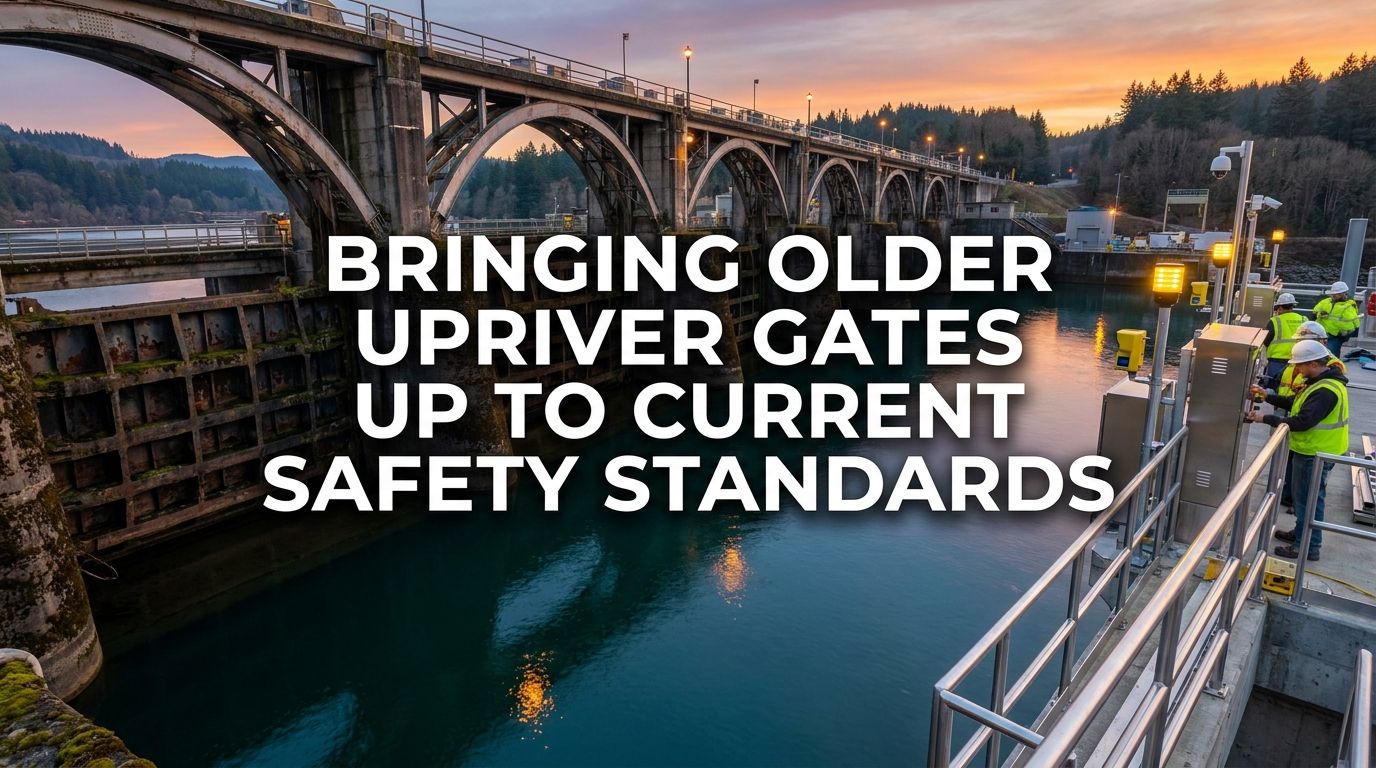
Gate safety upgrades Concrete WA properties need are usually invisible to the owner until someone looks. Upriver Skagit County has gates that have been in place for twenty or thirty years, quietly cycling on long rural driveways, and a large share of them are missing protection that current standards expect. Not because anyone cut corners, but because the gate predates the requirement and nobody has evaluated it since.
Emerald Gate Systems evaluates, upgrades, and services gate systems from our own shop in Sedro-Woolley, half an hour down the valley. We work the upriver corridor through Lyman, Hamilton, Concrete, Rockport, and Marblemount regularly, and the pattern here is consistent: sound old gates on long driveways, with automation that has aged past what is considered safe.
This page covers what gate safety upgrades Concrete WA gates typically need: what the two governing standards actually require, the findings we make most often on older rural systems, what an upgrade costs and involves, and when the honest answer is replacement instead. Call (360) 657-9975 or use the contact page to have your gate evaluated.
Why Gate Safety Upgrades Concrete WA Properties Need Go Unnoticed
A gate that works does not attract attention, and that is precisely the problem. Safety equipment fails silently on older systems, and the gate carries on cycling as though nothing has changed.
The clearest example is the photo eye. On systems installed before device monitoring was required, a photo eye could be disconnected during a repair, knocked out of alignment by a landscaper, or simply fail, and the operator would never know. The gate keeps opening and closing normally. The protection is gone. Nobody finds out until something happens.
Monitoring changed that. Current operators supervise their external safety devices and detect when one is missing or faulty, then change behavior rather than continuing as if nothing is wrong. That single difference separates most older rural installations from current ones.
The second reason these go unnoticed is that rural properties are private. There is no inspector walking a driveway. Electrical work gets inspected, but that inspection covers the electrical installation rather than a full entrapment protection audit. On a private driveway, often nobody looks at all.
The third is that use changes without anyone re evaluating. A gate installed for a couple becomes a gate used by grandchildren. A single family driveway becomes a shared lane for two homes. A property picks up a home business with deliveries. The gate is the same. What it is expected to protect against is not.
What the Two Standards Actually Require
Two documents govern this, and they divide the work between them in a way that matters for upgrades.
UL 325 covers the gate operator and its entrapment protection. It requires two independent means of protection in each direction of travel, coming from different types so a single failure cannot disable both. In practice that means the operator’s inherent sensing as one layer, plus monitored external devices such as photo eyes or edge sensors as the other.
ASTM F2200 covers the gate itself: how it is built, guarded, and prevented from falling or leaving its track. Positive stops on slide gates, guarding around rollers, screening near the operating zone so a hand cannot reach into a closing gap, and gates designed so they cannot fall if a support fails.
The interaction is the part owners miss. A brand new operator with perfect entrapment protection will still happily drive a gate that has no positive stops, unguarded rollers, or an open ornamental pattern next to a fixed post. Those are construction issues the operator cannot detect.
Neither document is a statute in itself. Their weight comes from manufacturer requirements, reference by officials, and their standing as the recognized standard of care that insurers and courts apply after an incident. On a rural property where nobody inspects, that last one is what actually matters.
Our page on automatic gate safety standards goes through both in detail.
Talk with Emerald Gate Systems. An evaluation tells you exactly where your gate stands against both standards in a single visit. Call (360) 657-9975 or use the contact page.
What We Find Most Often on Upriver Gates
After enough evaluations in this corridor the findings repeat, and they are worth listing plainly.
No secondary protection at all. The gate relies entirely on the operator’s inherent sensing, with no photo eye or edge sensor anywhere. Common on installations more than a decade old and on gates automated by someone unfamiliar with the requirement.
Photo eyes present but dead. Disconnected during a past repair and never reconnected, knocked out of alignment years ago, or failed without anyone noticing because the system does not monitor them.
Devices deliberately bypassed. Someone found the gate nuisance tripping, and instead of finding the cause, jumpered the input. This is the finding we take most seriously because it converts an annoyance into a hazard and it is almost never documented.
No positive stops on a slide gate. Nothing physically prevents the gate running past its intended travel and leaving its track or rollers. On a cantilever gate this is a serious condition, because a gate that leaves its support becomes a falling object.
Unguarded rollers and unscreened panels near the operating zone, which is common on ornamental gates built for appearance and automated later.
Missing warning signage, and a manual release that has seized from corrosion, sits under overgrowth, or whose key was lost with a previous owner.
None of these means the gate has to be replaced. Most are correctable. What they mean is that the system is not doing what its owner believes it is doing.
Long Rural Driveways and Why the Findings Cluster Here
The upriver corridor has conditions that make older systems degrade faster and make problems harder to notice.
Distance is the first. A gate a quarter mile from the house is out of sight and out of mind. Nobody notices a photo eye that has drifted or an indicator light that has changed, because nobody is standing there.
Vegetation is the second. Growth encroaches on beam paths, covers a manual release, and blocks a gate’s swing arc over a few seasons. What was a clear installation becomes an obstructed one without anyone doing anything.
Weather is the third. Persistent damp, seasonal flooding potential near the river, and freeze thaw cycles all work on hardware, footings, and enclosures. Water in an enclosure corrodes terminal blocks and grounding connections, and a degraded ground means fault protection is not doing its job.
Wildlife is the fourth and it is genuinely common here. Rodents and insects find warm enclosures attractive, nests bridge terminals, and chewed insulation produces shorts that look exactly like board failure until the wiring is traced.
Ground movement is the fifth. Saturated soil and slope let posts settle or lean, which changes the gate’s geometry and the arc it was set up for. A gate that binds at one point is now fighting on every cycle.
All of that is ordinary rural aging rather than neglect. It just means an older upriver gate deserves an evaluation rather than an assumption.
Talk with Emerald Gate Systems. If your gate is a long way from the house and has not been looked at in years, that is the case for a visit. Call (360) 657-9975.
What a Safety Upgrade Actually Involves
Upgrading an existing installation is a defined piece of work rather than an open ended project, and it follows the same sequence every time.
It starts with an evaluation: what operator is installed and whether it can support monitored devices, what protection exists and whether it functions, how the gate is built and supported, whether stops and guarding are present, how the gate is actually used and by whom, and whether the manual release works.
From there the work divides into three buckets. Electronics means adding or replacing monitored safety devices plus the wiring to support them. Construction means positive stops, guarding, screening, and any structural correction. Operational means signage, control placement, manual release, and documentation.
The decision point that moves the number is whether the existing operator can support monitored devices. Many can. Some are old enough that the honest answer is operator replacement rather than adapting around it, and that is where cost jumps.
Where the gate structure is sound, this work pairs efficiently with other automation improvements because the labor overlaps. Where the gate is sagging, corroded, or was never built for automation, correcting safety on top of a failing structure is money in the wrong place. Our gate automation retrofit page covers that evaluation, and repair cost versus replacement works through the comparison.
Nuisance Tripping and Why Bypassing Is Not the Fix
The single most common reason a safety device gets disabled is that it kept stopping the gate, and that impulse is understandable and wrong.
Nuisance tripping almost always indicates something real. A photo eye that trips every morning is usually misaligned, dirty, or being hit by low winter sun. A gate that trips its obstruction sensing at the same point each cycle is meeting actual resistance there, from debris, a sagging leaf catching a post, a raised slab, or ice. The device is doing its job.
Bypassing removes the protection while leaving the cause in place, and the cause usually gets worse. A binding gate that trips a sensor today will damage a gearbox in six months.
Finding the cause is usually quick and inexpensive. Realigning a photo eye, clearing a path, cleaning a lens, correcting drainage, resetting a post, or adjusting travel limits resolves the large majority of nuisance trips.
Where a device genuinely is failing, it gets replaced rather than removed. And on an upriver property where a technician visit costs travel time, fixing the underlying condition rather than the symptom is what prevents a repeat call.
Our gate repair and maintenance page covers diagnosis, and what to check when a gate will not open or close covers the safe things an owner can look at first.
Talk with Emerald Gate Systems. If your gate keeps tripping and someone suggested disabling the sensor, get a second opinion. Call (360) 657-9975.
Manual Release, Emergency Access and Long Response Times
Upriver Skagit County has longer emergency response times than the valley floor, which raises the stakes on two things that get neglected everywhere.
The manual release is the first. Every powered gate has a way to be moved by hand, and the moment to learn where it is and confirm it works is not during an outage with a vehicle blocked in a driveway. On older rural gates we routinely find releases that have seized from corrosion, sit under overgrowth, or whose key disappeared with a previous owner. A release that cannot be used is not a release.
Emergency responder access is the second. The fire district requires that a gate across an access route be openable without power and without anyone home, and which method they accept, whether a key switch, a lock box, or a radio activated receiver, is a district question rather than a preference. On a long private driveway, access requirements apply along the route rather than only at the gate.
Both belong in a safety upgrade rather than being treated as separate items, because both are about whether the gate can be opened when it matters most.
Battery backup ties into this. Winter storms take power down in this corridor, and a gate with a dead backup battery is a gate that will not open. Batteries fail quietly because the gate keeps working on utility power, so testing under load rather than at rest is the only reliable check.
Our page on gate permits in Washington State covers fire access review alongside electrical permitting, and solar gate openers covers remote entrances where trenching power is impractical.
Who This Matters For and Why
The exposure from an inadequately protected gate falls differently depending on the property, and it is worth being clear about it.
For a single family driveway used only by the household, the risk is mostly to the family, and particularly to children and pets who do not understand what the gate does. That is reason enough for most owners.
For a property with any regular visitors, deliveries, contractors, or a home business, the exposure widens to people who did not install the gate and have no familiarity with it. Gate class expectations recognize this distinction, and a gate that changed use without re evaluation is in a different position than it was.
For shared driveways serving more than one household, which are common upriver, the responsibility is shared and usually undefined. Nobody has decided who maintains the gate or who is responsible if something goes wrong, which is worth settling in writing.
For rental and vacation properties, the guests are strangers to the system entirely. That is the highest exposure profile and the one owners think about least.
Where these standards genuinely bite is after an incident, when the question becomes whether the system met the recognized standard of care. A gate with missing or bypassed protection is a difficult position regardless of whether an inspector ever visited.
Maintenance That Keeps an Upgrade Working
Safety equipment is only protective if it functions, and verifying that takes minutes rather than hours.
Photo eyes can be tested by breaking the beam with an object while the gate closes and confirming it stops or reverses. Edge sensors by applying pressure with an object. Inherent sensing by placing a solid obstruction in the path. Never test any device using a person or an animal.
Monitored systems should also be tested for fault behavior, meaning that disconnecting a device produces the response the operator is supposed to produce rather than being silently ignored. That test belongs to a technician.
Twice a year suits most rural properties here, timed before winter and after it. What gets checked: device alignment and function, wiring condition, gate structure and supports, stops and guarding, hinges and rollers, manual release, battery under load, enclosure sealing, drainage, vegetation encroachment on beam paths and swing arcs, and coating condition.
Between visits, the signals worth acting on are a gate reversing without obvious cause, an indicator light behaving differently, physical damage to a device housing, a post that has visibly shifted, vegetation growing into the path, or a gate whose alignment has changed.
Our preventive gate maintenance page covers a reasonable program for rural properties.
Talk with Emerald Gate Systems. An upgrade that is never checked drifts back toward where it started. A maintenance program is what keeps it current. Call (360) 657-9975.
Working Upriver From Sedro-Woolley
We are headquartered in Sedro-Woolley, which puts Concrete and the upriver corridor well inside regular territory rather than at the edge of it.
Everything structural is fabricated in our own shop, which matters on safety upgrades specifically because the work frequently involves a positive stop, a guard, a screening panel, or a bracket that has to be made rather than bought off a shelf.
One team handles evaluation, structural correction, safety devices, automation, access control, and service. On an upgrade that consolidation is worth more than on a new installation, because whether the gate is sound, what operator suits it, and how the devices mount are all the same question rather than three companies’ opinions.
Concrete sits alongside Sedro-Woolley, Lyman, Hamilton, and Rockport in our Skagit coverage. Our Skagit County gate installation page covers the county, and Northwest Washington service areas shows the full picture.
You can verify our license and bond status through Washington L&I contractor verification before anyone comes out, which is worth doing with any contractor.
Frequently Asked Questions About Gate Safety Upgrades Concrete WA
How do I know if my gate needs a safety upgrade?
Look for photo eyes, small sensors facing each other across the opening, and for a rubber strip along the gate edge. If neither is present, the gate is likely relying only on the operator’s inherent sensing, which is not sufficient on its own. If they are present, the question is whether they still work.
What does monitored mean and why does it matter?
The operator supervises its external safety devices and detects when one has failed or been disconnected, then changes behavior rather than continuing normally. Before monitoring was required, a dead photo eye left a gate cycling with no protection and nobody knew. That is the most common finding on older rural systems.
Is my old gate illegal?
These standards are not statutes in themselves. Their weight comes from manufacturer requirements, code references, and their standing as the recognized standard of care insurers and courts apply after an incident. A gate that predates them is not automatically in violation of a law, but it may be in a difficult position if something happens.
Does anyone inspect gate safety on a private driveway?
Usually no. Electrical work is inspected, but that covers the electrical installation rather than a full entrapment audit. On a rural private driveway often nobody looks at all, which is exactly why owners need to know the standards themselves.
How much does a safety upgrade cost?
It depends on what is missing. Adding monitored photo eyes to an operator that supports them is a modest job. Adding devices, stops, guarding, and a new operator to a thirty year old system is much larger. An evaluation gives you the number before you commit to anything.
Will I need a new operator?
Only if the existing one cannot support monitored devices. Many can. When it cannot, the honest answer is replacement rather than adapting around it, and that is the decision point where cost increases significantly.
My gate keeps tripping. Can we just disable the sensor?
No, and we will not do it. Nuisance tripping almost always indicates a real condition, usually a binding gate, a misaligned device, or debris in the path. Bypassing removes protection while leaving the cause, and the cause typically gets worse.
What are positive stops?
Physical stops that prevent a slide gate travelling past its intended limits. Without them a gate can leave its track or come off its rollers, which turns it into a falling object. Missing stops are one of the more serious findings on older installations.
Why would my ornamental gate need screening?
A decorative pattern with large openings lets a hand reach through into the closing gap as the gate passes a fixed post. Screening the portion nearest the operating area addresses that while leaving the rest of the design open. It is common on gates built for appearance and automated later.
Does my manual release matter?
Considerably, and more here than on the valley floor because response times are longer. On older rural gates we routinely find releases that have seized, sit under overgrowth, or whose key vanished with a previous owner. A release that cannot be used is not a release.
How do emergency responders get through my gate?
Through whatever method your fire district accepts, which may be a key switch, a lock box, or a radio activated receiver. Confirm it with the district rather than assuming, and remember that access requirements on a long private driveway apply along the route rather than only at the gate.
Does vegetation really affect the gate?
Yes. Growth encroaches on photo eye beam paths, covers manual releases, and blocks swing arcs over a few seasons. On a long rural driveway nobody notices until the gate starts misbehaving. Vegetation is on our maintenance checklist for exactly this reason.
Why do rodents matter?
A warm enclosure in a wet climate is attractive, and nests bridge terminals while chewed insulation creates shorts. Those faults look exactly like control board failure until the wiring is traced, which is why we check the wiring before condemning a board.
My gate is on a shared driveway. Who is responsible?
Usually undefined, which is a problem worth settling in writing. Who maintains the gate, who pays for repairs, who holds credentials, and who is responsible if something goes wrong are all questions better answered before an incident than after.
I rent my property out. Does that change anything?
It raises the exposure. Guests are strangers to the system entirely, with no familiarity with how the gate behaves. That is the highest risk profile and the one owners think about least. Gate class expectations recognize the distinction between household use and use by people unfamiliar with the system.
Can you evaluate a gate you did not install?
Yes, and most evaluations are exactly that. It covers the operator and whether it supports monitored devices, what protection exists and whether it functions, gate construction and supports, stops and guarding, manual release, signage, and how the gate is actually used. You get a written picture.
How often should safety devices be tested?
A basic function check every few months and a professional visit twice a year suits most rural properties, timed before and after winter. Never test any device using a person or an animal.
What should I have ready for an evaluation?
The operator brand if you know it, roughly how old the system is, who uses the gate and how often, whether it has been serviced and by whom, and whether anything has changed on the property. Photos of the operator, the posts, and any devices at the opening help.
Find Out Where the Gate Actually Stands
Gate safety upgrades Concrete WA properties need are usually smaller than owners fear and more necessary than they realize. Most findings are correctable with monitored devices, positive stops, guarding, screening, signage, and a manual release that works. Replacement enters the picture only when the operator cannot support monitoring or the structure itself is finished.
Emerald Gate Systems evaluates, upgrades, and services gate systems throughout upriver Skagit County from our own shop in Sedro-Woolley, including gates we did not build. One team handles the structure, the automation, the safety devices, and the service.
Call Emerald Gate Systems at (360) 657-9975 or schedule an evaluation for your Concrete or upriver property.
Frequently Asked Questions
What does UL 325 require for automatic gates already in service in Washington?
UL 325 sets the entrapment-protection standard for automatic gate operators. An existing installation is not legally required to update unless the gate is sold, substantially modified, or involved in an incident. The practical risk is liability: a gate that injures someone while relying on pre-2016 hardware will be difficult to defend. Most older systems lack monitored photo eyes and secondary edge sensors, both required in new Washington installations since that revision.
Do gate safety upgrades require a permit in Skagit County?
Adding entrapment-protection devices to an existing operator generally does not require a building permit in Skagit County, because the work is classified as electrical maintenance rather than new construction. Replacing the operator or making structural changes to the gate posts may require a permit depending on scope. Check with Skagit County Planning and Permit Services before beginning any work that alters the support structure.
What is the difference between monitored and non-monitored entrapment protection?
A monitored device reports its own condition to the gate operator continuously. If it stops communicating, the operator refuses to run or opens only. A non-monitored device such as a simple normally-closed loop only interrupts the circuit when physically triggered; a cut wire or disconnected sensor looks exactly like an all-clear signal. Current UL 325 installations require monitored devices for this reason.
Can an older gate operator support modern safety devices?
Some can, some cannot. Operators built before the mid-2000s often lack the input terminals needed for monitored entrapment sensors. In those cases a non-monitored loop provides partial protection but falls short of current standards. When the operator cannot support a full upgrade path, replacement becomes the more cost-effective route long term.
What is a positive stop on an automatic gate, and why does it matter?
A positive stop is a physical limit built into the gate or its support that prevents travel beyond the intended open or closed position. Without one, a mistuned limit switch or an operator running in battery mode after a sensor fault can drive the gate into a post or a person standing behind it. Positive stops are passive, inexpensive to add during fabrication, and significantly harder to retrofit on an existing installation.
Why is my electric gate sensor not working?
Start with what the sensor can actually see. Photo eyes have to face each other, stay clean and stay lined up, so a post that has shifted a little or a lens covered in mud can make the gate act as if something is in the way. A loose or cut wire can do the same. Do not bypass the sensor to get the gate moving: UL 325 calls for external entrapment protection because the operator's own sensing is not treated as enough. If the fault keeps returning, have the wiring and the device tested before anything is replaced.
Why will my electric gate manual release not work?
A release that sticks, turns hard or has lost its key is a safety problem, because it is how people get through the gate during a power outage or an emergency. Wet Pacific Northwest weather is hard on release hardware, and an operator that was never set up with an easy release is the other common cause. Do not force it. Have the release checked, and make testing it part of any safety upgrade.
Does a sliding gate need an edge sensor?
UL 325 calls for external entrapment protection on automatic gates, either non-contact such as photo eyes or contact such as an edge sensor. A sliding gate has a leading edge and a gap at the post where someone can be caught, so many need an edge sensor, photo eyes or both. What your gate needs depends on the entrapment zones on that gate, which is why we look at the gate itself during an evaluation.