
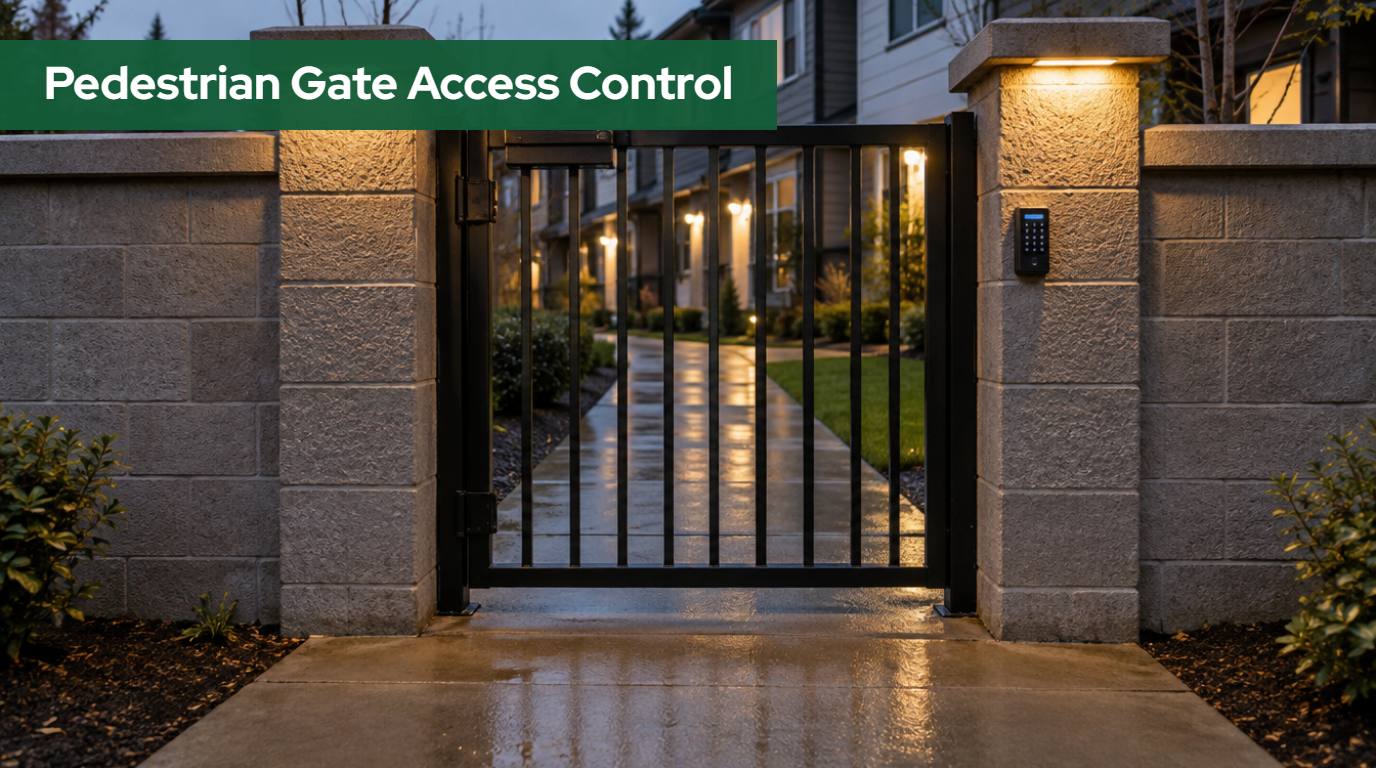
Pedestrian gate access control in Washington is the part of a property’s security that people touch most and plan least. The driveway gate gets the attention, the operator, the solar panel and the photo eyes. The walk gate next to it, or the gate into a courtyard, a pool area or the back of a commercial building, often ends up with a hardware-store latch, a keypad screwed to whatever post was closest, and a lock that nobody thought about until the power went out or a delivery driver could not get in.
This guide covers how a controlled pedestrian gate actually works: the credential people use (keypad, fob, card, intercom or phone), the electric lock that holds the gate, what happens when power fails, the self-closing hardware that makes the lock worth having, the accessibility rules that apply to gates on an accessible route, the exit side, and who may wire it under Washington rules. It is written for homeowners, HOA boards, multi-family and commercial property managers in Skagit, Whatcom, Snohomish, Island, San Juan, King and Pierce counties.
Quick answer
Pedestrian gate access control pairs a credential reader with an electric strike, maglock or motorized lock and a self-closing, self-latching gate. In Washington, gates on an accessible route follow the 2010 ADA Standards (32-inch clear width, hardware 34 to 48 inches high), and the exit side must stay free to open.
In this guide
- What pedestrian gate access control in Washington covers
- Who needs a controlled pedestrian gate?
- Keypad, fob, card, intercom or phone: choosing the credential
- Electric strikes, maglocks and motorized locks on a gate
- Fail-safe or fail-secure: what happens when the power goes out?
- Self-closing hinges, closers and latches that actually catch
- ADA rules for pedestrian gates in Washington
- The exit side: free egress and the building code
- A pedestrian gate beside an automatic driveway gate
- Pool and spa barrier gates
- Building a walk gate for Northwest Washington weather
- Wiring, conduit and L&I licensing
- A planning checklist before installation
- How we approach pedestrian gate access control
- Frequently asked questions
What Pedestrian Gate Access Control in Washington Covers
A controlled pedestrian gate is a small system with four parts that have to agree with each other. If one part is chosen without the others, the gate either does not lock when it should or does not open when it must.
- The gate and its frame. A walk gate, usually a single swing leaf, hung on posts that do not move. The posts and hinges carry the gate; the latch-side post carries the lock and often the reader.
- The credential reader. The keypad, proximity reader, card reader or intercom that decides who may enter.
- The electric lock. An electric strike, an electromagnetic lock (maglock) or an electrified or motorized lock that holds the gate closed until the reader releases it.
- The closing hardware. Self-closing hinges or a gate closer, plus a latch that catches every time. Without this, the best lock in the world holds a gate that is standing open.
Around those four parts sit the questions that decide the design: what the gate does when power fails, how people get out, whether it is on an accessible route, and how the wire reaches the latch side. Most answers are set by rules or physics, not taste.
The main difference from a driveway gate is the user. A pedestrian gate is usually opened by the person walking through it, which puts that person’s hand, reach and strength at the center of every choice.
Who Needs a Controlled Pedestrian Gate?
Pedestrian gates with access control show up in more places than people expect. The needs are different at each one, and so is the right level of hardware.
| Property | Typical goal | What usually works |
|---|---|---|
| Private home with a driveway gate | Let family, guests and deliveries walk in without opening the vehicle gate | Keypad or intercom on the walk gate, electric strike, self-closing hinges |
| Farm or acreage | Separate people from livestock or equipment areas; keep visitors to one entrance | Heavier gate and posts, weatherproof keypad, battery-backed power |
| HOA or private community | Resident access, guest entry, a record of who came in | Fob or card readers, telephone or video entry, managed user list |
| Apartments and multi-family | Controlled courtyard, pool or mailroom access; quick removal of former tenants | Cloud or networked access control, cards or fobs, ADA-compliant hardware |
| Commercial and industrial | Staff-only yards, side entrances, after-hours control | Card readers, request-to-exit, panic hardware where the code requires it |
For larger communities and apartment buildings, the pedestrian gate is usually one door in a bigger access plan. Our guides to HOA and community gate systems and to apartment access control modernization in Washington cover how the walk gates, the vehicle gates and the building doors can share one user list.
Keypad, Fob, Card, Intercom or Phone: Choosing the Credential
The credential is what a person presents to the gate. Each type trades convenience, cost of managing users and resistance to sharing in a different way.
| Credential | How people use it | Strengths | Watch out for |
|---|---|---|---|
| Keypad (PIN code) | Enter a code on the reader | No cards to hand out; easy for guests and deliveries | Codes get shared; worn keys reveal the digits; hard to know who entered |
| Proximity fob or card (RFID) | Hold the fob near the reader | Fast; each user can be removed individually; entry log per person | Fobs are lost; someone has to manage the list |
| Telephone or video intercom | Visitor calls a resident or the office, who releases the gate | Guests and deliveries without codes; video shows who is there | Needs a phone line, cellular or network connection |
| Mobile credential (phone app) | Phone as the key, by Bluetooth or the network | No hardware to hand out; remote changes | Phones die; some users do not want an app; needs connectivity |
| Mechanical key override | Key in a cylinder on the lock | Works without power | Keys copied and never returned |
Most residential walk gates do well with a keypad and a telephone or video intercom: family uses a code, guests and drivers use the call button. Most HOA and multi-family gates do better with fobs or cards, because the property needs to turn off one person without changing everyone’s code. Our comparison of RFID access versus keypad entry in Washington goes deeper on that trade, and the guide to a video intercom gate in Mount Vernon, WA covers call-box choices.
Where the reader goes matters as much as which one. On a pedestrian gate the reader is normally on the latch-side post or on a short pedestal just outside the swing, at a height a person standing or using a wheelchair can reach. The 2010 ADA Standards set the unobstructed forward reach range at 48 inches maximum high and 15 inches minimum low above the ground, a useful outer boundary for any reader a member of the public must use. Our article on gate keypad height and pedestal placement in Washington explains how that range is applied on a sloped approach.
Electric Strikes, Maglocks and Motorized Locks on a Gate
The electric lock is what turns a gate with a reader into a gate with access control. There are three common families, and each fits a different gate.
Electric strike. The gate keeps a normal mechanical latch, and the strike plate on the post becomes electric. When the reader grants access, the strike releases its keeper so the latch can pass, and the gate opens with a push or pull. A strike works well on a gate that already latches reliably, and the inside handle can open the latch mechanically at any time, which helps with free egress. Its weakness on gates is alignment: if the gate sags or the post moves, the latch no longer lines up with the strike.
Electromagnetic lock (maglock). An electromagnet on the post holds a steel armature plate on the gate. While power flows, the gate is held; when power is cut, it releases. Maglocks tolerate some misalignment and have no moving latch parts, which suits outdoor gates. Because they release when power stops, they are fail-safe by nature, and the building codes put conditions on how they are released from the inside on an egress path, covered in the exit-side section below.
Electrified or motorized lockset. The lock body inside the gate’s lock box is electric: the handle or the latch is released by the controller. These can be specified fail-safe or fail-secure and keep a key override. They need a power transfer hinge or a protected cable loop to bring wire into the moving gate leaf, which is more fabrication work on a metal gate.
| Lock type | Best fit | Power-loss behavior | Gate-specific notes |
|---|---|---|---|
| Electric strike | Gates with a good mechanical latch and a stable post | Either, depending on the model chosen | Needs a strike housing built into the post or a gate-rated box |
| Maglock | Outdoor gates, frequent use, some movement in the gate | Releases when power is lost (fail-safe) | Needs a flat armature mount on the gate and a free-egress release plan |
| Electrified lockset | Gates that need key override and a handle on both sides | Either, by specification | Wire must reach the moving leaf through a transfer hinge or loop |
Whatever the lock, the hardware that controls access for the public should be listed for the job. UL 294 is the safety standard for access control system units, and building codes and manufacturers reference it for electric locking hardware used in buildings. We choose locks and controllers from that listed category and match them to the gate’s material and use.
Not sure which lock fits your walk gate?
We look at the gate, the posts, how people come and go and what should happen in an outage, then recommend a reader and lock that work together.
Fail-Safe or Fail-Secure: What Happens When the Power Goes Out?
Every electric lock has to answer one question: when power stops, does the gate stay locked or does it release? The industry words are simple once defined.
- Fail-safe: the lock releases when it loses power. People can always get through. Security is lower during an outage.
- Fail-secure: the lock stays locked when it loses power. The property stays secure from the outside. Getting in during an outage takes a key or a backup plan.
On the inside, a fail-secure gate on an exit path still has to open for people leaving, which is why fail-secure strikes are usually paired with a mechanical inside handle that always works. That pairing gives security from the outside and free exit from the inside, no matter what the power does.
Outages are not a rare event here. Wind storms, snow on lines and long rural feeders make power interruptions a normal part of owning a gate in Skagit, Whatcom, Island and San Juan counties. The choice usually follows the use of the gate:
- Pool, playground and child-safety gates: the barrier must stay closed and latched; the electric part is only the access layer, and the mechanical self-latching hardware does the safety work.
- Private home walk gates: fail-secure from the outside with a key override is common, so an outage does not leave the yard open.
- Gates on a required exit path at a commercial or multi-family property: the exit side must work at all times; the building code and the local building official decide what is acceptable, and many designs use fail-safe maglocks with code-compliant release or fail-secure strikes with a mechanical inside lever.
Battery backup changes the picture: a backed-up power supply keeps the reader and lock working through ordinary outages. Our article on automatic gate battery backup in Skagit County explains how backup is planned.
Self-Closing Hinges, Closers and Latches That Actually Catch
The weakest point of most pedestrian gates is not the lock. It is a gate that does not close. A controlled walk gate that is left standing open, or that drifts shut and stops an inch short of the latch, gives no security at all.
Three pieces of hardware do the work:
- Self-closing hinges. Spring or gravity hinges that bring the gate back to the post. They are simple, but their closing force and speed have to be adjusted for the weight of the gate and the wind it sees.
- A gate closer. A hydraulic closer built for gates controls the speed through the swing and gives a final push to latch. On heavier steel or wood gates it gives far more consistent results than springs alone.
- A gravity or spring latch. The latch has to catch when the gate arrives at normal closing speed, not only when someone pushes it.
The accessibility rules set limits on speed so the gate does not hit people. Section 404.2.8 of the 2010 ADA Standards requires gate closers to be adjusted so that, from an open position of 90 degrees, the gate takes at least 5 seconds to reach 12 degrees from the latch, and spring hinges so that, from 70 degrees open, the gate takes at least 1.5 seconds to close. A gate that slams shut fails that test, and a gate that closes so softly it never latches fails the security test. Getting both right is an adjustment made on site, with the real gate, in real wind.
Most of the “self closing gate not closing” complaints we see come from three causes: a gate that has sagged so the latch rides on the keeper, a post that has moved in wet soil, or a closer that was never adjusted after the gate’s weight changed (a new panel, a privacy screen, a heavy lock box). Each of those is fixed at the gate, not at the lock.
For gates on an accessible route, the 2010 ADA Standards also limit the force to open interior hinged gates to 5 pounds. They set no number for exterior hinged gates, but an outdoor closer still has to resist wind and stay easy to open by hand.
ADA Rules for Pedestrian Gates in Washington
The 2010 ADA Standards, section 404 on doors, doorways and gates, apply to gates that are part of an accessible route. Section 404.1 is direct: doors, doorways and gates that are part of an accessible route shall comply with 404. That reaches the pedestrian gates at HOA amenities, apartment courtyards, commercial sites and public facilities. A private single-family home’s own walk gate is generally outside the ADA’s reach, though the same dimensions make any gate easier for everyone.
The numbers most often asked about, taken from the standards:
| Item | 2010 ADA Standards | What it means at the gate |
|---|---|---|
| Clear width (404.2.3) | 32 inches minimum, measured with the gate open 90 degrees | The leaf itself is wider than 32 inches once frame and hardware are counted |
| Double-leaf gates (404.2.2) | At least one active leaf must provide the clear width and maneuvering clearance | Two narrow leaves that each open less than 32 inches do not comply |
| Hardware height (404.2.7) | Operable parts 34 inches minimum and 48 inches maximum above the ground | Handles, latches and lock releases sit in that band |
| Hardware operation (309.4) | One hand, no tight grasping, pinching or twisting; 5 pounds maximum to activate | Lever handles and push pads, not round knobs or thumb latches |
| Closing speed (404.2.8.1) | From 90 degrees open to 12 degrees from the latch in 5 seconds minimum | Closer adjusted on site and rechecked after seasonal changes |
| Revolving gates and turnstiles (404.2.1) | Not part of an accessible route | A turnstile entrance needs an accessible gate beside it |
Two more parts of section 404 come up at outdoor gates. Maneuvering clearance (404.2.4) requires level space on both sides of a swinging gate, including space beside the latch, so a person using a wheelchair can pull the gate open; on a sloped Northwest Washington walkway that often means a level landing poured at the gate. And automatic gates (404.3) must comply with the ANSI/BHMA power-operated door standards and keep a 32-inch clear opening, so an automatic pedestrian gate is a different design from a manual one.
Washington adds its own layer. The state building code, adopted through chapter 51-50 WAC with the 2021 editions in effect since March 15, 2024, carries an accessibility chapter that local building departments enforce on commercial and multi-family projects, and cities such as Seattle add local amendments. For accessible doors as well as gates, our guide to ADA door requirements in Washington State covers the building side, and our ADA automatic door and entry installation page covers power-operated openings.
One point worth stating plainly because it is often missed: an access control reader on an accessible gate is an operable part too. A reader placed above 48 inches, or behind a curb a wheelchair cannot reach past, makes a compliant gate non-compliant.
The Exit Side: Free Egress and the Building Code
Access control is about who gets in. The building code is about who gets out. When a pedestrian gate sits on the path people use to leave a building or an enclosed area, it is part of the means of egress, and the International Building Code treats gates in a means of egress under the same requirements as doors.
In practice that brings several rules into play on commercial and multi-family gates:
- Egress without special knowledge. From the exit side, the gate opens without a key, a code, a card or special effort. A keypad on the inside of an exit gate is a classic mistake.
- Electric locks under defined conditions. The IBC permits electrically locked egress doors and gates only in specific arrangements, such as release by the door hardware itself, release by a sensor that detects a person approaching, or, in limited occupancies, delayed egress, each with its own conditions about power loss, signs and manual release.
- Panic hardware where required. In certain occupancies and occupant loads the code calls for panic or fire exit hardware, a push bar that releases the latch in one motion. Outdoor panic hardware for gates exists for exactly this reason.
- Listing. Electric locking hardware used on egress doors is typically required to be listed, with UL 294 the usual reference.
Section numbers have shifted between IBC editions, so we work from the edition Washington has adopted and the local reading of it. On commercial and multi-family projects the building department reviews the egress design, and release hardware is far easier to plan on paper than to retrofit after an inspection.
At a private home the commercial egress rules do not usually reach the yard gate, but the logic still holds: nobody should need a code to leave the backyard in an emergency. A mechanical inside lever on a fail-secure strike solves it.
Planning a walk gate for an HOA, apartment or commercial site?
We lay out the reader, the lock, the exit hardware and the accessible clearances together, so the gate controls entry without blocking the way out.
A Pedestrian Gate Beside an Automatic Driveway Gate
The most common place for a controlled pedestrian gate is right next to an automatic driveway gate. That pairing is not only convenient; the safety guidance for vehicle gates asks for it.
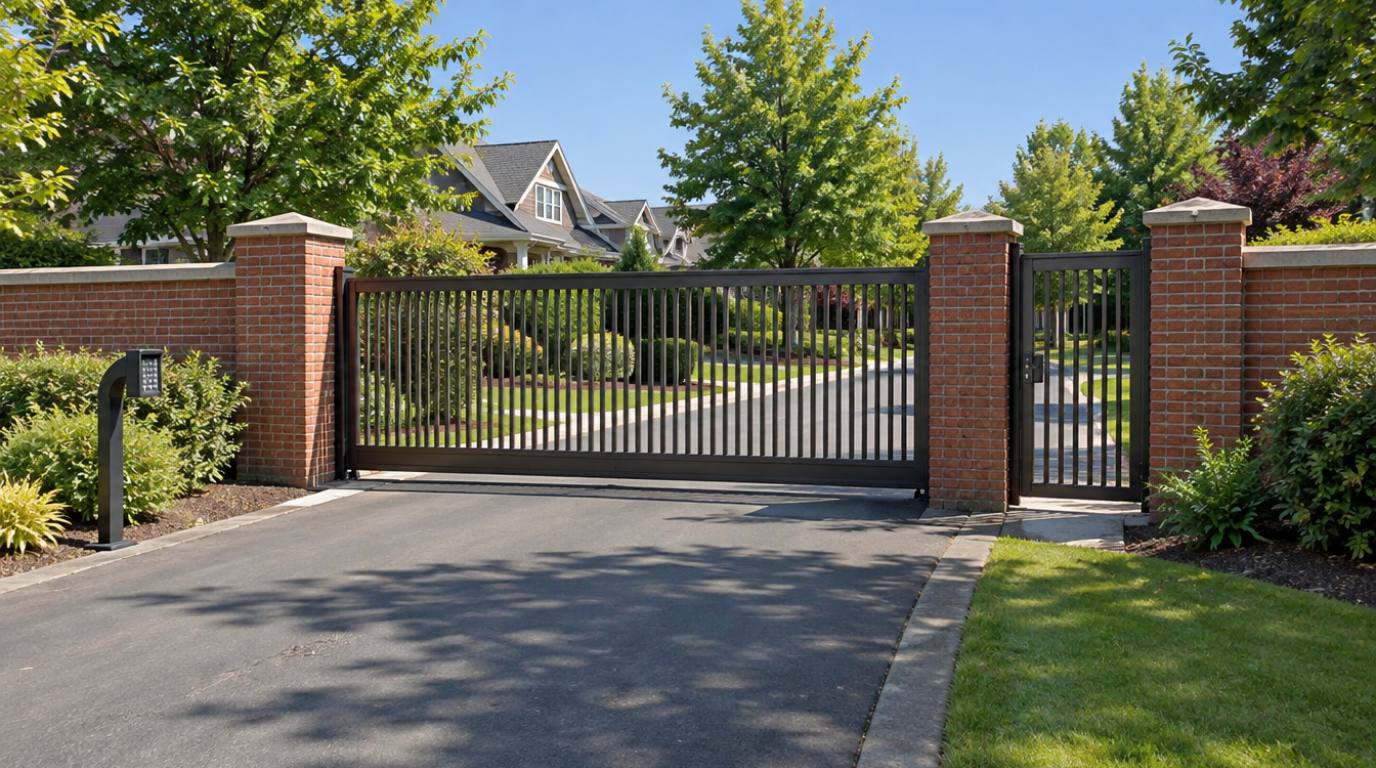
Gate operators listed under UL 325 are for vehicular gates. DASMA’s gate system safety guidance calls for a separate walk-through entrance for pedestrians, with warning signs on both sides of the vehicle gate, so people are not tempted to walk through a moving leaf. A photo eye can protect a person caught in the opening of a driveway gate; it does not turn the vehicle gate into a sidewalk. Our guide to gate photo eye installation in Washington covers that side of the safety plan.
Designing the two together pays off in several ways:
- One look. The walk gate is built in the same material, picket spacing and top line as the driveway gate, so it reads as one entrance instead of an afterthought.
- Shared posts and wiring. The walk gate can hang from the pillar that already carries the driveway gate’s hinges, and its lock wiring can run in the same conduit as the operator’s low-voltage cables.
- One access system. The keypad, intercom or fob reader that opens the driveway gate can also release the walk gate, with separate codes or permissions for each.
- Controls away from moving parts. DASMA and UL 325 ask that controls for a vehicle gate be placed at least 6 feet away from the gate, so nobody reaches through or around a moving leaf. A pedestrian gate with its own reader gives visitors a natural place to stand.
If you are planning the whole entrance, our custom gate design page explains how both gates are drawn as one set.
Pool and Spa Barrier Gates
Gates in the fence around a pool, spa or hot tub follow their own rules on top of everything above. The barrier codes Washington jurisdictions enforce require these gates to be self-closing and self-latching, and they set where the latch release sits so a small child cannot reach it from outside. Public and semi-public pools at HOAs and apartment buildings also fall under the state Department of Health pool rules.
The ADA Standards make room for that safety need. An exception in section 404.2.7 allows the latch release of self-latching devices on access gates in barrier walls and fences protecting pools, spas and hot tubs to sit up to 54 inches above the ground, instead of the usual 48-inch maximum, provided the self-latching device is not also a self-locking device operated by a key, an electronic opener or an integral combination lock. That last condition matters for access control: once a keypad or electric lock is added, the 54-inch allowance for the latch no longer applies to that device, and the design has to satisfy both the child-safety and the accessibility rules another way.
Pool barrier rules vary by jurisdiction, so we confirm latch height, swing direction and local amendments with the city or county before fabricating a pool gate, and the access control layer never stops the gate from closing and latching on its own.
Building a Walk Gate for Northwest Washington Weather
An access-controlled walk gate is only as reliable as the gate itself. In a climate with months of rain, freeze and thaw at higher elevations, salt air on the islands and constant wind on open farmland, a few construction choices decide whether the lock lines up for years or needs adjusting every season.
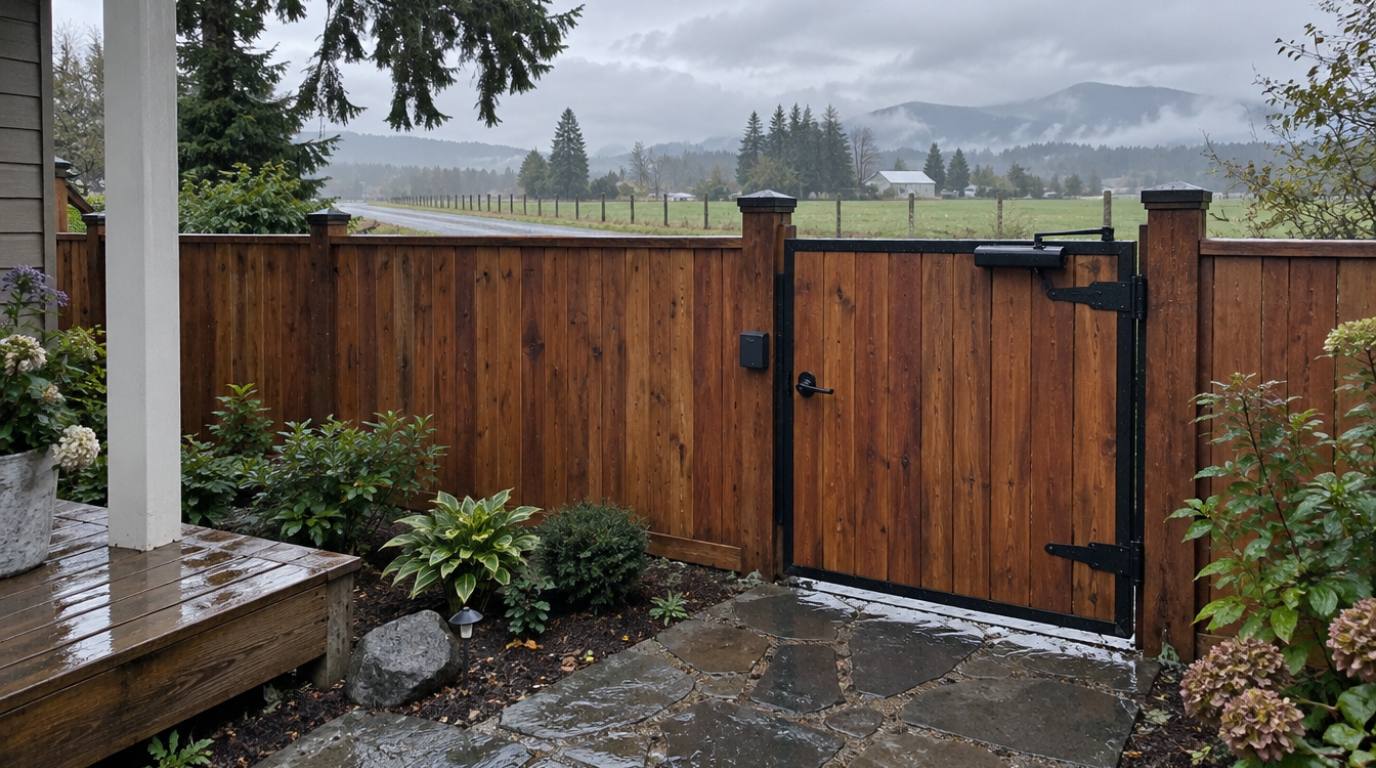
Posts that do not move. The latch-side post holds the lock, and the hinge-side post holds the gate’s weight. Both need footings sized for the soil, and in saturated soils of the Skagit and Snohomish river valleys, posts set too shallow lean over time. A lean of a fraction of an inch is enough to make an electric strike miss.
A frame that does not sag. A welded steel or aluminum frame with a diagonal brace, or a properly built wood gate with a compression brace and a steel frame option, keeps the latch edge at the same height. Wood gates in Western Red Cedar look right on many homes here, but they move with moisture, so the lock choice and adjustment have to allow for it.
Weather-rated hardware. Readers, locks, power supplies and closers should be rated for outdoor use, with housings that shed water. Salt air near the water in places like Anacortes, Whidbey Island and the San Juan Islands is hard on finishes and fasteners; our guide to gate materials for Washington weather compares how steel, aluminum and wood hold up.
Seasonal care. Closers change with temperature and hinges need lubrication; our seasonal automatic gate maintenance guide for Washington lists what to check.
Wiring, Conduit and L&I Licensing
The electrical side of a pedestrian gate is small but regulated. Washington’s Department of Labor and Industries licenses electrical work, including low-voltage systems. Under WAC 296-46B-920, the door, gate and similar systems specialty (10) covers the electrical operator wiring and equipment of electric gates, doors and similar systems, including their control push buttons, key switches and keypads. Other low-voltage work, and the line-voltage circuit that feeds a power supply, may need a different license or specialty, which is why the licensing question is asked at the design stage, not after the trench is dug.
Practical points that keep a walk gate reliable:
- Conduit to the latch side. The lock and reader live on the latch post, which is often the side away from power. Conduit under the walkway or along the fence line, placed before paving where possible, avoids surface cable that gets cut or chewed.
- Power transfer into the leaf. An electrified lockset in a moving gate needs wire through a power transfer hinge or an armored loop. A loose cable at the hinge is the most common failure point of electrified gates.
- A protected power supply. The access control power supply sits in a weatherproof enclosure on the secure side, with battery backup if the gate should keep working through outages.
- Request-to-exit where needed. Gates with maglocks or monitored locks often use a request-to-exit device on the inside so the system releases the lock and does not record a forced entry when someone walks out.
- Sealed connections. Moisture at terminals causes intermittent faults that look like a bad reader.
Choosing a contractor with the right registration and electrical license is also a consumer protection step in Washington. Our page on choosing a licensed gate contractor in Northwest Washington explains how to look up a contractor’s registration and electrical license on the L&I site.
Adding access control to an existing walk gate?
We check the posts, hinges and latch first, then plan the conduit, power and lock so the new hardware lines up and keeps working through the wet season.
A Planning Checklist Before Installation
Most problems with controlled pedestrian gates are decided before any hardware is ordered. These are the questions we answer with the owner first, in this order.
| Question | Why it matters | Typical answer to confirm |
|---|---|---|
| Who uses the gate, and how often? | Sets the credential type, the lock duty and the closer size | Family and guests, residents, staff or the public |
| Is the gate on an accessible route? | Brings in the ADA width, hardware height, force and clearance rules | Yes at HOA amenities, multi-family and commercial sites |
| Is the gate on an exit path? | Requires free egress and may require panic hardware | Check with the building department on commercial work |
| What should happen in an outage? | Decides fail-safe or fail-secure and battery backup | Secure outside, free exit inside, with backup power |
| Is it a pool or child-safety barrier? | Self-closing, self-latching and latch height rules apply | Confirm local barrier rules before fabrication |
| Where does power and network come from? | Sets conduit routes and the power supply location | From the driveway gate’s operator area or the building |
| Should it share a system with other gates? | One user list for the walk gate, vehicle gate and doors | Same platform as the vehicle gate’s access control |
| Can the posts and gate hold alignment? | An electric lock only works on a gate that does not sag | New posts or a new gate if the existing ones move |
Answering those eight questions usually reduces the choice to one or two hardware combinations. If you are still comparing reader types, our gate access control comparison for Bellingham, WA lays out keypads, cards, fobs, intercoms and phone entry side by side, and our access control installation page covers the systems we install.
How We Approach Pedestrian Gate Access Control
Emerald Gate Systems is a family-owned gate company that designs, fabricates in its own shop at 7557 Alpine Lane in Sedro-Woolley, Washington, installs, automates and services residential, farm and commercial gates across Skagit, Whatcom, Snohomish, Island, San Juan, King and Pierce counties. Because the same team handles planning, fabrication, installation, access control, testing and later service, the walk gate’s frame, posts, lock and reader are drawn together instead of being added by different trades at the end.
On a site visit we start with the checklist above, then look at the gate itself: whether the posts are plumb and solid, whether the leaf sags, where water runs, and how a person standing or using a wheelchair approaches the reader. If the existing gate cannot hold alignment, we say so before anyone buys a lock, and we can fabricate a matching walk gate in hand-forged wrought iron, laser-cut steel or Western Red Cedar to sit beside the driveway gate.
Access control options we install include keypads, intercoms, telephone entry, card readers and license plate recognition for the vehicle side, so the pedestrian gate can join the same system as the driveway gate. Before we leave, we test the reader, the lock, the closer and the latch together, show the owner how the gate behaves in an outage and how to open it by key or from the inside, and adjust the closer for the gate’s real weight and wind. The first step for any project is a free on-site consultation.
Washington requires contractors to show their registration in advertising: Emerald Gate Systems is registered with the Washington State Department of Labor and Industries as a construction contractor (EMERAGS748D6) and holds an electrical contractor license in the Doors and Gates specialty (EMERAGS747KE).
Frequently Asked Questions
What is a pedestrian gate access control system?
It is a walk gate fitted with a credential reader, such as a keypad, fob reader, card reader or intercom, connected to an electric lock that holds the gate closed. When the reader accepts a code or credential, the lock releases and the person opens the gate. Self-closing hinges or a closer and a reliable latch bring the gate back to the locked position.
Should a gate lock be fail-safe or fail-secure?
Fail-safe locks release when power is lost; fail-secure locks stay locked. Many private walk gates use fail-secure locks with a key override and a mechanical inside handle, so the yard stays secure but people can always leave. Gates on a required exit path at commercial or multi-family sites follow the building code and the local building official’s review.
What are the ADA requirements for a pedestrian gate?
For gates on an accessible route, the 2010 ADA Standards require a 32-inch minimum clear width, operable hardware between 34 and 48 inches above the ground that works with one hand and no tight grasping, maneuvering clearance on both sides, and a closer that takes at least 5 seconds to move from 90 degrees to 12 degrees from the latch.
Electric strike or maglock on an outdoor gate?
An electric strike keeps the gate’s mechanical latch and suits gates with stable posts and good alignment. A maglock holds the gate with an electromagnet, tolerates small misalignment and has no latch to wear, but it releases when power is lost and needs a code-compliant release plan on exit paths. The right choice depends on the gate, its use and the outage plan.
Why does my self-closing gate not close all the way?
The usual causes are a gate that has sagged so the latch rides on the keeper, a post that has moved in wet soil, or a closer or spring hinge that was never adjusted for the gate’s current weight and the wind it sees. Fix the alignment and adjust the closer first; replacing the lock does not solve a gate that does not reach the latch.
Who can wire a pedestrian gate lock in Washington?
Electrical work on gate systems is licensed by the Washington Department of Labor and Industries. WAC 296-46B-920 creates the door, gate and similar systems specialty (10), which covers gate operator wiring and controls such as keypads and key switches. The line-voltage circuit that feeds a power supply may need a different license, so confirm the contractor’s L&I licenses before work starts.