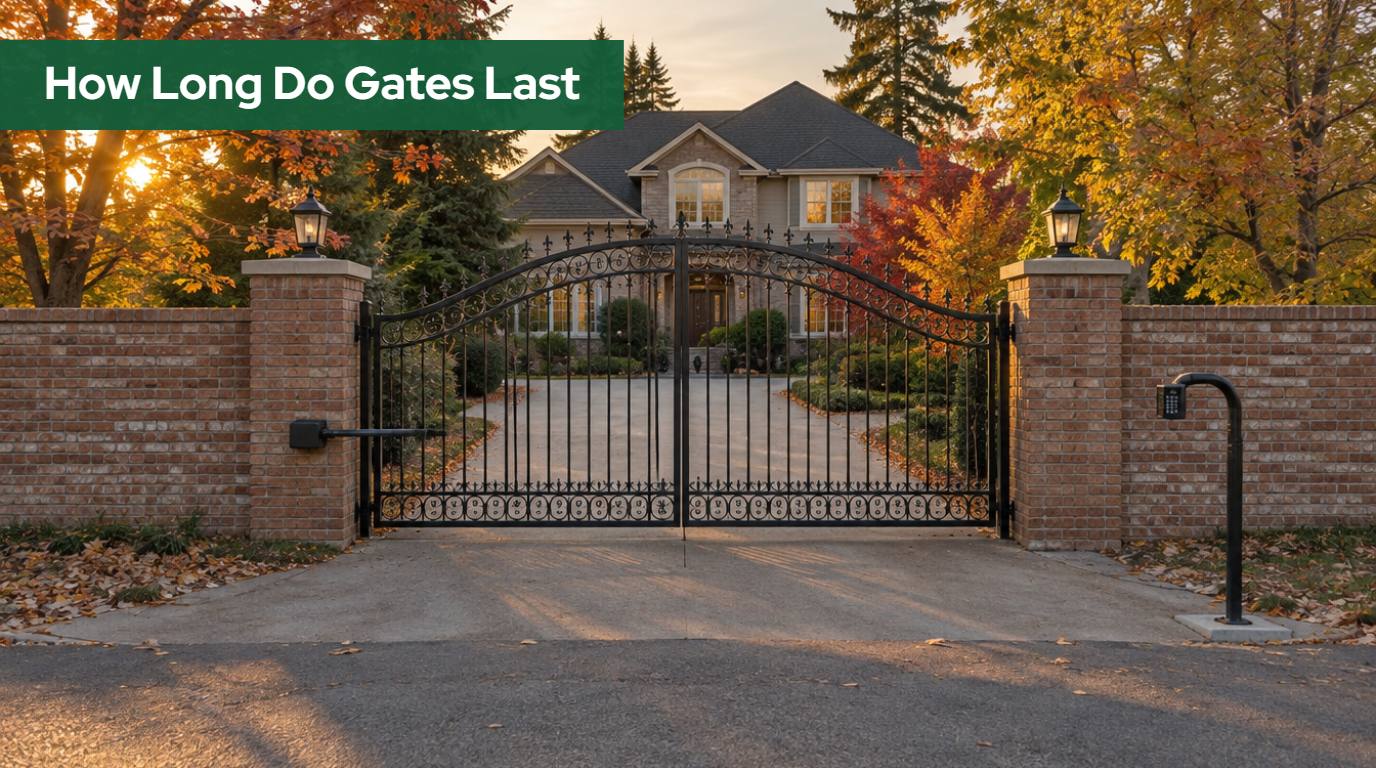
How long do automatic gates last in Washington? It is one of the most consistent questions we hear at consultations throughout Skagit, Whatcom, Snohomish and the island counties, and the honest answer is that two separate systems are inside every gate installation, each with its own clock. The gate structure – the steel, iron, cedar or aluminum panels, the posts, the hinges and the hardware – and the gate operator – the motor, control board, limit switches and electronics – wear out at different rates and for different reasons. Understanding how long each lasts, and what speeds up or slows down that timeline in the Pacific Northwest, gives you a realistic picture of what to expect and what to budget for.
This guide covers both systems, addresses the specific conditions that make Washington harder on gate hardware than drier climates, and explains what you can do to add years to both.
Quick answer
A quality gate structure in Northwest Washington commonly delivers 20 to 30 or more years of service with periodic maintenance. The gate operator – motor, control board and electronics – typically lasts 10 to 15 years under residential use and shorter under heavy commercial traffic. Pacific Northwest rain, humidity and frequent power-outage cycles all shorten that window without proper care.
In this guide
- What determines how long automatic gates last in Washington
- Gate structure vs gate operator: two very different timelines
- How Pacific Northwest weather affects gate longevity
- Duty cycles: how usage volume shapes operator life
- Gate materials and corrosion in Washington State
- Why maintenance is the single biggest factor in gate lifespan
- How long does a gate battery backup last?
- Swing gates vs slide gates: does design affect longevity?
- Warning signs that a gate operator is nearing end of life
- Repair vs replace: a practical framework for Washington properties
- What happens when gate operator parts are discontinued
- How we approach long-life gate installations in Northwest Washington
- Frequently asked questions
What Determines How Long Automatic Gates Last in Washington
Five factors drive how long an automatic gate lasts in Washington, and only one of them is the brand name on the operator.
Usage volume. Every gate operator is rated for a certain number of open-and-close cycles over its service life. A residential operator used four to six times a day draws on that budget very slowly. A commercial lot with fifty employees coming and going pulls through the same budget in a fraction of the time. The cycle count matters more than the calendar year.
Climate exposure. Washington State averages more than 150 days of precipitation per year in most of the service area. Rain is not the only issue: high relative humidity throughout fall and winter, morning fog along river valleys in Skagit and Snohomish counties, and coastal salt air on Whidbey, Camano and the San Juan Islands all accelerate corrosion on unpainted steel, degrade rubber seals, and work moisture into electronics housings that were never designed for submersion.
Alignment and mechanical condition. A gate that runs out of alignment puts extra torque on the operator every cycle. The motor works harder than it should, heats up more often, and the control board compensates with more frequent corrections. We see this pattern regularly on properties where the posts have shifted in saturated soil or the track has settled unevenly. The operator shows the wear, but the cause is structural.
Maintenance history. A gate that gets annual attention – lubricated hardware, cleaned sensor lenses, tested battery, adjusted limit switches – can run reliably well past the manufacturer’s typical service window. A gate that runs unattended until something breaks often reaches end of life before it should. The difference between a 10-year operator and a 15-year operator is frequently maintenance, not the product.
Sizing at installation. A residential operator on a heavy commercial entrance, or an operator sized for a lightweight aluminum gate driving a heavy steel panel, shortens lifespan predictably. Correct sizing at installation is the foundation everything else builds on.
Safety standards also factor into the picture: UL 325 requires that all gate operators include inherent entrapment protection and compatible external sensors. Our overview of automatic gate safety standards, UL 325 and ASTM F2200 explains what those requirements mean for equipment selection and why a non-compliant operator is not worth the cost savings.
Gate Structure vs Gate Operator: Two Very Different Timelines
The single most useful distinction in this conversation is that the gate structure and the gate operator are separate systems with different natural lifespans.
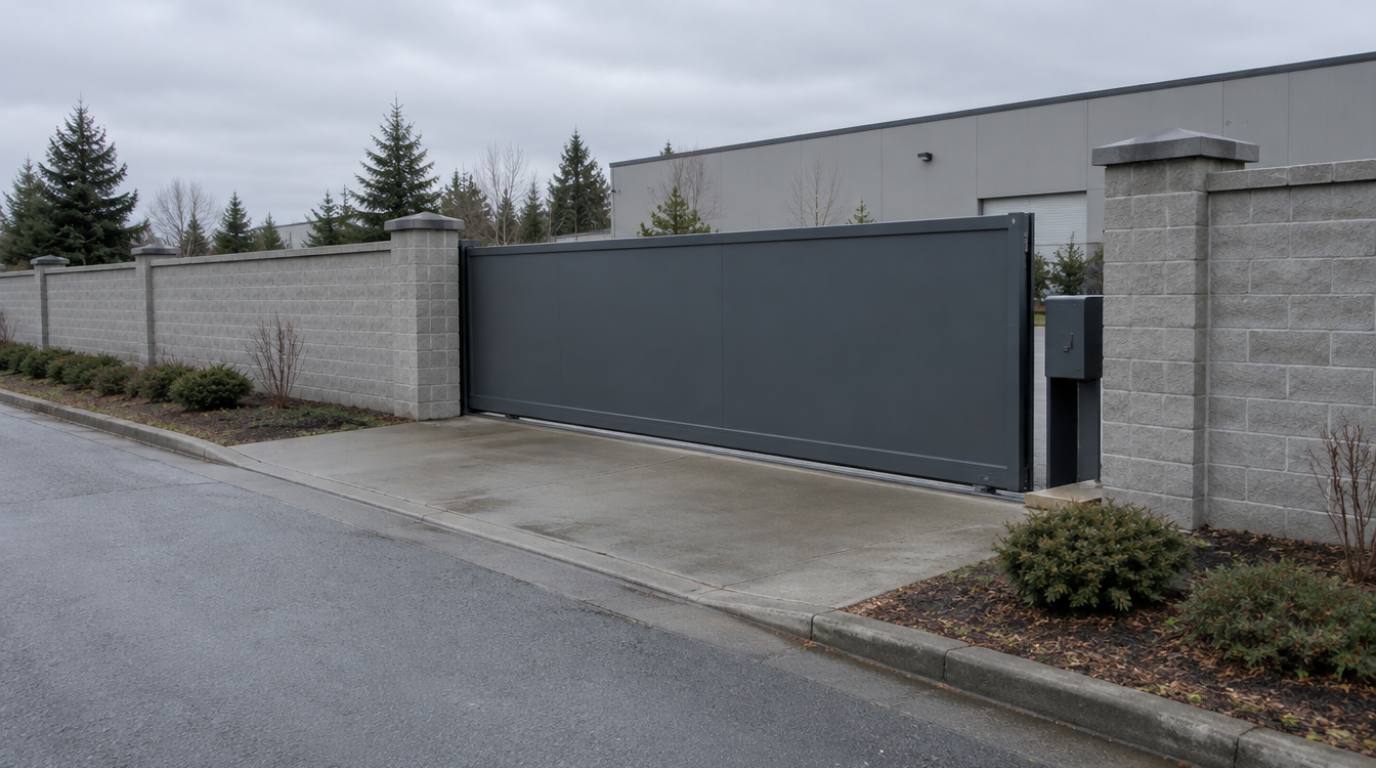
The gate structure is built from metal, wood or a combination of both. A steel or wrought iron panel, properly primed and painted, with quality hardware, can last 30 years or longer before it needs replacement rather than maintenance. The frame does not wear out from movement the way an electrical motor does. It corrodes, it can sag if the hinges shift, the welds can crack under repeated stress, and the infill can break. But none of those failure modes have the same clock as electronics.
Western Red Cedar gates, which Emerald Gate Systems fabricates in-house in Sedro-Woolley, behave differently. Cedar is naturally resistant to moisture and decay, but it does expand and contract with the wet-dry cycle of a Washington year. A cedar gate that was hung tight in a dry August can bind against a post in a wet January. Proper clearances at fabrication and annual inspection prevent this from becoming a mechanical failure.
The gate operator is an electromechanical device. It contains a motor, a gearbox, a control board, limit switches, a capacitor, wiring, and in many cases a battery. The control board and electronics are often the first to fail: a power surge, a lightning strike on a rural property, or a battery that was allowed to deep-discharge repeatedly can end a control board’s life years before the motor would have given out on its own.
The practical consequence of this difference is that a gate replacement project and a gate operator replacement project are very different conversations. When a client calls us about a gate that stopped working, the first question is always whether the gate itself is still sound. If the structure is in good shape, a new operator and updated sensors can extend the functional life of the installation by another decade or more. If the structure is failing – bent posts, cracked welds, significant corrosion in the base metal – the more economical path is often a complete replacement.
How Pacific Northwest Weather Affects Gate Longevity
The Pacific Northwest does not produce the extremes of heat that wear out electronics in desert climates, but it creates its own set of stresses that are just as damaging over time.
Rain and humidity. Most of the Puget Sound region and the counties north of it, including Skagit, Whatcom and Island, receive rainfall on more than 150 days per year. That number alone does not capture what happens in practice: there are stretches from October through March where the relative humidity stays above 80 percent for weeks at a time. Operator housings that are rated for rain exposure can still allow moisture to condense inside them in those conditions. Rubber seals dry out and crack less from sun exposure here than from the repeated wet-dry-wet cycle. Electrical connectors oxidize. Limit switch contacts become unreliable.
Wind. Wind load is significant in some parts of the service area. Properties on exposed ridges in Skagit County or on the shorelines of the islands can see winds that stress a gate panel repeatedly. A gate that is opened into the wind, held open by the operator, and then released has absorbed mechanical stress in the frame and the operator arm that a gate in a sheltered yard never experiences. Over years, this accelerates wear in the pivot points and the operator mechanism.
Power outages. Washington State experiences more widespread power outages than most of the country, particularly in rural areas and on the islands. Every outage cycles the battery backup, which we cover in detail in its own section. But outages also mean voltage spikes and sags when power returns, and control boards that lack good surge protection are vulnerable at those moments. Properties that lose power multiple times each winter accumulate more surge-exposure events than properties in areas with more stable supply.
Duty Cycles: How Usage Volume Shapes Operator Life
Gate operators are built to a duty cycle specification. That specification defines how many open-and-close cycles the operator can perform in a given time period and, in total, over its service life. Understanding duty cycles is essential to predicting how long a specific operator will last on a specific property.
Residential-class operators are generally designed for relatively low usage. A property where the gate opens and closes a handful of times each day, covering the typical pattern of a family arriving and leaving home, draws down the operator’s cycle budget slowly. Under those conditions, many residential operators run reliably for a decade or more before showing signs of wear.
Commercial properties operate at a fundamentally different scale. An industrial lot in Ferndale, a multi-family complex in Marysville, or an HOA gate serving dozens of households may see hundreds of cycles per day. A residential-class operator installed at that kind of entrance can fail in two or three years. This is not a product defect; it is a sizing error at installation. Commercial entrances require commercial-class operators, which are designed to sustain heavy cycle volumes without the thermal buildup that shortens motor life.
The brands Emerald Gate Systems installs reflect this spectrum. LiftMaster, Viking and FAAC each offer products across the residential-to-commercial range, and selecting the right duty cycle class for the application is part of every project we scope. A comparison of what distinguishes operator classes and how to match them to an entrance is covered in our guide to gate operator options in Northwest Washington.
Beyond raw cycle volume, duty cycle specifications also describe rest intervals. Many residential operators require the motor to cool between cycles. An operator on a property where the gate is used in rapid succession – a loading dock scenario, for example, or a gate being tested repeatedly after installation – can exceed its thermal limit even if the total daily cycle count is within spec. The correct solution is either an operator with a 100-percent duty cycle designed for continuous use, or a managed access system that prevents back-to-back actuation beyond what the hardware supports.
Not sure whether your gate operator is sized for the way you actually use it? We assess existing systems as part of every consultation, and we will tell you honestly if what is installed matches what the property needs.
Gate Materials and Corrosion in Washington State
The gate structure’s lifespan in Washington is heavily shaped by what it is made of and how it was finished. The Pacific Northwest is not a coastal desert, but it is also not the kind of dry-climate environment where a bare steel fence post lasts for decades without attention.
Steel and wrought iron. Steel gates fabricated in the shop need a proper priming and coating system to perform well in the Pacific Northwest. Hot-dip galvanizing provides the most durable base coat for structural components and hardware. Paint or powder coat over a galvanized base performs significantly better than paint over bare steel because the zinc layer continues to protect the base metal even if the topcoat is scratched. Gates that were installed with thin paint over bare steel often show rust at welds and around hardware mounting points within a few years, especially on any surface where water can collect.
Our guide to gate materials for Washington weather covers the specific coating and alloy decisions in more detail. The short version: hot-dip galvanized fasteners and 316 stainless hardware for components that will stay damp, and a proper prime-plus-topcoat system for the panel itself.
Aluminum. Aluminum does not rust the way steel does, which gives it a meaningful advantage in the wet lowlands and especially on the islands. The tradeoff is that aluminum is less stiff than steel at equivalent gauge, and it cannot be welded in the field the way steel can. Aluminum gates designed and fabricated correctly, with proper weld alloys and no dissimilar-metal contact, can outlast steel gates in Washington conditions by a wide margin, because they do not depend on a surface coating to resist oxidation.
Western Red Cedar. Cedar resists rot well by natural chemistry. In the Pacific Northwest context, cedar performs better than pressure-treated pine or most tropical hardwoods for gate applications because it moves predictably with moisture changes, its grain does not require painting to keep water out, and it holds fasteners well when the wood is dry. A cedar gate that is properly stained or oiled every two to three years and has the hardware mounted to prevent direct wood-to-steel contact will hold up for many years. A cedar gate that is left unfinished and allowed to dry-crack will eventually pull away from its hinges as the wood distorts.
Why Maintenance Is the Single Biggest Factor in Gate Lifespan
Of all the variables that determine how long an automatic gate lasts in Washington, routine maintenance is the one you control most directly. The research is consistent in this regard: a gate system that receives regular attention and early intervention on small problems will reliably outlast the same hardware on a neglected property.
The tasks that matter most are not complicated.
Lubrication. Gate hinges, rollers, slide gate tracks and operator chains or drive screws all require lubrication on a schedule. The interval depends on the component and the climate: hardware on an exposed waterfront property needs attention more often than the same hardware on a sheltered suburban lot. Using the correct lubricant matters: silicone spray on rubber components, chain-appropriate lubricant on chain drives, and grease specified for the hinge and roller type. The wrong lubricant attracts debris and can accelerate wear rather than prevent it.
Sensor inspection and cleaning. Photo eye lenses fog with spider webs, dirt and condensation, especially in the low-light, high-moisture months of a Washington fall and winter. A photo eye that is partially blocked may still allow the gate to operate while providing reduced entrapment protection. UL 325 requires monitored safety devices that detect a failure; a gate operator that can no longer confirm its sensors are working correctly should not continue operating until the sensors are cleaned or replaced.
Hardware tightening and alignment check. Vibration loosens fasteners. A gate that operates several times a day accumulates small amounts of movement in every bolted connection, and connections that were torqued correctly at installation can become loose within a season of use. A loose hinge that allows the gate to sag puts mechanical stress on the operator arm and on the post foundation. Catching a loose fastener at an annual checkup takes minutes and costs nothing; waiting until the gate sags far enough to drag the ground can require a new post, new hinges and a new operator arm.
Battery and electrical checks. Gate operator batteries have a finite number of charge-discharge cycles. Testing the battery under load, rather than checking the voltage at rest, reveals actual remaining capacity. A battery that reads adequate voltage but cannot sustain the load of operating the gate is a failure waiting to happen during the next outage. Electrical connections at the terminal block, on the control board and at the sensor junctions should be inspected for corrosion annually.
Limit switch calibration. A swing gate operator uses limit switches to know when the gate has reached its full open and full close positions. A slide gate uses a similar mechanism. When the ground shifts slightly – as it does in saturated soil – or when a post settles, those limit positions can drift. An operator that is continually pushing against its mechanical stops, thinking it has not yet reached full travel, is absorbing stress it was not designed to handle. Re-calibrating the limits is a simple adjustment that prevents compounding wear.
Our seasonal maintenance guide for automatic gates in Washington lays out a month-by-month framework for keeping a gate system in good condition through the Pacific Northwest year.
How Long Does a Gate Battery Backup Last?
The battery in a gate operator serves one job: to keep the gate operational when grid power fails. In Northwest Washington, where weather-related outages are more frequent than in much of the country, that job gets called on regularly. How long the battery lasts, and how to extend it, deserve specific attention.
Most residential gate operators use sealed lead-acid (SLA) batteries, typically in the 7 to 12 amp-hour range. The rated service life of an SLA battery in a standby application depends on the number of charge-discharge cycles it goes through, the temperature it is stored at, and whether it is ever allowed to deep-discharge. A battery that is rarely cycled, stored in a temperature-stable environment, and maintained at proper float voltage by the charger circuit can last several years. A battery on a property that loses power multiple times each winter, on an operator whose charger circuit has failed without anyone noticing, or in an operator box that regularly freezes, will reach end of life faster.
The reliable test is not checking the voltage at rest but putting the battery under the load of actually operating the gate. A battery that reads 12 volts at rest but can only produce enough current for two or three cycles before the voltage collapses is functionally depleted. On a property where backup power matters, replacing the battery on a schedule is more reliable than testing and waiting for a failure.
We cover gate battery backup in more depth, including what to expect from different backup configurations and what to do when the gate fails open or fails closed during an outage, in our guide to automatic gate battery backup in Skagit County.
If your gate stopped working during the last power outage, the battery may be the first thing to check, but it is often not the only thing. We diagnose the full system and give you a clear picture of what needs attention.
Swing Gates vs Slide Gates: Does Design Affect Longevity?
The physical type of gate affects how and where wear accumulates over time. Swing gates and slide gates distribute mechanical stress differently, and the Pacific Northwest conditions that affect each type are not identical.
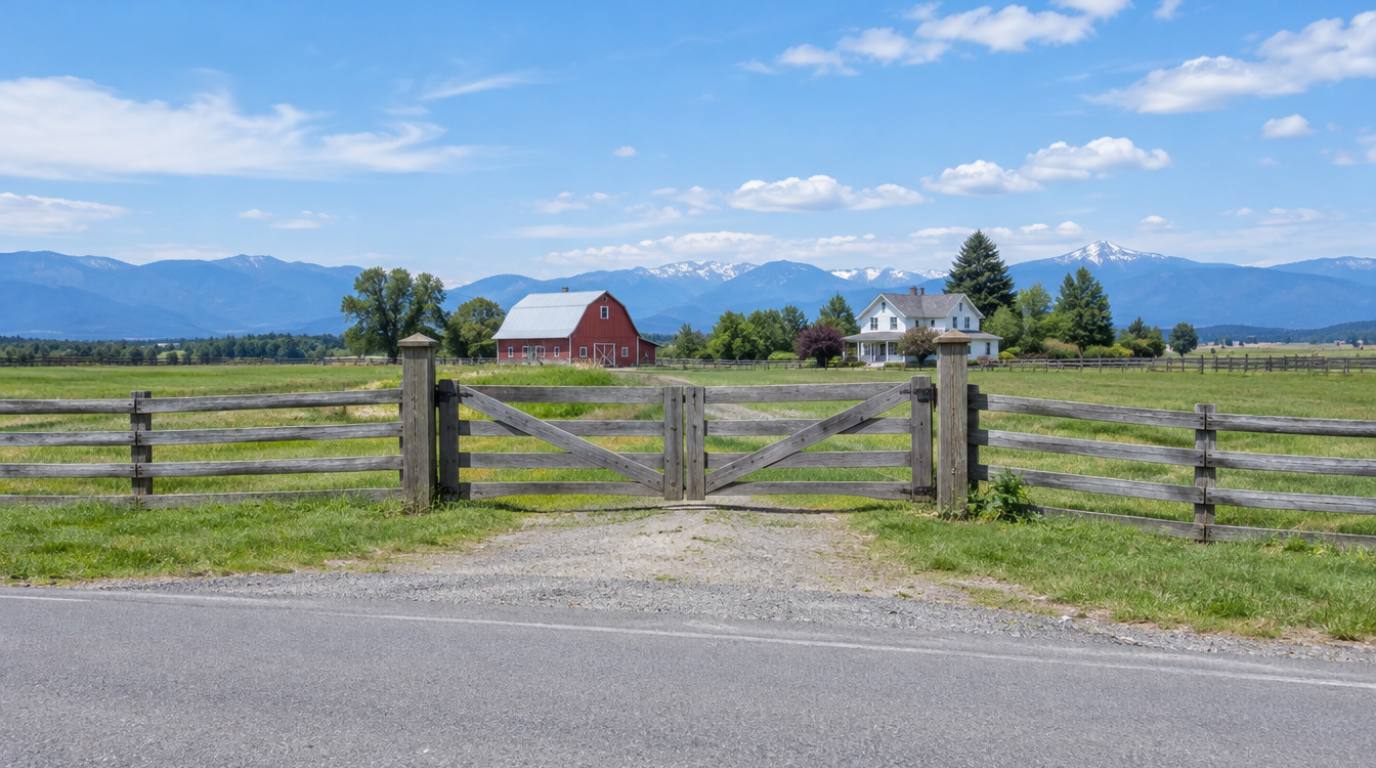
Swing gates. A swing gate operator works by pushing or pulling the gate leaf through an arc. The pivot point is the hinge, and the operator arm connects the gate to the drive mechanism at a point along the leaf. Every time the gate opens, the operator arm extends or rotates; every time it closes, it retracts or reverses. The primary wear surfaces are the hinge pin, the operator arm pivot, and the drive mechanism inside the operator. A swing gate that is slightly out of plumb, or a leaf that sags because a hinge has worked loose, puts the operator into a binding condition that accelerates wear.
Swing gates also face a specific challenge in Washington: they open into or away from the approaching surface. On a sloped driveway, a swing gate that opens uphill will eventually arc into rising ground. More relevant to longevity, a swing gate that must hold itself open against a prevailing wind – which happens routinely on exposed island properties and on rural lots in Skagit and Whatcom counties – puts continuous load on the operator.
Slide gates. A slide gate (also called a rolling gate) moves the panel laterally along a track or, in a cantilever configuration, along rollers at the top of a post set. The operator drives a chain or belt attached to the bottom of the gate. Slide gate operators typically handle heavier gates than arm operators of the same power class, because the load is distributed along the track rather than torqued at a pivot point.
The wear points on a slide gate are the rollers, the track itself, the chain or belt, and the drive sprocket in the operator. Dirt and debris in a ground track are a persistent maintenance issue, particularly in the fall when leaves and soil are introduced into the opening. A slide gate on a ground track that is not cleaned regularly will show accelerated wear on the rollers and the track surface. A cantilever slide gate, which uses rollers attached to posts rather than a ground track, avoids the dirt problem but requires that the posts be set accurately and maintained in alignment, because a racked post forces the rollers to run at an angle.
Our comparison of sliding and swing gates in the Pacific Northwest covers these design tradeoffs in detail, including which type is better suited to different slope conditions, available side room and traffic volumes.
Warning Signs That a Gate Operator Is Nearing End of Life
Gate operators rarely fail without warning. The warning signs appear incrementally, and they are easy to dismiss as minor annoyances until the gate stops working entirely at an inconvenient moment. Recognizing these signs early gives you the option of a planned replacement rather than an emergency call.
Slower or inconsistent operation. A gate that used to open in four seconds and now takes six or seven is showing reduced motor output. This can be caused by a weakening motor, a capacitor that has lost capacity, or a mechanical binding condition that is making the operator work harder than it should. Any of those causes is worth diagnosing, and the progression is generally not linear: a gate that slows gradually can reach a sudden stop when the motor’s thermal protection triggers during a hard cycle.
Unusual sounds. Grinding, clunking, a rattling that was not there before, or a high-pitched whine from the motor under load are all signs of mechanical wear. A grinding sound in a swing gate operator often indicates wear in the gearbox. A clanking in a slide gate system often indicates a loose or worn chain. These sounds identify specific components that are failing rather than indicating that the entire operator is at end of life.
Increasing nuisance reversals. An operator that reverses the gate without visible obstruction has a sensor alignment issue, a control board issue, or a mechanical binding condition that is triggering its internal obstruction detection. Occasional reversals on dusty or wet days are normal; frequent reversals that cannot be corrected by cleaning the sensors and rechecking the hardware are a sign of a deeper problem.
Control board error codes. Modern gate operators display or log error codes. An operator that is consistently recording errors, even if the gate is still operating, is telling you that something is outside its normal parameters. Documenting these codes and sharing them during a service call gives a technician a significant diagnostic head start.
Our troubleshooting guide for automatic gates that will not open or close walks through the diagnostic steps for the most common failure modes in order of likelihood.
Repair vs Replace: A Practical Framework for Washington Properties
When a gate system shows serious wear or fails outright, the repair-versus-replace question is rarely as simple as comparing parts costs to replacement costs. The full picture includes the age of the system, parts availability, the structural condition of the gate, and what has changed about the property since the original installation.
When repair makes sense. A gate operator that has a single failed component – a control board that was damaged by a surge, a capacitor that has lost capacity, a battery that has reached end of life – is often worth repairing if the operator is less than ten years old, the mechanical components are in good condition, and the parts are readily available. The motor and gearbox are the most expensive components in the operator, and an operator whose motor is still sound can often be restored to good service with a board or capacitor replacement.
When replacement makes sense. An operator that is more than twelve to fifteen years old, that has had multiple repairs in a short period, or that is showing signs of motor wear alongside an electronics failure is often at a decision point where replacement delivers better long-term value than continued repair. The calculation changes further if the operator’s manufacturer has been acquired, discontinued the product line, or no longer supports it, because repair depends on parts availability that may be closing.
The structural question. Before any repair or replacement decision on the operator, assess the gate structure itself. An operator replacement on a gate with cracked welds, significantly corroded posts, or misaligned posts will not solve the underlying mechanical stress that contributed to the operator’s failure. In those cases, addressing the structure before or simultaneously with the operator is the only approach that produces lasting results.
Upgrades at replacement time. Operator replacement is the natural opportunity to add or update the access control system, the safety sensors, and the battery backup. A replacement project that modernizes the operator and leaves a ten-year-old keypad in place will face access control issues sooner than expected. Treating a replacement as an opportunity to bring the whole system to current standards is typically more economical than doing the work in separate visits.
We cover the full cost and decision framework in our guide to automatic gate repair cost vs replacement in Washington.
Questions about whether to repair or replace your gate system? We assess the full picture before recommending anything, and we will tell you honestly if repair is the right call.
What Happens When Gate Operator Parts Are Discontinued
The gate industry has consolidated significantly over the past twenty years. Companies have been acquired, product lines discontinued, and support documentation removed. This matters to anyone planning a long-term gate installation, because a gate operator whose manufacturer no longer exists is not necessarily repairable when something goes wrong.
Parts availability follows a predictable pattern. A manufacturer typically supports a product for five to ten years after it is discontinued, providing boards, capacitors and mechanical components through authorized distributors. After that support window closes, parts move to third-party suppliers, whose inventory is finite and whose quality varies. Eventually, the only source for a specific board revision is a used unit pulled from another failing system, and that supply is unpredictable.
We carry LiftMaster, Viking and FAAC products in part because all three manufacturers have established parts support pipelines and histories of long-term product support. That does not mean any specific model will be supported forever, but it means the support window is meaningful and the parts distribution networks are organized. When a system reaches the point where parts are no longer available through normal channels, replacement becomes the only real option regardless of the mechanical condition of the motor.
How We Approach Long-Life Gate Installations in Northwest Washington
At Emerald Gate Systems, every gate installation is built and serviced by the same team. Our CAD planning, welding, installation, automation, access control and future service all stay in-house, which means the people who spec a project are available when that project needs attention five or ten years later. This accountability changes how we think about decisions at installation time.
In the projects we handle across Skagit, Whatcom, Snohomish and Island counties, the issues that cut gate system life short follow a consistent pattern. Corrosion starts at hardware mounting points and welds, not at the gate panel face. Operators fail from repeated torque stress, not always from simple wear. Batteries fail silently because the charger circuit has degraded and no one noticed. Sensors get dirty and the safety system is quietly compromised. None of these are exotic failures; they are all addressable with a structured maintenance program and components that were selected to handle the conditions of a Northwest Washington installation.
We specify marine-grade hardware on coastal properties as a baseline, not an upsell. We do not install residential operators on commercial or semi-commercial entrances regardless of the budget pressure, because we are the team that will be called when that operator fails ahead of schedule. We build backup power into every project in the service area because the power supply here makes backup a necessity rather than an option. And we recommend a first service visit at one year after installation, when the initial run-in period has revealed any adjustments that need to be made before they become larger problems.
Casey and Wyatt founded Emerald Gate Systems on the principle that a gate company that builds things to last is a gate company worth calling again. That principle shows up in material choices, in how we size equipment to the application, and in the service program we offer to keep the systems we install running the way they were designed to run.
Washington State contractor registration EMERAGS748D6 (General) and electrical contractor license EMERAGS747KE (Doors and Gates specialty) are active through 2028 as required by RCW 18.27.100, verifiable at lni.wa.gov/verify. Contact us at emeraldgatesystems.com/contact or call (360) 657-9975 to schedule a free on-site consultation.
Whether you are planning a new installation that needs to last, evaluating a system that has been running for years, or troubleshooting a failure, we assess the full picture and give you a straight answer.
Schedule a free on-site consultation or call (360) 657-9975.
Frequently Asked Questions: How Long Do Automatic Gates Last?
How long does a typical gate operator last in Washington State?
Under residential use – a few cycles per day – a properly sized and maintained gate operator in Washington commonly runs for 10 to 15 years before needing replacement. High-humidity conditions, frequent power outages and exposure to wind and rain all shorten that window compared to drier climates. The gate structure itself typically outlasts the operator by a significant margin if it was built and finished correctly.
Does the Pacific Northwest rain shorten gate lifespan?
Yes, meaningfully. The combination of 150-plus days of precipitation, sustained high humidity from October through March, and coastal salt air in areas like Whidbey Island and Anacortes accelerates corrosion in unpainted steel hardware, degrades rubber seals and works moisture into operator electronics. Proper material selection, protective coatings and annual maintenance can offset most of that effect, but the Pacific Northwest is a more demanding environment than the manufacturer’s rated specifications assume.
What is a gate operator duty cycle and why does it matter?
A duty cycle specification describes how many open-and-close cycles an operator can perform in a given time period without overheating or wearing out prematurely. Residential operators are designed for relatively low daily cycle counts. Commercial and semi-commercial operators are built for hundreds of cycles per day. Using a residential operator on a high-traffic entrance is one of the most common causes of premature operator failure we see in the service area.
How long does a gate backup battery last?
Sealed lead-acid backup batteries in gate operators typically last two to four years before capacity degrades enough to affect reliable operation, depending on how often they cycle and the temperature of the storage environment. Batteries on rural properties that lose power frequently will cycle more and wear out faster. Testing the battery under operating load, rather than measuring voltage at rest, gives the most accurate picture of remaining capacity.
When should I repair my gate operator rather than replace it?
Repair makes most sense when the operator is less than ten years old, the failure is a single identifiable component, the motor and gearbox are mechanically sound, and parts are available through normal channels. Replacement becomes the better value when the system is older than twelve to fifteen years, has needed multiple repairs in a short period, or has failed at the motor level. Replacement is also the right time to update sensors and backup hardware.
Does gate type affect how long it lasts?
Swing gates and slide gates distribute wear differently but have comparable service lives when correctly installed and maintained. Swing gates are more vulnerable to wind load on exposed properties and to binding on sloped approaches. Slide gates accumulate dirt in ground tracks if not cleaned regularly. Both types outlast their operators in most cases. The gate type affects where maintenance attention is most needed, not whether a gate will eventually need attention.