
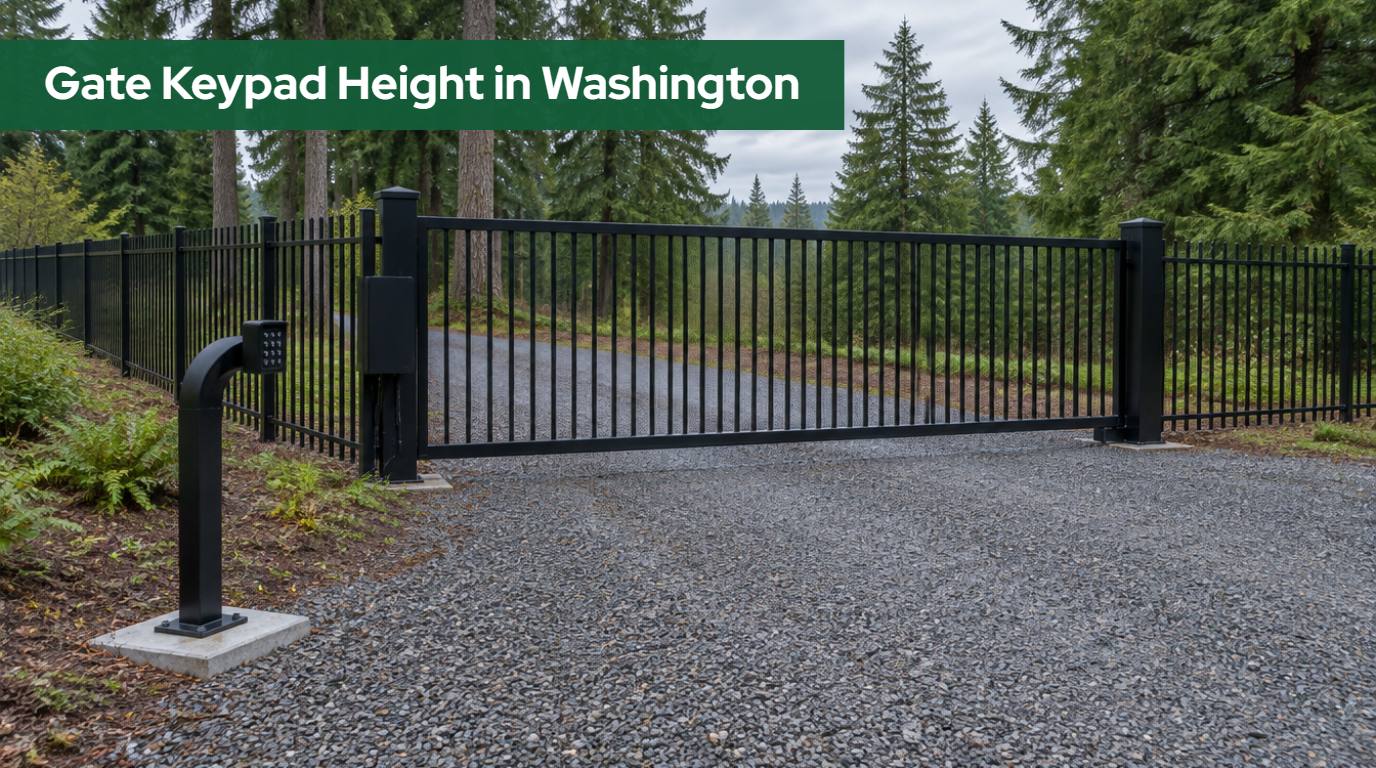
Getting automatic gate keypad height Washington right matters more than most people realize before the installation is done. A keypad set at the right height gets used every trip without anyone having to strain out a car window, open a truck door, or awkwardly reach over a mirror. Get it wrong and drivers adjust around it in ways that cause real problems: leaving the car running in neutral on a slope, reaching past the gate to tap a code, or simply avoiding the keypad and buzzing the house every time.
This guide covers the standard heights, the ADA reach rules that apply to commercial properties in Washington, the DASMA safety distance requirement that applies to all installations, and the practical adjustments for the mix of vehicles that actually use Northwest driveways, from sedans to full-size pickups. By the end you will know how to specify a pedestal before a contractor quotes it, or how to check the one you already have.
Quick answer
The standard gate keypad height in Washington is 42 inches from grade for pad-mount pedestals. ADA Standards require operable parts on accessible routes to be between 15 and 48 inches above ground. The keypad must be at least 6 feet from any moving gate part per ANSI/CAN/UL 325 and DASMA placement guidance.
In this guide
- Why automatic gate keypad height matters
- The ADA reach range rule for gate keypads
- Washington State building code and accessibility
- Practical vehicle heights and the 42-inch default
- Standard pedestal heights and when to use each
- The 6-foot rule: DASMA and UL 325 distance requirements
- Lateral offset and approach lane placement
- Line of sight and where the driver stops
- Video intercoms and combination units
- Dual-height pedestals for mixed fleets
- Pacific Northwest factors: rain, frost and sun
- Wire routing and conduit for the pedestal
- Commercial vs residential placement rules
- How we approach keypad placement
- Frequently asked questions
Automatic Gate Keypad Height Washington: Why Placement Matters
A gate keypad is a small piece of hardware that gets used hundreds of times a year. Every driver who approaches the gate reaches for it from inside a vehicle, usually without getting out. The height of that keypad determines whether the reach is effortless or awkward, and whether the gate actually gets used the way it was designed.
Beyond comfort, keypad height has three installation-level consequences that matter on any property in Washington:
- Safety distance. The keypad, by being placed at the right distance and height, keeps the driver in a position where they can see the gate moving without being close enough to be struck by it. A keypad placed too close to the gate or too far to one side can put the driver next to the gate instead of clear of it.
- Accessibility compliance. On commercial properties, multifamily housing, and any property subject to the Americans with Disabilities Act, a keypad is an operable part on an accessible route. ADA Standards define the reach range that makes it usable from a wheelchair. Washington State building code adopts those same height standards for permitted construction.
- Reliability. A keypad that is hard to reach gets hit with mirror corners, scraped by bumpers when someone pulls too close, or pushed by impatient fingers in a way that loosens the mounting. Proper placement extends the life of the hardware and the pedestal it sits on.
Height is also not the only number. The pedestal needs to be far enough from the gate, far enough from the driveway edge, and on the correct side of the approach lane. Height is where most people start, so that is where this guide starts, but the sections on lateral placement and safety distance are just as important.
The ADA Reach Range Rule for Gate Keypads
The 2010 ADA Standards for Accessible Design, published by the U.S. Department of Justice and available at ada.gov, define the forward and side reach ranges that make operable parts accessible to a person using a wheelchair.
For forward reach, Section 308.2 requires that an unobstructed forward reach be between 15 inches minimum and 48 inches maximum above the floor or ground. When there is an obstruction in front of the element, the maximum forward reach drops to 44 inches if the depth of reach exceeds 20 inches.
For side reach, Section 308.3 sets the unobstructed range at 15 inches minimum to 48 inches maximum. When there is a side obstruction deeper than 10 inches, the maximum drops to 46 inches.
Door and gate hardware specifically is governed by Section 404.2.7, which references Section 309.4. That section requires operable parts to be placed at a height of 34 inches minimum and 48 inches maximum above the finish floor or ground. This is a narrower window than the general reach range, because it covers hardware you grip or push, not just touch.
For a gate keypad, the practical takeaway is:
- The top of the usable keypad surface should be no higher than 48 inches above the ground at the pedestal base.
- The center of the keypad (the middle of the keypad face, where most digits sit) is typically at 44 to 46 inches when set to ADA maximums, depending on the keypad dimensions.
- If the pedestal sits on a raised pad or curb, measure from the ground surface on the approach side, not from the top of the pad.
The U.S. Access Board’s technical guide on operable parts, published at access-board.gov, explains the intent and covers edge cases, including how to handle sloped ground around the pedestal. That guide is the authoritative reference for anyone designing an accessible entrance in Washington.
Washington State Building Code and Accessibility
Washington State adopts the International Building Code through WAC Chapter 51-50. The current adoption is the 2021 IBC, effective March 15, 2024. Chapter 11 of the IBC, which covers accessibility, requires that new construction and alterations comply with ICC A117.1, the standard produced by the International Code Council that defines specific measurements for accessible features including operable parts.
The ICC A117.1 reach range requirements track the ADA Standards. For construction permitted after the effective date, any keypad or access credential reader on an accessible route, including a driveway gate on a commercial or multifamily property, must meet those height requirements under both the ADA (a federal civil rights law enforced independently of the building permit) and the Washington State Building Code (enforced through the local jurisdiction’s permitting process).
For residential properties, the IBC accessibility chapter applies less broadly, and most single-family driveway gate keypads are not on an accessible route in the code sense. But the practical guidance for wheelchair reach still applies: if anyone who uses the property uses a wheelchair, the keypad should be within the 15-to-48-inch range, and typically at the lower end of that range to work from the approach driveway rather than from a raised pad height.
Washington also has its own gate permit requirements, which vary by jurisdiction. A standalone keypad pedestal rarely triggers a building permit by itself, but the gate operator installation almost always triggers an electrical permit under RCW 19.28. Inspectors in some Skagit, Whatcom and Snohomish County jurisdictions will check keypad placement as part of a full gate installation inspection, particularly on commercial projects. Our guide to automatic gate permits in Bellingham, WA covers how that process typically works in Whatcom County.
Want a keypad placement that meets code and works for every driver?
We measure the approach, note the vehicle mix, and spec the pedestal height and position before we order anything.
Practical Vehicle Heights and the 42-Inch Default
The ADA reach range sets the compliance ceiling, but most driveway gate keypads serve drivers inside vehicles, not pedestrians. The optimal height for a drive-up keypad is the height of the driver’s side window opening, not the floor of a wheelchair approach.
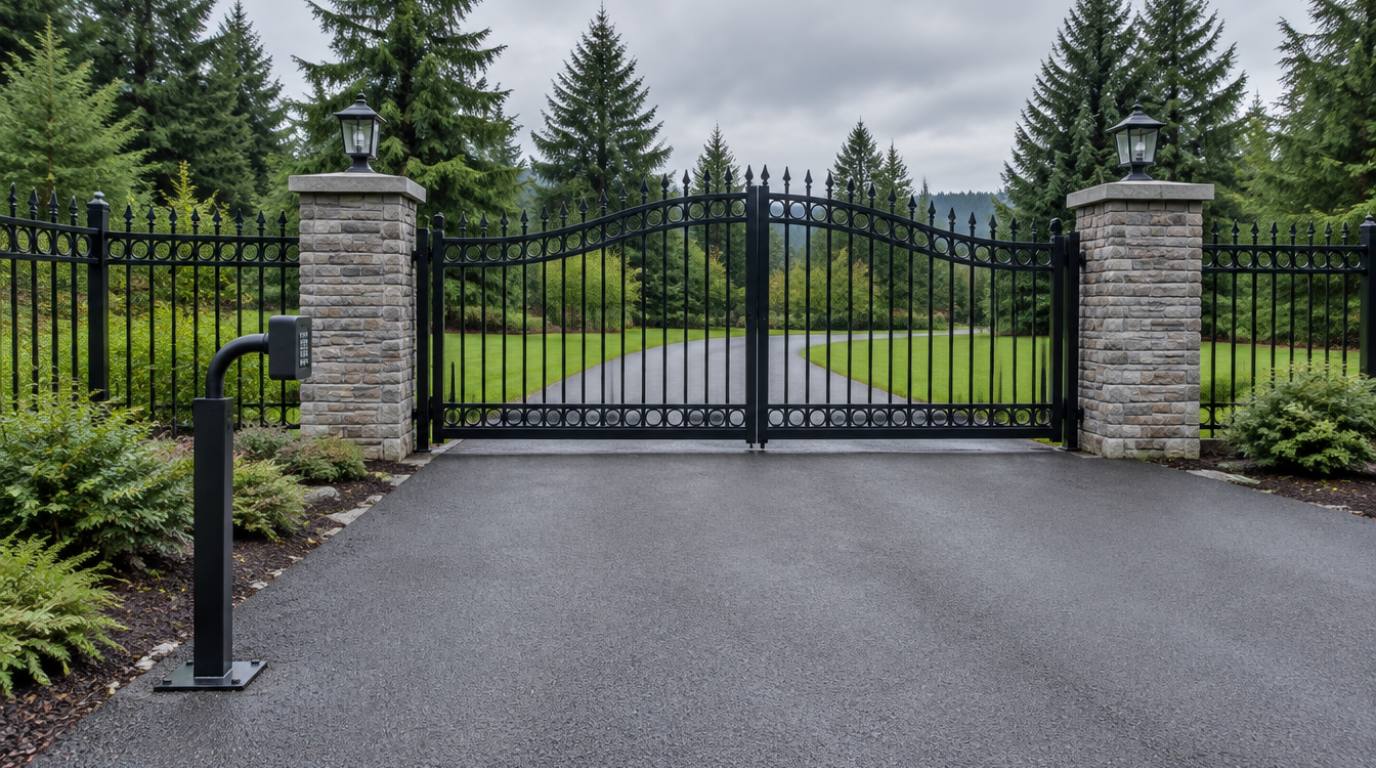
Vehicle window heights vary considerably. A compact car has a center-of-window height of roughly 46 to 47 inches. A full-size pickup puts the center of the driver’s window at roughly 62 to 63 inches. That is a 15- to 16-inch spread, and no single fixed height serves both from a reach-through-window position. The 42-inch standard, widely used by gate installers across Washington, is a practical compromise that works for car drivers and requires only a slight lean from a truck driver. It is also within the ADA forward reach range.
The table below shows how common vehicle types relate to the 42-inch standard height:
| Vehicle type | Approx. window center height | 42-in keypad reach |
|---|---|---|
| Compact/mid-size car | 46–47 in | Easy, arm slightly extended |
| Full-size car/wagon | 47–50 in | Easy, near eye level |
| Minivan | 54–56 in | Lean out, comfortable |
| Mid-size SUV/crossover | 54–58 in | Reach down, still easy |
| Full-size SUV/pickup | 60–63 in | Reach down farther; longer arm needed |
| Agricultural equipment | Highly variable | Usually requires a separate exit device |
On a property that is accessed primarily by trucks, farm equipment, or heavy commercial vehicles, a higher keypad or a dual-height pedestal is worth specifying. On a mixed residential driveway in Skagit, Whatcom or Snohomish County, 42 inches serves the majority of daily drivers, and a long-reach pedestal arm (gooseneck) offsets the window height difference more effectively than raising the post height.
Standard Pedestal Heights and When to Use Each
Gate keypad pedestals are made in a few standard heights that correspond to different mounting situations. Understanding those standard heights prevents ordering the wrong pedestal and finding it does not work with the driveway grade or the curb configuration after the concrete is poured.
The four common configurations, from shortest to tallest, are:
36-Inch Curb-Mount
A 36-inch curb-mount pedestal is designed for installations where the base is bolted to the top of a curb, a concrete pad that is raised above the driveway surface. The 36 inches is measured from the top of the curb or pad, which typically adds 6 to 8 inches to the effective ground-to-keypad measurement. A 36-inch post on an 8-inch curb puts the top of the post at 44 inches above the driveway surface, placing the keypad face within the ADA maximum range. Curb-mount pedestals are common in commercial driveways and HOA entrances where a concrete island is already planned into the layout.
42-Inch Pad-Mount
This is the most widely installed height for residential and light commercial driveways in Washington. The pedestal base bolts to a flat concrete pad that is flush with, or only slightly above, the driveway surface. The 42 inches puts the keypad face at approximately 38 to 40 inches to the center, which is inside the ADA hardware range of 34 to 48 inches and reaches car drivers without requiring them to stretch excessively. Most 42-inch pads ship with a 15-inch gooseneck curve that extends the keypad toward the driver’s window, effectively reducing the lateral gap between the post and the window.
48-Inch Pad-Mount
A 48-inch post is used when the driveway surface near the keypad is slightly below the typical grade, such as at the low point of a crowned driveway or at the base of a culvert approach. It is also used on properties where the driver mix skews toward SUVs and trucks. At 48 inches with a standard gooseneck, the center of the keypad face sits at roughly 44 to 46 inches above the driveway, which is still within ADA range and is closer to the window height of a pickup driver.
Direct-Bury (66-Inch) Post
A 66-inch direct-bury post is set with the lower 24 inches in the ground, leaving 42 inches above grade, the same effective height as a pad-mount. This method is faster where soil conditions allow and is common on rural properties where a concrete pad is not practical. The buried portion should be treated aluminum or galvanized steel; plain steel corrodes quickly in Northwest Washington soils.
The 6-Foot Rule: DASMA and UL 325 Distance Requirements
Height alone does not make a keypad installation safe. Distance from the gate is governed by ANSI/CAN/UL 325, the standard that gate operators must be listed to, and by the DASMA placement guidance that summarizes the code requirements for installers.
The requirement is straightforward: controls intended for user activation must be located at least 6 feet away from any moving part of the gate, measured from the widest point of travel. Additionally, the placement must prevent the user from reaching over, under, around, or through the gate to operate the controls.
The DASMA guidance, available at dasma.com, adds the line-of-sight requirement: when the gate is moving, the person operating the controls must be able to see the full gate area. A keypad hidden behind a column, a shrub, or a landscape wall that blocks the view of the gate fails this requirement even if the 6-foot distance is met.
In practice, the 6-foot rule shapes where the keypad pedestal can go. On a standard 16-foot driveway opening, the gate travel zone starts at the hinge post and ends at the fully open position. For a swing gate that opens toward the road, the travel zone extends 8 to 10 feet in the direction the gate swings. The pedestal must clear that entire zone by 6 feet.
For slide gates, the travel zone runs parallel to the fence, and the 6-foot requirement is measured from the last position of the leaf when fully open. On a 16-foot slide gate with 2 feet of overlap at the post, the leaf travels roughly 14 feet. The keypad must be at least 6 feet from the end of that travel zone.
We cover the detailed safety standards, including UL 325 monitored safety devices and ASTM F2200 gate construction requirements, in our guide to automatic gate safety standards in Washington. The keypad placement rules are one part of a larger compliance picture for any gated entrance.
Not sure if your keypad meets the 6-foot distance requirement?
We verify placement against UL 325 and DASMA requirements before every installation. Existing installations can be checked and moved if needed.
Lateral Offset and Approach Lane Placement
Once height and distance from the gate are established, the lateral placement of the pedestal within the approach lane determines whether drivers actually use it correctly. This is where many installations go wrong, not because the height is off, but because the pedestal ends up in the wrong lane position.
The Gooseneck Curve
A standard gooseneck or pad-mount pedestal does not put the keypad directly above the center of the post. The top of the post curves toward the driveway, typically 15 inches at the end of the bend, so the keypad face extends toward the driver’s window without the vehicle having to pull next to the post itself. That 15-inch offset is important. A pedestal set at the edge of the driveway with a 15-inch offset puts the keypad face roughly over the outer edge of the travel lane, where a car door or mirror could hit it if the driver stops too close.
The practical guidance: set the pedestal base 36 to 42 inches from the centerline of the approach lane, on the driver’s side. With the 15-inch gooseneck offset, the keypad face will sit roughly 18 to 24 inches from the edge of the vehicle’s travel path. That gap prevents contact without requiring the driver to lean out at a sharp angle.
Approach Lane vs Exit Lane
Most residential driveway gates in Washington have one lane, and the same keypad pedestal serves both entry and exit. On wider commercial entrances with separate entry and exit lanes, the entry keypad goes in the entry lane and is typically the only credential-entry device. The exit may use a ground loop detector, a vehicle-detection exit wand, or a push-to-exit button at a different height.
If the gate serves one lane that functions as both entry and exit, one option is to mount the entry keypad on the approach side and a push-to-exit button on the exit side, on the same pedestal or on a second shorter post. The exit button only needs to be reachable and does not need to face the driver’s window from the same angle, so a shorter, closer post is often acceptable on the exit side.
For properties that get frequent deliveries by large trucks, our guide to the access control options for gates in Northwest Washington covers how vehicle detection devices (loop detectors, exit wands, and LPR) compare to credential-based systems for the exit function.
Gravel vs Paved Approaches
On gravel driveways, a direct-bury post is typical but the grade around the post shifts as gravel settles and gets pushed by plow blades. A post set at 42 inches at installation may drop to 36 inches within two winters. A concrete collar around the base, poured just below the surface, prevents that movement. On paved driveways, a pad-mount on a separate concrete footer is more common and easier to verify at electrical inspection.
Line of Sight and Where the Driver Stops
The position where a vehicle stops to use the keypad determines a great deal about the installation. The driver needs to reach the keypad without getting out, see the gate while it moves, and not block traffic on the road while waiting. On a busy rural road in Skagit or Whatcom County, a gate that is too close to the road forces the stopping vehicle into the traffic lane; a gate that is set far back from the road requires a long driveway run before the keypad position, which changes how the gate looks from the road and how far the conduit run needs to go.
The standard guidance for vehicular gate setback from a public road in Washington is not universal; it depends on the jurisdiction and the road classification. In Skagit County, approaches to state-numbered highways fall under WSDOT encroachment permit rules, while approaches to county roads fall under Skagit County Public Works standards. In both cases, queuing a vehicle in the traffic lane while waiting for a gate is specifically prohibited.
Our guide to planning a gate before paving in Burlington, WA walks through how to lay out the gate position, the keypad pedestal position, and the underground conduit paths before the driveway surface is poured, which is the most cost-effective time to establish the correct stopping distance.
A few practical measurements help set the stopping distance correctly:
- The front bumper of the stopping vehicle should be at least 2 feet clear of the gate leaf or slide track, to give the gate room to start moving without the vehicle in the way.
- The keypad pedestal should be positioned so that when the driver’s window is at the keypad, the front bumper meets the clearance requirement above.
- On a slope, the stopping vehicle needs enough flat or level surface to sit without rolling. If the driveway grade at the stop point exceeds 2 percent, consider grading a level platform at the gate approach. This is also covered in our guide to installing a driveway gate on a slope.
Video Intercoms and Combination Units
A video intercom at a gate entrance has different height requirements than a simple keypad, because it includes a camera. If the camera is set to the same height as a keypad, it looks across at the driver’s door rather than up at the driver’s face, and the image it captures is a shoulder and window frame rather than a face.
For a useful video intercom image from a drive-up position, the camera height is typically set higher than the keypad face: 50 to 56 inches above grade for a camera aimed at a car driver’s face, which is higher than the ADA keypad hardware range. This is a genuine conflict on properties where ADA compliance is required and video intercom is also installed.
The common resolution is a combination unit where the keypad or credential reader panel is at 42 to 48 inches and a separate camera module is mounted at 54 to 60 inches on the same pedestal or on an adjacent column. Some manufacturers build dual-panel units with the keypad at the lower ADA-compliant height and the camera at a higher position on the same housing. These are worth specifying on any commercial entrance in Washington that is subject to ADA compliance.
For a deeper look at which intercom systems work best at gated Washington State entrances, our article on video intercom systems for gates in Mount Vernon, WA covers the camera, audio, and integration considerations in detail.
Dual-Height Pedestals for Mixed Fleets
On properties that receive a regular mix of cars and full-size trucks, a dual-height pedestal is a practical answer to the vehicle height problem. These units use two sections of post, one at the standard 42-inch pad-mount height and a second that extends to 66 inches, with a separate keypad or credential reader mounted at each height. The driver of a small car uses the lower pad; the driver of a pickup or heavy truck uses the upper one.
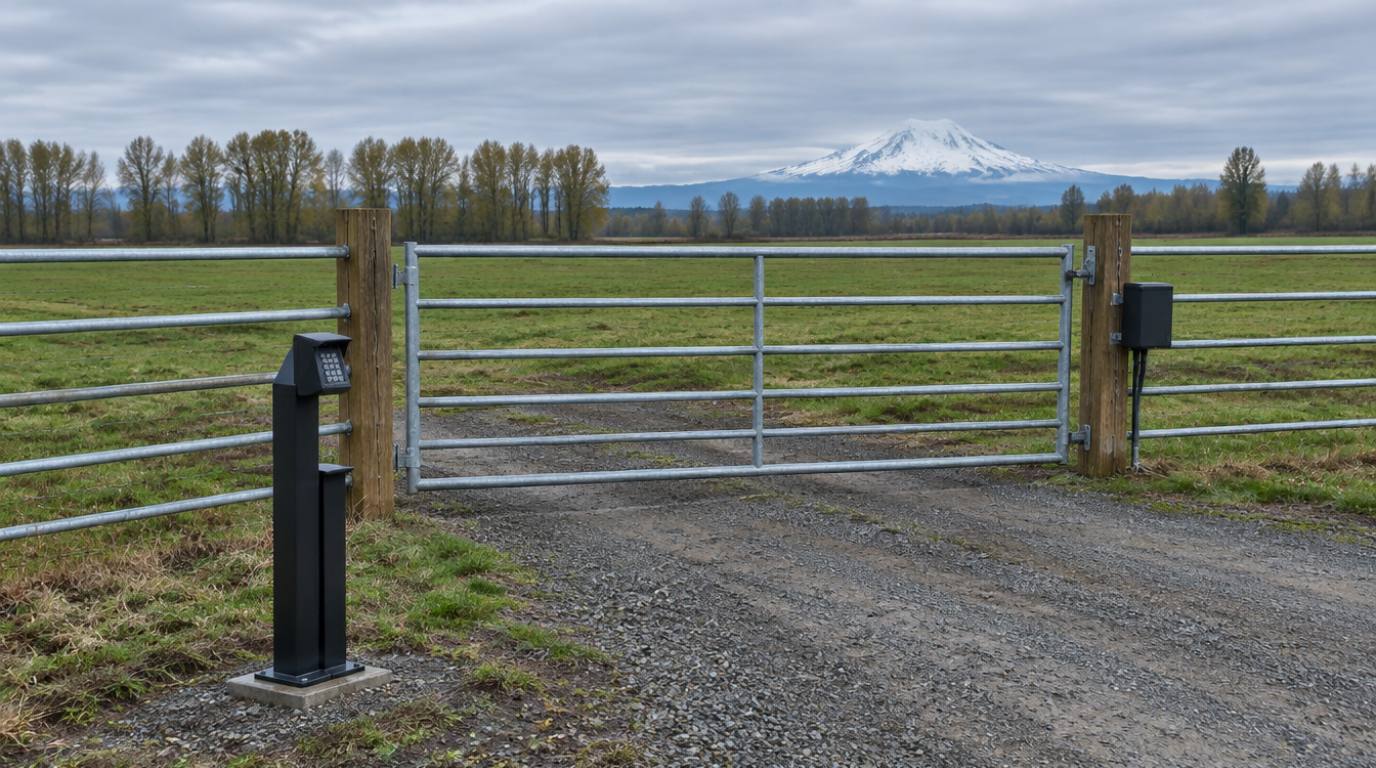
Dual-height pedestals are most common at agricultural properties in Skagit County, where farm trucks, grain trailers and service vehicles enter alongside personal vehicles, and at commercial yards in Snohomish County where contractor fleets use the same entrance as office staff.
For HOA and community gate entrances, a dual-height pedestal serves both the resident population and the delivery, maintenance, and emergency vehicles that enter infrequently but cannot be locked out. At these entrances, the lower pad typically handles resident credentials and the upper pad or a separate device handles access codes for service vendors.
Dual-height pedestals are also worth considering at any entrance where agricultural equipment enters regularly. Tractor and combine cab heights vary widely, and a fixed-height keypad at 42 inches may not be reachable from the cab of a large tractor without the operator getting out of the seat. A fixed code panel at 60 to 66 inches, or a handheld remote in the cab, is more practical than a drive-up keypad for those vehicles.
Farm or commercial property with mixed traffic?
We spec dual-height pedestals and vehicle-appropriate access devices as part of every commercial and agricultural gate quote.
Pacific Northwest Factors: Rain, Frost and Sun
Skagit and Whatcom counties see 35 to 45 inches of rain per year, with temperatures that drop below freezing on dozens of nights each winter. Those conditions affect both pedestal placement and hardware selection.
Water infiltration. The conduit should enter the side of the pedestal base, not the bottom, and be sealed with conduit foam or a seal-off at the interior. If the conduit runs under the driveway, the transition point should slope away from the post rather than toward it.
Frost heave. Direct-bury posts set above the local frost depth will rise and tilt each winter. Frost depth in the Skagit Valley is typically 12 to 18 inches; in the foothills toward Concrete or Darrington it can be deeper. A concrete collar extending to or below that depth keeps the post stable.
Low-angle sun. A south-facing keypad on a south-facing driveway can be unreadable when winter sun hits the face directly. Noting the driveway orientation before the pedestal position is fixed avoids a relocation after installation.
Keypad sealing. Specify a weatherproof keypad rated to at least IP55 for any Northwest Washington installation. Inexpensive residential keypads that are not rated for outdoor use fail quickly in the freeze-thaw cycles common to Skagit and Snohomish counties.
Wire Routing and Conduit for the Pedestal
Under Washington’s electrical code (WAC 296-46B, governing gate operators under RCW 19.28), wiring from the gate operator to the keypad must be in conduit when buried. Cover depth under a vehicle-traffic surface requires 24 inches for rigid conduit; 12 inches is the minimum for PVC Schedule 80 in non-traffic areas.
The best time to run conduit is before the driveway is paved or the gate post concrete is poured. A 1-inch sleeve from the operator position to the pedestal location, with a pull string inside, is inexpensive at construction time. Our guide to planning a gate before paving in Burlington, WA covers the full conduit layout process for new driveways.
For existing driveways, conduit is run by directional boring (preferred on concrete or asphalt) or open-cut trenching on gravel. Longer runs require heavier wire gauge to prevent voltage drop at the keypad.
Commercial vs Residential Keypad Placement Rules
The differences between commercial and residential placement rules in Washington come down to enforcement and documentation rather than the physical specifications, which are largely the same.
For commercial properties, the keypad location and mounting height may need to appear on submitted permit plans. In Snohomish County, a commercial gate permit application typically includes a site plan showing gate position, pedestal position, road setback, and electrical routing. A keypad that fails the ADA height check or is within 6 feet of the gate is a correction item at final inspection.
For residential properties, the electrical permit for the gate operator does not typically require a site plan. But the UL 325 6-foot requirement still applies as a condition of the operator’s listing under IFC 503.6 (adopted in Washington through WAC 51-54A). A residential installation that fails it is technically non-compliant even without a specific permit check.
On HOA entrances, the keypad is treated as an element on an accessible route and the full ADA height range applies. Washington HOAs are also subject to WAC 64.38 on member access rights. Our article on HOA gate planning and access control in Washington covers these requirements in detail.
Need help with commercial keypad placement and permit documentation?
We prepare the site plan, confirm ADA compliance, and handle the electrical permit for commercial gate installations across Northwest Washington.
How We Approach Keypad Placement
At Emerald Gate Systems, the keypad pedestal location is determined at the site evaluation, before any equipment is ordered. On every project, from a single-family driveway in Sedro-Woolley to a commercial yard entrance in Burlington or an HOA gate in Marysville, we work through the same checklist:
- Vehicle mix. We ask what vehicles use the gate and how often. A household that primarily drives sedans and a farm that uses full-size pickups and tractors daily get different pedestal height recommendations.
- ADA applicability. For any commercial, multifamily, or publicly accessible property, we identify whether the ADA height range applies and specify the pedestal height accordingly.
- Gate travel zone. We mark the full travel zone of the gate at its intended installation position and verify that the pedestal sits at least 6 feet from any point in that zone.
- Stop point. We note where a vehicle will actually stop, accounting for the driveway slope, the sight lines from inside the vehicle, and the clearance needed between the front bumper and the gate.
- Conduit path. We plan the conduit run from the pedestal to the operator housing before any concrete is poured, and use conduit rated for the burial depth on the specific soil and surface conditions at the site.
- Weatherproofing. We specify pedestals with keypad heads rated to at least IP55, and seal conduit entries to prevent water intrusion in Washington’s wet climate.
All of our installations are carried out by our licensed team under Washington electrical contractor license EMERAGS747KE (Doors and Gates specialty). Our construction contractor registration is EMERAGS748D6. Both licenses are required for a complete gate installation that includes a pedestrian keypad, underground conduit, and a UL 325-listed gate operator.
The result is a keypad that drivers use correctly from the first day, an installation that passes electrical inspection, and a hardware placement that will not need to be relocated six months after the gate goes in because someone pulled a vehicle too close to the gate or because the ADA inspector found a problem at a permit renewal.
Frequently Asked Questions
What is the standard height for a gate keypad in Washington?
The most common standard is 42 inches from grade to the top of the keypad face for a pad-mount pedestal. This puts the center of the keypad at roughly 38 to 40 inches, within the ADA range of 34 to 48 inches for door and gate hardware. On properties with a lot of truck and SUV traffic, 48 inches is a better fit.
Does ADA apply to a residential driveway gate keypad in Washington?
For a single-family residence, ADA accessibility requirements generally do not apply to the driveway gate keypad as a matter of federal law. However, if anyone using the property uses a wheelchair, designing the keypad within the ADA reach range of 15 to 48 inches above ground is straightforward and costs nothing extra. For commercial properties, multifamily housing, and HOA entrances in Washington, ADA compliance is required.
How far from the gate does the keypad pedestal need to be?
ANSI/CAN/UL 325 requires that user-activated controls be at least 6 feet from any moving part of the gate at its widest point of travel. This applies to all gate installations, residential and commercial, as a condition of the gate operator’s UL listing. The DASMA placement guidance also requires that the user have a full view of the gate area while it is moving.
Can the keypad be on the gate post itself?
A keypad mounted on the gate post would be within arm’s reach of the gate leaf, which is almost certainly closer than 6 feet from the moving gate. That placement fails the UL 325 distance requirement. The keypad must be on a separate pedestal or on a column or pillar that is independent of the gate and at least 6 feet from the gate’s travel zone.
What height should a video intercom be set at for a drive-up gate?
The keypad or button portion of a video intercom should be at 42 to 48 inches above grade to meet ADA reach requirements. The camera module is typically mounted higher, at 50 to 56 inches, to capture the driver’s face rather than the vehicle door. Combination units that separate the input panel and the camera on one housing solve this in a single pedestal.
What is a gooseneck pedestal and why is it used?
A gooseneck pedestal is a standard keypad post that curves at the top toward the driveway, typically extending the keypad face about 15 inches horizontally toward the driver’s window. The curve puts the keypad within arm’s reach of the car window without requiring the driver to pull the vehicle right up against the post. Most pad-mount and direct-bury keypads for gate installations in Washington use a gooseneck configuration.
How do I keep a keypad pedestal from heaving in winter in Northwest Washington?
Direct-bury posts are most susceptible to frost heave in the North Cascade foothills and at higher elevations in Skagit and Snohomish counties. Setting the buried section below the local frost depth and pouring a concrete collar around the base prevents most heave. Pad-mount posts on properly sized concrete footers that extend to frost depth are less prone to movement. In the Skagit Valley floor, frost depth is typically 12 to 18 inches.