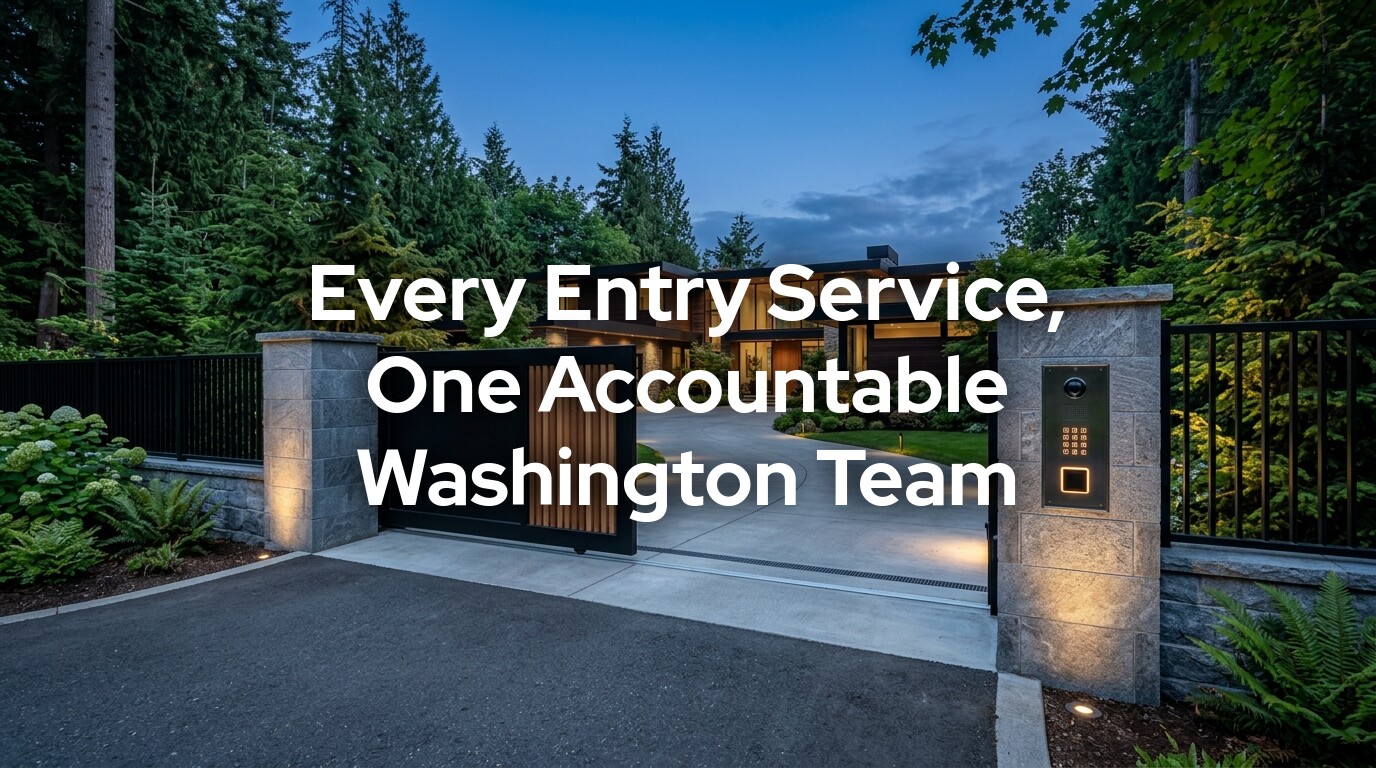
Gate, Access Control & Entry Services should work as one coordinated system, even when a property owner only needs help with one part of the entrance. The gate structure, operator, safety equipment, access controls, power supply, drainage, emergency access, and maintenance plan affect one another. Treating them as unrelated purchases is one of the fastest ways to create an entrance that looks finished but does not work reliably.
Emerald Gate Systems provides design, CAD planning, fabrication, installation, automation, access control, ADA entry work, bollards, solar power, repair, and ongoing service from one accountable Washington team. The company is family-owned, licensed and insured, headquartered in SedroWoolley, and backed by more than 15 years in the trade. The core work is not divided among unrelated subcontractors.
This page is the starting point for those services. It explains what each service includes, where it fits, what it does not solve, and which full service page should answer your next question. It also explains how Washington rain, soil, wind, salt air, winter outages, rural power runs, permits, and safety standards change the way an entrance should be planned.
The right starting point depends on the property. A homeowner may need a custom driveway gate with a keypad and battery backup. A farm may need an equipment-width opening with solar automation. An HOA may need high-cycle operators, visitor entry, individual resident credentials, and a maintenance agreement. A commercial facility may need vehicle loops, badge access, bollards, cameras, and documented emergency operation.
Those are different projects, but the planning principle is the same. The moving structure, controls, safety devices, users, site, power, and long-term service requirements should be evaluated together before equipment is selected.
What Are Gate, Access Control & Entry Services?
Gate, Access Control & Entry Services include the physical barrier, the equipment that moves it, the devices that authorize entry, the safety systems that protect users, and the infrastructure that keeps everything working. Depending on the property, the complete entrance may include fabricated gates, operators, keypads, intercoms, cameras, bollards, accessible controls, solar power, and repair support.
A gate is the moving or fixed physical part of the entrance. It may be ornamental, private, agricultural, commercial, pedestrian, or designed primarily for traffic control. Its frame, posts, hinges, rollers, guides, track, infill, finish, and foundations determine whether it can remain aligned and move with reasonable resistance.
Automation is the movement layer. An operator opens and closes the gate, but it should not be expected to overcome a dragging leaf, weak post, failing roller, distorted frame, or severe wind load. The gate must move properly before the operator can perform properly.
Access control is the permission layer. It decides who may request entry and under what conditions. A system may use remotes, keypad codes, cards, fobs, mobile credentials, telephone entry, video intercoms, license plate recognition, or a managed platform with schedules and user records.
Safety equipment is the protection layer. Monitored photo eyes, sensing edges, physical guards, correct gate construction, warning signs, controls, and testing help address impact and entrapment hazards. Vehicle loops and exit devices may support traffic operation, but they do not automatically replace required entrapment protection.
Infrastructure includes foundations, conduit, wiring, power, solar panels, batteries, communication links, drainage, paving transitions, and mounting locations. These parts are less visible than the gate, but they often determine whether the system remains dependable through Northwest Washington winters.
The practical trade-off is complexity. Every added feature can improve convenience, security, accessibility, or management, but it also adds equipment that needs power, programming, documentation, updates, inspection, and eventual replacement. The goal is not to install the largest possible system. The goal is to install the simplest complete system that meets the property’s real needs.
Why Use One Accountable Washington Team?
One accountable team reduces the gaps that develop when the gate fabricator, automation installer, access control vendor, electrician, and service company make separate assumptions. Emerald Gate Systems coordinates design, CAD, welding, installation, automation, access control, and service so that the structure and electronics are planned as parts of the same entrance.
That coordination begins before fabrication. The gate frame may need reinforcement for an operator bracket. Conduit may need to reach the hinge side, operator pad, keypad pedestal, photo eyes, vehicle loops, or intercom. Posts must support the gate’s weight and wind load. Access devices must be placed where drivers and pedestrians can actually use them.
When those decisions are divided among multiple companies, each company may provide a technically acceptable piece that does not fit the other pieces well. A fabricator may build a beautiful gate with no good operator attachment point. An access control vendor may select a pedestal location without considering trailer turning paths. An operator may be sized by weight while ignoring wind area and mechanical resistance.
Keeping responsibility together does not mean every project becomes simple. Electrical jurisdiction, fire access, paving, utilities, networking, HOA review, and site construction may still involve outside authorities or specialized trades. The benefit is that the gate and entry scope has one team responsible for coordinating its own work and explaining the boundaries of the proposal.
Local accountability also matters after installation. Gates need adjustments, batteries, mechanical wear parts, safety testing, credential changes, and occasional repair. An owner should not have to call three companies to determine whether a problem began in the gate structure, operator, wiring, or access control.
Emerald Gate Systems operates from its own fabrication shop in Sedro-Woolley rather than treating Northwest Washington as a distant territory. That location supports work across Skagit, Whatcom, and Snohomish counties, Whidbey and Camano islands, the San Juan Islands, and the greater Puget Sound region.
The limitation of a one-team approach is that proper planning takes time. Custom design, fabrication, site work, permits, and controls cannot always be compressed into the timeline of a stock equipment purchase. The trade-off is clearer responsibility and a system designed around the property instead of a collection of separately selected products.
Not sure which entry service applies? Schedule a free on-site consultation so the gate, site, power, safety, and access needs can be reviewed together.
How Do You Choose the Right Entry Service?
Choose the service by starting with the problem you need to solve, not the product you have already seen. New entrances usually begin with installation or fabrication. Existing gates may need repair or retrofit automation. Managed properties often begin with access control. Public-facing buildings may need ADA entries, bollards, or coordinated door security.
| Your current situation | Best starting service | What the service evaluates | Important limitation |
|---|---|---|---|
| No gate exists yet | Automatic gate installation | Opening, configuration, operator, foundations, safety, power, and access | A final design requires an on-site evaluation |
| You want a unique gate | Custom gate design and fabrication | Materials, CAD layout, frame, infill, finish, hardware, and automation preparation | Custom work takes longer than ordering a stock panel |
| The gate is slow, noisy, or stopped | Gate repair and maintenance | Mechanical condition, operator, batteries, sensors, wiring, controls, and safety | Some obsolete or unsafe systems are not economical to repair |
| Users and visitors are difficult to manage | Access control systems | Credentials, intercoms, cameras, schedules, user records, and remote management | More features require more administration and cybersecurity care |
| The property has frequent vehicle traffic | Commercial gate solutions | Duty cycle, queues, vehicle loops, delivery access, credentials, and service response | Residential equipment is not automatically suitable for commercial use |
| Vehicles need to be kept away from a building or public area | Bollard installation | Traffic purpose, vehicle threat, spacing, foundation, drainage, and approvals | Decorative bollards are not the same as crash-rated systems |
| A public or employee entrance needs accessible operation | ADA entry and door automation | Accessible route, controls, door condition, opening, safety, and documentation | An automatic operator alone does not make the full route compliant |
| Utility power is distant or impractical | Solar gate openers | Winter sun, shade, cycles, batteries, accessory loads, and backup | Solar is not reliable at every shaded Western Washington site |
| The entrance serves equipment, livestock, or acreage | Farm and agricultural gates | Equipment width, mud, livestock safety, power distance, and rugged operation | Residential gate layouts may not fit farm traffic |
| The entrance serves residents and visitors | HOA and community gate systems | Daily cycles, directories, resident credentials, vendors, records, and maintenance | The system needs a clear administrator after installation |
| A usable manual gate already exists | Gate automation retrofit | Gate condition, support, movement, safety upgrades, operator, and smart access | Not every manual gate is suitable for automation |
Some projects belong in more than one category. A custom residential gate may also require automatic installation, access control, solar power, and future maintenance. A commercial project may include a sliding gate, credential system, ADA pedestrian door, fixed bollards, cameras, and emergency access.
In those cases, use the service page that matches the primary purchase decision as the starting point. The other services become parts of the project scope. This prevents the owner from planning each component in isolation.
What Happens During a Free On-Site Consultation?
A free on-site consultation examines the entrance as a working site rather than a blank opening. Emerald Gate Systems reviews measurements, grade, drainage, soil, gate travel, vehicle movement, power, communication, safety zones, emergency access, weather exposure, user groups, and the owner’s priorities before recommending a service or configuration.
- Define the main problem. Identify whether the goal is security, privacy, convenience, traffic control, accessibility, livestock management, property appearance, or repair.
- Measure the opening. Record the clear width, fence line, shoulders, road edge, grades, slopes, available runback, and potential gate travel.
- Review vehicle movement. Consider passenger vehicles, trucks, trailers, deliveries, farm equipment, fire apparatus, visitor stopping points, and queue space.
- Inspect drainage and soil. Look for standing water, soft fill, slopes, culverts, ditches, track locations, runoff, and areas where foundations can be supported.
- Evaluate the existing gate. For repair or retrofit work, check posts, hinges, rollers, frame alignment, corrosion, travel resistance, gaps, guards, and operator attachments.
- Plan power. Compare utility power, trenching, conductor distance, battery backup, solar exposure, accessory loads, and outage operation.
- List every user group. Include residents, family, employees, vendors, guests, deliveries, caregivers, property managers, emergency responders, and maintenance crews.
- Locate access devices. Determine where drivers, pedestrians, wheelchair users, and staff will stop and how they will reach the control safely.
- Identify hazards. Review entrapment zones, pinch points, reach-through areas, public exposure, pedestrian routes, road conflicts, and areas needing photo eyes or sensing edges.
- Confirm likely approvals. Discuss electrical permits, local jurisdiction, fire access, HOA review, right-of-way issues, and inspection documentation.
- Choose the starting service. Determine which dedicated service page and project process best fit the property.
- Prepare a clear scope. Separate fabrication, installation, controls, safety, infrastructure, permits, exclusions, and future maintenance.
A useful consultation may rule out an option the owner initially preferred. A swing gate may not fit the driveway grade. A tracked sliding gate may be a poor choice where gravel and fir needles collect. A solid cedar gate may create too much wind load. A solar operator may not receive enough January sunlight under mature trees.
Those limitations should be identified before material is ordered. Changing configuration on paper is manageable. Changing it after concrete, conduit, columns, or gate fabrication is expensive.
Call (360) 657-9975 to schedule a site visit that checks drainage, gate travel, power, vehicle approach, and access needs before the entrance is designed.
What Is Included in Automatic Gate Installation?
Automatic gate installation includes selecting and installing a gate configuration, operator, safety devices, controls, power source, foundations, and access equipment suited to the site’s traffic and conditions. A complete installation may use a swing, tracked slide, cantilever, vertical, or barrier-style system, but the right configuration depends on the property.
A swing gate can provide a traditional appearance and relatively simple movement where the driveway is reasonably level and has enough clear arc space. A single leaf uses one large moving gate. A paired gate reduces the length and swing radius of each leaf but adds a second operator or coordinated drive arrangement.
Wind matters with swing gates. Solid cedar, sheet steel, signage, and tightly spaced infill create a larger surface that transfers force into hinges, posts, operator arms, brackets, and foundations. An exposed property near Anacortes or on Whidbey Island may need a different frame, infill, configuration, or opening direction than a sheltered residential driveway.
A sliding gate moves parallel to the fence and preserves driveway depth. It can fit sloped approaches and commercial traffic well, but it needs side runback. A tracked slider depends on a straight, supported, clean path. Gravel, mud, ice, leaves, and fir needles can interfere with wheels and track.
A cantilever gate crosses the roadway without a ground track. That can be valuable for gravel, uneven pavement, snow, heavy trucks, and debris. The trade-off is a longer gate structure, counterbalance section, larger support foundations, and additional frame weight.
The operator must be selected for gate weight, length, balance, travel resistance, duty cycle, wind exposure, and expected daily use. A motor rating is not a substitute for a gate that rolls or swings freely. Installing a larger operator on a binding gate can increase structural stress without solving the underlying problem.
Safety devices must be planned from the actual movement and hazard areas. The complete installation may include monitored photo eyes, sensing edges, physical guarding, warning signs, vehicle detection, emergency access, manual release, battery backup, and programmed obstruction response.
Read the full automatic gate installation service page for swing, sliding, and cantilever systems designed around Washington rain, slopes, traffic, and winter outages.
When Does a Gate Need Repair or Maintenance?
A gate needs inspection when it becomes slower, noisier, uneven, intermittent, difficult to release, unreliable around its sensors, or visibly out of alignment. Maintenance should also occur before failure because mechanical wear, battery aging, debris, corrosion, drainage problems, and loose hardware often create warning signs before the entrance stops working.
Emerald Gate Systems services all brands, including gates the company did not install. The transparent repair labor rate is $100 per hour. Parts, specialty equipment, travel, permits, and projectspecific work should be identified separately in the service scope.
Mechanical problems include worn hinges, rollers, wheels, bearings, chain, rack, guides, stops, brackets, latches, and structural attachments. A gate that drags or changes alignment may also indicate post movement, foundation settlement, track damage, impact, or frame distortion.
Electrical and control problems include weak batteries, poor charging, damaged wiring, water intrusion, failed relays, control board faults, remote problems, communication loss, and incorrect limit settings. Access devices such as keypads, intercoms, cards, fobs, cameras, and network equipment can fail independently of the operator.
Safety faults should not be bypassed to keep the gate moving. Repeated photo-eye problems may come from misalignment, unstable mounts, dirty lenses, insects, vegetation, water, sunlight, snow, damaged wire, or a failing device. The monitored circuit should be diagnosed and restored.
Many residential systems benefit from professional inspection every six to twelve months. Highcycle commercial, HOA, coastal, agricultural, or debris-heavy sites may need quarterly or semiannual service. These are planning intervals, not guarantees. The correct schedule depends on use, environment, equipment, and the consequences of downtime.
Some systems should be replaced rather than repaired. Severe structural deterioration, obsolete control equipment, unavailable safety interfaces, repeated water damage, extensive corrosion, or an unsafe gate design can make another partial repair a poor long-term investment.
Review the full gate repair and maintenance service page for all-brand troubleshooting, maintenance planning, and the published $100 per hour repair rate.
If your gate has changed speed, sound, alignment, or sensor behavior, call (360) 657-9975 before repeated operation causes additional damage.
How Does Custom Gate Design and Fabrication Work?
Custom gate design and fabrication turn the opening, architecture, materials, operating method, and site loads into one purpose-built structure. Emerald Gate Systems draws and fabricates gates in its Sedro-Woolley shop using options that include hand-forged wrought iron, laser-cut steel, Western Red Cedar, and coordinated stone elements.
Custom does not only mean decorative. The frame must support its own weight, remain square, resist expected movement, accept the selected hardware, and provide suitable attachment points for automation. Infill spacing, lower clearance, hinge geometry, roller placement, drainage openings, guards, and operator brackets all affect performance.
CAD planning helps the owner see proportions before fabrication and helps the shop coordinate structural and visual details. It can also reveal conflicts between a requested design and the realities of the site. A large solid panel may create excessive wind area. Closely spaced ornament may trap debris or create reach-through concerns. Heavy stone columns may limit service access if controls are buried inside them.
Steel offers strength, fabrication flexibility, and repairability. It requires a complete corrosionprotection strategy, especially where coating damage, trapped water, or salt exposure is possible. Decorative iron can add detail and traditional character but requires skilled labor and careful finish protection around joints and shaped elements.
Western Red Cedar provides privacy and a Northwest appearance. It moves with moisture, needs airflow and drainage, and requires finish maintenance. Cedar boards should be installed so individual pieces can be replaced without rebuilding the complete gate.
Stone can create a strong architectural entrance, but columns and monuments must be coordinated with foundations, conduit, access devices, gate clearances, and future service. A finished column should not prevent technicians from reaching wiring, controls, hinges, or release hardware.
The trade-off with custom fabrication is time. Design approval, material procurement, welding, fitting, finishing, and quality checks take longer than buying a stock panel. The benefit is a gate built around the actual opening, automation method, materials, and visual character of the property.
Explore the full custom gate design and fabrication service for CAD planning, iron, steel, cedar, stone, and in-house production.
What Can an Access Control System Manage?
An access control system manages who may enter, where they may enter, and when their permission is valid. It may use keypads, cards, fobs, mobile credentials, telephone entry, video intercoms, cameras, license plate recognition, schedules, and event records for homes, businesses, HOAs, apartments, farms, and institutions.
A keypad is simple and familiar. It can work well for a private driveway or small user group. The limitation is that shared codes can be copied and passed to former workers, guests, vendors, or tenants. A shared code also provides little individual accountability.
Cards, fobs, and mobile credentials can be assigned to individual users. That makes it possible to remove one person’s access without changing every user’s credential. The trade-off is ongoing administration. Lost credentials, former residents, departed employees, and temporary vendors must actually be removed from the system.
A video intercom allows a resident, receptionist, manager, or security desk to see and speak with a visitor before granting entry. The design should account for camera angle, night lighting, rain, glare, network reliability, driver position, vehicle height, and what happens when the primary call recipient does not answer.
License plate recognition can support specific commercial or managed-property workflows, but it requires appropriate camera positioning, lighting, database management, and expectations about plate visibility. A wide overview camera does not automatically provide reliable plate identification, and a plate-focused camera may not show the driver or complete scene.
For a longer look at what plate recognition does well, where it fails and what it takes to install it properly, see our article on license plate recognition for gates in Northwest Washington.
Modern systems may connect to local networks or cloud services. That improves remote administration but creates cybersecurity responsibilities. Default passwords, shared administrator accounts, unrestricted remote support, outdated software, and forgotten credentials should be avoided. Physical access control systems are included within the broader operational technology guidance discussed by NIST.
UL 294 addresses access control system units and provides requirements for electronic and electromechanical equipment controlling entry or exit. A listed component does not remove the need for correct system design, wiring, permissions, power backup, network protection, and owner administration.
Read the full access control systems service page for keypads, RFID, video intercoms, cameras, mobile access, and license plate recognition.
After reviewing the credential options, request an access assessment at (360) 657-9975 to decide which users need permanent, temporary, scheduled, or visitor access.
What Makes a Commercial Gate System Different?
A commercial gate system is designed around higher traffic, defined operating schedules, larger vehicles, managed users, delivery workflows, and the cost of downtime. It may require high-cycle operators, vehicle loops, badge or phone access, visitor verification, cameras, separate pedestrian entry, emergency access, and documented maintenance.
Duty cycle is a central distinction. A private residential gate may open a limited number of times each day. A warehouse, apartment entrance, employee lot, or managed facility may cycle repeatedly during shift changes, delivery windows, school arrival, or resident peak periods.
The operator must be selected for the actual traffic pattern, not just the gate’s appearance. Cycle estimates should include entries, exits, visitors, deliveries, vendors, maintenance staff, and repeated opening during busy periods. Future growth should also be considered.
Vehicle stacking matters. Drivers need enough room to stop at a credential reader or intercom without blocking a public road, crossing a pedestrian route, or placing a trailer at an impossible angle. A gate that opens quickly can still create a poor entrance if vehicles cannot approach and queue safely.
Vehicle loops and presence detection can support opening, closing, free exit, and traffic logic. Loop locations must account for gate travel, vehicle length, tailgating risk, pavement, drainage, and the vehicles expected on the property. A passenger-car layout may not work well for trucks or trailers.
Commercial access control also needs administrative ownership. Someone must add employees, remove former users, issue temporary credentials, review events, coordinate visitors, and respond to outages. The system should not depend on one employee whose login and programming knowledge disappear when that person leaves.
Downtime planning should identify manual operation, battery backup, emergency opening, service contacts, spare credentials, and communication procedures. A busy entrance may exhaust battery backup faster than expected if the gate continues to cycle normally during a prolonged outage.
Review the full commercial gate installation service for warehouses, storefronts, campuses, managed properties, and high-traffic facilities.
Which Type of Bollard Does a Property Need?
The right bollard depends on whether the goal is visual separation, parking control, storefront protection, removable access, automated vehicle restriction, or certified crash performance. Fixed, removable, retractable, and crash-rated bollards are different systems with different foundations, operation, cost, maintenance, and engineering requirements.
A fixed bollard remains permanently in place. It can define pedestrian areas, protect building corners, discourage vehicle encroachment, or support traffic layout. Its actual protective capability depends on the bollard design, steel, embedment, reinforcement, concrete, spacing, and installation.
A removable bollard allows occasional vehicle access. It may fit fire lanes, service areas, event spaces, or seasonal operations. The receiving sleeve needs drainage and maintenance. Dirt, gravel, water, ice, and corrosion can make a neglected removable bollard difficult to operate.
A retractable bollard lowers into the ground or moves out of the vehicle path. Manual and powered versions are available. Retractable systems preserve flexible access but require deeper foundations, drainage, mechanical service, and protection from water and debris.
A crash-rated bollard is tested or engineered for defined vehicle impact conditions. The word rated should not be used for a decorative post or an unverified installation. The complete assembly, including foundation and spacing, must match the required performance and project documentation.
Bollard placement must preserve pedestrian movement and accessible routes. Spacing should support the intended vehicle restriction without creating an obstacle pattern that people cannot navigate. Utilities, drainage, frost conditions, paving, and building foundations also affect installation.
Cost varies substantially because a decorative fixed post and a powered crash-rated system do not have similar excavation, reinforcement, equipment, control, or approval requirements. A responsible proposal must first define what the bollards are expected to stop or control.
Review the full bollard installation service for fixed, removable, retractable, decorative, and crash-rated applications.
Ask Emerald Gate Systems about bollard options after defining the traffic problem, vehicle risk, access frequency, and required documentation for the site.
What Is Included in ADA Entry and Door Automation?
ADA entry and door automation can include low-energy operators, push-button controls, accessible keypads, safety sensors, door hardware, access control integration, and inspection-ready documentation. The complete accessible route, clear space, reach range, opening, threshold, door condition, and control location matter. Adding an operator alone does not make an entrance compliant.
Accessible operable parts generally need clear floor space and placement within required reach ranges. Under the 2010 ADA Standards, an unobstructed forward reach is generally between 15 and 48 inches above the finished floor or ground. Operable parts should work with one hand without tight grasping, pinching, or twisting, and activation force is limited to 5 pounds.
Door and gate hardware on covered accessible routes is generally placed between 34 and 48 inches above the finished floor or ground. Automatic doors require a minimum clear opening of 32 inches in power-on and power-off modes, subject to the applicable provisions and project conditions.
Control placement must account for the door swing. A push plate positioned inside the moving door arc can force a user to activate the door and then move backward quickly. The clear floor space should allow a user to reach the control and proceed through the opening without being placed in the path of the moving door.
The existing door condition also matters. Worn pivots, damaged hinges, binding thresholds, poor alignment, incorrect closers, warped frames, or unsuitable hardware can prevent the operator from working correctly. Automation should not be used to overpower a door that needs mechanical repair.
Access control and accessibility must be coordinated. A card reader, keypad, intercom, or request-toexit device may satisfy the security plan but remain difficult to reach or operate. The secure opening, egress behavior, fire alarm interface, power-loss response, and accessible route should be reviewed as one system.
Not every entrance has identical obligations, and ADA work can involve federal standards, state codes, local review, fire and egress rules, and facility-specific requirements. Emerald Gate Systems provides inspection-ready documentation for applicable work, but the authority having jurisdiction determines acceptance.
Read the full ADA entry and door automation service page for push-button operators, accessible controls, integration, and documentation.
Do Solar Gate Openers Work in Washington?
Solar gate openers can work in Washington when the system is sized around winter conditions, not summer production. Panel exposure, tree shade, daily cycles, gate resistance, battery capacity, operator load, intercoms, cameras, radios, heaters, and other accessories all affect whether an off-grid entrance remains dependable.
Solar is often valuable on long rural driveways, farms, acreage, and island properties where trenching utility power would disturb a large distance or cross difficult terrain. It can also provide independence from certain grid outages when the battery bank and charging system are suitable.
The limitation is Western Washington’s short winter daylight and frequent cloud cover. A panel location that appears open during summer may receive significant winter shade from fir trees, hills, buildings, or the lower sun angle. The site should be evaluated for the weakest normal production period.
Daily cycle count matters because every opening uses stored energy. A private gate opening a few times per day has a different energy requirement from an HOA entrance, commercial yard, farm operation, or property with frequent deliveries.
Accessory loads can exceed expectations. A video intercom, cellular communicator, Wi-Fi bridge, camera, heater, keypad lighting, loop detector, and standby controller continue drawing power even while the gate is not moving. The energy budget must include continuous and intermittent loads.
Batteries are consumable components. A planning range of approximately three to five years is common for many gate backup and solar batteries, but deep discharge, cold weather, heat, poor charging, high traffic, and battery chemistry can shorten or extend service life. Capacity testing is more useful than checking resting voltage alone.
Solar is not always the lower-cost choice over the life of the system. Panels, mounting, batteries, charge controls, enclosures, vegetation management, and battery replacement all have costs. Where utility power can be installed reasonably, it may provide simpler long-term operation.
Review the full solar and off-grid gate automation service page for winter sizing, battery backup, rural sites, farms, and island properties.
Call (360) 657-9975 for an honest solar assessment based on January sun, shade, actual gate cycles, battery capacity, and accessory loads.
How Are Farm and Agricultural Gates Different?
Farm and agricultural gates are planned around equipment width, trailers, livestock, mud, gravel, remote power, repeated impact risk, and the need to keep working during poor weather. A gate that is appropriate for a residential driveway may be too narrow, too delicate, too slow, or too difficult to service on working land.
Opening width should be based on the widest equipment and the turning approach, not only the machine’s body width. Mirrors, implements, trailers, wagons, delivery trucks, livestock vehicles, snow equipment, and future machinery all affect the usable opening.
A straight approach can use an opening differently from a tight turn off a narrow road. Columns, ditches, shoulders, fence corners, and access pedestals can reduce the effective path even when the measured gate opening appears sufficient.
Livestock safety influences spacing, lower clearances, projections, latches, fence transitions, and the way the gate moves. A decorative residential design can create gaps or trapping areas that are unsuitable around animals. The gate should match the species, traffic, handling method, and location.
Mud and gravel change automation choices. Ground tracks collect material. Low components are exposed to splash, manure, vegetation, and equipment contact. Foundations may be installed in wet or disturbed soil. Drainage and service access should be considered from the beginning.
Solar can be practical for far pastures or remote entrances where trenching is not reasonable. The same winter-sizing limits still apply. A farm gate with frequent cycles, electric locks, cameras, communication devices, and shaded panel locations may require a larger system or a different power strategy.
Agricultural entrances also experience accidental contact. Equipment, trailers, and livestock can bend gates, damage pedestals, break photo eyes, or shift posts. Components should be placed where they can function without becoming the first object struck during normal work.
Read the full farm and agricultural gate service page for equipment-width openings, livestock-aware design, solar power, and mud-season automation.
What Do HOA and Community Gate Systems Require?
HOA and community gate systems require equipment sized for resident traffic, clear visitor entry, individual credentials, move-in and move-out procedures, vendor schedules, emergency access, service planning, and communication during outages. The technology matters, but consistent management is what keeps the system accurate after installation.
Cycle count should be estimated from the number of homes, vehicles, entries, exits, visitors, deliveries, service providers, and peak traffic. A community entrance may cycle heavily during morning departures, evening returns, school transportation, holidays, and delivery windows.
Resident credentials should be individual where practical. One shared keypad code may become known by former residents, contractors, cleaners, guests, delivery drivers, and vendors. Changing that code can inconvenience everyone, while individual credentials can be disabled one at a time.
Visitor entry may use a directory, telephone entry, video intercom, temporary code, mobile invitation, guard station, or property management workflow. The right method depends on staffing, internet reliability, resident expectations, delivery volume, and the board’s ability to administer the system.
The community needs a named administrator. That may be a manager, board representative, management company, or service provider. The administrator should control credentials, retain login information, authorize changes, review user removal, and coordinate resident communications.
Tailgating cannot be solved by software alone. Gate speed, lane design, vehicle spacing, loops, signage, resident behavior, and enforcement all affect whether one authorized entry allows a second vehicle to follow.
Maintenance contracts should define response expectations, inspection frequency, included testing, after-hours procedures, parts handling, documentation, and what happens when a gate must be left open for safety or traffic reasons. A promise of service is more useful when the scope is written.
Review the full HOA and community gate systems service page for resident lanes, visitor directories, cloud credentials, and maintenance planning.
Boards and property managers can contact Emerald Gate Systems to compare resident access, visitor entry, traffic capacity, and maintenance responsibilities before requesting proposals.
Can an Existing Manual Gate Be Automated?
An existing manual gate can often be automated when the frame, posts, hinges, rollers, track, guides, alignment, and clearances are suitable. The gate must also be capable of receiving required safety upgrades. A retrofit evaluation should determine whether repair and automation offer better long-term value than replacing the gate.
The first test is mechanical. A swing gate should move freely without lifting, dropping, dragging, or placing excessive load on the hinges. A slide gate should roll smoothly through its complete travel. Binding, frame twist, damaged wheels, weak guides, or moving foundations must be corrected first.
The second test is structural. The gate and support system must withstand operator force, repeated cycling, wind, and emergency conditions. Operator brackets should attach to reinforced areas rather than thin decorative members. Posts and columns must remain stable under the new operating loads.
The third test is safety. A manual gate may have large openings, exposed rollers, reachable pinch points, protrusions, unstable guides, or other features that were not designed for automatic movement. ASTM F2200 addresses automated vehicular gate construction, while UL 325 addresses operator systems and entrapment protection.
The fourth test is infrastructure. The property needs an appropriate power source, operator location, controls, photo-eye paths, sensing-edge connections, conduit, manual release access, and credential devices. Solar may be considered where utility power is impractical, but it must be sized for winter.
The fifth test is value. A retrofit may cost less than a completely new gate, especially when the existing structure is sound and attractive. It may not be a good investment when the gate needs extensive welding, new posts, new hinges, safety reconstruction, finish repair, and obsolete access equipment at the same time.
Retrofit projects also provide an opportunity to replace shared codes, add individual credentials, install video entry, improve battery backup, correct unsafe sensor layouts, and document manual operation.
Read the full gate automation retrofit service page for operators, safety devices, smart access, and existing-gate evaluations.
How Do the Eleven Entry Services Work Together?
The eleven entry services work together by solving different parts of the same property-access problem. Fabrication creates the structure. Installation and retrofit automation create movement. Access control manages permission. Commercial, farm, HOA, ADA, bollard, and solar services adapt the system to a specific use. Repair preserves operation after installation.
A custom residential entrance may begin with fabrication, then add automatic gate installation, a keypad, video intercom, battery backup, and ongoing maintenance. Each service has a separate purpose, but the final entrance should be designed as one system.
A commercial property may need a continuous-duty sliding gate, vehicle loops, badge access, camera verification, fixed bollards, a separate ADA pedestrian entrance, and a written maintenance plan. Selecting those parts from unrelated scopes can create conflicts in power, conduit, controls, emergency release, and user management.
A farm may combine a fabricated equipment-width gate, solar automation, remote access, livestock-aware fencing, and repair planning. The solar design must account for the operator and every access-control accessory. The gate frame must account for wind and the selected automation hardware.
An HOA may combine high-cycle gates, resident credentials, visitor directories, cameras, vehicle detection, battery backup, and service contracts. The traffic logic, access database, mechanical duty, and outage procedures should be tested together.
An ADA entry may connect to the same credential system used for employee or resident access. That integration must preserve accessible operation, egress behavior, power-loss response, fire interface, and security requirements.
The central trade-off is integration versus simplicity. A unified platform can reduce separate databases and improve management, but it can also create a larger single point of failure. Critical openings should have documented fallback methods and local operation when networks or cloud services are unavailable.
Speak with an installation expert at (360) 657-9975 when a project crosses multiple services and needs one coordinated scope instead of separate equipment quotes.
How Does Washington Weather Affect Every Entry Service?
Washington weather affects every entry service through moisture, soil movement, debris, wind, salt air, ice, snow, outages, and reduced winter solar production. The correct response is not one weatherproof product. The entrance needs suitable drainage, foundations, materials, enclosures, hardware, power, clearances, and maintenance.
What does persistent rain change?
Persistent rain creates problems where water remains or travels into places it should not. Soft soil can reduce foundation stability. Conduit can carry water. Underground boxes can fill. Tracks can collect debris. Damaged coatings can trap moisture against steel. Cedar can swell when drainage and airflow are poor.
Weather-rated enclosures are important, but ratings do not correct bad cable entry, damaged seals, poor mounting, or a conduit path that delivers water into the enclosure. The lowest connection point often needs the most careful planning.
Why do wet and shifting soils matter?
Gate posts experience leverage from long, heavy moving structures. Wet fill, disturbed shoulders, organic soil, slopes, and inadequate foundations can allow movement. The first signs may be a dragging gate, changing center gap, misaligned latch, roller problems, or repeated operator-limit adjustments.
Reprogramming limits does not fix a post or track that continues to move. The structural cause should be identified before the operator is adjusted repeatedly.
How do fir needles and leaf litter cause failures?
Fir needles and leaves collect in sliding tracks, cover drains, block photo-eye paths, hold moisture against hardware, and hide stones that interfere with wheels. They can also fill removable bollard sleeves and gather around ground-level access devices.
Field observation: seasonal debris removal is one of the least expensive ways to prevent avoidable service calls in Northwest Washington. A clean travel path makes it easier to identify real mechanical wear before the gate is forced against an obstruction.
Why is wind important on solid gates?
Solid cedar and steel panels create wind area. The resulting force affects the frame, posts, hinges, rollers, operator, attachment brackets, and foundations. Coastal, hilltop, open-farm, and exposed island properties require more attention than sheltered urban entrances.
More motor power is not the complete answer. Open infill, spaced boards, different framing, stronger supports, paired leaves, a sliding configuration, or a change in opening direction may reduce the load more effectively.
What changes near salt water?
Salt air increases corrosion risk around Anacortes, Whidbey Island, Camano Island, and the San Juans. Aluminum, suitable stainless hardware, protected steel, drainage, isolated dissimilar metals, and regular inspection can improve durability.
No coastal material is maintenance free. Salt collects in sheltered joints and hardware pockets that may not be visible from the front of the gate.
How do winter outages affect gate planning?
Battery backup provides limited stored operation. Its capacity depends on battery age, temperature, gate resistance, traffic, and accessory loads. A community gate cycling continuously can exhaust backup capacity faster than a private residential entrance.
Every owner should know the manual release procedure and emergency access method before a storm. The release should remain reachable, documented, and protected from unauthorized use.
Which Permits and Safety Standards Apply?
Gate and entry projects may involve Washington electrical permits, local building or fire review, HOA approval, ADA requirements, UL 325, UL 294, and ASTM F2200. The applicable requirements depend on the equipment, property use, jurisdiction, and whether the project affects vehicle access, pedestrian access, egress, or emergency response.
Electrical permitting is handled by Washington Labor and Industries in many jurisdictions. Some cities operate their own electrical inspection programs. The project address and scope determine the correct authority.
Fire authorities may review clear opening width, approach, setback, turnarounds, emergency access devices, manual release, power-loss behavior, and whether the gate affects the only apparatus route. Requirements should be confirmed before columns, foundations, conduit, or gates are installed.
UL 325 is used for automatic gate operators and systems, including entrapment protection. UL identifies swing, slide, pivot, vertical lift, barrier arm, and bifold operators within the standard’s gate-operator scope.
UL 294 addresses access control system units. It covers equipment controlling entry or exit and recognizes performance levels for areas such as attack resistance, communication security, endurance, and standby power.
ASTM F2200 addresses construction of automated vehicular gates. It works alongside the operator and safety requirements. Installing a listed operator does not automatically make an unsuitable manual gate safe for automation.
The 2010 ADA Standards for Accessible Design address accessible routes, doors, gates, controls, clear space, reach ranges, operation, and other requirements relevant to covered entrances.
Connected access control should also be treated as a physical security and operational technology system. NIST SP 800-82 Revision 3 identifies physical access control systems among the technologies that interact with and control the physical environment.
Standards and permits do not replace field judgment. A technically listed product can still be installed in the wrong location, attached to a poor structure, programmed incorrectly, or left without adequate maintenance. Compliance depends on the complete installation and the authority having jurisdiction.
Contact Emerald Gate Systems before permit-sensitive work begins so electrical jurisdiction, fire access, ADA details, and safety equipment can be identified early.
What Do Gate and Entry Services Cost?
Gate and entry service costs depend on the structure, site work, equipment, power, safety, access controls, approvals, and travel. The only universal company price provided for this page is Emerald Gate Systems’ transparent repair labor rate of $100 per hour. New installations require a property-specific scope rather than a generic online price.
A complete proposal may include:
- Site evaluation, measurements, planning, and CAD design.
- Steel, wrought iron, cedar, stone coordination, hardware, finish, and fabrication.
- Posts, foundations, tracks, cantilever supports, hinges, rollers, guides, and stops.
- Gate operator, control board, drive components, and mounting hardware.
- Photo eyes, sensing edges, guards, warning signs, and vehicle detection.
- Keypads, cards, fobs, mobile credentials, intercoms, cameras, and network equipment.
- Utility power, trenching, conduit, conductors, communication links, solar, and batteries.
- Drainage, paving repair, fence transitions, columns, and site restoration.
- Electrical permits, inspections, fire access coordination, and documentation.
- Programming, testing, user setup, training, and maintenance planning.
- Travel, ferry coordination, remote-site staging, and specialty equipment.
Custom fabrication generally costs more than a stock panel because it includes design, structural coordination, welding, fitting, finishing, and site-specific automation preparation. A stock product may still require field changes, stronger posts, operator reinforcement, or finish repair that reduce the initial savings.
Access control cost rises with the number of entrances, users, credentials, intercom stations, cameras, network connections, licenses, and management features. The owner should also consider ongoing subscription, cellular, software, credential, and administration costs where applicable.
Solar cost depends on panel capacity, mounting, batteries, charge equipment, enclosure, shade, traffic, and accessory loads. It should be compared with the full cost of trenching utility power, not only the cost of a small panel kit.
ADA entry work depends on the condition of the door, frame, hardware, threshold, power, controls, access system, fire interface, and documentation. An operator may be only one part of the necessary work.
Bollard cost varies widely between decorative fixed posts, removable systems, powered retractable units, and crash-rated installations. Excavation, reinforcement, drainage, utilities, controls, testing, and engineering drive the scope.
Responsible simplification is possible. An owner may reduce cost by simplifying ornament, choosing open infill, planning conduit before paving, selecting one well-supported access method, or avoiding features no one will administer. Structural support, safety devices, drainage, and required approvals should not be removed to reach a lower number.
Where Does Emerald Gate Systems Provide Service?
Emerald Gate Systems provides gate, access control, entry, and repair services across Skagit, Whatcom, and Snohomish counties, Whidbey Island, Camano Island, the San Juan Islands, and the greater Puget Sound region. The company is headquartered in Sedro-Woolley and fabricates gates in its own Skagit County shop.
In Skagit County, projects may include residential gates in Sedro-Woolley and Mount Vernon, commercial and distribution entrances around Burlington, coastal systems near Anacortes, and farm access across the Skagit Valley.
Whatcom County work may include homes and businesses in Bellingham, farm and acreage entrances near Lynden and Ferndale, and controlled entries for commercial, institutional, and managed properties.
Snohomish County includes high-traffic commercial and residential projects around Everett, Marysville, Lynnwood, Bothell, Edmonds, Mukilteo, and Mill Creek, along with farm, acreage, foothill, and rural work near Arlington, Monroe, Lake Stevens, Granite Falls, Darrington, Sultan, Gold Bar, and Index.
Island work requires additional planning. Coastal finishes, salt exposure, ferry logistics, material staging, solar power, battery backup, remote access, documentation, and future service should be considered before the crew travels.
Service territory should not be treated as a list of city names added to every paragraph. Geography matters when it changes the entrance. An Anacortes waterfront gate has different corrosion concerns from a farm entrance near Lynden. A Darrington property may face snow, long power runs, and storm outages. An Everett facility may prioritize traffic and credential management.
Long-term ownership also depends on service availability. Batteries, rollers, operators, controls, sensors, intercoms, and credentials will need attention over time. Property owners should choose a system that can be inspected, repaired, documented, and renewed rather than one that depends on unsupported or inaccessible components.
Explore Emerald Gate Systems’ Northwest Washington service areas for county, city, coastal, rural, and island coverage.
Request an itemized proposal after the site visit so fabrication, infrastructure, controls, permits, safety equipment, and future service are visible in one scope.
If your project starts with a new entrance rather than a repair or an upgrade, our guide to automatic gate installation in Northwest Washington walks through site preparation, power, permitting, and operator selection in more detail, and our overview of access control systems in Northwest Washington covers how credentials, intercoms, and entry logs fit into the same plan.
Frequently Asked Questions About Gate, Access Control and Entry Services
What services does Emerald Gate Systems provide?
Emerald Gate Systems designs, fabricates, installs, automates, and repairs custom gate and entry systems. Services include automatic gates, custom fabrication, access control, commercial gates, bollards, ADA door automation, solar gate openers, farm gates, HOA systems, automation retrofits, and maintenance throughout Northwest Washington.
The same project may use several services. A custom gate can include solar automation, monitored safety devices, a video intercom, and future maintenance. The services hub helps identify the starting point, while each dedicated page explains the full scope and trade-offs of that service.
Does Emerald Gate Systems use subcontractors?
Emerald Gate Systems uses one accountable team for its core design, CAD, welding, installation, automation, access control, and service work. Keeping these stages together reduces gaps between the gate structure, operator, safety devices, power, controls, and the team responsible for future repair.
Some projects may still involve permitting authorities, utilities, paving, networking, or other project participants. The important distinction is that the central gate and entry work is not passed among unrelated gate, automation, and service companies without clear responsibility.
How do I know which gate service I need?
Start with the current problem. Choose installation for a new automatic entrance, fabrication for a custom gate, repair for an unreliable system, access control for user management, retrofit for a sound manual gate, and specialized pages for commercial, farm, HOA, ADA, bollard, or solar needs.
A free on-site consultation can identify overlapping needs. For example, a farm entrance may require fabrication, solar, automation, remote access, and repair planning. The service matching the main purchase decision becomes the starting page, while the remaining services are coordinated into the project.
Does Emerald Gate Systems offer free on-site consultations?
Yes. Emerald Gate Systems offers free on-site consultations for gate, automation, access control, ADA entry, bollard, solar, repair, and related projects. The visit allows the team to review dimensions, grade, drainage, power, traffic, safety, user needs, and Washington weather conditions before preparing a scope.
Prepare by listing who needs access, which vehicles use the entrance, whether privacy matters, where visitors stop, what happens during an outage, and any known HOA or permit concerns. Site plans, surveys, utility information, existing equipment records, and design examples are also useful.
How much does automatic gate installation cost?
Automatic gate installation cost depends on the gate, opening, foundations, configuration, operator, safety equipment, power, trenching, access control, drainage, permits, and site logistics. Emerald Gate Systems prepares property-specific proposals rather than advertising one universal installation range that may omit necessary infrastructure or safety work.
Compare complete installed scopes. A low equipment quote may exclude foundations, conduit, access devices, safety sensors, paving restoration, electrical work, or emergency access. Two openings of the same width can have very different costs because of slope, soil, power distance, wind, and traffic.
What does Emerald Gate Systems charge for gate repair?
Emerald Gate Systems publishes a transparent gate repair labor rate of $100 per hour and services all brands, including systems installed by other companies. Parts, travel, specialty equipment, permits, and project-specific work may be additional and should be identified in the service scope.
A repair visit may address gate alignment, hinges, rollers, operators, batteries, photo eyes, sensing edges, control boards, solar charging, intercoms, keypads, or access-control problems. If the system is obsolete or unsafe, the technician should explain repair, upgrade, and replacement options honestly.
Can Emerald Gate Systems repair a gate installed by someone else?
Yes. Emerald Gate Systems repairs and maintains gates installed by other contractors and services all brands. The technician can evaluate mechanical condition, operator performance, batteries, wiring, safety devices, access controls, solar equipment, and whether the existing system remains practical to maintain.
Serviceability depends on condition and parts availability. Severe corrosion, moving foundations, unsafe gate construction, obsolete boards, undocumented wiring, or unavailable proprietary components can make repair difficult. The goal is to explain what can be restored and what would remain unreliable.
Can an existing manual gate be automated?
An existing manual gate can often be automated if it moves freely, remains aligned, has stable posts and hardware, and can accept appropriate operator attachments and safety upgrades. Emerald Gate Systems evaluates the complete gate before recommending a retrofit operator or access-control package.
A gate that drags, sags, twists, has weak hinges, large hazardous openings, or unstable foundations may need substantial repair. When the correction cost approaches the cost of a purpose-built automatic gate, replacement may provide better long-term value.
What is the difference between access control and gate automation?
Gate automation moves the gate. Access control decides whether a person, credential, vehicle, or schedule is authorized to request that movement. An operator can work from a simple remote, while a managed accesscontrol system may use individual credentials, video verification, schedules, event records, and remote administration.
The two systems must still be coordinated. Access control sends an authorized command, but the operator and monitored safety devices control movement. A valid credential should never cause the gate to ignore an obstruction, failed safety circuit, or unsafe operating condition.
Which access-control method is best for a home?
Many homes use remotes or mobile credentials for regular users, a keypad for temporary access, and a video intercom for guests and deliveries. The best combination depends on household size, visitor frequency, internet reliability, rental use, security expectations, and how often permissions change.
One shared code is simple but can spread widely. Separate temporary codes or individual credentials provide better control. The household should also have a practical fallback when a phone is lost, the internet is down, or the primary access device fails.
Which access-control method is best for an HOA?
HOAs usually benefit from individual resident credentials, visitor communication, scheduled vendor access, event history, and a documented move-in and move-out process. The gate operator must also be sized for actual community traffic, including residents, guests, deliveries, maintenance, and peak-hour use.
The board or management company must assign an administrator. Without consistent credential removal, account control, resident communication, and service coordination, even an advanced system becomes inaccurate. Technology does not replace a clear management process.
Do automatic gates work during power outages?
Automatic gates may use battery backup, solar charging, manual release, or programmed outage behavior. Backup capacity is limited and depends on battery age, temperature, gate resistance, cycle count, and accessory loads. Owners should understand manual and emergency operation before a storm or outage occurs.
A hightraffic HOA or commercial entrance can consume backup capacity quickly. Intercoms, cameras, radios, heaters, lights, and network equipment also use power. The system should be tested under realistic load rather than assuming the batteries provide unlimited operation.
Do solar gate openers work in Western Washington?
Solar gate openers can work in Western Washington when panel exposure, January daylight, tree shade, battery capacity, gate cycles, and accessory loads are sized honestly. Solar is especially useful where trenching utility power is impractical, but it is not dependable at every shaded property.
The evaluation should consider the lowest seasonal production, not summer sunlight. Batteries require eventual replacement, panels need clear exposure, and vegetation can create new shade over time. Utility power may be the better long-term choice where it can be installed reasonably.
What safety devices does an automatic gate need?
Automatic gates commonly use monitored photo eyes, sensing edges, physical guards, warning signs, and properly constructed gate components. The correct combination depends on gate configuration, operator, entrapment zones, public exposure, and site layout. Vehicle loops and exit probes do not automatically replace entrapment protection.
Safety devices must be compatible with the operator and tested during installation and maintenance. A listed operator does not correct a gate with exposed rollers, reachable pinch points, unstable guides, hazardous openings, or structural problems.
What are UL 325 and ASTM F2200?
UL 325 addresses automatic gate operators, systems, controls, and entrapment protection. ASTM F2200 addresses construction requirements for automated vehicular gates. They work together: the operator and monitored safety system must be appropriate, and the physical gate must also be constructed to reduce recognized hazards.
A manual gate may require guarding, spacing changes, structural repair, stops, guides, or other modifications before automation. Installing a compliant operator on an unsuitable gate does not make the complete system compliant or safe.
Do I need an electrical permit for a gate in Washington?
Electrical gate work may require a permit and inspection through Washington Labor and Industries or through a city that operates its own electrical program. The correct authority depends on the project address and scope. Low-voltage controls or solar power should not be assumed exempt without verification.
Permit responsibility should be discussed before trenching, wiring, operator installation, or concealment of connections. Fire access, building review, right-of-way concerns, and HOA approval may also apply separately from the electrical permit.
Can Emerald Gate Systems install ADA automatic doors?
Yes. Emerald Gate Systems installs ADA entry and door automation for applicable Washington commercial, institutional, and publicfacing properties. Work may include low-energy operators, push-button controls, accessible keypads, safety devices, access control integration, mechanical correction, and inspection-ready documentation.
An operator alone does not make an entrance accessible. Reach ranges, clear floor space, door width, threshold, opening force, control placement, hardware, route conditions, power-loss operation, and egress requirements may all affect the finished system.
What type of bollard should I choose?
Choose a bollard by defining its purpose. Fixed bollards support permanent separation. Removable bollards allow occasional access. Retractable bollards provide controlled openings. Crash-rated bollards address defined vehicle-impact conditions. Decorative posts should not be represented as crash protection without appropriate testing, engineering, and installation.
Foundation depth, reinforcement, drainage, utilities, spacing, pedestrian access, paving, maintenance, and permits affect the choice. A site review should determine what vehicles must be controlled and how often authorized vehicles still need to pass.
How often should an automatic gate be maintained?
Many residential gates benefit from professional inspection every six to twelve months. High-cycle commercial, HOA, agricultural, coastal, or debris-heavy gates may require quarterly or semiannual attention. The correct interval depends on traffic, environment, equipment, safety-device condition, and the consequences of downtime.
Do not wait for the scheduled visit when speed, noise, alignment, stopping behavior, battery performance, or sensor reliability changes. Early correction of a roller, hinge, chain, battery, or drainage issue can prevent damage to the operator and gate structure.
What gate materials work best in Washington?
Steel provides strength and fabrication flexibility. Wrought iron supports detailed ornamental work. Aluminum reduces weight and offers strong corrosion resistance. Western Red Cedar provides privacy and Northwest character. The right material depends on wind, salt exposure, maintenance expectations, gate size, structure, finish, and architectural goals.
No material is maintenance free. Steel needs coating protection. Cedar moves with moisture and needs finish care. Aluminum requires suitable frame design and hardware. Coastal installations need attention to salt deposits, fasteners, drainage, and contact between dissimilar metals.
Does Emerald Gate Systems serve island properties?
Emerald Gate Systems serves Whidbey Island, Camano Island, the San Juan Islands, and other properties within its Northwest Washington service territory. Island projects are planned around ferry logistics, coastal exposure, material staging, solar or battery power, remote access, documentation, and future service needs.
Completing fabrication and system preparation before travel reduces field uncertainty. Coastal materials, spare components, remote diagnostics, and clear owner instructions become especially valuable when an unscheduled return trip requires ferry coordination.
How long does a custom gate project take?
A custom gate project generally moves through site evaluation, design, approval, fabrication, infrastructure, installation, programming, testing, and handoff. Straightforward projects can move faster, while permits, custom detailing, finish schedules, concrete work, power installation, weather, and island logistics can extend the schedule.
Owners should think in stages rather than assuming the physical installation date represents the whole project. Making decisions about design, access control, power, columns, lighting, and landscaping early helps prevent changes after fabrication begins.
What should be included in a gate proposal?
A gate proposal should identify design, materials, fabrication, foundations, hardware, operator, safety devices, access controls, power, conduit, drainage, permits, programming, testing, documentation, exclusions, and maintenance. It should also explain the recommended configuration and the owner responsibilities required before installation.
Vague equipment lists are difficult to compare. Ask whether trenching, electrical work, paving repair, credential setup, fire access, battery backup, network service, and inspection support are included. A lower price may represent a smaller scope rather than equal work at a lower cost.
Which Entry Service Should You Start With?
Start with the service that matches the property’s immediate decision. Choose automatic gate installation for a new powered entrance, custom fabrication for a purpose-built gate, repair for a failing system, access control for user management, or retrofit automation for a sound manual gate. Use the specialized pages when the property is commercial, agricultural, community-managed, accessible, offgrid, or in need of bollards.
The service page is only the beginning. The site still determines the correct system. Drainage, soil, gate travel, wind, power, winter outages, traffic, emergency access, permits, safety zones, and long-term maintenance should be evaluated before the project is reduced to an equipment list.
Informed planning also makes cost discussions more useful. A complete itemized proposal can distinguish the gate, infrastructure, operator, safety devices, controls, approvals, and owner responsibilities. That gives the property owner a better basis for comparing options than a single total attached to an incomplete scope.
Emerald Gate Systems keeps design, CAD, fabrication, installation, automation, access control, and service under one accountable team based in Sedro-Woolley. The goal is not to sell every service on this page. The goal is to identify the right service, explain its limits honestly, and design an entrance that can be used, maintained, and repaired for years.
Contact Emerald Gate Systems at (360) 657-9975 or schedule a free on-site consultation to identify the right starting service for your Washington property.