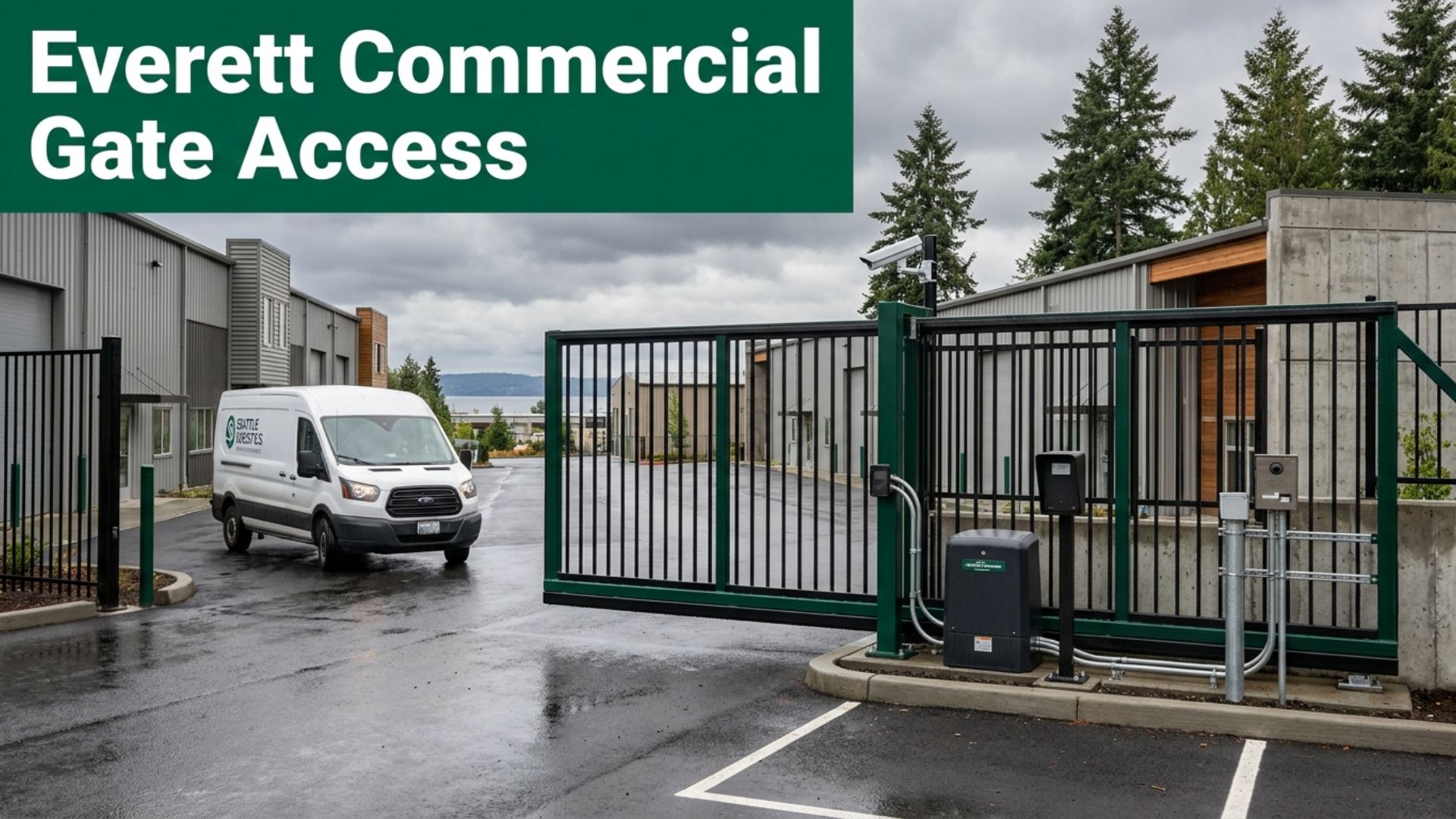
Commercial gate access control Everett WA businesses install rarely fails at the gate. What fails first is the code.
A commercial property in Everett installs a gate with a keypad and one shared PIN. It works. Then a contractor gets the code, and a delivery company writes it on a clipboard, and an employee leaves on bad terms, and a driver reads it aloud on the phone in the parking lot. Eighteen months later the code is known to a few hundred people, nobody can say who, and the only fix is to change it and reissue it to everyone at once. Nine months after that, the same thing has happened again.
The gate is doing exactly what it was asked to do. The problem is that it was asked the wrong question. A commercial entrance is not a lock. It is a system that has to admit five different populations who arrive at different times, for different reasons, with different levels of trust, and it has to be able to take that permission back from one of them without disrupting the other four.
This guide covers how to design that system for an Everett commercial property: how to read your own traffic before selecting technology, how the credential types actually compare, why duty cycle decides whether an operator survives, the difference between detecting a vehicle and protecting a person, what tailgating costs you, and how emergency access fits in. Permitting and fire apparatus access approval are covered separately in the companion article on automatic gate permits in Everett, so this one stays on the operational design.
What Does Commercial Gate Access Control Need to Do?
Short answer: A commercial gate system has four jobs: let authorized vehicles in without creating a queue, verify anyone who is not already authorized, record what happened, and allow a single credential to be revoked without changing access for everyone else. Technology choice follows from traffic volume, the mix of employees, vendors, deliveries and visitors, and how often that population changes. A shared PIN code fails the fourth job, which is why it becomes a problem at almost every commercial site eventually.
Table of Contents
- Read the Traffic Before You Choose the Technology
- The Five Populations at a Commercial Entrance
- Credential Types Compared
- Why Shared Codes Break Down and What Replaces Them
- Duty Cycle: The Number That Decides Whether the Operator Survives
- Detecting a Vehicle Is Not Protecting a Person
- Free Exit, Exit Lanes and the Queue Problem
- Tailgating and What It Actually Costs
- Revocation, Event History and Remote Administration
- Emergency Access at a Commercial Gate
- What Everett Commercial Properties Should Consider
- What Determines the Cost of a Commercial Access System
- Implementation Sequence for a Commercial Entrance
- Common Mistakes at Commercial Entrances
- Questions to Ask Before You Specify a System
- Frequently Asked Questions
- Final Thoughts
Read the Traffic Before You Choose the Technology
Most bad commercial entrances are the result of picking a product first. The productive order runs the other way. Before anyone quotes hardware, the property should be able to answer a short set of questions about its own traffic, and the answers usually surprise the person who has to gather them.
How many vehicles enter and exit on a normal weekday? Not an impression. A count. There is a large practical difference between forty cycles a day and four hundred.
What does the peak look like? A site with two hundred employees arriving inside a thirty minute shift change has a completely different entrance problem than a site with the same daily total spread evenly across ten hours. Peak, not average, determines whether a queue forms.
How long is the approach? The distance from the public street to the gate determines how many vehicles can stack before the queue reaches the road. This is the constraint that most often forces a design change.
What is the largest vehicle that regularly enters? Semi tractors with fifty three foot trailers, aerospace or project cargo on heavy haul equipment, refuse trucks, fire apparatus and moving vans all need different width and turning geometry than a delivery van.
How often does the authorized population change? A site with stable staffing and three regular vendors has a very different administration burden than a site with rotating contractors, seasonal labor and daily freight carriers.
Who is authorized to grant access, and from where? If the only person who can let a driver in is on site during business hours, the system will fail every Saturday morning.
What has to be provable after the fact? Some properties genuinely need to answer “who opened this gate at 2:14 on Tuesday.” Others do not. That answer changes the system.
Those seven answers narrow the technology field faster than any product comparison. A property that cannot answer them is not ready to buy an entrance.
The Five Populations at a Commercial Entrance
Commercial access design gets much clearer when you stop thinking about “people” and start thinking about five distinct groups. Each one needs a different mechanism, and mixing them into one credential is the root of most operational pain.
Employees. Known, recurring, high frequency, and the population you most want to pass through without stopping. They are also the population that turns over, which means the credential has to be individually assignable and individually revocable.
Vendors and contractors. Recurring but temporary. A landscaping crew every Thursday, an HVAC contractor for two weeks, a fire sprinkler inspector twice a year. These need scheduled or time limited access, not permanent access, and the permission should expire on its own rather than depending on someone remembering to remove it.
Deliveries and freight. High volume, unpredictable timing, and staffed by drivers who are not your people and change constantly. This is the population that shared codes leak through. It is also the population where video verification tends to pay for itself, because the question is usually not “is this person authorized” but “is there actually a truck there and does it belong here.”
Visitors. Low volume, unscheduled, and the population that most needs a human interaction. A video intercom that reaches whoever is actually available, including a phone off site, solves this better than any credential.
Emergency responders. Not a credential population at all. They need a mechanism that works when everything else does not, including when the power is out and the network is down. This is the one group whose access must never depend on your access control system functioning.
The design test is simple. If revoking access for one member of one group requires changing anything for the other four groups, the design is wrong.
Planning an entrance for an Everett commercial property? The cheapest time to sort out these five populations is before conduit is placed, because the credential strategy determines where devices sit, how many pedestals you need and how much low voltage capacity has to be in the ground. Emerald Gate Systems can evaluate the entrance, the traffic profile and the access control requirements as one design. Start: call (425) 879-9400 or schedule a free consultation call.
Credential Types Compared
There is no best credential. There are credentials matched to populations. Most working commercial entrances use two or three in combination.
| Credential | Best for | Advantages | Limitations | Administration | Typical application |
|---|---|---|---|---|---|
| Shared PIN keypad | Very small sites, temporary use, low security | Lowest cost, no hardware to issue, works without a network | Cannot be revoked individually; spreads by word of mouth; no meaningful audit trail | Almost none until it fails, then all at once | A single tenant site with a handful of known users |
| Individual PIN codes | Small sites that need accountability without issuing hardware | Each user has a distinct code that can be deleted; some systems log by code | Codes still get shared between people; entry requires stopping and reaching out | Manageable at small scale, tedious at large scale | Small office or shop with modest turnover |
| Proximity card or fob | Employee populations with defined turnover | Individually issued and revoked; familiar; inexpensive per credential | Requires stopping and presenting at a reader; cards get loaned; weather exposed readers need consideration | Straightforward, one record per person | Office parks, small industrial sites |
| Long range RFID vehicle tag | High volume employee and fleet traffic | Reads at a distance so the vehicle does not have to stop; keeps a queue moving | Credential is attached to the vehicle rather than the person; tags can be moved between vehicles; positioning and mounting matter | Assign per vehicle, revoke per tag | Shift change traffic, fleet yards, high cycle entrances |
| Mobile or smartphone credential | Populations that change often, and remote administration | Issued and revoked instantly from anywhere; no physical credential to collect; can be time limited | Depends on the phone, and on connectivity or Bluetooth range at the gate; some users resist installing an app | Very low ongoing effort, higher initial setup | Contractors, multi site portfolios, properties without on site staff |
| Video intercom | Visitors, deliveries, anyone unverified | Lets a person see who is there before releasing; can route to a phone off site; creates a visual record | Requires someone to answer; needs power, network and a workable camera position and lighting | Low, but depends on someone being reachable | Any site with unscheduled visitors or freight |
| License plate recognition | Known recurring vehicles at commercial sites | No credential to carry; hands free; useful event record | Accuracy depends on camera position, lighting, plate condition and weather; does not help with an unknown vehicle; raises privacy questions worth deciding deliberately | Moderate; plate lists need maintenance | Fleet and employee vehicles at larger commercial sites |
| Attended entry or guard | Very high value or high complexity sites | Human judgment handles exceptions no system anticipates | Highest ongoing cost by a wide margin | Staffing rather than administration | Restricted industrial sites |
The pattern that works at most Everett commercial properties is a layered one: a hands free or low friction credential for the recurring population, a video intercom for everyone else, and a separate emergency mechanism for responders. That combination handles the daily traffic without a queue, verifies the unpredictable traffic, and does not put emergency access at the mercy of the network.
Why Shared Codes Break Down and What Replaces Them
It is worth being precise about why the shared PIN fails, because “it is not secure” is not the useful part of the answer.
A shared code fails because it has no identity and no expiry. Every person who has ever received it retains it indefinitely, and the system has no record of which of them used it. When you need to remove access for one person, the only tool available removes access for everyone, which means a coordinated reissue across your entire authorized population. Because that is painful, most properties postpone it, and the code stays live long after it should have been retired.
The replacement is not necessarily expensive. What it needs is two properties the shared code lacks:
Identity. The credential belongs to one person or one vehicle, so it can be removed individually.
Expiry. The credential can be issued with an end date, so temporary access ends on its own rather than depending on somebody remembering.
Once a system has those two properties, the operational burden drops sharply. A contractor gets access for the duration of the job. A driver gets a one time release for a specific delivery window. An employee who leaves is removed the same day, and nothing else changes.
There is one more benefit that facilities managers tend to value more than they expect. When credentials are individual, the entrance stops being a recurring argument. Nobody has to decide whether this particular request is worth the disruption of a code change, because there is no disruption.
Duty Cycle: The Number That Decides Whether the Operator Survives
Duty cycle is the rate of operation an operator is built to sustain, and it is the single most common reason commercial gate systems fail early.
A residential driveway gate might cycle six to twenty times a day. A commercial entrance at a modest office site might cycle one hundred times. A busy freight yard or a shift change entrance can cycle several hundred times a day, every weekday, for years. Those are not variations of the same requirement. They are different product categories, with different motors, different gearboxes, different thermal behavior and different service expectations.
Two things follow.
A residential operator on a commercial entrance is a scheduled failure. It will work initially. It will then run hot, wear its drive components at a rate its design never anticipated, and fail at the worst possible moment, which at a commercial site means a queue of trucks on the street. The savings at purchase are usually erased by the first unplanned failure and the emergency service call.
Gate mass and configuration compound the problem. A wide, heavy commercial gate takes longer to travel and puts more load on the drive. A cantilever slide gate at a twenty four foot opening is a substantially different mechanical problem than a twelve foot residential swing gate, and the operator has to be selected against the actual gate, not against the opening width alone.
The related standard is worth knowing. ASTM F2200 sorts automated vehicular gates into usage classes: Class I for residential use, Class II for commercial locations such as multifamily housing, Class III for industrial locations such as a factory or loading dock area, and Class IV for restricted guarded industrial locations. The class is not a marketing tier. It describes the intended application and the construction and protection expected for it. Installing a Class I product at a Class III entrance is a recognizable defect, not a value engineering decision.
For an Everett site anywhere near the aerospace, port or manufacturing economy, the honest starting assumption is that traffic will be heavier and vehicles larger than the initial estimate, because commercial sites in that corridor tend to grow into their entrances rather than out of them.
Detecting a Vehicle Is Not Protecting a Person
This distinction gets confused constantly, including by people selling gates, and confusing it creates genuine injury risk.
Vehicle detection answers the question “is there a vehicle here.” The common implementation is an inductive loop: a loop of wire in or under the driving surface connected to a detector that senses the change in the electromagnetic field when a large metal object passes over it. Loops are used to call a gate open for free exit, to hold a gate open while a vehicle is in the path, and to trigger a close once the vehicle has cleared.
Entrapment protection answers a different question: “is something in the gate’s path that would be harmed if the gate keeps moving.” Under UL 325, a powered gate operator‘s protection is backed by at least one external device that detects an obstruction without contact, such as a photo eye, or a device that responds on contact, such as a safety edge. The operator’s own inherent sensing is not treated as sufficient on its own.
The critical point is that a loop is not a safety device. Inductive loops are designed around detecting metal mass. They may detect cars, trucks and trailers, and sometimes motorcycles. They should never be relied on to detect a person, a child, a bicycle, a pet or a stroller. A commercial entrance that uses loops for detection and treats them as its safety system has no safety system.
A properly designed commercial entrance uses both, for different reasons:
- Loops or equivalent vehicle detection to manage traffic flow, free exit and hold open behavior.
- Monitored photo eyes, safety edges or other approved entrapment protection devices, positioned for the entrapment zones that actually exist at that installation, to protect people.
- Physical separation of pedestrians from the vehicle gate, because the most reliable way to keep a person out of a gate’s path is to give them a different path.
That last item matters more at commercial sites than anywhere else. Employees walk. Drivers get out of trucks. Visitors approach on foot to reach an intercom. If the only way through the entrance on foot is the vehicle gate, the design has created a hazard that no sensor fully removes.
Reviewing an existing commercial entrance in Everett? If your gate uses loops for detection and nothing else, or if photo eyes have been repositioned, bypassed or disconnected because they were nuisance tripping, that is a diagnosis appointment rather than a purchase decision. Emerald Gate Systems services and upgrades commercial gate and access control systems across Northwest Washington. Details: call (425) 879-9400 or schedule a free consultation call.
Free Exit, Exit Lanes and the Queue Problem
Most commercial properties do not want to credential the exit. Employees leaving should not have to stop, and a driver who has completed a delivery should not need permission to leave the yard. The standard solution is free exit: a detection device inside the gate that calls it open as a vehicle approaches from within.
Free exit is straightforward in principle and generates two design problems in practice.
Placement determines whether the gate is ever in the way. An exit loop placed too close to the gate means the vehicle arrives before the gate has finished opening, which produces either a stopped vehicle or an impatient driver. Placed correctly, the gate is already moving before the vehicle reaches it. The right distance depends on the gate’s travel speed, its width and the approach speed, which is why it is calculated rather than guessed.
A single lane serving both directions creates conflict. At low volume this is fine. At higher volume, an entering vehicle waiting for a credential and an exiting vehicle triggering free exit end up negotiating one opening, and the entering vehicle is stopped where it can block the street. Sites above a certain volume need either a wider opening, separate entry and exit lanes, or a traffic strategy such as scheduled hold open during known peaks.
The queue is the metric that matters. If the distance from the public street to the gate is shorter than the queue that forms at peak, the property is putting vehicles on the road. In Everett, on commercial corridors and near the industrial and port areas, that can involve a truck stopped in a travel lane, which is a different order of problem than an inconvenienced car.
A hold open policy deserves a deliberate decision, not a default. Many commercial sites hold the gate open during business hours and close it after hours. This is a legitimate strategy that trades daytime access control for throughput. What it should not be is an accident, where a gate ends up permanently held open because it was too slow or too unreliable to use as designed. If the gate is going to be open during the day, that should be a choice made with the security objective in view, and the after hours behavior should be tested rather than assumed.
Tailgating and What It Actually Costs
Tailgating, sometimes called piggybacking, is when a second vehicle follows an authorized one through the gate before it closes. Every gated commercial property experiences it.
The first thing worth saying is that tailgating is not always a problem worth solving. At a site where the objective is deterrence, traffic management and a clear property boundary, a second vehicle following an employee in is a minor issue. At a site with high value inventory, controlled materials, or a genuine need to know who is on the property, it defeats the entire system.
Deciding which of those you are is the useful step. Once decided, the mitigations differ in cost and complexity:
Timing and detection tuning. Closing the gate promptly after the authorized vehicle clears, using detection to determine when that has happened, removes the easiest opportunities. This is inexpensive and should be done regardless.
Single vehicle enforcement. Some sites use detection logic to allow only one vehicle per credential presentation. This reduces convenience and can create queuing, so it should be matched to genuine need.
Video with event correlation. Rather than preventing tailgating, this records it and ties it to a credential event. For many commercial properties this is the practical answer, because it turns an unknown into something reviewable.
Physical measures. Separate entry and exit lanes, longer gates, or an interlocked arrangement at genuinely high security sites.
The honest framing for a facilities manager: tailgating prevention has a real cost in throughput and driver frustration. It is worth paying that cost where the security objective requires it, and not worth paying it where the actual objective is traffic control and a defined boundary.
Revocation, Event History and Remote Administration
These three capabilities separate a commercial access system from a gate with a lock on it, and they are what most properties are actually buying when they upgrade.
Revocation. The ability to remove one credential immediately without affecting anyone else. This is the capability whose absence causes the shared code spiral. It matters most on the day an employee leaves under bad circumstances, a contractor is dismissed mid job, or a credential is lost.
Event history. A record of which credential opened the gate and when. This does two things. It answers questions after an incident, and it changes behavior before one, because a system that records is treated differently than a system that does not. Be clear eyed about what the record proves: it shows that a credential was used, not who was holding it, unless video is correlated with the event.
Remote administration. The ability to grant, modify or revoke access from somewhere other than a keypad at the gate. For a property manager with several sites, this is the difference between a system that scales and a system that requires a drive across Snohomish County to add a vendor.
Two practical cautions belong here.
Remote administration and event history usually depend on connectivity. A managed system that loses its network connection generally continues to admit already provisioned credentials, but you may lose the ability to change anything until it is back. Confirm exactly what a specific system does offline before selecting it, because the answer varies and it matters at a site where the internet is not reliable.
Data retention is a decision, not a default. Event logs and video are records about identifiable people, including employees. How long they are kept, who can see them, and what they are used for should be a deliberate policy, particularly where employees are the primary population being recorded.
Emergency Access at a Commercial Gate
This deserves its own section even in an operational article, because it is the one requirement that does not bend to convenience.
If the driveway or private road is a required fire apparatus access road, the gate is reviewed by the Fire Code Official, and Everett’s Fire Marshal’s Office publishes specific expectations for gates securing fire apparatus access roads. Those include a minimum unobstructed width, a setback from the street, restrictions on gate type, and, for electrically operated gates, both a fire department override key switch and an automatic activation device, with the gate opening fully within a defined time and holding open until fire department personnel reset it. The permitting and fire access requirements are covered in detail in the companion article on automatic gate permits in Everett.
Three points specific to commercial sites:
Emergency access must not depend on your access control system. If the network is down, the credential server is unreachable, or the access platform has a fault, the fire department override still has to work. This is an argument for keeping the override wired directly into the operator rather than routed through the access control layer.
Power loss behavior must be known and tested. The fire code expects a gate that can be operated manually by one person. At a commercial site with a heavy, wide gate, that requirement is not automatically satisfied by having a manual release lever. Someone has to have actually done it, on that gate, and confirmed a single person can.
Somebody on site has to know how. At a commercial property this is a training and documentation problem more than a hardware problem. Staff turn over. The person who was shown the manual release three years ago may not work there now.
What Everett Commercial Properties Should Consider
Everett has a genuinely distinctive commercial base, and it affects entrance design in ways that generic guidance misses.
This is a heavy industrial and aerospace economy. Everett supports roughly eighty two thousand covered jobs, with aerospace, manufacturing, health care, technology, port industry and Naval Station Everett all present. The Boeing Everett Factory alone is a very large employment site. What that means for entrances is that a great many Everett commercial properties are somewhere in an aerospace or industrial supply chain, with the traffic profile that implies: shift based arrival peaks, freight, and vehicles larger than a typical office park.
Oversized loads are a real design input here, not a hypothetical. The Port of Everett handles oversized aerospace components for the 767, 777, 777X and tanker programs, moving them by sea, rail and heavy haul road, with a satellite barge to rail facility in south Everett. Properties on or near those routes may see over dimensional loads with escorts. If a site ever receives that kind of freight, gate width, approach geometry, turning radius and any overhead structure at the entrance need to be designed for the largest realistic vehicle rather than the average one. Ornamental arches and overhead signage across an entrance are a common and expensive mistake at industrial sites for exactly this reason.
Shift change is the peak, not lunchtime. At manufacturing and aerospace adjacent sites, the entire day’s traffic can compress into two or three narrow windows. Design the entrance for the shift change, not for the daily average, or the queue will reach the street twice a day.
Marine influence near the waterfront. Everett sits on Port Gardner Bay and the Snohomish River estuary. Properties closer to the water experience more marine air than properties up the hill. That affects fastener and hardware selection, coating specification, enclosure ratings for outdoor readers and cameras, and the realistic maintenance interval. It is not a reason to specify marine grade everything at an inland Everett site.
Sustained winter wet is the dominant climate factor. Not deep freeze. Months of rain, saturated ground, moss, and organic debris. For a commercial entrance the specific consequences are predictable: leaves and grit in a slide gate track, camera and photo eye lenses fouled with road film, loop saw cuts and splices degraded by water intrusion, and corrosion at connections that were never sealed properly. Loop installation quality in particular tends to reveal itself in the second wet season rather than the first.
Short winter daylight affects anything camera based. Everett is at roughly forty eight degrees north. December afternoons are dark and often overcast. Any system that depends on reading something visually, including license plate recognition and video verification, needs its lighting designed rather than assumed. A camera position that works in July may be useless at 4:30 in the afternoon in December.
The jurisdictional boundary matters. Everett performs its own permitting and inspection functions that are handled differently in unincorporated Snohomish County. A property manager with sites in Everett, Marysville and unincorporated county areas should not assume one approval path covers all of them.
Managing several commercial properties across Snohomish County? Entrances tend to be inherited rather than designed, and the common inheritance is a shared code, an undersized operator and safety devices that somebody moved. Emerald Gate Systems can assess existing entrances, document what is there, and plan upgrades in a sequence that matches how the properties actually operate. Details: call (425) 879-9400 or schedule a free consultation call.
What Determines the Cost of a Commercial Access System
Project costs vary substantially based on site conditions and system design, and commercial entrances vary more than residential ones. Rather than a fabricated range, here is what moves the number.
Opening width and gate configuration. A twenty four foot cantilever slide gate is a different structural and mechanical problem than a twelve foot swing gate, with heavier posts, larger foundations and substantial lateral runback.
Operator class and duty cycle. A high cycle industrial operator with an appropriate control platform is a different product category than a light commercial unit, and this is not the place to save money at a busy entrance.
Number of lanes. Separate entry and exit lanes roughly double the equipment at the entrance and change the civil work.
Trenching, conduit and surface restoration. Distance from the power source, what the trench has to cross, and whether an existing paved surface has to be cut and restored. Cutting finished pavement is dramatically more expensive than trenching before it exists.
Loop installation. Saw cutting, loop geometry, sealing and splice quality. This is a place where cheap work produces failures in the second winter.
Credential technology. A keypad and a managed cloud platform with mobile credentials, event history and multi site administration are different orders of investment, with different ongoing costs.
Video and lighting. Camera count, positioning, mounting infrastructure, and the lighting required to make video useful in a dark, wet Northwest winter.
Safety devices. Monitored entrapment protection appropriate to the entrapment zones present, plus the wiring to support it. Budget as part of the system, not as an upgrade.
Emergency access hardware. Override devices, activation hardware and the wiring to integrate them into the operator correctly.
Network and communications. Whether usable connectivity exists at the gate. If it does not, providing it is part of the project.
Ongoing costs. Software subscriptions, credential costs, and a maintenance interval appropriate to the cycle count. A commercial entrance running hundreds of cycles a day needs a real service plan, and pretending otherwise is how properties end up with emergency calls instead of scheduled ones.
An honest number follows a site visit and a traffic profile. A quote produced without either is pricing a generic entrance rather than yours.
Implementation Sequence for a Commercial Entrance
- Build the traffic profile. Counts, peaks, vehicle mix, approach length, and how often the authorized population changes.
- Confirm fire apparatus access status and requirements. This determines width, setback and emergency access hardware before anything else is designed.
- Establish the entrance geometry. Gate line, clear width, lane configuration, queue length and turning movements for the largest realistic vehicle.
- Evaluate grade, drainage and surface condition. Where water goes, whether the surface will support a track or a loop, and what happens in a heavy rain event.
- Select the gate configuration and size the structure. Swing, slide or cantilever, with posts and foundations designed for the actual gate.
- Select the operator against the gate and the duty cycle. UL 325 listed, matched to the gate mass and travel, with the appropriate usage class.
- Design the detection and traffic logic. Free exit, hold open, close timing, and lane behavior.
- Design the entrapment protection independently. Monitored devices positioned for the actual entrapment zones, plus a separate pedestrian route.
- Design the credential strategy per population. Employees, vendors, deliveries, visitors, each with its own mechanism and its own expiry behavior.
- Design emergency access as an independent path. Wired so it works when the network and the access platform do not.
- Plan power, conduit and communications with spare capacity. Extra conduit is close to free during the trench and expensive afterward.
- Submit for the applicable permits and reviews.
- Install, then commission deliberately. Test safety device response, override behavior, free exit timing, queue behavior at simulated peak, and manual operation under power loss.
- Document and train. Who administers credentials, how revocation is done, where the manual release is and how it works, and who to call.
- Set a maintenance interval matched to cycle count. Not to the calendar alone.
Common Mistakes at Commercial Entrances
Specifying a residential operator for commercial traffic. The most expensive mistake by total lifetime cost. It fails during a queue, not during a quiet moment.
Designing for average traffic instead of peak. The entrance is judged twice a day at shift change, and never at 11 a.m.
Treating loops as safety devices. Loops detect metal mass. They do not protect people. Entrapment protection is a separate system.
Leaving pedestrians in the vehicle path. Drivers get out of trucks. Employees walk. A separate pedestrian route is part of the entrance design.
Building the queue into the street. If the approach is shorter than the peak queue, the property is putting vehicles on a public road, and at an industrial site those vehicles are large.
Routing emergency access through the access control platform. If the network fails, the override must still work.
One shared code for everyone. It works until the first revocation is needed, at which point there is no partial fix.
Overhead structures at the entrance. Arches, signage and decorative headers create clearance problems the first time an oversized or high load arrives.
Skipping lighting for camera based systems. Video verification and plate reading both degrade badly in a dark Northwest winter afternoon without designed lighting.
Cheap loop installation. Poor saw cuts, unsealed splices and bad geometry survive one dry season and fail in the wet one.
No revocation procedure and no named administrator. A system nobody is responsible for administering reverts to whatever is easiest, which is usually holding the gate open.
Deferring maintenance at a high cycle entrance. A gate cycling several hundred times a day accumulates wear on a schedule. Unscheduled failure at a commercial entrance costs more than the maintenance would have.
Questions to Ask Before You Specify a System
- What is our actual peak traffic, and how long is the queue it creates?
- Is this driveway a required fire apparatus access road, and what does that require here?
- What usage class and duty cycle is the proposed operator rated for, and how does that compare to our cycle count?
- Which devices in this design are vehicle detection, and which are entrapment protection? Show me both.
- Where do pedestrians go, and is that route separate from the vehicle gate?
- How do I revoke access for one person, and how long does it take?
- What still works if the internet goes down? What stops working?
- How does the fire department get in, and does that path depend on any of this equipment?
- What is the largest vehicle this entrance can accept, including height?
- What lighting does the camera or plate reading system need to work in December?
- What conduit is being installed, including spare capacity, and is it in before any paving?
- What are the ongoing costs, including subscriptions, credentials and maintenance?
- Who administers the system day to day, and what happens when that person leaves?
- Can this be expanded later without cutting the pavement again?
- What does the maintenance interval look like at our cycle count, and what does it include?
For the wider picture beyond this one entrance, see our guide to access control systems in Northwest Washington.
Related reading: whether license plate recognition is worth it, and comparing keypad, RFID, mobile and intercom credentials.
Frequently Asked Questions
What is the best access control system for a commercial gate?
There is no single best system, and any vendor who answers that question without asking about your traffic is selling inventory. The right design usually layers a low friction credential for the recurring population, such as long range RFID tags or mobile credentials, with a video intercom for visitors and deliveries, and a separate emergency access path for responders. The choice is driven by peak traffic volume, approach length, how often your authorized population changes, and whether you need to prove who entered.
How do I stop delivery drivers from sharing my gate code?
You cannot stop it, which is why the answer is to stop relying on a shared code. Replace it with credentials that have identity and expiry: individually issued codes or credentials that can be revoked one at a time, time limited access for a specific delivery window, or a video intercom that lets someone verify and release the gate without giving out anything reusable. Once no reusable secret exists, there is nothing to share.
Do commercial gates need different operators than residential gates?
Yes, and the difference is not marketing. Duty cycle, gate mass and travel distance determine the operator, and a commercial entrance can cycle ten to fifty times more often than a residential driveway. ASTM F2200 also sorts gates into usage classes, from Class I residential through Class IV restricted industrial, describing the intended application and the construction expected for it. A residential operator on a commercial entrance typically fails early, and it fails during peak traffic rather than at a convenient moment.
Is a loop detector a safety device?
No, and treating it as one is dangerous. An inductive loop detects the change in an electromagnetic field caused by a large metal object, which makes it useful for vehicle detection, free exit and hold open logic. It should never be relied on to detect a person, a child, a bicycle or a pet. Under UL 325, entrapment protection is provided by external devices such as monitored photo eyes that detect without contact, or safety edges that respond on contact. A commercial entrance needs both, for different purposes.
How do I keep a queue from backing onto the street?
Start by measuring the distance from the public road to the gate, then estimate the queue at your actual peak rather than your daily average. If the queue exceeds the approach, the options are a faster or hands free credential so vehicles do not have to stop, separate entry and exit lanes, a wider opening, a longer approach if the site allows it, or a deliberate hold open policy during known peaks. At Everett industrial sites the vehicles involved are often large, which raises the stakes considerably.
Can one gate handle both entry and exit?
At low volume, comfortably. At higher volume it creates conflict, because an entering vehicle waiting for a credential and an exiting vehicle triggering free exit have to negotiate one opening. The entering vehicle is the one that ends up stopped where it can block the street. Sites above a certain volume are usually better served by separate entry and exit lanes, or by a wider opening with detection logic that handles both directions cleanly.
What happens to my access control if the internet goes down?
It depends on the system, and you should confirm the specific answer before you buy. Many managed platforms continue to admit already provisioned credentials during an outage while you lose the ability to grant or revoke access until connectivity returns. Some functions, including remote release and event logging, may be unavailable. What should never depend on connectivity is emergency access for responders, which is one reason the fire department override is normally wired directly into the operator.
How does the fire department get through a commercial gate in Everett?
Through an approved emergency access mechanism, not through your access control system. Everett’s Fire Marshal’s Office publishes specific expectations for gates securing fire apparatus access roads, including override and automatic activation provisions for electrically operated gates, with the gate opening fully within a defined time and holding open until fire department personnel reset it. Requirements depend on the property, so confirm them with the Everett Fire Marshal’s Office at 425-257-8120 before designing the entrance.
Is license plate recognition worth it for a commercial property?
Sometimes, and it depends on what you are trying to solve. LPR works well for known recurring vehicles, removes the need to carry a credential, and produces a useful event record. It does not help with an unknown vehicle, and its accuracy depends on camera position, lighting, plate condition, weather and mounting. It also raises privacy questions that deserve a deliberate policy, particularly where employees are the population being recorded. It is a good supplement to a credential strategy and a poor substitute for one.
How often should a commercial gate be serviced?
Service intervals should follow cycle count and conditions rather than the calendar alone, and manufacturer guidance for the specific operator should be followed. A high cycle entrance accumulates wear far faster than a low cycle one, and Northwest Washington adds debris, moisture and corrosion to the picture. In practice, higher cycle commercial entrances warrant more frequent inspection than residential gates, with attention to safety device alignment and function, gate alignment and hardware, drainage, and the condition of loops and connections.
Can I hold my commercial gate open during business hours?
Yes, and many properties do. It is a legitimate trade of daytime access control for throughput, and it can be the right answer for a site whose real objective is after hours security. What it should not be is an accident. If the gate ends up permanently open because it was too slow or too unreliable to use as designed, the security objective has been abandoned without anyone deciding to abandon it. Decide the policy deliberately and test that the after hours behavior actually works.
What is tailgating and do I need to prevent it?
Tailgating is a second vehicle following an authorized one through before the gate closes. Whether it needs prevention depends on your objective. If the gate exists for deterrence, traffic management and a defined boundary, tailgating is a minor issue and prompt close timing handles most of it. If you have high value inventory or a genuine need to know who is on the property, it defeats the system, and mitigations range from single vehicle enforcement to video correlated with credential events. Prevention costs throughput, so match it to actual need.
Can I add access control to an existing commercial gate?
Often yes, and it is frequently the better investment compared with replacing a serviceable gate. The evaluation covers whether the existing operator has the capacity and control platform to support what you want, whether the gate structure and safety devices meet current expectations, whether conduit and power are adequate, and whether the emergency access provisions are correct. Retrofits sometimes reveal that the existing operator is undersized for current traffic, in which case the access control upgrade and the operator replacement should be planned together.
How do I give a contractor access for two weeks without giving them permanent access?
Use a credential type that supports expiry. Mobile credentials, managed cloud platforms and some card systems allow access to be issued with a defined end date, so it lapses on its own rather than depending on someone remembering to remove it. If the site has staff available, a video intercom handles it without issuing anything. What does not work is a shared code, because there is no mechanism to take it back from one contractor without changing it for everybody.
Commercial Gate Access Control Everett WA: Final Thoughts
The useful reframe for a commercial entrance is that you are not buying a gate. You are buying the ability to say yes and no to five different groups of people, repeatedly, for years, while the composition of those groups keeps changing.
That reframe changes the specification. It puts revocation ahead of features. It puts the traffic count ahead of the product comparison. It puts duty cycle ahead of appearance. It treats entrapment protection as a separate system from vehicle detection rather than as the same wire. And it keeps emergency access on its own path, independent of everything else, because that is the one requirement that has to work on the worst day rather than the average one.
None of that is exotic. It is mostly a matter of asking the site the right questions before asking a vendor anything. Properties that do that end up with entrances that stay closed because staying closed is not inconvenient. Properties that do not end up with an expensive gate that lives in the open position.
Planning or upgrading a commercial entrance in Everett or elsewhere in Snohomish County? Emerald Gate Systems designs, fabricates, automates and services commercial gate and access control systems across Northwest Washington. A commercial access planning consultation covers the traffic profile, gate and operator sizing, detection and safety design, credential strategy for each population, emergency access, and the conduit and power infrastructure that has to be in the ground before anything is paved. Request commercial gate and access control planning: call (425) 879-9400 or schedule a free consultation call.
Where fire apparatus access, permitting or code compliance is involved, confirm current requirements with the City of Everett Permit Services at 425-257-8810 and the Everett Fire Marshal’s Office at 425-257-8120. This article is general guidance and does not substitute for plan review or approval by the authority having jurisdiction.